Kia Cadenza Replacement Engine UAE: When Repair Costs Become a Smarter Financial Move Than Vehicle Replacement
June 12, 2026
Most vehicle owners think about repair costs.
Very few think about depreciation.
Yet depreciation is often the largest ownership expense a vehicle experiences throughout its lifetime.
The challenge becomes particularly interesting with the Kia Cadenza.
Unlike ultra-premium luxury vehicles that can experience dramatic depreciation or economy cars that prioritise low operating costs, the Kia Cadenza occupies a unique middle ground within the UAE automotive market.
It offers executive-level comfort.
Premium features.
Strong practicality.
Long-distance driving capability.
And often, surprisingly resilient long-term ownership potential.
However, as mileage increases and major mechanical decisions begin appearing on the horizon, owners reach a critical financial crossroads.
Should the engine be replaced?
Should the vehicle be sold?
Or should ownership continue with ongoing repairs?
Many people answer these questions emotionally.
Depreciation-intelligent owners answer them financially.
Because in many cases, replacing an engine is not simply a repair decision.
It is an asset-preservation decision.
The objective is no longer restoring a vehicle.
The objective is protecting ownership value.
Understanding that distinction is the purpose of this guide.
The Kia Cadenza Depreciation Journey: Understanding How Ownership Value Changes Over Time
Every vehicle follows a depreciation curve.
The Kia Cadenza is no exception.
The highest rate of value loss usually occurs during the early years of ownership.
After that, depreciation often slows.
Eventually a different financial dynamic begins to emerge.
Repair costs start competing with remaining vehicle value.
Typical Ownership Phases
Early Ownership Phase
Characteristics:
- Strong resale value
- Lower maintenance costs
- Higher market demand
Mid-Life Ownership Phase
Characteristics:
- Slower depreciation
- Increasing maintenance requirements
- Greater ownership flexibility
Mature Ownership Phase
Characteristics:
- Reduced depreciation speed
- Higher repair exposure
- Increased importance of strategic decisions
Depreciation Lifecycle Analysis
| Ownership Stage | Value Trend |
| New Vehicle | Rapid Depreciation |
| Early Ownership | High Depreciation |
| Mid-Life Ownership | Moderate Depreciation |
| Mature Ownership | Slower Depreciation |
| Long-Term Ownership | Stabilised Depreciation |
This transition creates opportunities.
The smartest owners recognise when preserving value becomes more important than avoiding expenditure.
The Financial Crossroads: When Owners Begin Comparing Engine Investment Against Vehicle Replacement
The Kia Cadenza often reaches a point where repair decisions become larger than routine maintenance.
This is the ownership crossroads.
At this stage owners begin asking:
- Should I replace the engine?
- Should I continue repairing?
- Should I replace the vehicle?
The answer depends on economics rather than emotion.
Factors Supporting Engine Replacement
✓ Strong overall vehicle condition
✓ Predictable ownership plans
✓ Lower replacement-vehicle costs
✓ Positive resale outlook
✓ Good maintenance history
Factors Supporting Vehicle Replacement
✓ Multiple major mechanical failures
✓ Significant future repair exposure
✓ Poor maintenance history
✓ Structural deterioration
Ownership Economics Comparison
| Decision | Financial Objective |
| Engine Replacement | Value Preservation |
| Continued Repairs | Cost Deferral |
| Vehicle Replacement | Asset Renewal |
| Vehicle Sale | Capital Recovery |
Depreciation-intelligent owners focus on preserving value rather than avoiding investment.
Understanding Residual Value: Why Two Similar Kia Cadenza Models Can Have Very Different Market Values
One of the most misunderstood aspects of vehicle ownership is residual value.
Two Kia Cadenza vehicles may share:
- Similar age
- Similar mileage
- Similar specifications
Yet their market values can differ dramatically.
Why?
Because residual value reflects more than age.
It reflects ownership behaviour.
Residual Value Influencers
✓ Maintenance history
✓ Documentation quality
✓ Mechanical condition
✓ Workshop records
✓ Engine health
✓ Ownership consistency
Residual Value Comparison
| Vehicle Profile | Residual Value Outlook |
| Excellent Documentation | Strong |
| Complete Service History | Strong |
| Average History | Moderate |
| Missing Records | Weak |
| Poor Mechanical Condition | Lowest |
The market frequently rewards transparency.
The UAE Climate Effect on Depreciation: How Heat Accelerates Both Mechanical Wear and Value Loss
The UAE creates ownership conditions unlike many global automotive markets.
Climate does not merely affect reliability.
It also affects depreciation.
Vehicles exposed to prolonged heat stress often experience accelerated wear across multiple systems.
Systems Commonly Influenced by UAE Temperatures
- Cooling systems
- Engine seals
- Sensors
- Air-conditioning systems
- Electronic components
Climate Exposure Analysis
| Environment | Mechanical Stress |
| Mild Climate | Moderate |
| UAE Winter Operation | Moderate |
| UAE Summer Highway Driving | High |
| Urban Stop-Start Driving | Very High |
| Continuous Commercial Use | Critical |
Climate and Depreciation Relationship
Greater wear often results in:
- Higher repair costs
- Lower buyer confidence
- Reduced resale value
Climate awareness therefore becomes part of depreciation management.
The Cost-of-Delay Equation: How Postponed Repairs Often Accelerate Depreciation
Many owners believe delaying repairs saves money.
Depreciation intelligence often reveals the opposite.
A delayed repair can trigger two simultaneous losses:
- Increased repair expense
- Reduced vehicle value
This combination can be financially damaging.
Commonly Delayed Issues
- Cooling-system faults
- Oil leaks
- Warning lights
- Sensor failures
- Minor overheating events
Cost-of-Delay Analysis
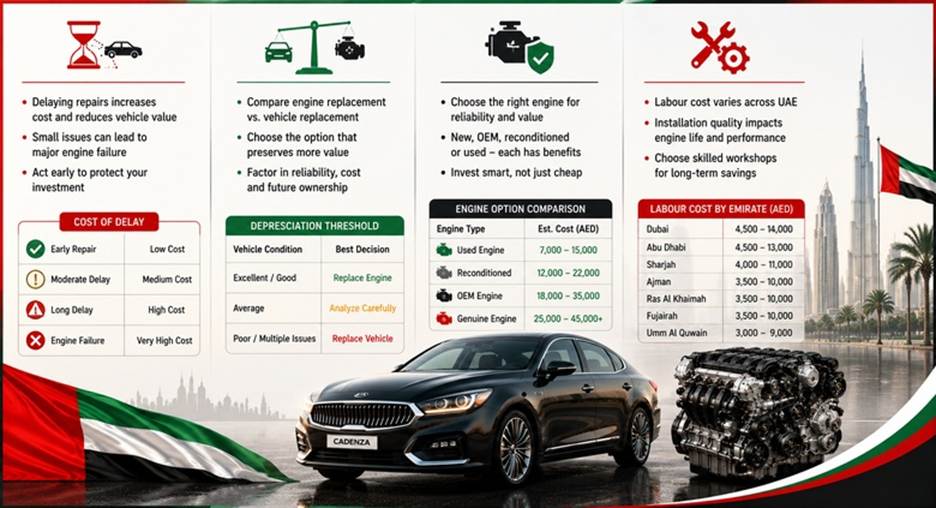
| Decision Timing | Financial Exposure |
| Early Intervention | Lower |
| Moderate Delay | Increased |
| Extended Delay | High |
| Catastrophic Failure | Maximum |
The longer a major issue remains unresolved, the greater the impact on ownership value.
The Depreciation Threshold: Identifying the Point Where Engine Replacement Creates Better Financial Outcomes
One of the most important concepts in depreciation intelligence is the threshold point.
This is the moment when preserving the vehicle creates greater value than allowing depreciation to continue.
Indicators That Engine Replacement May Be Financially Sensible
✓ Strong overall vehicle condition
✓ Stable ownership plans
✓ Positive maintenance history
✓ Manageable repair exposure
✓ Strong replacement-vehicle costs
Indicators Requiring Further Evaluation
- Multiple major failures
- Severe neglect
- Significant future expenses
Depreciation Threshold Matrix
| Vehicle Condition | Engine Replacement Outlook |
| Excellent | Strong Candidate |
| Good | Positive Candidate |
| Average | Detailed Analysis Required |
| Poor | Evaluate Alternatives |
| Multiple Failures | Compare Vehicle Replacement |
This threshold varies by vehicle.
But recognising it often determines whether value is preserved or lost.
Kia Cadenza Replacement Engine UAE: Evaluating Engine Investment Through an Asset-Preservation Lens
Many owners focus on engine price.
Depreciation-intelligent owners focus on return on investment.
The objective is not buying the cheapest engine.
The objective is protecting future ownership value.
Engine Options
Used Engine
Advantages:
- Lower purchase cost
Potential Risks:
- Unknown operational history
Reconditioned Engine
Advantages:
- Balanced investment profile
Potential Risks:
- Quality variations
OEM Engine
Advantages:
- Strong reliability outlook
Potential Risks:
- Higher initial investment
Genuine Engine
Advantages:
- Maximum confidence
Potential Risks:
- Highest acquisition cost
Engine Cost Comparison
| Engine Type | Estimated Cost (AED) |
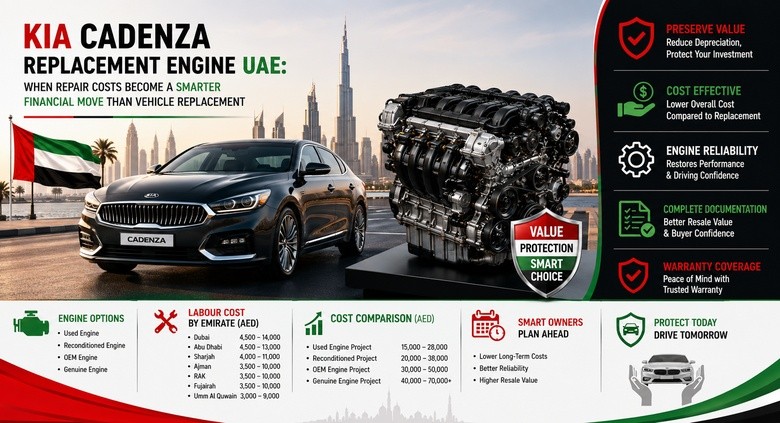
| Used Engine | 7,000 – 15,000 |
| Reconditioned Engine | 12,000 – 22,000 |
| OEM Engine | 18,000 – 35,000 |
| Genuine Engine | 25,000 – 45,000+ |
Total Project Cost Comparison
| Project Type | Estimated Cost (AED) |
| Used Engine Project | 15,000 – 28,000 |
| Reconditioned Project | 20,000 – 38,000 |
| OEM Project | 30,000 – 50,000 |
| Genuine Project | 40,000 – 70,000+ |
The cheapest option does not always preserve the most value.
UAE Labour Cost Analysis by Emirate
Labour costs influence the economics of engine replacement significantly.
However, labour quality often matters as much as labour pricing.
Labour Cost Comparison
| Emirate | Typical Labour Cost (AED) |
| Dubai | 4,500 – 14,000 |
| Abu Dhabi | 4,500 – 13,000 |
| Sharjah | 4,000 – 11,000 |
| Ajman | 3,500 – 10,000 |
| Ras Al Khaimah | 3,500 – 10,000 |
| Fujairah | 3,500 – 10,000 |
| Umm Al Quwain | 3,000 – 9,000 |
Depreciation Intelligence Observation
A lower labour invoice does not automatically create a better financial outcome.
The objective is protecting asset value through quality installation.
The First Depreciation Intelligence Conclusion
At this stage, a clear pattern emerges.
The Kia Cadenza should not be viewed merely as a vehicle.
It should be viewed as a depreciating asset.
Engine replacement therefore becomes more than a repair decision.
It becomes a value-preservation strategy.
The smartest owners evaluate:
- Depreciation rates
- Residual value
- Repair exposure
- Labour quality
- Climate effects
- Cost-of-delay risks
- Future ownership plans
before making major decisions.
Kia Cadenza Replacement Engine UAE: Comparing Engine Options Through an Asset-Preservation Lens
Most owners compare engine options by asking:
"Which engine is cheapest?"
Depreciation-intelligent owners ask a different question.
"Which engine protects the most future value?"
The distinction is important.
An engine replacement is not simply an expense.
It is an investment intended to extend useful vehicle life while slowing further value erosion.
Used Engine Strategy
Advantages:
✓ Lowest upfront investment
✓ Faster availability
✓ Lower immediate financial exposure
Potential Risks:
- Unknown service history
- Variable reliability
- Reduced buyer confidence
Reconditioned Engine Strategy
Advantages:
✓ Balanced ownership economics
✓ Refreshed internal components
✓ Strong value proposition
Potential Risks:
- Rebuild quality differences
OEM Engine Strategy
Advantages:
✓ High reliability potential
✓ Strong market confidence
✓ Better long-term value protection
Potential Risks:
- Higher acquisition cost
Genuine Engine Strategy
Advantages:
✓ Maximum confidence
✓ Strongest residual-value protection
✓ Lowest ownership uncertainty
Potential Risks:
- Highest project cost
Asset Preservation Comparison
| Engine Type | Residual Value Protection |
| Used Engine | Moderate |
| Reconditioned Engine | Good |
| OEM Engine | Very Good |
| Genuine Engine | Excellent |
The most depreciation-efficient solution is often not the least expensive one.
Hidden Costs and Supporting Components: The Financial Variables That Affect Long-Term Ownership Returns
A common ownership mistake is focusing solely on the replacement engine.
The reality is more complex.
The engine operates within a larger mechanical ecosystem.
When supporting components fail shortly after installation, ownership economics can deteriorate quickly.
Common Supporting Components
✓ Water pump
✓ Radiator
✓ Cooling fans
✓ Thermostat
✓ Engine mounts
✓ Sensors
✓ Belts
✓ Tensioners
✓ Filters
✓ Fluids
Supporting Component Cost Analysis
| Component | Typical Cost (AED) |
| Radiator | 1,500 – 6,000 |
| Water Pump | 800 – 4,000 |
| Thermostat | 400 – 2,000 |
| Engine Mounts | 1,000 – 5,000 |
| Sensors | 500 – 4,500 |
| Belts & Tensioners | 500 – 3,500 |
| Fluids & Filters | 500 – 3,000 |
Depreciation Intelligence Observation
Owners who address supporting systems during installation often preserve more value than owners who postpone these expenses.
Hidden Cost Analysis: Why Project Costs Sometimes Exceed Initial Expectations
Depreciation intelligence requires realistic budgeting.
Unexpected expenses frequently emerge once disassembly begins.
Common Hidden Costs
- Wiring repairs
- Electrical faults
- Cooling-system deterioration
- Sensor replacement
- Mount replacement
- Additional labour
Example Project Analysis
Initial Estimate:
AED 22,000
Cooling-System Repairs:
AED 3,000
Sensor Replacement:
AED 2,000
Additional Labour:
AED 2,500
Mount Replacement:
AED 2,000
Final Project Cost:
AED 31,500
Hidden Cost Exposure Matrix
| Vehicle Condition | Hidden Cost Risk |
| Excellent | Low |
| Good | Moderate |
| Average | Elevated |
| Limited History | High |
| Deferred Maintenance | Very High |
Planning for hidden costs often improves ownership outcomes.
Documentation and Depreciation Intelligence: Why Records Become More Valuable as Vehicles Age
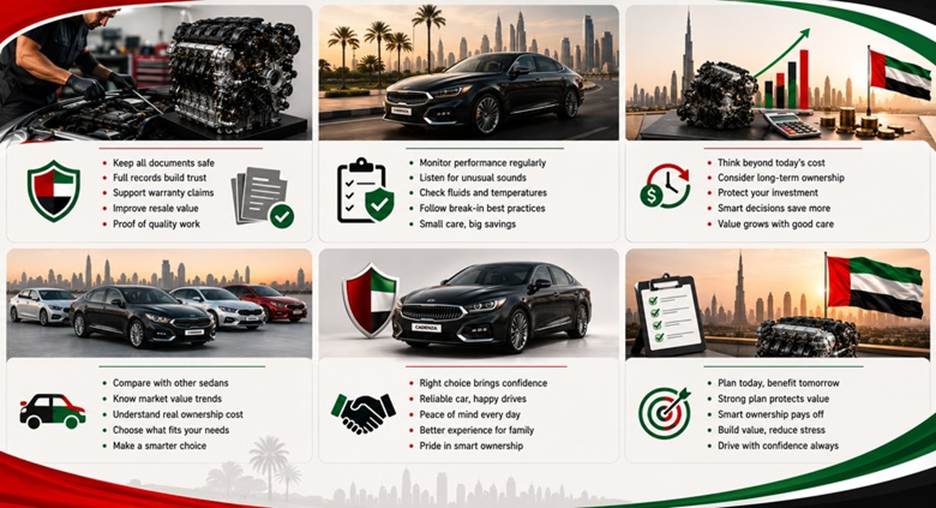
Documentation functions as financial evidence.
As vehicles age, paperwork often becomes more valuable than owners realise.
Future buyers rarely witness years of maintenance behaviour.
They evaluate documentation instead.
Documentation Verification Checklist
✓ Engine purchase invoice
✓ Installation invoice
✓ Warranty certificate
✓ Diagnostic reports
✓ Service records
✓ Compression-test results
✓ Workshop reports
Documentation Quality Analysis
| Documentation Status | Market Confidence |
| Complete Records | Excellent |
| Strong Records | Very Good |
| Partial Records | Moderate |
| Limited Records | Weak |
| Missing Records | Poor |
Documentation frequently protects residual value.
Warranty Economics: Measuring the Financial Value of Risk Reduction
Many owners evaluate warranty coverage emotionally.
Depreciation intelligence evaluates warranty coverage economically.
A warranty reduces uncertainty.
Reduced uncertainty often translates into stronger ownership confidence and improved resale appeal.
Characteristics of Strong Warranty Protection
✓ Written coverage
✓ Defined duration
✓ Clear exclusions
✓ Transparent claims process
✓ Installation accountability
Warranty Red Flags
✗ Verbal assurances
✗ Missing documentation
✗ Undefined coverage periods
✗ Ambiguous exclusions
✗ Unclear claim procedures
Warranty Value Comparison
| Warranty Type | Risk Reduction |
| Comprehensive Written Warranty | Highest |
| Standard Written Warranty | Strong |
| Limited Warranty | Moderate |
| Verbal Warranty | Weak |
Warranty quality often influences future ownership value.
Mileage Evaluation Strategy: How Engine History Influences Future Market Perception
Mileage remains one of the most visible indicators buyers evaluate.
However, mileage alone rarely tells the complete story.
Depreciation-intelligent buyers assess the quality of those kilometres.
Key Evaluation Areas
✓ Service history
✓ Cooling-system maintenance
✓ Oil-change consistency
✓ Diagnostic records
✓ Previous repair history
Mileage Assessment Matrix
| Mileage Range | Ownership Risk |
| Under 100,000 km | Lower |
| 100,000 – 180,000 km | Moderate |
| 180,000 – 250,000 km | Elevated |
| Above 250,000 km | High |
Maintenance history often influences value more than mileage itself.
Executive Ownership Perspective: Protecting Time, Convenience and Financial Efficiency
Many Kia Cadenza owners use their vehicles for executive commuting and professional responsibilities.
For these owners, downtime carries additional financial implications.
Executive Priorities
✓ Reliability
✓ Time efficiency
✓ Predictable ownership costs
✓ Reduced disruptions
✓ Professional presentation
Executive Ownership Analysis
| Priority | Importance |
| Reliability | Critical |
| Downtime Reduction | High |
| Cost Predictability | High |
| Performance | Moderate |
| Luxury Features | Moderate |
Time often becomes as valuable as repair expenditure.
Family Ownership Perspective: Balancing Asset Preservation and Household Economics
Family ownership introduces a different decision framework.
The objective extends beyond vehicle operation.
It includes financial stability.
Family Ownership Priorities
✓ Safety
✓ Reliability
✓ Cost control
✓ Long-term value
✓ Reduced financial surprises
Family Decision Matrix
| Priority | Importance |
| Safety | Critical |
| Reliability | Critical |
| Cost Stability | High |
| Resale Value | Moderate |
| Prestige | Lower |
Depreciation intelligence often helps families make more financially sustainable decisions.
Poor Installation Warning Signs That Can Accelerate Future Depreciation
An engine replacement intended to preserve value can quickly lose effectiveness if installation quality is poor.
Warning Signs
- Fluid leaks
- Warning lights
- Rough idle
- Excessive vibration
- Cooling instability
- Unusual fuel consumption
Risk Assessment Matrix
| Observation | Future Risk |
| Stable Operation | Low |
| Minor Irregularities | Moderate |
| Persistent Warning Lights | High |
| Repeated Leaks | High |
| Overheating | Critical |
Installation quality directly influences future depreciation.
Supporting Parts Replacement Checklist
Before finalising installation, depreciation-intelligent owners often review:
✓ Radiator condition
✓ Water pump condition
✓ Thermostat operation
✓ Cooling fan functionality
✓ Engine mounts
✓ Sensors
✓ Belts
✓ Tensioners
✓ Fluid condition
✓ Filter replacement
This checklist helps reduce future labour duplication.
The Second Depreciation Intelligence Conclusion
At this stage, a broader financial picture emerges.
Successful engine replacement projects are rarely defined solely by the engine itself.
They are defined by:
- Supporting-component decisions
- Documentation quality
- Warranty strength
- Installation standards
- Hidden-cost management
- Mileage history
- Ownership objectives
For buyers researching Kia Cadenza engine for sale online, the strongest ownership outcomes usually result from treating engine replacement as an asset-preservation project rather than a simple repair transaction.
The First 1,000 Kilometres After Engine Replacement: Protecting the Asset Recovery Process
Here's the uncomfortable truth: an engine replacement does not magically rewind depreciation. Workshops may imply otherwise. Sellers certainly hope buyers believe it. Reality is less generous.
What a replacement engine actually provides is a second chance.
And second chances, unlike guarantees, require management.
The first 1,000 kilometres are often treated as an afterthought—a brief honeymoon period between collecting the vehicle and forgetting about the invoice. That mindset is expensive. In asset-recovery terms, this early phase is where value either begins clawing its way back or quietly starts leaking away through overlooked faults, rushed workmanship, or neglected monitoring.
The installation may be complete. The verification process is not.
First 1,000 km Asset Protection Checklist
✓ Monitor oil levels
✓ Monitor coolant levels
✓ Observe operating temperatures
✓ Watch dashboard warning lights
✓ Check for leaks
✓ Monitor fuel economy
✓ Listen for abnormal noises
Early Detection Value Analysis
| Issue Detected Early | Potential Future Cost Avoided |
| Coolant Leak | High |
| Oil Leak | High |
| Sensor Fault | Moderate |
| Calibration Issue | Moderate |
| Cooling-System Failure | Very High |
Most catastrophic failures begin as minor warnings that owners convince themselves can wait until next week.
Next week has destroyed many engines.
Asset preservation starts the moment the vehicle leaves the workshop—not six months later when problems become impossible to ignore.
Resale Value Preservation Strategy: Turning Engine Replacement Into a Value-Retention Opportunity
The market has a peculiar habit. It punishes uncertainty more aggressively than it punishes repairs.
Many owners assume an engine replacement automatically damages resale value. Sometimes it does. Sometimes it achieves the opposite.
The determining factor is rarely the engine itself.
It is the story surrounding the engine.
A documented replacement performed professionally creates a narrative buyers can understand. An undocumented replacement creates suspicion. And suspicion is expensive.
Resale Value Preservation Factors
✓ Installation quality
✓ Documentation quality
✓ Warranty support
✓ Service history
✓ Supporting-component renewal
Resale Confidence Matrix
| Vehicle Profile | Buyer Confidence |
| Genuine Engine + Complete Records | Excellent |
| OEM Engine + Strong Documentation | Very Good |
| Reconditioned Engine + Full Records | Good |
| Used Engine + Partial Records | Moderate |
| Unknown Engine History | Weak |
Buyers rarely purchase mechanical components.
They purchase confidence.
The objective, therefore, is not simply replacing an engine. It is constructing a credible ownership history that survives scrutiny.
Three-Year Ownership Forecast: Understanding Medium-Term Financial Outcomes
Most vehicle owners stare at today's invoice as though it contains the entire financial story.
It doesn't.
The invoice is merely the opening chapter.
Three years from now, the quality of today's decisions becomes visible in maintenance costs, reliability patterns and resale positioning.
That is where depreciation intelligence becomes useful. It forces attention beyond immediate expenditure.
Estimated Three-Year Ownership Costs
| Category | Estimated Cost (AED) |
| Scheduled Maintenance | 3,000 – 9,000 |
| Fluids & Filters | 1,500 – 4,500 |
| Diagnostics | 1,000 – 4,000 |
| Preventive Repairs | 2,000 – 10,000 |
| Contingency Repairs | 2,000 – 12,000 |
Three-Year Ownership Risk Analysis
| Engine Type | Future Risk |
| Used Engine | Highest |
| Reconditioned Engine | Moderate |
| OEM Engine | Lower |
| Genuine Engine | Lowest |
The irony is familiar.
Owners often spend weeks comparing engine prices and only minutes evaluating long-term ownership consequences.
Yet those consequences usually determine the true cost.
Five-Year Ownership Forecast: Measuring Long-Term Asset Preservation
Five years is where optimism encounters mathematics.
A replacement engine that appears economical today may reveal hidden costs later. Conversely, a more expensive solution may quietly outperform expectations through reliability and reduced disruption.
Time has a habit of exposing shortcuts.
Key Variables
- Annual mileage
- Maintenance discipline
- Workshop quality
- Climate exposure
- Driving behaviour
Five-Year Reliability Outlook
| Engine Type | Long-Term Outlook |
| Used Engine | Variable |
| Reconditioned Engine | Balanced |
| OEM Engine | Strong |
| Genuine Engine | Strongest |
Long-term asset preservation is rarely dramatic.
It is usually the cumulative result of dozens of small, disciplined decisions repeated over several years.
Engine Replacement Versus Vehicle Replacement: Which Option Produces Better Financial Efficiency?
This debate appears straightforward until actual numbers enter the conversation.
Replace the engine?
Replace the vehicle?
The emotionally satisfying answer is often different from the financially rational one.
Many owners instinctively assume replacing the vehicle represents progress. Sometimes it does. Other times it simply exchanges one set of uncertainties for another at a significantly higher cost.
Factors Supporting Engine Replacement
✓ Strong vehicle condition
✓ Predictable future ownership
✓ Positive maintenance history
✓ Lower total investment
✓ Stable operating costs
Factors Supporting Vehicle Replacement
✓ Multiple major failures
✓ Escalating ownership uncertainty
✓ Significant future repair exposure
✓ Changing ownership needs
Cost Comparison
| Option | Estimated Cost (AED) |
| Used Engine Project | 15,000 – 28,000 |
| Reconditioned Project | 20,000 – 38,000 |
| OEM Project | 30,000 – 50,000 |
| Genuine Project | 40,000 – 70,000+ |
| Replacement Vehicle | 90,000 – 220,000+ |
The market often rewards owners who preserve functioning assets rather than abandoning them prematurely.
Not always.
But often enough to justify careful analysis.
Real UAE Ownership Scenarios
Financial decisions rarely occur in spreadsheets alone. They occur in real households with competing priorities.
Dubai Executive Owner
Vehicle:
Kia Cadenza
Situation:
A well-maintained vehicle facing significant engine concerns despite otherwise excellent condition.
Decision:
OEM replacement engine combined with supporting-system renewal.
Outcome:
Improved reliability, stronger ownership confidence and preserved residual value.
Abu Dhabi Family Owner
Situation:
Long-term ownership plans supported by a strong maintenance history.
Decision:
Reconditioned engine backed by comprehensive documentation.
Outcome:
Balanced expenditure with sustainable value retention.
Sharjah Budget-Conscious Owner
Situation:
Need to minimise immediate spending while maintaining dependable transportation.
Decision:
Documented used engine supported by extensive diagnostics.
Outcome:
Reduced upfront costs with manageable ownership risk.
Different owners pursue different objectives.
The mistake is assuming every owner should pursue the same solution.
Competitor Ownership Comparison
A vehicle never exists in isolation.
Every major repair decision is, implicitly, a comparison against alternatives.
Ownership Economics Comparison
| Vehicle | Depreciation Exposure | Ownership Complexity |
| Kia Cadenza | Moderate | Moderate |
| Hyundai Azera | Moderate | Moderate |
| Toyota Avalon | Lower | Lower |
| Nissan Maxima | Moderate | Moderate |
| Chrysler 300 | Higher | Higher |
The comparison is not about badges.
It is about economics.
A vehicle's true cost emerges from depreciation, maintenance exposure, reliability trends and ownership predictability—not marketing brochures.
Common Depreciation Mistakes That Destroy Ownership Value
Major financial losses rarely arrive dramatically.
More often, they accumulate quietly through neglect, procrastination and misplaced confidence.
Common Mistakes
- Delaying major repairs
- Ignoring cooling-system issues
- Failing to document repairs
- Choosing solely on price
- Ignoring warranty quality
- Deferring supporting-component replacement
Depreciation Impact Matrix
| Mistake | Financial Consequence |
| Delayed Repairs | Accelerated Value Loss |
| Poor Documentation | Reduced Resale Appeal |
| Weak Warranty | Increased Risk |
| Cheapest Engine Selection | Variable Outcome |
| Deferred Supporting Repairs | Higher Future Costs |
Depreciation is rarely caused by one disastrous decision.
It is usually the cumulative effect of several seemingly harmless ones.
Buyer Decision Matrix
No universal answer exists because ownership objectives differ.
Ownership Goal: Lowest Upfront Cost
Recommended Strategy:
Documented Used Engine
Ownership Goal: Balanced Financial Efficiency
Recommended Strategy:
Reconditioned Engine
Ownership Goal: Long-Term Value Protection
Recommended Strategy:
OEM Engine
Ownership Goal: Maximum Confidence
Recommended Strategy:
Genuine Engine
Depreciation Intelligence Matrix
| Ownership Objective | Recommended Solution |
| Budget Focus | Used Engine |
| Value Focus | Reconditioned Engine |
| Asset Protection | OEM Engine |
| Maximum Confidence | Genuine Engine |
The correct choice depends less on mechanical theory and more on financial priorities.
Insurance, Registration and Documentation Considerations
Documentation is rarely exciting.
It is also one of the cheapest forms of value protection available.
Essential Documentation
✓ Engine invoice
✓ Installation invoice
✓ Warranty paperwork
✓ Service records
✓ Diagnostic reports
These documents support:
- Resale transactions
- Warranty claims
- Ownership verification
- Market confidence
When records disappear, confidence usually follows.
And confidence has measurable market value.
The UAE Depreciation Intelligence Blueprint: A Framework for Protecting Long-Term Ownership Value
The Kia Cadenza occupies an interesting position in the UAE market.
It is neither a disposable economy car nor an ultra-premium luxury asset.
That middle ground creates opportunity.
Owners who approach major repairs strategically often preserve substantial value that might otherwise be lost through reactive decision-making.
Viewed narrowly, an engine replacement appears to be a repair expense.
Viewed correctly, it is an asset-management decision.
For owners researching solutions through PartFinder UAE, the strongest outcomes typically emerge when replacement decisions are evaluated through the lens of long-term ownership economics rather than short-term repair anxiety.
Final Depreciation Intelligence Blueprint
| Decision Area | Primary Objective |
| Diagnostics | Accurate Financial Decisions |
| Engine Selection | Value Protection |
| Labour Quality | Installation Confidence |
| Supporting Components | Future Stability |
| Warranty Protection | Risk Reduction |
| Documentation | Residual Value Preservation |
| Ownership Forecasting | Financial Clarity |
| Resale Planning | Future Flexibility |
The most financially disciplined Kia Cadenza owners rarely ask:
"How little can I spend today?"
That question feels practical but often produces expensive outcomes.
Instead, they ask:
"Which decision protects the greatest amount of value over the next several years?"
In the UAE automotive market, that distinction matters more than many owners realise.
It is often the difference between a repair that drains money and an investment that preserves it.
Frequently Asked Questions
Categories
- Audi
- BMW
- Car Accessories
- Car Tips
- Ford
- Land Rover
- Mazda
- Range Rover
- Top 10
- UAE Car Parts
- Used Car Parts
- Toyota
- Replacement Engines
- Nissan
- Hyundai
- Mitsubishi
- Volkswagen
- Honda
- Kia
- Chevrolet
- Dodge
- Jeep
- Subaru
- Renault
- Lexus
- Mercedes
- Suzuki
- Hummer
- Porsche
- Infiniti
- Peugeot
- GMC
- Mini
- Volvo
- Replacement Gearboxes
- MG
- Jaguar
- Skoda
- Cadillac
- Daihatsu
- Fiat
- German Car Parts
- Japanese Car Parts
- Aftermarket Car Parts
- Genuine Car Parts
- New Car Parts
- Reconditioned Car Parts
- European Car Parts
- American Car Parts
- Korean Car Parts
- British Car Parts
- Chinese Car Parts
- Sports/Exotic Car Parts
- Luxury Car Parts
- Performance Car Parts
- SUV/4x4 Spare Parts
- Truck Spare Parts
- EV Car Parts
- Hybrid Car Parts
- Auto Spare Parts in UAE
- Tesla
- Isuzu
- Ram
- Ferrari
- Bentley
- Lamborghini
- Genesis
- Maserati
- Lincoln
- Chrysler
- Opel
- Citroen
- SsangYong
- Seat
- McLaren
- Aston Martin
- Rolls Royce
- Maybach
- Alfa Romeo
- Bugatti
- Scion
- Abu Dhabi Car Parts
- Ajman Car Parts
- Al Khan Car Parts
- Al Sajaa Car Parts
- Deira Car Parts
- Dubai Car Parts
- Fujairah Car Parts
- Industrial Area 6 Car Parts
- Mussafah Car Parts
- Ras Al Khaimah Car Parts
- Sharjah Car Parts
- Umm Al Quwain Car Parts
- Acura
- BYD
- Chery
- Dacia
- DS
- Geely Emgrand
- EXEED
- GAC
- GAC Gonow
- Geely
- Gonow
- Great Wall
- Haima
- Haval
- Holden
- Iveco
- JAC
- Jaecoo
- Jetour
- Lotus
- Omoda
- Proton
- Renault Samsung
- Roewe
- Lucid
- Replacement Headlight