Kia Rio Replacement Gearbox Cost in UAE: Solve Gearbox Problems Quickly with the Right Replacement at the Right Price
July 3, 2026
Identify the Problem Before It Becomes More Expensive
Why Your Kia Rio Gearbox May Be Failing and the First Warning Signs You Should Never Ignore Before the Damage Gets Worse
A gearbox doesn't usually fail without giving you opportunities to stop it.
The problem is that those opportunities often look too ordinary to matter.
One morning, your Kia Rio pauses for a second before moving away from the traffic lights. Later that week, the gear change feels a little sharper than usual. A few days pass, and you notice the engine revving higher while the car doesn't accelerate quite as confidently as it used to.
Nothing dramatic.
Nothing that forces you to call a recovery truck.
That's exactly why so many gearbox problems become expensive.
Across the UAE, the Kia Rio has become a trusted choice for commuters, first-time drivers, small families and business users who want dependable transport without high running costs. Whether it's navigating busy roads in Dubai, handling daily traffic around Sharjah, travelling between Abu Dhabi and Al Ain or covering regular journeys across Ajman, Ras Al Khaimah, Fujairah and Umm Al Quwain, the gearbox works continuously in the background.
Thousands of gear changes every week.
Constant heat.
Frequent stop-start driving.
Long motorway journeys.
It all adds up.
Automatic transmissions are engineered to cope with demanding conditions, but they aren't immune to wear. High ambient temperatures, congested roads, extended idling and delayed maintenance gradually place more strain on internal components. Most of this happens out of sight, which is why the first symptom often arrives long before the first serious breakdown.
Here's the encouraging news.
Many Kia Rio gearbox problems are identified early enough to prevent significantly higher repair costs.
That's where timing becomes your biggest advantage.
Owners often assume that every transmission fault means the gearbox has reached the end of its life. In reality, that's only one possible outcome. A faulty speed sensor, deteriorated transmission fluid, worn shift solenoid, valve body issue or software-related fault can all produce symptoms that feel remarkably similar to major gearbox failure.
From behind the steering wheel, they can be difficult to distinguish.
Inside a professional workshop, they're very different repairs.
That's why experienced transmission specialists never recommend replacing a gearbox simply because the vehicle hesitates or shifts roughly. They investigate first. Live diagnostic data is analysed, transmission fluid is inspected, fault codes are interpreted in context, hydraulic performance is assessed and the vehicle is road-tested before any conclusions are reached.
Evidence always comes before recommendations.
That's the approach that protects both your vehicle and your budget.
Ignoring early symptoms, on the other hand, rarely saves money. Continued driving with an unresolved transmission problem can increase internal wear, raise operating temperatures and allow small faults to affect additional components inside the gearbox. What might have been a straightforward repair can gradually develop into a complete replacement.
The solution isn't to panic.
It's to act promptly.
Throughout this guide, you'll discover what influences the cost of a Kia Rio replacement gearbox in the UAE, how to compare used, reconditioned, OEM and genuine gearbox options, what labour and installation typically cost, how to avoid expensive buying mistakes, and what experienced workshops check before recommending any replacement. You'll also learn where a Kia Rio reconditioned gearbox for sale may appear to offer good value—and why proper compatibility checks matter far more than the lowest advertised price.
Key Takeaways
If you're looking for the essentials before making any decisions, start here:
- Early gearbox symptoms should never be ignored.
- A professional diagnosis should always come before approving a replacement.
- Not every gearbox fault requires a complete replacement.
- UAE heat and heavy traffic can accelerate transmission wear.
- Compare complete quotations, not gearbox prices alone.
- Verify VIN compatibility before purchasing any replacement gearbox.
- Installation quality is just as important as the gearbox itself.
- Keep all invoices, diagnostic reports and warranty documents.
At a Glance: Kia Rio Replacement Gearbox in the UAE
| Item | Typical Information |
| Typical replacement cost | AED 8,000–18,000+ |
| Typical labour cost | AED 1,800–4,000 |
| Typical installation time | 1–3 working days |
| Available gearbox options | Used, Reconditioned, OEM and Genuine |
| Typical warranty | 3–24 months (varies by supplier) |
| Best value for most owners | Professionally reconditioned gearbox |
| Best for long-term ownership | OEM or Genuine gearbox |
| First priority | Accurate diagnosis before replacement |
The Most Common Kia Rio Gearbox Problems Reported by UAE Owners and What Usually Causes Them
One pattern appears again and again in transmission workshops.
Owners don't usually arrive because the gearbox failed without warning.
They arrive because the warning signs seemed too small to justify a visit.
Perhaps Reverse takes an extra second to engage.
Maybe the transmission shifts harshly only after the vehicle has warmed up.
Sometimes the dashboard remains completely clear while the gearbox quietly begins behaving differently.
Small changes matter.
Professional technicians pay close attention to them because they often reveal the earliest stages of wear.
The issues most frequently encountered in Kia Rio gearboxes include delayed engagement, slipping gears under acceleration, harsh or inconsistent shifting, valve body wear, shift solenoid faults, transmission fluid deterioration, overheating, hydraulic pressure loss, electronic communication faults and internal clutch wear.
Each symptom points towards a different possible cause.
That's why replacing parts before confirming the diagnosis is rarely the right solution.
The right repair starts with understanding the real problem.
Early Comparison: Used vs Reconditioned vs OEM vs Genuine Kia Rio Gearboxes
Before requesting quotations from suppliers, it helps to understand what you're actually comparing.
The four main replacement options each serve a different type of owner.
| Gearbox Type | Typical UAE Cost (AED) | Best Suited For | Typical Warranty |
| Used | 8,000–11,500 | Lowest initial purchase cost | Limited |
| Reconditioned | 10,000–15,000 | Best balance of reliability and value | Good |
| OEM | 13,000–18,000 | Long-term ownership | Strong |
| Genuine | 16,000–21,000+ | Maximum factory specification | Excellent |
The cheapest gearbox isn't automatically the best value.
Nor is the most expensive option automatically the right one.
The right decision is the one backed by proper diagnosis, verified compatibility, professional installation and a replacement gearbox that suits how you actually use your Kia Rio every day in the UAE.
Part 1b: Understand the Real Problem Before Choosing the Wrong Solution
How to Tell Whether Your Kia Rio Needs a Gearbox Repair, a Replacement or Just a Professional Diagnosis
The gearbox isn't trying to confuse you.
It just doesn't speak in straightforward sentences.
Instead, it leaves clues.
A hesitation pulling away from a junction.
A slightly rough shift between gears.
An unexpected rise in engine revs while the car seems reluctant to gather speed.
Reverse engages, although not as quickly as it used to.
Individually, none of those symptoms tells the whole story.
Together, they suggest one thing.
Something has changed.
That's where many Kia Rio owners unintentionally make their first expensive mistake. They assume the gearbox has failed completely because the symptoms feel serious, or they convince themselves the problem is too minor to justify a workshop visit.
Both assumptions can lead to unnecessary costs.
Professional transmission specialists approach the situation differently.
They don't begin by deciding whether the gearbox should be repaired or replaced.
They begin by asking why the symptoms appeared in the first place.
Sometimes the answer is surprisingly straightforward.
A deteriorated transmission fluid that has lost its protective properties.
A faulty speed sensor sending inaccurate information.
A worn shift solenoid struggling to operate consistently.
A valve body developing hydraulic pressure issues.
Software that requires recalibration.
None of those faults automatically demands a complete replacement gearbox.
On the other hand, there are occasions when internal clutch packs have worn beyond practical repair, overheating has caused widespread internal damage or contaminated transmission fluid has circulated metal particles throughout the transmission. In those cases, replacing the gearbox often becomes the more sensible long-term solution.
The challenge is this.
From the driver's seat, those situations can feel remarkably similar.
That's why diagnosis always comes before decisions.
Experienced workshops across the UAE combine computer diagnostics, live transmission data, hydraulic pressure testing, fluid inspection and structured road testing before recommending any repair. The objective isn't to sell the largest repair.
It's to identify the correct one.
That distinction protects both your vehicle and your budget.
The best solution isn't always the biggest solution.
It's the one supported by evidence.
Should You Continue Driving with a Faulty Kia Rio Gearbox or Stop Immediately to Prevent Further Damage?
This question usually appears after the first warning sign.
The car still drives.
So, surely it can't be that serious?
Sometimes that's true.
Sometimes it isn't.
A gearbox that hesitates occasionally but continues operating normally may still allow enough time to arrange a professional inspection without creating immediate risk. That doesn't mean the symptom should be ignored. It simply means the problem hasn't necessarily reached its most serious stage.
Other situations deserve a much faster response.
If your Kia Rio begins slipping gears repeatedly, refuses to engage Drive or Reverse, produces loud mechanical noises, develops a burning smell, leaks transmission fluid or displays a persistent transmission warning light, continuing to drive becomes increasingly risky.
Think about what happens inside the gearbox.
Automatic transmissions rely on precise hydraulic pressure, carefully controlled clutch engagement and constant lubrication. Once one part begins failing, surrounding components often experience additional stress.
Heat increases.
Wear accelerates.
Repair costs rarely move in the opposite direction.
Transmission specialists throughout Dubai, Abu Dhabi, Sharjah and the other Emirates frequently see vehicles that could have been repaired more economically if they had arrived earlier. Instead, owners continued driving because the vehicle still felt "good enough."
Unfortunately, "good enough" doesn't always remain good for long.
If the gearbox suddenly loses drive, enters limp mode or produces severe slipping, arranging vehicle recovery is usually the wiser option.
One recovery journey often costs less than repairing damage caused by continuing to drive.
How Early Professional Diagnosis Can Save You Thousands Before a Minor Gearbox Problem Turns into a Major Repair
Here's something worth remembering.
A fault code isn't a diagnosis.
It's the beginning of one.
Modern Kia Rio transmissions monitor dozens of operating conditions every second. When something falls outside the expected range, the vehicle records information designed to help technicians investigate the issue.
That information is valuable.
On its own, however, it doesn't identify every failed component.
Professional diagnosis involves much more than connecting a scan tool.
Experienced transmission technicians study live gearbox data while the vehicle is operating. They examine transmission fluid for signs of contamination or overheating. They measure hydraulic performance, compare sensor readings, evaluate shift quality during a road test and consider how the vehicle behaves under different driving conditions.
Every stage contributes another piece to the puzzle.
Only after those pieces fit together does the workshop recommend a repair strategy.
Sometimes the diagnosis confirms that replacing the gearbox is the most practical and economical solution.
Sometimes it reveals a much smaller repair.
Without proper investigation, there's no reliable way of knowing which situation you're facing.
That's exactly why early diagnosis saves money.
It prevents owners from replacing components unnecessarily.
It also prevents manageable faults from quietly developing into much larger repairs through continued use.
The solution to a gearbox problem isn't found by guessing.
It's found by understanding precisely what's happening before making one of the biggest maintenance decisions your Kia Rio is ever likely to need.
Understand the Costs Before You Choose the Solution
Kia Rio Replacement Gearbox Cost in UAE: Complete Price Guide with Used, Reconditioned, OEM and Genuine Options
The first quotation almost always creates more questions than answers.
One workshop says the replacement will cost around AED 9,000.
Another suggests AED 14,000.
A third explains that the total project could exceed AED 20,000.
It feels confusing.
Until you realise they're probably not quoting for the same job.
That's where many Kia Rio owners head in the wrong direction. They compare one number against another without looking at everything hiding behind it. One quotation may include only the gearbox itself. Another covers diagnostics, labour, transmission fluid, ECU programming, road testing, warranty support and post-installation inspections.
Those aren't equal comparisons.
They're completely different packages.
Price only becomes meaningful when you know exactly what you're buying.
Across the UAE, the total cost of replacing a Kia Rio gearbox depends on several factors. The gearbox type, vehicle model year, compatibility, workshop labour rates, parts availability, software programming requirements and even the condition of surrounding transmission components all influence the final invoice.
That's why professional workshops rarely provide an accurate fixed quotation before completing a diagnosis.
They investigate first.
Then they price the solution.
That approach protects both the workshop and the customer from unpleasant surprises later.
Typical Kia Rio Replacement Gearbox Prices in the UAE
| Gearbox Type | Typical Cost (AED) | Ideal For |
| Used Gearbox | 8,000–11,500 | Budget-conscious owners |
| Reconditioned Gearbox | 10,000–15,000 | Best balance of value and reliability |
| OEM Gearbox | 13,000–18,500 | Long-term ownership |
| Genuine Kia Gearbox | 16,500–22,500+ | Factory-specification replacement |
The cheapest gearbox isn't always the cheapest repair.
If poor compatibility, limited warranty or premature failure results in another removal and installation, yesterday's saving quickly becomes tomorrow's expense.
That's why experienced buyers look beyond the purchase price.
Used vs Reconditioned vs OEM vs Genuine Kia Rio Gearboxes: Which Replacement Offers the Best Value for Your Budget and Ownership Plans?
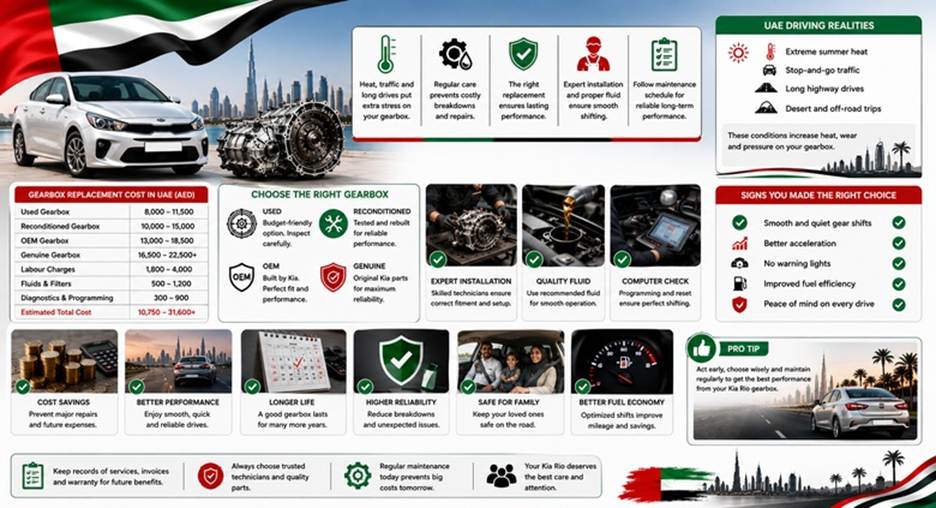
Choosing the right gearbox isn't really about choosing the most expensive one.
Nor is it about choosing the cheapest.
It's about matching the solution to the way you actually use your Kia Rio.
A verified used gearbox can represent excellent value when sourced from a reputable supplier, professionally inspected and matched correctly to the vehicle. For owners planning shorter-term ownership, it may provide an economical solution.
A professionally reconditioned gearbox often sits in the middle.
That's where many experienced workshop managers point first.
Internal wear components have been replaced, the transmission has been rebuilt and tested, and warranty support is usually stronger than with a standard used gearbox. It strikes a practical balance between cost and confidence.
OEM gearboxes suit owners who intend to keep their Kia Rio for several years and want a high-quality replacement built to manufacturer specifications.
Then there are genuine Kia gearboxes.
Maximum compatibility.
Factory engineering.
Usually the highest purchase price.
Sometimes that's absolutely the right investment.
Sometimes it isn't.
The "best" gearbox is always the one that fits your ownership plans—not somebody else's.
Quick Comparison
| Option | Initial Cost | Reliability | Warranty | Best For |
| Used | Lower | Good (if verified) | Limited | Lower upfront spending |
| Reconditioned | Medium | Very Good | Good | Everyday long-term value |
| OEM | Higher | Excellent | Strong | Long-term ownership |
| Genuine | Highest | Excellent | Excellent | Factory-standard replacement |
Complete Labour Cost Breakdown for Kia Rio Gearbox Replacement Across the UAE
Labour is one of the most misunderstood parts of a gearbox replacement.
People often see a single labour figure and wonder why it's so high.
The reality is rather different.
Replacing an automatic gearbox involves far more than removing one transmission and fitting another. Diagnostic testing, safe removal, inspection of supporting components, installation, software adaptation, transmission fluid filling, road testing and final quality checks all require time and specialist knowledge.
That's what the labour charge is covering.
Typical Labour Costs
| Labour Item | Typical UAE Cost (AED) |
| Initial diagnostics | 150–500 |
| Gearbox removal | 800–1,500 |
| Replacement installation | 1,000–2,000 |
| ECU programming and adaptation | 300–900 |
| Final road testing and inspection | Usually included |
| Typical Total Labour | 1,800–4,000 |
Choosing the lowest labour quotation isn't always the most economical decision.
Poor workmanship often creates costs that never appeared on the original invoice.
Labour Cost Comparison Across the UAE
Workshop rates naturally vary between Emirates because operating costs differ.
The figures below provide a general guide rather than fixed prices.
| Emirate | Typical Labour Cost (AED) |
| Dubai | 2,500–4,000 |
| Abu Dhabi | 2,300–3,800 |
| Sharjah | 2,000–3,500 |
| Ajman | 1,900–3,300 |
| Ras Al Khaimah | 1,800–3,200 |
| Fujairah | 1,800–3,200 |
| Umm Al Quwain | 1,800–3,100 |
The right workshop isn't necessarily the cheapest.
It's the one that combines experience, transparency and quality workmanship.
Total Project Cost Explained: Gearbox, Labour, Transmission Fluid, Programming and Hidden Charges You Should Expect
Here's the figure that really matters.
Not the gearbox price.
The total project cost.
That's the amount your bank account actually notices.
Estimated Total Project Cost
| Item | Typical Cost (AED) |
| Replacement gearbox | 8,000–22,500+ |
| Labour | 1,800–4,000 |
| Transmission fluid | 500–1,200 |
| ECU programming | 300–900 |
| Diagnostic testing | 150–500 |
| Estimated Total Project | 10,750–29,100+ |
Understanding the complete picture makes comparing quotations much easier.
Common Kia Rio Gearbox Fault Codes Explained in Simple English and What They Mean for Your Vehicle
Dashboard warning lights create anxiety.
That's understandable.
What they shouldn't create is immediate panic.
A gearbox fault code isn't telling you which part to replace.
It's telling you something requires investigation.
Some fault codes point towards shift solenoids.
Others indicate speed sensor irregularities, transmission overheating, hydraulic pressure changes or communication issues between electronic control modules.
Different causes.
Remarkably similar symptoms.
Professional technicians never replace a gearbox because of one fault code alone.
They investigate why that code appeared in the first place.
That's the difference between replacing parts and solving problems.
How UAE Heat, Daily Traffic and Long Commutes Can Reduce the Lifespan of Your Kia Rio Gearbox
You can't control the weather.
You can control how well prepared your gearbox is to deal with it.
Summer temperatures across the UAE create demanding conditions for every automatic transmission. Long periods of stop-start traffic, extended idling, motorway journeys and constant air-conditioning loads all contribute to higher transmission temperatures.
Heat affects transmission fluid.
Transmission fluid protects internal components.
As fluid performance gradually declines, wear increases.
The process is slow.
Almost invisible.
Until one day the gearbox begins behaving differently.
Regular servicing, early diagnosis and professional installation remain the simplest ways to interrupt that cycle before it becomes significantly more expensive.
Most gearbox failures don't begin with catastrophic damage.
They begin with small problems that remained unsolved for just a little too long.
Choose the Right Solution Instead of the Fastest One
How to Choose the Right Kia Rio Replacement Gearbox Quickly Without Sacrificing Reliability, Compatibility or Warranty Protection
Finding a replacement gearbox isn't usually the hardest part.
Choosing the right one is.
When your Kia Rio is sitting in the workshop and every day without it disrupts work, family commitments or business, it's easy to focus on one thing.
"Just get the car back on the road."
Completely understandable.
But here's what experienced transmission specialists see all the time. Owners who rush the buying decision often spend longer off the road than those who spend an extra hour asking the right questions.
It sounds backwards.
It isn't.
Imagine two replacement gearboxes.
Both fit your budget.
Both arrive within a day.
Both look almost identical from the outside.
One has been professionally inspected, matched to your vehicle using the VIN, tested and supplied with a clear warranty.
The other comes with little more than a verbal promise.
The price difference might not even be dramatic.
The long-term difference often is.
A gearbox isn't simply another spare part. It's a collection of precision-machined components, hydraulic circuits, electronic controls and software that must work together every single time you drive. If even one part of that equation is wrong, the driving experience changes.
Sometimes immediately.
Sometimes months later.
That's why experienced workshops never recommend choosing a gearbox based on price alone.
They recommend choosing the solution that solves the problem permanently.
Before approving any replacement, think about how long you intend to keep the vehicle.
Planning to sell it within a year?
Your priorities may be different.
Keeping the Kia Rio for another five years?
Reliability suddenly becomes far more valuable than saving a relatively small amount today.
Good decisions always begin with understanding your own ownership plans.
Why VIN Matching, Gearbox Coding and Compatibility Checks Are Essential Before Buying Any Replacement Gearbox
Here's one sentence that should make every buyer pause.
Not every Kia Rio gearbox fits every Kia Rio.
That surprises people.
It shouldn't.
Over the years, Kia introduced different model generations, software revisions, gearbox calibrations and transmission control strategies. Two vehicles may appear identical from the outside while using different transmission specifications underneath.
That's why compatibility matters so much.
Professional workshops don't simply compare engine size and production year.
They verify the Vehicle Identification Number.
They confirm gearbox codes.
They compare software requirements.
They ensure electronic communication between the transmission and the engine management system will function exactly as intended.
Skipping those checks creates unnecessary risk.
A gearbox may physically fit.
That doesn't mean it will operate correctly.
Some compatibility issues don't even appear immediately. They emerge later as inconsistent gear changes, dashboard warnings or software communication faults that require additional labour to diagnose.
Those problems are largely preventable.
Professional verification takes minutes.
Correcting the wrong installation can take days.
Compatibility Checklist
Before ordering any gearbox, confirm:
- Vehicle Identification Number (VIN) verified.
- Gearbox identification code matches.
- Engine specification confirmed.
- Model year checked.
- Software compatibility reviewed.
- ECU communication confirmed.
- Final diagnostic validation completed before installation.
These checks don't delay the repair.
They protect it.
Kia Rio Model and Generation Differences That Can Affect Gearbox Compatibility, Performance and Replacement Costs
Not all Kia Rio models share the same transmission design.
That's where many online buyers become caught out.
A gearbox advertised for one production year may require different software, revised electronics or alternative supporting components compared with another seemingly identical vehicle.
From a distance, they look interchangeable.
Inside the workshop, the differences become much more obvious.
Transmission specialists pay attention to production changes because they influence far more than compatibility.
They affect labour time.
Programming requirements.
Replacement part availability.
Overall project cost.
One of the advantages of working with experienced suppliers is that these details are normally checked before the gearbox arrives, not afterwards.
That saves everyone time.
More importantly, it prevents expensive delays after the vehicle has already been dismantled.
Should You Replace the Torque Converter, Gearbox Mounts and Other Supporting Components During Installation?
Here's a question worth asking while the gearbox is already out.
"What else should be inspected now?"
The answer could save you another large labour bill later.
Removing an automatic gearbox creates access to components that are otherwise difficult and time-consuming to inspect. Good technicians take advantage of that opportunity.
Not because they want to increase the invoice.
Because they want to reduce the chance of another repair in six months' time.
The torque converter deserves particular attention.
If the original gearbox experienced overheating or internal contamination, the torque converter may also have been affected. Reusing it without inspection isn't always the best decision.
The same applies to gearbox mounts.
Transmission oil seals.
Cooling lines.
Electrical connectors.
Transmission cooler condition.
None of those components automatically requires replacement.
Each one deserves careful inspection.
Professional workshops replace parts because evidence supports the recommendation.
Not because replacing more parts looks impressive.
Supporting Components Commonly Checked
| Component | Reason for Inspection |
| Torque converter | Internal wear and contamination |
| Gearbox mounts | Excessive movement and vibration |
| Oil seals | Prevent future fluid leaks |
| Transmission cooler | Remove contamination |
| Cooling lines | Check for restrictions or leaks |
| Electrical connectors | Ensure reliable communication |
| Driveshaft seals | Prevent fluid loss |
| Flexplate | Inspect for wear or damage |
Addressing these items while the gearbox is already removed is often considerably more economical than paying for another major dismantling job later.
A Complete Gearbox Buying Checklist Every Kia Rio Owner Should Follow Before Purchasing
The final buying decision shouldn't depend on confidence alone.
It should depend on evidence.
Think of this checklist as the last quality control step before approving the replacement.
If every answer is positive, you're probably moving in the right direction.
If several questions remain unanswered, it's worth slowing the process down before making a commitment.
Essential Buying Checklist
| Checkpoint | Verified? |
| Professional diagnosis completed | ✓ |
| VIN compatibility confirmed | ✓ |
| Correct gearbox code verified | ✓ |
| Gearbox professionally inspected | ✓ |
| Mileage confirmed where available | ✓ |
| Written warranty provided | ✓ |
| Labour included in quotation | ✓ |
| ECU programming included | ✓ |
| Fresh transmission fluid included | ✓ |
| Road test after installation | ✓ |
| Supporting components inspected | ✓ |
| Written invoice supplied | ✓ |
A checklist might feel simple.
Simple is good.
It keeps important details from being overlooked when there's pressure to make a quick decision.
Because in the end, the best solution isn't simply finding another gearbox.
It's finding the right gearbox, installing it correctly and driving away knowing the original problem has genuinely been solved rather than temporarily covered up.
Solve the Installation Problem Properly the First Time
What Actually Happens During a Professional Kia Rio Gearbox Replacement from Initial Diagnosis to Final Road Test
Most vehicle owners only experience two moments.
Handing over the keys.
Collecting them again.
Everything between those two moments determines whether the repair becomes a long-term solution or the beginning of another problem.
A professional gearbox replacement isn't simply about removing one transmission and installing another. If it were that straightforward, every workshop would achieve the same results.
They don't.
The process starts long before the first bolt is loosened. Experienced transmission technicians review the original diagnosis, confirm the replacement gearbox specifications once again and make sure the transmission delivered to the workshop matches the Kia Rio perfectly.
It sounds repetitive.
That's intentional.
Some of the most expensive workshop mistakes happen because somebody assumed the gearbox was correct instead of verifying it one final time.
Once compatibility has been confirmed, the vehicle is carefully dismantled. Driveshafts, electrical connectors, transmission cooling lines, mounting brackets and supporting components are removed in a controlled sequence. Automatic gearboxes are heavy precision assemblies. Rushing this stage can damage surrounding components that were working perfectly before the repair even began.
Then comes one of the most valuable parts of the entire job.
Inspection.
With the gearbox removed, technicians can finally examine areas that are normally hidden from view. A slightly worn mount, a gearbox oil seal beginning to harden or contamination inside the transmission cooler suddenly becomes visible.
Professional workshops don't ignore those discoveries.
They explain them.
This is often where owners prevent another expensive labour bill six months later.
Once the replacement gearbox has been installed, attention shifts towards calibration rather than mechanics. Fresh transmission fluid meeting the correct specification is added. Electronic adaptations are completed where necessary. Diagnostic equipment confirms communication between the gearbox and the vehicle's control systems before the first road test begins.
The road test itself isn't simply a drive around the block.
Technicians evaluate cold starts, low-speed traffic behaviour, motorway acceleration, downshifts, kick-down response and gearbox operating temperatures while monitoring live diagnostic information.
Only after every stage performs as expected is the vehicle considered ready for collection.
A typical professional replacement includes:
| Replacement Stage | Purpose |
| Initial diagnostics | Confirm the exact fault |
| VIN and gearbox verification | Prevent compatibility problems |
| Safe gearbox removal | Protect surrounding components |
| Inspection of supporting parts | Identify hidden wear |
| Installation of replacement gearbox | Correct mechanical fitting |
| Transmission fluid replacement | Ensure correct lubrication |
| ECU programming and adaptation | Optimise gearbox operation |
| Live diagnostic testing | Verify system communication |
| Comprehensive road test | Confirm smooth performance |
| Final quality inspection | Ensure reliable handover |
The objective isn't simply to finish the job.
It's to finish it properly.
Supporting Components That Should Always Be Inspected While the Gearbox Is Removed to Prevent Future Repairs
Think of gearbox replacement as a rare opportunity.
Not because gearboxes fail regularly.
Because removing one creates access to components that normally remain hidden behind hours of labour.
Ignoring those components rarely saves money.
Quite the opposite.
Imagine replacing the gearbox today only to discover a leaking transmission seal or worn gearbox mount a few months later. The gearbox may need to be partially removed again just to reach a component that could have been inspected while everything was already dismantled.
That's frustrating.
It's also avoidable.
Experienced workshops treat gearbox replacement as a complete transmission health inspection rather than an isolated repair.
The torque converter deserves particular attention because it operates alongside the gearbox throughout every journey. If the original transmission suffered overheating or internal contamination, microscopic debris may also have affected the converter.
The same logic applies elsewhere.
Transmission mounts gradually soften.
Cooling lines age.
Electrical connectors become brittle after years of engine bay heat.
Oil seals lose flexibility.
Most of these issues develop quietly.
Finding them early is considerably easier than repairing them later.
Supporting Components Worth Inspecting
| Component | Why It Matters |
| Torque converter | Prevents contamination affecting the replacement gearbox |
| Gearbox mounts | Reduces vibration and drivetrain movement |
| Oil seals | Helps prevent future transmission fluid leaks |
| Transmission cooler | Removes contamination and improves cooling |
| Cooling lines | Ensures unrestricted fluid circulation |
| Electrical connectors | Maintains reliable gearbox communication |
| Driveshaft seals | Prevents transmission fluid loss |
| Flexplate | Confirms structural integrity before reassembly |
Inspection doesn't automatically mean replacement.
It means informed decision-making.
How to Choose a Trusted Kia Rio Gearbox Workshop in the UAE That Prioritises Quality Over Shortcuts
The gearbox is only half the equation.
The workshop completes the other half.
Even an excellent replacement transmission can disappoint if installation standards are poor.
That's why choosing the right workshop deserves as much attention as choosing the gearbox itself.
Good workshops rarely rely on exaggerated promises.
Instead, they explain their process.
They discuss diagnostics before repairs.
They verify compatibility.
They provide written quotations.
They answer technical questions without becoming defensive.
Those small details reveal a great deal about how the business operates.
A workshop that invests time in communication usually invests similar care in the repair itself.
When comparing gearbox specialists, look beyond advertising.
Look at procedures.
Professional workshops generally provide:
- Detailed transmission diagnostics.
- VIN compatibility verification.
- Qualified transmission technicians.
- Written quotations.
- Genuine or approved transmission fluids.
- ECU programming where required.
- Comprehensive road testing.
- Written warranty documentation.
- After-sales technical support.
Anyone can promise a quick repair.
The better workshops explain exactly how they'll achieve it.
Professional Installation vs Poor Workmanship: Why Correct Installation Protects Your Investment for Years
Not every gearbox problem begins inside the gearbox.
Some begin after the replacement has already been completed.
That's the uncomfortable truth.
Two Kia Rio owners may purchase identical replacement gearboxes from the same supplier. Six months later, one vehicle continues driving perfectly while the other develops harsh shifts, warning lights or fluid leaks.
The gearbox isn't always responsible.
Installation quality often decides the outcome.
Professional technicians follow precise procedures because automatic transmissions leave very little room for shortcuts. Correct torque settings, clean assembly practices, proper fluid filling procedures, electronic calibration and final road testing all contribute to long-term reliability.
Poor workmanship usually reveals itself gradually.
A small leak.
A vibration.
An inconsistent gear change.
Nothing dramatic at first.
Then the owner is back in the workshop wondering why a recently replaced gearbox no longer feels right.
Good installation isn't something you notice.
It's something you stop thinking about because the vehicle simply works as it should.
How Long Does a Kia Rio Replacement Gearbox Take and What Can Delay the Installation Process?
One question appears in almost every conversation.
"When can I have my car back?"
The honest answer depends on preparation.
If the correct gearbox is already available, compatibility has been confirmed and no additional faults appear during dismantling, many professional replacements can be completed within one to three working days.
Sometimes even sooner.
Occasionally a little longer.
Extra time doesn't necessarily indicate slow workmanship.
Quite often it reflects careful workmanship.
Perhaps the transmission cooler requires cleaning.
Maybe a gearbox mount needs replacing.
An oil seal shows early signs of leakage.
Software updates become necessary after installation.
Addressing those issues before returning the vehicle usually prevents future interruptions.
Typical Installation Timeline
| Stage | Typical Time Required |
| Initial inspection and diagnostics | 1–3 hours |
| Gearbox removal | Half to one working day |
| Supporting component inspection | 1–2 hours |
| Replacement gearbox installation | Half to one working day |
| ECU programming and adaptation | 1–2 hours |
| Transmission fluid filling | 30–60 minutes |
| Road testing and final quality checks | 1–2 hours |
Waiting a little longer for a properly completed repair is often far preferable to returning a few weeks later because something important was overlooked.
The real solution isn't getting your Kia Rio back as quickly as possible.
It's getting it back ready to stay on the road.
Keep the Solution Working for Years, Not Just Weeks
How Long Should a Replacement Kia Rio Gearbox Last Under Real UAE Driving Conditions with Proper Maintenance?
Replacing the gearbox solves today's problem.
Looking after it determines whether the problem stays solved.
That's an important difference.
One of the first questions owners ask after approving a replacement is, "How many years should this gearbox last?"
The honest answer is that there isn't a fixed number.
A replacement gearbox doesn't wear out because the calendar says so. It responds to how it's driven, how well it's maintained and whether it was installed correctly in the first place.
Consider two Kia Rio owners.
Both collect their vehicles on the same afternoon.
Both receive professionally installed replacement gearboxes.
One spends most weekdays travelling smoothly between Abu Dhabi and Dubai on open motorways. The other drives through dense stop-start traffic in Sharjah, spends long periods idling with the air conditioning running and regularly covers short urban journeys.
The workload isn't the same.
Neither is the long-term wear.
The gearbox quietly adapts to everything you ask it to do.
Thousands of gear changes.
Constant temperature fluctuations.
Daily acceleration and braking.
Long queues at traffic lights.
Repeated parking manoeuvres.
Every journey adds another small chapter to the gearbox's working life.
Fortunately, modern replacement gearboxes are designed to cope with demanding conditions when they're maintained properly.
Regular servicing, correct transmission fluid, sensible driving habits and early attention to small warning signs all help preserve smooth operation for many years.
Professional workshops across the UAE often notice a clear pattern.
Owners who deal with small transmission concerns early usually avoid the largest repair bills later.
That's not luck.
It's preventative maintenance doing exactly what it's supposed to do.
What You Should and Shouldn't Do During the First 1,000 Kilometres After a Gearbox Replacement
Those first thousand kilometres matter more than many people realise.
Not because the gearbox is fragile.
Because everything is settling into normal operation.
Fresh transmission fluid begins circulating through every hydraulic passage. Electronic control systems continue refining shift behaviour. Internal components establish their normal operating patterns under everyday driving conditions.
Think of it as allowing the gearbox to find its rhythm.
This isn't the time for aggressive acceleration every time the traffic lights change or repeated high-speed kick-downs simply to see how the transmission performs.
It already proved itself during workshop testing.
Now it needs consistent, sensible use.
Smooth acceleration.
Normal braking.
A mixture of urban and motorway driving.
Nothing extreme.
If you notice anything unusual during this period—unexpected warning lights, delayed engagement, persistent vibrations or fluid leaks—contact the workshop promptly.
Most issues, when identified early, are considerably easier to investigate than after months of continued driving.
A little patience during the first few weeks can contribute significantly to the long-term reliability of your replacement gearbox.
Everyday Driving Habits That Can Extend the Life of Your Kia Rio Replacement Gearbox
There's no secret formula.
No miracle product.
Just good driving habits repeated consistently.
Allow the vehicle to stop completely before selecting Reverse.
Avoid harsh acceleration immediately after a cold start.
Don't keep your foot on the accelerator while shifting between Drive and Reverse.
Reduce unnecessary full-throttle launches.
Simple actions.
Noticeable benefits.
Transmission specialists often explain that automatic gearboxes dislike unnecessary shock loads. Smooth driving reduces stress on clutch packs, hydraulic systems and internal bearings without making the vehicle any less enjoyable to drive.
Another habit deserves equal attention.
Listen to the car.
If gear changes suddenly feel different, don't assume they'll improve by themselves.
Vehicles rarely invent new behaviours without a reason.
Small changes usually appear before larger problems.
Recognising them early is one of the simplest ways to protect both the gearbox and your wallet.
Why Routine Gearbox Servicing Is One of the Most Cost-Effective Ways to Prevent Future Failures
Routine servicing rarely feels urgent.
That's exactly why people postpone it.
Then one day, the gearbox begins behaving differently and the service they delayed suddenly looks remarkably inexpensive compared with the repair they're now facing.
Transmission fluid has an exceptionally demanding role.
It cools.
Lubricates.
Transfers hydraulic pressure.
Protects internal components.
Maintains smooth gear changes.
Every kilometre gradually reduces those protective qualities.
The UAE climate speeds up that process.
High temperatures, extended idling, heavy traffic and frequent motorway driving all place additional demands on the transmission.
Regular servicing isn't about replacing perfectly good parts.
It's about preserving the ones already working properly.
Professional inspections also give technicians an opportunity to identify developing issues before they become serious enough to affect the entire gearbox.
That's where servicing creates real value.
It prevents small problems from becoming expensive ones.
Can a Replacement Gearbox Restore Your Kia Rio's Original Performance, Fuel Economy and Driving Comfort?
Many owners notice the difference almost immediately.
The hesitation disappears.
Gear changes become smoother.
Acceleration feels more predictable.
Traffic becomes less frustrating because the vehicle responds exactly when expected.
A healthy gearbox doesn't simply change gears.
It transforms the overall driving experience.
Power delivery becomes smoother because the transmission is no longer struggling with internal wear or inconsistent hydraulic pressure. The engine can operate within its intended efficiency range, reducing unnecessary strain during acceleration and cruising.
Fuel economy may also improve if the previous gearbox had been slipping or operating inefficiently.
Of course, results still depend on other factors.
Engine condition.
Tyre pressures.
General vehicle maintenance.
Driving style.
The gearbox is an important part of the equation, but it isn't the only one.
When installation, diagnostics and maintenance are all completed properly, however, many Kia Rio owners find that the vehicle feels remarkably close to the way it drove when it was new.
How a Healthy Gearbox Improves Acceleration, Smooth Gear Changes and Everyday Driving Confidence
The biggest benefit of a replacement gearbox isn't always something dramatic.
Sometimes it's the absence of worry.
You stop wondering whether the next junction will bring another delayed shift.
You stop listening for unfamiliar noises every time the vehicle changes gear.
You stop planning journeys around the possibility of a breakdown.
Confidence quietly returns.
Mechanically, a healthy transmission keeps engine power flowing efficiently to the wheels, selects the correct gear at the right moment and maintains consistent hydraulic pressure throughout every journey.
The result is noticeable in everyday driving.
Joining fast-moving traffic becomes smoother.
Overtaking feels more predictable.
Stop-start commuting becomes less tiring.
Long motorway journeys feel more refined.
Those improvements aren't simply about comfort.
They're reminders that the original problem has genuinely been solved.
And that's the outcome every Kia Rio owner hopes for when investing in a replacement gearbox.
Protect Your Investment Before Another Problem Appears
How Often Should You Service a Replacement Kia Rio Gearbox to Maximise Reliability and Long-Term Performance?
Most gearbox failures don't begin with a dramatic mechanical breakage.
They begin quietly.
Transmission fluid gradually loses its protective qualities. Heat builds over thousands of kilometres. Tiny amounts of normal wear continue circulating through the system. None of those changes feels urgent when you're driving the car.
Until one day the gear changes don't feel quite as smooth.
This is where routine servicing becomes part of the solution rather than another expense.
A replacement gearbox represents a significant investment. Looking after it properly costs considerably less than replacing it again.
Across the UAE, driving conditions place automatic transmissions under continuous pressure. Summer temperatures regularly climb to levels that challenge cooling systems, while heavy traffic in Dubai, Abu Dhabi, Sharjah and other busy urban areas forces the gearbox to work constantly through repeated acceleration, braking and gear changes.
The transmission rarely gets an easy day.
That's why maintenance schedules should reflect real driving conditions rather than ideal laboratory conditions.
Professional workshops often recommend periodic inspections even when the gearbox appears to be operating perfectly. Transmission fluid condition, electronic operation and shift quality can all be assessed before small concerns develop into larger repairs.
Preventative maintenance isn't exciting.
It is effective.
Suggested Service Guide
| Maintenance Item | Typical Recommendation |
| Transmission fluid inspection | During routine servicing |
| Transmission fluid replacement | According to workshop recommendations and vehicle use |
| Diagnostic scan | If symptoms appear or during major servicing |
| Road-test evaluation | During transmission inspections |
| Leak inspection | Every scheduled service |
| Cooling system inspection | During transmission servicing |
The objective isn't simply to maintain the gearbox.
It's to prevent today's solution becoming tomorrow's problem.
A Real UAE Workshop Case Study Showing How Early Action Prevented a Much More Expensive Gearbox Failure
One workshop visit illustrates this perfectly.
A Kia Rio owner noticed that Reverse occasionally took an extra second to engage after the vehicle had been parked overnight.
Nothing else seemed wrong.
The car drove normally throughout the day.
Many people would have ignored it.
Instead, the owner booked an inspection.
Diagnostic testing revealed deteriorating transmission fluid and early valve body wear. Internal gearbox damage had not yet developed, and the problem was addressed before contaminated fluid caused more extensive wear inside the transmission.
The repair remained relatively straightforward.
More importantly, the owner avoided the inconvenience of an unexpected breakdown.
Now imagine the alternative.
The hesitation continues for another few months.
Heat increases.
Hydraulic pressure becomes less consistent.
Internal clutch wear accelerates.
The repair becomes larger.
The invoice follows.
This isn't an unusual story.
Transmission specialists throughout the UAE regularly see both outcomes.
The difference is rarely luck.
It's timing.
Owners who respond to early warning signs usually preserve more repair options than those who wait until the gearbox refuses to move altogether.
Understanding Gearbox Warranties So You Know Exactly What Is and Isn't Covered Before You Buy
A warranty isn't just another document placed inside your glovebox.
It's part of the gearbox you're buying.
Yet many owners spend more time comparing prices than comparing warranty terms.
That's understandable.
It's also risky.
Not every warranty provides the same level of protection.
Some cover only internal gearbox components.
Others include replacement parts but exclude labour.
Certain warranties require servicing to be completed at specified intervals, while others apply only if installation has been carried out by qualified technicians.
Those details matter.
Before approving any replacement gearbox, ask for the warranty conditions in writing.
Read them carefully.
Clarify anything that seems unclear.
Professional suppliers expect informed questions because they understand that a gearbox replacement represents a major investment.
Warranty Checklist
| Question | Why It Matters |
| How long is the warranty? | Understand the period of protection |
| What components are covered? | Avoid future misunderstandings |
| Is labour included? | Clarify possible future costs |
| Are servicing conditions specified? | Maintain warranty validity |
| What could invalidate the warranty? | Prevent accidental breaches |
| How are warranty claims handled? | Understand the support process |
Good warranties don't remove every risk.
They reduce uncertainty.
Important Warning Signs to Watch for After Your Replacement Gearbox Has Been Installed
Collecting your Kia Rio from the workshop isn't the final chapter.
It's the beginning of a new one.
Most professionally installed gearboxes perform exactly as expected from the first journey. Even so, experienced owners continue paying attention during the first few weeks.
Not because they expect problems.
Because they recognise the value of identifying them early if they do appear.
A slight fluid leak.
A persistent warning light.
Repeated harsh shifts.
Unexpected vibrations.
Delayed engagement.
None of these symptoms automatically means something serious has gone wrong.
Each one deserves prompt investigation.
Early inspections often identify simple adjustments before unnecessary wear develops.
Waiting usually achieves very little.
Mechanical issues rarely improve without intervention.
If something feels different, trust your judgement.
You know your vehicle better than anyone.
How Service Records, Invoices and Warranty Documents Can Protect Your Kia Rio's Future Resale Value
A replacement gearbox changes more than the way the vehicle drives.
It changes the questions future buyers will ask.
"Who carried out the work?"
"Was the gearbox professionally installed?"
"Is there a warranty?"
"Do you have the paperwork?"
Fortunately, these questions are easy to answer if you've kept proper records.
Documentation tells a reassuring story.
Professional diagnosis.
Compatibility verification.
Installation invoices.
Transmission servicing.
Warranty certificates.
Inspection reports.
Together, they demonstrate that the gearbox replacement wasn't simply completed.
It was completed properly.
That confidence often helps maintain resale value because prospective buyers have evidence rather than uncertainty.
Many dealers appreciate comprehensive documentation for exactly the same reason.
It reduces risk.
It builds trust.
Documents Worth Keeping
- Initial diagnostic report.
- Gearbox compatibility confirmation.
- Workshop invoice.
- Labour breakdown.
- Warranty documentation.
- Transmission service records.
- ECU programming records where applicable.
- Post-installation inspection reports.
Paperwork may not seem important on the day the repair is completed.
Years later, it often becomes one of the strongest selling points your Kia Rio has.
Because confidence isn't built only by the way a vehicle drives.
It's also built by the evidence showing how well it has been cared for.
Choose the Right Supplier and Eliminate the Risk of Buying the Wrong Gearbox
The Most Important Checks to Carry Out Before Buying Any Kia Rio Replacement Gearbox from a UAE Supplier
The gearbox might look perfect.
That doesn't mean it is.
One of the biggest misconceptions among vehicle owners is believing that if a replacement gearbox is clean, complete and physically fits the vehicle, everything else will fall into place.
Unfortunately, automatic transmissions don't work that way.
A gearbox is more than a mechanical assembly. It has to communicate with electronic control systems, match the vehicle's specifications and operate under conditions that are very different from those inside a dismantled donor vehicle.
That's why professional suppliers spend more time verifying information than most buyers expect.
Good suppliers don't simply ask for the vehicle model.
They ask for the Vehicle Identification Number.
Production year.
Engine specification.
Transmission code.
Previous repairs.
Sometimes they even request photographs of identification labels before confirming availability.
It isn't because they're making the process complicated.
They're reducing the chances of the wrong gearbox arriving at the workshop.
That's a problem nobody wants.
Before agreeing to any purchase, slow the process down just enough to confirm the important details.
Ask where the gearbox came from.
Ask how it was inspected.
Ask what testing was completed before it was offered for sale.
Ask about warranty support after installation.
The answers often reveal more than the quotation itself.
Essential Pre-Purchase Verification Checklist
| Inspection Point | Why It Matters |
| VIN confirmed | Ensures correct compatibility |
| Gearbox code verified | Prevents installation issues |
| Production year checked | Avoids model differences |
| Professional inspection completed | Confirms gearbox condition |
| Warranty supplied in writing | Protects your investment |
| Installation requirements explained | Reduces future disputes |
| Supplier provides technical support | Improves after-sales confidence |
Buying confidently doesn't mean buying quickly.
It means buying with enough information to avoid expensive surprises.
Essential Questions Every Kia Rio Owner Should Ask Before Approving a Gearbox Replacement
Most people ask one question first.
"How much will it cost?"
A better first question is this.
"What exactly am I paying for?"
That simple change completely alters the conversation.
Professional workshops appreciate informed customers because good questions prevent misunderstandings later.
Instead of focusing only on the final figure, ask how the gearbox was inspected.
Was compatibility confirmed using the VIN?
Does the quotation include transmission fluid?
Will ECU programming be completed after installation?
Is a road test included before the vehicle is returned?
What happens if a warranty claim becomes necessary?
These questions don't make the repair more expensive.
They make the decision more informed.
Questions Worth Asking
- Has the gearbox been professionally inspected?
- Has VIN compatibility been confirmed?
- Is the mileage known where applicable?
- What warranty is included?
- Does the quotation include labour?
- Is ECU programming included?
- Will fresh transmission fluid be installed?
- Will supporting components be inspected?
- Is a final road test included?
- Will I receive written documentation?
Professional answers usually indicate professional processes.
That's exactly what you want when replacing one of the most important mechanical components in your vehicle.
A Complete Inspection Checklist to Help You Choose the Right Replacement Gearbox with Confidence
The best buying decisions rarely happen by chance.
They happen because somebody followed a process.
Professional workshops rely on checklists every day because consistency prevents mistakes.
Vehicle owners can benefit from exactly the same approach.
Before approving the replacement gearbox, confirm that every critical checkpoint has been completed.
Complete Inspection Checklist
| Checkpoint | Completed |
| Professional diagnosis completed | ✓ |
| Correct gearbox selected | ✓ |
| VIN compatibility verified | ✓ |
| Gearbox code confirmed | ✓ |
| External inspection completed | ✓ |
| Mounting points checked | ✓ |
| Electrical connectors inspected | ✓ |
| Warranty documentation provided | ✓ |
| Labour quotation received | ✓ |
| Transmission fluid included | ✓ |
| ECU programming included | ✓ |
| Road testing planned | ✓ |
It takes only a few minutes to review.
It could save weeks of inconvenience later.
Premium vs Budget Kia Rio Replacement Gearboxes: Which One Delivers Better Long-Term Value and Reliability?
This isn't really a conversation about expensive versus cheap.
It's a conversation about value.
A lower purchase price often looks attractive on the quotation.
What matters is the total cost over the years that follow.
Imagine two Kia Rio owners.
One chooses the least expensive gearbox available because the initial saving feels worthwhile.
The other invests a little more in a professionally inspected replacement with documented compatibility and stronger warranty support.
Five years later, which owner has actually spent less?
Sometimes it's the first.
Quite often, it isn't.
The answer depends on reliability, installation quality, maintenance and ownership plans rather than the invoice alone.
A professionally reconditioned gearbox frequently offers an excellent balance between cost and long-term dependability.
OEM and genuine gearboxes generally suit owners intending to keep the vehicle for many years.
Used gearboxes can also provide good value when they come from reputable suppliers with verified history.
The important point is this.
Choose the gearbox that matches your future plans—not just today's budget.
Complete UAE Cost Comparison: Gearbox Prices, Labour Costs, Programming Charges and Total Replacement Budget
Looking at one figure rarely tells the whole story.
Looking at the complete project usually does.
Complete Cost Comparison
| Replacement Item | Typical UAE Cost (AED) |
| Used gearbox | 8,000–11,500 |
| Reconditioned gearbox | 10,000–15,000 |
| OEM gearbox | 13,000–18,500 |
| Genuine gearbox | 16,500–22,500+ |
| Labour | 1,800–4,000 |
| Transmission fluid | 500–1,200 |
| ECU programming | 300–900 |
| Diagnostics | 150–500 |
| Supporting components (if required) | 300–2,500+ |
| Estimated Total Project Cost | 10,750–31,600+ |
Understanding the complete budget before work begins helps eliminate unpleasant surprises after the repair has been completed.
How to Find a Trusted Kia Rio Replacement Gearbox Supplier in the UAE for Fast Delivery and Dependable Support
Fast delivery matters.
Reliable support matters even more.
A supplier's responsibility shouldn't end when the gearbox leaves the warehouse.
Professional suppliers continue supporting customers through compatibility verification, technical guidance, warranty assistance and after-sales communication.
That's often what separates a trusted supplier from an ordinary one.
If you're comparing different replacement options across the UAE, PartFinder UAE allows you to compare compatible Kia Rio gearboxes from multiple suppliers, helping you review availability, pricing and suitable replacement solutions before making your final decision.
Ultimately, solving a gearbox problem isn't about finding the first gearbox that's available.
It's about finding the right gearbox, backed by the right supplier, installed by the right workshop and supported by the right warranty.
When those four pieces come together, the original problem usually stays exactly where it belongs.
In the past.
Solve the Problem Properly and Drive Away with Confidence
The Biggest Mistakes Kia Rio Owners Make When Replacing a Gearbox and the Practical Solutions That Prevent Them
The gearbox isn't always the most expensive part of the repair.
The wrong decision usually is.
That may sound surprising, but experienced transmission specialists across the UAE see the same pattern repeatedly. The original gearbox develops a problem. The owner understandably wants the vehicle back on the road as quickly as possible. Decisions are made under pressure, quotations are accepted without much comparison, and the focus shifts towards speed instead of suitability.
That's when small mistakes become expensive ones.
The first mistake is delaying diagnosis.
Many owners continue driving because the vehicle still moves. The hesitation doesn't seem serious. The warning light disappears. The harsh shift only happens occasionally.
Until it doesn't.
Heat, contaminated transmission fluid and internal wear rarely stop developing simply because the warning light has gone away. Every additional journey has the potential to increase damage inside the transmission.
The solution is straightforward.
Arrange a professional inspection as soon as the symptoms appear.
The second mistake is choosing purely on price.
A quotation that appears significantly cheaper than every other option deserves careful examination. Does it include diagnostics? Labour? Transmission fluid? ECU programming? Warranty? Road testing?
Sometimes it does.
Sometimes the lowest quotation becomes the highest invoice by the time the repair is actually finished.
The third mistake is overlooking compatibility.
A gearbox that "looks the same" isn't necessarily the correct gearbox for your Kia Rio. VIN verification, gearbox codes and software compatibility should always be confirmed before installation begins.
Skipping those checks creates problems that are entirely avoidable.
The fourth mistake is overlooking the importance of the workshop.
A professionally inspected gearbox can still perform poorly if installation standards aren't equally professional. Calibration, fluid specification, torque settings and post-installation testing all influence how the gearbox performs once you're back on the road.
The gearbox solves only part of the problem.
The installation completes the solution.
The fifth mistake is forgetting about maintenance after the repair.
A replacement gearbox still requires sensible driving habits, routine servicing and prompt attention to any future warning signs. Looking after the transmission from the beginning usually proves much less expensive than correcting neglected maintenance later.
The solution to every one of these mistakes is remarkably similar.
Don't rush the decision.
Rush the diagnosis.
There's an important difference.
Five-Year Ownership Cost Comparison Between Used, Reconditioned, OEM and Genuine Kia Rio Gearboxes
The purchase price is only the beginning.
Long-term ownership tells the real financial story.
A gearbox that costs less today may require more maintenance over the next several years, while a higher-quality replacement may provide greater reliability, stronger resale value and fewer unexpected repairs.
Looking beyond today's invoice often leads to a better decision.
| Gearbox Type | Typical Initial Cost (AED) | Estimated Five-Year Maintenance (AED) | Overall Long-Term Value |
| Used | 8,000–11,500 | 2,500–5,000 | Good when professionally verified |
| Reconditioned | 10,000–15,000 | 2,000–4,000 | Excellent balance of cost and reliability |
| OEM | 13,000–18,500 | 1,800–3,500 | Strong long-term ownership option |
| Genuine | 16,500–22,500+ | 1,500–3,000 | Highest factory confidence and compatibility |
The cheapest gearbox doesn't always deliver the lowest ownership cost.
Looking five years ahead often changes the conversation completely.
Practical Ways to Reduce Kia Rio Replacement Gearbox Costs Without Compromising Quality, Reliability or Warranty Protection
Saving money doesn't require cutting corners.
It requires making informed decisions.
Owners who act early generally spend less because developing faults are identified before they create additional damage. Comparing complete quotations rather than gearbox prices alone also prevents unexpected costs appearing halfway through the repair.
Another sensible approach is choosing a replacement that matches your ownership plans. Someone intending to keep the Kia Rio for many years may benefit from investing more initially, while shorter-term ownership may justify a different option.
The important point is that every decision should be supported by evidence rather than urgency.
Practical ways to control costs include:
- Arrange professional diagnostics as soon as symptoms appear.
- Compare complete quotations instead of gearbox prices alone.
- Verify VIN compatibility before approving any replacement.
- Understand warranty terms before installation begins.
- Inspect supporting components while the gearbox is already removed.
- Follow recommended servicing intervals after installation.
- Keep every invoice, inspection report and warranty document.
Small decisions made early often prevent much larger expenses later.
Final Expert Guide to Choosing the Right Kia Rio Replacement Gearbox Quickly, Safely and Confidently in the UAE
Every gearbox problem creates two separate challenges.
The first is fixing the vehicle.
The second is making sure the same problem doesn't return.
The owners who achieve the best long-term results rarely do anything extraordinary. They simply follow a logical process. They investigate warning signs early, insist on proper diagnostics, compare replacement options carefully, choose experienced workshops and continue maintaining the gearbox after installation.
That approach consistently produces better outcomes than rushing towards the quickest available solution.
Whether your Kia Rio spends its days navigating Dubai traffic, commuting around Sharjah, travelling between Abu Dhabi and Al Ain or covering journeys throughout Ajman, Ras Al Khaimah, Fujairah and Umm Al Quwain, the objective remains exactly the same.
Solve the problem properly.
Protect your investment.
Restore dependable performance.
Drive with confidence.
If you're comparing replacement options from multiple suppliers, PartFinder UAE provides a convenient way to review compatible Kia Rio gearboxes, compare availability, evaluate pricing and identify suitable replacement options before making your final decision.
The best gearbox replacement isn't measured by how quickly the repair is completed.
It's measured by how many years pass before you need to think about the gearbox again.
When the diagnosis is accurate, the replacement is compatible, the installation is professional and the maintenance continues afterwards, your Kia Rio can return to doing what it has always done best.
Getting you where you need to go—smoothly, reliably and without unnecessary interruptions.
Frequently Asked Questions
Categories
- Audi
- BMW
- Car Accessories
- Car Tips
- Ford
- Land Rover
- Mazda
- Range Rover
- Top 10
- UAE Car Parts
- Used Car Parts
- Toyota
- Replacement Engines
- Nissan
- Hyundai
- Mitsubishi
- Volkswagen
- Honda
- Kia
- Chevrolet
- Dodge
- Jeep
- Subaru
- Renault
- Lexus
- Mercedes
- Suzuki
- Hummer
- Porsche
- Infiniti
- Peugeot
- GMC
- Mini
- Volvo
- Replacement Gearboxes
- MG
- Jaguar
- Skoda
- Cadillac
- Daihatsu
- Fiat
- German Car Parts
- Japanese Car Parts
- Aftermarket Car Parts
- Genuine Car Parts
- New Car Parts
- Reconditioned Car Parts
- European Car Parts
- American Car Parts
- Korean Car Parts
- British Car Parts
- Chinese Car Parts
- Sports/Exotic Car Parts
- Luxury Car Parts
- Performance Car Parts
- SUV/4x4 Spare Parts
- Truck Spare Parts
- EV Car Parts
- Hybrid Car Parts
- Auto Spare Parts in UAE
- Tesla
- Isuzu
- Ram
- Ferrari
- Bentley
- Lamborghini
- Genesis
- Maserati
- Lincoln
- Chrysler
- Opel
- Citroen
- SsangYong
- Seat
- McLaren
- Aston Martin
- Rolls Royce
- Maybach
- Alfa Romeo
- Bugatti
- Scion
- Abu Dhabi Car Parts
- Ajman Car Parts
- Al Khan Car Parts
- Al Sajaa Car Parts
- Deira Car Parts
- Dubai Car Parts
- Fujairah Car Parts
- Industrial Area 6 Car Parts
- Mussafah Car Parts
- Ras Al Khaimah Car Parts
- Sharjah Car Parts
- Umm Al Quwain Car Parts
- Acura
- BYD
- Chery
- Dacia
- DS
- Geely Emgrand
- EXEED
- GAC
- GAC Gonow
- Geely
- Gonow
- Great Wall
- Haima
- Haval
- Holden
- Iveco
- JAC
- Jaecoo
- Jetour
- Lotus
- Omoda
- Proton
- Renault Samsung
- Roewe
- Lucid