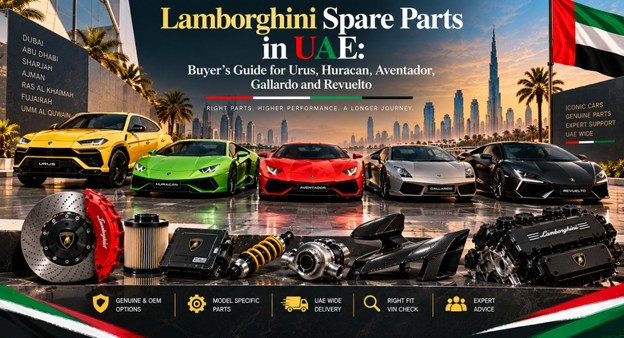
Lamborghini Spare Parts in UAE: Buyer’s Guide for Urus, Huracan, Aventador, Gallardo and Revuelto
September 14, 2026
Buying Lamborghini Parts in the UAE
Why Lamborghini parts need a different buying strategy
A Lamborghini part is rarely just a matter of finding something that looks identical and paying the lowest price.
That approach can work with an ordinary service item. It becomes expensive very quickly on a Huracán, Aventador or Urus.
The reason is simple: specification matters. Model year, engine, transmission, braking system, drivetrain, market specification and sometimes the vehicle's exact production configuration can change what actually fits. Lamborghini itself states that original spare parts are made to match the technical specifications of each model and that its official network uses original parts and manufacturer procedures.
In the UAE, there is another layer. A car may spend most of its life crawling through Dubai traffic with the air conditioning running, then sit for weeks in a private garage, then be driven hard on an open road. Low mileage does not automatically mean low wear.
That is where the buying decision starts.
The five checks to make before ordering
Before paying for any Lamborghini spare parts in UAE, establish these points:
- Exact model and model year
- VIN and, where available, the existing part number
- Engine and transmission specification
- Whether the vehicle is GCC, European, North American or another specification
- Whether the replacement is genuine, OEM, used, reconditioned or aftermarket
Then ask a less glamorous question: what caused the original part to fail?
Replacing a failed cooling part without checking the rest of the cooling system is false economy. Installing a new suspension part while ignoring an alignment problem is much the same.
For an expensive Lamborghini, the correct part is only half the job.
Genuine, OEM, aftermarket and used are not the same
These terms are often thrown around as if they mean roughly the same thing.
They do not.
Genuine means the part is supplied as an original Lamborghini part or through the manufacturer's authorised parts chain.
OEM generally refers to a part made by the original equipment manufacturer or to the original equipment specification, but the exact commercial meaning varies between sellers. Do not assume that an “OEM” label automatically means it is identical to a boxed Lamborghini part.
Aftermarket covers independent replacement parts. Quality can range from excellent to questionable.
Used or second-hand means the part has already been installed in another vehicle. Its history becomes part of its value.
Reconditioned means the used part has been inspected, repaired or rebuilt to some stated standard. The word alone does not tell you how thoroughly it was rebuilt.
Lamborghini's official position is straightforward: its official network uses original spare parts for certified repairs.
The buyer's job is to decide whether that premium is justified for the particular part.
Why the VIN matters more on a Lamborghini
A photograph can tell you whether a part looks similar.
It cannot tell you whether the software, connector, mounting point, calibration range or internal specification is correct.
Use the VIN before ordering expensive electronics, suspension parts, transmission parts, engine parts, body panels and model-specific trim.
This is particularly important when buying online because two visually similar Lamborghini parts can belong to different production periods or equipment packages.
A good quotation should identify the part number, description, quantity and compatibility rather than simply saying “Urus suspension” or “Huracán brake part”.
That level of detail also makes later warranty discussions much easier.
Dubai, Abu Dhabi or another emirate — does location change the buying decision?
The part itself does not become mechanically different because the car is in Dubai rather than Sharjah.
The surrounding ownership costs can change, though.
Dubai has a dense specialist workshop market and significant demand for Lamborghini service. Abu Dhabi owners may have different collection, inspection and workshop arrangements. Sharjah and Ajman can offer more competitive independent workshop labour, while owners in Ras Al Khaimah, Fujairah and Umm Al Quwain may face additional transport or sourcing time for specialist work.
For a major repair, compare the delivered and installed cost, not merely the advertised part price.
A cheaper part that takes several days longer to arrive can become more expensive once the vehicle is immobilised.
UAE heat changes the meaning of “low mileage”
A Lamborghini with 25,000 km is not automatically healthier than one with 40,000 km.
A car that has spent years sitting in extreme heat can develop ageing in seals, rubber, plastics, batteries, cooling-system materials and other parts despite very little driving.
Conversely, a regularly serviced car with higher mileage may have better documentation and fewer surprises.
Dubai summer heat, dusty conditions, stop-start traffic and prolonged air-conditioning use are particularly relevant when assessing cooling, battery, AC, tyres, brakes and suspension. UAE specialist workshop reports specifically identify cooling, suspension, braking, batteries and electronics as areas worth careful attention in local Lamborghini use.
The odometer is evidence.
It is not the whole story.
Model-Specific Lamborghini Parts
Lamborghini Urus spare parts
The Urus is the odd one out in this group because it combines Lamborghini performance with genuine SUV duties.
The current Urus family uses a 4.0-litre twin-turbo V8, while the Urus SE adds an electric motor to the powertrain.
That creates a different parts basket from a Huracán or Aventador.
UAE owners commonly need to think about:
- Air suspension
- Brakes and tyres
- Cooling and charge-air systems
- AC
- Gearbox and differential servicing
- Control modules and sensors
- Suspension arms and bushes
- Batteries
- Body and trim parts
Local workshop reporting highlights air-suspension leaks, brake concerns, cooling restriction and gearbox service as recurring areas worth attention on Urus vehicles in Dubai.
Urus air suspension deserves careful inspection
A Urus sitting lower at one corner after being parked overnight is not something to dismiss as “normal ageing”.
Possible causes include:
- Air strut leakage
- Valve-block problems
- Compressor weakness
- Height-sensor faults
- Calibration issues
- Air-line leakage
A part should not be ordered simply because the dashboard displays a suspension warning.
First determine whether the system is actually losing pressure, whether the compressor is overworking and whether the ride-height readings are correct.
A proper inspection can prevent replacing a costly air-suspension part when the real problem is a smaller supporting part.
Urus cooling and AC parts
The Urus combines a high-output turbocharged engine with substantial thermal loads.
In UAE traffic, cooling problems deserve a lower tolerance for delay.
Check:
- Radiator condition
- Cooling fans
- Coolant level and condition
- Hoses
- Expansion tank
- Water pump operation
- Charge-air cooling
- AC condenser condition
If coolant is disappearing, topping it up is not a repair. Pressure testing is the sensible next step.
Dubai workshop guidance similarly recommends investigating coolant loss rather than repeatedly adding coolant and continuing to drive.
Huracán spare parts
The Huracán's naturally aspirated V10 and seven-speed Lamborghini Doppia Frizione dual-clutch transmission give it a very different mechanical character from the Aventador's ISR system. Lamborghini's technical documentation identifies the Huracán's 5.2-litre V10 and LDF dual-clutch transmission.
Parts buying therefore needs particular attention to:
- Dual-clutch transmission parts
- Cooling components
- Brake systems
- Front-lift components
- Suspension
- Steering
- Sensors
- Carbon-fibre body parts
- Electronics
- AWD-related parts on applicable versions
A Huracán used primarily for weekend driving may have surprisingly low mileage but still require careful inspection of battery health, tyres, fluids, seals and brakes.
Huracán front-lift system
The front-lift system looks like a convenience feature until it stops working.
Then the owner discovers how much damage a low front end can suffer on UAE ramps, car parks and badly judged speed bumps.
When investigating a lift fault, do not immediately replace the visible hydraulic or suspension part.
Check:
- Hydraulic pressure where applicable
- Pump operation
- Lines
- Leaks
- Ride-height sensors
- Electrical connections
- Stored diagnostic faults
- Calibration
A front splitter or underbody panel damaged by a failed lift system can turn a relatively contained fault into a bodywork bill.
Aventador spare parts
The Aventador is a very different proposition.
Its naturally aspirated V12, carbon-fibre structure and ISR transmission create a combination that requires model-specific knowledge. Lamborghini describes the Aventador's V12 as a naturally aspirated 6.5-litre engine, while its ISR transmission was designed for rapid shifts and low weight.
For parts buyers, attention commonly falls on:
- ISR transmission parts
- Clutch-related parts
- Suspension
- Carbon-fibre body and structural pieces
- Cooling
- Brakes
- Battery and electrical systems
- Exhaust components
- Sensors and control modules
The correct part is particularly important because the cost of discovering a mismatch after installation is considerable.
Aventador ISR behaviour needs context
The ISR gearbox does not behave like a conventional luxury automatic.
A degree of mechanical drama can be part of its character. But harsh engagement, excessive delay, repeated warning messages or worsening clutch behaviour should not simply be blamed on the gearbox being “aggressive”.
Diagnostic data matters.
A pre-purchase inspection should examine clutch wear information and gearbox behaviour rather than relying solely on a short drive. UAE inspection guidance specifically identifies Aventador clutch-wear data as a critical diagnostic area.
Gallardo spare parts
The Gallardo has become a modern classic rather than simply an old Lamborghini.
Lamborghini confirms that the Gallardo debuted in 2003 and that production ended in 2013, with 14,022 cars produced over its ten-year run.
That age changes the buying strategy.
A replacement part may now need to be assessed for:
- Availability
- Superseded part numbers
- Storage condition
- Rubber and seal ageing
- Donor-car history
- Correct transmission specification
- Restoration value
A clean-looking used part can be more valuable than an inexpensive new generic substitute if originality matters.
Gallardo E-Gear and clutch risk
E-Gear Gallardos deserve particular attention before purchasing used transmission parts.
Specialist reports identify clutch wear, hydraulic system problems and transmission issues as known areas of concern on E-Gear cars.
A clutch quotation should therefore answer more than “new or used?”
Ask:
- What clutch version is being supplied?
- What is the donor mileage?
- Has the clutch been measured?
- Is the actuator healthy?
- Has the hydraulic system been tested?
- Is calibration included?
- What warranty applies to the complete job?
A replacement clutch without actuator diagnosis can leave the owner paying twice.
Revuelto parts require another level of caution
The Revuelto is Lamborghini's first high-performance electrified V12 model.
It combines a naturally aspirated V12 with three electric motors and an eight-speed dual-clutch transmission. Lamborghini's technical material describes the hybrid architecture and a 1015-hp combined maximum output.
That means traditional V12 parts are only part of the story.
A Revuelto repair may involve:
- High-voltage systems
- Hybrid cooling
- Electric motors
- Battery-related systems
- Power electronics
- Control modules
- Carbon-fibre structures
- V12 engine systems
- Dual-clutch transmission
Do not treat a Revuelto as simply an Aventador with a newer body.
Revuelto and UAE heat
Hybrid systems introduce additional thermal-management considerations.
The sensible approach is not to assume that UAE heat will automatically damage the hybrid system. Instead, verify cooling performance, warning history, battery-system diagnostics and the condition of associated electrical and cooling parts.
Lamborghini's newer maintenance programme specifically includes Revuelto and other current models within its original maintenance approach.
For a used Revuelto, diagnostic evidence should therefore be part of the purchase file.
Model comparison at a glance
| Model | Main mechanical focus | UAE buying concern |
| Urus | V8 turbo, AWD, air suspension, automatic transmission | Cooling, suspension, brakes, AC |
| Huracán | V10, LDF dual clutch | Front lift, brakes, cooling, electronics |
| Aventador | V12, ISR transmission | Clutch, gearbox, cooling, carbon fibre |
| Gallardo | V10, E-Gear/manual depending on version | Clutch, hydraulics, age-related parts |
| Revuelto | V12 + hybrid system, DCT | High-voltage diagnostics, cooling, electronics |
Choosing the Right Part
Genuine Lamborghini parts
For safety-critical, electronically controlled or model-specific parts, genuine parts deserve serious consideration.
Lamborghini says its official service network uses original spare parts and manufacturer instructions for certified repairs.
That does not mean every used or independent part is automatically unsuitable.
It means the buyer should understand what is being traded away when moving away from the manufacturer's original supply chain.
For:
- Airbags
- Advanced control modules
- Carbon-ceramic brake hardware
- Hybrid/high-voltage components
- Critical suspension parts
- Engine internals
the cost of a failed experiment can be much greater than the initial saving.
OEM parts
OEM can be an excellent middle ground, but verify the claim.
Ask the seller for:
- Manufacturer identity
- Part number
- Packaging details
- Production markings
- Warranty
- Compatibility confirmation
“Same factory” is not evidence by itself.
A genuine Lamborghini boxed part and an independently supplied OEM part may be perfectly comparable in some applications, but the buyer should establish that rather than assuming it.
Used Lamborghini parts
Used parts can make financial sense on older or discontinued Lamborghinis.
They are especially interesting for:
- Body panels
- Interior trim
- Wheels
- Certain suspension parts
- Non-safety electrical items
- Older engine ancillaries
- Restoration pieces
But used is not synonymous with cheap.
A good used carbon-fibre panel with documented donor history may be more desirable than an uncertain aftermarket panel that requires repainting and alignment.
Reconditioned parts
Reconditioning is useful when a specialist has actually rebuilt the part.
The word should trigger questions rather than confidence.
Find out:
- What was replaced?
- What was measured?
- Which tolerances were checked?
- Was the part pressure-tested?
- Was it calibrated?
- What warranty is provided?
- What happens if it fails after installation?
This is particularly important for hydraulic units, steering systems, transmissions and electronic modules.
Aftermarket parts
There is good aftermarket engineering.
There is also cheap aftermarket material that looks fine in a photograph and performs poorly in a hot UAE environment.
Use aftermarket parts selectively.
For cosmetic trim or certain service items, the risk can be manageable. For carbon-ceramic brake systems, advanced electronics, hybrid hardware or safety systems, the standard of evidence should be much higher.
“Tijari” does not automatically mean bad
In the UAE market, buyers may encounter the term Tijari when discussing commercial or non-genuine replacement parts.
The label alone tells you little about engineering quality.
The useful questions remain:
- Who made it?
- What specification does it meet?
- Is there a recognised warranty?
- Has the workshop used it successfully?
- Does it fit the VIN-specific application?
- Is the saving meaningful after labour?
Judge the part, not the sticker.
When a used part is actually the smarter purchase
A used part becomes attractive when three things line up:
- The original part is difficult or expensive to source new.
- The donor vehicle is documented.
- The replacement can be inspected or tested before installation.
This is especially relevant to Gallardo and older Aventador applications where originality, availability and age all influence value.
The opposite is true for a cheap used safety-critical part with unknown history.
There is no bargain in buying an unknown brake part twice.
Donor history matters
Ask where the used Lamborghini part came from.
Was the donor:
- Accident damaged?
- Flood exposed?
- Fire damaged?
- Mechanically failed?
- Professionally maintained?
- Stored indoors?
- Track used?
- Modified?
A transmission from a car that suffered a severe drivetrain failure is not automatically a good transmission merely because its odometer shows 40,000 km.
For electronics, accident history can be particularly relevant because wiring and modules may suffer damage that is not obvious from the outside.
Inspection Before Installation
Physical inspection of the part
Before installation, photograph the replacement part.
Record:
- Part number
- Serial number where present
- Manufacturer markings
- Connector condition
- Mounting points
- Surface damage
- Corrosion
- Leaks
- Packaging
- Included hardware
This takes minutes.
It can save hours of argument later.
Inspect rubber and seals carefully
UAE heat is hard on elastomers.
On a used Lamborghini, inspect:
- Bushes
- Hoses
- O-rings
- Gaskets
- Suspension boots
- Mounts
- Seals
- Wiring insulation
A used part may be mechanically sound but still carry aged rubber that has spent years in a hot storage environment.
That matters particularly for Gallardo and older Aventador parts.
Electrical parts need more than a visual check
A control module can look immaculate and still be unsuitable.
Before fitting an expensive electronic part, confirm:
- Correct part number
- Software compatibility
- Coding requirements
- VIN relationship
- Connector integrity
- Diagnostic history
- Whether the unit is new, virgin, used or cloned
Ask whether programming is included in the quotation.
A cheap module plus an expensive coding surprise is not a cheap repair.
Compression testing for engine-related purchases
Compression testing is not necessary for every Lamborghini part purchase.
It becomes valuable when the decision involves an engine, long block, cylinder-head repair or a suspected internal-engine problem.
The objective is not to chase one perfect number.
Look for consistency between cylinders and compare the readings with the correct specification and test procedure.
For a used engine, also consider:
- Cold-start behaviour
- Oil pressure
- Leak-down testing
- Oil contamination
- Coolant contamination
- Misfire history
- Borescope inspection where appropriate
- ECU fault history
A compression result without context can mislead. A complete mechanical inspection is stronger.
Leak-down testing can reveal what compression cannot
A compression test tells you how effectively the cylinder builds pressure.
A leak-down test helps identify where pressure is escaping.
Air heard through the intake, exhaust or crankcase can point towards different internal conditions.
For a high-value used V10 or V12 engine, the extra diagnostic work can be insignificant compared with the cost of fitting a poor replacement.
Diagnostic scanning before replacing parts
Modern Lamborghini systems are interconnected.
A dashboard warning may be the consequence rather than the cause.
Before ordering a control module, sensor, pump or actuator, scan the relevant systems and review stored and current faults.
The manufacturer's own independent-operator repair information platform exists specifically to provide repair and maintenance information for independent operators.
That tells you something important: specialist information matters.
Cooling-system pressure testing
If the vehicle is losing coolant, pressure-test the system.
Check:
- Radiators
- Hoses
- Expansion tanks
- Water pumps
- Connections
- Coolers
- Visible residue
A recurring coolant top-up is not maintenance.
It is evidence.
Brake inspection must be measurement-led
On a Lamborghini with carbon-ceramic brakes, visual inspection is not enough.
Measure where the manufacturer's procedure calls for measurement.
Check:
- Rotor condition
- Wear
- Surface condition
- Pad thickness
- Cracks
- Caliper condition
- Brake fluid
- Wheel and tyre condition
Dubai workshop guidance specifically notes that carbon-ceramic rotor wear should be measured rather than judged by appearance alone.
This is one of those areas where a specialist inspection can prevent an unnecessarily large bill.
Suspension inspection
Listen before replacing.
Check:
- Bushes
- Arms
- Dampers
- Air struts on Urus
- Ride height
- Wheel alignment
- Ball joints
- Mounts
- Sensors
- Hydraulic or pneumatic leaks
A knocking sound does not automatically identify the failed part.
The workshop should isolate the noise.
VIN verification and part-number matching
A robust parts quotation should ideally contain:
VIN → model → year → part number → description → quantity → condition → warranty
That chain creates accountability.
If a seller refuses to provide the part number before payment, be cautious with expensive parts.
This is especially relevant for Lamborghini because model families contain numerous variants and special editions.
UAE Cost and Labour Reality
Why Lamborghini parts prices vary so wildly
A Lamborghini quotation can change dramatically depending on whether the part is:
- Genuine new
- OEM
- Used
- Reconditioned
- Aftermarket
- Imported
- Special-order
Then add:
- Shipping
- Customs or import charges where applicable
- VAT
- Diagnostic time
- Installation
- Coding
- Calibration
- Wheel alignment
- Fluids
- Consumables
- Recovery or transport
The advertised part price is therefore rarely the final number.
Indicative UAE specialist labour ranges
These are planning ranges, not fixed Lamborghini tariffs. Actual labour varies by workshop, model, diagnostic complexity and whether specialist programming is required.
| Work area | Indicative UAE planning range |
| Diagnostic scan | AED 300–800+ |
| Basic inspection | AED 300–1,000+ |
| Brake inspection | AED 300–700+ |
| Suspension diagnosis | AED 300–800+ |
| Minor service labour | AED 500–1,500+ |
| Major mechanical labour | AED 2,000–8,000+ |
| Transmission removal/reinstallation | AED 3,000–10,000+ |
| Engine removal/reinstallation | AED 6,000–15,000+ |
| Specialist coding/calibration | AED 500–2,500+ |
Current Dubai specialist pricing published for Lamborghini work includes diagnostic and inspection services in the hundreds of dirhams and major service work in the thousands, illustrating how sharply labour rises once specialist procedures are involved.
Treat the table as a budgeting tool, not a quotation.
Parts plus labour is the number that matters
Suppose a used transmission part costs considerably less than a new unit.
Good.
Now calculate:
Part + shipping + VAT/import costs + diagnosis + installation + fluids + calibration + warranty risk
Suddenly the gap may be smaller.
This is why The PartFinder UAE buyers should compare the complete repair rather than a headline price.
Dubai versus Abu Dhabi versus Sharjah
A useful comparison is not “which emirate is cheapest?”
Ask instead:
- Who has the correct diagnostic equipment?
- Who can code the replacement?
- Who offers written warranty?
- Who provides an itemised invoice?
- Who can source the part quickly?
- Who has experience with the exact model?
- Who will stand behind the installation?
A workshop saving AED 800 on labour is not cheaper if the car has to return twice.
Imported parts and landed cost
Imported parts can be attractive when local availability is poor.
Calculate:
Part price + international freight + insurance + duties where applicable + VAT + local delivery + possible return cost
Then check the warranty.
An overseas seller may offer a lower part price but make a defective return slow and expensive.
For a Lamborghini, downtime itself has a value.
Warranty is part of the price
A used part with a 30-day written warranty may be worth more than an apparently cheaper part sold “as is”.
For expensive parts, establish:
- Warranty duration
- What failure qualifies
- Labour coverage
- Shipping responsibility
- Exclusions
- Installation requirements
- Whether coding is required
- Whether warranty is void if another supporting part is not replaced
Verbal promises are difficult to enforce when a supercar is sitting on a workshop lift.
Hidden costs that catch owners
The part itself is often not the unpleasant surprise.
Watch for:
- Diagnostic fees
- Special tools
- Coding
- Calibration
- Fluids
- Seals
- One-time-use fasteners
- Alignment
- Recovery
- Storage
- Reinspection
- Return freight
Ask for a complete installed estimate before authorising major work.
Repair or Replace?
Repair the original part when the core is healthy
Repair is often preferable when:
- The original part is structurally sound.
- Replacement parts are available.
- A specialist can test the repaired unit.
- The repair has a meaningful warranty.
- Originality matters.
- The replacement market is uncertain.
This can make sense for certain hydraulic, electronic or mechanical assemblies.
But repair should not become an excuse to repeatedly rebuild a part that has reached the end of its useful life.
Replace when failure risk is high
Replacement becomes more attractive when:
- The part has suffered structural damage.
- The internal wear is excessive.
- Repair cost approaches replacement cost.
- The repaired unit has no meaningful warranty.
- A known-good replacement is readily available.
- Failure could damage other expensive systems.
The cheapest route is not necessarily the lowest-risk route.
Model-specific decision matrix
| Part/system | Repair | Used | Reconditioned | Genuine new |
| Urus air strut | Sometimes | Good if tested | Good | Best risk control |
| Urus control module | Limited | Risky without testing | Possible | Strong choice |
| Huracán brake parts | Limited | Selective | Selective | Preferred for critical parts |
| Aventador ISR unit | Specialist only | Possible | Often attractive | Lowest uncertainty |
| Gallardo E-Gear actuator | Specialist repair possible | Risky | Attractive if documented | Lowest uncertainty |
| Revuelto hybrid hardware | Specialist only | Very high caution | Specialist only | Strongly preferred |
When an engine replacement makes sense
Engine replacement should not be approved from a single symptom.
Establish:
- Compression
- Leak-down
- Oil pressure
- Oil condition
- Coolant condition
- Misfire history
- Mechanical noise
- ECU history
- Service records
If the existing engine has suffered major internal damage, a properly documented replacement engine can be rational.
For a used replacement engine, insist on evidence of donor condition.
Replace the engine or replace the vehicle?
This is a financial decision, not an emotional one.
| Question | Engine replacement becomes stronger when... |
| Vehicle condition | Body, gearbox and electronics are healthy |
| History | Complete and documented |
| Resale | Model remains desirable |
| Parts availability | Replacement engine can be verified |
| Total repair | Well below comparable replacement vehicle cost |
| Warranty | Written and meaningful |
| Future use | Owner intends to keep the car |
A neglected Lamborghini with a failed engine, tired transmission, damaged carbon fibre and poor history may be a different proposition.
Do not pour money into a car simply because the money has already been spent.
Repair versus replacement of a transmission
Transmission repair can make sense when the casing and major internal structures remain sound.
Replacement is more attractive when:
- Multiple internal components have failed.
- The unit has suffered severe contamination.
- The hydraulic or electronic system is beyond economic repair.
- A tested replacement is available.
- The repair warranty is weak.
On Gallardo and Aventador cars, clutch and actuator condition should be assessed together rather than treating them as isolated problems.
Supporting parts should be checked at the same time
A new part does not operate in isolation.
When replacing:
Cooling parts: inspect hoses, radiator condition, thermostat, pump and fans.
Suspension parts: inspect alignment, bushes, mounts and opposite-side wear.
Transmission parts: inspect fluid, clutch, actuator and calibration.
Engine parts: inspect cooling, lubrication, ignition and fuel systems.
Brake parts: inspect pads, discs, calipers, fluid, hoses and tyres.
This is how you avoid the classic “new part failed again” argument when the original problem was elsewhere.
Mileage, History and UAE Usage
How to evaluate Lamborghini mileage
Mileage should be compared with evidence.
Look at:
- Service intervals
- Tyre dates
- Brake wear
- Seat wear
- Steering-wheel condition
- Pedal wear
- Battery history
- Diagnostic history
- Accident records
- Number of owners
- Track-use evidence
A 15,000-km Gallardo with poor records can be a riskier purchase than a 60,000-km car with excellent documentation.
Stored cars have their own risks
Supercars that spend months parked are not automatically preserved.
Long storage can affect:
- Batteries
- Tyres
- Seals
- Fluids
- Fuel systems
- Brakes
- Cooling systems
- Air-conditioning systems
A Lamborghini that is used rarely should still have a proper maintenance history.
“Only driven on weekends” is not a maintenance record.
Track use changes the equation
A car used regularly on track can consume brakes, tyres, clutch and suspension parts at a very different rate.
Look for:
- Performance tyres
- Brake wear
- Heat discolouration
- Stone damage
- Alignment settings
- Track-specific modifications
- Launch-control use where relevant
- Service invoices after track events
The owner may have cared for the car meticulously.
Or not.
Evidence decides.
UAE road conditions and underbody damage
Low cars have a particular problem in the UAE.
Speed humps, basement ramps, kerbs and poorly judged entrances can damage:
- Front splitters
- Undertrays
- Exhaust sections
- Cooling ducts
- Suspension components
- Lift systems
Inspect underneath the car.
A glossy paint finish tells you very little about what happened underneath it.
Desert dust and cooling
Dust accumulation can reduce airflow through heat exchangers and cooling surfaces.
For a Lamborghini operating in Dubai, Abu Dhabi or other dusty areas, inspect the cooling stack rather than merely checking the coolant level.
The same principle applies to the AC system.
A weak cooling system is more dangerous in July than in January.
First-year ownership cost
For a used Lamborghini, budget for more than scheduled servicing.
A sensible first-year reserve should consider:
- Routine service
- Tyres
- Brake wear
- Battery
- Fluids
- Minor seals
- Diagnostic work
- Unexpected sensors
- Suspension wear
- Air-conditioning repairs
- Cosmetic restoration
The amount depends heavily on model, condition and history, so a fixed figure can be misleading.
A better strategy is to keep a repair reserve based on the vehicle's age and inspection results.
Buying Online and Receiving the Part
What a trustworthy online listing should show
A serious listing should ideally provide:
- Exact part number
- Model compatibility
- Condition
- Actual photographs
- Donor information for used parts
- Warranty
- Delivery terms
- Return conditions
- VAT status
- Availability
Stock photographs are especially unhelpful for used parts.
You want to see the actual item.
Beware of “fits Lamborghini” listings
That phrase is almost meaningless.
Which Lamborghini?
Which year?
Which engine?
Which transmission?
Which market?
Which option package?
A part described simply as “fits Huracán” may still be wrong for your particular vehicle.
The correct question is not “Does it fit a Lamborghini?”
It is “Does this exact part number fit my VIN?”
Compare three quotes properly
Do not compare:
Seller A — AED 8,000
with
Seller B — AED 10,500
until you know what each includes.
Build a comparison:
| Cost item | Quote A | Quote B | Quote C |
| Part | — | — | — |
| Shipping | — | — | — |
| VAT/import | — | — | — |
| Warranty | — | — | — |
| Labour | — | — | — |
| Coding | — | — | — |
| Calibration | — | — | — |
| Fluids/consumables | — | — | — |
| Total installed | — | — | — |
The cheapest line at the top is rarely the most useful number.
The final buyer decision
Before purchasing an expensive Lamborghini spare part in the UAE, the decision should pass through four filters.
Fitment: VIN and part number confirmed.
Condition: New, used or reconditioned status clearly established.
Evidence: Photos, donor history, testing and documentation where relevant.
Economics: Part, shipping, labour, coding, warranty and downtime calculated together.
Then consider the vehicle itself.
A Urus used every day around Dubai needs a different parts strategy from a garage-kept Gallardo. A track-used Huracán needs different brake scrutiny from a low-mileage road car. An Aventador's ISR system cannot be assessed using the same assumptions as a Huracán dual-clutch transmission. A Revuelto requires a completely different level of attention around its hybrid architecture.
That is the point often missed in online parts buying.
There is no single “best Lamborghini spare part”.
There is only the right part, for the right car, with enough evidence behind it.
Installation, Documentation and Warranty
First 1,000 km after installation
Do not treat installation as the finish line.
During the first 1,000 km, pay attention to:
- New warning lights
- Fluid levels
- Unusual noises
- Gear engagement
- Brake vibration
- Steering pull
- Suspension height
- Cooling temperature
- AC performance
- Battery warnings
- New fault messages
Return to the workshop if something changes.
For electronically controlled parts, confirm that coding and calibration have been completed before taking the vehicle for extended driving.
Installation timeline
Typical timelines vary considerably.
| Job | Practical planning window |
| Standard service parts | Same day to 2 days |
| Brake parts | 1–3 days |
| Suspension work | 1–4 days |
| Electronic module | 2–7 days |
| Imported mechanical part | Several days to several weeks |
| Transmission repair | Several days to 2+ weeks |
| Engine replacement | 1–3+ weeks |
| Rare Gallardo restoration part | Highly variable |
These are planning ranges rather than guarantees. Parts availability is often the biggest variable.
Documentation to keep
Keep:
- Original quotation
- VIN
- Part number
- Invoice
- Warranty
- Installation invoice
- Diagnostic report
- Before-and-after photographs
- Calibration report where applicable
- Alignment report
- Compression or leak-down results where relevant
- Donor information for used parts
This paperwork has practical value.
It can support future warranty claims and can also help demonstrate maintenance quality when the vehicle is sold.
Warranty red flags
Be cautious if a seller says:
- “No need for the part number.”
- “All Lamborghini models use this.”
- “Used but guaranteed” without written terms.
- “Coding is not required” without checking the exact module.
- “No return after installation” without explaining why.
- “OEM quality” without identifying the manufacturer.
- “Tested” without saying what was tested.
A warranty that cannot survive a basic question is not much of a warranty.
Resale value and originality
Originality matters more on some Lamborghinis than others.
For a newer Urus or Revuelto, correct specification and documented maintenance can support buyer confidence.
For a Gallardo or limited Aventador, originality can become even more significant.
Keep removed original parts when practical, particularly:
- Trim
- Exhaust components
- Wheels
- Electronic modules
- Special interior pieces
- Original body parts
A future buyer may care about what was replaced and why.
Final Lamborghini Buying Checklist
Before ordering
- Confirm VIN.
- Confirm exact model year.
- Confirm engine and transmission.
- Match the part number.
- Establish genuine, OEM, used or reconditioned status.
- Ask for actual photographs.
- Check donor history for used parts.
- Confirm warranty in writing.
- Calculate shipping and VAT/import costs.
- Ask whether coding or calibration is required.
Before installation
- Inspect the physical part.
- Photograph markings.
- Check connectors and seals.
- Compare mounting points.
- Scan the vehicle.
- Identify the original failure.
- Check supporting parts.
- Carry out compression or leak-down testing where an engine is involved.
- Pressure-test cooling systems when coolant loss is suspected.
- Measure brake wear where applicable.
- Confirm alignment requirements.
After installation
- Save the invoice.
- Save the diagnostic report.
- Record the part number.
- Complete coding and calibration.
- Check fluids.
- Carry out a controlled road test.
- Monitor the car through the first 1,000 km.
- Keep all warranty documentation.
Repair-versus-replacement quick matrix
| Situation | Sensible starting point |
| Minor Urus suspension leak | Diagnose and repair first |
| Major air-strut failure | Compare tested used, reconditioned and new |
| Huracán brake wear | Measure before ordering |
| Aventador clutch concern | Diagnose clutch and ISR system together |
| Gallardo E-Gear fault | Test hydraulics, actuator and clutch |
| Used V10/V12 engine | Compression + leak-down + history |
| Revuelto hybrid warning | Specialist high-voltage diagnostics |
| Damaged carbon-fibre panel | Compare genuine replacement with documented repair |
| Electronic module fault | Confirm VIN, part number and programming |
| Unknown used transmission | Walk away unless condition can be demonstrated |
Lamborghini parts buying FAQs
Categories
- Audi
- BMW
- Car Accessories
- Car Tips
- Ford
- Land Rover
- Mazda
- Range Rover
- Top 10
- UAE Car Parts
- Used Car Parts
- Toyota
- Replacement Engines
- Nissan
- Hyundai
- Mitsubishi
- Volkswagen
- Honda
- Kia
- Chevrolet
- Dodge
- Jeep
- Subaru
- Renault
- Lexus
- Mercedes
- Suzuki
- Hummer
- Porsche
- Infiniti
- Peugeot
- GMC
- Mini
- Volvo
- Replacement Gearboxes
- MG
- Jaguar
- Skoda
- Cadillac
- Daihatsu
- Fiat
- German Car Parts
- Japanese Car Parts
- Aftermarket Car Parts
- Genuine Car Parts
- New Car Parts
- Reconditioned Car Parts
- European Car Parts
- American Car Parts
- Korean Car Parts
- British Car Parts
- Chinese Car Parts
- Sports/Exotic Car Parts
- Luxury Car Parts
- Performance Car Parts
- SUV/4x4 Spare Parts
- Truck Spare Parts
- EV Car Parts
- Hybrid Car Parts
- Auto Spare Parts in UAE
- Tesla
- Isuzu
- Ram
- Ferrari
- Bentley
- Lamborghini