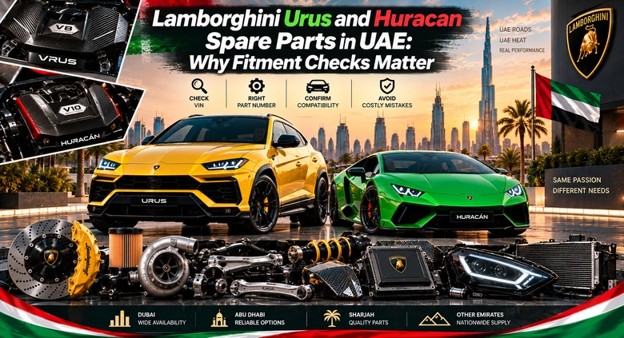
Lamborghini Urus and Huracan Spare Parts in UAE: Why Fitment Checks Matter
September 14, 2026
Fitment Starts Before You Compare Prices
The cheapest Lamborghini part can be the most expensive one
A Lamborghini part that costs less is not necessarily the better purchase. With the Urus and Huracán, the more important question is whether the part actually belongs to the exact vehicle configuration sitting in the workshop.
That sounds obvious until a seller offers a visually identical part from another model year, another market or another specification. It may physically mount, yet the connector, software, calibration, dimensions or associated hardware can differ.
Lamborghini itself stresses that original parts should match the technical specifications of the relevant model, while its official service network follows manufacturer repair instructions.
In the UAE, that makes fitment before price the sensible starting point.
Urus and Huracán are not interchangeable simply because they share the badge
The two cars occupy completely different engineering territory.
The Urus uses a 4.0-litre twin-turbo V8 and, depending on version, has complex all-wheel-drive, suspension and electronic systems. Lamborghini's current Urus family also includes the Urus SE plug-in hybrid, which combines its V8 with an electric motor and an eight-speed automatic transmission.
The Huracán uses a naturally aspirated 5.2-litre V10, with variants using the seven-speed Lamborghini Doppia Frizione dual-clutch transmission and different driveline configurations.
So “Lamborghini part” is nowhere near enough information.
The buying checklist should be short
Before paying for a Urus or Huracán part, establish:
- Full VIN
- Exact model and variant
- Production year
- Engine
- Transmission
- Drivetrain
- GCC or imported specification
- Exact part number
- Superseded part number, if applicable
- New, used, OEM, reconditioned or aftermarket status
- Donor VIN for used parts
- Donor mileage where available
- Actual photographs of the part
- Testing evidence for major mechanical parts
- Coding or calibration requirements
- Warranty terms
- Complete installed cost
If the seller cannot answer several of these questions, the attractive price is not much of an advantage.
Why fitment errors happen in the UAE
Dubai has a large luxury-car ecosystem, and parts can arrive through official channels, independent specialists, dismantlers, importers and international suppliers. That gives buyers choice. It also creates opportunities for confusion.
A part may be advertised simply as “Urus 2019–2024” even though the actual applicability needs more careful checking.
The same problem appears with Huracán parts because the range includes different versions, drivetrains and equipment levels. A Huracán RWD part should not be assumed compatible with an AWD car merely because the body looks almost identical.
A visual match proves very little
This is particularly dangerous with:
- Electronic modules
- Sensors
- Suspension parts
- Cooling-system parts
- Brake assemblies
- Gearbox parts
- Wiring
- Body electronics
- Lighting assemblies
- Carbon-fibre trim
- Control units
A photograph can establish that a part looks similar.
It cannot establish software compatibility, internal specification, calibration, manufacturing revision or vehicle applicability.
That is why a proper fitment check needs information from the vehicle and the part together.
VIN is more useful than a model name
“Lamborghini Urus 2020” is a starting point.
It is not a complete identification.
The VIN can help establish the exact vehicle configuration, while the manufacturer's catalogue or appropriate technical system can then be used to confirm the applicable part number.
Lamborghini also provides repair and maintenance information for independent operators through its service-information system, including repair information and spare-parts catalogue access.
For an expensive part, that extra step is cheap insurance.
Urus Fitment Has Its Own Problems
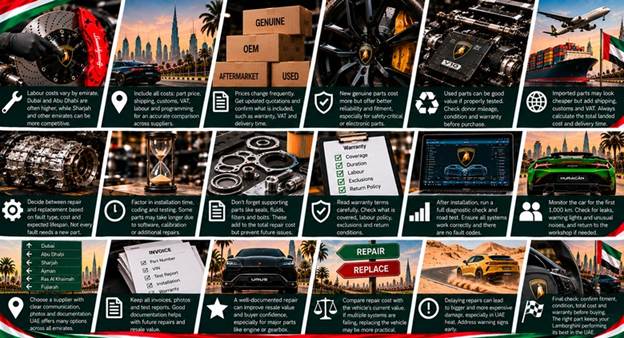
Urus parts need SUV-specific reasoning
The Urus is not simply a Lamborghini with more ground clearance.
Its architecture combines high performance with SUV functionality, and Lamborghini describes it as capable across different terrain and driving conditions.
That matters when assessing replacement parts.
Suspension, cooling, brakes, tyres, drivetrain parts and electronic systems can experience different loads from those seen on a Huracán. A Urus used for daily Dubai commuting can also accumulate many more low-speed cycles, stop-start traffic exposure and air-conditioning hours than a weekend Huracán.
Urus suspension fitment deserves extra attention
The suspension system is one of the areas where “it looks right” can become an expensive mistake.
Before purchasing a replacement suspension-related part, establish:
- Exact model year
- Variant
- Front or rear position
- Left or right side
- Suspension configuration
- Part number
- Revision/supersession
- Sensor or connector arrangement
- Whether calibration is required after installation
For air-suspension-related repairs, the workshop should also establish whether the failed part is actually the source of the problem.
Replacing a suspension assembly when the underlying fault is elsewhere simply moves money from the buyer's wallet to the workshop.
Urus cooling parts need more than dimension matching
The UAE puts obvious thermal pressure on cooling systems.
But the relevant question is not merely “is this radiator the same size?”
Check:
- Mounting points
- Hose connections
- Cooling capacity
- Sensor connections
- Fan arrangement
- Vehicle specification
- Part-number revision
- Associated control systems
A cooling part that physically fits but does not match the intended specification is not a successful repair.
Urus brakes are a configuration issue
Brake parts can vary with model version, wheel specification, brake package and factory equipment.
Before ordering discs or pads, verify:
- Front/rear position
- Disc dimensions
- Caliper type
- Pad shape
- Sensor arrangement
- Wheel clearance
- Part number
- Vehicle specification
For used brake parts, the economics often make little sense unless the part is unusual or exceptionally valuable.
Brake wear is measurable. A cheaper used brake assembly with uncertain remaining life can become false economy.
Urus electronics need coding questions before purchase
Electronic parts are where the difference between physical fitment and functional fitment becomes obvious.
Ask before purchasing:
- Does the module require coding?
- Does it require programming?
- Does it require vehicle configuration?
- Does it need calibration?
- Is the module locked to the donor vehicle?
- Can the workshop access the required software?
- Does the replacement need adaptation after installation?
Do not assume that clearing a fault code means the installation is complete.
Urus SE changes the conversation
The Urus SE adds another layer because it combines the 4.0-litre twin-turbo V8 with a permanent-magnet synchronous electric motor and an eight-speed automatic transmission. Lamborghini states that the system produces 800 CV and 950 Nm in the Urus SE.
That means a buyer should be especially careful when searching generically for “Urus electrical parts”, “Urus transmission parts” or “Urus hybrid parts”.
A part intended for a conventional Urus cannot be assumed to apply to the hybrid simply because the body and badge are similar.
Huracán Fitment Is Different
Huracán buyers need variant-level identification
The Huracán family contains multiple versions, and that matters enormously for parts.
The Huracán platform uses a 5.2-litre naturally aspirated V10, while drivetrain configurations and technical equipment vary across the range. Lamborghini's technical material confirms the seven-speed LDF dual-clutch transmission on relevant Huracán versions.
Therefore, “Huracán part” is often too broad for an expensive order.
Huracán gearbox parts require careful identification
The LDF dual-clutch system is not something to buy from a photograph.
For a gearbox or major transmission part, ask for:
- Exact transmission identification
- Vehicle VIN
- Part number
- Donor VIN for used assemblies
- Mileage
- Removal reason
- Fault history
- Fluid condition
- Diagnostic scan
- Adaptation information where available
- Warranty
A used gearbox with no history should be priced as a risk, not merely as a bargain.
Huracán RWD and AWD differences matter
Lamborghini's own technical information shows different drivetrain configurations within the Huracán family. The RWD Spyder, for example, uses a rear-wheel-drive system with a rear mechanical self-locking differential, while other Huracán configurations use electronically controlled all-wheel drive.
That makes drivetrain-related fitment especially sensitive.
Never assume that an AWD component is suitable for a RWD model because the mounting location looks similar.
Huracán engine parts need a different diagnostic approach
The Huracán's naturally aspirated 5.2-litre V10 is fundamentally different from the Urus's twin-turbo V8.
For a used engine or major internal engine part, the workshop should consider:
- Compression testing
- Leak-down testing
- Oil pressure where relevant
- Cooling-system checks
- Oil contamination
- Coolant contamination
- Diagnostic scan
- Borescope inspection where justified
- Donor history
Compression numbers should not be considered in isolation. Cylinder-to-cylinder consistency and the reason for any variation are more useful than a single impressive-looking figure.
Huracán carbon-fibre parts need physical inspection
Carbon-fibre body parts can be expensive enough that used sourcing becomes attractive.
But inspect for:
- Cracks
- Delamination
- Previous repairs
- Mounting damage
- Distortion
- Poor-quality refinishing
- Broken clips or brackets
- Heat damage
- Correct weave/finish
A carbon panel that looks excellent from two metres away may reveal damage around mounting points when removed.
Front-lift parts need system-level thinking
A failed front-lift system does not automatically mean the lift assembly itself needs replacement.
The workshop should determine whether the problem originates in:
- Mechanical hardware
- Hydraulic/pneumatic system where applicable
- Sensor
- Wiring
- Control module
- Valve or actuator
- Calibration
- Stored fault
That diagnostic sequence can save the cost of replacing an expensive part unnecessarily.
Genuine, OEM, Used and Reconditioned
Genuine does not mean the same thing as OEM
These terms are often thrown around casually.
Genuine generally means supplied as an original manufacturer part through the relevant manufacturer channel.
OEM refers to original-equipment manufacturing relationships, but the term is often used too loosely in the independent market.
Aftermarket means produced outside the vehicle manufacturer's original supply route.
Reconditioned means an existing part has been inspected, repaired or rebuilt.
Used genuine means an original part removed from another vehicle.
The buyer needs to know what is actually being offered rather than relying on the label.
Lamborghini's position on original parts is clear
Lamborghini states that its official dealers and service points use original Lamborghini spare parts in UAE and follow manufacturer instructions. It also says original parts are intended to match the technical specifications of each model.
That does not mean every repair outside the official network is automatically poor.
It means the buyer should understand what changes when moving away from the manufacturer's original supply route.
When used genuine makes sense
Used genuine parts can make economic sense for:
- Older vehicles
- Interior trim
- Certain body panels
- Rare discontinued items
- Expensive assemblies where testing is possible
- Parts with low wear and strong donor history
They are less attractive when the part is safety-critical, heavily worn, electronically locked or difficult to test.
The correct question is not:
“Is used cheaper?”
It is:
“Is the remaining useful life and compatibility risk acceptable at this price?”
Reconditioned parts require a rebuild specification
“Reconditioned” is not a magic word.
Ask:
- What was replaced?
- What was measured?
- Which internal parts were reused?
- What was machined?
- What test was performed?
- What tolerances were checked?
- What warranty is provided?
- Does the warranty include labour?
For a gearbox or engine, a written rebuild specification is much more meaningful than a seller simply saying “fully rebuilt”.
Aftermarket can be sensible in the right category
Not every aftermarket part is poor quality.
But the risk varies dramatically.
A cosmetic trim item is not equivalent to a brake component, suspension actuator or electronic control module.
For every aftermarket part, ask:
Who manufactured it, what specification does it follow, and what evidence shows that it is suitable for this exact vehicle?
That is a better question than simply asking whether it is cheaper.
Tijari parts need especially clear documentation
Where a UAE buyer is offered a commercially sourced replacement described as “Tijari”, the term itself does not establish quality.
Establish:
- Manufacturer
- Country of manufacture
- Part number
- Warranty
- Application
- Test evidence
- Return conditions
A generic label should never substitute for identification.
VIN, Part Numbers and Superseded Numbers
A correct VIN check should answer several questions
The workshop or supplier should use the VIN to establish:
- Exact vehicle
- Model year
- Engine
- Transmission
- Drivetrain
- Factory configuration
- Relevant equipment
- Applicable part number
For high-value orders, keep the VIN confirmation with the quotation.
That creates a useful paper trail if the wrong part is later supplied.
Part numbers matter more than photographs
A photograph is useful for checking physical condition.
A part number is more useful for checking identity.
Ideally, compare:
Vehicle VIN → catalogue application → original part number → replacement part number → supplier's actual part.
If those four stages do not connect, stop before paying.
Superseded numbers can cause unnecessary confusion
Manufacturers sometimes replace an older part number with a newer number.
That does not automatically mean the newer number is wrong.
It may be the current replacement for the older part.
The critical question is whether the new number is officially applicable to the vehicle.
This is another reason why searching by model name alone can be misleading.
A seller should be able to explain a number mismatch
Suppose your vehicle's original part shows number A, while the seller offers number B.
Do not automatically reject B.
Ask:
“Is B the superseding number for A, and can you confirm compatibility with my VIN?”
A credible supplier should be able to explain the relationship.
An answer such as “same thing, don't worry” is not enough for a high-value Lamborghini part.
Keep the old part until fitment is confirmed
When practical, do not throw the removed part away immediately.
The original part can help confirm:
- Number
- Connector
- Mounting
- Physical dimensions
- Revision
- Damage pattern
It can also help resolve a dispute if the replacement is supplied incorrectly.
The strongest fitment record
For an expensive repair, retain:
| Record | Why it matters |
| Vehicle VIN | Identifies the exact car |
| Original part number | Establishes what was fitted |
| Replacement number | Confirms what was supplied |
| Supersession information | Explains number changes |
| Supplier quotation | Records commercial terms |
| Photos | Establishes condition |
| Diagnostic report | Shows pre-repair fault |
| Installation invoice | Documents the work |
| Coding/calibration record | Confirms electronic setup |
| Warranty | Establishes post-sale protection |
That paperwork becomes surprisingly valuable when the car is sold later.
UAE Specification, Heat and Mileage
GCC specification should not be treated as a marketing phrase
A seller may say “GCC spec” as though that alone proves compatibility.
It does not.
The buyer should still confirm the exact vehicle configuration.
An imported European, North American or Japanese-market car can have differences in equipment, software, emissions systems, cooling requirements or other specifications.
For an expensive electronic or mechanical part, market origin should be part of the fitment investigation.
Imported cars need additional checking
Imported Lamborghini cars are common enough in the UAE that this deserves its own question during parts sourcing.
Ask:
- Which market was the car built for?
- Has the vehicle been modified?
- Has any control module been replaced previously?
- Has the cooling system been altered?
- Does the current VIN catalogue information match the vehicle?
- Are there previous accident repairs?
The physical car should agree with its documentation.
UAE heat affects parts differently
“UAE heat” is too broad unless we explain what it does.
On the Urus, consider heat exposure around:
- Cooling systems
- Turbo-related plumbing
- Rubber seals
- Suspension components
- Wiring
- Battery systems
- Electronic modules
On the Huracán, also consider:
- Engine-bay heat
- Rubber and seals
- Cooling
- Electronic systems
- Carbon-fibre body areas
- Battery condition on low-use cars
The exact risk depends on the part and the vehicle's usage.
Low mileage can hide an entirely different problem
A 30,000-km Lamborghini can be more attractive than an 80,000-km car.
But mileage alone is not enough.
Investigate:
- Storage periods
- Battery history
- Service frequency
- Tyre age
- Seal condition
- Accident history
- Cooling-system condition
- Short-trip usage
- Previous modifications
For a used part, donor mileage should be considered alongside donor age and operating history.
Storage is part of the condition report
A donor vehicle that spent years parked in a poorly controlled environment may have suffered from:
- Battery deterioration
- Seal ageing
- Corrosion
- Rubber hardening
- Moisture exposure
- Interior deterioration
- Tyre degradation
A low-mileage donor is therefore not automatically a premium donor.
UAE traffic changes the usage pattern
A Lamborghini used around Dubai every day can accumulate extensive:
- Idle time
- Air-conditioning operation
- Low-speed braking
- Stop-start cycles
- Short trips
- Heat-soak periods
A weekend Huracán that spends most of its life parked has a different wear profile.
The part buyer needs to understand how the vehicle was used, not just how far it travelled.
What the Workshop Should Actually Test
Ask for diagnostic evidence before buying expensive electronic parts
For modules, sensors and electronically controlled assemblies, ask the workshop to establish:
- Stored fault codes
- Current fault codes
- Relevant live data
- Power supply
- Ground integrity
- Wiring condition
- Connector condition
- Communication with other modules
- Calibration status
Replacing an electronic module without confirming the original fault can become an expensive guessing exercise.
Used gearboxes need more than a clean casing
For a used Urus or Huracán gearbox, inspect:
- Housing damage
- Oil leaks
- Oil condition
- Fault history
- Donor mileage
- Removal reason
- Adaptation values where accessible
- Gear-selection behaviour
- Clutch-related data where relevant
- Road-test evidence where available
A gearbox that has simply been pressure-washed can look remarkably convincing.
That proves nothing.
Used engines deserve a proper test package
For a used engine, consider:
- Compression testing
- Leak-down testing
- Oil inspection
- Coolant inspection
- Borescope examination
- Diagnostic scan where possible
- Cooling-system pressure testing
- Donor history
- Mileage verification
Compression should ideally be compared across cylinders rather than presented as one headline figure.
A workshop should also explain whether the engine was tested cold, warm or under another specified procedure, because test conditions influence interpretation.
Suspension testing should reproduce the complaint
If the customer reports that the Urus sits low overnight, the workshop should not simply replace a visible suspension part.
The system needs diagnosis.
Depending on the suspected fault, inspect:
- Ride height
- Leakage
- Compressor operation
- Valve behaviour
- Sensors
- Lines
- Electrical supply
- Stored faults
The aim is to identify the failed part, not the most expensive part that could theoretically be related.
Brake inspection should produce measurements
For brakes, a useful report can include:
- Disc thickness
- Minimum permissible thickness where specified
- Pad thickness
- Surface condition
- Cracks
- Heat damage
- Run-out where relevant
- Caliper condition
This makes the repair decision much more objective.
Cooling problems need pressure and temperature logic
If an Urus is experiencing overheating or coolant loss, the workshop should investigate the system rather than immediately replacing the radiator.
Depending on the symptoms, useful checks can include:
- Cooling-system pressure
- Visible leakage
- Hose condition
- Fan operation
- Temperature data
- Coolant condition
- Thermostat behaviour
- Relevant diagnostic faults
The replacement part should solve an identified failure.
Price Is Not Repair Cost
A part quotation is only one line of the bill
Consider this simplified calculation:
Part price
- shipping
- VAT/customs where applicable
- inspection
- labour
- fluids
- seals/gaskets/bolts
- programming
- calibration
- alignment or testing where required
= actual repair cost
A buyer comparing only two part prices is comparing incomplete numbers.
UAE labour varies by workshop and emirate
Planning ranges should be treated as quotation benchmarks, not fixed tariffs.
| Work category | Dubai | Abu Dhabi | Sharjah | Other emirates |
| Diagnostic inspection | Higher specialist rates possible | Higher specialist rates possible | Often competitive | Varies widely |
| Routine mechanical installation | Moderate–high | Moderate–high | Moderate | Wide variation |
| Major engine work | High | High | Moderate–high | Depends heavily on specialist |
| Electronic coding/calibration | Specialist-dependent | Specialist-dependent | Specialist-dependent | Specialist-dependent |
| Complex gearbox work | High | High | Moderate–high | Specialist-dependent |
The important point is not that one emirate is always cheaper.
It is that the workshop's capability matters more than the postcode for a difficult Lamborghini repair.
Imported parts need a landed-cost calculation
An imported part can look cheap until the complete cost arrives.
Before comparing it with UAE stock, establish:
- Purchase price
- International shipping
- Insurance where applicable
- Customs/clearance
- VAT
- Delivery inside UAE
- Return cost
- Warranty arrangements
- Expected delivery time
A part that saves AED 3,000 but delays the car for three weeks and has no practical return route may not actually be the better purchase.
Published prices should be treated as snapshots
Luxury-car parts prices change.
The article should therefore distinguish between:
Current observed price
and
planning estimate.
A quotation from one seller should not be presented as the universal UAE market price.
The strongest comparison records the date, part condition, specification and what the quotation actually includes.
Genuine parts can carry a substantial premium
That premium can make sense for certain parts, especially where:
- Fitment is critical
- Coding is involved
- Safety is involved
- The part is difficult to test
- The car is relatively new
- Resale documentation matters
But the buyer should still compare the total ownership cost, not simply assume the most expensive option is automatically correct.
Used parts need a risk-adjusted price
A used part with:
- Known donor
- Verified mileage
- Test report
- Good photographs
- Written warranty
can reasonably command more than an unknown used part.
That is not paying for a logo.
It is paying for reduced uncertainty.
Repair, Replace and Installation
Repair versus replacement should be decided technically
| Situation | Repair | Used replacement | Genuine/new replacement |
| Minor mechanical fault | Often sensible | Usually unnecessary | May be excessive |
| Expensive electronic module | Depends on specialist repair | Possible with coding | Strong option |
| Major gearbox damage | Specialist assessment | Possible | Strong but costly |
| Safety-critical brake damage | Limited | Carefully assessed | Often preferable |
| Cosmetic trim damage | Often possible | Good option | Depends on value |
| Used engine | Rebuild may make sense | Possible | Depends on vehicle economics |
There is no universal “always replace with genuine” answer.
There is also no universal “used is better value” answer.
Installation time is part of the quotation
A supplier saying “available today” does not mean the car will leave the workshop today.
The real sequence may involve:
Part arrival → inspection → removal → supporting-part replacement → installation → fluids → coding → calibration → road test → diagnostic recheck → handover.
Electronic parts can extend the process significantly.
Major mechanical jobs can also reveal secondary faults once the original part is removed.
Supporting parts can change the economics
Replacing a major assembly may require:
- Seals
- Gaskets
- Bolts
- Fluids
- Filters
- Hoses
- Mounts
- Clips
- Fasteners
- Calibration
- Software procedures
These should be included in the quotation before the buyer decides that one supplier is cheaper.
Warranty language matters more than the word “warranty”
Ask:
- How long?
- What exactly is covered?
- Is labour covered?
- Is removal covered?
- Is refitting covered?
- Are diagnostic costs covered?
- Are coding problems excluded?
- What voids the warranty?
- Is installation required at a specific workshop?
- What is the return period?
Lamborghini's own warranty information also makes clear that warranty conditions can vary by country and directs owners to official dealers/service points for detailed terms.
That same discipline should be applied to independent used-part warranties.
A good installation ends with verification
After installation, the workshop should establish that:
- The part is correctly fitted
- Fasteners are secured
- Fluids are correct
- Fault codes have been reviewed
- Coding has been completed where necessary
- Calibration has been completed where required
- The system operates correctly
- The original symptom has disappeared
“Installed” is not the same as “successfully repaired”.
First 1,000 km should be treated differently by part
For an engine:
- Monitor oil and coolant
- Watch temperatures
- Check for leaks
- Recheck warning lights
- Avoid assuming that a silent engine is automatically healthy
For a gearbox:
- Observe shift quality
- Watch for hesitation
- Check for leaks
- Monitor abnormal noises or warnings
For suspension:
- Watch ride height
- Check overnight settling
- Monitor compressor behaviour
- Listen for unusual operation
For electronic parts:
- Check recurring warnings
- Confirm all associated functions
- Return promptly if calibration faults reappear
Buying, Documentation and Long-Term Value
A UAE supplier should be able to communicate clearly
Good sourcing is not necessarily about finding the cheapest seller.
Look for:
- Clear part identification
- Actual photographs
- Written quotation
- Donor information for used parts
- Test information
- Warranty terms
- Return conditions
- Delivery timing
- Installation requirements
A vague seller becomes particularly risky when the part is worth tens of thousands of dirhams.
Keep evidence of the repair
For future resale, retain:
- Invoice
- Part number
- VIN confirmation
- Donor VIN where applicable
- Diagnostic report
- Test report
- Installation invoice
- Coding/calibration evidence
- Warranty
- Before-and-after photographs
A documented repair is easier for the next buyer to understand than an expensive repair with no paperwork.
Resale value is partly about confidence
A future buyer may not know whether an expensive used gearbox was a sensible purchase.
But a file showing:
VIN → part number → donor information → diagnostic test → installation → warranty
makes the story much easier to trust.
For a high-value Lamborghini, documentation can be more persuasive than simply saying “genuine part fitted”.
When the repair becomes too expensive
The replace-or-repair decision should eventually include the value of the vehicle itself.
Consider:
Current market value
versus
repair cost
plus
likely near-term maintenance
plus
existing faults
plus
resale implications
A major engine replacement on an otherwise excellent Lamborghini can be financially rational.
The same repair on a poorly documented, accident-damaged car with several unrelated faults may be difficult to justify.
Cost of delay needs to be calculated, not exaggerated
Not every warning light means the car will immediately suffer catastrophic damage.
But some faults become more expensive when ignored.
Examples:
- Small coolant leak → overheating risk
- Suspension leak → additional compressor workload
- Brake wear → disc damage
- Transmission problem → progressive internal wear
- Electrical fault → secondary system faults
- Oil leak → contamination of surrounding parts
The correct response is diagnosis.
Not panic.
The final fitment decision
For Urus and Huracán parts in the UAE, the safest purchasing sequence is remarkably simple:
Identify the car.
Identify the exact part.
Confirm the number.
Check whether the number has been superseded.
Establish whether the car is GCC or imported specification.
Inspect the actual part.
Check donor history for used parts.
Test major mechanical or electronic assemblies.
Calculate the complete installed cost.
Confirm warranty and installation requirements.
Document the repair.
This is where PartFinder UAE can be useful as part of a broader sourcing process: the buyer should still compare fitment, condition, documentation and total cost rather than choosing a part simply because it appears in a search result.
UAE Buyer Decision Matrix
| Buying situation | Best starting point | Main risk | What to verify |
| New Urus electronic module | Genuine/new | Coding | VIN, software, calibration |
| Used Urus suspension part | Tested used/genuine | Donor wear | Donor VIN, mileage, leak test |
| Huracán gearbox | Genuine/reconditioned/tested used | Internal wear | Diagnostic data, adaptation, warranty |
| Used Huracán engine | Tested used/rebuilt | Hidden internal damage | Compression, leak-down, donor history |
| Carbon-fibre body part | Used genuine | Structural damage | Cracks, mounting points, repair history |
| Brake assembly | New/genuine or proven-quality alternative | Safety/wear | Dimensions, thickness, caliper compatibility |
| Rare imported part | Genuine/verified used | Landed cost | Shipping, customs, VAT, returns |
| Older model trim | Used genuine | Cosmetic damage | Part number, condition, mounting points |
What a Proper UAE Fitment Check Should Contain
A serious quotation for an expensive Urus or Huracán part should ideally look more like a technical record than a WhatsApp message saying “available”.
| Check | Minimum useful information |
| Vehicle | VIN + exact model |
| Part | Exact number |
| Revision | Current/superseded status |
| Specification | GCC/imported |
| Condition | New/used/reconditioned |
| Donor | VIN + mileage for used parts |
| Test | Relevant diagnostic/mechanical test |
| Price | Part price separately |
| Extras | Shipping, VAT, customs, labour |
| Programming | Required/not required |
| Calibration | Required/not required |
| Warranty | Duration + exclusions |
| Delivery | Expected date |
| Documentation | Invoice and part identification |
First-Year Ownership Cost: Why the Part Price Is Only the Beginning
A buyer spending AED 20,000 on a replacement assembly should not mentally record the repair as an AED 20,000 decision.
The first-year cost could include:
- AED 20,000 part
- AED 2,000–5,000 installation depending on complexity
- Fluids and supporting parts
- Coding/calibration
- Diagnostics
- Imported delivery or clearance
- Follow-up repairs
- Warranty-related inspection
The exact figures vary by part and workshop, so these should be calculated from actual quotations rather than presented as universal UAE tariffs.
The important principle is simple:
The cheapest part is not necessarily the cheapest repair.
Used Part Inspection: What Should Be Visible in the Photographs?
Before travelling across Dubai, Abu Dhabi or another emirate to collect a part, request clear photographs showing:
- Part-number label
- Connector faces
- Mounting points
- Seals
- Housing
- Damage
- Corrosion
- Previous repair marks
- Serial markings where relevant
- Packaging
- Actual physical condition
For carbon-fibre or painted parts, request close-ups of the edges and mounting areas.
For engines and gearboxes, ask for photographs of areas that would normally be hidden after installation.
Genuine UAE Workshop Scenario: The “Correct Part, Wrong Revision” Problem
Consider a realistic purchasing scenario rather than a dramatic failure story.
A Urus owner receives a quote for an electronic assembly. The seller provides photographs and the unit looks identical to the original. The price is attractive.
The workshop checks the vehicle VIN and finds that the number offered is an older revision.
That does not automatically make the part unusable.
The next step is to establish whether the manufacturer superseded the old number and whether the offered revision is officially applicable.
The important lesson is that the buyer has avoided two opposite mistakes:
- rejecting a legitimate superseded part;
- accepting an incompatible part merely because it looks identical.
That is the level of fitment checking expensive Lamborghini repairs deserve.
Genuine UAE Workshop Scenario: Low-Mileage Donor
A used Huracán assembly from a low-mileage donor may sound ideal.
But the workshop should still ask why the donor was dismantled.
Was it:
- Accident-damaged?
- Flood-damaged?
- Mechanically failed?
- Stored for years?
- Properly maintained?
- Modified?
- Running when dismantled?
“Only 25,000 km” is useful information.
It is not a complete condition report.
Why Urus and Huracán Buyers Should Not Use the Same Buying Strategy
The Urus is more likely to be used as a daily vehicle, carrying passengers, sitting in traffic and operating its cooling and comfort systems extensively.
The Huracán is more likely to be used differently, with lower annual mileage in some cases but potentially more intense performance driving.
Neither pattern automatically means more wear.
It means the wear evidence needs to be interpreted differently.
For a Urus suspension part, repeated urban use may matter.
For a Huracán gearbox or engine, driving style and service history may matter more than the odometer alone.
That is why model-specific reasoning is not cosmetic SEO work. It changes the buying decision.
Repair or Replace the Vehicle?
This is an extreme decision, but expensive Lamborghini repairs eventually reach this point.
Repair the vehicle when:
- The chassis is sound
- Service history is strong
- The interior/body remain valuable
- The problem is isolated
- The replacement part can be properly verified
- The total repair cost remains sensible against vehicle value
Reconsider the repair when:
- Multiple major systems are failing
- Accident history is extensive
- Documentation is poor
- The vehicle has repeated unresolved faults
- Repair cost approaches a large proportion of vehicle value
- Future repair exposure remains high
A single expensive part does not automatically make the car uneconomical.
Several unrelated expensive systems failing together can change the calculation.
Final Buying Checklist for Urus and Huracán Parts in UAE
Before payment, confirm:
- VIN checked
- Exact variant identified
- GCC/imported specification confirmed
- Engine confirmed
- Transmission confirmed
- Drivetrain confirmed
- Part number confirmed
- Superseded number checked
- Actual photographs received
- Used donor VIN requested
- Donor mileage checked
- Removal reason established
- Relevant testing completed
- Coding requirement confirmed
- Calibration requirement confirmed
- Supporting parts identified
- Labour quoted
- Shipping included
- VAT/customs checked
- Warranty received in writing
- Return conditions understood
- Installation timeline confirmed
- Invoice/documentation retained
FAQs
Categories
- Audi
- BMW
- Car Accessories
- Car Tips
- Ford
- Land Rover
- Mazda
- Range Rover
- Top 10
- UAE Car Parts
- Used Car Parts
- Toyota
- Replacement Engines
- Nissan
- Hyundai
- Mitsubishi
- Volkswagen
- Honda
- Kia
- Chevrolet
- Dodge
- Jeep
- Subaru
- Renault
- Lexus
- Mercedes
- Suzuki
- Hummer
- Porsche
- Infiniti
- Peugeot
- GMC
- Mini
- Volvo
- Replacement Gearboxes
- MG
- Jaguar
- Skoda
- Cadillac
- Daihatsu
- Fiat
- German Car Parts
- Japanese Car Parts
- Aftermarket Car Parts
- Genuine Car Parts
- New Car Parts
- Reconditioned Car Parts
- European Car Parts
- American Car Parts
- Korean Car Parts
- British Car Parts
- Chinese Car Parts
- Sports/Exotic Car Parts
- Luxury Car Parts
- Performance Car Parts
- SUV/4x4 Spare Parts
- Truck Spare Parts
- EV Car Parts
- Hybrid Car Parts
- Auto Spare Parts in UAE
- Tesla
- Isuzu
- Ram
- Ferrari
- Bentley
- Lamborghini