Land Rover Spare Parts in UAE: Complete Guide for Defender, Discovery, Range Rover, Evoque and Velar
August 24, 2026
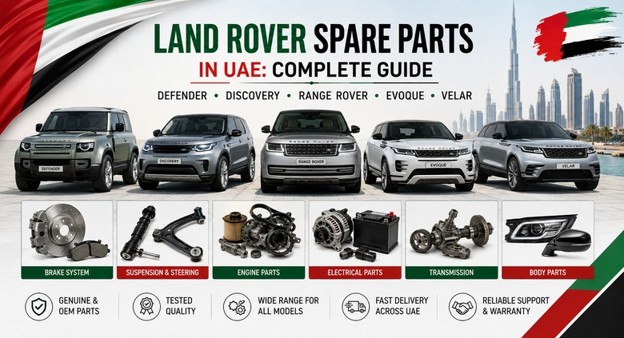
Common Land Rover Spare Parts Owners Replace
Land Rover Spare Parts in UAE: Which Parts Need Replacement Most Often?
Land Rover ownership in the UAE is rarely hard because of one dramatic failure. It is the smaller, cumulative stuff that tends to catch owners out — worn suspension bushes, tired brake components, cooling-system leaks, weak batteries, ageing sensors and AC parts that suddenly stop keeping up with August heat.
And then there is air suspension. That deserves its own conversation.
Across Defender, Discovery, Range Rover, Evoque and Velar, the exact failure pattern changes with the model, engine, generation and mileage. A part that is perfectly sensible for a high-mileage Discovery may be a poor choice for a newer Range Rover.
Brake components:
Brake pads, discs, wear sensors and other Land Rover spare parts in UAE are straightforward examples of parts that eventually need replacing. Heavy vehicles, repeated urban braking and long journeys all contribute to wear.
Listen for squealing, grinding or vibration, but don't diagnose the entire braking system from a noise alone.
A worn pad is one thing. A damaged disc, sticking caliper or uneven wear pattern is another.
Suspension components:
Control arms, bushes, ball joints, stabiliser links and dampers can become tired over time. On a vehicle with air suspension, the list gets longer.
A knocking sound over a speed hump may be nothing more than a worn link. Or it could be a deeper suspension problem. Find out before buying parts.
Air suspension:
If a Land Rover sits lower after being parked overnight, something needs checking. The culprit could be an air spring, compressor, valve block, air line or height sensor.
Replacing the compressor immediately is not always the clever move.
If an air leak is forcing the compressor to run constantly, the compressor may simply be the second victim.
Cooling-system parts:
Radiators, water pumps, thermostats, coolant pipes, expansion tanks and hoses all deserve attention as a Land Rover ages.
The UAE climate makes this especially important. A cooling system that is only just coping during a mild month can struggle badly when the outside temperature climbs and the vehicle is sitting in traffic.
AC components:
Weak cabin cooling is not something UAE owners can comfortably ignore.
The fault might be the compressor, condenser, refrigerant circuit, blower motor, expansion valve or another climate-control component. Diagnose it first.
Electrical parts:
Batteries, alternators, starters, sensors and control modules can all create confusing symptoms.
One warning message can have several possible causes, so buying the first electronic component that appears in an online search is risky.
Engine-related parts:
Engine mounts, ignition components, sensors, seals, cooling parts and other supporting components can wear without the engine itself being seriously damaged.
This distinction is important when a repair quotation starts getting frightening.
Body and lighting parts:
Bumpers, headlights, tail lights, mirrors, doors, wings and trim can become necessary after accidents or cosmetic damage.
Used genuine parts can sometimes cut the bill considerably, although condition, colour, mounting points and included electronics need checking.
The practical Land Rover approach:
Diagnose the fault → identify the exact component → confirm the part number → check compatibility → compare genuine, OEM, used and aftermarket options → calculate the complete repair cost.
Do that before ordering.
It saves money, and more importantly, it stops a perfectly good Land Rover part from being bought for a problem it was never going to fix.
Land Rover Brake Pads and Discs: Replacement Signs and Buying Guide
Brakes are not an area where “I'll sort it next month” works particularly well.
A Land Rover has considerable weight to control, and repeated braking through Dubai traffic or during long UAE motorway journeys can expose worn components quickly.
Brake pad wear:
Thin pads can produce noise, reduced braking performance or a dashboard warning where wear monitoring is fitted.
The important thing is to inspect the actual pad thickness and wear pattern rather than relying entirely on the warning light.
Brake discs:
Discs can develop grooves, scoring, corrosion, heat damage or excessive wear.
If the steering wheel shakes under braking, don't automatically order new discs. Suspension, wheel and tyre problems can also create vibration.
Brake calipers:
A sticking caliper can create uneven pad wear and excessive heat at one wheel.
If one side is wearing dramatically faster than the other, investigate why.
Brake wear sensors:
Some Land Rover braking systems use wear sensors that need replacing alongside the relevant pads. Check what the supplier's quotation actually includes.
Otherwise, the supposedly “complete” brake job may not be complete.
Defender brakes:
Defender variants can differ substantially in specification, so confirm the exact vehicle before ordering. Model name and year alone may not be enough.
Discovery brakes:
Discovery's weight and driving conditions make brake condition particularly important. Check pads, discs, calipers and related hardware together rather than treating each component in isolation.
Range Rover brakes:
Higher-specification Range Rover braking systems can involve expensive components. Here, buying the cheapest available disc or pad without checking manufacturer and specification is false economy.
Evoque and Velar brakes:
These models still require exact fitment checks because engine, trim and braking configuration can affect the required component.
Genuine vs OEM vs aftermarket:
A reputable OEM or aftermarket brake manufacturer can provide a sensible alternative for some Land Rover applications. But the manufacturer needs to be known.
“Premium quality” printed on an online listing tells you very little.
Used brake parts:
Pads and worn discs are not sensible places to chase second-hand savings. Certain reusable components, such as calipers, are a different matter, but they should be inspected and tested.
Before buying:
Confirm:
VIN + model + generation + axle + brake specification + part number + manufacturer + warranty.
Then compare the delivered price.
Land Rover Air Suspension Parts in UAE: Air Springs, Compressors and Valve Blocks
Air suspension is one of the areas where Land Rover owners can spend money unnecessarily if the diagnosis is rushed.
The vehicle drops overnight. The suspension warning appears. The compressor is blamed.
Sometimes that's right.
Sometimes it isn't.
Air springs:
A leaking air spring can cause one corner of the vehicle to sit lower than the others, particularly after the vehicle has been parked for several hours.
Rubber components can deteriorate with age and repeated heat cycles.
Air compressor:
The compressor supplies air to the suspension system, but it is often affected by another fault.
If an air spring or line leaks, the compressor may run far more frequently than intended. Eventually, that extra workload can damage it.
Valve block:
The valve block controls how compressed air moves through the suspension system.
A valve-block fault can produce uneven ride height, slow adjustment or strange suspension behaviour.
Air lines:
Small leaks are not always obvious while driving. A vehicle that looks normal after a short journey but settles overnight deserves a proper leak test.
Height sensors:
Height sensors tell the suspension system where the vehicle is sitting. A failed or inaccurate sensor can create warning messages and incorrect ride-height behaviour.
Compressor noise:
An unusually loud compressor is worth investigating, particularly if it is running for longer than normal.
Don't wait until it stops completely.
UAE heat:
High ambient temperatures and repeated heat cycles are tough on rubber, seals and other components. That does not mean the climate automatically destroys air suspension, but small problems should not be ignored.
Used air-suspension parts:
Used genuine components can make financial sense on older Land Rovers, especially where a new assembly is disproportionately expensive.
Ask for actual photographs, donor details, testing information and warranty terms.
Reconditioned compressors:
This can be another option, but ask what has actually been rebuilt.
A compressor described as “reconditioned” should not be treated as automatically equivalent to a properly rebuilt unit with documented work.
The right sequence:
Find the leak → identify the failed component → confirm the part number → compare replacement options.
Do not start with the most expensive component.
Land Rover Suspension Parts: Control Arms, Bushes, Ball Joints and Dampers
Land Rover suspension has a hard job. It has to manage substantial vehicle weight while maintaining stability and comfort, and some owners spend years driving over speed humps, kerbs and uneven surfaces without thinking much about what happens underneath.
Eventually, something complains.
Control arms:
Worn control arms can produce vague steering, knocking noises and uneven tyre wear.
Under braking, you may notice the vehicle feels less settled than it used to.
Suspension bushes:
Bushes absorb movement and help keep suspension geometry controlled. With age, rubber can crack, soften or deteriorate.
A worn bush may not make the vehicle feel broken. It can simply make it feel slightly wrong.
That subtle change is worth investigating.
Ball joints:
Ball joints affect suspension movement and steering. Excessive play needs attention because the component is part of a critical mechanical system.
Stabiliser links:
These smaller parts can produce surprisingly loud knocking noises over bumps.
It is one of those workshop situations where the noise sounds expensive, yet the failed component may not be.
Dampers:
Worn dampers can affect body control, tyre contact and ride quality. Oil leakage, excessive bouncing and uneven tyre wear are useful clues.
PASM or electronically controlled suspension:
Where the Land Rover specification includes electronically controlled damping or other advanced suspension systems, exact component matching becomes even more important.
Uneven tyre wear:
Don't simply fit new tyres and send the vehicle back onto the road.
If worn suspension or incorrect alignment caused the original tyre wear, the same problem can chew through the replacement tyres too.
Used suspension parts:
Used genuine components can work for certain older Land Rovers, but mileage and previous use matter. A second-hand control arm or damper is not automatically a bargain.
OEM suspension parts:
Reputable OEM suppliers can offer useful alternatives where the application is correct. Verify the manufacturer and part number rather than relying on vague “OEM quality” claims.
Before ordering:
Ask the workshop to identify the actual worn component.
Not the general area.
The actual component.
That small distinction can keep the repair bill under control.
Land Rover Cooling System Parts: Radiators, Water Pumps, Thermostats and Hoses
Cooling-system problems deserve quick attention in the UAE.
A Land Rover can cope with extreme temperatures when its cooling system is healthy. Once a leak, weak pump or restricted radiator starts reducing that margin, things can go downhill rather quickly.
Radiators:
A damaged, blocked or leaking radiator can reduce cooling performance.
External contamination, physical damage and internal restriction should all be considered during diagnosis.
Water pumps:
The water pump circulates coolant through the engine and cooling system. If it becomes worn or fails, coolant circulation can suffer and engine temperature can rise.
Thermostats:
The thermostat regulates coolant flow according to operating temperature.
If it sticks open or closed, the engine may not maintain the intended temperature range.
Coolant hoses:
Rubber hoses and plastic connectors can deteriorate through age and repeated heat cycles.
A small crack can turn into a significant leak once the system becomes hot and pressurised.
Expansion tanks:
Expansion tanks and their connections can develop cracks or leaks. An unexplained drop in coolant level should always be investigated.
Cooling fans:
Fan problems can become particularly noticeable in slow-moving traffic because natural airflow is reduced.
If the vehicle behaves normally at motorway speed but struggles in stationary traffic, the fan system deserves attention.
Coolant leaks:
Look for visible coolant, unusual smells, warning messages or repeated low coolant levels.
Don't simply keep topping it up.
Find the leak.
UAE summer driving:
This is where preventive thinking pays off. A cooling component that is already marginal can become a serious liability during a long August journey.
Genuine vs OEM cooling parts:
A reputable OEM component may be a sensible option for some Land Rover applications. For critical cooling components, however, the manufacturer, specification and warranty should matter more than saving the final few dirhams.
Used cooling components:
Used radiators, expansion tanks and other cooling parts require careful inspection because their previous service life is unknown.
A cheap used component that leaks after installation is not cheap anymore.
Before buying:
Confirm the VIN, engine specification, exact part number, manufacturer, condition and warranty.
Then ask the workshop whether any related hoses, seals, clamps or fluids should be replaced at the same time.
A good parts decision is not simply about finding something that fits.
It is about fitting the right component once, and getting the Land Rover back on the road without creating another repair two weeks later.
Defender and Discovery Spare Parts
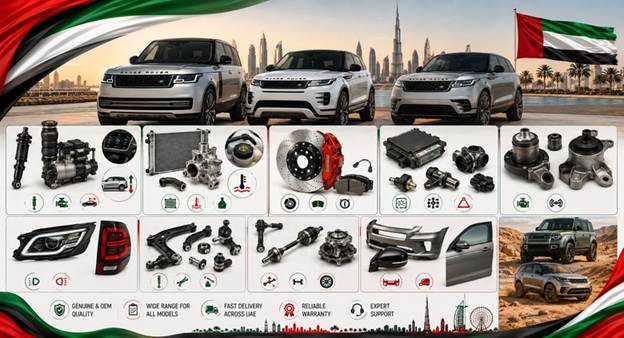
Land Rover Defender Spare Parts in UAE: Common Parts Owners Replace
The Defender has changed dramatically over the years, but one thing has not: owners still need to keep an eye on the components that take the daily punishment.
Brakes. Suspension. Cooling. Electronics. Drivetrain.
And, depending on the generation, the parts list can look completely different.
Defender brake parts:
Brake pads, discs and wear sensors are regular maintenance concerns, particularly on vehicles used heavily in city traffic.
A Defender that feels heavier under braking, pulls to one side or develops vibration deserves an inspection rather than a quick online parts order.
Defender suspension components:
Control arms, bushes, ball joints, links and dampers can wear with mileage.
Off-road use adds another variable. A Defender that regularly sees desert tracks, rocky surfaces or rough access roads may put considerably more stress through its suspension than one used mainly for commuting.
Air suspension:
Where fitted, air suspension introduces compressors, air springs, valve blocks, lines and height sensors into the equation.
If the vehicle drops after parking, find out why before replacing the compressor.
Cooling parts:
Radiators, water pumps, thermostats, hoses and expansion tanks deserve attention in UAE conditions. A Defender working hard in high temperatures needs a healthy cooling system, particularly during slow off-road driving where airflow is reduced.
Engine-related parts:
Depending on the generation and engine, owners may eventually replace ignition components, sensors, engine mounts, seals, cooling components and other supporting parts.
Don't jump from a warning light to “engine failure”. That's a very expensive leap.
Drivetrain components:
The Defender's drivetrain can see serious loads, especially when towing or driving away from paved roads.
Transfer-case, differential, driveshaft and related components should be investigated when unusual vibration, clunking or drivetrain noise appears.
Electrical components:
Modern Defenders contain a substantial amount of electronics. Sensors, batteries, modules, cameras and other electrical components can create warning messages that need proper diagnostics.
A fault code is a clue.
It isn't automatically the name of the part you need to buy.
Body and lighting parts:
Bumpers, mirrors, lights, doors, panels and trim can be replaced after accidents or off-road damage.
Used genuine components can be useful here, but inspect brackets and mounting points carefully.
Defender parts for older models:
Older Defenders can have a completely different parts strategy from newer vehicles. Availability, aftermarket support and used components may be more important than simply buying everything new.
Before buying Defender parts:
Confirm the generation, engine, transmission, VIN and exact part number.
A Defender badge alone doesn't narrow the search enough.
Land Rover Defender Suspension and Air Suspension Parts: What Should You Check?
The Defender's suspension has to cope with two very different worlds.
One day it may be commuting through Dubai. The next, it could be crawling over sand or rough terrain.
That changes how you should think about wear.
Control arms:
Worn control arms can cause steering looseness, knocking and uneven tyre wear.
If the vehicle feels vague through corners or under braking, inspect the suspension before blaming the tyres.
Bushes:
Bushes absorb movement and help maintain suspension geometry.
Once they deteriorate, the Defender can start feeling less precise, particularly over rough surfaces.
Ball joints:
Excess play in a ball joint can affect steering and suspension movement.
This is a safety-critical component, so diagnosis should not be postponed simply because the vehicle still drives.
Dampers:
Worn dampers can reduce body control and make the Defender bounce or feel unsettled.
Off-road driving can accelerate wear, particularly when the vehicle has been used hard.
Air springs:
Where the Defender uses air suspension, an air spring can develop a leak or deteriorate with age.
A vehicle sitting low on one side after being parked is a useful warning sign.
Compressor:
A compressor that runs for unusually long periods may be struggling to maintain pressure.
Don't just replace it. Find out why it is working so hard.
Valve blocks:
The valve block controls air distribution. A fault can produce inconsistent ride-height behaviour or slow suspension adjustment.
Height sensors:
A faulty height sensor can make the system believe the Defender is sitting somewhere it isn't.
That can trigger warnings or incorrect ride-height changes.
Off-road inspection:
After serious off-road use, inspect suspension arms, bushes, underbody components and related mounting points.
Mud, sand and impact damage can hide problems surprisingly well.
Used suspension parts:
Used genuine components may work for selected repairs, particularly on older Defenders. But ask about donor mileage, previous use and testing.
A part that spent years doing hard off-road work is not equivalent to one that lived an easy road-going life.
The Defender suspension rule:
Identify the failed component before buying the replacement.
It sounds basic. It saves money.
Land Rover Defender Engine Parts in UAE: Common Components That Wear
A Defender engine can cover serious mileage when maintained properly, but individual components will still age.
The trick is separating routine component wear from genuine internal engine trouble.
Engine mounts:
Worn mounts can create vibration and excessive engine movement.
If the engine feels rough at idle but otherwise performs normally, mounts deserve inspection.
Spark plugs and ignition components:
On petrol-powered variants, worn spark plugs or ignition coils can cause misfires, hesitation and rough running.
These are much smaller problems than an internal engine failure, obviously, so diagnose them first.
Sensors:
Engine-management sensors monitor temperature, pressure, air flow and other operating conditions.
A failed sensor can trigger warning lights or affect performance without the engine itself being damaged.
Cooling components:
Water pumps, thermostats, hoses, radiators and expansion tanks should be checked if the Defender shows signs of overheating or coolant loss.
Belts and related components:
Depending on the engine and generation, drive belts and associated components can require periodic attention.
Check the correct maintenance specification for the exact vehicle rather than following a generic mileage rule.
Seals and gaskets:
Age and heat cycles can lead to leaks around seals and gaskets.
A small oil or coolant leak is easier to deal with when it is still small.
Turbo-related components:
Turbocharged Defender variants contain additional hardware that can affect boost and engine performance.
Loss of power does not automatically mean the turbocharger itself needs replacement.
Used engine parts:
Used genuine components can reduce costs, particularly on older Defenders.
Ask for actual photographs, donor information, mileage where known and a clear warranty.
Reconditioned engine components:
If buying a reconditioned turbocharger, pump or another major assembly, ask what was rebuilt.
Don't pay extra simply because a listing uses the word “reconditioned”.
Complete engine replacement:
If internal engine damage is confirmed, compare rebuilding with tested used, reconditioned and new options.
Include labour, fluids, supporting parts and warranty risk.
The sensible Defender engine approach:
Diagnose first. Buy second.
Otherwise, an expensive replacement component can end up sitting on a workshop shelf while the actual fault remains untouched.
Land Rover Discovery Spare Parts in UAE: Common Replacement Parts
Discovery ownership brings a familiar collection of wear areas, but the exact parts depend heavily on generation, engine and specification.
Older Discovery models and newer versions should not be treated as interchangeable.
Discovery brakes:
Pads, discs, wear sensors and calipers can all require attention.
Heavy urban use can increase brake wear, while towing or carrying heavy loads can place additional demand on the system.
Discovery suspension:
Control arms, bushes, links, ball joints and dampers can develop wear over time.
A knocking sound over speed humps is worth investigating rather than simply turning the radio up.
Air suspension:
Where fitted, air springs, compressors, valve blocks, air lines and height sensors can all become relevant.
One corner sitting low after parking is a particularly useful clue.
Cooling system:
Radiators, water pumps, thermostats, hoses and expansion tanks should be monitored carefully.
A coolant warning should not become a routine topping-up exercise.
AC parts:
The compressor, condenser, blower motor, refrigerant system and climate-control components can all influence cabin cooling.
For a Discovery used daily in UAE summer, poor AC performance becomes difficult to ignore.
Engine components:
Engine mounts, sensors, ignition parts, cooling components, seals and other supporting parts can wear with mileage.
A diagnostic scan can help separate a relatively small component failure from a major engine problem.
Electrical components:
Batteries, alternators, starters, sensors and control modules can all create warning messages or starting issues.
Modern Discovery models contain plenty of electronics, so proper diagnostics matter.
Body parts:
Bumpers, headlights, mirrors, doors, tailgates and other panels can be replaced after accidents or damage.
For used components, inspect mounting points rather than looking only at the painted surface.
Discovery drivetrain parts:
Towing and off-road use can place extra demands on driveshafts, differentials, transfer-case components and related hardware.
Unusual vibration or clunking deserves investigation.
Buying Discovery parts online:
Send the supplier the VIN and exact part number whenever possible.
Then ask whether the component is genuine, OEM, aftermarket, used or reconditioned.
That one conversation can eliminate a lot of confusion.
Land Rover Discovery Air Suspension Problems: Parts, Symptoms and Repair Choices
Air suspension can transform the Discovery's ride quality.
It can also produce a frustrating repair bill when several components are blamed without proper testing.
Vehicle dropping overnight:
If the Discovery sits noticeably lower after several hours parked, a leak is one possibility.
The exact location needs to be identified before buying replacement parts.
Air spring failure:
A leaking air spring can cause one corner to drop or the vehicle to struggle to maintain its normal height.
Replacing the affected component may solve the problem if the compressor has not already been damaged.
Compressor failure:
A compressor can fail through normal wear, but it can also become overworked because of another leak.
That's why compressor replacement should usually follow a proper system check.
Valve block problems:
A faulty valve block can create uneven height adjustment and strange suspension behaviour.
It should be tested rather than assumed to be the cause.
Air-line leaks:
Small leaks can be particularly sneaky.
The Discovery may appear normal after driving, then slowly settle once it is parked.
Height sensors:
A faulty height sensor can send incorrect information to the suspension control system.
The result may be a warning light, incorrect ride height or repeated adjustment attempts.
Compressor overheating:
If the compressor keeps running because the system cannot hold pressure, heat builds up.
Eventually, a small air leak can turn into a compressor problem too.
Used Discovery air-suspension parts:
Used genuine compressors, air springs and other components can offer worthwhile savings on older Discoveries.
Condition and testing matter, though.
Reconditioned compressors:
A properly rebuilt compressor can be a practical middle-ground option.
Ask what components were replaced, whether the unit was tested and what the warranty actually covers.
Genuine vs OEM:
A reputable OEM alternative can make sense where the manufacturer and specification are known.
For critical suspension components, avoid anonymous products simply because they are dramatically cheaper.
Before buying:
Check:
VIN → suspension specification → fault diagnosis → exact component → part number → condition → warranty.
The key point:
If a Discovery is sinking onto one corner every night, don't just keep inflating the system or repeatedly replacing parts.
Find the leak.
Find the failed component.
Then buy the part that actually fixes the problem.
Range Rover, Evoque and Velar Parts
Range Rover Spare Parts in UAE: Common Parts Owners Replace
Range Rover ownership has its own rhythm. The vehicle can feel effortless for years, then a suspension warning, cooling issue or electronic fault suddenly demands attention.
The mistake is treating every warning as a major mechanical failure.
Often, it isn't.
Range Rover brake parts:
Brake pads, discs, wear sensors and caliper-related components are common replacement items. Heavy vehicle weight and frequent urban braking can gradually take their toll.
If braking becomes noisy or the steering wheel vibrates, get the system inspected rather than ordering discs immediately.
Air suspension:
Air springs, compressors, valve blocks, air lines and height sensors can all become relevant.
A Range Rover that drops noticeably after parking needs proper leak and system testing.
Suspension arms and bushes:
Control arms, bushes, ball joints and links can wear with mileage. Steering may become less precise, or the vehicle may knock over small bumps.
That annoying little noise? Worth investigating.
Cooling components:
Radiators, water pumps, thermostats, hoses and expansion tanks deserve particular attention in UAE conditions.
A coolant warning should never become something you simply clear from the dashboard.
AC components:
Compressor, condenser, refrigerant circuit, blower and climate-control components can all affect cabin temperature.
A Range Rover used daily in Dubai or Abu Dhabi needs an AC system that can handle serious heat.
Electrical modules and sensors:
Modern Range Rovers depend heavily on electronics. Sensors, control modules, batteries, alternators, cameras and other electrical components can create complicated-looking symptoms.
Proper diagnosis matters.
Engine-related parts:
Engine mounts, ignition components, sensors, seals, cooling components and turbo-related hardware can all require replacement depending on the engine.
Don't confuse a component failure with an engine failure.
Body and lighting parts:
Headlights, tail lights, bumpers, mirrors, doors and other panels are frequently searched after accident damage.
Used genuine parts can reduce the bill, but inspect mounting points, connectors and hidden damage before buying.
Range Rover buying approach:
For any expensive component, compare genuine, OEM, reconditioned and used options.
Then add delivery, labour, programming and supporting parts.
The cheapest component is not necessarily the cheapest repair.
Range Rover Air Suspension Parts: Common Faults and Replacement Options
Air suspension is one of the defining features of many Range Rover models. It also happens to be one of the areas where a quick diagnosis can prevent a surprisingly large bill.
Vehicle drops overnight:
If the Range Rover sits lower after being parked, a leak should be investigated.
One corner dropping points towards a different problem from the entire vehicle settling.
Air springs:
The rubber air spring can deteriorate with age and repeated heat cycles. A leak may initially be small, then become progressively harder for the system to compensate for.
Compressor:
A compressor that runs excessively may be responding to another problem.
If the suspension has a leak, the compressor works harder to maintain ride height. Eventually, that extra workload can damage it.
Valve block:
The valve block distributes compressed air around the suspension system.
A fault can cause uneven lifting, slow height adjustment or incorrect ride height.
Air lines:
Small leaks in the air lines can be difficult to spot without proper testing.
The vehicle may drive normally and then sag while parked.
Height sensors:
Height sensors tell the suspension control system where each corner is positioned. A faulty sensor can create warnings or incorrect suspension adjustment.
Compressor failure versus compressor overload:
These are not necessarily the same thing.
If the compressor has failed because another component leaked, replacing only the compressor may leave the original problem untouched.
Used Range Rover air-suspension parts:
Used genuine air springs, compressors and other components can make sense on older vehicles.
Ask about mileage, donor vehicle, testing and warranty.
Reconditioned compressors:
A properly rebuilt compressor may offer a useful middle-ground solution.
But ask what was actually replaced and tested. “Reconditioned” should describe work, not merely provide a comforting label.
Genuine vs OEM:
A reputable OEM suspension component can be a sensible alternative where the exact specification is confirmed.
Avoid anonymous low-cost parts on a system that controls the vehicle's ride height and behaviour.
Before ordering:
Diagnose the leak → identify the failed component → confirm the part number → check the warranty → compare the complete repair cost.
Don't start with the compressor just because it is the component everyone talks about.
Range Rover Engine and Cooling Parts: What UAE Owners Should Check
Engine-related repairs can become expensive very quickly, but the engine itself is not always the problem.
A rough idle might be an ignition component. A temperature warning might involve a thermostat or water pump. A strange vibration could be a mount.
Details matter.
Engine mounts:
Worn mounts can transmit excessive vibration into the cabin and allow too much engine movement.
The vehicle may still drive perfectly well, but it won't feel quite right.
Ignition components:
On applicable petrol engines, spark plugs and ignition coils can cause misfires, hesitation and rough running.
These should be checked before considering much larger engine repairs.
Sensors:
Temperature, pressure, air-flow and other sensors influence engine management.
A failed sensor can cause a warning light or performance problem without any internal engine damage.
Turbo-related parts:
Turbocharged Range Rover variants have additional components that can affect boost and engine performance.
A drop in power does not automatically mean the turbocharger itself has failed.
Water pumps:
The water pump is critical to coolant circulation. Wear or failure can contribute to overheating.
If the vehicle is losing coolant or running hotter than expected, investigate quickly.
Thermostats:
A thermostat that sticks can disrupt temperature control.
Replacing it may be far cheaper than dealing with damage caused by prolonged overheating.
Radiators:
Radiators can suffer from leakage, restriction or physical damage.
External contamination can also reduce airflow and cooling efficiency.
Coolant hoses and expansion tanks:
Ageing plastic and rubber components can develop cracks, particularly after repeated heat cycles.
A small coolant leak rarely becomes smaller.
UAE summer conditions:
High temperatures put extra demand on the cooling system, especially when the Range Rover is crawling through traffic with the AC running hard.
A marginal cooling component can become a serious issue quickly.
Used engine components:
Used genuine components can make financial sense for older Range Rovers.
Ask for actual photographs, donor details, testing and warranty before buying.
Complete engine replacement:
If internal engine damage is confirmed, compare rebuilding with used, reconditioned and new replacement options.
Include removal, installation, fluids, supporting parts and diagnostics in the calculation.
The sensible approach:
Find the failed component first.
Then choose the replacement category.
Not the other way around.
Range Rover Evoque Spare Parts in UAE: Common Replacement Parts
The Evoque is smaller than the full-size Range Rover, but that does not mean its parts decisions are simple.
Different generations, engines and equipment packages can use different components.
Evoque brake parts:
Brake pads, discs and wear sensors are among the most straightforward replacement categories.
Confirm the exact braking specification before ordering.
Suspension components:
Control arms, bushes, ball joints, links and dampers can wear with mileage.
A knocking sound over speed humps or uneven tyre wear should trigger a suspension inspection.
Cooling system:
Radiators, water pumps, thermostats, hoses and expansion tanks can require replacement as the vehicle ages.
In UAE conditions, don't ignore coolant loss or repeated temperature warnings.
AC components:
The AC compressor, condenser, blower system and refrigerant circuit all deserve attention if cabin cooling deteriorates.
And yes, a weak AC system becomes very obvious in an Evoque parked under the UAE sun.
Engine components:
Depending on engine specification, owners may eventually replace ignition parts, sensors, mounts, cooling components, seals and other supporting hardware.
Electrical components:
Sensors, batteries, alternators, starters and control modules can all create starting or warning-light issues.
Exact compatibility becomes particularly important with electronic parts.
Body parts:
Bumpers, mirrors, headlights, tail lights, doors and other panels are often sourced after accidents.
Used genuine body components can offer useful savings when condition is good.
Used Evoque parts:
For an older Evoque, used genuine components may be financially sensible.
Ask about donor mileage, condition and warranty instead of accepting “good condition” as sufficient information.
Aftermarket parts:
Quality aftermarket components can work well for selected brakes, suspension and service applications.
Manufacturer identity matters.
Before buying:
Provide the supplier with the VIN, engine specification, generation and exact part number.
The Evoque name alone is not enough.
Range Rover Velar Spare Parts in UAE: What Owners Commonly Replace
Velar ownership combines a relatively modern design with a large amount of electronic and mechanical equipment. That means replacement decisions can range from ordinary brake work to expensive electronic diagnosis.
Velar brake components:
Pads, discs and wear sensors are regular maintenance items.
Check the exact brake specification because different versions can require different components.
Suspension:
Control arms, bushes, links and dampers can wear with mileage.
If the Velar develops knocking, steering looseness or uneven tyre wear, inspect the suspension before replacing tyres again.
Air suspension:
Where fitted, the system can involve air springs, compressors, valve blocks, air lines and height sensors.
A vehicle that lowers after parking needs leak testing rather than guesswork.
Cooling components:
Radiators, thermostats, water pumps, coolant hoses and expansion tanks can all become relevant as the vehicle ages.
High UAE temperatures make cooling-system maintenance particularly important.
AC components:
The compressor, condenser, blower and climate-control system all contribute to cabin cooling.
If the Velar is blowing cool air rather than properly cold air, diagnose the system before buying a compressor.
Electrical modules:
Velar models contain numerous electronic systems, including sensors, control modules, cameras and other equipment.
A replacement module may require programming or coding after installation.
Lighting components:
Headlights and tail lights can become expensive when they contain advanced electronics.
Confirm the exact specification and whether calibration or programming is required.
Body panels:
Bumpers, mirrors, doors and other panels can be sourced used, genuine, OEM or aftermarket.
A cheaper panel still needs paint and fitting, so compare the complete repair rather than the online part price alone.
Used Velar parts:
Used genuine parts can be useful for older vehicles, particularly bodywork and selected mechanical components.
For electronic parts, insist on compatibility confirmation and a clear warranty.
Genuine vs OEM vs aftermarket:
The right choice depends on the component.
A reputable OEM brake component may be perfectly sensible. A complex electronic module may justify a new genuine part. A used mirror or body panel may be the smarter financial choice.
There is no single winner.
Before ordering Velar parts:
Check:
VIN → generation → engine → transmission → factory specification → part number → condition → warranty.
Then add delivery and fitting costs.
That final figure tells you whether the “cheap” Velar part is actually cheap.
Genuine, Used, OEM and Compatibility Searches
Genuine vs OEM vs Used Land Rover Spare Parts in UAE: Which Is Better?
This is where Land Rover parts shopping gets interesting. The same repair can have three or four possible routes, and the most expensive option is not automatically the best one.
For an older Discovery, paying full genuine-part money for every component may make little financial sense. For a newer Range Rover with a complicated electronic module, chasing the cheapest used unit can create a different sort of headache.
Genuine Land Rover parts:
New genuine parts are the straightforward choice when exact specification, new condition and manufacturer backing matter most.
They can be particularly sensible for complex electronics, specialised suspension components and repairs where removing and reinstalling the part would involve substantial labour.
OEM parts:
A reputable OEM component can offer a useful middle ground.
But check who actually manufactured it.
“OEM quality” is not the same thing as identifying the original manufacturer, specification and part reference.
Used genuine parts:
Used genuine components can make plenty of sense on older Land Rovers.
Body panels, mirrors, lights and certain mechanical components are obvious examples, although condition and previous use still need checking.
Reconditioned parts:
Reconditioned compressors, gearboxes, turbochargers and other major components can sit between used and new.
Ask what was rebuilt.
Not what the sticker says.
Aftermarket parts:
Aftermarket is not automatically synonymous with poor quality. A reputable manufacturer can produce a perfectly sensible alternative for brakes, suspension, cooling and service components.
The unknown bargain component is where the risk rises.
Quick comparison:
| Option | Price position | Main advantage | Main concern |
| Genuine new | Higher | New + exact specification | Higher cost |
| OEM | Medium | Quality/value balance | Verify manufacturer |
| Used genuine | Lower | Genuine component at lower cost | Previous wear |
| Reconditioned | Medium | Rebuilt major component | Rebuild quality |
| Aftermarket | Low–Medium | More choice | Quality varies |
For brakes:
A reputable OEM or aftermarket component can make sense where the exact application is confirmed.
Used brake pads and worn discs? Not a sensible place to save.
For air suspension:
Used genuine components can work on older vehicles when properly tested. Reconditioned compressors may also be worth considering.
For electronics:
This is where compatibility becomes critical.
A used control module may physically fit but still require programming, coding or configuration.
For body parts:
Used genuine panels and lights can be excellent value if the condition is good. Just remember that paint, fitting and hidden mounting damage can change the final cost.
For engines and gearboxes:
Compare used, reconditioned and genuine new options carefully.
The part price is only the beginning because removal, installation, fluids, diagnostics and warranty all enter the calculation.
The sensible rule:
Choose the part category according to the vehicle, component, repair risk and ownership plans.
Don't choose purely by the lowest AED figure.
Used Land Rover Spare Parts in UAE: What Should You Check Before Buying?
Used Land Rover parts can save a substantial amount of money.
They can also become a false economy when the supplier cannot tell you where the component came from, how long it was used or whether it was tested.
Ask for the donor vehicle:
Ideally, you should know the model, generation, engine and specification of the vehicle the part came from.
That gives you another layer of compatibility information.
Ask about mileage:
For mechanical components, donor mileage can be useful.
A used suspension component from a low-mileage road car is a different proposition from one removed from a heavily used vehicle.
Request actual photographs:
Don't rely entirely on catalogue photographs.
Ask to see the exact component you are buying, especially when condition matters.
Check part numbers:
Compare the number on the used component with your original part or the supplier's confirmed replacement reference.
A similar-looking component is not enough.
Inspect physical condition:
Look for cracks, corrosion, oil leakage, damaged connectors, worn mounting points and signs of previous repair.
Electronic components:
Ask whether the module has been tested and whether it can be programmed to your Land Rover.
This matters enormously for modern Defender, Discovery, Range Rover, Evoque and Velar models.
Air-suspension components:
For used compressors, air springs and valve blocks, ask about testing.
If the component's condition cannot be established, the low price becomes less attractive.
Used engines:
Ask for engine code, donor vehicle information, mileage where available, compression or testing information where appropriate, and warranty terms.
A photograph of an engine sitting on a pallet proves very little.
Used gearboxes:
Confirm the transmission code.
Ask about mileage, testing, donor vehicle and warranty, and establish whether programming or adaptation will be required after installation.
Used body panels:
Check colour, dents, previous repairs, mounting points and whether trim or sensors are included.
A cheap bumper without its required brackets or sensor hardware may not remain cheap.
Warranty:
Ask a very direct question:
What happens if the part fails after installation?
For major components, also ask whether labour is covered.
Before paying:
VIN + part number + donor details + condition + testing + warranty + delivery + returns.
If the supplier cannot answer basic questions, pause.
There will usually be another part somewhere.
Reconditioned Land Rover Spare Parts: Are They Worth Buying?
“Reconditioned” sounds reassuring, but it is not a magic word.
Two suppliers can use the same label while carrying out very different levels of work.
Reconditioned compressors:
A rebuilt air-suspension compressor can be an attractive alternative to a new unit.
Ask which internal components were replaced, whether the motor was tested and whether pressure output was checked.
Reconditioned turbochargers:
A rebuilt turbo should come with clear information about what was inspected and replaced.
Ask about balancing and testing where relevant.
Reconditioned gearboxes:
This requires even more caution.
Ask what was replaced, what was inspected and whether the unit was tested before dispatch.
Reconditioned engines:
An engine described as reconditioned should have a clear scope of work.
Was it stripped? Which internal components were replaced? What was measured or tested?
Those questions matter.
Reconditioned electronic components:
The term can become particularly vague here.
Ask whether the module was repaired, tested, refurbished or simply removed from another vehicle and described differently.
Warranty:
A meaningful warranty is one of the strongest things to look for.
But read the conditions.
Some warranties may require professional installation, specific fluids or diagnostic procedures.
Labour risk:
A reconditioned component that fails after six weeks can cost more than the component price suggests because the workshop may need to remove and reinstall it.
For high-labour repairs, warranty terms deserve serious weight.
When reconditioned makes sense:
It can be attractive for an older Land Rover where a new genuine component would be disproportionately expensive.
When to be more cautious:
For a critical component with uncertain rebuild quality, a slightly higher-cost option from a reputable manufacturer may be the better financial decision.
The right question:
Don't ask only:
“Is it reconditioned?”
Ask:
“What exactly was done to it, how was it tested and what happens if it fails?”
That gives you something useful to compare.
How to Find the Correct Land Rover Spare Part Using the VIN
Ordering Land Rover parts by model name alone is asking for trouble.
“Range Rover 2019” is not enough. Neither is “Discovery 2020”.
The VIN gives the supplier a much more precise starting point.
Start with the VIN:
Provide the complete VIN and ask the supplier to confirm the vehicle application.
This helps narrow down the generation, engine and factory specification.
Confirm the generation:
Defender, Discovery, Range Rover, Evoque and Velar parts can change significantly between generations.
A newer-looking component is not necessarily the correct component.
Confirm the engine:
Engine specification can affect cooling parts, sensors, mounts, ignition components, turbo-related hardware and numerous other parts.
Confirm the transmission:
Transmission specification becomes essential when ordering gearbox components, mounts, drivetrain parts or related electronics.
Check factory options:
Suspension, brakes, lighting, cameras and other equipment can vary within the same model.
That is why two vehicles of the same year may still require different parts.
Find the original part number:
If possible, ask the workshop to photograph the number on the existing component.
Then compare it with the supplier's reference.
Superseded part numbers:
Sometimes the supplier provides a newer reference that replaces the old one.
That can be completely legitimate.
Ask the supplier to confirm the supersession rather than guessing.
Electronic parts:
For modules, sensors and cameras, ask whether coding or programming is required after installation.
The right hardware can still need software configuration.
Used parts:
VIN matching remains important even when buying second-hand.
A used genuine Land Rover part is not automatically compatible just because it came from the same model family.
VIN checklist:
VIN → model → generation → engine → transmission → factory options → original part number → replacement reference → compatibility → programming requirement.
Before payment:
Send the VIN and part number together and ask for written confirmation.
It's a tiny step.
Compared with paying for the wrong Range Rover electronic module and discovering the mistake after installation, it is a very good use of five minutes.
Land Rover Spare Parts Compatibility: Why Model and Year Are Not Enough
This is one of the most overlooked parts of buying Land Rover components online.
A listing can say “Discovery 2018” and still be wrong for your vehicle.
Engine differences:
Different engines can require different cooling, ignition, exhaust, mounting and sensor components.
Transmission differences:
Gearbox type and specification can change the required transmission components, mounts, electronics and related hardware.
Suspension specification:
A vehicle equipped with air suspension can require completely different components from one using conventional suspension.
Brake specification:
Different brake packages can use different pad and disc dimensions, calipers and wear sensors.
Factory options:
Cameras, advanced lighting, parking systems, electronic suspension and other options can change component compatibility.
Generation changes:
Manufacturers update parts during a model's production life.
Sometimes the change is obvious.
Sometimes the component looks almost identical.
Facelift models:
A facelift can introduce different lighting, bodywork, trim, sensors or electronic systems.
Don't assume a pre-facelift component will transfer directly to a facelift vehicle.
Left-hand-drive and right-hand-drive considerations:
Certain components can differ depending on vehicle configuration and market.
This is particularly important for steering-related, interior, lighting and some electronic components.
Software compatibility:
Electronic modules can require coding or programming after installation.
Physical fitment is only one part of compatibility.
Used-part compatibility:
When buying used, ask for the donor VIN or at least the donor model, year, engine and specification where appropriate.
That gives you a much better chance of identifying a true match.
Part-number matching:
The strongest confirmation usually comes from the exact part number or an officially confirmed replacement reference.
Compatibility checklist:
VIN + generation + engine + transmission + options + part number + software requirements.
The bottom line:
Don't ask a supplier, “Will this fit my Land Rover?”
Give them enough information to answer properly.
Send the VIN. Send the existing part number. Explain the vehicle specification.
Then get confirmation before paying.
UAE Prices, Online Buying and Supplier Comparison
Land Rover Spare Parts Prices in UAE: Genuine, OEM, Used and Aftermarket
Land Rover parts pricing can be all over the place. One supplier quotes a low figure, another gives you a much higher number, and both insist they have the “correct” part.
Sometimes both are right.
They may simply be selling different versions of the same repair.
Genuine Land Rover parts:
New genuine parts generally sit towards the higher end of the price range. For newer Range Rover, Defender and Velar models, that premium can be easier to justify when the component is complex or difficult to install.
OEM parts:
A reputable OEM component can reduce the purchase price while retaining a strong quality level.
But identify the manufacturer.
“Original quality” is not a manufacturer.
Used genuine parts:
Used genuine parts can make a lot of sense for older Land Rover models, especially body panels, mirrors, lights and selected mechanical components.
Condition matters, though.
A used part with unknown history is not automatically a bargain.
Reconditioned parts:
For compressors, turbochargers, gearboxes and engines, reconditioned options can sit between used and new.
Ask what work was carried out, how the component was tested and what the warranty covers.
Aftermarket parts:
Aftermarket components vary enormously in quality.
A respected manufacturer may offer an excellent alternative, while an anonymous bargain component may create another repair later.
Why prices vary:
The exact price can depend on:
- Land Rover model
- Generation
- Engine
- Transmission
- Factory options
- Exact part number
- Manufacturer
- New or used condition
- Warranty
- UAE availability
Simple price comparison:
| Part option | General price position | What to check |
| Genuine new | Higher | Specification + warranty |
| OEM | Medium | Actual manufacturer |
| Used genuine | Lower | Condition + donor |
| Reconditioned | Medium | Rebuild work |
| Aftermarket | Low–Medium | Manufacturer + quality |
Don't compare incomplete quotations:
One supplier might quote only the component.
Another might include delivery, seals or supporting hardware.
A third might include installation.
Those three prices are not directly comparable.
Land Rover repair-cost formula:
Part + delivery + labour + fluids + supporting parts + diagnostics/programming = actual repair cost.
That is the figure that matters.
A useful UAE buying habit:
Ask several suppliers for a quotation using the same VIN and exact part number.
Then compare.
Otherwise, you're not comparing prices. You're comparing different assumptions.
Land Rover Spare Parts Cost in Dubai, Abu Dhabi and Sharjah
The best supplier is not necessarily the one closest to your workshop.
If a specialist in another Emirate has the exact tested part, a clear warranty and reasonable delivery, that option may still work out better.
Dubai:
Dubai offers a broad range of Land Rover parts suppliers and workshops.
That can be useful when searching for genuine, OEM, used and aftermarket components, particularly for less common Defender, Discovery and Range Rover parts.
Sharjah:
Sharjah can be useful for comparing used genuine and replacement components.
For used parts, ask for photographs of the actual item and confirm whether brackets, sensors, trim or other supporting pieces are included.
Abu Dhabi:
Abu Dhabi owners can compare local stock with suppliers elsewhere in the UAE.
If the vehicle is already immobilised at a workshop, however, delivery time becomes part of the decision.
Ajman:
Don't restrict the search too narrowly.
A supplier outside Ajman may have the exact component in stock and still offer a lower delivered cost.
Ras Al Khaimah:
For RAK owners, supplier support and delivery arrangements can matter considerably when the required part is unusual.
Ask when the part will actually arrive.
Fujairah:
A wider UAE search can be useful for rare Defender, Discovery and Range Rover components.
Before paying, check return terms carefully.
Umm Al Quwain:
Location should not be the only deciding factor.
Compare the same part, same condition, same warranty and same delivered cost.
UAE comparison:
| Emirate | Main buying consideration |
| Dubai | Supplier choice + availability |
| Sharjah | Used and value options |
| Abu Dhabi | Stock + delivery |
| Ajman | Delivered price |
| Ras Al Khaimah | Delivery + warranty |
| Fujairah | Availability + returns |
| Umm Al Quwain | UAE-wide sourcing |
What should you compare?
Not simply the part price.
Compare:
Part + delivery + warranty + returns + labour implications.
A AED 2,500 component arriving tomorrow with a proper warranty may be a better purchase than a AED 2,200 component that takes two weeks and has unclear return terms.
Where to Buy Land Rover Spare Parts Online in UAE
Online Land Rover parts shopping can save time, particularly when a Defender or Range Rover is already sitting in a workshop waiting for one specific component. PartFinder UAE can be considered when comparing available Land Rover parts and supplier options, while buyers should still verify the VIN, exact part number, condition, warranty and delivery terms.
Start with the VIN and ask the supplier to confirm the exact vehicle application before payment.
Give the part number:
If the original component has a visible part number, provide it.
This gives the supplier another way to verify compatibility.
Confirm stock:
Ask whether the part is physically available in the UAE.
“Available online” does not always mean “ready to dispatch”.
Used parts:
Request photographs of the actual component.
Ask about donor vehicle, mileage where available, previous use, testing and condition.
OEM parts:
Ask who manufactured the component.
If the supplier cannot identify the manufacturer, the term “OEM” does not tell you very much.
Electronic components:
For control modules, sensors, cameras and similar parts, ask whether programming or coding is required.
A physically correct module may still need configuration before it works.
Air-suspension components:
For compressors, air springs and valve blocks, ask how the component was tested.
A used compressor that looks clean in a photograph tells you almost nothing about its internal condition.
Warranty:
Ask how long the warranty lasts.
Then ask what it actually covers.
For major components, ask whether removal and reinstallation labour is included if the part fails.
Returns:
Check the return policy before payment, particularly for electrical modules and special-order components.
Delivery:
Ask for a realistic delivery date.
If the Land Rover is off the road, downtime has a cost.
Online buying checklist:
VIN → generation → engine → transmission → part number → condition → manufacturer → testing → warranty → delivery → returns → installation.
One useful comparison method:
Send the same information to several suppliers.
Then compare their responses side by side.
That is far more reliable than searching different websites with slightly different descriptions and assuming every result represents the same component.
Land Rover Spare Parts Buying Checklist: What to Confirm Before Payment
Buying the right Land Rover part is mostly about eliminating uncertainty.
Do that properly and the actual purchase becomes fairly straightforward.
Confirm the VIN:
Always provide the complete VIN for expensive or specification-sensitive components.
Confirm the generation:
Defender, Discovery, Range Rover, Evoque and Velar have changed substantially across production periods.
Confirm the engine:
Engine specification can affect numerous mechanical and electronic components.
Confirm the transmission:
This becomes critical for gearbox, drivetrain and transmission-related parts.
Confirm factory options:
Air suspension, brake packages, lighting systems, cameras and electronic equipment can all affect compatibility.
Confirm the part number:
This is one of the strongest checks you can make.
If the supplier gives you a different number, ask whether it is an officially superseded reference.
Confirm condition:
Is the part:
Genuine new, OEM, aftermarket, used or reconditioned?
Get the answer clearly.
Confirm the manufacturer:
Especially for OEM and aftermarket components.
Know who made the part.
Confirm testing:
For used or reconditioned mechanical and electronic components, ask what was actually tested.
Confirm warranty:
Find out the warranty period, exclusions and installation requirements.
Confirm returns:
Ask what happens if the part is incompatible, damaged or defective.
Confirm delivery:
Know where the part is located and when it should arrive.
Confirm installation requirements:
Some components may require:
- Programming
- Coding
- Calibration
- Special fluids
- Seals
- Adaptation
- Diagnostic procedures
Confirm the complete cost:
Don't stop at the supplier's component price.
Add the workshop labour and supporting parts.
Final checklist:
VIN ✓
Part number ✓
Generation ✓
Engine ✓
Transmission ✓
Condition ✓
Manufacturer ✓
Testing ✓
Warranty ✓
Returns ✓
Delivery ✓
Installation ✓
Complete repair cost ✓
Then pay.
Not before.
The final Land Rover buying rule:
Don't buy the cheapest part.
Buy the most sensible complete repair.
For one owner, that may mean a new genuine component. For another, a tested used genuine part is the smarter move. An older Discovery may justify an OEM suspension component, while a high-value electronic module on a newer Range Rover could warrant a more cautious approach.
The decision should come down to fitment, quality, condition, warranty, labour and total ownership cost.
And before the payment goes through, check the VIN one more time.
Land Rover parts are not generic pieces that happen to fit a badge. The right component belongs to the right vehicle, with the right specification, for the right repair.
That's the bit worth getting right.
FAQs
Categories
- Audi
- BMW
- Car Accessories
- Car Tips
- Ford
- Land Rover
- Mazda
- Range Rover
- Top 10
- UAE Car Parts
- Used Car Parts
- Toyota
- Replacement Engines
- Nissan
- Hyundai
- Mitsubishi
- Volkswagen
- Honda
- Kia
- Chevrolet
- Dodge
- Jeep
- Subaru
- Renault
- Lexus
- Mercedes
- Suzuki
- Hummer
- Porsche
- Infiniti
- Peugeot
- GMC
- Mini
- Volvo
- Replacement Gearboxes
- MG
- Jaguar
- Skoda
- Cadillac
- Daihatsu
- Fiat
- German Car Parts
- Japanese Car Parts
- Aftermarket Car Parts
- Genuine Car Parts
- New Car Parts
- Reconditioned Car Parts
- European Car Parts
- American Car Parts
- Korean Car Parts
- British Car Parts
- Chinese Car Parts
- Sports/Exotic Car Parts
- Luxury Car Parts
- Performance Car Parts
- SUV/4x4 Spare Parts
- Truck Spare Parts
- EV Car Parts
- Hybrid Car Parts
- Auto Spare Parts in UAE
- Tesla
- Isuzu
- Ram
- Ferrari
- Bentley
- Lamborghini
- Genesis
- Maserati
- Lincoln
- Chrysler
- Opel
- Citroen
- SsangYong
- Seat
- McLaren
- Aston Martin
- Rolls Royce
- Maybach
- Alfa Romeo
- Bugatti
- Scion
- Abu Dhabi Car Parts
- Ajman Car Parts
- Al Khan Car Parts
- Al Sajaa Car Parts
- Deira Car Parts
- Dubai Car Parts
- Fujairah Car Parts
- Industrial Area 6 Car Parts
- Mussafah Car Parts
- Ras Al Khaimah Car Parts
- Sharjah Car Parts
- Umm Al Quwain Car Parts
- Acura
- BYD
- Chery
- Dacia
- DS
- Geely Emgrand
- EXEED
- GAC
- GAC Gonow
- Geely
- Gonow
- Great Wall
- Haima
- Haval
- Holden
- Iveco