Lexus GS 300 Replacement Engine UAE: Understanding Labour, Parts and Profit Drivers Behind Repair Costs
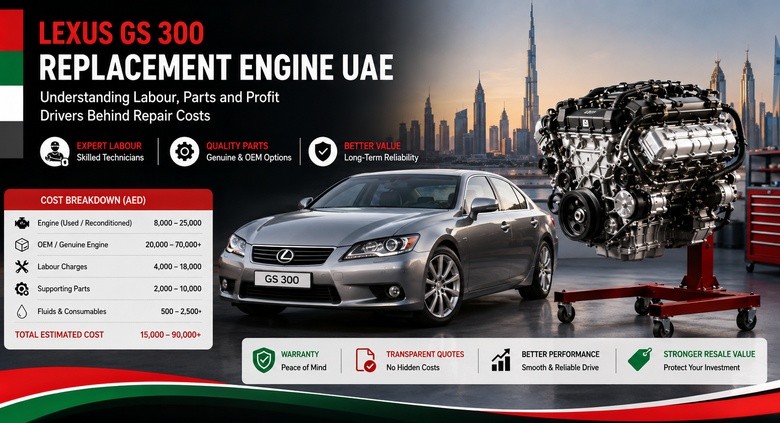
June 12, 2026
A Lexus GS 300 engine replacement rarely becomes expensive because of the engine alone.
That is often the first misconception.
Owners typically focus on the headline figure attached to the replacement engine itself. Yet once the vehicle enters a workshop environment, an entirely different economic system begins operating behind the scenes.
Labour.
Diagnostics.
Parts sourcing.
Workshop overheads.
Technician expertise.
Warranty exposure.
Business risk.
All of these influence the final invoice.
This is particularly relevant in the UAE, where Lexus GS 300 owners often keep their vehicles for many years because of the model's strong reputation for refinement, comfort and long-term durability.
Many examples now exceed mileage levels where major mechanical decisions become increasingly common.
The result is a question that appears regularly across Dubai, Abu Dhabi, Sharjah and the wider Emirates:
Should the existing engine continue receiving repairs, or has the ownership equation reached the point where replacement becomes the better financial decision?
To answer that properly, owners need to understand the economics operating inside modern UAE workshops.
Not simply engine prices.
The entire economic chain behind the project.
UAE Workshop Pricing Reality: Why Lexus GS 300 Engine Replacement Costs Differ Between Workshops
One of the first surprises owners encounter is the enormous variation between quotations.
Two workshops can inspect the same vehicle.
Both can recommend engine replacement.
Yet their quotations may differ by tens of thousands of dirhams.
The obvious assumption is that one workshop is overcharging.
The reality is usually more complex.
Major Pricing Variables
- Workshop location
- Technician experience
- Equipment investment
- Diagnostic capability
- Parts sourcing strategy
- Warranty exposure
- Business overheads
A workshop operating in a premium commercial district in Dubai faces different operating costs from an independent specialist operating in Sharjah or Ajman.
Those costs eventually influence customer pricing.
Typical UAE Replacement Engine Project Comparison
| Workshop Type | Typical Project Cost (AED) |
| Budget Independent Workshop | 12,000 – 28,000 |
| Lexus Specialist Workshop | 18,000 – 45,000 |
| Premium Japanese Vehicle Specialist | 25,000 – 60,000 |
| High-End Full-Service Facility | 35,000 – 80,000+ |
The lowest quotation is not always the lowest-cost ownership decision.
And the highest quotation is not automatically excessive.
The key question is what each quotation includes.
Diagnostic Cost Economics: Why Proper Engine Inspection Saves Money in the Long Run
Many owners view diagnostics as an additional expense.
Workshops view diagnostics differently.
They view them as risk reduction.
A replacement engine project built on incomplete information creates financial risk for both customer and workshop.
Common Diagnostic Procedures
- Compression testing
- Leak-down testing
- Cooling-system assessment
- Oil-pressure evaluation
- Electronic diagnostics
- Internal engine inspection
These investigations cost money.
But they frequently prevent much larger costs later.
Diagnostic Investment Comparison
| Diagnostic Level | Typical Cost (AED) |
| Basic Scan | 150 – 500 |
| Advanced Diagnostics | 500 – 1,500 |
| Comprehensive Mechanical Assessment | 1,500 – 4,000 |
| Full Engine Investigation | 2,000 – 6,000+ |
Many expensive ownership mistakes begin with incomplete diagnostics.
A relatively small diagnostic investment often prevents major financial surprises.
Labour Cost Breakdown: What Drives Lexus GS 300 Engine Installation Charges in the UAE?
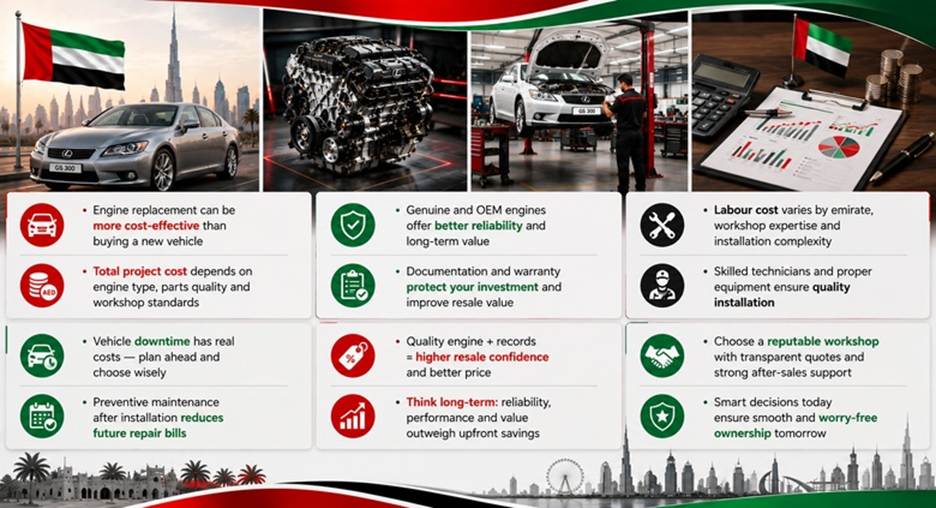
When owners discuss engine replacement, labour becomes one of the most misunderstood costs.
Many assume labour is simply the cost of time.
In reality, labour pricing reflects expertise.
A Lexus GS 300 engine replacement requires far more than removing one engine and installing another.
Technicians must:
- Diagnose related systems
- Remove supporting assemblies
- Inspect components
- Install replacement systems
- Perform calibration procedures
- Conduct post-installation testing
Factors Affecting Labour Costs
- Technician experience
- Project complexity
- Engine type
- Workshop standards
- Testing requirements
- Installation documentation
Labour Cost Comparison by Emirate
| Emirate | Typical Labour Cost (AED) |
| Dubai | 5,000 – 18,000 |
| Abu Dhabi | 5,000 – 17,000 |
| Sharjah | 4,000 – 14,000 |
| Ajman | 4,000 – 12,000 |
| Ras Al Khaimah | 4,000 – 11,000 |
| Fujairah | 4,000 – 11,000 |
| Umm Al Quwain | 3,500 – 10,000 |
Labour Cost Escalation Factors
Additional costs often appear when:
- Cooling-system issues are discovered
- Electrical faults emerge
- Engine mounts require replacement
- Sensors require replacement
- Supporting components show wear
Labour costs often increase because project scope increases.
Not because workshops arbitrarily raise prices.
Workshop Operating Costs: How Facility Standards Affect Engine Replacement Pricing
The workshop itself operates within its own economic reality.
Customers typically see only the repair invoice.
They rarely see the operating structure behind it.
Workshop Cost Categories
- Facility rent
- Staff salaries
- Diagnostic equipment
- Insurance
- Utilities
- Technical training
- Inventory management
Premium workshops generally invest heavily in:
- Advanced diagnostic systems
- Technical training
- Quality-control procedures
- Warranty support
Those investments influence pricing.
Workshop Economics Comparison
| Workshop Category | Overhead Level | Customer Cost Impact |
| Small Independent | Lower | Lower |
| Specialist Facility | Moderate | Moderate |
| Premium Specialist | Higher | Higher |
| Large Multi-Service Facility | Highest | Highest |
Higher pricing sometimes reflects higher capability.
Not necessarily higher profit.
Engine Selection Economics: Choosing the Right Replacement Engine for Maximum Value
Perhaps no decision affects project economics more than engine selection.
The replacement engine determines:
- Upfront investment
- Future reliability
- Warranty exposure
- Resale value
- Long-term ownership costs
Used Engine Economics
Advantages:
- Lowest initial investment
- Faster sourcing
Risks:
- Unknown history
- Reduced predictability
Reconditioned Engine Economics
Advantages:
- Balanced cost structure
- Refreshed wear components
Risks:
- Quality depends on rebuild standards
OEM Engine Economics
Advantages:
- Strong compatibility
- Predictable performance
Risks:
- Higher purchase cost
Genuine Lexus Engine Economics
Advantages:
- Maximum confidence
- Strong resale support
Risks:
- Largest upfront investment
Lexus GS 300 Engine Cost Comparison
| Engine Type | Engine Cost (AED) |
| Used Engine | 8,000 – 18,000 |
| Reconditioned Engine | 12,000 – 25,000 |
| OEM Engine | 20,000 – 40,000 |
| Genuine Lexus Engine | 35,000 – 70,000+ |
Total Project Economics
| Engine Type | Estimated Project Cost (AED) |
| Used Engine Project | 15,000 – 35,000 |
| Reconditioned Engine Project | 20,000 – 45,000 |
| OEM Engine Project | 30,000 – 65,000 |
| Genuine Lexus Engine Project | 45,000 – 90,000+ |
The cheapest option frequently delivers the lowest entry cost.
It does not always deliver the lowest ownership cost.
UAE Engine Supply Chain Economics: How Availability Influences Replacement Costs
Engine pricing is heavily influenced by supply-chain economics.
The same engine can vary substantially in price depending on market conditions.
Factors Influencing Supply
- UAE inventory levels
- Import availability
- Demand fluctuations
- Engine condition
- Mileage history
- Documentation quality
When supply becomes restricted, prices typically increase.
When inventory expands, pricing pressure eases.
Supply Chain Risk Comparison
| Supply Source | Cost Stability |
| Local Inventory | Higher |
| Regional Imports | Moderate |
| International Imports | Lower |
| Rare Specification Engines | Most Volatile |
Owners often focus on engine condition.
Workshops frequently focus on sourcing risk.
Both perspectives influence final pricing.
The First Major Workshop Economics Conclusion
At this stage, a clear pattern emerges.
The final cost of a Lexus GS 300 replacement engine project is shaped by far more than the replacement engine itself.
It is influenced by:
- Workshop economics
- Diagnostic strategy
- Labour complexity
- Facility standards
- Engine selection
- Supply-chain conditions
Mileage and Value Assessment: How Engine History Impacts Future Ownership Costs
Every workshop quotation begins with a mechanical assessment.
Every ownership decision should begin with an economic assessment.
Mileage sits at the intersection of both.
The mileage attached to a replacement engine often influences:
- Purchase price
- Workshop confidence
- Warranty coverage
- Long-term reliability expectations
- Future resale value
Yet mileage alone never tells the complete story.
A poorly maintained Lexus GS 300 engine with 120,000 km may present greater future financial exposure than a properly maintained engine with 220,000 km.
The economic value lies in the history behind the mileage.
Mileage Evaluation Guide
| Mileage Range | Ownership Risk | Economic Outlook |
| Under 80,000 km | Lower | Strong |
| 80,000 – 150,000 km | Moderate | Balanced |
| 150,000 – 220,000 km | Elevated | Requires Investigation |
| Above 220,000 km | Higher | Requires Detailed Assessment |
Questions That Influence Value
✓ Service history available?
✓ Oil change records available?
✓ Cooling-system maintenance documented?
✓ Compression testing completed?
✓ Previous major repairs documented?
Mileage affects pricing.
History affects value.
The two are not always the same thing.
UAE Climate Impact Economics: How Extreme Heat Increases Engine Ownership Expenses
Few ownership variables influence costs as consistently as climate.
The UAE operating environment creates conditions that are considerably harsher than many international markets.
The workshop economics reflect that reality.
Systems Most Commonly Affected by UAE Heat
- Cooling systems
- Radiators
- Water pumps
- Thermostats
- Engine seals
- Sensors
- Engine oil
Summer temperatures do not create problems by themselves.
They amplify weaknesses that already exist.
Climate Exposure Comparison
| Operating Environment | Mechanical Stress |
| Mild Climate | Moderate |
| UAE Winter Driving | Moderate |
| UAE Summer Highway Driving | High |
| UAE Urban Traffic During Summer | Very High |
| Heavy Summer Usage | Critical |
This explains why many engine replacement discussions begin after a summer season rather than before it.
UAE Summer Failure Pattern Analysis
Common workshop observations include:
- Increased overheating incidents
- Cooling-system failures
- Seal deterioration
- Higher oil-consumption complaints
- Sensor-related faults
The climate does not merely affect reliability.
It directly influences workshop economics.
Supporting Component Costs: Parts Commonly Replaced During Engine Installation
Many owners budget for the engine.
Experienced workshops budget for the project.
The distinction matters.
During installation, technicians often identify supporting components that influence future reliability.
Ignoring them may reduce today's invoice.
It frequently increases tomorrow's invoice.
Supporting Parts Replacement Checklist
✓ Radiator
✓ Water pump
✓ Thermostat
✓ Engine mounts
✓ Cooling hoses
✓ Belts
✓ Tensioners
✓ Sensors
✓ Filters
✓ Fluids
Typical Supporting Part Costs
| Component | Typical Cost (AED) |
| Radiator | 1,500 – 6,000 |
| Water Pump | 800 – 4,500 |
| Thermostat | 400 – 2,500 |
| Engine Mounts | 1,500 – 6,000 |
| Sensors | 500 – 5,000 |
| Belts & Tensioners | 500 – 3,500 |
| Fluids & Filters | 500 – 2,500 |
Economic Reality
Many workshops recommend replacing certain supporting parts not because they generate additional revenue.
They do so because labour access already exists during installation.
Replacing them later often costs more.
Hidden Labour Costs: Why Engine Replacement Projects Often Exceed Initial Estimates
One of the most misunderstood workshop economics concepts is labour expansion.
A quotation reflects the information available at the beginning of a project.
As disassembly progresses, additional findings may emerge.
Common Labour Expansion Factors
- Wiring repairs
- Cooling-system faults
- Damaged mounts
- Sensor failures
- Oil leaks
- Transmission-related issues
Example Labour Escalation Scenario
Initial Labour Estimate:
AED 6,000
Additional Sensor Work:
AED 1,200
Cooling-System Repairs:
AED 2,500
Wiring Corrections:
AED 1,000
Updated Labour Total:
AED 10,700
This is not necessarily a pricing issue.
It is often a project-scope issue.
Labour Expansion Risk Matrix
| Project Condition | Labour Escalation Risk |
| Excellent Condition | Low |
| Average Condition | Moderate |
| Unknown Service History | High |
| Long-Term Neglected Vehicle | Very High |
Understanding this reality helps owners evaluate quotations more realistically.
Documentation and Resale Economics: Why Service Records Matter
Documentation rarely attracts attention during a repair.
It attracts significant attention during resale.
Future buyers often trust documentation more than verbal assurances.
A replacement-engine project supported by strong records usually generates greater confidence.
Documentation Verification Checklist
✓ Engine purchase invoice
✓ Installation invoice
✓ Engine serial information
✓ Diagnostic reports
✓ Compression-test results
✓ Warranty paperwork
✓ Service history
Documentation Value Comparison
| Documentation Status | Buyer Confidence |
| Complete Documentation | Excellent |
| Strong Documentation | Very Good |
| Partial Records | Moderate |
| Missing Records | Weak |
Documentation protects more than resale value.
It protects ownership credibility.
Insurance and Ownership Documentation Considerations
Owners frequently focus on mechanical aspects while overlooking administrative responsibilities.
Important records should include:
- Engine purchase details
- Installation records
- Warranty documentation
- Maintenance records
These documents may become important during:
- Ownership verification
- Future resale negotiations
- Warranty claims
- Vehicle-history assessments
Good record keeping often becomes a financial asset.
Warranty Value Analysis: How Coverage Reduces Long-Term Financial Risk
A warranty is essentially an economic risk-sharing agreement.
The workshop accepts certain future risks.
The customer gains financial protection.
Strong warranty structures generally indicate greater workshop confidence.
Characteristics of Strong Warranty Coverage
✓ Written documentation
✓ Clear claim procedures
✓ Defined coverage periods
✓ Transparent exclusions
✓ Traceable installation records
Warranty Red Flags
✗ Verbal promises
✗ Extremely short coverage
✗ Missing documentation
✗ Unclear exclusions
✗ Undefined claim procedures
Warranty Protection Comparison
| Warranty Type | Protection Level |
| Comprehensive Written Warranty | Strong |
| Limited Written Warranty | Moderate |
| Basic Coverage | Weak |
| Verbal Warranty | Very Weak |
The lowest-priced project sometimes becomes expensive because warranty protection is inadequate.
Poor Installation Warning Signs Every Lexus GS 300 Owner Should Monitor
A replacement engine project should reduce future expenses.
Poor installation can create new ones.
Owners should monitor:
Warning Signs
- Fluid leaks
- Temperature fluctuations
- Warning lights
- Rough idle
- Unusual vibration
- Abnormal fuel consumption
Risk Assessment Table
| Observation | Risk Level |
| Stable Operation | Low |
| Minor Irregularity | Moderate |
| Repeated Warning Lights | High |
| Persistent Fluid Leaks | High |
| Overheating | Critical |
The first weeks after installation often determine whether the project has achieved its intended economic outcome.
The Second Major Workshop Economics Conclusion
At this stage, a broader economic picture emerges.
The final ownership cost is influenced not only by the replacement engine but also by:
- Mileage history
- Climate exposure
- Supporting-part requirements
- Labour expansion
- Documentation quality
- Warranty protection
- Installation standards
For owners researching buy online Lexus GS 300 replacement engine, the strongest financial outcomes usually come from evaluating the complete project rather than comparing engine prices alone.
Post-Installation Cost Protection: The First 1,000 Kilometres After Engine Replacement
The workshop economics story does not end when the invoice is paid.
In many respects, the investment-protection phase begins immediately after installation.
The first 1,000 kilometres often determine whether the replacement-engine project delivers the expected financial return.
This period should be treated as a structured evaluation phase rather than routine driving.
First 1,000 km Protection Checklist
✓ Monitor coolant levels
✓ Check oil levels regularly
✓ Watch for warning lights
✓ Monitor operating temperatures
✓ Listen for unusual noises
✓ Observe fuel consumption
✓ Check for fluid leaks
Early Detection Economics
| Issue Identified Early | Potential Cost Avoided |
| Minor Coolant Leak | High |
| Sensor Fault | Moderate |
| Oil Leak | High |
| Calibration Issue | Moderate |
| Cooling-System Fault | Very High |
The sooner an issue is identified, the lower the economic impact tends to be.
Resale Value Economics: How a Replacement Engine Affects Market Perception
One of the most common concerns among Lexus GS 300 owners involves resale value.
Will a replacement engine reduce market appeal?
The answer depends less on the engine itself and more on the economic evidence supporting it.
Buyers generally evaluate:
- Installation quality
- Documentation quality
- Workshop reputation
- Warranty support
- Maintenance history
Resale Value Comparison
| Ownership Scenario | Resale Confidence |
| Genuine Engine + Complete Documentation | Excellent |
| OEM Engine + Strong Records | Very Good |
| Reconditioned Engine + Documentation | Good |
| Used Engine + Partial Records | Moderate |
| Unknown Engine History | Weak |
A replacement engine supported by credible documentation often performs better in the market than owners expect.
Long-Term Ownership Forecast: Estimating Three-Year and Five-Year Costs
Many owners focus entirely on replacement costs.
Workshops often think further ahead.
The long-term ownership economics determine whether the investment ultimately proves successful.
Three-Year Ownership Forecast
| Category | Estimated Cost (AED) |
| Scheduled Maintenance | 3,000 – 10,000 |
| Fluids & Filters | 1,500 – 5,000 |
| Diagnostics | 1,000 – 4,000 |
| Preventive Repairs | 2,000 – 10,000 |
| Contingency Costs | 2,000 – 12,000 |
Five-Year Ownership Exposure
| Engine Type | Long-Term Risk |
| Used Engine | Highest |
| Reconditioned Engine | Moderate |
| OEM Engine | Lower |
| Genuine Lexus Engine | Lowest |
The cheapest engine rarely produces the lowest five-year ownership cost.
Vehicle Downtime Economics: Understanding the Cost of Being Without Your Lexus GS 300
Downtime represents one of the least discussed ownership costs.
Yet many owners experience its consequences immediately.
Family Ownership Impact
Downtime can affect:
- School transport
- Family schedules
- Daily commuting
- Personal convenience
Executive Ownership Impact
Downtime may influence:
- Business meetings
- Professional commitments
- Client-facing activities
- Travel flexibility
Business Ownership Impact
For business users, downtime may result in:
- Lost productivity
- Additional transportation costs
- Scheduling disruptions
- Reduced operational efficiency
Downtime Cost Assessment
| Downtime Duration | Economic Impact |
| 1–3 Days | Low |
| 4–7 Days | Moderate |
| 1–2 Weeks | High |
| More Than 2 Weeks | Significant |
Reliability often becomes more valuable than initial savings.
Real UAE Workshop Economics Scenarios
Dubai Executive Owner
Vehicle:
Lexus GS 300
Situation:
Growing repair frequency and increasing downtime.
Decision:
Invest in OEM replacement engine through specialist workshop.
Outcome:
Higher initial investment but reduced long-term disruption.
Abu Dhabi Family Owner
Vehicle:
Lexus GS 300
Situation:
Cooling-system failures and increasing maintenance costs.
Decision:
Replace engine and supporting cooling-system components simultaneously.
Outcome:
Improved reliability and reduced future repair exposure.
Sharjah Budget-Conscious Owner
Vehicle:
Lexus GS 300
Situation:
Limited budget but long-term ownership plans.
Decision:
Documented reconditioned engine with written warranty.
Outcome:
Balanced cost structure and predictable ownership experience.
These examples demonstrate how workshop economics influence real-world ownership outcomes.
Engine Replacement vs Vehicle Replacement: Which Option Delivers Better Financial Value?
Eventually most owners arrive at a fundamental question.
Should the engine be replaced?
Or should the entire vehicle be replaced?
The answer depends on broader ownership economics.
Factors Supporting Engine Replacement
- Strong vehicle condition
- Well-maintained chassis
- Long-term ownership plans
- Lower overall investment
Factors Supporting Vehicle Replacement
- Multiple major system failures
- Significant future repair exposure
- Structural deterioration
- Changing ownership requirements
Financial Comparison
| Option | Typical Cost (AED) |
| Used Engine Project | 15,000 – 35,000 |
| Reconditioned Engine Project | 20,000 – 45,000 |
| OEM Engine Project | 30,000 – 65,000 |
| Genuine Engine Project | 45,000 – 90,000+ |
| Replacement Vehicle | 70,000 – 250,000+ |
The strongest decision typically emerges from total ownership economics rather than emotional attachment.
Common Buyer Mistakes That Increase Ownership Costs
Workshop professionals frequently observe recurring patterns.
Certain mistakes consistently increase financial exposure.
Common Mistakes
- Choosing solely on price
- Ignoring diagnostics
- Delaying repairs
- Overlooking documentation
- Accepting weak warranty terms
- Ignoring supporting components
Economic Consequences
| Mistake | Long-Term Impact |
| Cheapest Engine Selection | Higher Future Costs |
| Poor Documentation | Reduced Resale Value |
| Weak Warranty | Increased Financial Risk |
| Delayed Repairs | Cost Escalation |
| Ignoring Supporting Parts | Repeat Labour Costs |
Strong ownership outcomes generally begin with informed decisions.
Competitor Ownership Comparison
Many Lexus GS 300 owners compare costs against alternative executive sedans.
Ownership Comparison
| Vehicle | Engine Replacement Exposure | Ownership Complexity |
| Lexus GS 300 | Moderate | Moderate |
| BMW 5 Series | Higher | Higher |
| Mercedes-Benz E-Class | Higher | Higher |
| Toyota Avalon | Lower | Lower |
Long-term reliability frequently influences ownership economics more than initial purchase price.
Buyer Decision Matrix
Priority: Lowest Upfront Cost
Recommended Path:
Documented Used Engine
Priority: Balanced Value
Recommended Path:
Reconditioned Engine
Priority: Long-Term Ownership
Recommended Path:
OEM Engine
Priority: Maximum Confidence
Recommended Path:
Genuine Lexus Engine
Decision Matrix
| Ownership Goal | Recommended Strategy |
| Budget Focus | Used Engine |
| Balanced Ownership | Reconditioned Engine |
| Reliability Focus | OEM Engine |
| Maximum Confidence | Genuine Engine |
UAE Workshop Economics Conclusion: Creating a Cost-Effective Lexus GS 300 Ownership Strategy
The economics of a Lexus GS 300 replacement-engine project extend far beyond the engine itself.
The final outcome is influenced by:
- Diagnostic quality
- Labour efficiency
- Engine selection
- Workshop standards
- Supporting-part decisions
- Documentation quality
- Warranty protection
- Long-term ownership planning
For owners researching solutions through PartFinder UAE, the strongest results typically come from evaluating total ownership economics rather than focusing exclusively on the lowest quotation.
Final Ownership Economics Framework
| Decision Area | Primary Objective |
| Diagnostics | Accurate Decision-Making |
| Labour Strategy | Installation Quality |
| Engine Selection | Reliability Balance |
| Documentation | Future Protection |
| Warranty Review | Risk Reduction |
| Supporting Parts | Long-Term Stability |
| Ownership Forecasting | Financial Clarity |
| Resale Planning | Value Preservation |
The most successful Lexus GS 300 owners rarely ask:
"Which replacement engine is cheapest?"
Instead, they ask:
"Which investment delivers the strongest combination of reliability, cost control and long-term ownership value?"
In the UAE's demanding automotive environment, that question often determines whether a replacement-engine project becomes a financial burden or a smart long-term investment.
Frequently Asked Questions
Categories
- Audi
- BMW
- Car Accessories
- Car Tips
- Ford
- Land Rover
- Mazda
- Range Rover
- Top 10
- UAE Car Parts
- Used Car Parts
- Toyota
- Replacement Engines
- Nissan
- Hyundai
- Mitsubishi
- Volkswagen
- Honda
- Kia
- Chevrolet
- Dodge
- Jeep
- Subaru
- Renault
- Lexus
- Mercedes
- Suzuki
- Hummer
- Porsche
- Infiniti
- Peugeot
- GMC
- Mini
- Volvo
- Replacement Gearboxes
- MG
- Jaguar
- Skoda
- Cadillac
- Daihatsu
- Fiat
- German Car Parts
- Japanese Car Parts
- Aftermarket Car Parts
- Genuine Car Parts
- New Car Parts
- Reconditioned Car Parts
- European Car Parts
- American Car Parts
- Korean Car Parts
- British Car Parts
- Chinese Car Parts
- Sports/Exotic Car Parts
- Luxury Car Parts
- Performance Car Parts
- SUV/4x4 Spare Parts
- Truck Spare Parts
- EV Car Parts
- Hybrid Car Parts
- Auto Spare Parts in UAE
- Tesla
- Isuzu
- Ram
- Ferrari
- Bentley
- Lamborghini
- Genesis
- Maserati
- Lincoln
- Chrysler
- Opel
- Citroen
- SsangYong
- Seat
- McLaren
- Aston Martin
- Rolls Royce
- Maybach
- Alfa Romeo
- Bugatti
- Scion
- Abu Dhabi Car Parts
- Ajman Car Parts
- Al Khan Car Parts
- Al Sajaa Car Parts
- Deira Car Parts
- Dubai Car Parts
- Fujairah Car Parts
- Industrial Area 6 Car Parts
- Mussafah Car Parts
- Ras Al Khaimah Car Parts
- Sharjah Car Parts
- Umm Al Quwain Car Parts
- Acura
- BYD
- Chery
- Dacia
- DS
- Geely Emgrand
- EXEED
- GAC
- GAC Gonow
- Geely
- Gonow
- Great Wall
- Haima
- Haval
- Holden
- Iveco
- JAC
- Jaecoo
- Jetour
- Lotus
- Omoda
- Proton
- Renault Samsung
- Roewe
- Lucid
- Replacement Headlight