Lexus IS300 Engine Replacement Cost Analysis UAE: The Financial Impact of Delayed Action
June 11, 2026
The most expensive automotive decisions are not always the ones that involve the largest invoices.
Often, they involve the longest delays.
That distinction matters.
Particularly when discussing a Lexus IS300.
Owners frequently view engine replacement as a major expense. They see the quotation. They see the labour costs. They see the commitment required.
What they often do not see is the alternative cost.
The cost of waiting.
The cost of postponing.
The cost of hoping.
Those costs rarely arrive immediately.
They arrive gradually.
A repair today becomes a larger repair six months later.
A minor oil-consumption issue becomes internal engine wear.
A cooling-system concern becomes a reliability problem.
A reliability problem becomes a replacement-engine project.
And eventually a replacement-engine project becomes a vehicle-replacement discussion.
This is where fleet decision-makers think differently.
A fleet manager does not ask:
"How much does this repair cost?"
A fleet manager asks:
"What happens financially if we do nothing?"
The second question is often more valuable than the first.
Across Dubai, Abu Dhabi, Sharjah, Ajman, Ras Al Khaimah, Fujairah and Umm Al Quwain, Lexus owners face increasingly similar ownership decisions.
Many vehicles have accumulated substantial mileage.
Many remain mechanically capable.
Many continue delivering reliable service.
Yet reliability and longevity are not identical concepts.
Eventually every asset reaches a point where strategic investment becomes necessary.
The challenge is recognising that point before financial exposure begins accelerating.
Why Delayed Engine Decisions Rarely Reduce Costs and Often Increase Financial Exposure Over Time
Human nature encourages delay.
Businesses do it.
Private owners do it.
Fleet operators do it.
The reasoning usually sounds sensible.
The vehicle still starts.
The vehicle still drives.
The problem is not yet catastrophic.
Therefore the decision can wait.
Sometimes that is true.
Often it is not.
Mechanical systems rarely become cheaper as they deteriorate.
The Delay Cycle
Stage One:
- Small fault
- Low repair cost
- Minimal disruption
Stage Two:
- Expanding fault
- Additional component stress
- Increased repair exposure
Stage Three:
- Reliability decline
- Secondary system damage
- Significant financial impact
Stage Four:
- Major repair
- Engine replacement discussion
- Asset-value reduction
Financial Escalation Example
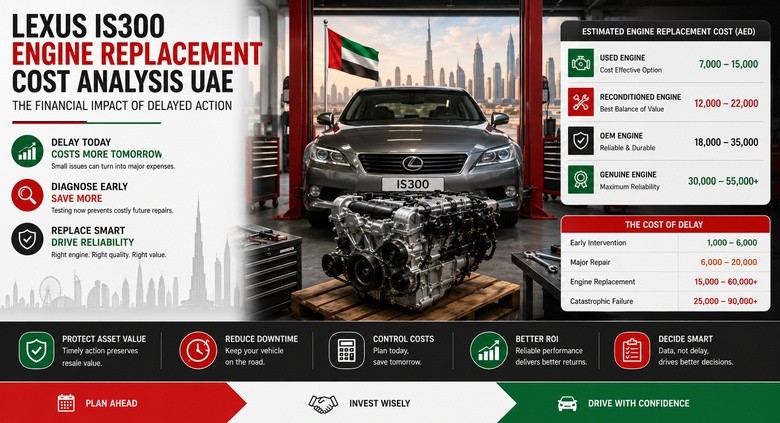
| Decision Stage | Estimated Cost (AED) |
| Early Intervention | 1,000 – 5,000 |
| Moderate Mechanical Repair | 5,000 – 12,000 |
| Major Engine Repair | 12,000 – 25,000 |
| Engine Replacement Project | 15,000 – 60,000+ |
The most expensive stage is rarely the first one.
That is precisely the problem.
Understanding How Lexus IS300 Engine Problems Progress from Minor Mechanical Concerns into Major Capital Expenditure Events
Reliability deterioration is rarely dramatic.
It is cumulative.
A vehicle does not wake up one morning and decide to fail.
It accumulates stress.
Heat.
Wear.
Fatigue.
Contamination.
Time.
The Lexus IS300 has earned a reputation for durability.
That reputation is deserved.
But durability does not eliminate wear.
It merely slows it.
Common Progression Pathways
Initial Symptom:
- Minor oil consumption
Potential Escalation:
- Increased internal wear
- Reduced lubrication efficiency
- Bearing deterioration
Initial Symptom:
- Small coolant leak
Potential Escalation:
- Repeated overheating
- Head-gasket damage
- Cylinder-head issues
Initial Symptom:
- Occasional overheating
Potential Escalation:
- Cooling-system overload
- Internal engine damage
- Replacement-engine requirement
The important observation is that none of these outcomes appear suddenly.
They evolve.
Which means intervention opportunities usually exist.
The Hidden Cost of Waiting: How UAE Heat, Traffic Conditions and Daily Operational Demands Accelerate Engine Deterioration
The UAE creates operating conditions that deserve respect.
Summer temperatures are not merely uncomfortable.
They are mechanically significant.
A Lexus operating in Dubai traffic during August experiences stresses very different from those found in many global markets.
Environmental Stress Factors
- Extreme temperatures
- Long idle periods
- Heavy air-conditioning demand
- Stop-start traffic
- Urban congestion
- High thermal loads
- Dust exposure
These factors affect more than engines.
They influence entire systems.
Components Most Commonly Affected
| Component | UAE Stress Impact |
| Cooling System | Very High |
| Radiator | High |
| Water Pump | High |
| Engine Seals | High |
| Lubrication System | High |
| Sensors | Moderate |
| Fuel System | Moderate |
What makes delay particularly expensive in the UAE is that environmental conditions frequently accelerate deterioration.
Small problems rarely remain small forever.
Early Financial Warning Signs That Fleet Decision-Makers Should Never Ignore
One characteristic separates effective fleet managers from reactive owners.
Attention to trends.
Individual faults matter.
Patterns matter more.
Reliability Warning Indicators
- Increasing oil consumption
- Repeated coolant top-ups
- Temperature fluctuations
- Reduced fuel economy
- Engine warning lights
- Rough idling
- Delayed starting
- Power loss
- Unusual engine noise
Each symptom represents information.
The challenge is interpreting it correctly.
Financial Warning Matrix
| Observation | Financial Risk Level |
| Isolated Symptom | Low |
| Repeated Symptom | Moderate |
| Multiple Symptoms | High |
| Escalating Symptoms | Very High |
| Reliability Decline Across Systems | Critical |
The earlier the trend is identified, the greater the number of available options.
That flexibility has financial value.
Lexus IS300 Replacement Engine Costs in UAE: Used, Reconditioned, OEM and Genuine Engine Investment Comparisons
Eventually every decision reaches the numbers.
But numbers require context.
The cheapest engine is not automatically the cheapest ownership solution.
Nor is the most expensive engine automatically the smartest investment.
Used Lexus IS300 Engine
Estimated Cost:
AED 7,000 – 15,000
Advantages:
- Lower acquisition cost
- Faster sourcing opportunities
- Suitable for shorter ownership horizons
Potential Risks:
- Unknown history
- Variable wear
- Limited predictability
Reconditioned Lexus IS300 Engine
Estimated Cost:
AED 12,000 – 22,000
Advantages:
- Improved reliability outlook
- Refreshed internal components
- Better lifecycle expectations
OEM Engine
Estimated Cost:
AED 18,000 – 35,000
Advantages:
- Strong compatibility
- Predictable performance
- Improved long-term planning
Genuine Engine
Estimated Cost:
AED 30,000 – 55,000+
Advantages:
- Highest confidence level
- Strong resale support
- Maximum reliability potential
Engine Investment Comparison
| Engine Type | Estimated Cost (AED) | Investment Outlook |
| Used | 7,000 – 15,000 | Budget-Focused |
| Reconditioned | 12,000 – 22,000 | Balanced |
| OEM | 18,000 – 35,000 | Strong Long-Term Value |
| Genuine | 30,000 – 55,000+ | Premium Reliability |
A fleet decision-maker rarely evaluates purchase price alone.
Lifecycle value matters more.
Why the Lowest Engine Purchase Price Often Creates the Highest Long-Term Ownership Cost
This is where many ownership decisions go wrong.
People compare invoices.
Fleet managers compare outcomes.
Those are very different exercises.
Purchase-Price Thinking
Questions:
- What costs less today?
- What reduces immediate spending?
Lifecycle Thinking
Questions:
- What reduces future downtime?
- What protects asset value?
- What improves reliability?
- What lowers total ownership cost?
Ownership Cost Comparison
| Factor | Cheap Option | Reliability-Focused Option |
| Initial Cost | Lower | Higher |
| Downtime Risk | Higher | Lower |
| Predictability | Lower | Higher |
| Future Repairs | Higher | Lower |
| Asset Preservation | Lower | Higher |
A lower invoice today can easily create larger invoices later.
Example Lifecycle Cost Scenario
Budget Engine Strategy
- Engine Cost: AED 8,000
- Future Repairs: AED 8,000
- Downtime Exposure: Significant
Potential Total Cost:
AED 16,000+
Quality Engine Strategy
- Engine Cost: AED 18,000
- Reduced Future Repairs
- Improved Reliability
Potential Total Cost:
AED 18,000–22,000
The difference between those strategies often becomes surprisingly small.
The reliability difference can be substantial.
This is why fleet decision-makers rarely focus solely on engine prices.
They focus on asset performance.
Asset continuity.
Asset value.
And the financial consequences of delaying decisions that eventually become unavoidable.
Mileage Verification Versus Asset Productivity: Which Metric Matters More?
Owners often become obsessed with mileage.
Fleet operators usually become obsessed with productivity.
That distinction matters.
A Lexus IS300 with higher mileage but strong reliability may continue delivering excellent value.
A lower-mileage vehicle suffering reliability decline may become a financial burden.
Productivity Indicators
- Reliability history
- Maintenance consistency
- Fuel efficiency
- Downtime frequency
- Service records
- Operating stability
Mileage provides information.
Productivity provides context.
And in fleet-style decision-making, context usually wins.
Because an asset is ultimately judged not by the kilometres already travelled.
But by the reliable kilometres still remaining.
Compression Testing, Leak-Down Testing and Diagnostic Evidence Before Approving Major Capital Decisions
Fleet decision-makers dislike uncertainty.
Not because uncertainty is unusual.
Because uncertainty is expensive.
The problem with engine deterioration is that symptoms can be misleading.
A Lexus IS300 may continue operating reasonably well while internal wear quietly accumulates.
Another may feel worse than it actually is.
That is why evidence matters.
Before approving a replacement-engine project, experienced operators seek data.
Not assumptions.
Compression testing and leak-down testing provide that data.
Compression Testing Reveals
- Cylinder sealing efficiency
- Internal wear levels
- Combustion consistency
- Ring-condition indicators
- Valve-performance concerns
Leak-Down Testing Reveals
- Air leakage pathways
- Valve-sealing issues
- Ring deterioration
- Head-gasket concerns
- Internal engine health
Diagnostic Decision Matrix
| Test Outcome | Financial Interpretation |
| Strong Across All Cylinders | Continue Evaluation |
| Minor Variations | Monitor Carefully |
| Moderate Variations | Financial Review Required |
| Significant Variations | Replacement Candidate |
| Multiple Weak Cylinders | High-Risk Asset |
The purpose of diagnostics is simple.
Reduce uncertainty before committing capital.
The Cost-of-Delay Matrix: Comparing Early Intervention, Major Repair and Complete Engine Failure Scenarios
Many owners believe delaying a decision saves money.
Occasionally it does.
More often it shifts costs into larger categories.
Fleet management teaches a valuable lesson:
Deferred spending is not always avoided spending.
Sometimes it is merely postponed spending.
With interest attached.
Early Intervention Scenario
Typical Actions:
- Cooling-system repairs
- Oil-leak repairs
- Sensor replacement
- Preventative maintenance
Estimated Cost:
AED 1,000 – 6,000
Major Repair Scenario
Typical Actions:
- Cylinder-head repairs
- Internal engine work
- Cooling-system restoration
Estimated Cost:
AED 6,000 – 20,000
Replacement Engine Scenario
Typical Actions:
- Used engine installation
- Reconditioned engine installation
- OEM replacement
- Genuine replacement
Estimated Cost:
AED 15,000 – 60,000+
Catastrophic Failure Scenario
Typical Consequences:
- Secondary damage
- Additional labour
- Extended downtime
- Reduced asset value
Estimated Cost:
AED 25,000 – 80,000+
Cost Escalation Table
| Decision Timing | Financial Exposure |
| Immediate Action | Lowest |
| Moderate Delay | Moderate |
| Significant Delay | High |
| Failure After Escalation | Highest |
The financial penalty often comes from waiting until options disappear.
Hidden Costs That Frequently Appear After Engine Deterioration Has Already Begun
One of the most common budgeting mistakes involves focusing exclusively on the engine.
The engine is rarely the only expense.
Deterioration affects neighbouring systems.
And neighbouring systems generate invoices.
Hidden Costs Commonly Encountered
- Cooling-system failures
- Sensor replacement
- Radiator replacement
- Water-pump replacement
- Engine-mount replacement
- Turbo-related repairs
- Electrical diagnostics
- Labour expansion
Hidden Cost Estimates
| Item | Typical Cost (AED) |
| Water Pump | 500 – 2,500 |
| Radiator | 800 – 4,000 |
| Engine Mounts | 800 – 3,500 |
| Sensors | 300 – 5,000 |
| Wiring Repairs | 500 – 6,000 |
| Additional Diagnostics | 300 – 2,000 |
Many replacement-engine projects become more expensive because secondary deterioration remains undiscovered until dismantling begins.
That is not unusual.
It is normal.
Why Supporting Components Often Determine Whether an Engine Replacement Delivers Long-Term Value
The temptation is understandable.
Replace the engine.
Save money elsewhere.
Move on.
Unfortunately, mechanical systems rarely cooperate with that logic.
A replacement engine installed into an ageing support environment may inherit reliability problems almost immediately.
Supporting Components Worth Evaluating
- Radiator
- Thermostat
- Cooling hoses
- Water pump
- Oil cooler
- Engine mounts
- Fuel-system components
- Sensors
Investment Comparison
| Strategy | Initial Cost | Long-Term Outlook |
| Engine Only | Lower | Moderate |
| Engine Plus Critical Components | Higher | Strong |
| Full Supporting-System Refresh | Highest | Strongest |
Fleet managers rarely purchase reliability one component at a time.
They purchase reliability through systems.
Downtime Economics: Calculating the Real Financial Impact of a Lexus IS300 Sitting Idle
Many ownership decisions underestimate downtime.
That is understandable.
Downtime rarely appears on workshop quotations.
Yet it often becomes one of the largest expenses.
Direct Downtime Costs
- Alternative transportation
- Rental vehicles
- Driver disruption
- Business interruption
Indirect Downtime Costs
- Scheduling issues
- Productivity loss
- Opportunity cost
- Customer inconvenience
Example Daily Financial Exposure
| Usage Profile | Daily Cost Impact (AED) |
| Private Owner | 100 – 500 |
| Executive Vehicle | 300 – 1,000 |
| Corporate Fleet Asset | 500 – 2,000 |
| Business-Critical Asset | 1,000 – 5,000+ |
A replacement engine costing AED 20,000 may initially appear expensive.
Ten days of downtime can change that perspective remarkably quickly.
Asset Preservation Versus Asset Replacement: When Does a Lexus IS300 Still Deserve Investment?
Every asset eventually reaches a crossroads.
Invest further.
Or move on.
The challenge is identifying the correct moment.
Fleet decision-makers evaluate more than engine condition.
They evaluate total asset condition.
Positive Investment Indicators
- Healthy chassis
- Strong transmission
- Consistent service history
- Stable electrical systems
- Strong market demand
- Long-term usability
Negative Investment Indicators
- Multiple major failures
- Structural concerns
- Escalating maintenance costs
- Declining reliability
- Limited future value
Asset Evaluation Matrix
| Asset Factor | Continue Investing | Consider Replacement |
| Chassis | Strong | Weak |
| Transmission | Healthy | Deteriorating |
| Reliability | Stable | Declining |
| Ownership Horizon | Long-Term | Short-Term |
| Asset Value | Preserved | Eroding |
An engine replacement should improve the future.
Not merely postpone the inevitable.
Why Asset Value Erosion Often Accelerates Faster Than Owners Expect
There is a common misconception.
Owners assume delaying a repair preserves cash.
Sometimes it does.
But it can simultaneously destroy asset value.
Potential buyers rarely pay premiums for unresolved mechanical concerns.
The market tends to discount uncertainty aggressively.
Asset Value Risks
- Poor diagnostics history
- Unresolved engine issues
- Reliability concerns
- Missing maintenance records
- Visible deterioration
Example Asset-Value Impact
| Vehicle Condition | Market Confidence |
| Fully Maintained | High |
| Minor Concerns | Moderate |
| Known Engine Issues | Low |
| Major Reliability Concerns | Very Low |
The vehicle loses value while the problem grows.
That creates a double financial penalty.
Operational Continuity Versus Workshop Savings: Which Creates Better Financial Outcomes?
An interesting pattern appears repeatedly across fleet operations.
The businesses that focus solely on workshop invoices often spend more over time.
The businesses that focus on continuity frequently spend less.
Workshop-Cost Thinking
Questions:
- What is the cheapest repair?
- What reduces today's invoice?
Operational-Continuity Thinking
Questions:
- What reduces downtime?
- What improves reliability?
- What protects future asset value?
- What lowers total ownership cost?
For owners researching Lexus Is300 Used engines for sale in UAE online, this distinction becomes particularly important.
The objective is not merely purchasing an engine.
The objective is preserving asset productivity.
Because productivity generates value.
Downtime destroys it.
And delayed decisions frequently create far more downtime than the original repair would have caused.
The financial impact of delayed action is rarely measured by the repair that was postponed.
It is measured by everything that happened while the decision remained unmade.
Replace the Engine or Replace the Vehicle? A Fleet Decision-Maker's Capital Allocation Framework
Every asset reaches a decision point.
Not a mechanical decision.
A financial decision.
That distinction matters.
By the time a Lexus IS300 requires a replacement engine, the discussion is no longer solely about engineering.
It becomes a question of capital allocation.
Should additional capital be invested into the existing asset?
Or should capital be redirected into a replacement asset?
Fleet decision-makers confront this question constantly.
The strongest decisions rarely begin with emotion.
They begin with evidence.
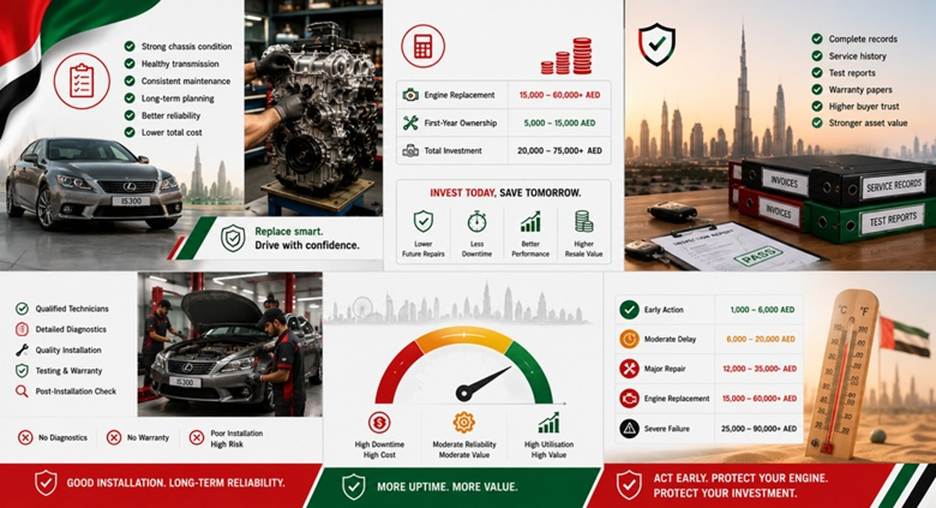
Factors Supporting Engine Replacement
- Strong chassis condition
- Healthy transmission
- Consistent maintenance history
- Strong market demand
- Long-term ownership plans
- Predictable operating costs
Factors Supporting Vehicle Replacement
- Multiple major system failures
- Structural deterioration
- Escalating repair frequency
- Poor maintenance history
- Declining asset value
- Limited future lifespan
Capital Allocation Matrix
| Evaluation Area | Engine Replacement Favoured | Vehicle Replacement Favoured |
| Chassis Condition | Strong | Weak |
| Transmission | Healthy | Deteriorating |
| Reliability Trend | Stable | Declining |
| Asset Value | Preserved | Eroding |
| Ownership Horizon | Long-Term | Short-Term |
| Future Repair Exposure | Moderate | High |
The objective is not avoiding expenditure.
The objective is generating the strongest return from expenditure.
First-Year Ownership Costs After Engine Replacement and the Expenses That Commonly Surprise Owners
Many owners evaluate only the replacement project.
Fleet managers evaluate the first year afterwards.
Because ownership does not stop when the installation is completed.
Typical First-Year Cost Categories
- Scheduled servicing
- Fluids and filters
- Cooling-system maintenance
- Diagnostic inspections
- Supporting-part replacements
- Contingency repairs
First-Year Cost Estimates
| Category | Estimated Cost (AED) |
| Scheduled Servicing | 1,000 – 4,000 |
| Fluids & Filters | 500 – 2,000 |
| Diagnostics | 500 – 2,000 |
| Cooling-System Maintenance | 500 – 4,000 |
| Contingency Budget | 2,000 – 10,000 |
Example Ownership Scenarios
Conservative Scenario
- Engine Project: AED 15,000
- Year-One Running Costs: AED 5,000
Total:
AED 20,000
Balanced Scenario
- Engine Project: AED 25,000
- Year-One Running Costs: AED 8,000
Total:
AED 33,000
Comprehensive Scenario
- Engine Project: AED 40,000
- Year-One Running Costs: AED 15,000
Total:
AED 55,000
The replacement decision should always include post-installation ownership costs.
Not just installation costs.
Resale Value Preservation, Asset Depreciation and the Financial Consequences of Delayed Action
Asset value rarely disappears overnight.
It erodes gradually.
Then suddenly.
Mechanical uncertainty accelerates depreciation.
Buyers dislike uncertainty.
Dealers dislike uncertainty.
The market dislikes uncertainty.
Positive Value-Preservation Factors
- Replacement-engine documentation
- Complete service records
- Diagnostic reports
- Warranty information
- Supporting-part replacement records
Negative Value Factors
- Unknown engine condition
- Missing maintenance history
- Repeated reliability concerns
- Unresolved warning indicators
Value Preservation Matrix
| Asset Condition | Market Confidence |
| Fully Documented | High |
| Well Maintained | Strong |
| Partial Documentation | Moderate |
| Uncertain History | Low |
| Known Mechanical Concerns | Very Low |
The market generally rewards certainty.
It discounts risk.
Documentation, Service Records and Maintenance History as Financial Risk-Reduction Tools
Many owners underestimate paperwork.
Fleet operators rarely do.
Documentation creates transparency.
Transparency creates confidence.
Confidence creates value.
Essential Documentation
- Engine purchase invoice
- Installation invoice
- Compression-test reports
- Diagnostic reports
- Warranty documents
- Maintenance records
- Service history
Financial Benefits of Documentation
- Stronger resale potential
- Improved buyer confidence
- Easier future diagnostics
- Better warranty protection
- Reduced transaction friction
Documentation does not directly improve reliability.
It improves financial flexibility.
That can be equally valuable.
Workshop Selection, Installation Quality and Why Poor Execution Can Destroy Expected Return on Investment
An engine may be excellent.
The outcome may still be poor.
Why?
Installation quality.
Fleet decision-makers understand this instinctively.
Execution determines results.
Indicators of Strong Workshop Practices
- Detailed diagnostics
- Written quotations
- Clear labour scope
- Testing procedures
- Warranty support
- Post-installation inspections
Warning Signs
- No diagnostics
- No written documentation
- No warranty coverage
- Unclear labour costs
- No post-installation testing
Installation Quality Matrix
| Workshop Standard | Long-Term Outcome |
| Excellent | Excellent |
| Good | Strong |
| Average | Moderate |
| Poor | Weak |
| Uncontrolled | High Risk |
A poor installation can erase much of the value created by a quality engine.
Asset Utilisation Versus Asset Ownership: The Metric That Fleet Managers Actually Track
Owners often focus on ownership.
Fleet operators focus on utilisation.
The distinction matters.
An asset that sits idle creates little value.
An asset that operates consistently creates returns.
Utilisation Indicators
- Uptime percentage
- Reliability performance
- Downtime frequency
- Operating consistency
- Cost per kilometre
- Annual maintenance burden
Utilisation Assessment Matrix
| Asset Status | Operational Value |
| High Reliability | High |
| Stable Reliability | Strong |
| Moderate Reliability | Acceptable |
| Declining Reliability | Weak |
| Frequent Downtime | Poor |
The replacement-engine decision should ultimately improve utilisation.
Not simply restore functionality.
The Cost of Delaying Action for Another UAE Summer
Many owners choose one final summer.
Then another.
Then another.
The vehicle survives.
Until eventually it does not.
The UAE climate can be unforgiving.
Summer Risk Factors
- Elevated coolant temperatures
- Increased thermal stress
- Greater air-conditioning loads
- Accelerated seal ageing
- Higher cooling-system demand
Financial Impact of Delay
| Scenario | Estimated Exposure (AED) |
| Early Intervention | 1,000 – 6,000 |
| Moderate Delay | 6,000 – 20,000 |
| Major Engine Repair | 12,000 – 35,000 |
| Engine Replacement | 15,000 – 60,000+ |
| Escalated System Failure | 25,000 – 90,000+ |
Waiting rarely reduces risk.
It usually redistributes it.
The Final Fleet Decision Matrix: Determining Whether Delaying a Lexus IS300 Engine Replacement Still Makes Financial Sense
Fleet decision-makers rarely ask:
"What is the cheapest option?"
They ask:
"What creates the strongest financial outcome?"
Those are not the same question.
The Lexus IS300 remains one of those vehicles capable of delivering substantial long-term value when managed correctly.
Many examples continue performing well beyond expectations.
Many remain worthy investments.
Many deserve engine replacement.
Others do not.
The difference lies in evidence.
Not optimism.
Not sentiment.
Evidence.
Final Decision Framework
| Evaluation Category | Positive Outcome |
| Chassis Health | Strong |
| Transmission Condition | Healthy |
| Reliability Trend | Stable |
| Documentation Quality | Comprehensive |
| Ownership Horizon | Long-Term |
| Asset Utilisation Potential | High |
The more positive indicators present, the stronger the replacement-engine business case becomes.
For owners researching solutions through PartFinder UAE, the objective should never be finding the cheapest possible engine.
The objective should be preserving operational continuity, protecting asset value and reducing future financial exposure.
Because the true financial impact of delayed action is rarely the repair bill that was postponed.
It is the collection of larger costs that appear afterwards.
The costs that arrive when options become fewer.
When reliability becomes weaker.
When asset value begins disappearing.
And when a decision that once felt optional becomes unavoidable.
That is why the strongest fleet decisions are rarely reactive.
They are timely.
They are evidence-based.
And they are made before delay becomes the most expensive choice of all.
Frequently Asked Questions
Categories
- Audi
- BMW
- Car Accessories
- Car Tips
- Ford
- Land Rover
- Mazda
- Range Rover
- Top 10
- UAE Car Parts
- Used Car Parts
- Toyota
- Replacement Engines
- Nissan
- Hyundai
- Mitsubishi
- Volkswagen
- Honda
- Kia
- Chevrolet
- Dodge
- Jeep
- Subaru
- Renault
- Lexus
- Mercedes
- Suzuki
- Hummer
- Porsche
- Infiniti
- Peugeot
- GMC
- Mini
- Volvo
- Replacement Gearboxes
- MG
- Jaguar
- Skoda
- Cadillac
- Daihatsu
- Fiat
- German Car Parts
- Japanese Car Parts
- Aftermarket Car Parts
- Genuine Car Parts
- New Car Parts
- Reconditioned Car Parts
- European Car Parts
- American Car Parts
- Korean Car Parts
- British Car Parts
- Chinese Car Parts
- Sports/Exotic Car Parts
- Luxury Car Parts
- Performance Car Parts
- SUV/4x4 Spare Parts
- Truck Spare Parts
- EV Car Parts
- Hybrid Car Parts
- Auto Spare Parts in UAE
- Tesla
- Isuzu
- Ram
- Ferrari
- Bentley
- Lamborghini
- Genesis
- Maserati
- Lincoln
- Chrysler
- Opel
- Citroen
- SsangYong
- Seat
- McLaren
- Aston Martin
- Rolls Royce
- Maybach
- Alfa Romeo
- Bugatti
- Scion
- Abu Dhabi Car Parts
- Ajman Car Parts
- Al Khan Car Parts
- Al Sajaa Car Parts
- Deira Car Parts
- Dubai Car Parts
- Fujairah Car Parts
- Industrial Area 6 Car Parts
- Mussafah Car Parts
- Ras Al Khaimah Car Parts
- Sharjah Car Parts
- Umm Al Quwain Car Parts
- Acura
- BYD
- Chery
- Dacia
- DS
- Geely Emgrand
- EXEED
- GAC
- GAC Gonow
- Geely
- Gonow
- Great Wall
- Haima
- Haval
- Holden
- Iveco