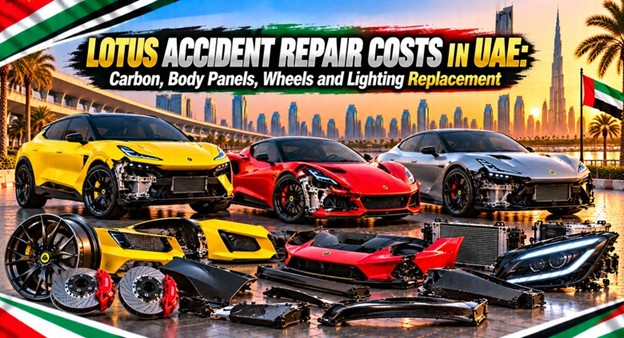
Lotus Accident Repair Costs in UAE: Carbon, Body Panels, Wheels and Lighting Replacement
October 13, 2026
A Lotus accident bill rarely stays at the number written beside the first damaged panel. That is the trap.
A cracked bumper may conceal broken brackets, damaged parking sensors, distorted wheel-arch liners or a headlamp mounting that has shifted by only a few millimetres; a scraped carbon-fibre aero piece can look cosmetic while carrying a price that makes a conventional bodyshop estimate seem almost quaint; and on the Eletre and Emeya, where lighting, radar, cameras, active aero and other electronics are folded into the front and rear body architecture, the question after an impact is no longer simply which panel needs replacing? It becomes what did the impact disturb, what must be calibrated afterwards, and which parts can safely be repaired rather than thrown away?
That is where Lotus ownership in the UAE gets interesting.
And expensive.
UAE Update Reference: October 2026
Lotus Accident Repair in the UAE Starts With the Damage Behind the Damage
The first estimate after a collision is often visually persuasive because the eye naturally follows the obvious thing: the smashed bumper, the bent bonnet, the cracked lamp, the wheel that is no longer pointing quite where it ought to.
Cars are less obliging.
An Eletre's front end, for example, incorporates an active grille, radar and camera hardware, cooling openings and aerodynamic surfaces; Lotus also describes its body as using aluminium panels and carbon-fibre aerodynamic elements, while the front lighting architecture is split between slim upper light clusters and recessed main lamps.
So the visible damage is merely the opening argument.
The invoice comes later.
Which Lotus Models Are We Talking About?
The UAE Lotus range now includes the Emira, Eletre and Emeya, alongside the limited-production Evija, and the current Eletre and Emeya ranges have themselves become more complicated as 600 and 900 versions have been introduced.
That matters after an accident because Lotus spare parts in UAE cannot sensibly be priced from the badge alone.
An Emira is a mid-engined sports car with a completely different body and lighting arrangement from the Eletre hyper-SUV; the Emeya, meanwhile, brings active aerodynamics and a more electronically dense electric architecture into the repair equation. Lotus's own current material identifies the Emeya 600 and 900 as distinct powertrain and equipment configurations, with the 900 receiving a two-speed rear transmission.
One Lotus name. Three very different repair problems.
Why a Lotus Bumper Can Cost More Than Expected
A bumper cover is not necessarily a bumper assembly.
That distinction sounds pedantic until the quotation arrives.
A complete front-end repair can involve the outer cover, lower sections, ducts, brackets, absorbers or reinforcement, grilles, sensors, wiring, lamps and sometimes cooling components; on an Eletre or Emeya, active aerodynamic hardware and driver-assistance equipment can sit within the same general territory.
The part that looks damaged may therefore be the least interesting part of the inspection.
Public Lotus Parts Pricing Gives Us Some Useful Benchmarks
Lotus's Korean parts-information portal provides unusually useful public component pricing, although these are South Korean prices excluding VAT, not UAE dealer prices. The October 6, 2026 exchange rate was approximately ₩1 = AED 0.002733, so the figures can be converted into rough AED reference values without pretending they are landed UAE costs.
That distinction matters.
A Korean catalogue price can tell us something about the relative cost of a genuine Lotus component. It cannot tell us what the same component will cost after UAE logistics, taxes, local supply, labour, paint and any calibration.
Still, the numbers are revealing.
Lotus Emira Front Bumper: A Useful Price Reference
One public Lotus parts listing identifies an Emira front bumper at ₩2,152,000, which converts to roughly AED 5,880 before VAT and any international/UAE logistics. The same listing identifies a rear bumper at ₩2,156,000, roughly AED 5,890.
That is a useful benchmark, not a UAE quotation.
And it immediately explains why a bodyshop estimate of, say, AED 8,000 or AED 10,000 for a bumper-related accident should not automatically be dismissed as outrageous: once paint, fitting, brackets, shipping and associated damage enter the calculation, the original panel price is no longer the whole story.
The invoice has layers.
Emira Headlights Are Where the Numbers Become Serious
The same public Lotus parts catalogue lists an Emira front headlamp at ₩6,508,000, equivalent to roughly AED 17,790 before VAT and other costs. A rear tail lamp is listed at ₩2,706,000, or about AED 7,400.
That front-lamp figure is the sort of number that changes an accident conversation.
A cracked bumper is annoying.
A damaged headlamp can become the expensive item in the entire front-end repair.
And because the Emira's lamps are integrated LED assemblies rather than simple bulb-and-reflector units, replacement should be based on the actual assembly and vehicle specification, not a photograph found online. Lotus describes the Emira's rear lighting as C-shaped LED clusters, while current technical material confirms the car's performance-focused hardware
The Eletre's Front End Is More Complicated Still
The Eletre is a particularly awkward car to repair badly because so much of what makes its nose distinctive is also functional.
Lotus describes seven sets of air ducts guiding airflow through and over the body, a carbon-fibre split roof spoiler, an active front grille and a LIDAR sensor integrated high in the front architecture; its earlier technical description also identifies radar and advanced lighting hardware within the front-end design.
So if an Eletre hits a kerb, barrier or another vehicle squarely enough to damage the front bumper, the sensible inspection extends considerably further than the painted plastic.
Check what the bumper was protecting.
Eletre Front Bumper Prices: What Public Parts Data Shows
One public Lotus parts listing shows a front bumper at ₩3,093,000, around AED 8,455 at the October 6 exchange rate, while another Lotus listing shows a front bumper at ₩4,320,000, around AED 11,810.
The variation is itself useful.
It suggests that even before UAE-specific costs are introduced, the exact part reference matters.
So a buyer should not ask a supplier for “an Eletre front bumper” and then compare whichever number comes back with another supplier's number. Ask for the part number. Ask which model-year configuration it belongs to. Ask whether it includes the associated trim and mounting hardware.
Otherwise, you are comparing labels rather than parts.
Emeya Bumpers Sit in the Same Expensive Territory
A separate public Lotus parts listing shows an Emeya front bumper at ₩4,320,000, approximately AED 11,810, and a rear bumper at ₩1,750,000, approximately AED 4,780, before VAT and UAE landed costs.
That spread between front and rear is not surprising.
The Emeya's front end carries much more technological and aerodynamic complexity, while the rear incorporates active aero of its own: Lotus identifies an active front grille, air dam, rear diffuser and rear wing as part of the car's aerodynamic system.
A rear bumper can therefore still be expensive without necessarily resembling the cost structure of the nose.
Carbon Fibre Changes the Accident Equation
Carbon fibre has a strange relationship with body repair.
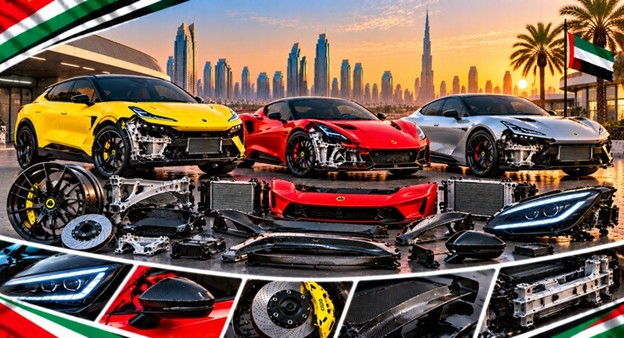
It looks delicate because it is beautiful, yet its structural and material properties are precisely why Lotus uses it in selected performance and aerodynamic applications. On the Eletre, Lotus identifies carbon-fibre elements in the roof spoiler and other aerodynamic areas; the Emira 420 Sport can be specified with an exterior carbon-fibre pack covering the front splitter, side sills, wheel-arch vents, side pods, rear spoiler and diffuser surround.
The problem after an accident is not simply whether the weave is scratched.
A carbon component may have hidden delamination, crushed edges, broken mounting points or damage beneath a clear coat that looks superficially acceptable.
Polishing is not a structural inspection.
Emira Carbon Parts Can Cost More Than the Panel They Replace
The aftermarket illustrates the scale.
A UAE supplier currently lists a Lotus Emira dry-carbon full body kit at AED 35,293, covering components including front-lip sections, side wind knives, diffuser, side skirts, GT wing and rear-bumper trim. The supplier identifies the parts as pre-preg dry carbon and lists fitment for both the 2.0-litre turbo-four and 3.5-litre supercharged V6.
That is not an OEM accident-repair price.
It is an aftermarket body-kit price.
But it demonstrates something useful: carbon-fibre parts are not interchangeable with ordinary plastic trim in terms of replacement economics.
A Carbon Part Should Not Be Repaired Merely Because It Can Be Repaired
This is where judgement matters.
A cosmetic scratch in a clear coat is one thing. A fractured laminate, distorted mounting area or impact damage around a load-bearing attachment is another.
The workshop should establish what material has been damaged, whether the underlying laminate remains sound, and whether the repair method is appropriate for that specific component.
There is no virtue in saving AED 3,000 on a repair that leaves a damaged carbon part waiting to fail.
Sometimes replacement is the cheaper answer.
Eventually.
The Emira's 420 Sport Adds Another Carbon-Fibre Complication
The 2026 Emira 420 Sport is not simply another trim badge. Lotus describes it as the lightest and most powerful Emira yet, with carbon-fibre options, titanium exhaust hardware, adjustable Multimatic dampers and a choice of nine wheel designs, including 20-inch forged alloy wheels.
That matters after an accident because the parts specification can change the quote dramatically.
A damaged front splitter on an ordinary Emira and a damaged carbon component from a 420 Sport with the optional carbon pack should not be treated as equivalent jobs.
The VIN decides what is actually fitted.
Body Panels: Aluminium Does Not Mean Cheap
The Eletre uses aluminium body panels, according to Lotus's technical description, while carbon fibre is used for selected aerodynamic structures.
Aluminium is lighter, corrosion-resistant in useful ways and well suited to performance vehicles.
It is not immune to accident economics.
A panel that has folded, stretched or developed damage around an attachment point may be repairable, but the decision should be based on panel condition, access, geometry and the repairer's capability rather than on the simplistic idea that aluminium must always be replaced.
Likewise, a replacement panel still needs paint, blending and fitting.
The catalogue price is merely the beginning.
Emira Body Panels Need a Different Accident Philosophy
The Emira's mid-engined layout and low-slung body make its accident repairs rather different from those of an ordinary front-engine saloon.
The car's published architecture and aerodynamic philosophy place considerable emphasis on controlled body shape and airflow, while the current Emira continues to use 20-inch wheels and specialised performance tyres.
So a damaged side section should not be assessed solely for whether the paint can be made smooth again.
Look underneath.
Check mounting points. Check wheel alignment. Check suspension geometry. Check the wheel and tyre. Check the underside where the impact may have travelled.
A pretty panel can hide an ugly mechanical problem.
Wheels Are Often the Forgotten Accident Cost
People notice the bumper first.
The wheel quietly waits underneath.
A kerb strike can bend or crack an alloy wheel, damage the tyre, disturb alignment and transmit force into suspension components. On a performance Lotus, especially one fitted with 20-inch wheels and high-performance tyres, the replacement bill can become uncomfortable very quickly. Lotus confirms 20-inch wheels across the Emira specification described in its technical material, with Goodyear Eagle F1 Supersport tyres standard and Michelin Pilot Sport Cup 2 available with the Drivers Pack.
And a wheel that looks merely scuffed may still deserve a proper inspection.
Do Not Repair a Bent Performance Wheel by Guesswork
Wheel repair is one of those jobs where a workshop's equipment and experience matter more than the optimism of the person holding the wheel.
The wheel should be inspected for cracks, runout and deformation, with the tyre examined for sidewall or bead damage; after suspension impact, alignment and relevant steering components should also be checked.
A wheel that has been straightened is not automatically a bad wheel.
A wheel that has been straightened without proper inspection is another matter.
Eletre Wheels Carry More Weight and More Complexity
The Eletre's published launch specification included 23-inch machine-cut split-finish wheels with carbon-fibre inserts on higher-performance configurations, alongside ceramic-composite braking hardware in the original technical description.
Current model-year configurations vary, so the actual wheel fitted to a UAE car must be established from its VIN and equipment specification.
This is particularly important when sourcing used wheels.
A seller saying “genuine Eletre 23-inch wheel” has not yet told you enough.
You still need width, design, offset, condition and the precise application.
Emeya Wheel Damage Can Be Equally Painful
The Emeya's high-output variants are built around large performance wheels and tyres, and specialist UAE suppliers already advertise forged Emeya wheel sets.
One UAE listing currently prices a forged Emeya wheel set at US$1,760, approximately AED 6,460 at the October 6 USD/AED rate of about 3.6726. That is a supplier price for a wheel set, not a Lotus UAE dealer quotation, and the exact configuration needs confirmation before comparison.
The important point is less the precise number than the scale.
A four-wheel replacement decision can turn a seemingly minor kerb accident into a five-figure parts discussion.
Lighting Costs Can Overtake Bodywork
Lighting is where modern Lotus cars punish old-fashioned accident estimating.
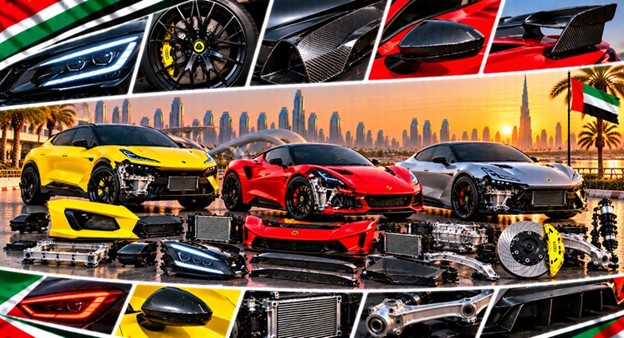
The Emira's front headlamp benchmark above is already around AED 17,800 before UAE-specific costs; public Lotus parts data also shows Eletre and Emeya front lamps in the same broad high-value category. One listing shows an Eletre front headlamp at ₩5,595,000, around AED 15,290, while another shows ₩6,869,000, around AED 18,780.
Those are not UAE retail quotations.
They are nevertheless a useful warning.
If the headlamp is damaged, don't build the accident estimate around the bumper and add the light later.
Price the light immediately.
Why Headlamp Compatibility Matters More Than Appearance
Modern Lotus lighting assemblies contain electronics and are integrated into the vehicle's broader control architecture.
A used lamp can therefore be physically correct and still be unsuitable because of specification, hardware revision or configuration.
The workshop should establish the exact part number and determine whether any coding, configuration or calibration procedure is required after installation.
This is particularly important with Eletre and Emeya, whose broader electronic architecture includes advanced driver-assistance systems and software-controlled vehicle functions. Lotus states that both models receive over-the-air software updates through Hyper OS.
A headlamp is no longer just a lamp.
It is an electronic assembly wearing a lens.
Eletre Lighting Is Tied Into a Much Bigger Front-End System
The Eletre's front lighting is deliberately layered: slim daytime-running light and indicator elements sit above the recessed main lamps, while the front architecture also accommodates LIDAR and other sensing technology.
So after a frontal collision, a replacement headlamp should not be the end of the diagnostic conversation.
Inspect the mounting structure.
Inspect connectors.
Check adjacent sensors.
Check the bonnet and wing gaps.
Check the calibration status of relevant driver-assistance systems.
A lamp that illuminates perfectly does not prove that everything around it is aligned correctly.
Emeya Lighting and Active Aero Make Rear Damage More Complicated
The Emeya's rear is not merely decorative. Lotus identifies active rear aerodynamics, including a deployable rear diffuser and rear wing, while its lighting and exterior systems are integrated into the car's wider electronic architecture.
That matters after a rear-end collision.
A cracked bumper may sit in front of a damaged actuator or distorted mounting structure. A damaged lamp may have wiring damage behind it. A boot-lid impact can disturb panel alignment while also affecting sensors and camera hardware.
The repair estimate should follow the architecture of the car, not the shape of the dent.
Accident Damage to Eletre and Emeya Sensors Is Easy to Miss
Radar and camera systems can be displaced without looking broken.
Lotus describes the Eletre's advanced sensing architecture, including multiple radar units, cameras and LIDAR in its technical material.
The practical implication is slightly uncomfortable: a car can come out of a bodyshop looking immaculate and still require further diagnostic work because a sensor is misaligned.
That is why calibration belongs in the repair estimate from the beginning, particularly after frontal or rear impacts affecting sensor mounting areas.
What the Workshop Should Check After a Front-End Accident
Before ordering a bumper, the inspection should establish the condition of the outer panel and everything attached to or immediately behind it.
That means looking at mounting points, brackets, liners, cooling components, wiring, lamps, radar/camera hardware, structural areas and — where fitted — active aerodynamic mechanisms.
On an Eletre, the front grille itself has a functional role in airflow and cooling; Lotus describes it opening to feed air towards the radiator and cooling systems for the electric motors, battery and front brakes.
So a damaged front grille is not necessarily cosmetic.
That little distinction can become a large invoice.
What the Workshop Should Check After a Side Impact
A side impact deserves a similarly broad inspection.
The obvious door or side panel may be damaged, but the wheel, tyre, suspension arm, steering system, wheel bearing, underbody and adjacent mounting structures can also receive load.
On the Emira, where suspension geometry is central to the car's handling character, replacing an outer body panel without checking the geometry would be an odd economy.
The paint can be perfect.
The steering can still be wrong.
What the Workshop Should Check After a Rear Impact
The rear assessment should go beyond the bumper skin.
Check the boot or tailgate, lamps, mounting points, sensors, rear structural components, diffuser or aero hardware, wiring and exhaust-related components on the Emira; on the Emeya and Eletre, inspect the relevant active aero and electronic systems where fitted.
This is especially important on the Emeya because Lotus explicitly identifies active front grille, air dam, rear diffuser and rear wing systems.
A broken plastic clip is cheap.
A damaged active-aero actuator is not.
Can Lotus Accident Parts Be Repaired Instead of Replaced?
Sometimes, absolutely.
A bumper cover with superficial deformation may be repairable. A carbon component with cosmetic clear-coat damage may be recoverable. A wheel with acceptable cosmetic damage may be refinished.
But repairability is not a moral virtue.
The correct question is whether the repaired component will return to the required geometry, strength, finish and function.
For a carbon component, that means understanding the laminate. For a wheel, runout and structural integrity matter. For a bumper, mounting points and sensor interfaces matter.
Save money where the engineering allows it.
Not where wishful thinking does.
Used Lotus Accident Parts Can Make Sense in the UAE
Used genuine body parts are particularly interesting for low-volume cars because they can reduce both cost and waiting time, provided the donor history is credible.
A used bumper, door, bonnet or wheel can be excellent value when the component is undamaged, correctly identified and supplied with sensible return protection.
The opposite is also true.
A used lamp with moisture damage, a carbon panel with hidden impact damage or a wheel with a repaired crack can turn an apparently brilliant bargain into the second repair you never wanted.
“Used” describes history.
It does not describe quality.
Genuine, Aftermarket and Carbon-Fibre Parts Need Separate Decisions
A genuine Lotus panel is not automatically the only rational choice.
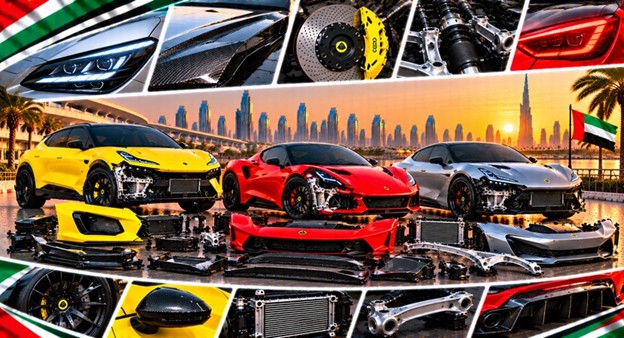
For some bodywork, a high-quality aftermarket component may make commercial sense; for an exact-fit lamp, sensor housing, active-aero component or safety-related structure, the case for genuine hardware can be considerably stronger.
Carbon fibre complicates the equation further. A UAE supplier's Emira dry-carbon kit may be beautifully manufactured and dramatically cheaper or more expensive than an original component depending on what is being compared, but it is still an aftermarket product and should be judged as such.
The useful question is not “OEM or cheap?”
It is “what function does this part perform, and what evidence do I have that the alternative performs it properly?”
UAE Accident Repair Costs Are Not Just Parts Costs
This is where online price comparisons routinely go wrong.
Suppose an Eletre bumper appears at AED 8,500 in a converted catalogue price. Fine. The actual UAE repair may then require shipping, VAT, paint preparation, blending, labour, clips, brackets, sensors, calibration and perhaps additional hidden parts discovered after disassembly.
The same logic applies to an Emira headlamp that appears around AED 17,800 in a foreign catalogue.
That number is not a repair invoice.
It is a component benchmark.
And it should be labelled honestly as one.
A Useful UAE Repair-Cost Reference Table
| Component | Public reference | Approx. AED reference | Important limitation |
|---|---|---|---|
| Emira front bumper | ₩2,152,000 | ~AED 5,880 | Korean price, before VAT/logistics |
| Emira rear bumper | ₩2,156,000 | ~AED 5,890 | Korean price, before VAT/logistics |
| Emira front headlamp | ₩6,508,000 | ~AED 17,790 | Korean price, before VAT/logistics |
| Emira rear lamp | ₩2,706,000 | ~AED 7,400 | Korean price, before VAT/logistics |
| Eletre front bumper | ₩3,093,000–₩4,320,000 | ~AED 8,460–11,810 | Different public listings/part references |
| Eletre front headlamp | ₩5,595,000–₩6,869,000 | ~AED 15,290–18,780 | Different public listings/part references |
| Emeya front bumper | ₩4,320,000 | ~AED 11,810 | Korean price, before VAT/logistics |
| Emeya rear bumper | ₩1,750,000 | ~AED 4,780 | Korean price, before VAT/logistics |
| Emira dry-carbon body kit | AED 35,293 | AED 35,293 | UAE aftermarket, not OEM accident price |
| Emeya forged wheel set | US$1,760 | ~AED 6,460 | UAE aftermarket listing; exact fitment required |
The Korean-to-AED conversions use approximately ₩1 = AED 0.002733 on 6 October 2026; the USD conversion uses approximately US$1 = AED 3.6726. These are reference conversions, not supplier quotations in the UAE.
The table is therefore useful for scale, not for pretending that a UAE insurer, dealer or bodyshop must charge these amounts.
Insurance Assessment Can Be More Important Than the Parts Search
For an accident-damaged Lotus, the owner should establish whether the vehicle is being repaired under insurance, privately or through a warranty-related process before committing to imported parts.
The distinction matters because insurer-approved repair networks, genuine-part requirements, workshop approvals and depreciation policies can alter the economically sensible route.
Lotus's published accident-assistance programme in other markets illustrates the manufacturer's preferred philosophy: approved bodyshops, genuine Lotus parts, trained technicians, specialist tooling and a formal repair estimate.
The UAE policy terms and approved repair arrangements need to be checked separately.
Don't assume an overseas Lotus accident programme automatically applies in Dubai or Abu Dhabi.
Warranty Does Not Mean Accident Damage Is Free
This needs saying because “five-year warranty” can sound more generous than it is.
The current UAE Lotus warranty pages cover the relevant vehicle systems under their stated warranty conditions; the Emira carries a three-year warranty, while Eletre and Emeya have five-year/150,000 km basic warranty coverage in the published current material, with separate high-voltage coverage on the EVs.
Collision damage is a different question.
A cracked bumper caused by an accident is not suddenly a warranty claim because the car is two years old.
But if the post-accident inspection uncovers a separate warranty-related component failure, that should be distinguished from the collision damage.
Keep the causes separate.
Grey-Import Lotus Cars Need an Extra Layer of Checking
Lotus UAE maintains a dedicated warranty area for grey-import vehicles, which is a useful reminder that market origin can affect the ownership and repair conversation.
For an imported Eletre, Emeya or Emira involved in an accident, confirm the VIN, original market, specification and applicable warranty position before assuming that a particular part or repair route is covered.
The same badge can hide meaningful specification differences.
That is why VIN-based sourcing is not bureaucracy.
It is protection.
The Most Expensive Part May Be the One You Did Not Order
This is the unpleasant arithmetic of accident repair.
A supplier quotes a bumper. The workshop removes the old one and discovers damaged brackets. Then a sensor mount. Then a wiring connector. Then the headlamp has a cracked mounting ear. Then the wheel alignment is out. Then the radar needs calibration.
None of those surprises are necessarily evidence of dishonesty.
They may simply be damage that could not be seen before disassembly.
The sensible estimate therefore contains a known-cost section and a possible-additional-damage section.
That is far more honest than pretending an accident has a perfectly fixed price before the car has been dismantled.
What Should You Ask Before Buying a Used Lotus Body Panel?
Ask for photographs of the actual part, not catalogue images.
Ask whether the mounting tabs are intact. Ask whether the panel has been repaired or painted. Ask where it came from. Ask whether it was removed from a collision-damaged vehicle. Ask whether the part number is visible.
For carbon fibre, ask specifically about cracks, delamination and previous repair.
For wheels, ask about welding, straightening and cracks.
For lamps, ask whether there is condensation, broken mounting hardware or previous water intrusion.
It takes five minutes.
Returning the wrong £10,000 part takes considerably longer.
What Should You Ask Before Buying a Lotus Headlamp?
Get the exact part number.
Then establish whether the lamp is new, used or refurbished.
Ask whether the control electronics are included. Ask whether the unit has been tested. Ask about the donor VIN if used. Ask about coding or calibration. Ask whether the return policy remains valid after installation.
A seller who can answer those questions is giving you usable information.
A seller who only says “fits Eletre” is giving you a slogan.
The Sensible Lotus Accident-Repair Decision
Before ordering anything, photograph the damage, identify the VIN and exact specification, obtain a diagnostic and physical inspection, then separate the estimate into body panels, structural components, lighting, wheels and tyres, suspension, electronics, calibration, paint and labour.
When comparing Lotus accident parts through PartFinder UAE, the useful comparison is not simply the number beside the component; it is the complete repair equation — the part itself, delivery, VAT, paint, fitting, calibration, warranty and the possibility that dismantling the damaged car will reveal something nobody could see from the outside.
Only after that should you compare new genuine, used genuine, aftermarket and specialist carbon alternatives.
For an Emira, a used bumper may be an excellent purchase while a used headlamp could become a headache. For an Eletre, replacing the bumper without checking the sensing hardware leaves the repair unfinished. For an Emeya, ignoring active aero because the visible damage appears to be “just the bumper” is an invitation to a second invoice.
And when two prices look dramatically different, don't celebrate too quickly.
Find out what the cheaper part actually is.
The Sensible Lotus Accident-Repair Decision
Before ordering anything, photograph the damage, identify the VIN and exact specification, obtain a diagnostic and physical inspection, then separate the estimate into body panels, structural components, lighting, wheels and tyres, suspension, electronics, calibration, paint and labour.
Only after that should you compare new genuine, used genuine, aftermarket and specialist carbon alternatives.
For an Emira, a used bumper may be an excellent purchase while a used headlamp could be a headache. For an Eletre, a replacement bumper without checking the sensing hardware is incomplete. For an Emeya, ignoring active aero because the visible damage appears to be “just the bumper” is asking for a second invoice.
And when the price difference between two parts looks surprisingly large, don't celebrate immediately.
Find out what the cheaper one actually is.
FAQ: Lotus Accident Repair Costs in UAE
Categories
- Audi
- BMW
- Car Accessories
- Car Tips
- Ford
- Land Rover
- Mazda
- Range Rover
- Top 10
- UAE Car Parts
- Used Car Parts
- Toyota
- Replacement Engines
- Nissan
- Hyundai
- Mitsubishi
- Volkswagen
- Honda
- Kia
- Chevrolet
- Dodge
- Jeep
- Subaru
- Renault
- Lexus
- Mercedes
- Suzuki
- Hummer
- Porsche
- Infiniti
- Peugeot
- GMC
- Mini
- Volvo
- Replacement Gearboxes
- MG
- Jaguar
- Skoda
- Cadillac
- Daihatsu
- Fiat
- German Car Parts
- Japanese Car Parts
- Aftermarket Car Parts
- Genuine Car Parts
- New Car Parts
- Reconditioned Car Parts
- European Car Parts
- American Car Parts
- Korean Car Parts
- British Car Parts
- Chinese Car Parts
- Sports/Exotic Car Parts
- Luxury Car Parts
- Performance Car Parts
- SUV/4x4 Spare Parts
- Truck Spare Parts
- EV Car Parts
- Hybrid Car Parts
- Auto Spare Parts in UAE
- Tesla
- Isuzu
- Ram
- Ferrari
- Bentley
- Lamborghini
- Genesis
- Maserati
- Lincoln
- Chrysler
- Opel
- Citroen
- SsangYong
- Seat
- McLaren
- Aston Martin
- Rolls Royce
- Maybach
- Alfa Romeo
- Bugatti
- Scion
- Abu Dhabi Car Parts
- Ajman Car Parts
- Al Khan Car Parts
- Al Sajaa Car Parts
- Deira Car Parts
- Dubai Car Parts
- Fujairah Car Parts
- Industrial Area 6 Car Parts
- Mussafah Car Parts
- Ras Al Khaimah Car Parts
- Sharjah Car Parts
- Umm Al Quwain Car Parts
- Acura
- BYD
- Chery
- Dacia
- DS
- Geely Emgrand
- EXEED
- GAC
- GAC Gonow
- Geely
- Gonow
- Great Wall
- Haima
- Haval
- Holden
- Iveco
- JAC
- Jaecoo
- Jetour
- Lotus
- Omoda
- Proton
- Renault Samsung
- Roewe