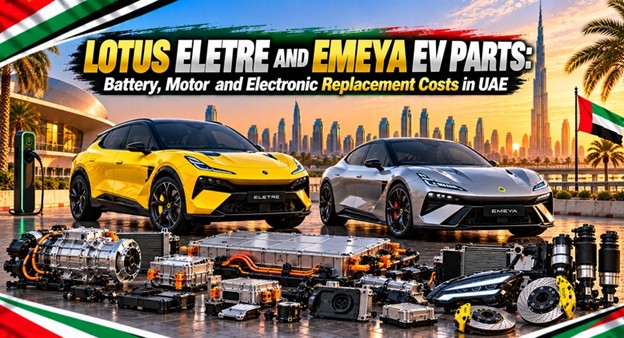
Lotus Eletre and Emeya EV Parts: Battery, Motor and Electronic Replacement Costs in UAE
October 13, 2026
A battery warning on a Lotus Eletre or Emeya can make the mind jump straight to the most frightening number on the internet: complete battery replacement. That is understandable, particularly when the car is carrying a 102–112 kWh high-voltage pack, dual electric motors, active air suspension, radar, cameras, electronically controlled braking and a software architecture that makes a conventional luxury SUV look almost quaint.
Yet the expensive part is often not the part that has actually failed.
That is the point worth keeping in view when pricing Lotus parts in UAE, because an Eletre or Emeya fault can sit anywhere between a sensor, wiring connection, cooling component, control module, software issue, motor assembly, inverter-related system or the battery itself — and those are very different repairs, even when the dashboard gives the owner a similarly alarming message.
The current Eletre and Emeya ranges are also not mechanically identical. Lotus now offers 600 and 900 versions, with the Eletre 900 and Emeya 900 using high-output dual-motor systems and a two-speed rear transmission, while the 600 versions use single-speed front and rear arrangements. The current Eletre carries a 112 kWh gross battery rated at 708 V; the current Emeya uses a 102 kWh gross battery rated at 705 V.
So “Lotus electric motor” is not a sufficiently precise parts request.
Nor is “Eletre battery”.
You need the car's exact specification first.
UAE Update Reference: October 2026
How Much Do Lotus Eletre and Emeya EV Repairs Cost in the UAE?
There is no honest single figure.
A minor electronic sensor can be a relatively contained repair; an air-suspension component can become considerably more expensive once calibration and alignment enter the invoice; a damaged bumper can require sensors, brackets and wiring; and a high-voltage battery or drive-unit problem can move the discussion into a completely different financial bracket.
That is why public UAE pricing for these cars needs to be treated as a collection of evidence points rather than a neat price list.
For context, current UAE market sources place the 2026 Eletre around AED 439,000–615,000 depending on version, with one source explicitly stating that its published figures exclude VAT and registration/insurance costs.
The current Emeya is listed by UAE automotive sources from roughly AED 439,000, with higher variants reaching about AED 570,000 in one 2026 pricing reference.
Those vehicle values explain why parts sourcing deserves more care than simply buying whatever appears first in a search result.
Eletre and Emeya Are Not the Same Parts Catalogue
They share technology and a broader engineering family, but that does not make their components interchangeable.
The current Eletre 600 uses a 112 kWh battery, permanent-magnet electric motors and single-speed front/rear transmissions; the Eletre 900 uses the same gross battery capacity but a two-speed rear transmission. Lotus quotes 603 hp for the 600 and 905 hp for the 900.
The current Emeya uses a 102 kWh battery. Its 600 variants have single-speed front and rear transmission arrangements, while the 900 Sport Carbon combines a single-speed front unit with a two-speed rear transmission; the 900 is rated at 905 hp and 985 Nm.
That difference is not decorative trim.
It can change the component you need.
What Does the Eletre Battery Cost?
This is one of those areas where a supposedly authoritative-looking number can be more misleading than useful.
I could not verify a current, public UAE retail quotation for a complete genuine Lotus Eletre high-voltage battery pack in October 2026, so it would be irresponsible to announce a figure as though Lotus UAE publishes one openly.
What can be established is the hardware itself.
The current Eletre uses a 112 kWh gross ternary lithium-ion battery at 708 V, with published 10–80% charging time of about 20 minutes at a 350 kW DC charger.
That is a substantial high-voltage assembly. It should not be treated like a conventional replacement battery.
And no, a battery warning does not automatically mean the entire pack needs replacing.
Emeya Battery Replacement Is a Different Calculation
The current Emeya range uses a 102 kWh gross ternary lithium-ion battery at 705 V, with Lotus quoting around 18 minutes for 10–80% DC charging at 350 kW in its published technical specification.
Lotus also states that Emeya's 600 and 900 ranges use the same gross battery capacity, despite their substantially different power outputs.
So if someone offers a “102 kWh Lotus battery” without establishing the precise vehicle, battery configuration and part reference, stop there.
Battery capacity is only one identifier.
The Most Important Battery Price in the UAE May Be AED 0
That sounds absurd until you check the warranty.
Lotus currently states that the Eletre's battery and electric-drive systems are covered for eight years or 200,000 km, with the battery guaranteed to maintain at least 70% state of health.
The current Emeya warranty carries the same eight-year/200,000 km high-voltage coverage and 70% minimum battery state-of-health guarantee.
That does not mean every battery complaint is automatically covered. Warranty conditions apply, and diagnosis still matters.
But before anyone starts shopping for a used battery, establish whether the vehicle is still within the applicable Lotus warranty.
That could change the economics completely.
Battery Degradation Is Not the Same as Battery Failure
This distinction gets lost online.
A battery can lose usable capacity over time without suffering a catastrophic component failure. A vehicle can also report a high-voltage fault because of a problem elsewhere in the battery-management or charging system.
For an Eletre or Emeya, the workshop should establish what the diagnostic system is actually reporting, examine battery state-of-health information where available, review relevant fault codes and inspect the high-voltage system according to the manufacturer's procedures.
The question is not merely:
“Is the battery bad?”
It is:
“Which part of the high-voltage system has failed, and what evidence proves it?”
Never Diagnose an EV Battery From Range Alone
Range is affected by far more than battery health.
Driving speed, temperature, air-conditioning load, tyre condition, wheel choice, traffic, driving mode, gradients and recent usage all influence consumption.
The Eletre itself has published WLTP ranges varying substantially by version — roughly 570–600 km for the 600-series and around 410 km for the 900 variants in the current technical table.
So an owner seeing a lower-than-expected range should not immediately assume battery degradation.
A proper assessment comes first.
What Should a UAE Workshop Test Before Replacing the Battery?
At minimum, the diagnosis should be built around the vehicle's high-voltage fault information and manufacturer procedures.
That can include:
- stored and current diagnostic trouble codes
- battery state-of-health information
- charging behaviour
- battery-management-system communication
- thermal-management faults
- isolation-related diagnostics
- high-voltage interlock status
- relevant module communication
- 12V electrical-system condition
- charging-system operation
- physical inspection for damage or water ingress
The exact procedures should be performed by appropriately trained personnel.
High-voltage systems are not a place for improvisation.
What About Used Eletre and Emeya Batteries?
Used EV batteries exist in the international dismantling market, but a battery with the right model name is not necessarily the right battery.
Ask for the donor VIN where possible, donor year, exact vehicle version, mileage, accident history, flood history, battery condition, reason for dismantling, testing information, storage history, warranty and return conditions.
Most importantly, determine whether the pack is being sold as a complete assembly or as modules/components.
Those are entirely different propositions.
A used battery without credible health information is simply an expensive box of uncertainty.
Can Eletre and Emeya Battery Packs Be Interchanged?
Do not assume so.
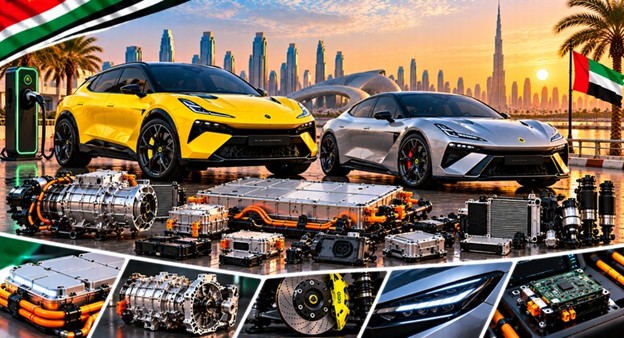
The current Eletre specification is built around a 112 kWh, 708 V battery, whereas the current Emeya specification uses a 102 kWh, 705 V battery.
Even where nominal voltage appears close, that does not establish compatibility.
Battery casing, cooling connections, management electronics, communication protocols, mounting, software configuration and vehicle integration all matter.
For a high-voltage assembly, VIN and part-number verification outrank visual similarity.
How Much Does a Lotus Electric Motor Cost?
Again, there is no sufficiently reliable current public UAE retail price for a complete genuine Eletre or Emeya drive motor that I would present as a definitive October 2026 figure.
And that absence is useful information.
The current cars use dual-motor all-wheel-drive architecture, with substantial differences between 600 and 900 configurations. Lotus quotes up to 675 kW/918 hp for the Eletre 900 and Emeya 900 families in its published technical material.
A complete drive unit is therefore not a generic “electric motor”.
It is part of a much larger propulsion system.
One Electric-Motor Fault Does Not Necessarily Mean Motor Replacement
A drive fault can originate in the motor itself, but it can also involve associated power electronics, sensors, wiring, cooling, control software or communication between modules.
That distinction is crucial.
If a diagnostic code points towards a drive unit, the workshop should still establish whether the fault is internal to the motor assembly or caused by another part of the system.
Replacing a complete drive unit because a communication fault was misunderstood is precisely the kind of repair mistake that turns an expensive car into an unnecessarily expensive car.
Eletre 600 and 900 Motor Parts Need Separate Identification
Lotus describes the Eletre 600 as a dual-motor all-wheel-drive vehicle producing 603 hp and 710 Nm, while the 900 rises to 905 hp and 985 Nm and adds the two-speed rear transmission.
The motor assemblies therefore should not be treated as one universal Eletre component.
For a used drive unit, obtain:
VIN → model year → 600/900 specification → front/rear position → motor/drive-unit part number.
If one of those is missing, the enquiry is incomplete.
Emeya 600 and 900 Drive Units Are Likewise Different
The current Emeya 600 uses single-speed front and rear transmission arrangements, while the Emeya 900 Sport Carbon uses a single-speed front transmission and two-speed rear transmission.
That two-speed rear unit matters.
It is one reason why “Emeya motor” is too broad a description for a parts order.
A supplier should know whether the requested component is front or rear, 600 or 900, and which production specification applies.
Two-Speed Rear Drive Units Can Change the Repair Bill
The two-speed rear transmission is part of the higher-output 900 configuration, rather than something common to every current Eletre or Emeya.
Lotus explicitly lists the Eletre 900 and Emeya 900 configurations with two-speed rear transmission arrangements.
If the vehicle has a drivetrain warning accompanied by abnormal acceleration behaviour, unusual noise or shift-related symptoms, the diagnosis needs to distinguish motor, reduction gear, two-speed transmission and control-system faults.
Otherwise, “motor replacement” becomes a guess.
A very expensive guess.
What Do Electronic Parts Cost for the Eletre?
The Eletre is loaded with electronic systems.
Lotus describes its current driver-assistance architecture as using four laser radars, six millimetre-wave radars and seven cameras, while its Hyper OS receives periodic over-the-air updates.
That means the phrase “electronic parts” covers a remarkably wide field:
- cameras
- radar
- control modules
- displays
- infotainment components
- parking sensors
- body-control electronics
- charging electronics
- battery-management components
- wiring
- communication modules
Prices vary wildly.
Eletre Camera and Radar Replacement Is Not Just a Hardware Purchase
A replacement camera or radar can require configuration, calibration or system validation after installation, depending on the component and vehicle procedure.
This is where an apparently cheap used electronic component can become less attractive.
Suppose a sensor costs AED 1,500 less than the new component. Fine. But if it is the wrong hardware revision, requires additional programming, fails calibration or cannot communicate correctly with the vehicle, the saving was imaginary.
Electronic compatibility is not a visual exercise.
Emeya Has the Same Problem — With More Technology to Consider
The Emeya's technology package includes Lotus Hyper OS, a large projected head-up display, active aerodynamics and advanced driver-assistance systems; Lotus also describes its 800 V battery technology and Hyper Charging capability.
So after an accident, an apparently simple front-end repair may involve much more than the bumper.
A camera. Radar. Wiring. Mounting bracket. Active aerodynamic component. Cooling hardware. Calibration.
That is why an Emeya accident estimate should be dismantled into systems, not just panels.
Lotus Hyper OS Changes the Meaning of “Replacement Part”
Modern Lotus EV electronics are increasingly software-dependent.
The Eletre and Emeya both receive over-the-air software updates through Lotus Hyper OS.
A physical module can therefore fit correctly and still not behave correctly if its configuration, software state or communication with the vehicle is wrong.
For used electronic components, ask whether programming or configuration is required before purchase.
The physical connector is only half the story.
What Does a Used Eletre Bumper Cost?
Here the international used-parts market gives us something more tangible.
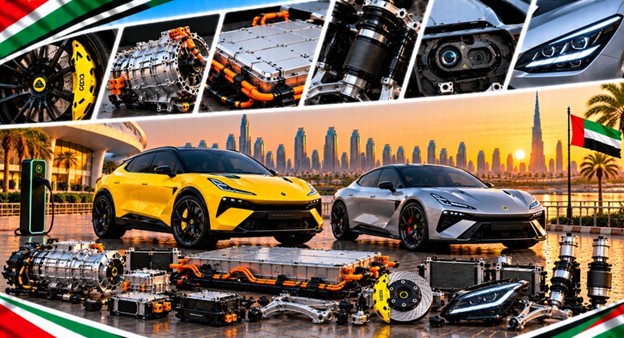
A current dismantler listing shows used Eletre front bumpers from roughly €353 to more than €3,000, with several examples around €600–1,500. At an October 2026 EUR/AED reference of roughly 4.1, that corresponds broadly to around AED 1,450–12,500 before UAE landed costs, depending heavily on the individual part.
That enormous spread is not a typo.
Condition, completeness, exact part number and seller all matter.
It is also why quoting “an Eletre bumper costs AED X” would be nonsense.
Used Emeya Body Parts Require the Same Discipline
Public UAE retail listings for genuine Emeya body panels remain relatively thin, while international suppliers and dismantlers offer a growing range of components.
An Emeya front bumper listed from China, for example, may look inexpensive compared with genuine dealer supply, but its compatibility, material specification, finish, mounting points and actual OEM status need to be established before treating it as a genuine replacement.
The word “replacement” does not mean “original Lotus part”.
That distinction matters.
Wheels Can Become Surprisingly Expensive
The Eletre and Emeya use large wheels, and performance specifications can make replacement rims costly.
A UAE-based supplier currently advertises forged Emeya wheel sets from US$1,760, roughly AED 6,460 before considering the exact configuration, shipping and any UAE taxes or fitting costs.
Specialist European suppliers also list Eletre wheel-and-tyre packages around €4,590–4,790, roughly AED 18,900–19,700 using an approximate October 2026 exchange rate, although these are complete specialist winter wheel sets rather than bare replacement rims.
That is why wheel damage should be assessed alongside tyre, alignment and suspension damage rather than priced as an isolated circle of metal.
Air Suspension Is Another Major Eletre and Emeya Cost Area
The Eletre uses active air suspension, and published specifications for the Emeya likewise identify adaptive air suspension front and rear.
A suspension warning can therefore relate to a compressor, valve system, air spring/strut, height sensor, wiring, control module or calibration issue.
Do not buy a complete air strut simply because the vehicle is sitting low.
First establish why it is sitting low.
A leak and a failed compressor can produce related symptoms while requiring completely different repairs.
What Should a Workshop Check on an Eletre Air-Suspension Fault?
A sensible inspection can include:
- fault codes
- vehicle height readings
- left/right height comparison
- compressor operation
- pressure behaviour
- air leaks
- air lines and connections
- valve-block operation
- ride-height sensors
- wiring and connectors
- suspension strut condition
- control-module communication
- calibration after repair where required
The diagnostic sequence matters because replacing a compressor when an air leak caused it to run excessively is a particularly poor way to spend money.
Why UAE Heat Matters to EV Electronics — But Is Not a Diagnosis
The UAE's heat places real demands on thermal management, air-conditioning and charging systems, but that does not mean every electronic fault should be blamed on temperature.
The Eletre and Emeya have sophisticated battery and thermal-management systems precisely because their high-voltage architecture needs controlled operating conditions.
If charging slows, a warning appears or performance changes, check the vehicle's diagnostic information and thermal-management system rather than assuming the battery has deteriorated.
Climate is context.
It is not a fault code.
What About Charging-System Replacement Costs?
Charging problems can come from the vehicle's charging hardware, communication with the charger, thermal conditions, high-voltage system faults or external charging equipment.
The Emeya's published architecture includes 800 V battery technology and Lotus Hyper Charging, while the current Eletre technical specification lists a 708 V battery architecture and high-power DC charging.
So if a car refuses to charge, the first question should be:
Does the fault follow the car, the charger, or the charging environment?
That distinction can save a great deal of unnecessary parts replacement.
A 12V Battery Problem Can Masquerade as a Much Bigger EV Fault
This is one of the easiest things to overlook.
An EV still relies on low-voltage electrical architecture for many control and communication functions. A weak 12V system can create strange warnings, module communication problems and apparently unrelated electronic symptoms.
That does not mean every warning is caused by the 12V battery.
It means the 12V system should be checked before anyone starts quoting high-voltage components.
The cheap check comes first.
Should You Buy Used Electronic Parts for a Lotus EV?
Sometimes, yes.
But the safest candidates are usually components where compatibility can be confidently established and where failure does not create an immediate high-voltage or safety concern.
For radar, cameras, control modules, charging electronics and high-voltage components, the supplier should provide the exact part reference and compatibility information.
Ask whether the unit has been tested.
Ask what vehicle it came from.
Ask whether programming is required.
Ask about warranty.
Then ask again if the answer sounds vague.
Battery, Motor or Electronics: Which Repair Is Most Expensive?
There is no universal ranking because the scope of each failure varies, but a useful way to think about the Eletre and Emeya is this:
| Component | Public UAE price evidence | What affects the final cost |
|---|---|---|
| High-voltage battery | No reliable current public UAE genuine-pack retail price verified | Battery specification, warranty, diagnosis, replacement procedure |
| Electric drive unit | No reliable current public UAE genuine-unit retail price verified | 600/900, front/rear, exact drive unit, software/configuration |
| High-voltage electronics | No dependable universal UAE price | Module, cooling, charging system, diagnosis and programming |
| Radar/camera | Public pricing varies considerably by component | Hardware revision, calibration, programming |
| Air suspension | No reliable universal UAE OE price verified | Compressor, strut, valve block, sensor, calibration |
| Eletre used front bumper | International listings roughly AED 1,450–12,500 before UAE landed costs | Condition, completeness, part number, freight |
| Emeya forged wheel set | UAE listing around AED 6,460 | Wheel size, design, material, exact application |
| Eletre specialist wheel/tyre set | Around AED 18,900–19,700 equivalent | Tyre specification and wheel configuration |
The table is deliberately uneven. That is reality. Public evidence is much stronger for some physical components than for complete high-voltage assemblies.
What Should You Pay for a Battery Health Diagnosis?
There is no single trustworthy Lotus UAE public diagnostic tariff I would use as a standard.
A proper high-voltage diagnosis is not merely “plug in scanner, print codes, quote battery”.
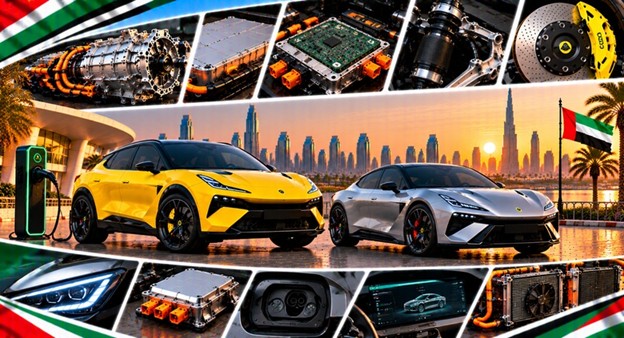
The technician needs the appropriate equipment, information and safety procedures, and the diagnosis should establish whether the fault concerns the battery pack, battery-management system, thermal management, charging system, electrical isolation or another vehicle system.
A cheap diagnosis that leads directly to a wildly expensive unnecessary replacement is not cheap.
When Does a Used EV Battery Make Financial Sense?
Used battery sourcing can make sense when:
- the vehicle is outside relevant warranty coverage;
- the battery has a documented donor history;
- the exact specification is confirmed;
- state of health has been independently assessed;
- the pack has not suffered flood or major impact damage;
- the supplier provides meaningful warranty;
- return conditions are clear;
- installation and testing costs are known.
If several of those conditions are missing, the discount needs to be very large before the gamble becomes rational.
And even then, I would hesitate.
Accident-Damaged Eletre and Emeya EVs Need a Different Parts Inspection
A conventional body repair estimate can miss high-voltage consequences.
After a serious impact, inspect the battery enclosure and surrounding structure, high-voltage wiring, charging hardware, cooling system, drive units and relevant sensors according to manufacturer procedures.
The Eletre and Emeya are heavy, powerful EVs, and their battery packs are integral to the vehicle architecture.
A damaged bumper is cosmetic only if the inspection proves it is cosmetic.
Flood-Damaged EV Parts Are Especially Problematic
A used electronic module from a flood-damaged Eletre may look immaculate after cleaning.
That proves very little.
Water intrusion can affect connectors, circuit boards, sensors, wiring and high-voltage components in ways that are not immediately visible.
For used Lotus EV parts, donor history should therefore be treated as technical evidence, not paperwork decoration.
If the supplier cannot tell you where the component came from, be cautious.
Genuine, OEM-Equivalent and Aftermarket Are Not the Same Thing
For Eletre and Emeya parts, these labels should be separated carefully.
Genuine Lotus means supplied through the manufacturer's parts channel.
Aftermarket means produced outside that channel, with quality and compatibility depending on the manufacturer.
Used genuine means an original component removed from another vehicle, but its history now matters.
Reconditioned means a component has been rebuilt or restored, but the quality of that process needs evidence.
A cheaper label is not automatically a worse part.
But neither is a reassuring label proof of quality.
The Cost of Getting the Wrong Lotus EV Part Is Higher Than It Looks
Suppose an electronic module costs AED 2,000 less online.
It arrives. It physically fits.
Then it does not communicate with the vehicle.
Now there is a return process, another delivery, workshop labour, diagnostic time and potentially a calibration appointment.
The saving has evaporated.
The same problem becomes even more painful with a high-voltage drive unit or battery assembly, because removal and installation are not trivial operations.
Parts buying should therefore be judged by installed cost, not catalogue cost.
How to Identify the Correct Eletre or Emeya Part
For expensive components, send the supplier:
- VIN
- model year
- exact model
- 600 or 900 specification
- production specification
- front/rear location
- existing part number
- photograph of the original component
- relevant diagnostic information where appropriate
For battery and drive-unit enquiries, be even more exact.
“Lotus Eletre 2025” is not enough.
Why the Eletre 900 and Emeya 900 Need Extra Care
The high-output 900 variants are not simply 600 cars with software turned up.
Lotus publishes different transmission arrangements and substantially higher output: the Eletre 900 and Emeya 900 reach 905 hp/918 PS and 985 Nm, with two-speed rear transmission arrangements in the specified 900 configurations.
That has obvious implications for drivetrain components.
A used 600 drive unit should not be assumed to be an appropriate substitute for a 900 unit simply because both cars wear the same badge.
Why the Warranty Should Be Checked Before Every Major EV Parts Purchase
The Eletre has a published five-year/150,000 km basic warranty, with eight-year/200,000 km coverage for its battery and electric-drive systems and a 70% minimum battery state-of-health guarantee.
The Emeya carries the same broad five-year/150,000 km basic coverage and eight-year/200,000 km high-voltage coverage, again with the 70% battery-health guarantee.
Grey-import vehicles deserve particular attention because warranty eligibility can depend on the vehicle's market and applicable terms.
Before spending thousands on a used motor or battery, check the VIN and warranty position.
It could save the entire repair budget.
The Right UAE Repair Strategy for Lotus Eletre and Emeya
Start with diagnosis.
Then identify the failed system.
Then establish the exact component.
Then check warranty.
Only after that should you compare new genuine, used genuine, reconditioned and aftermarket options.
For buyers comparing Lotus EV parts through PartFinder UAE, that sequence matters because a cheaper component is useful only if it is actually the component the vehicle needs, is compatible with its specification, can be installed correctly and comes with enough protection to make the saving meaningful.
That is the difference between sourcing a part and solving a repair.
The Practical Lotus EV Parts Checklist
Before approving an expensive Eletre or Emeya repair, ask:
Vehicle
- What exact model year is it?
- Is it Eletre or Emeya?
- Is it 600 or 900?
- What is the VIN?
Battery
- What evidence shows the battery itself has failed?
- What is the reported state of health?
- Is the issue inside warranty?
- Is the proposed replacement complete or modular?
- What is the donor history if used?
Motor/drive unit
- Front or rear?
- 600 or 900?
- Exact part number?
- Single-speed or two-speed arrangement?
- Has the unit been tested?
Electronics
- What module has actually failed?
- Does the replacement require programming?
- Does it require calibration?
- Has compatibility been confirmed?
Body
- Are sensors, cameras and wiring included?
- Are brackets intact?
- Has hidden structural damage been checked?
- Does the part require painting?
Commercial
- Is VAT included?
- Is delivery included?
- What is the warranty?
- What is the return policy?
- What is the installation cost?
- What happens if the part does not work?
Those questions may feel excessive when the car is sitting in a workshop with a warning light glowing on the dashboard. They are not. They are the difference between buying a component and buying the right component.
The sensible rule is simple: diagnose the system, identify the exact component, check warranty, verify the VIN and part number, then compare the complete installed cost. Anything else is gambling with a very expensive car.
FAQ: Lotus Eletre and Emeya EV Parts in UAE
Categories
- Audi
- BMW
- Car Accessories
- Car Tips
- Ford
- Land Rover
- Mazda
- Range Rover
- Top 10
- UAE Car Parts
- Used Car Parts
- Toyota
- Replacement Engines
- Nissan
- Hyundai
- Mitsubishi
- Volkswagen
- Honda
- Kia
- Chevrolet
- Dodge
- Jeep
- Subaru
- Renault
- Lexus
- Mercedes
- Suzuki
- Hummer
- Porsche
- Infiniti
- Peugeot
- GMC
- Mini
- Volvo
- Replacement Gearboxes
- MG
- Jaguar
- Skoda
- Cadillac
- Daihatsu
- Fiat
- German Car Parts
- Japanese Car Parts
- Aftermarket Car Parts
- Genuine Car Parts
- New Car Parts
- Reconditioned Car Parts
- European Car Parts
- American Car Parts
- Korean Car Parts
- British Car Parts
- Chinese Car Parts
- Sports/Exotic Car Parts
- Luxury Car Parts
- Performance Car Parts
- SUV/4x4 Spare Parts
- Truck Spare Parts
- EV Car Parts
- Hybrid Car Parts
- Auto Spare Parts in UAE
- Tesla
- Isuzu
- Ram
- Ferrari
- Bentley
- Lamborghini
- Genesis
- Maserati
- Lincoln
- Chrysler
- Opel
- Citroen
- SsangYong
- Seat
- McLaren
- Aston Martin
- Rolls Royce
- Maybach
- Alfa Romeo
- Bugatti
- Scion
- Abu Dhabi Car Parts
- Ajman Car Parts
- Al Khan Car Parts
- Al Sajaa Car Parts
- Deira Car Parts
- Dubai Car Parts
- Fujairah Car Parts
- Industrial Area 6 Car Parts
- Mussafah Car Parts
- Ras Al Khaimah Car Parts
- Sharjah Car Parts
- Umm Al Quwain Car Parts
- Acura
- BYD
- Chery
- Dacia
- DS
- Geely Emgrand
- EXEED
- GAC
- GAC Gonow
- Geely
- Gonow
- Great Wall
- Haima
- Haval
- Holden
- Iveco
- JAC
- Jaecoo
- Jetour
- Lotus
- Omoda
- Proton
- Renault Samsung
- Roewe