Lucid Accident Repair Costs in UAE: Headlights, Bumpers, Cameras and ADAS Sensor Replacement
October 14, 2026
A Lucid accident can look wonderfully cheap from ten metres away.
There is a crack in the bumper. One headlight is broken. The bonnet has acquired the sort of crease that makes insurance assessors reach for a clipboard. Perhaps a door is scraped. Fine. Bodywork. Paint. Replace a few bits. Everyone goes home.
Then somebody removes the bumper.
And there, hiding behind the thing that was supposed to be the expensive bit, are cameras, radar, ultrasonic sensors, wiring, brackets, mounting points and other electronic hardware. The Lucid Air's DreamDrive system uses as many as 20 sensors and cameras in its base configuration, 24 in DreamDrive Premium, with DreamDrive Pro adding forward-facing LiDAR; Gravity's DreamDrive 2 uses 23 sensors and cameras in Premium and 34 in Pro.
Suddenly “replace the bumper” sounds rather less convincing.
That is the real problem with Lucid accident repair in the UAE. The visible damage is often the least interesting part of the quotation.
The Bumper Is Rarely Just the Bumper
A bumper cover has traditionally been one of those wonderfully uncomplicated pieces of a car.
It gets scratched. You paint it.
It gets cracked. You replace it.
On a modern Lucid, that old logic can still work — but only when the collision has been genuinely superficial.
The Air's DreamDrive hardware includes radar, ultrasonic sensors and multiple cameras around the vehicle, while DreamDrive Pro can add forward-facing LiDAR. Gravity's DreamDrive 2 similarly spreads sensing hardware around the vehicle, with the exact quantity and type dependent on whether the car has Premium or Pro.
So after an accident, the workshop has to ask what happened behind the bumper.
That is where the bill starts.
Why a Lucid Accident Quote Can Change After Dismantling
The first estimate is often based on what can be seen.
Fair enough.
The problem is that impact energy does not politely stop at the edge of a cracked plastic panel. It travels through brackets, mounts, body structures, wheels, suspension and whatever else happens to be in its way.
Lucid says Gravity uses an ultra-strong single-piece aluminium body with engineered crumple zones designed to absorb and distribute crash energy away from occupants and critical components.
That is precisely why a proper inspection matters.
A damaged panel tells you where the accident happened.
It does not tell you everything the accident did.
Headlights Are Where the Simple Repair Starts Getting Expensive
A headlamp is an obvious casualty.
It is also a terrible part to price from a photograph.
You need the exact vehicle, model year, trim and lamp specification, because modern lighting assemblies can contain their own electronics and mounting hardware, while the surrounding bodywork may also have been disturbed.
The sensible inspection covers:
- lens and housing;
- mounting tabs;
- connectors;
- wiring;
- internal moisture;
- control hardware where applicable;
- surrounding body structure.
A used lamp with a clean lens can still be damaged internally.
It happens.
Used Lucid Headlights Can Make Financial Sense
There is no rule saying an accident repair must contain only new Lucid spare parts in UAE.
For an older Lucid, a tested used genuine headlamp can be an entirely rational option, particularly when the new replacement is expensive or difficult to source.
But the evidence needs to be stronger than “it came off another Air”.
Ask for the exact part reference.
Ask which vehicle it came from.
Ask whether it has been tested.
Ask whether the electronics are included.
Ask about water ingress.
Ask about warranty and returns.
If the seller becomes strangely vague at this point, you have learned something useful.
The Headlight Must Be Matched to the Car
Lucid's current Air range is not one mechanical specification. The UAE range includes Pure, Touring, Grand Touring and Sapphire variants, with materially different powertrain configurations and equipment.
That matters because a parts listing that says simply “Lucid Air headlight” is not necessarily enough to identify the correct assembly.
The same principle applies to Gravity.
A VIN is much more useful than a model name.
And a part number is more useful than a photograph.
Bumper Damage Needs a Second Look
The outer bumper can be damaged while the sensor hardware behind it remains untouched.
Or the opposite can happen.
The plastic may look surprisingly healthy while a bracket, connector or sensor mounting point has been shifted.
That is why the inspection should go from outside to inside.
Panel.
Mounting.
Hardware.
Wiring.
Sensor.
System.
Only then should the repair be signed off.
The Cheap Bumper Problem
Imagine two quotations.
One says:
Used bumper: AED 2,000.
Another says:
New bumper: AED 4,000.
It looks like an easy decision.
Except the used bumper needs paint, fitting, replacement clips and a damaged sensor bracket that was not included in the seller's photograph.
The new bumper may arrive complete enough to reduce some of that work.
Now the AED 2,000 saving has become considerably less impressive.
The relevant figure is therefore not the bumper price.
It is the finished repair price.
Body Panels Are Usually the More Sensible Place to Save
A door, bonnet, wing or bumper cover is fundamentally different from a camera or ADAS control component.
If the panel is genuine, undamaged, correctly identified and repairable or paintable, a used part can be attractive.
Inspect it for:
- previous accident repair;
- distortion;
- damaged mounting points;
- excessive filler;
- poor paint;
- cracks;
- incorrect specification.
The UAE's strong used-parts market can make this route worth investigating, particularly for older vehicles.
But cheap bodywork still needs to be good bodywork.
Aluminium Changes the Repair Question
Gravity's body uses a single-piece aluminium structure.
That means serious accident repair should not be treated as though every damaged section were simply a piece of conventional steel sheet that can be persuaded back into shape.
The workshop needs to establish whether the damaged component is repairable and whether the appropriate repair method can restore the vehicle properly.
There is a difference between:
“It looks straight.”
and
“It has been correctly repaired.”
The second sentence is the one that matters.
Cameras Are Small Until They Stop Working
A camera can be physically tiny.
Its consequences are not.
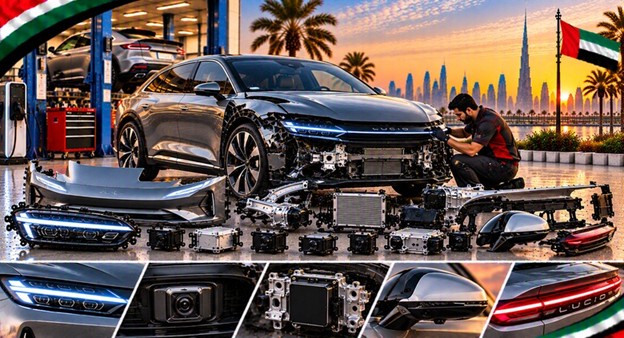
The Air's DreamDrive architecture uses cameras for functions including surround-view monitoring, driver assistance and other safety-related features, while Gravity's DreamDrive 2 uses six exterior/interior camera systems in Premium and 14 in Pro.
So after a collision involving a mirror, bumper, windscreen area or body corner, the camera system deserves attention.
The camera itself may be undamaged.
Its mounting may not be.
And if the camera has moved, the car may not know exactly where the world is anymore.
That is rather important.
A Camera Fault Does Not Automatically Mean a Dead Camera
This is one of the easiest ways to waste money.
A camera-related warning appears.
Someone orders a replacement camera.
The warning remains.
Then somebody finally checks the wiring, connector, mounting position or calibration.
The original camera was fine.
The repair bill was not.
A diagnostic code is evidence.
It is not always a shopping list.
Radar Is Even Less Forgiving
Lucid's Air DreamDrive hardware includes short- and long-range radar and ultrasonic sensors, with DreamDrive Pro adding forward-facing LiDAR.
Gravity's DreamDrive 2 similarly uses short- and long-range radar and ultrasonic sensors, while Pro adds LiDAR.
After an accident, these systems need more than a visual inspection.
The sensor might survive.
The bracket might not.
The bracket might survive.
The alignment might not.
The alignment might be correct.
The wiring might not.
That is why replacing radar merely because the dashboard complains is not a particularly sophisticated diagnostic method.
LiDAR Makes the Repair Conversation More Interesting
DreamDrive Pro on both vehicle families introduces forward-facing LiDAR capability.
For Gravity, Lucid describes DreamDrive 2 Pro as the most advanced ADAS level, with 34 sensors and cameras and additional functionality beyond Premium.
This matters when assessing a damaged vehicle because two cars carrying the same badge may not contain the same sensor hardware.
A parts seller needs to know which one you have.
Again, the VIN earns its keep.
The Same Accident Can Cost Two Owners Different Amounts
Take two Lucid Gravity vehicles.
Same model.
Same bumper damage.
One has DreamDrive 2 Premium.
The other has DreamDrive 2 Pro.
The hardware content is not identical: Lucid lists 23 sensors and cameras for Premium and 34 for Pro.
So the repair path may not be identical either.
This is why generic online accident-repair prices should be treated as benchmarks, not promises.
ADAS Calibration Is Part of the Repair
There is a slightly absurd habit in accident repair of treating calibration as some optional electronic afterthought.
It isn't.
If a camera or sensor has been removed, replaced or disturbed, the appropriate system procedure needs to be established.
Lucid's own documentation makes clear that DreamDrive depends on a network of sensors and cameras feeding onboard computers.
The car therefore needs those sensors to be installed correctly and functioning correctly.
A perfectly painted bumper is not proof of a correctly restored driver-assistance system.
There Is No Honest Universal UAE “Lucid ADAS Calibration Price”
This is another place where fake precision would be easy.
You can find general UAE ADAS calibration quotations in the hundreds of dirhams, with more complex multi-system jobs costing considerably more.
But that does not establish a universal Lucid Air or Gravity tariff.
The actual requirement depends on:
- which sensor or camera was affected;
- whether its mounting was disturbed;
- whether the component was replaced;
- the vehicle's DreamDrive configuration;
- the required procedure;
- diagnostic and calibration equipment;
- whether additional repair is needed.
So ask for the calibration requirement as part of the repair quotation.
Do not assume every collision needs the same procedure.
A Windshield Repair Can Become an ADAS Issue
This is one of the less obvious accident-repair problems.
A collision may not damage the front bumper at all.
Instead, the windscreen is replaced.
If the vehicle's camera hardware is mounted in or around that area, the replacement can have consequences for the driver-assistance system.
The workshop should therefore establish whether camera calibration or system verification is required after the particular windscreen work.
The glass may be new.
The software still needs to understand what it sees through it.
Mirrors Can Hide Cameras Too
The side mirror is another deceptively innocent component.
It gets clipped.
The housing cracks.
The owner orders a replacement.
But modern driver-assistance systems can use cameras mounted around the sides of the vehicle, and Lucid's documentation shows cameras distributed around Air and Gravity depending on DreamDrive level.
So after mirror damage, check what equipment is actually fitted to that particular car.
A mirror is not always just glass, plastic and a folding motor anymore.
The Gravity's Air Suspension Adds Another Layer
Gravity's adjustable air suspension is one of the vehicle's defining mechanical features. Lucid says it can raise the vehicle for certain conditions or lower it to improve aerodynamic efficiency.
After an accident, that makes suspension inspection especially important.
If the car sits low on one side, don't simply order an air-suspension component.
Establish whether the problem comes from the suspension itself, a sensor, the pneumatic system, associated control hardware or impact damage elsewhere.
A low corner is a symptom.
It is not a diagnosis.
Wheel Damage Can Become Suspension Damage
This is where accident repair needs a little common sense.
A kerb strike bends the wheel.
Fine.
But what did the force do next?
Tyre.
Hub.
Bearing.
Suspension arm.
Steering.
Alignment.
Possibly body mounting points.
The wheel is merely the thing you can see.
After a significant impact, a proper inspection should follow the force rather than stopping at the most obvious damaged object.
Gravity's Large Wheels Make This More Important
Gravity can be configured with 20/21-inch wheels as standard, with 21/22 and 22/23 combinations available. The current UAE configurator prices the 21/22 option at AED 6,825 above the base wheel configuration and the 22/23 Aether option at AED 13,650.
Those option prices are not replacement-wheel retail prices.
They do, however, show why the exact wheel specification matters.
If you need a replacement after an accident, don't ask for “a 23-inch Gravity wheel”.
Ask for the exact design and specification.
Paint Can Turn a Cheap Body Part Into a Proper Repair Bill
A used door may cost much less than a new one.
Then the painter gets involved.
The colour is slightly different.
The panel needs preparation.
The adjacent panel needs blending.
The trim needs transferring.
The clips are damaged.
Suddenly the body panel itself is only part of the bill.
This is why used body parts should be compared on a finished-repair basis.
Otherwise you're comparing a naked panel with a painted, fitted car.
Headlight, Bumper and Camera Damage Often Travel Together
Front-end accidents are particularly troublesome because several systems occupy the same territory.
A bumper gets pushed.
A headlamp breaks.
A camera bracket moves.
A radar sensor reports a fault.
The workshop replaces the obvious components and then discovers that the electronic system still needs attention.
This is why front-end collision repair should be treated as a sequence rather than a shopping list.
First establish what moved.
Then what broke.
Then what needs replacing.
Then what needs calibration.
Rear Accidents Are Not Automatically Simple Either
The same logic applies at the back.
A rear bumper can conceal ultrasonic sensors, cameras and other equipment, depending on the vehicle specification.
Gravity's DreamDrive 2 system includes rear cross-traffic protection, rear pedestrian collision protection, rear parking protection and surround-view functions depending on configuration.
So a rear bumper replacement deserves the same scrutiny as the front.
A car can have a beautiful new rear bumper and still have a system fault lurking underneath it.
Why Used ADAS Sensors Need Much Stronger Evidence
I am far more comfortable with a used genuine door than a used ADAS sensor.
That is not because used sensors are automatically bad.
It is because their job is different.
A door has to open, close and look right.
A sensor has to measure the environment accurately enough for systems designed to warn or intervene.
That means a used sensor needs proper identification and evidence of condition.
If the supplier cannot tell you where it came from or whether it has been tested, the low price is not enough.
The Same Applies to Cameras
A used camera can potentially be a sensible repair component.
But ask:
Is it the correct camera?
Is the lens undamaged?
Are the mounting points intact?
Is the connector sound?
Has it been tested?
Does the vehicle require calibration after installation?
What warranty comes with it?
If those questions cannot be answered, you are not comparing two camera prices.
You are comparing certainty with uncertainty.
A Genuine Part Can Still Be the Wrong Part
This is an easy mistake because “genuine” sounds reassuring.
But a genuine Lucid component intended for one configuration is not automatically correct for another.
Gravity's DreamDrive 2 Premium has 23 sensors and cameras; Pro has 34. Air's DreamDrive configurations also vary, from the pre-2025 base system through Premium and Pro.
So the correct order is:
VIN → configuration → part number → component.
Not:
Lucid badge → photograph → purchase.
The UAE Warranty Should Be Checked Before the Credit Card
Lucid's Middle East warranty provides four years/80,000 km for the vehicle, eight years/160,000 km for the powertrain and high-voltage battery, with the battery covered to 70% capacity; body and paint are listed at four years/unlimited kilometres, while SRS coverage is five years/100,000 km.
That matters enormously when an accident or component fault occurs.
Warranty does not mean every collision repair is covered. Accident damage and normal exclusions remain relevant.
But a buyer should establish the warranty position before privately sourcing an expensive powertrain, battery or electronic component.
There is little point spending AED thousands first and asking the warranty question afterwards.
Lucid's Current UAE Service Support Matters Too
Lucid provides UAE customer-care and service support, with a UAE customer-care number and Dubai sales contact published on its regional site.
For accident repairs involving high-voltage systems, sophisticated electronics or uncertain warranty status, knowing where the official support route sits is useful.
Independent repair can still be relevant.
But the more complicated the system, the more important it becomes to know what level of equipment and training the workshop actually has.
What a Proper Accident Inspection Should Look Like
For a meaningful collision, I would expect the repair process to move roughly like this:
Visible damage.
Then:
mounting points and body structure.
Then:
lights and wiring.
Then:
cameras, radar and ultrasonic hardware.
Then:
wheels, tyres and suspension.
Then:
diagnostics.
Then:
calibration or system verification where required.
Not every vehicle needs every step.
But the workshop should be able to explain why a particular step is or is not necessary.
That is the important bit.
Don't Let a Fault Code Become a Parts Order
This deserves another warning because modern cars make it very tempting.
The scanner reports a sensor-related fault.
A sensor is ordered.
The fault returns.
The technician discovers the wiring was damaged in the accident.
Now there is a sensor sitting on a shelf and another labour charge on the bill.
Diagnostics should narrow the fault.
They should not simply identify the nearest expensive component.
The Cost of Getting the Wrong Part Is More Than the Part
A wrong component can create:
- delivery costs;
- return shipping;
- lost workshop time;
- second fitting labour;
- vehicle storage;
- additional diagnostics;
- calibration delays;
- paint delays;
- insurance complications.
And on a relatively low-volume luxury EV, sourcing another correct component may not happen overnight.
This is why VIN verification is not an administrative detail.
It is cost control.
What Parts Are Most Suitable for Used Sourcing?
For an accident-damaged Lucid, the most obvious used-part candidates are generally the components where condition can be physically established and the risk of hidden electronic failure is lower.
That may include:
body panels
bumper covers
trim
certain interior components
wheels after inspection
some lighting assemblies, with proper testing
The further you move into ADAS and safety electronics, the more demanding the evidence should become.
What Parts Should Be Treated With the Most Suspicion?
I'd put these near the top of the caution list:
ADAS cameras
radar
LiDAR
electronic control modules
high-voltage components
drive units
restraint-system components
electronically controlled suspension hardware
A used component is not automatically unsuitable.
An undocumented component is.
What Should a UAE Repair Quote Actually Include?
Ask the workshop to separate:
| Cost | Why it matters |
|---|---|
| Parts | New, used or alternative |
| Delivery | Local or imported |
| VAT | Changes the final bill |
| Labour | Removal and installation |
| Paint | Body-panel repairs |
| Diagnostics | Fault identification |
| Programming/configuration | Electronic components |
| Calibration | ADAS/camera/sensor systems |
| Alignment | Wheel/suspension damage |
| Warranty | Protection after repair |
| Additional damage | Discovered during dismantling |
That makes competing quotations much easier to compare.
The cheapest quote is not necessarily the cheapest repair.
It may simply be the one that has forgotten the most lines.
Lucid Accident Repair Prices: What Can Actually Be Said?
There is no defensible universal UAE retail price for a Lucid Air or Gravity bumper, headlamp, radar, camera or LiDAR unit based on the public evidence available in October 2026.
That does not mean accident repairs cannot be priced.
It means they need to be priced by vehicle and component.
For general UAE context, independent ADAS businesses commonly advertise calibration from several hundred dirhams, while more complex calibration packages can run into the low thousands. These are broad UAE market benchmarks, not Lucid-specific tariffs.
Likewise, bodywork, paint and structural repairs vary heavily with the severity and location of the impact.
A precise number without a precise car and damage assessment would be false precision.
Air Versus Gravity: Accident Costs Do Not Behave Identically
The Air is a low luxury saloon with DreamDrive sensor configurations ranging from 20 to 24 sensors and cameras, plus LiDAR on Pro.
Gravity is a much larger SUV with 23 or 34 sensors and cameras depending on DreamDrive 2 configuration, adjustable air suspension and wheel packages reaching 23 inches.
So a collision involving the same-looking corner of each car can produce quite different repair requirements.
Air:
lighting, bodywork, sensors, cameras, suspension and low-mounted hardware.
Gravity:
all of that, plus SUV-specific body structure, air suspension and larger wheel/tire considerations.
Same manufacturer.
Very different repair puzzle.
The Gravity's Published Equipment Shows Why Trim Matters
The current UAE Gravity configurator offers DreamDrive 2 as standard, with Premium at AED 5,775 and Pro at AED 26,250. The Pro system adds hardware and features beyond Premium.
Again, those are option prices, not accident-repair prices.
But they show why a generic “Gravity sensor” listing is not enough.
The equipment level changes.
The hardware can change.
The repair requirement can change.
The VIN settles the argument.
The Same Goes for Wheels
The current Gravity configurator shows the 21/22-inch Orion option at an additional AED 6,825 and the 22/23-inch Aether option at AED 13,650 over the base wheel specification.
If a wheel is damaged, therefore, the replacement should be matched to the exact design and configuration.
And after a significant wheel impact, inspect the tyre and suspension before declaring victory.
A replacement wheel can make the photograph look perfect.
It cannot straighten a bent suspension arm.
Why the Finished Repair Is More Important Than the Parts List
Imagine the accident quotation says:
Bumper — AED 3,000
Headlamp — AED 5,000
Camera — AED 2,000
You now have AED 10,000 worth of parts.
You do not yet have a repaired car.
You may still need:
paint
fitting
brackets
diagnostics
calibration
alignment
VAT
additional damaged components
This is why, when comparing accident parts through PartFinder UAE, the useful question is not simply “Which supplier has the lowest component price?” It is “Which route gives me the lowest credible cost for returning the car to proper working order?”
That is the number worth chasing.
A Sensible Lucid Accident-Repair Decision Matrix
| Damaged component | Used part | New part | Main thing to verify |
|---|---|---|---|
| Door | Often sensible | Useful where availability is good | Structure, fit, paint |
| Bonnet | Often sensible | Compare total cost | Alignment, condition |
| Bumper cover | Can make sense | Compare finished repair | Brackets, sensors |
| Headlight | Possible | Safer price certainty | Exact lamp, electronics |
| Wheel | Possible after inspection | Good for high-value specification | Damage, design, offset |
| Camera | High caution | Prefer verified source | Compatibility/calibration |
| Radar | High caution | Prefer verified source | Exact hardware/alignment |
| LiDAR | Very high caution | Specialist route | Hardware/software |
| ADAS module | High caution | Specialist route | Configuration |
| Air suspension | Diagnosis first | Compare after diagnosis | Cause of failure |
| HV components | Specialist only | Warranty first | Safety and compatibility |
The Repair Should End With the Systems Working, Not the Paint Shining
This is the point at which accident repair often goes wrong.
The car looks magnificent.
The bumper is straight.
The paint matches.
The wheel is new.
Everyone takes photographs.
But the warning light remains.
Or the camera has not been calibrated.
Or the sensor is reporting a fault.
Or the suspension is still sitting incorrectly.
A repaired Lucid should be judged by what it does, not merely by what it looks like.
That is especially true when the damaged vehicle carries dozens of sensors and cameras whose job is to interpret the road around it.
UAE Update Reference: October 2026
The sensible way to repair a Lucid after an accident is to resist the temptation to price what you can see. Inspect what sits behind it. Diagnose before ordering. Match every electronic component to the vehicle. Then price the complete repair, including calibration and all the awkward little things that tend to appear once the bumper comes off.
That is how you avoid paying twice for the same accident.
FAQ
Categories
- Audi
- BMW
- Car Accessories
- Car Tips
- Ford
- Land Rover
- Mazda
- Range Rover
- Top 10
- UAE Car Parts
- Used Car Parts
- Toyota
- Replacement Engines
- Nissan
- Hyundai
- Mitsubishi
- Volkswagen
- Honda
- Kia
- Chevrolet
- Dodge
- Jeep
- Subaru
- Renault
- Lexus
- Mercedes
- Suzuki
- Hummer
- Porsche
- Infiniti
- Peugeot
- GMC
- Mini
- Volvo
- Replacement Gearboxes
- MG
- Jaguar
- Skoda
- Cadillac
- Daihatsu
- Fiat
- German Car Parts
- Japanese Car Parts
- Aftermarket Car Parts
- Genuine Car Parts
- New Car Parts
- Reconditioned Car Parts
- European Car Parts
- American Car Parts
- Korean Car Parts
- British Car Parts
- Chinese Car Parts
- Sports/Exotic Car Parts
- Luxury Car Parts
- Performance Car Parts
- SUV/4x4 Spare Parts
- Truck Spare Parts
- EV Car Parts
- Hybrid Car Parts
- Auto Spare Parts in UAE
- Tesla
- Isuzu
- Ram
- Ferrari
- Bentley
- Lamborghini
- Genesis
- Maserati
- Lincoln
- Chrysler
- Opel
- Citroen
- SsangYong
- Seat
- McLaren
- Aston Martin
- Rolls Royce
- Maybach
- Alfa Romeo
- Bugatti
- Scion
- Abu Dhabi Car Parts
- Ajman Car Parts
- Al Khan Car Parts
- Al Sajaa Car Parts
- Deira Car Parts
- Dubai Car Parts
- Fujairah Car Parts
- Industrial Area 6 Car Parts
- Mussafah Car Parts
- Ras Al Khaimah Car Parts
- Sharjah Car Parts
- Umm Al Quwain Car Parts
- Acura
- BYD
- Chery
- Dacia
- DS
- Geely Emgrand
- EXEED
- GAC
- GAC Gonow
- Geely
- Gonow
- Great Wall
- Haima
- Haval
- Holden
- Iveco
- JAC
- Jaecoo
- Jetour
- Lotus
- Omoda
- Proton
- Renault Samsung
- Roewe
- Lucid