Lucid Gravity Parts in UAE: Replacement Costs for Lights, Sensors, Air Suspension and Body Panels
October 14, 2026
The Lucid Gravity has a rather unfortunate relationship with the phrase “it’s only bodywork.”
A front bumper gets damaged. A headlight cracks. One corner of the car sits lower after an impact. Somebody looks at the damage, rubs their chin and announces a price for the visible Lucid Gravity parts in UAE.
Then the bumper comes off.
And suddenly there are sensors, wiring, brackets, camera hardware, suspension components, wheel damage and calibration questions sitting underneath the bit of plastic everyone thought was the whole problem.
This is what makes Gravity repair costs in the UAE difficult to reduce to a tidy list of AED figures. The car itself starts at AED 372,225 for the 560 hp Touring and AED 435,855 for the 828 hp Grand Touring, while its equipment can include adjustable air suspension, 20–23-inch wheels and DreamDrive 2 driver-assistance hardware.
It is a large electric SUV, then, but not a simple one.
And if yours has been damaged, the important question is not how much is a bumper? It is what else did the bumper take with it?
The Gravity Is Expensive Before You Have Broken Anything
There is a useful psychological trap with expensive cars.
People assume that because the vehicle costs a great deal, every component must therefore have some absurd price attached to it. That is not necessarily true. A cabin filter is still a cabin filter. A tyre is still a tyre. A piece of plastic trim does not become plutonium merely because it has been clipped onto an expensive SUV.
The problem comes when that apparently ordinary component is carrying something important.
The Gravity's current UAE range starts at AED 372,225 for Touring and AED 435,855 for Grand Touring, with AWD, up to seven seats and up to 828 hp.
That is the context.
The part price still needs to be established separately.
Touring and Grand Touring Are Not One Giant Parts Specification
The current Gravity Touring produces 560 hp, while Grand Touring reaches 828 hp. The published UAE configurator also shows different wheel packages, including 20/21-inch, 21/22-inch and 22/23-inch combinations.
So “Gravity parts” is not precise enough.
For a body panel, perhaps the difference is obvious.
For a wheel, suspension component, sensor, electronic module or drivetrain component, it may not be.
A proper supplier should want the VIN.
That is not bureaucracy for its own sake. It is how you stop an expensive vehicle turning into an expensive pile of incompatible parts.
The Real Cost of a Gravity Accident Starts Behind the Bumper
Imagine a fairly ordinary UAE parking accident.
Someone clips the front corner.
The bumper is scratched and cracked. The headlight is damaged. The bonnet still opens. The car drives away.
You might reasonably think this is a bumper-and-headlamp job.
Perhaps it is.
But the Gravity's safety architecture includes DreamDrive 2 and a sophisticated sensor suite, while the vehicle's structure uses a single-piece aluminium body with engineered crumple zones.
So the inspection needs to go deeper than paintwork.
Look behind the visible damage.
That is where the expensive surprises live.
Bumper Damage Is a Starting Point, Not a Diagnosis
The bumper cover itself can be relatively straightforward to replace.
The difficult question is what has happened to everything attached to, behind or around it.
A workshop should inspect mounting points, brackets, wiring, cameras, sensors and any adjacent structural or cooling components before the final repair scope is agreed.
If the car has been struck hard enough to move the bumper, something else may have moved too.
Sometimes nothing has.
The point is that you need to establish which situation you are dealing with.
Why a Used Gravity Bumper Can Make Sense
This is one of the more interesting areas of the UAE parts market.
A used genuine bumper can potentially save money on an older or accident-damaged Gravity, particularly if the replacement part is straight, undamaged and correctly specified.
But the calculation needs to include paint and fitting.
And then there is the awkward matter of everything attached to it.
If the used bumper has damaged mounting points, missing brackets or different provisions for sensors or cameras, its advertised price stops being especially interesting.
A cheap bumper is only cheap until the bodyshop starts rebuilding it.
Body Panels Are Usually Easier to Understand
Doors, wings, bonnet panels and other exterior panels are comparatively simple propositions.
That does not mean they are trivial.
A used panel needs inspection for previous repairs, corrosion where applicable, distortion, mounting damage and poor-quality paintwork. Colour matching is another issue, particularly with metallic finishes and when the vehicle has already spent years in the UAE sun.
Still, compared with a radar sensor or high-voltage component, bodywork is refreshingly understandable.
Metal bends.
Paint scratches.
You fix it.
Usually.
Aluminium Changes the Accident-Repair Conversation
Gravity's body construction uses a single-piece aluminium body structure.
That matters after a serious impact.
Aluminium repair is not simply a case of treating every damaged panel as though it were a conventional steel body panel. The workshop needs appropriate repair methods and should establish whether a panel is repairable or whether replacement is the better route.
The important question is not:
Can somebody make it look straight?
It is:
Can the repaired structure be returned to the correct condition?
Those are not necessarily the same thing.
Headlights Are Where the Parts Bill Can Suddenly Become Interesting
A broken headlight looks wonderfully simple.
It isn't always.
Modern lighting assemblies can contain electronics, control hardware and sophisticated light functions, while Gravity's specification includes advanced driver-assistance equipment around the vehicle.
So before buying a used headlamp, establish the exact part number and specification.
Then inspect it.
Has the housing been cracked?
Is there moisture inside?
Are the mounting tabs intact?
Is the connector undamaged?
Is the control hardware included?
Has the lamp already been repaired?
A photograph showing a shiny headlamp on a dismantler's shelf answers almost none of those questions.
The Headlamp Price Is Not the Headlamp Repair Cost
Suppose a used lamp is AED 2,500.
Wonderful.
Now add delivery.
Then fitting.
Then any missing module.
Then configuration or calibration if the vehicle requires it.
Then discover the original accident also damaged a mounting point.
The number has changed.
This is why a parts buyer should compare installed cost, not simply advertised component price.
That sounds obvious.
It is surprisingly often ignored.
Gravity's 20–23-Inch Wheels Are Not Decorative
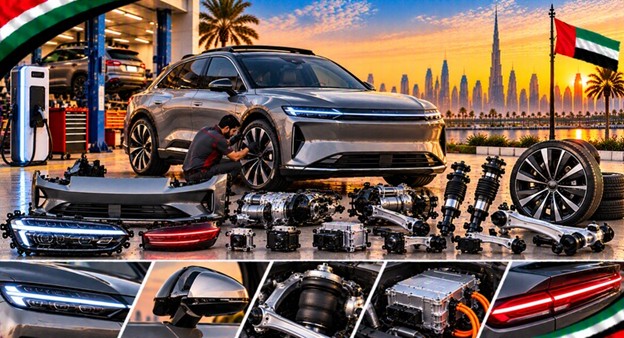
The Gravity can be configured with wheels ranging from 20 to 23 inches, including staggered combinations such as 20-inch front/21-inch rear and 22-inch front/23-inch rear.
Those wheels look magnificent.
They also have considerably less tolerance for casual treatment than a small, thick-sidewall wheel.
After a hard pothole or kerb strike, inspect the wheel and tyre together.
A wheel can look perfectly acceptable and still deserve checking for deformation.
And if there is a vibration afterwards, do not assume balancing is automatically the answer.
Suspension and alignment need looking at too.
The Tyre Can Hide the Evidence
This is one of those mundane details that matters after an accident.
A tyre can sustain internal damage without presenting an enormous dramatic hole.
So if a Gravity has taken a serious wheel impact, inspect the tyre sidewall and inner structure as appropriate, then check the wheel, hub and suspension.
The wheel is not an isolated object.
It is the last visible part of a chain of components transferring force into the car.
Air Suspension Is the Gravity's Big Mechanical Complication
Here is where Gravity ownership becomes rather different from owning a conventional SUV.
Lucid specifies adjustable air suspension, allowing the vehicle to alter ride height for different conditions and aerodynamic efficiency.
So if one corner is sitting low after an accident, do not immediately order an air-suspension component.
Find out why it is low.
That could involve the air system, suspension hardware, sensing, control or damage caused elsewhere.
The visible symptom tells you something.
It does not tell you which part to buy.
A Low Corner Is Not a Part Number
This deserves repeating because it is exactly the sort of thing that produces unnecessary bills.
Gravity is sitting unevenly.
Fine.
Measure and inspect it.
Do not simply replace the most expensive-looking suspension component.
A proper investigation should establish whether the issue is mechanical, pneumatic, electrical, sensor-related or associated with impact damage.
If the vehicle has been in an accident, wheel alignment and suspension geometry deserve attention as well.
You want the cause.
Not merely a component that happens to disappear when the car is put on a lift.
Air Suspension Repair Has More Than One Price
When somebody says:
“The air suspension will cost AED X.”
Ask what that includes.
Does it cover the component?
Labour?
Diagnosis?
Alignment?
Any required calibration?
Programming?
Additional damaged hardware?
That distinction matters because a suspension component can be only one part of the repair.
A quotation that looks cheap because it excludes everything around the part is not really cheap.
It is incomplete.
Sensors Are the Other Big Gravity Expense
This is where modern cars have become slightly ridiculous.
A bumper can now cost more to repair because something the size of a biscuit is hiding behind it.
Gravity's DreamDrive 2 system uses advanced driver-assistance technology to sense the surrounding environment and support driving and parking functions. The available system can be upgraded to DreamDrive 2 Premium or Pro through the UAE configurator.
So when a collision occurs, the sensor itself is only part of the story.
Its bracket matters.
Its position matters.
Its wiring matters.
And, where required, calibration matters.
Never Diagnose a Sensor From the Warning Light Alone
A warning light says something has gone wrong.
It does not necessarily say the sensor is dead.
The problem could be:
- wiring;
- connector damage;
- physical misalignment;
- mounting damage;
- communication fault;
- software/configuration;
- contamination;
- calibration;
- or the sensor itself.
Replacing the sensor first is therefore rather like replacing the smoke alarm because the toaster caught fire.
Investigate.
Then buy.
Calibration Is Part of the Repair, Not an Optional Decoration
This is especially important after collision work.
If a camera or sensor has been removed, replaced or disturbed, the vehicle may require a specified calibration or system-check procedure.
The exact requirement depends on the component and vehicle configuration, so I would not put a universal AED figure against “Gravity calibration” and pretend it applies to every repair.
UAE independent ADAS services commonly advertise calibration from several hundred dirhams, with more complex systems reaching higher amounts, but those are general market benchmarks rather than a Lucid Gravity tariff.
The useful number is the quotation for your vehicle after the damaged hardware has been identified.
A Bumper Can Be Perfectly Fitted and Still Leave the Car Wrong
This is the modern accident-repair nightmare.
The bumper is painted.
The panel gaps look excellent.
The headlight works.
The car looks brand new.
But the sensor system has not been correctly restored.
From ten metres away, nobody can tell.
From the driver's seat, perhaps the car can.
That is why a proper repair should include the relevant electronic checks after bodywork rather than stopping when the paint shines.
Gravity's Body Repair Should Also Consider Hidden Structure
Lucid describes the Gravity as using engineered crumple zones designed to absorb and distribute crash energy away from occupants and critical components.
That makes hidden-damage inspection important after a meaningful collision.
The body panel may be replaceable.
The mounting structure behind it may not be.
A wheel may be replaceable.
The suspension geometry may still need attention.
A headlamp may be replaceable.
Its mounting structure and wiring may have been damaged.
The visible part is simply the evidence that something happened.
It is not the complete forensic report.
How Much Do Lucid Gravity Body Panels Cost in the UAE?
There is no sufficiently broad public UAE retail catalogue to give defensible universal AED prices for every Gravity bumper, door, bonnet, wing and lamp assembly as of October 2026.
That is worth saying plainly.
Rather than inventing numbers, buyers should obtain a VIN-matched quotation and separate:
part price
delivery
VAT
paint
fitting
brackets and clips
sensor/camera transfer
calibration
diagnostics
That produces a usable repair number.
A fabricated universal “Gravity bumper = AED X” does not.
The UAE Price of the Car Helps Explain the Repair Strategy
The current UAE Gravity starts at AED 372,225 for Touring and AED 435,855 for Grand Touring, with VAT, transportation and documentation fees included in the published prices.
That puts the car firmly into the premium luxury-SUV category.
Yet it would still be wrong to assume every replacement part must be bought new from the most expensive possible route.
A used genuine body panel can be perfectly sensible.
A high-quality wheel can be sensible.
A questionable safety sensor from an unknown donor is a different proposition.
The right strategy is not new at all costs.
It is evidence according to risk.
Which Gravity Parts Are Reasonable Used Purchases?
I'd be most comfortable considering used parts where failure is primarily cosmetic or where the component can be thoroughly inspected before installation.
That can include:
- doors;
- bonnet panels;
- wings;
- bumper covers;
- trim;
- certain interior pieces;
- wheels, after proper inspection.
The further you move towards active safety, propulsion and high-voltage systems, the more demanding the evidence should become.
A used door with a scratch is annoying.
A used sensor that quietly lies to the car is another matter.
Which Parts Deserve Much More Caution?
Put these in the high-scrutiny category:
ADAS sensors
cameras
electronic control modules
air-suspension control components
high-voltage components
drive units
restraint-system components
For these, ask for the exact part number, donor information where applicable, testing evidence, compatibility confirmation and warranty.
If the answer is “it came off a Gravity, mate”, that is not a test report.
Genuine Does Not Automatically Mean Correct
A genuine Lucid part can still be the wrong part for a particular Gravity.
The badge is not enough.
The component must match the vehicle specification.
That is why VIN matching matters, especially for electronics and suspension hardware.
The UAE Gravity configurator itself shows different wheel combinations, optional DreamDrive packages and different trim levels.
So the exact specification should travel with the parts enquiry.
What About Aftermarket Gravity Parts?
Aftermarket body and consumable components may eventually become more widely available as the Gravity population grows, but availability does not establish compatibility.
A generic body clip is one thing.
An electronically controlled suspension component is another.
A replacement camera is another world entirely.
For any safety-critical or software-dependent part, establish the manufacturer's specification, compatibility and installation requirements rather than treating “aftermarket” as a sufficient description.
Gravity's Air Suspension Makes the Workshop More Important
There are cars where you can buy a part, hand it to a competent mechanic and get on with your life.
Gravity is less forgiving.
With adjustable air suspension, sophisticated driver assistance and a high-voltage electric powertrain, the workshop needs to understand how the systems interact.
A suspension repair may affect alignment.
An accident may affect sensors.
A bumper repair may disturb camera hardware.
A wheel impact may produce suspension symptoms.
The car is a system.
The quotation should reflect that.
A Proper Gravity Accident Inspection Should Follow the Damage Inwards
This is how I'd approach a significant front or rear collision.
Start with the obvious.
Panel.
Then:
mounting points.
Then:
wiring and connectors.
Then:
lights and sensor hardware.
Then:
wheel and suspension.
Then:
alignment.
Then:
driver-assistance systems.
Then the relevant diagnostics and calibration.
It is essentially following the force through the vehicle.
That is a much better method than replacing whatever looks broken in the photograph.
What a UAE Workshop Should Check Before Ordering Expensive Parts
Depending on the accident or fault, the inspection should consider:
- diagnostic fault codes;
- live data;
- physical sensor condition;
- wiring and connectors;
- bumper and lamp mounting points;
- wheel and tyre condition;
- suspension geometry;
- ride height;
- alignment;
- relevant camera/sensor positioning;
- electronic-system status;
- programming/configuration requirements;
- calibration requirements.
Not every repair needs every test.
That is the point.
The checks should follow the actual fault.
Warranty Can Change the Gravity Parts Decision
The current UAE Gravity specification lists:
- Basic vehicle: 4 years/80,000 km;
- Powertrain: 8 years/160,000 km;
- High-voltage battery: 8 years/160,000 km, to 70% capacity;
- Body and paint: 4 years/unlimited km;
- SRS: 5 years/100,000 km.
Those terms are important before anyone spends a large amount on a replacement component.
A vehicle still covered by the relevant warranty should have its warranty position established before the owner starts sourcing expensive alternatives.
There is no special prize for paying privately for a component that might fall under coverage.
The Complete Repair Is the Number That Matters
Suppose the damaged Gravity needs a front bumper.
Supplier A:
Used bumper — AED 2,000.
Supplier B:
New bumper — AED 4,000.
The used one appears to win.
Until you discover it needs paint, brackets, clips, sensor transfer and additional labour.
The new one may already include some of those elements.
Now the difference could be much smaller.
This is why a serious comparison should calculate:
part + delivery + VAT + paint + labour + associated hardware + diagnostics + calibration + warranty.
Not merely the number printed beside the bumper.
For buyers comparing Gravity components through PartFinder UAE, that complete repair equation is the useful figure — not the seductive little price tag attached to a component that has not yet become part of a working car.
Current Gravity Prices and Specifications Put the Repair in Perspective
| Gravity version | UAE starting price | Power | Drive |
|---|---|---|---|
| Touring | AED 372,225 | 560 hp | AWD |
| Grand Touring | AED 435,855 | 828 hp | AWD |
The published Gravity specifications include up to seven seats, up to 3,415 litres of cargo space, adjustable air suspension, 20–23-inch wheel options and projected range of more than 700 km for the Grand Touring under the stated configuration.
Those figures are current UAE manufacturer-published specifications, not spare-parts prices.
That distinction matters.
The 22/23-Inch Wheel Option Can Change Accident Economics
The UAE configurator lists the 22-inch front/23-inch rear Aether wheel option at an additional AED 13,650 over the standard configuration.
That does not tell us the replacement retail price of an individual wheel.
It does, however, demonstrate how much the wheel specification itself can vary in value.
So after an accident, don't order a replacement wheel merely by saying “Gravity 23-inch”.
Confirm the exact design and application.
There may be more than one answer.
DreamDrive Options Matter When Comparing Damaged Sensors
Gravity can be configured with standard DreamDrive 2 and upgraded DreamDrive 2 Premium or Pro packages. The UAE configurator currently lists Premium at AED 5,775 and Pro at AED 26,250.
Those option prices are not sensor replacement prices.
They are useful evidence of something else: the equipment level can differ significantly between vehicles carrying the same Gravity badge.
That is precisely why VIN matching is so important when sourcing electronic parts.
Don't Buy a Sensor From a Photograph
If a seller sends you a photograph of a sensor and says it came from a Gravity, ask for more.
You want:
part number
donor vehicle
model year
condition
test information
compatibility
warranty
return policy
And if calibration is required, establish who is responsible for that.
A sensor is not valuable because it looks like the old sensor.
It is valuable because the car can use it correctly.
The Same Rule Applies to Cameras
Cameras are particularly unforgiving because physical installation is only the first step.
A replacement camera may need the correct mounting position, configuration and calibration.
After an accident, the bracket itself can be part of the problem.
This is why replacing the camera without inspecting what holds the camera is a poor repair strategy.
The camera may be innocent.
The bracket may have moved.
Paint Can Be the Forgotten Part of a Body Repair
A used panel may look like a bargain until it arrives in a colour that is “almost right”.
Almost right is not right.
Metallic and pearl finishes can be particularly unforgiving, and blending adjacent panels may become necessary to make the repair visually convincing.
So when comparing a used Gravity body panel with a new one, include:
panel + paint + preparation + fitting + blending where required.
Otherwise you are comparing a bare component with a finished repair.
When Is Repair Better Than Replacement?
A damaged bumper cover or body panel may be repairable.
A badly cracked or distorted component may be better replaced.
The decision should depend on material, damage location, mounting integrity, repair quality and the final structural and cosmetic result.
Do not repair something simply because repair is cheaper.
And do not replace something simply because replacement is easier.
The correct question is:
Which route restores the vehicle properly for the lowest sensible total cost?
That is a much more grown-up question.
The Cost of Getting the Wrong Gravity Part Is Larger Than the Part Price
The obvious loss is the component itself.
But then there is shipping.
Return shipping.
Workshop labour.
Time.
Vehicle storage.
Potentially another fitting charge.
Paint.
Programming.
Calibration.
And the aggravation of discovering that the replacement part was never suitable in the first place.
On a relatively rare vehicle such as Gravity, that risk deserves more attention because parts availability may be less forgiving than for a mass-market SUV.
Cheap mistakes still cost real money.
A Practical Gravity Parts Buying Checklist
Before ordering any expensive Gravity component, have these details ready:
VIN
model year
Touring or Grand Touring
drive configuration
wheel specification
exact damaged component
part number
side/location
new or used
donor details
testing evidence
warranty
return policy
delivery
VAT
installation
calibration/programming requirements
If the supplier cannot establish the application, slow down.
The car can wait.
The wrong part will not become correct merely because you have paid for it.
UAE Update Reference: October 2026
The sensible way to repair a Gravity is to follow the damage inward. Start with what you can see, then investigate what the impact may have disturbed, and only after that start ordering parts. The bumper, lamp or body panel is often the easy bit. The expensive bit is discovering six weeks later that everyone repaired the thing they could see while nobody checked the things they couldn't.
FAQ
Categories
- Audi
- BMW
- Car Accessories
- Car Tips
- Ford
- Land Rover
- Mazda
- Range Rover
- Top 10
- UAE Car Parts
- Used Car Parts
- Toyota
- Replacement Engines
- Nissan
- Hyundai
- Mitsubishi
- Volkswagen
- Honda
- Kia
- Chevrolet
- Dodge
- Jeep
- Subaru
- Renault
- Lexus
- Mercedes
- Suzuki
- Hummer
- Porsche
- Infiniti
- Peugeot
- GMC
- Mini
- Volvo
- Replacement Gearboxes
- MG
- Jaguar
- Skoda
- Cadillac
- Daihatsu
- Fiat
- German Car Parts
- Japanese Car Parts
- Aftermarket Car Parts
- Genuine Car Parts
- New Car Parts
- Reconditioned Car Parts
- European Car Parts
- American Car Parts
- Korean Car Parts
- British Car Parts
- Chinese Car Parts
- Sports/Exotic Car Parts
- Luxury Car Parts
- Performance Car Parts
- SUV/4x4 Spare Parts
- Truck Spare Parts
- EV Car Parts
- Hybrid Car Parts
- Auto Spare Parts in UAE
- Tesla
- Isuzu
- Ram
- Ferrari
- Bentley
- Lamborghini
- Genesis
- Maserati
- Lincoln
- Chrysler
- Opel
- Citroen
- SsangYong
- Seat
- McLaren
- Aston Martin
- Rolls Royce
- Maybach
- Alfa Romeo
- Bugatti
- Scion
- Abu Dhabi Car Parts
- Ajman Car Parts
- Al Khan Car Parts
- Al Sajaa Car Parts
- Deira Car Parts
- Dubai Car Parts
- Fujairah Car Parts
- Industrial Area 6 Car Parts
- Mussafah Car Parts
- Ras Al Khaimah Car Parts
- Sharjah Car Parts
- Umm Al Quwain Car Parts
- Acura
- BYD
- Chery
- Dacia
- DS
- Geely Emgrand
- EXEED
- GAC
- GAC Gonow
- Geely
- Gonow
- Great Wall
- Haima
- Haval
- Holden
- Iveco
- JAC
- Jaecoo
- Jetour
- Lotus
- Omoda
- Proton
- Renault Samsung
- Roewe
- Lucid