Mazda 6 Headlights in UAE: New, Used and OEM Price Comparison
October 21, 2026
The Mazda 6 headlights in UAE can be an unexpectedly expensive repair. The car may be running beautifully, the air-conditioning still coping with an Abu Dhabi afternoon, and then a cracked lamp or a failed LED turns an otherwise ordinary week into a hunt for spare parts. The first online price looks manageable. The next is three times higher. Both claim to fit the same car.
Often, they don't describe the same part.
The Mazda 6 changed its headlight design and equipment over the years, particularly around the 2018 model-year facelift. Earlier cars can have halogen or discharge lighting, while selected later models use LED assemblies, with further differences between adaptive and non-adaptive systems. A replacement that fits one version may be unsuitable for another.
So, before comparing prices in Dubai, Sharjah or Abu Dhabi, establish the year, specification and exact headlight fitted to your car. It is a little less exciting than scrolling through cheap listings, but it is how you avoid buying the wrong lamp twice.
Mazda 6 headlight prices: what should you expect?
The honest answer is that prices vary widely, and a single UAE-wide figure would be misleading without knowing the model year and lighting type.
A broad UAE parts guide published in 2026 gives indicative prices for headlight assemblies across makes: AED 1,000–3,500 for new OEM parts, AED 400–1,500 for aftermarket units and AED 200–800 for used assemblies. These are general-market estimates, not verified Mazda 6 quotations, so treat them as a rough budgeting reference rather than a price promise.
Mazda-specific listings show why the distinction matters. An overseas supplier lists selected 2018–2021 aftermarket LED assemblies at US$664.95 for the left side and US$827.95 for the right, while a US genuine-parts catalogue lists certain 2018 Mazda 6 headlamps at considerably higher prices. Those figures are not UAE retail quotations and do not include a standardised allowance for shipping, import charges or fitting.
| Replacement option | Broad UAE budgeting reference | What you need to verify |
|---|---|---|
| Used original headlight | AED 200–800, general-market guide | Condition, exact part number and testing |
| New aftermarket headlight | AED 400–1,500, general-market guide | Brand, lighting specification and included equipment |
| New genuine/OEM headlight | AED 1,000–3,500, general-market guide | Correct Mazda part number and current local quote |
| Repair or restoration | No reliable single price established | Whether the fault is repairable and what the work includes |
These broad ranges should not be used to price every Mazda 6. A complex LED or adaptive assembly can sit outside them, and a used lamp may cost more than expected if it is scarce or comes complete with valuable electronics.
Get two or three quotations for the same part number. That is the useful comparison.
Which Mazda 6 generation do you have?
The Mazda 6 has been sold in several generations, and parts catalogues distinguish the earlier GG/GY, GH and later GJ/GL families. The model name alone is not enough to establish headlight compatibility.
| Broad generation | Approximate period | Main headlight checks |
|---|---|---|
| GG/GY | Early 2000s to mid-2000s, depending on body and market | Exact year, body style and lamp type |
| GH | Around 2007–2013, depending on market | Halogen or xenon/discharge configuration and side |
| GJ/GL | From around 2012 onwards, with later revisions | Facelift, build date, LED or other lighting system, adaptive features |
This is a guide for narrowing the search, not a definitive fitment table. Model-year boundaries and equipment differ between markets, and a vehicle registered in one year may have been manufactured earlier.
The most important distinction for many owners shopping for a third-generation Mazda 6 is the 2018 redesign. A catalogue guide identifies a major headlight change for the 2018 model year, with different assemblies for earlier halogen applications and later LED-equipped cars.
If your car was registered in 2018, don't assume that registration year settles it. Check the build date, VIN and original headlight number.
The 2018 facelift: a costly detail to overlook
The 2018 Mazda 6 facelift brought a revised front-end design, and the headlight assembly changed with it. That means a listing covering “2014–2021 Mazda 6” needs closer inspection before you buy. It may describe a specific housing, bulb type or replacement application rather than one lamp that fits every year in that span.
For selected 2018–2021 cars without adaptive headlamps, one catalogue identifies GRF5-51-041A as the left-hand assembly and GRF5-51-031A as the right-hand assembly. Separate references are listed for versions with adaptive headlamps.
Those numbers are useful examples, not universal recommendations. Confirm them against the specific car and equipment before ordering.
A seller may tell you the lamp fits a 2017, 2018 and 2019 Mazda 6. Ask which exact configuration the listing covers. If the answer is vague, keep looking.
Genuine Mazda headlights: when the extra cost is justified
A genuine Mazda headlight is worth considering when you want the original equipment specification, particularly if the vehicle has adaptive lighting or an LED assembly with integrated electronics. But genuine parts can be expensive, and you still have to match the correct application.
For the 2018 Mazda 6, one genuine-parts catalogue lists GRF5-51-031A for the passenger side without adaptive headlamps at US$1,499.99, while the corresponding driver-side unit GRF5-51-041A is listed at US$1,483.34. The same catalogue shows higher prices for selected adaptive headlamp assemblies. These are overseas catalogue prices, not UAE quotations, and they may change.
Why consider genuine? Fitment and original specification are clearer when the part number is verified. That can matter on a car whose lights, levelling or adaptive functions need to work as intended.
Why not automatically buy genuine? Because the cost may be disproportionate for an older vehicle, especially if a good-quality aftermarket lamp or tested used original is available. Compare the complete repair, not the badge on the box.
Aftermarket headlights: a middle ground, not a single quality level
Aftermarket assemblies range from reputable replacements to products with uncertain optics, seals or fit. The word “aftermarket” tells you who supplies the part, not how well it performs.
For selected 2018–2021 Mazda 6 models without adaptive headlamps, one US supplier lists aftermarket LED assemblies under Partslink numbers MA2502152 for the left side and MA2503152 for the right. The same listing gives the respective original-equipment references as GRF5-51-041A and GRF5-51-031A.
That does not prove that these particular units are the right choice for a UAE vehicle. It does show the sort of detail a useful listing should provide: side, lighting type, model-year application and part references.
Before paying, ask about the brand, warranty, lens quality, mounting points, connector layout and whether the assembly includes the necessary electronics. If the supplier cannot tell you what is inside the box, don't assume the missing pieces will be easy to source later.
Used OEM headlights: lower purchase price, more homework
A used original headlight can be good value, especially when the genuine replacement is expensive. It can also be a false economy if it has hidden moisture damage or a broken bracket that only becomes apparent once the technician tries to fit it.
Ask for photographs of the actual lamp, including the lens, rear housing, connector sockets and part-number label. Inspect the mounting tabs and look for cracks, cloudy patches, corrosion and signs of previous repairs. If the seller says it has been tested, ask what that means: did the lamp simply switch on, or were its other functions checked too?
One overseas used-parts listing for a 2006–2008 Mazda 6 gives a price of US$102.95 for a specific left-hand assembly with a black internal bezel. The listing explicitly warns that halogen and xenon versions differ in wiring and components. That is a useful reminder about compatibility, not a UAE price for a later Mazda 6.
For a used lamp, the return policy matters nearly as much as the price. Get it in writing.
Reconditioned headlights: what does the seller mean?
The word reconditioned can cover a quick lens polish, a repaired mounting tab, replacement seals or a more substantial repair to the assembly. Ask which one you're paying for.
If the lens has become cloudy from surface oxidation, professional restoration may improve clarity and light output. But polishing cannot fix a failed LED driver, damaged reflector or badly corroded internal connection. Nor will a shiny lens keep water out if the housing is cracked.
A decent repairer should explain what was done, which parts were replaced and whether the assembly was tested for leaks and electrical operation. If the housing has been opened, ask how it was resealed. A fresh bead of sealant is not proof of a durable repair.
Reconditioning may make financial sense on an older Mazda 6 when the housing and electronics remain sound. If the lamp has suffered serious internal damage, replacement is likely to be the more straightforward option.
Halogen, xenon and LED: three different buying decisions
Mazda 6 headlight catalogues distinguish halogen, discharge/xenon and LED configurations, and the differences go beyond the bulb itself. The 2014 catalogue, for example, lists separate halogen and discharge headlamp diagrams and identifies parts such as a HID control unit and an adaptive front-lighting control unit.
Here's why that matters.
- Halogen: The bulb may be replaceable separately if the housing and optics remain in good condition.
- Xenon or HID: The system may use a ballast, igniter and other specific equipment. Confirm what's included with the replacement.
- LED: The light source or driver may be integrated into the assembly, making a complete replacement more expensive.
- Adaptive lighting: The headlamp may use additional control equipment, so a basic non-adaptive unit may not be a suitable substitute.
Never assume that a bulb from one lighting type can be fitted to another simply because it appears to fit the opening. Check the manufacturer's specification and have the beam pattern assessed after any repair or upgrade.
Adaptive headlamps: check before you buy a cheaper unit
Some Mazda 6 configurations have adaptive headlamp equipment, and catalogues list different assemblies for cars with and without it. The 2018 parts catalogue, for example, separates the GRF5 references for non-adaptive lamps from GRF8 references for selected adaptive applications.
That distinction can turn a seemingly simple purchase into a compatibility problem. A cheaper non-adaptive lamp might share the general shape, yet still lack the correct equipment or support the functions fitted to your car.
Ask the supplier to confirm whether your vehicle has adaptive headlamps and whether the replacement supports them. If you're unsure, have a workshop identify the system from the vehicle and original part number.
Do not let the seller decide by photograph alone. The housing shape is only part of the story.
GCC-specification and imported Mazda 6 models
A Mazda 6 originally supplied for the UAE may not have precisely the same specification as one imported from another market. Lighting equipment, connectors, part numbers and approval details can vary, so an overseas listing should be treated as a reference until compatibility is confirmed.
Tell the supplier if your car is GCC specification or imported. If it came from North America, Japan or another market, say so rather than leaving the seller to guess. The VIN and original part number can help narrow down the correct application.
Also establish whether the replacement is suitable for the vehicle's intended road use. A lamp that bolts into place may still have the wrong beam arrangement or fail to reproduce the original lighting functions.
It's a small detail to check before purchase. A much larger nuisance to discover after the bumper has been removed.
Left or right headlight: avoid the wrong-side delivery
Parts sellers often describe headlamps as LH and RH, but confirm the convention they use and match it to the catalogue. Don't rely on the photograph alone; a listing may use a generic image or show the opposite side from the unit being sold.
For selected 2018–2021 Mazda 6 non-adaptive LED applications, the catalogue references mentioned earlier distinguish the left assembly, GRF5-51-041A, from the right assembly, GRF5-51-031A. That is a useful illustration of why side-specific part numbers matter.
Ask whether the price covers one lamp or a pair. If only one side is damaged, you may not need to replace both, provided the other headlight is in good condition and produces an appropriate beam.
Can you repair the existing headlight instead?
Possibly. A failed bulb, fuse or connector may be repairable without replacing the full assembly. A cloudy lens may benefit from restoration if the internal optics and housing remain sound.
A cracked housing is another matter. If water can get inside, it may damage the electronics, while a broken mounting point can leave the lamp loose or misaligned. A technician should inspect the actual fault before recommending a repair or replacement.
Ask the workshop to show you what has failed and explain why the proposed fix is appropriate. If the fault is electrical, request a test of the power supply and relevant components. If the lens is damaged, establish whether a repair can restore safe light output and maintain a proper seal.
Don't replace a whole headlight just because a bulb has failed. Equally, don't keep polishing a lamp whose internal reflector or electronics have given up.
UAE heat, dust and moisture: signs worth checking
The Mazda 6 spends much of its life in hot, bright conditions, whether it's parked outdoors in Dubai, commuting through Abu Dhabi or travelling between emirates. Over time, sunlight can cloud exposed plastic, while dust and road debris leave their mark on the front of the car.
Moisture needs a closer look. Temporary misting can occur as temperatures change, but recurring condensation, visible water droplets or water pooling inside the headlamp may point to a damaged seal, vent or housing.
After a long summer day, check for lens haze, uneven illumination and cracks around the edges. If the car has been involved in a minor front-end collision, inspect the mounting tabs too. A lamp can appear intact from the front while its rear brackets have fractured.
Don't wait for a complete failure if the light has begun flickering or dimming. Night driving on an unlit road is no place to discover that the problem has been getting worse for weeks.
Symptoms, possible causes and workshop checks
A headlight that has stopped working may have a simple fault, but the symptom alone cannot identify it.
| Symptom | Possible cause | What the workshop should check |
|---|---|---|
| One headlight is out | Bulb, fuse, connector, wiring or internal fault | Bulb condition, power supply and ground |
| Light flickers | Loose connection or failing electrical part | Connector pins and voltage stability |
| Lens is cloudy | Surface oxidation or internal deterioration | Whether restoration can improve output |
| Condensation keeps returning | Seal, vent or housing damage | Leak paths and internal moisture |
| Beam points too high or low | Misalignment, broken adjuster or damaged mount | Mounts, adjusters and beam aim |
| Replacement lamp will not work | Wrong part, missing module or wiring mismatch | Part number, connectors and required electronics |
These are diagnostic possibilities, not a verdict. If both lamps fail together, the technician should look for a shared electrical problem before recommending two replacements.
A proper diagnosis costs less than buying a part on a guess.
Installation costs and what the quote should include
Labour depends on the Mazda 6 model year, access to the lamp and the amount of surrounding trim that needs to come off. Some jobs are straightforward; others take longer if the bumper or mounting hardware has been damaged.
Ask for an itemised quotation that separates the headlight price from labour, delivery and any additional parts. Confirm whether the assembly includes the required bulbs or control equipment, or whether suitable parts from the old unit will need to be transferred.
If the car has adaptive lighting or other electronic functions, ask whether a diagnostic check or calibration is required for the replacement. The workshop should explain any such charge rather than adding a vague line to the bill.
Before driving away, test the low and high beams, indicators and daytime running lights where fitted. Have the beam aim checked and make sure the assembly sits securely without uneven gaps.
Hidden costs that change the comparison
The price shown on a product page is not necessarily the price of a completed repair. The difference can be significant if the lamp arrives without the required electronics or the seller has quoted for a housing rather than a complete assembly.
Include these items when comparing offers:
- Delivery charges and applicable VAT.
- Labour to remove and refit the headlight or bumper trim.
- Bulbs, ballasts, drivers, connectors or brackets not included.
- Diagnostic work, coding or calibration where required.
- Beam alignment and post-installation checks.
- Warranty limitations, return shipping and possible repeat labour.
- Import costs if the part is sourced from overseas.
A supplier offering a slightly higher price may actually be cheaper once the full contents and warranty are taken into account. Compare like with like, and get the final amount in writing.
New genuine versus used original: which makes more sense?
A new genuine lamp gives you a clear route to the original specification when the correct part is available. A used original can reduce the upfront bill, but its condition and return terms deserve more attention.
| Consideration | New genuine | Used original |
|---|---|---|
| Purchase price | Often higher | Usually lower, but varies by model and availability |
| Condition | New, subject to provenance | Depends on the individual unit |
| Fitment | Must match VIN and specification | Must match VIN and specification |
| Hidden wear | Generally lower | Higher risk of moisture or previous damage |
| Warranty | Depends on supplier terms | May be shorter or more limited |
| Main check | Correct part number and included equipment | Condition, testing and return policy |
For an older Mazda 6, a tested used original may be a reasonable choice if the saving is meaningful. For a newer car with LED or adaptive equipment, a verified new assembly may be easier to justify, particularly if the used unit has uncertain electronics.
Neither option wins automatically. The car, the fault and the actual parts on offer decide the matter.
Where to source Mazda 6 headlights in the UAE
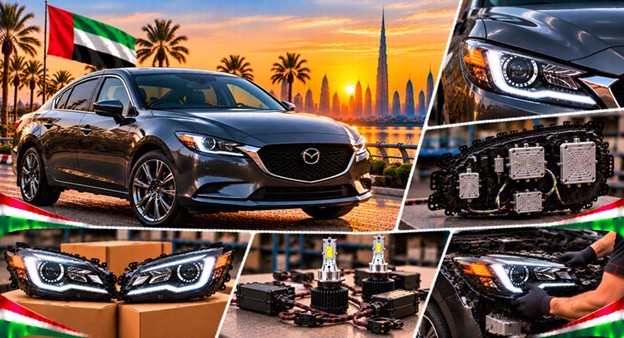
Dubai and Sharjah are useful starting points for comparing genuine parts, aftermarket assemblies and used original headlights. Suppliers in Abu Dhabi and other emirates may also be able to source the correct lamp or arrange delivery, although stock depends on the exact model and specification.
Online catalogues help narrow the search. UAE suppliers can then confirm whether the item is physically available, what it costs in AED and how quickly it can be delivered. Don't confuse a part appearing in a catalogue with a lamp sitting on a shelf, ready to go.
When requesting quotations through PartFinder UAE or directly from a supplier, send the model year, VIN, lighting type, side and existing part number if available. Ask for the actual item's photographs, condition, price, delivery estimate, warranty and return terms.
If the car is already at a workshop, coordinate delivery before authorising the fitting. It is far better to discover a mismatch while the lamp is still in its packaging.
Workshop red flags worth noticing
Be cautious if a workshop recommends replacing the complete assembly without checking whether the fault is simply a bulb, fuse or connector. The reverse is true too: repeated bulb replacements are not a proper fix if the wiring or headlamp housing is damaged.
Other warning signs include vague part descriptions, no identifiable manufacturer, unclear warranty terms, stock photographs for a used lamp and extra charges that appear only after the job has begun.
A good technician should explain what has failed, confirm that the replacement matches the car and identify any additional work before fitting it. They should also check the beam aim and test the relevant lighting functions afterwards.
You don't need to know every Mazda part number by heart. The supplier should.
A practical buying decision for different budgets
Use the condition of your current lamp and the car's lighting specification to narrow the choices.
| Your situation | Option to investigate | Why |
|---|---|---|
| One bulb has failed | Replace the bulb after diagnosis | Avoids buying an unnecessary assembly |
| Older Mazda 6 with a broken lamp | Tested used original or correctly specified aftermarket | May reduce the repair bill |
| Cloudy lens, sound housing | Professional restoration assessment | The full assembly may not need replacing |
| Newer LED-equipped Mazda 6 | VIN-confirmed genuine or compatible replacement | Electronics and exact fitment matter |
| Adaptive headlamp fault | Correct adaptive assembly or specialist repair | A basic non-adaptive lamp may not support the original functions |
| Used lamp with uncertain condition | Compare another supplier | A low price may not compensate for the risk |
| Daily-use vehicle | Prioritise confirmed stock, warranty and delivery | Avoidable delays can cost more than a small price difference |
Before paying, compare the total fitted cost. Include the part, delivery, labour, additional equipment and warranty. A bargain is only a bargain if it fits and works.
UAE Update Reference: October 2026
For Mazda 6 owners comparing replacement headlights in the UAE, the available price evidence needs to be read carefully.
A general UAE parts-price guide published in 2026 places headlight assemblies across vehicle makes at approximately AED 200–800 for used parts, AED 400–1,500 for aftermarket units and AED 1,000–3,500 for new OEM parts. These are broad estimates rather than Mazda 6-specific quotations, and higher-specification LED or adaptive assemblies may fall outside those ranges.
Overseas catalogues show why specification matters. Selected 2018–2021 aftermarket LED headlamps are listed at US$664.95 for the left side and US$827.95 for the right, while a US genuine-parts catalogue lists selected non-adaptive 2018 Mazda 6 assemblies at around US$1,500. These are overseas advertised prices, not confirmed UAE offers, and they should not be converted into a local fitted price without checking shipping, tax treatment, availability and labour.
Before ordering in October 2026, confirm:
- The correct part number against your VIN or chassis details.
- Whether your vehicle uses halogen, xenon or LED lighting, and whether adaptive functions are fitted.
- Whether the seller's price is current and the actual item is available.
- Whether the assembly includes the necessary bulbs, modules and fittings.
- Delivery, VAT, fitting costs, warranty and return conditions.
For buyers in Dubai, Abu Dhabi, Sharjah, Ajman, Ras Al Khaimah, Fujairah, Umm Al Quwain and Al Ain, the same rule applies: a catalogue reference can help identify the part, but only a supplier's current quotation confirms the price and availability of the specific item.
FAQs about Mazda 6 headlights in the UAE
Categories
- Audi
- BMW
- Car Accessories
- Car Tips
- Ford
- Land Rover
- Mazda
- Range Rover
- Top 10
- UAE Car Parts
- Used Car Parts
- Toyota
- Replacement Engines
- Nissan
- Hyundai
- Mitsubishi
- Volkswagen
- Honda
- Kia
- Chevrolet
- Dodge
- Jeep
- Subaru
- Renault
- Lexus
- Mercedes
- Suzuki
- Hummer
- Porsche
- Infiniti
- Peugeot
- GMC
- Mini
- Volvo
- Replacement Gearboxes
- MG
- Jaguar
- Skoda
- Cadillac
- Daihatsu
- Fiat
- German Car Parts
- Japanese Car Parts
- Aftermarket Car Parts
- Genuine Car Parts
- New Car Parts
- Reconditioned Car Parts
- European Car Parts
- American Car Parts
- Korean Car Parts
- British Car Parts
- Chinese Car Parts
- Sports/Exotic Car Parts
- Luxury Car Parts
- Performance Car Parts
- SUV/4x4 Spare Parts
- Truck Spare Parts
- EV Car Parts
- Hybrid Car Parts
- Auto Spare Parts in UAE
- Tesla
- Isuzu
- Ram
- Ferrari
- Bentley
- Lamborghini
- Genesis
- Maserati
- Lincoln
- Chrysler
- Opel
- Citroen
- SsangYong
- Seat
- McLaren
- Aston Martin
- Rolls Royce
- Maybach
- Alfa Romeo
- Bugatti
- Scion
- Abu Dhabi Car Parts
- Ajman Car Parts
- Al Khan Car Parts
- Al Sajaa Car Parts
- Deira Car Parts
- Dubai Car Parts
- Fujairah Car Parts
- Industrial Area 6 Car Parts
- Mussafah Car Parts
- Ras Al Khaimah Car Parts
- Sharjah Car Parts
- Umm Al Quwain Car Parts
- Acura
- BYD
- Chery
- Dacia
- DS
- Geely Emgrand
- EXEED
- GAC
- GAC Gonow
- Geely
- Gonow
- Great Wall
- Haima
- Haval
- Holden
- Iveco
- JAC
- Jaecoo
- Jetour
- Lotus
- Omoda
- Proton
- Renault Samsung
- Roewe
- Lucid
- Replacement Headlight
- Replacement Bumper