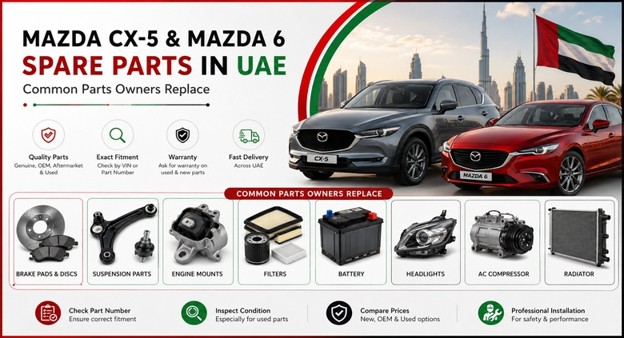
Mazda CX-5 and Mazda 6 Spare Parts in UAE: Common Parts Owners Replace
August 25, 2026
Mazda CX-5 and Mazda 6 Parts Owners Replace Most Often
Mazda CX-5 and Mazda 6 Spare Parts Commonly Replaced in the UAE
A Mazda CX-5 or Mazda 6 doesn't usually announce a part failure with a dramatic bang.
More often, things get gradually worse.
The brake pedal feels slightly different. A suspension knock appears when crossing a speed hump. The AC takes longer to cool the cabin after the car has sat outside in Dubai heat. A battery starts cranking more slowly. Then, one morning, the warning light comes on and the owner finally starts searching for the replacement Mazda spare parts in UAE.
For UAE owners, the parts most likely to enter that search include:
Brake pads + brake discs + control arms + bushes + stabiliser links + wheel bearings + batteries + alternators + starters + filters + belts + engine mounts + sensors + AC parts + cooling-system parts + headlights + mirrors + bumpers.
But these parts don't all fail for the same reason.
Some are normal wear items.
Some deteriorate because of heat and age.
Some are damaged by road conditions.
Others are replaced because a previous repair was done poorly.
Brake parts
Brake pads naturally wear down.
Discs can develop excessive wear, scoring or vibration, particularly when the braking system has been neglected.
For these parts, buying new is usually the sensible route. A used brake pad isn't a clever saving.
Suspension parts
Control-arm bushes, stabiliser links, ball joints, bearings and dampers can become noisy or loose over time.
UAE roads are generally smooth on major routes, but repeated speed humps, rough access roads, construction areas and sudden road-surface changes still put stress on suspension.
Cooling parts
Radiators, cooling fans, thermostats, hoses and related parts deserve attention in the UAE.
The climate doesn't automatically destroy a cooling system.
It does, however, make an already weak cooling system much less forgiving.
AC parts
AC performance matters here more than it does in many cooler markets.
A weak compressor, leaking condenser, restricted airflow or tired blower can turn a comfortable Mazda into a very unpleasant car during summer.
Electrical parts
Batteries, alternators, starters and sensors are common replacement categories.
Battery life, in particular, can be affected by the combination of high ambient temperatures and repeated heat exposure.
Body and lighting
A small accident, parking scrape or damaged mounting tab can send an owner looking for a used genuine bumper, mirror, headlight or grille.
This is where the UAE used-parts market can become useful.
A clean used genuine panel may make more financial sense than a new replacement that still needs paint.
The important distinction
Not every part that commonly gets replaced is a “weak part”.
Some are simply parts that wear.
That distinction matters because it changes how you should buy them.
Wear item + predictable service life = usually buy new.
Expensive assembly + good used availability = compare used, OEM and genuine options.
Electronic or specification-sensitive part = verify the part number and VIN first.
That basic logic will save more money than chasing the cheapest listing.
Mazda CX-5 Spare Parts: Which Parts Wear Out First?
The CX-5 is used in several very different ways across the UAE.
One owner drives mostly between home and office.
Another uses it for family trips, school runs and weekend motorway driving.
A third spends long hours in traffic, leaves the vehicle outside during the day and runs the AC almost constantly.
The same CX-5 can therefore show very different wear patterns.
Brake pads and discs
Brake wear depends heavily on driving style and traffic.
Frequent stop-start driving means more braking than long motorway journeys.
If the car is regularly driven through busy Dubai or Abu Dhabi traffic, brake components may need attention sooner than an identical CX-5 used mainly for longer highway journeys.
Watch for:
Squealing + grinding + steering-wheel vibration + pedal pulsation + reduced braking feel.
Don't wait for grinding.
Once friction material is exhausted, the repair can become more expensive.
Control arms and bushes
A worn bush may not announce itself clearly.
You may notice a dull knock over speed humps, vague steering or uneven tyre wear instead.
A workshop should inspect the complete suspension rather than replacing the first part that looks suspicious.
Stabiliser links
These are relatively small parts, but worn links can create an irritating knocking sound over uneven roads.
The noise can be more obvious at low speed.
Wheel bearings
A bearing can produce a humming or droning sound that rises with road speed.
The noise may initially be mistaken for tyre noise.
Diagnosis matters.
Replacing the wrong side because the sound was misidentified is an avoidable expense.
Air-conditioning parts
The CX-5's AC system has a difficult job in UAE summer.
If cooling becomes weak, don't immediately order a compressor.
Check refrigerant level, leaks, condenser condition, airflow, electrical operation and compressor performance first.
Cooling system
A radiator, thermostat or cooling fan should be replaced because testing shows a problem — not because the vehicle is old and the part “probably needs changing”.
That distinction is important.
Battery
Battery deterioration can become noticeable through:
Slow cranking + electrical warnings + inconsistent starting + repeated jump-starts.
A battery is not a good candidate for a used replacement.
Buy the correct new specification.
Engine mounts
A worn engine mount can create vibration at idle or during gear engagement.
The symptom can sometimes be confused with an engine-running problem.
Check before buying expensive engine parts.
Sensors
A diagnostic code can point toward a system.
It doesn't automatically prove that the sensor itself has failed.
Test first.
Buy second.
Headlights and body parts
These are different from mechanical wear parts.
They are often replaced because of accident damage, cracked lenses, failed electronics or broken mounting points.
This is where used genuine parts can be particularly attractive.
CX-5 buying pattern
For everyday wear:
New is usually the safer baseline.
For expensive body or mechanical assemblies:
Compare used genuine + OEM + genuine new.
For electronic parts:
Verify the exact number and programming requirements.
That's a much more useful buying strategy than treating every CX-5 part the same way.
Mazda 6 Spare Parts: Common Repairs by Mileage and Age
The Mazda 6 has a slightly different ownership character.
Many examples spend years as daily commuters, accumulating substantial mileage while travelling through city traffic and on longer UAE highway routes.
Age begins to matter alongside mileage.
A lower-mileage older car can still have deteriorated rubber, seals, battery performance and cooling-system parts.
A high-mileage car may have excellent maintenance history and fewer surprises.
Mileage is evidence.
It isn't the whole story.
Lower-mileage Mazda 6
At lower mileage, owners are more likely to deal with routine service parts and age-related issues than major mechanical replacement.
Think:
Filters + fluids + batteries + wipers + brake wear + tyres + selected rubber parts.
Middle-mileage vehicles
As mileage accumulates, suspension and braking become more relevant.
Control-arm bushes, links, bearings and dampers deserve inspection.
Not automatic replacement.
Inspection.
Higher-mileage Mazda 6
Now engine mounts, cooling parts, sensors, AC components and larger suspension assemblies may become more relevant depending on maintenance history.
This is also where a proper diagnosis becomes more valuable because several smaller problems can appear together.
Brake system
A Mazda 6 used heavily in urban traffic can consume brake material faster than one driven mainly on open highways.
Look at actual pad thickness and disc condition.
Don't replace parts based only on mileage.
Suspension
A worn suspension system can affect comfort, steering feel and tyre wear.
If one control arm is worn, inspect the rest of the front suspension before ordering only one part.
You may discover that several items have similar remaining life.
AC system
A Mazda 6 used in UAE summer places enormous demand on the AC system.
Weak cooling may come from several causes.
Low refrigerant + leakage + condenser problems + compressor wear + electrical faults + restricted airflow can produce overlapping symptoms.
Cooling system
Cooling-system condition deserves attention as vehicles age.
Look for:
Coolant loss + temperature fluctuations + visible leaks + fan problems + damaged hoses.
Never treat overheating as a minor inconvenience.
Continued overheating can turn a relatively manageable cooling repair into major engine damage.
Electrical system
Alternators, starters, batteries and sensors become more relevant as the vehicle ages.
Electrical diagnosis is important because one weak battery can create a surprisingly long list of warning messages.
Body parts
Older Mazda 6 models can also benefit from the used genuine-parts market.
A clean original mirror, headlight, grille or bumper can sometimes be a sensible alternative to buying a new replacement and paying additional paint or finishing costs.
Age versus mileage
| Vehicle condition | What deserves attention |
| Low mileage, older age | Rubber, battery, fluids, seals |
| Moderate mileage | Brakes, suspension, AC, cooling |
| High mileage | Suspension, mounts, cooling, sensors |
| High mileage + poor history | Full inspection before major spending |
| High mileage + documented maintenance | Evaluate actual condition rather than mileage alone |
The Mazda 6 rule
Don't use mileage as a replacement schedule for every part.
Use mileage to decide what deserves inspection.
Then let the actual condition decide what gets replaced.
Mazda CX-5 vs Mazda 6 Spare Parts: Which Parts Cost More to Replace?
This is where owners often expect a simple answer.
CX-5 costs more.
Mazda 6 costs more.
But that's not really how spare-parts pricing works.
The exact part matters far more than the badge on the boot.
A Mazda 6 headlight and CX-5 headlight may sit in completely different price categories depending on specification, generation and whether you're buying genuine, OEM, aftermarket or used.
Routine service parts
Filters, wiper-related items and other ordinary maintenance parts can be relatively straightforward for both vehicles.
The difference between models may be modest.
Brakes
Brake prices depend on:
Disc size + brake specification + manufacturer + front/rear application.
Don't compare a CX-5 front-disc quotation with a Mazda 6 rear-disc quotation and call one model expensive.
Suspension
The complete repair can vary significantly.
A control arm may be affordable.
A collection of arms, bushes, bearings and dampers is a different bill.
AC
Compressor prices can vary sharply according to manufacturer and condition.
A tested used genuine compressor can be worth considering for an older vehicle.
For a newer vehicle, genuine or reputable OEM may make more sense.
Body parts
This is where used parts can change the calculation dramatically.
A used genuine bumper may be inexpensive compared with a new genuine assembly, but the colour, condition and mounting points matter.
Headlights
Lighting assemblies can become expensive because modern lamps may include additional electronics.
Always check whether the quoted price includes the complete assembly.
Engines
A CX-5 or Mazda 6 engine should never be priced by model name alone.
Confirm:
Engine code + specification + donor vehicle + mileage + testing + warranty.
For applicable petrol engines, compression testing can provide useful evidence when evaluating a used engine.
Gearboxes
Again, transmission identification comes first.
A cheaper gearbox that doesn't match the vehicle is worth exactly nothing to you.
Labour changes the comparison
Suppose one part costs AED 1,000 and another costs AED 1,300.
That doesn't necessarily make the AED 1,000 option cheaper.
If the first part requires additional labour, programming or supporting parts, the final bill can reverse the apparent saving.
A better comparison
| Part category | What determines cost most |
| Brake pads | Brand, specification, front/rear |
| Brake discs | Size, manufacturer, quantity |
| Control arm | Genuine/OEM/used, assembly type |
| Headlight | Generation, specification, electronics |
| AC compressor | Manufacturer, condition, testing |
| Radiator | Specification, manufacturer, complete assembly |
| Engine | Code, mileage, testing, warranty |
| Gearbox | Transmission code, condition, warranty |
| Bumper | Genuine/aftermarket, condition, paint |
| Electronic module | Part number, condition, programming |
The real comparison
Don't ask which model is more expensive to repair. Ask which exact part is required, what quality level you're buying and what the complete installed repair will cost.
That answer is much more useful.
How UAE Heat, Dust and Traffic Affect Mazda CX-5 and Mazda 6 Parts
The UAE environment doesn't magically destroy Mazda parts.
It does expose weaknesses quickly.
A vehicle that spends every weekday outside under intense summer heat is experiencing a very different operating environment from one parked indoors and driven mainly in the evening.
Then add traffic.
Then add AC load.
Then add dust.
Now the pattern starts to make sense.
Battery life
High temperatures can accelerate battery ageing.
A battery may still start the vehicle perfectly in one week and struggle shortly afterwards.
If the battery is already near the end of its useful life, summer tends to expose the weakness.
AC system
The cabin can become extremely hot after the car sits outside.
The AC then has to remove that heat quickly.
That doesn't mean the compressor should be replaced every few years.
It means the entire system needs to remain healthy.
Cooling system
Radiator airflow, coolant condition, fans and hoses matter.
Dust and debris can reduce airflow through external cooling surfaces.
A cooling problem should be diagnosed before it becomes an overheating problem.
Engine oil
Heat and operating conditions make correct oil specification and service intervals important.
Don't choose engine oil solely because it is cheap.
Follow the appropriate specification for the Mazda engine.
Tyres
Heat and road temperatures affect tyre operating conditions.
Tyre condition should be checked alongside suspension and wheel alignment.
Suspension
The heat itself isn't the only issue.
Repeated driving over speed humps, rough shoulders and uneven access roads can accelerate wear in bushes, links and other suspension parts.
Brake system
Heavy traffic means repeated braking.
That creates more heat and wear than a long uninterrupted motorway journey.
If the vehicle is regularly used in congested areas, brake inspection deserves attention.
Air filters
Dusty conditions make filtration important.
A dirty air filter can restrict airflow.
A clogged cabin filter can also reduce AC airflow and make the cabin feel less comfortable.
Don't confuse restricted cabin airflow with a failing compressor.
Electrical connections
Heat and age can affect connectors, insulation and electronic equipment.
When diagnosing an intermittent electrical fault, inspect wiring and connections rather than replacing modules at random.
Parking habits matter
Two identical Mazda CX-5s can age differently.
One spends every day under direct sun.
The other sits in a covered parking area.
Interior plastics, rubber seals, paint, batteries and certain electrical parts can experience different ageing patterns.
Traffic matters too
A Mazda 6 doing long highway journeys has a different operating pattern from one crawling through city traffic every evening.
This affects:
Brakes + cooling + AC + fuel consumption + engine operating time + transmission workload.
What UAE owners should do
Keep the maintenance practical.
Inspect cooling performance + check battery condition + maintain AC airflow + inspect brakes + watch suspension symptoms + replace filters when due + investigate warning lights early.
Don't wait for a small issue to become an expensive parts order.
The UAE rule
Heat, dust and traffic don't automatically mean premature failure. Poor maintenance combined with those conditions is the real problem.
That distinction matters because replacing parts unnecessarily costs money, while ignoring genuine deterioration can cost far more.
Brakes, Suspension, Steering and Wheel-Related Parts
Mazda CX-5 Brake Pads and Discs: When Should They Be Replaced?
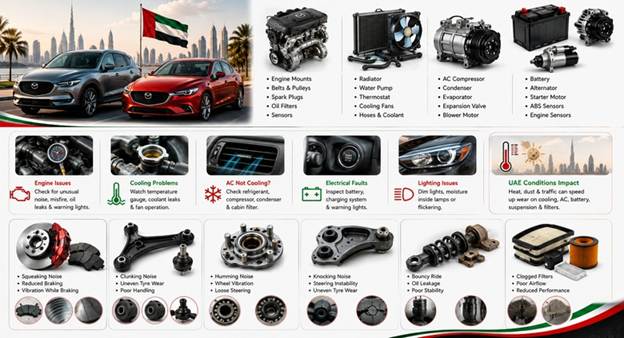
Brake parts are among the more predictable Mazda CX-5 replacement items, but the UAE driving pattern can change how quickly they wear.
A CX-5 spending hours in stop-start Dubai traffic is working its brakes much more frequently than one travelling mostly on open highways. Add repeated speed humps, heavy summer traffic and a fully loaded family vehicle, and brake wear can build up quietly.
Don't replace pads because someone says the car has reached a certain mileage.
Inspect them.
Brake pads
The friction material gradually becomes thinner.
Early signs can include:
Squealing + reduced bite + increased pedal travel + visible pad wear.
Not every squeal means the pads are finished, though. Dust, surface contamination and other brake conditions can produce noise.
Brake discs
Discs can develop:
Grooves + scoring + excessive wear + heat spots + vibration.
A steering-wheel vibration during braking can be a useful warning sign, particularly at higher speeds.
But don't diagnose the disc from vibration alone.
Suspension, wheel balance and tyre problems can produce similar sensations.
When should CX-5 brake pads be replaced?
Replace them when inspection shows insufficient friction material or another confirmed defect.
Don't use an arbitrary mileage number as the only decision point.
Driving style matters.
Front versus rear
Front brakes generally carry more braking load, so they may wear differently from the rear system.
That doesn't mean the rear brakes should be ignored.
Inspect all four corners.
Genuine versus aftermarket
For brake pads and discs, reputable aftermarket options can make financial sense.
The key is manufacturer quality and correct specification.
A cheap unknown pad isn't necessarily a bargain.
Used brake parts
This is one area where saving money through used parts usually makes little sense.
Buy friction components new.
Calipers
Calipers are different.
A tested used genuine caliper can be a reasonable choice if the housing, piston and sliding mechanism are in good condition.
Ask whether it has been inspected or tested.
Brake fluid
The braking system isn't just pads and discs.
Brake-fluid condition matters too.
If the fluid is old or contaminated, replacing the pads won't solve every braking concern.
UAE heat
Repeated braking generates heat, while high ambient temperatures reduce the system's ability to shed that heat as easily as it would in cooler conditions.
That doesn't mean the CX-5's brakes are unsuitable for UAE use.
It means maintenance matters.
A practical inspection
Ask the workshop to check:
Pad thickness + disc condition + calipers + brake-fluid condition + brake hoses + tyre condition.
Then decide what actually needs replacing.
The brake rule
Replace worn brake parts because inspection proves they are worn, not because an online parts seller has a promotion running.
Mazda 6 Brake Parts: Common Wear Signs and Replacement Costs
The Mazda 6 can rack up serious mileage as a daily UAE commuter.
That makes brake wear a normal ownership issue rather than an unusual failure.
Still, owners often wait until the noise becomes impossible to ignore.
That's the wrong moment.
Brake-pad wear
A thin pad can eventually reach the point where the backing plate approaches the disc.
Once metal starts contacting metal, the repair can escalate quickly.
Common warning signs
Watch for:
Squealing + grinding + vibration + pulling under braking + reduced braking response + warning indicators.
A single symptom doesn't always identify the failed part.
A proper inspection does.
Disc wear
A disc can develop a lip around its outer edge as material wears.
Deep grooves or excessive thickness loss may require replacement.
The workshop should measure the disc where appropriate rather than relying solely on appearance.
Brake vibration
If the steering wheel shakes during braking, don't immediately order new discs online.
Check:
Disc condition + wheel balance + suspension + wheel mounting + tyres.
You want the cause, not an expensive guess.
Brake pads in UAE traffic
Frequent stop-start driving increases brake use.
A Mazda 6 used mostly for long highway journeys may experience a different wear rate from one driven through congested city roads every day.
Brake discs and pads together
Sometimes replacing only pads makes sense.
Sometimes the disc condition means both should be replaced.
Don't assume one fixed package applies to every vehicle.
Genuine versus OEM
For ordinary braking maintenance, reputable OEM or aftermarket options may offer useful savings compared with genuine Mazda parts.
For specialist applications, verify the exact specification.
Used brake parts
Used pads and heavily worn discs should not be treated as economical alternatives.
The saving isn't worth the uncertainty.
Used calipers
A tested used genuine caliper can make more sense.
Ask whether the piston, seals and sliding mechanism were checked.
Brake-system inspection
If one side is wearing faster than the other, don't simply replace the worn side.
Investigate why.
Uneven wear can indicate a caliper, slider, hydraulic or mechanical issue.
What affects the repair bill?
The final price depends on:
Front or rear + pads or discs + manufacturer + genuine/OEM/aftermarket + labour + brake-fluid service + any additional fault.
Don't compare incomplete quotations
A quotation saying “Mazda 6 brake service — AED X” isn't particularly useful until you know what it includes.
Ask for the actual parts and labour breakdown.
The Mazda 6 brake check
Inspect first + identify the worn part + compare equivalent-quality replacements + calculate labour + verify the final specification.
That's much safer than buying a cheap brake kit because the photograph looked right.
Mazda CX-5 Suspension Parts: Control Arms, Bushes, Links and Dampers
Suspension problems often start with a sound.
A dull knock.
A light clunk.
A faint creak.
Then the steering starts feeling slightly vague, the tyre wears unevenly and suddenly you're standing at a workshop discussing several parts at once.
That's why suspension diagnosis matters.
Control arms
Control arms connect the wheel assembly to the vehicle structure and contain wear-prone joints or bushes depending on the assembly.
A worn bush can cause:
Knocking + steering instability + uneven tyre wear + changes in handling.
Bushes
Rubber deteriorates with age, heat and repeated movement.
A vehicle doesn't need extremely high mileage for a rubber part to become tired.
Stabiliser links
These smaller parts can produce a surprisingly noticeable knocking sound over speed humps and uneven roads.
Because the replacement cost can be relatively modest, they are sometimes replaced unnecessarily.
Confirm the fault first.
Ball joints
A worn ball joint can become a safety concern.
If there is excessive play, the workshop should address it promptly rather than simply fitting another part nearby.
Dampers
Worn dampers can affect:
Body control + ride quality + braking stability + tyre contact with the road.
Look for excessive bouncing, uneven tyre wear or fluid leakage.
UAE road conditions
Speed humps are common.
So are abrupt transitions between road surfaces, parking ramps and rough access roads around construction or industrial areas.
Repeated impacts can accelerate suspension wear.
Used suspension parts
Used genuine control arms can be considered if the assembly is in good condition.
But inspect the bushes and joints.
A cheap used control arm with tired rubber isn't a bargain.
New aftermarket suspension
A reputable aftermarket manufacturer can be a sensible alternative.
The manufacturer matters.
“Aftermarket” alone tells you very little.
Genuine Mazda suspension
Genuine parts can make sense when exact fitment and long-term confidence matter more than the lowest purchase price.
Wheel alignment
If suspension components are replaced, ask whether alignment is required.
Often it is.
Skipping alignment after relevant steering or suspension work can create another tyre bill later.
Tyre wear as evidence
Look at the tyres.
Uneven inner or outer wear can provide a useful clue that something in the suspension or alignment system needs attention.
Don't replace everything at once
A workshop should identify the failed parts.
Replacing every suspension component “while we're there” isn't automatically better.
Sometimes it is sensible.
Sometimes you're simply paying for parts you don't yet need.
The CX-5 suspension rule
Find the noisy or worn part first, then decide whether new genuine, OEM, aftermarket or used genuine gives the best value.
Mazda 6 Suspension Problems: Control Arms, Bushes, Bearings and Shocks
The Mazda 6 can become noticeably less composed as suspension wear accumulates.
Owners may describe it as a “hard ride”, “loose steering” or simply “something knocking underneath”.
Those descriptions are useful.
They're not diagnoses.
Control arms
A worn control-arm bush can change how the wheel moves under braking and acceleration.
The driver may notice steering movement or instability.
Bushes
Rubber deterioration can happen gradually.
A workshop inspection should look for cracking, excessive movement and separation where relevant.
Stabiliser links
A knocking sound over small bumps can point towards a worn link, although other suspension parts can create similar noises.
Don't order the link until the source has been established.
Wheel bearings
A bearing problem often produces a humming or droning sound that changes with vehicle speed.
The sound can sometimes be confused with tyre noise.
A technician should confirm the affected side and bearing condition.
Shock absorbers
Worn dampers can reduce body control and contribute to uneven tyre wear.
Look for:
Excessive bouncing + oil leakage + poor body control + uneven tyre wear.
UAE conditions
A Mazda 6 used every day in urban traffic encounters more repeated braking, acceleration and speed-hump impacts than a vehicle used primarily for long-distance motorway driving.
Usage matters.
Used genuine parts
For certain suspension assemblies, a clean used genuine component can be a practical option for an older Mazda 6.
But inspect the wear parts attached to it.
Aftermarket options
Reputable aftermarket suspension manufacturers can offer a useful price alternative.
Don't select purely by the lowest quotation.
Alignment after suspension repair
If control arms or other steering-related components are replaced, wheel alignment should be checked.
A small alignment problem can quietly destroy an otherwise good set of tyres.
Tyres can tell the story
Inspect for:
Inner-edge wear + outer-edge wear + feathering + uneven tread depth.
These clues can help the workshop determine whether suspension or alignment needs attention.
Replacing one side or both?
It depends on the part.
Some parts are normally replaced in pairs because their wear affects handling balance.
Others can be replaced individually when only one has failed.
Ask why the workshop recommends one approach.
Cost of ignoring suspension
A small suspension issue can eventually contribute to:
Tyre wear + alignment problems + poor handling + additional component stress.
That doesn't mean every knock becomes a major repair.
It means early diagnosis is usually cheaper.
The Mazda 6 suspension rule
Don't diagnose suspension from sound alone. Inspect the complete system, identify the failed part and then compare replacement options.
Mazda CX-5 and Mazda 6 Wheel Hubs and Bearings: Warning Signs Before Failure
Wheel bearings are easy to overlook because the first symptom can sound like a tyre.
A low humming noise.
It increases with speed.
You change the road surface and it seems to change.
You wonder whether the tyre is simply noisy.
Sometimes it is.
Sometimes the bearing is beginning to fail.
Common bearing symptoms
Watch for:
Humming + rumbling + growling + vibration + changing noise while cornering.
The sound may become more noticeable as speed increases.
Don't diagnose by noise alone
Tyre cupping, uneven tread wear and road-surface noise can produce similar sounds.
A workshop should inspect the bearing and tyre together.
Wheel play
Excessive play can indicate a bearing or another suspension problem.
It should be inspected promptly.
Hub assemblies
Some vehicles use integrated hub-and-bearing assemblies.
That means the quotation may refer to the complete hub rather than a simple bearing.
Ask what you are actually buying.
CX-5 versus Mazda 6
The part numbers and hub assemblies can differ by generation and specification.
Never assume a CX-5 and Mazda 6 bearing are interchangeable because the vehicles share other Mazda engineering characteristics.
Genuine parts
Genuine hub assemblies can be attractive when exact fitment and long-term durability are priorities.
OEM parts
A reputable OEM manufacturer can sometimes reduce the cost without moving into unknown-quality territory.
Identify the manufacturer.
Used hubs
A used genuine hub can be considered in some situations, but bearing condition is difficult to judge purely from appearance.
For a bearing itself, a new reputable replacement is usually easier to justify.
Why cheap used bearings are risky
You may save on the part.
Then pay labour to install it.
Then pay again when the bearing starts making noise.
That's false economy.
Wheel alignment
A bearing replacement doesn't automatically mean alignment is required in every case, but if related suspension or steering work has also been performed, alignment should be checked where appropriate.
Wheel and tyre inspection
Before ordering a hub, inspect:
Tyre condition + wheel condition + suspension play + bearing noise.
You want to rule out cheaper explanations first.
UAE driving conditions
Long highway journeys make bearing noise easier to notice because road speed remains consistent.
City traffic may hide the symptom until the vehicle reaches higher speeds.
Warning versus emergency
A mild humming noise deserves inspection.
Severe grinding, significant wheel play, instability or other serious symptoms should not be ignored.
A wheel-end problem isn't something to postpone indefinitely.
The wheel-bearing rule
Confirm the bearing fault before buying the hub, and confirm the exact hub specification before ordering it online.
That small distinction can save both money and another trip to the workshop.
Engine, Cooling, AC and Electrical Parts
Mazda CX-5 Engine Parts: Common Items Owners Replace
Engine repairs can become expensive very quickly, which is exactly why a CX-5 owner shouldn't jump from a warning light straight to an engine-part order.
A fault code isn't a shopping list.
Diagnosis comes first.
For everyday CX-5 ownership, many engine-related replacements are smaller than an engine itself. Filters, belts, mounts, sensors, ignition-related parts, cooling components and seals can all enter the repair cycle long before a complete engine replacement becomes sensible.
Engine mounts
A worn engine mount can produce:
Excessive vibration + clunking during gear engagement + movement under acceleration + rough-feeling idle.
That doesn't automatically mean something inside the engine has failed.
A proper inspection can separate a mount problem from an engine-running problem.
Belts and related parts
Belts and their associated tensioning or drive components should be inspected according to the particular engine and maintenance requirements.
Cracking, unusual noise or abnormal wear deserves attention.
Don't wait until a belt-related failure leaves the vehicle stranded.
Spark plugs
For applicable petrol engines, spark plugs are routine maintenance items rather than parts to buy used.
Use the correct specification.
A cheaper plug that doesn't meet the required specification isn't a saving.
Filters
Engine air filters and oil filters are inexpensive compared with major engine repairs.
They should be replaced as required rather than stretched indefinitely to save a small amount.
Sensors
The CX-5 uses multiple sensors to manage engine operation.
A diagnostic code can point toward a sensor circuit, but it doesn't always prove the sensor itself has failed.
Check:
Sensor + wiring + connector + power supply + related system.
Engine cooling
A cooling fault can become an engine problem if ignored.
If coolant is disappearing, the temperature is rising or the cooling fan isn't operating correctly, investigate immediately.
Oil leaks
A small oil leak should not automatically lead to an engine replacement.
The source matters.
It may be a seal, gasket or another accessible part.
Find the leak first.
Engine overheating
Overheating deserves a different level of urgency.
A faulty thermostat, radiator, fan, hose or other cooling-system part may be responsible, but continued overheating can damage the engine itself.
Don't keep driving and hope the warning disappears.
Used CX-5 engines
If a complete engine replacement eventually becomes necessary, a tested used genuine engine may be worth comparing with a reconditioned or replacement option.
Ask for:
Engine code + donor information + mileage + testing + compression results where applicable + warranty.
Compression testing
For applicable petrol engines, actual compression readings can provide useful evidence about cylinder condition.
Don't be satisfied with “compression tested” if the seller cannot provide the readings.
Numbers tell you more.
Engine price versus installation
A used engine quoted at AED 5,000 is not a AED 5,000 repair.
Budget for:
Removal + installation + fluids + filters + seals + supporting parts + diagnostics + possible programming.
The CX-5 engine rule
Diagnose the failed part first. For major engine purchases, verify the exact engine specification and demand evidence of condition before paying.
Mazda 6 Engine Parts: Belts, Mounts, Filters, Sensors and Other Wear Items
A Mazda 6 that has been maintained properly can cover substantial mileage, but age and mileage eventually catch up with individual engine-related parts.
Usually one small thing at a time.
A mount.
A sensor.
A belt-related part.
A cooling-system component.
Then, occasionally, several items appear together.
Engine mounts
Worn mounts can create vibration through the cabin.
The symptom can be more noticeable:
At idle + during gear selection + when accelerating + when moving away from a stop.
Don't confuse mount vibration with internal engine trouble.
Air filters
A restricted air filter can affect airflow and should be replaced according to condition and maintenance requirements.
It is inexpensive.
There's little sense in stretching its life to the point where it becomes visibly clogged.
Oil filters
Use the correct filter specification.
A filter is not an area where an unknown bargain is particularly attractive.
Spark plugs
For applicable petrol engines, use the correct plug type and specification.
They are routine replacement items and should be purchased new.
Sensors
A Mazda 6 can display warning lights for many different reasons.
Don't replace sensors blindly.
A wiring problem can imitate a sensor failure.
Engine mounts and vibration
If the engine itself runs smoothly but the cabin vibrates excessively, inspect the mounts before assuming internal engine damage.
That distinction can save a very large repair bill.
Oil leaks
Look for the actual source.
A small seal or gasket repair can be very different financially from replacing an engine.
Cooling system
The radiator, thermostat, hoses, fan and related parts should be inspected when temperature behaviour changes.
A rising temperature isn't something to keep driving through.
Used engine buying
For a major engine replacement, compare:
Used genuine + reconditioned + new replacement options.
The correct choice depends on vehicle age, value, mileage, condition and budget.
Compression testing
Where applicable, request actual compression readings for a used petrol engine.
If readings differ significantly between cylinders, ask what that means for the engine's condition before buying.
Engine replacement versus vehicle replacement
This is worth considering for an older Mazda 6.
If the vehicle has:
High mileage + poor body condition + transmission problems + suspension wear + major engine failure, replacing the engine may not be financially sensible.
But if the Mazda is structurally sound, well maintained and otherwise reliable, an engine replacement can still make excellent economic sense.
The Mazda 6 engine rule
Don't price an engine in isolation. Compare the complete repair cost with the vehicle's current condition and expected first-year ownership cost.
Mazda CX-5 Cooling System Parts: Radiator, Water Pump, Thermostat and Fans
The UAE climate makes cooling-system maintenance particularly important.
Not because a CX-5 is inherently unsuitable for hot weather.
Because when ambient temperatures are high, a marginal cooling-system fault has less room to hide.
Radiator
A radiator can suffer from:
Leaks + damaged fins + restricted airflow + internal blockage.
External inspection is useful, but pressure testing can reveal problems that aren't obvious visually.
Cooling fans
If a cooling fan doesn't operate correctly, temperature can rise, particularly when the vehicle is stationary or moving slowly.
A fan problem isn't necessarily a fan-motor problem.
Check the control circuit too.
Thermostat
A thermostat regulates coolant flow.
If it sticks or behaves incorrectly, the engine may run at the wrong temperature.
Symptoms can vary, so diagnosis matters.
Water pump
A failing water pump can cause coolant circulation problems and potentially overheating.
Look for appropriate evidence rather than replacing it simply because the vehicle has reached a certain mileage.
Hoses
Hoses age.
Heat cycles can affect rubber over time.
Inspect for:
Cracking + swelling + softness + leaks + damaged connections.
Coolant
Use the correct coolant specification and maintain the correct concentration.
Mixing incompatible coolant types without proper consideration can create problems.
Overheating
This is the point where owners should stop gambling.
If the temperature rises abnormally, pull over safely and investigate.
Continuing to drive an overheating engine can turn a cooling-system repair into major engine work.
Used radiators
A used genuine radiator can be considered when it is clean and appropriately tested.
Ask whether it has been pressure-tested.
Used cooling fans
A tested used fan assembly can be reasonable for an older vehicle.
Ask how the motor was tested.
New aftermarket
A reputable new aftermarket radiator, fan or thermostat can provide good value.
Manufacturer identity matters.
UAE dust
Dust and debris can reduce airflow through external cooling surfaces.
Keep the cooling system and surrounding areas clean enough to allow proper airflow.
AC condenser versus radiator
They sit in the same general front area but perform different jobs.
A technician should identify which system is actually causing the problem.
Don't order a radiator because the AC isn't cooling.
Cooling-system warning signs
Watch for:
Temperature increase + coolant loss + fan problems + visible leaks + unusual coolant smell + repeated overheating warnings.
The CX-5 cooling rule
Find the cause of overheating or coolant loss before replacing a cooling-system part. A correct diagnosis is cheaper than replacing three unrelated parts.
Mazda 6 AC Parts: Compressor, Condenser, Evaporator and Common UAE Problems
A Mazda 6 AC system has one brutally difficult job in the UAE.
Make the cabin comfortable after the car has been sitting in intense heat.
When it stops doing that, owners understandably want the compressor replaced immediately.
Don't.
Start with airflow
A restricted cabin filter can reduce airflow and make the AC seem weak.
Check the simple things first.
Refrigerant level
Low refrigerant can indicate a leak.
Adding refrigerant without finding the reason for the loss is not a proper long-term repair.
Compressor
A failing compressor can produce poor cooling, abnormal noise or other system symptoms.
But those symptoms can overlap with other AC faults.
Condenser
The condenser sits at the front of the vehicle and can be affected by debris, physical damage and leaks.
A damaged condenser may need replacement.
Evaporator
Evaporator problems can be more labour-intensive because access can be difficult.
That makes diagnosis especially important before ordering the part.
AC electrical system
Relays, wiring, sensors and control systems can affect AC operation.
A compressor that doesn't engage doesn't automatically mean the compressor itself is dead.
AC compressor replacement
If a compressor genuinely has failed, ask whether the system needs:
Recovery + flushing where required + oil + vacuum testing + refrigerant recharge + leak testing.
The compressor price isn't the complete repair.
Used compressor
A tested used genuine compressor can be an attractive option for an older Mazda 6.
But ask:
Was it tested?
Does it rotate correctly?
Was it removed from a working system?
What warranty is provided?
New aftermarket compressor
A reputable aftermarket compressor can reduce the purchase price.
Identify the manufacturer.
Check compatibility.
Compare the warranty.
UAE summer
AC weakness becomes obvious quickly when temperatures climb.
Don't wait until the system completely stops cooling.
Cabin filter
A blocked cabin filter is one of the cheapest problems to solve.
Check it before ordering expensive AC hardware.
AC repair cost
A complete quotation may include:
Part + labour + refrigerant + oil + diagnostics + leak testing + additional seals or supporting parts.
The Mazda 6 AC rule
Diagnose airflow, refrigerant, electrical operation and mechanical operation before buying a compressor.
That sequence can save thousands of dirhams.
Mazda CX-5 and Mazda 6 Electrical Parts: Batteries, Alternators, Starters and Sensors
Electrical problems have a nasty habit of creating several warning lights at once.
The owner sees the dashboard lit up and assumes five things have failed.
Sometimes the battery is simply weak.
That's why diagnosis matters.
Battery
A weak battery can cause:
Slow starting + clicking + intermittent warning lights + electrical glitches + repeated starting problems.
High temperatures can accelerate battery ageing, so UAE owners should pay attention to battery condition.
Don't buy a used battery
This is one of the simplest decisions in the entire article.
Buy the correct new battery.
The saving from a used battery rarely justifies the uncertainty.
Alternator
The alternator maintains electrical supply and charges the battery while the engine runs.
Signs of a charging problem can include:
Battery warning light + dimming lights + starting problems + electrical instability.
Test the charging system before ordering an alternator.
Used alternator
A tested used genuine alternator can be an option for an older CX-5 or Mazda 6.
Ask for actual testing evidence.
Starter motor
A weak starter can cause slow cranking or clicking.
But battery condition, cable connections and electrical supply should be checked first.
Sensors
Sensors are another area where online parts buying can go wrong.
A fault code may identify a circuit or system.
It doesn't automatically prove that the sensor itself has failed.
ABS sensors
Wheel-speed sensors can be affected by wiring, connectors and physical damage.
Don't replace the sensor without checking the circuit.
Engine sensors
Depending on the system, sensors can affect engine operation, fuel control and warning lights.
Use the exact part number.
Electronic modules
Modules are more expensive and more specification-sensitive.
Confirm:
Part number + vehicle application + condition + programming requirement.
Used modules
A used genuine module can be attractive on price.
But ask whether it needs coding or configuration.
Programming
Some electronic parts aren't simply “plug and play”.
The installation may require diagnostics, coding, calibration or configuration.
Budget for it.
Connectors and wiring
Inspect the connector before ordering a replacement component.
Corrosion, damaged pins or broken wiring can mimic a failed module or sensor.
UAE heat and electronics
High temperatures are hard on batteries and can accelerate ageing of electrical components and connections.
That doesn't mean every warning light is heat damage.
It means electrical diagnosis should include the basics.
Electrical repair comparison
| Part | Used option | New option | Main check |
| Battery | Avoid | Recommended | Correct specification |
| Alternator | Possible | Usually preferred | Charging test |
| Starter | Possible | Compare options | Cranking test |
| Sensor | Possible | Usually sensible | Exact part number |
| ABS sensor | Possible | Compare | Wiring + sensor test |
| Module | Possible | Compare | Number + programming |
| Wiring | Repair where appropriate | Replacement if needed | Circuit diagnosis |
The electrical rule
Test the electrical system before buying an electrical part.
A battery, alternator, wiring fault and module problem can sometimes produce overlapping symptoms.
The right diagnosis saves you from buying the wrong box of electronics.
Lighting, Body Parts, Interior and Electronic Components
Mazda CX-5 Headlights, Tail Lights and Fog Lights: What Owners Replace
Lighting problems are often more complicated than a burned-out bulb.
Modern CX-5 lighting assemblies can contain wiring, connectors, control hardware and other elements, so the first question should be what actually failed?
A cracked lens is one problem.
A failed bulb or LED element is another.
A damaged control unit is something else entirely.
Headlights
A CX-5 headlight may need replacement because of:
Cracked lens + water ingress + damaged housing + failed internal electronics + accident damage + broken mounting points.
Don't automatically buy the complete assembly.
Sometimes a smaller repair is possible.
Moisture inside the lamp
A little condensation can behave differently from persistent water accumulation.
If moisture repeatedly returns or water is visibly collecting inside the housing, investigate the seal and housing condition.
Used genuine headlights
This is an area where used genuine parts can make financial sense.
But inspect the actual headlight.
Look for:
Cracks + broken tabs + moisture marks + damaged connectors + lens deterioration.
Aftermarket headlights
A new aftermarket lamp may cost less than a genuine replacement.
Check:
Fitment + connector compatibility + beam performance + manufacturer + warranty.
A headlight that technically fits but produces poor light distribution isn't a good bargain.
Tail lights
Tail-light assemblies can suffer from accident damage, cracked housings, water ingress or electrical faults.
Ask whether the quotation includes the complete assembly.
Fog lights
Check whether the listing is for:
Lamp assembly + housing + bulb/LED unit + trim surround.
The photograph may show more than the quoted part.
Programming and electronics
Some lighting systems may include control electronics that require appropriate configuration.
Ask the supplier and workshop before buying.
UAE heat and sunlight
External plastic lenses can age under prolonged exposure to strong sunlight.
Clouding or deterioration affects appearance and potentially light output.
Headlight replacement cost
The final cost may include:
Part + delivery + fitting + alignment/adjustment + programming where required.
Don't compare a part-only price with an installed quotation.
The CX-5 lighting rule
Identify whether the failure is the lamp, bulb/LED system, wiring, connector or control hardware before ordering the complete headlight.
Mazda 6 Headlights and Lighting Parts: Genuine, Used and Aftermarket Choices
The Mazda 6 has a similar problem with online lighting purchases.
A photograph can make two headlights look interchangeable.
They may not be.
Generation, specification, connectors and internal electronics can all matter.
Headlight identification
Before ordering, confirm:
Model year + generation + specification + part number + VIN compatibility.
Genuine new
A genuine Mazda headlight is usually the easiest option when budget allows and exact fitment matters.
But the price can be substantial.
Used genuine
For an older Mazda 6, a clean used genuine headlight can be a much more economical choice.
Inspect the actual item.
Don't accept “excellent condition” without photographs.
Check the mounting tabs
A cracked mounting point can turn a visually attractive headlight into a poor purchase.
Ask for close-up photographs of the mounting areas.
Check the rear housing
Look at the connectors and rear casing.
Damage isn't always visible from the front.
Check for moisture
Persistent moisture can indicate sealing problems.
Ask whether the lamp was tested before sale.
Aftermarket
Aftermarket headlights can provide a lower-cost alternative.
Manufacturer identity matters.
So does fitment.
Tail lights
Check whether the listing includes the complete tail-light assembly or only part of it.
Fog lights
Confirm the correct trim and mounting arrangement.
A fog lamp may be physically similar across different specifications but still use different fittings.
Bulbs
Bulbs are normally purchased new.
There is little reason to save a small amount by buying an old used bulb.
Lighting electronics
If a headlight contains control hardware, verify whether that hardware is included.
A complete-looking photograph doesn't necessarily mean the price includes everything shown.
Repair versus replacement
If the issue is a connector, wiring fault or minor electrical problem, replacing the entire lamp may be unnecessary.
Diagnosis first.
UAE-specific consideration
Strong sunlight can accelerate cosmetic ageing of plastic lamp surfaces.
If you're buying a used headlight, compare its lens clarity with the headlight remaining on the vehicle.
A slightly different appearance can be surprisingly noticeable.
The Mazda 6 lighting rule
For used headlights, inspect the lens, housing, connectors, mounting points and electronics before comparing price.
Mazda CX-5 Body Parts: Bumpers, Mirrors, Grilles, Doors and Fenders
Body parts are one of the strongest areas for the UAE used genuine-parts market.
Why?
Because a perfectly serviceable original part can be removed from a damaged vehicle and reused on another.
That can save a considerable amount compared with buying new.
But condition matters.
Bumpers
Check:
Mounting tabs + cracks + previous repairs + sensor openings + grille compatibility.
A bumper that has already been repaired may still be perfectly usable.
You just need to know.
Parking sensors
If the CX-5 has parking sensors or other equipment integrated into the bumper, confirm that the replacement has the correct openings and mounting points.
Front grille
Grilles can vary by generation and specification.
Don't order by “CX-5 grille” alone.
Mirrors
A mirror can be:
Shell only + glass + complete electrical assembly + indicator + folding mechanism where applicable.
Ask exactly what you're buying.
Mirror colour
A used genuine mirror in the correct colour can reduce paint costs.
But compare the colour under natural light where possible.
The UAE sun can make colour differences more obvious.
Doors
A used door shell may not include:
Glass + regulator + lock + wiring + trim + mirror.
Confirm the contents.
Fenders
Check whether the fender is straight and whether previous repairs have altered the mounting points.
Bonnet and boot parts
Inspect edges, hinges and alignment points.
A panel that looks straight in a photograph can still have mounting damage.
Used genuine versus aftermarket
A used genuine panel can be attractive because fitment is already based on the original vehicle specification.
A new aftermarket panel may be cheaper, but fitment and paint preparation can affect the final cost.
Paintwork
Don't forget the paint.
A AED 500 used bumper may become a much larger repair once repainting, preparation and fitting are included.
Delivery
Large body panels need careful transport.
Ask how the supplier protects the item against scratches and impact damage.
The body-part rule
Compare the complete painted-and-fitted repair, not the bare panel price.
Mazda 6 Body Parts: Which Used Genuine Parts Can Save Money?
This is where buying used can make excellent financial sense.
Especially with an older Mazda 6.
A genuine original body panel may cost less used than a new replacement, and if the colour and condition are right, the saving can be even greater.
Bumpers
Used genuine bumpers can be worthwhile when:
Mounting tabs are intact + cracks are limited + sensor openings match + paint condition is acceptable.
Doors
A complete used door can save time if it includes the required hardware.
But ask what is included.
A bare shell and complete door are completely different purchases.
Mirrors
Used genuine mirrors can be excellent value.
Confirm:
Glass + motor + indicator + wiring + folding function where applicable.
Headlights
Used genuine headlights can save substantial money compared with new genuine units.
But inspect moisture, lens condition, mounting points and electronics.
Tail lights
A used genuine tail light can also be practical.
Check for water ingress and damaged mounting tabs.
Grilles
Grilles are relatively simple compared with mechanical parts, but generation and trim specification still matter.
Fenders
Check for previous accident repair.
A repaired panel isn't automatically bad.
But you need to know.
Bonnet
Look along the edges and mounting points.
A panel can appear straight while having been repaired previously.
Colour matching
This matters in the UAE because intense sunlight can age the original paint.
A used panel with the same factory colour code may still appear slightly different from an older surrounding panel.
Used genuine versus new aftermarket
| Part | Used genuine advantage | New aftermarket advantage |
| Bumper | Original fitment | New condition |
| Mirror | Original electronics/specification | Lower uncertainty over wear |
| Headlight | Original design | New lens/housing |
| Tail light | Original fitment | New condition |
| Door | Original structure | No previous wear |
| Grille | Original finish | New appearance |
| Fender | Factory fitment | Fresh panel |
When used genuine wins
A used genuine part is particularly attractive when the vehicle is older, the replacement is expensive and the donor part is clean and complete.
When new makes more sense
If the used part is heavily repaired, badly faded, incomplete or only slightly cheaper, buy new.
The bodywork rule
A used genuine part is valuable because of its condition and original fitment — not simply because it carries a Mazda label.
For UAE owners comparing genuine, OEM, aftermarket and used Mazda parts, PartFinder UAE can be considered as one option when checking availability, part compatibility and replacement choices. The important checks remain the same: confirm the VIN, verify the part number, establish the part's condition and compare the complete repair cost before ordering.
Mazda CX-5 and Mazda 6 Electronic Modules: What to Check Before Buying
Electronic modules are where online Mazda parts buying becomes much less forgiving.
A bumper can be visibly checked.
A module can look perfect and still be completely wrong.
Part number
Start here.
Match the exact part number or have the supplier verify compatibility against the VIN.
Vehicle specification
Confirm:
Model + year + engine + trim/specification.
A module from another vehicle may physically connect but still not operate correctly.
Used module
Used genuine modules can be considerably cheaper than new replacements.
That can be useful.
But ask whether the unit has been tested.
Programming
Some modules may require programming, coding, configuration or calibration after installation.
Find out before buying.
Programming cost
Add the diagnostic/programming cost to the quotation.
A AED 600 module isn't necessarily a AED 600 repair.
Electronic control units
Don't assume every module is interchangeable because the connector fits.
The software and vehicle configuration can matter.
ABS-related electronics
If an ABS warning appears, the problem might involve:
Sensor + wiring + connector + wheel bearing + module + hydraulic system.
Don't order a module because the dashboard light is on.
Airbag-related modules
These require particularly careful identification and appropriate diagnostic work.
Don't buy an unknown used unit without understanding its condition and compatibility.
Body-control electronics
Modules controlling vehicle functions can have vehicle-specific configuration.
Verify the part number.
Used module condition
Ask about:
Water exposure + physical damage + donor vehicle + testing + warranty.
A module from a flood-damaged vehicle is obviously a different proposition from one removed from a dry, intact donor vehicle.
Connector inspection
Ask for a photograph of the connector.
Look for:
Bent pins + corrosion + damaged housing + broken locking tabs.
Heat and electronics
UAE temperatures can be hard on electronic equipment over time.
That doesn't prove a module has failed because of heat.
It does make proper diagnosis and inspection worthwhile.
New genuine module
This is generally the lowest-risk option for compatibility when correctly identified, but it can be expensive.
OEM alternative
Where a reputable OEM option exists, compare the manufacturer and warranty.
Used genuine
Used genuine can make financial sense for an older CX-5 or Mazda 6, particularly when the module is known to be tested and the programming requirements are understood.
The module rule
Never buy an electronic module on appearance alone. Match the number, verify the VIN, establish whether programming is required and confirm the warranty before paying.
Prices, Compatibility, Buying Options and Replacement Decisions
Mazda CX-5 Spare Parts Prices in UAE: New, Used, Genuine and Aftermarket
There is no single “Mazda CX-5 spare parts price”.
That answer sounds obvious, yet it is where many online quotations become misleading.
A CX-5 brake pad, headlight, control arm, radiator and engine are completely different purchases. Even within one category, the price can change substantially depending on whether you choose genuine, OEM, aftermarket, used or reconditioned.
Brake pads
New brake pads are usually among the more manageable CX-5 replacement costs.
Compare:
Genuine + reputable aftermarket + OEM options.
Don't compare a used assembly with a new friction part and call the cheaper one “better value”.
Brake discs
Disc pricing depends on specification, manufacturer and whether you're buying one disc or a complete axle set.
Always clarify the quantity.
Control arms
A used genuine control arm can be cheaper than a new genuine unit, but inspect the bushes and ball-joint condition.
If the attached rubber is already deteriorated, the apparent saving becomes much less attractive.
Headlights
Lighting assemblies can sit much higher in the price range.
Ask whether the listing includes:
Complete housing + electronics + bulbs/LED elements + mounting hardware where applicable.
Mirrors
A mirror shell and a complete electrically equipped mirror are not the same product.
Confirm what you're actually being quoted.
AC compressors
A used tested genuine compressor can be considered for an older CX-5.
A new reputable aftermarket unit may also make sense.
The right choice depends on vehicle age, remaining ownership period and warranty.
Radiators
Compare genuine, OEM and reputable aftermarket options.
For used radiators, ask whether the unit was pressure-tested.
Engines
Engine prices need a completely different level of scrutiny.
Ask for:
Engine code + donor vehicle + mileage + testing + compression results where applicable + warranty.
Gearboxes
Confirm the transmission code before comparing prices.
A gearbox quotation without exact identification isn't particularly useful.
Labour
The part price is only one line on the invoice.
For major repairs, calculate:
Part + delivery + removal + installation + fluids + filters + diagnostics + programming + supporting parts.
Price comparison
| Part | Lower-cost option | Higher-confidence option | Main concern |
| Brake pads | Aftermarket | Genuine/OEM | Manufacturer |
| Control arm | Used genuine | New genuine/OEM | Bush/joint condition |
| Headlight | Used genuine | New genuine | Electronics/condition |
| Mirror | Used complete | New genuine | Completeness |
| AC compressor | Tested used | New genuine/OEM | Testing/warranty |
| Radiator | Aftermarket | Genuine/OEM | Specification |
| Engine | Tested used | Reconditioned/new replacement | Internal condition |
| Gearbox | Tested used | Reconditioned/new replacement | Transmission code |
UAE ownership calculation
For an older CX-5, a tested used genuine part can sometimes be the financially sensible option.
For a newer CX-5, the extra cost of a new genuine or reputable OEM part may be easier to justify.
There isn't one universal answer.
The CX-5 price rule
Compare equivalent parts, then compare the complete installed cost.
A cheap listing is only useful when you know what it actually includes.
Mazda 6 Spare Parts Prices in UAE: What Affects the Final Repair Cost?
Mazda 6 repair costs can vary just as sharply.
The vehicle's age is particularly important.
Putting a premium new part into an older Mazda 6 can make sense if you're keeping the car for years.
It can also make very little sense if the vehicle already needs several major repairs.
Context matters.
Routine service parts
Filters, plugs and other maintenance items are relatively straightforward.
Buy the correct specification and avoid false savings from unknown-quality parts.
Brakes
The cost depends on:
Front/rear + pads/discs + manufacturer + quantity + labour.
Suspension
One worn stabiliser link is a very different repair from replacing multiple control arms, dampers and wheel bearings.
Get the diagnosis first.
AC
Compressor replacement can become expensive once labour, refrigerant, oil, leak testing and related work are included.
Don't compare compressor prices alone.
Cooling system
Radiator, thermostat, fan, hose and water-pump repairs all have different labour requirements.
Headlights
Used genuine lighting can save money on an older Mazda 6, provided the actual unit is clean, complete and tested where necessary.
Body panels
A used genuine door, bumper, mirror or fender can be attractive.
But include paintwork.
Engine
For a major engine repair, calculate the total installation cost before deciding.
A low-priced used engine can become expensive if several supporting parts are discovered during installation.
Gearbox
The same principle applies.
Verify the transmission first.
Then compare tested used, reconditioned and other suitable options.
Labour by UAE location
Labour rates can differ between Dubai, Abu Dhabi, Sharjah and other emirates.
The part itself may cost the same.
The workshop bill may not.
For that reason, obtain a local installation quotation before deciding that an online part is cheaper.
Hidden costs
Don't forget:
Delivery + fluids + seals + diagnostics + programming + alignment + paintwork + additional damaged parts.
First-year ownership cost
If you're considering an expensive repair on an older Mazda 6, estimate what the vehicle could cost over the following twelve months.
Include likely maintenance, tyres, AC, suspension and other known issues.
Repair versus replacement
If the Mazda 6 is otherwise excellent, spending money on a major repair may be sensible.
If the vehicle has multiple expensive problems at once, compare the total against the cost of replacing the vehicle.
The Mazda 6 price rule
The cheapest spare part isn't necessarily the cheapest repair. Calculate what it costs to put the Mazda back on the road properly.
How to Check Mazda CX-5 and Mazda 6 Parts by VIN and Part Number
This is probably the most useful habit in the entire online buying process.
Don't search only by:
“Mazda CX-5 suspension part.”
Search by the vehicle identity and exact part information.
VIN verification
The VIN identifies the individual vehicle and helps suppliers establish the correct application.
Give it to the supplier for important or specification-sensitive parts.
Part number
If the original part is accessible, photograph its label or markings.
The part number can provide a much stronger starting point than the model name alone.
Check the number carefully
A single character can matter.
Don't type it from memory if you can photograph it.
Superseded numbers
Sometimes a manufacturer replaces an older part reference with a newer one.
If the supplier gives you a different number, ask whether it is a confirmed superseding reference.
Engine parts
For engines and related parts, verify:
Engine code + VIN + vehicle year + specification.
Gearbox parts
Confirm the transmission code.
Don't rely on “fits Mazda 6”.
Headlights
Check the exact lighting specification.
Different equipment levels can use different assemblies.
Electronic modules
These are particularly sensitive to exact identification.
Confirm the number and programming requirements.
Suspension parts
Control arms, hubs and other suspension assemblies can vary by generation and specification.
Body parts
A bumper or mirror may look identical but have different openings, connectors or mounting arrangements.
Ask the supplier to confirm
A useful message is simple:
“Please confirm this exact part number is compatible with my VIN before I place the order.”
Keep the response.
Before payment
Compare:
Original number + quoted number + vehicle application + photographs.
If something doesn't match, stop and ask.
When the part arrives
Compare it with the original before installation.
Check:
Number + connectors + mounting points + physical shape.
Don't force an incorrect part
If the connector doesn't match or the mounting points are wrong, don't modify the part just to make it fit.
Contact the supplier.
The VIN rule
For expensive, electronic, drivetrain and specification-sensitive Mazda parts, VIN verification should happen before payment, not after the part arrives.
Used vs Genuine vs OEM vs Aftermarket Mazda CX-5 and Mazda 6 Parts
This is where the cheapest quotation often becomes the least useful comparison.
“Used.”
“Genuine.”
“Aftermarket.”
“OEM.”
These aren't four levels on a simple quality ladder.
They describe different buying propositions.
Genuine Mazda
A genuine Mazda part is supplied as a Mazda-branded part appropriate to the vehicle application.
It can offer confidence in specification and fitment.
The drawback is often price.
OEM
OEM parts are produced by manufacturers that supply original-equipment parts or meet the relevant manufacturing requirements, but the branding and exact supply arrangement need to be established.
Don't assume every product labelled “OEM” is automatically identical to a genuine Mazda-branded part.
Aftermarket
Aftermarket means the part is produced outside the vehicle manufacturer's branded parts channel.
Quality varies enormously.
A reputable aftermarket manufacturer can be a good choice.
An unknown manufacturer is a different proposition.
Used genuine
This can be one of the most useful options for older CX-5 and Mazda 6 vehicles.
A used genuine headlight, mirror, body panel, module or certain mechanical assembly can provide original fitment at a lower price.
Condition is everything.
Reconditioned
A reconditioned part has been inspected and repaired or rebuilt according to the supplier's process.
Ask what was actually done.
“Reconditioned” without details isn't enough.
Which option suits which part?
| Part type | Often worth considering |
| Brake pads | New genuine/OEM/reputable aftermarket |
| Brake discs | New genuine/OEM/reputable aftermarket |
| Battery | New |
| Filters | New |
| Control arms | New or tested used genuine |
| Headlights | New genuine, OEM or tested used genuine |
| Mirrors | Tested used genuine or new |
| Body panels | Used genuine or new |
| AC compressor | Tested used genuine or reputable new |
| Engine | Tested used, reconditioned or suitable replacement |
| Gearbox | Tested used or reconditioned |
| Electronic module | Tested used genuine or new verified unit |
Older Mazda
Used genuine can make more sense when the vehicle's market value is lower.
You don't necessarily need the most expensive option for every repair.
Newer Mazda
New genuine or reputable OEM parts may offer better long-term confidence.
Safety-critical parts
For brakes, steering and other safety-related systems, prioritise proven quality and correct specification over the smallest possible saving.
Appearance-related parts
Used genuine body and lighting parts can provide excellent value if the condition is good.
Major mechanical parts
For engines and gearboxes, condition evidence and warranty become more important than whether the listing sounds impressive.
The decision rule
Choose the part category according to the job: buy new for predictable wear items, compare used genuine for expensive assemblies, and demand stronger evidence for engines, gearboxes and electronics.
Mazda CX-5 and Mazda 6 Spare Parts Buying Checklist for UAE Owners
The final check should be boring.
Boring is good.
It means there are no surprises left.
Identify the vehicle
Have:
VIN + model year + engine + transmission + specification.
Identify the part
Record the original part number where possible.
Confirm the diagnosis
Know why the part is being replaced.
Don't buy a sensor because a dashboard light appeared.
Don't buy a compressor because the AC isn't cold.
Don't buy an engine because the car is smoking.
Diagnose first.
Choose the part type
Decide whether you need:
Genuine + OEM + aftermarket + used genuine + reconditioned.
For used parts
Ask for:
Actual photographs + donor information + mileage where relevant + testing + condition + warranty.
For engines
Request:
Engine code + compression results where applicable + testing evidence + donor details + warranty.
For gearboxes
Request:
Transmission code + testing + donor information + warranty.
For electronic modules
Confirm:
Part number + VIN compatibility + programming requirement + warranty.
For headlights
Check:
Lens + housing + mounting tabs + connectors + electronics + moisture.
For body panels
Check:
Cracks + previous repair + mounting points + colour + paint requirements.
For suspension
Check:
Bushes + ball joints + bearings + dampers + alignment requirements.
For brakes
Check:
Pad thickness + disc condition + calipers + brake fluid.
Get the complete quotation
Don't stop at the part price.
Ask for:
Part + delivery + labour + diagnostics + fluids + programming + alignment + paintwork where applicable.
Check the warranty
Know:
Duration + exclusions + installation requirements + labour coverage + return procedure.
Check delivery
Ask:
Is the exact item physically in UAE stock?
Then ask when it can actually reach the workshop.
Keep documentation
Save:
Quotation + invoice + part-number confirmation + warranty + photographs + installation record.
For a major repair, this documentation is worth keeping for the vehicle's future owner as well.
Think about the next 1,000 km
After installing a major part, pay attention to:
Leaks + warning lights + unusual noises + overheating + abnormal shifting + vibration + fluid loss.
Don't assume that a newly installed part cannot fail.
Think about resale
A documented repair history can make a used Mazda easier to explain to a future buyer.
Keep invoices for significant engine, gearbox, suspension and electrical work.
Repair versus replacement vehicle
If a CX-5 or Mazda 6 needs one major part but is otherwise healthy, repairing it can be sensible.
If it needs:
Engine + gearbox + AC + suspension + bodywork, the calculation changes.
Compare the total repair bill with the vehicle's current market position and expected first-year ownership cost.
Final buyer decision matrix
| Situation | Sensible direction |
| Routine wear part | New |
| Safety-critical part | Proven new option |
| Expensive body part | Compare used genuine |
| Older vehicle | Used genuine can improve value |
| Electronic module | Verify number + programming |
| Used engine | Testing + compression + warranty |
| Used gearbox | Code + testing + warranty |
| Very low quotation | Investigate what is excluded |
| Multiple major failures | Compare repair vs replacement vehicle |
| Long-term ownership | Consider higher-quality new option |
The UAE ownership test
Before ordering, ask yourself:
Is the part correct?
Is the condition clear?
Is the price complete?
Can I return it if it is wrong?
Does the warranty actually protect me?
Will the repair still make financial sense a year from now?
If the answer is yes, proceed.
If not, slow down.
A Mazda CX-5 or Mazda 6 does not need the cheapest spare part. It needs the right spare part at a sensible total cost, installed properly and supported by enough documentation that you won't be solving the same problem again a few months later.
Frequently Asked Questions
Categories
- Audi
- BMW
- Car Accessories
- Car Tips
- Ford
- Land Rover
- Mazda
- Range Rover
- Top 10
- UAE Car Parts
- Used Car Parts
- Toyota
- Replacement Engines
- Nissan
- Hyundai
- Mitsubishi
- Volkswagen
- Honda
- Kia
- Chevrolet
- Dodge
- Jeep
- Subaru
- Renault
- Lexus
- Mercedes
- Suzuki
- Hummer
- Porsche
- Infiniti
- Peugeot
- GMC
- Mini
- Volvo
- Replacement Gearboxes
- MG
- Jaguar
- Skoda
- Cadillac
- Daihatsu
- Fiat
- German Car Parts
- Japanese Car Parts
- Aftermarket Car Parts
- Genuine Car Parts
- New Car Parts
- Reconditioned Car Parts
- European Car Parts
- American Car Parts
- Korean Car Parts
- British Car Parts
- Chinese Car Parts
- Sports/Exotic Car Parts
- Luxury Car Parts
- Performance Car Parts
- SUV/4x4 Spare Parts
- Truck Spare Parts
- EV Car Parts
- Hybrid Car Parts
- Auto Spare Parts in UAE
- Tesla
- Isuzu
- Ram
- Ferrari
- Bentley
- Lamborghini
- Genesis
- Maserati
- Lincoln
- Chrysler
- Opel
- Citroen
- SsangYong
- Seat
- McLaren
- Aston Martin
- Rolls Royce
- Maybach
- Alfa Romeo
- Bugatti
- Scion
- Abu Dhabi Car Parts
- Ajman Car Parts
- Al Khan Car Parts
- Al Sajaa Car Parts
- Deira Car Parts
- Dubai Car Parts
- Fujairah Car Parts
- Industrial Area 6 Car Parts
- Mussafah Car Parts
- Ras Al Khaimah Car Parts
- Sharjah Car Parts
- Umm Al Quwain Car Parts
- Acura
- BYD
- Chery
- Dacia
- DS
- Geely Emgrand
- EXEED
- GAC
- GAC Gonow
- Geely
- Gonow
- Great Wall
- Haima
- Haval
- Holden
- Iveco