McLaren Genuine Parts in UAE: Why Fitment, VIN and Specialist Checks Matter
September 24, 2026
A McLaren part can look absolutely right and still be the wrong part.
That sounds obvious until you are staring at a carbon-fibre trim panel, suspension component, electronic module or lamp assembly that appears identical to the one on the car. Same shape. Same connectors. Same finish. The seller says it came from a McLaren. The photograph looks convincing. And yet the VIN check tells a different story.
That is where expensive mistakes begin.
For owners in the UAE, sourcing McLaren genuine parts in UAE are less about finding something with a McLaren logo on the packaging and much more about establishing a chain of fitment: the exact car, exact specification, exact part identity, correct revision, correct side, correct assembly and, where relevant, the correct software or calibration requirement.
McLaren's own service portal provides dedicated parts-support channels for EMEA, while its Qualified pre-owned programme explicitly states that authorised retailers use McLaren Genuine Parts fitted by McLaren-trained technicians.
The part number is not the whole story
A part number is useful. It is not magic.
On a high-performance car with model revisions, option packages and component supersessions, the number needs to be interpreted against the vehicle specification. A quotation containing only “McLaren front suspension arm” is not enough information for a serious purchase.
You want the exact identifier, the application it belongs to and confirmation that the current replacement number, if there has been a supersession, is valid for the vehicle.
That little distinction can save a rather unpleasant second-order problem: ordering the wrong component, paying to fit it, discovering the mismatch afterwards, then paying again.
VIN is the first serious filter
The VIN gives the specialist a much stronger starting point than simply saying “I have a 720S”.
A 720S is not merely a 720S when you are ordering components. Production year, market specification, body style, equipment and build configuration can matter depending on the part.
The same principle applies across the wider range — 570S, 570GT, 650S, 675LT, 720S, GT, 750S, Senna and Artura should not be treated as one enormous interchangeable McLaren catalogue.
Give the VIN before the quotation wherever possible.
Why model name alone can become dangerous
“McLaren 720S parts” is a useful search phrase.
It is a poor final fitment instruction.
The model name gets you into the right room; the VIN, build information and part identification tell you which shelf to open.
This matters particularly when body panels, lamps, suspension components, electronic control units or interior assemblies have variations that are difficult to distinguish from photographs.
A genuine part can still be ordered incorrectly
This is the awkward bit buyers sometimes miss.
A genuine McLaren component is not automatically correct for every McLaren.
Authenticity answers one question: is the component genuinely supplied as a McLaren part?
Fitment answers another: is this the correct component for this particular vehicle?
Those are separate checks.
McLaren Dubai gives UAE buyers a useful reference point
For Dubai and the Northern Emirates, McLaren Dubai – Performance Tuning L.L.C. is identified by the Khalifa Juma Al Nabooda Group as the official McLaren Automotive Retail Partner for Dubai and the Northern Emirates. Its Dubai operation includes a dedicated McLaren Service Centre on Sheikh Zayed Road and a team of McLaren-trained engineers.
That does not mean every repair must be carried out there.
It does mean UAE buyers have an identifiable authorised reference route when a part's identity, specification or technical requirement becomes unclear.
The specialist check is where the real work starts
A decent specialist does not simply type a VIN and announce a price.
For a complicated component, the conversation should move towards what is actually fitted to the vehicle, what has failed, whether the old part can be identified, whether the replacement has superseded the original number, and whether installation requires additional programming, calibration or related components.
That is the difference between parts shopping and parts diagnosis.
Look at the old component before throwing it away
This is particularly useful after an accident or mechanical failure.
Photograph the removed component before disposal.
Capture labels. Connectors. Mounting points. Casting marks. Damage. Fastener locations. Anything that looks like an identifier.
On some jobs, the old part becomes the best physical reference available — especially when the car has already been repaired incorrectly or a previous owner has fitted something questionable.
Left and right are not interchangeable just because they look similar
Front-left and front-right components can share an astonishing amount of visual DNA.
That does not make them interchangeable.
Suspension arms, hubs, steering-related components, brake assemblies, body panels, mirrors and certain electronic or wiring assemblies can have side-specific applications.
“Front suspension part” is not a sufficient description.
Specify front left or front right.
Carbon-fibre parts deserve more scrutiny
McLaren's lightweight construction makes carbon-fibre components a particularly poor place for guesswork.
A panel may appear intact while its mounting structure, bonding area or underlying material has suffered damage. A used carbon component from a donor vehicle also needs more than a photograph showing the shiny surface.
Ask for close photographs of mounting points and edges.
A beautiful carbon panel photographed from three metres away tells you almost nothing about hidden damage.
Bodywork fitment can be deceptively complicated
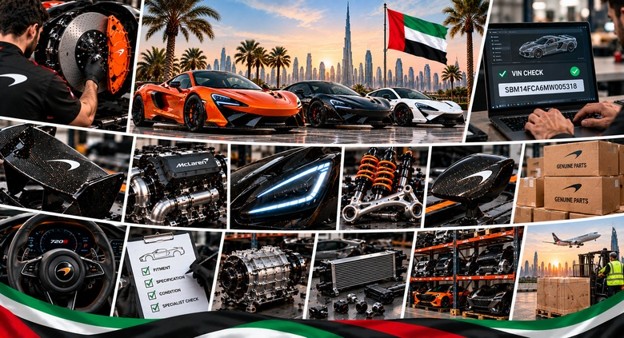
Bumpers, wings, doors, bonnet sections, engine covers and aerodynamic pieces can vary with model, body style, options or related assemblies.
A 570S, 650S and 720S may all look unmistakably McLaren, but that visual family resemblance is precisely what makes casual online matching risky.
For body parts, send the VIN and photographs of the damaged area together.
Headlights are not simply “McLaren headlights”
Lighting assemblies can contain electronics, control units, connectors and vehicle-specific programming or configuration requirements.
So when a seller offers a headlamp assembly, ask what exactly is included.
Is it the complete lamp?
Is the control electronics included?
Is it new or removed from a donor?
Has it been tested?
Is there evidence of condensation or impact damage?
Those questions sound fussy until a very expensive lamp arrives and turns out to be incomplete.
Mirrors deserve the same treatment
A mirror assembly may contain much more than glass and a painted shell.
Depending on specification, there can be electric adjustment, heating, folding, indicators, sensors or associated wiring.
For a used unit, photographs should show the casing, glass, mounting base, connector and wiring.
“Mirror available” is not a fitment description.
Brakes are a particularly poor place to improvise
Brake discs, calipers and related hardware should be matched against the exact vehicle specification and braking package.
Do not assume that a visually similar McLaren brake assembly belongs on your car because it physically bolts up.
With carbon-ceramic systems especially, condition matters as much as identity. A used disc requires proper inspection rather than a seller's description saying “good condition”.
For safety-critical braking components, the sensible question is not merely will it fit? but is its condition and specification appropriate for this vehicle?
Suspension parts need more than a visual match
McLaren's chassis engineering is one of the reasons these cars feel so different from ordinary road cars.
That makes suspension fitment worth treating seriously.
If you are sourcing a damper, spring-related component, control arm, upright or associated hardware, establish the exact application before buying. Then have the installed component inspected after fitting.
A part can be physically compatible and still leave you with incorrect ride-height, geometry or system behaviour if the wider setup has not been considered.
The 570S family needs its own fitment thinking
The 570S, 570GT and 570S Spider share important architecture, but a buyer should not turn that into a blanket assumption that every component crosses between them.
The 570GT's different body and practical configuration, for example, means body and trim sourcing deserves particular care.
For older cars, donor provenance becomes more valuable too. Mileage, accident history and storage conditions can tell you much more about a used component than the word “genuine”.
The 650S is another case where photographs can mislead
The 650S sits in an older generation of McLaren road cars, and genuine components can be harder to identify confidently from marketplace photographs alone.
A used component should be accompanied by its identifying information wherever available.
If a seller cannot establish where the part came from, what vehicle it came off and what identifier it carries, the buyer is effectively being asked to supply the missing research.
That is not a bargain. It is unpaid detective work.
The 720S raises the stakes
The 720S combines a 4.0-litre V8, seven-speed SSG transmission and McLaren's lightweight carbon-fibre architecture.
That combination makes some replacement decisions considerably more involved than swapping an ordinary mechanical component.
An electronic module, transmission-related component, body controller or complex suspension component may need more than physical installation.
Before ordering, establish what happens after the part arrives.
A 750S should not be treated as a 720S parts catalogue
The 750S belongs to the same broad family of McLaren supercars, but its exact component application should still be confirmed rather than inferred from visual similarity.
This is one of those occasions where “it looks the same” is perhaps the least useful sentence in the workshop.
Use the VIN.
Use the part identification.
Use the specialist.
Then buy.
Artura changes the conversation
Artura introduces a hybrid powertrain, which means parts sourcing can involve systems that simply do not exist on earlier V8 McLarens.
That makes specialist involvement particularly important around high-voltage components and associated electrical systems.
Do not treat high-voltage components as ordinary used electrical parts. If the diagnosis points towards a hybrid-system component, the technician's qualification, diagnostic equipment and correct safety procedure matter before the part itself does.
Electronics are where “plug and play” gets shaky
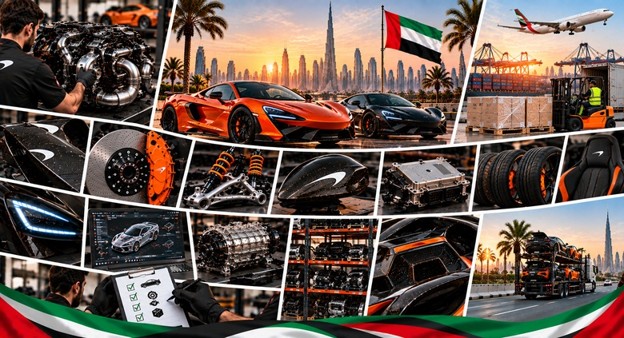
A module can physically plug into a car and still not behave correctly.
That is the bit online listings tend to glide past.
Control modules, sensors and other electronically integrated components can involve configuration, coding, software compatibility or system calibration. The exact requirement depends on the component and vehicle.
So ask the specialist one simple question before ordering:
What will need to happen after installation?
If the answer is “nothing, it just plugs in”, ask them to confirm that for your exact VIN and component.
Genuine does not mean immune to storage damage
A new genuine part stored badly is still a problem.
Rubber seals can age. Electronic components can be exposed to moisture. Carbon components can be damaged during handling. Painted panels can acquire scratches long before they reach the vehicle.
For UAE buyers, this is worth remembering when sourcing parts that have spent considerable time in warehouses, shipping containers or hot storage environments.
The UAE climate does not magically destroy every stored part, but heat exposure and poor storage are legitimate reasons to ask about provenance and condition.
Imported genuine parts need a different calculation
If the correct genuine component is not immediately available in the UAE, importing may make sense.
But compare the landed cost, not the catalogue price.
Freight, insurance, customs treatment, VAT where applicable, handling and delivery can alter the final number considerably.
A part that looks cheaper abroad can become surprisingly ordinary once it has travelled halfway around the world.
The UAE's geography changes sourcing decisions
Dubai is not the whole UAE.
A specialist or supplier in Dubai may be convenient for an owner in Al Barsha, Jumeirah or Al Quoz but less convenient for someone operating from Abu Dhabi, Sharjah, Ajman or Ras Al Khaimah.
For a large body component, engine assembly or gearbox, delivery logistics matter.
For a small sensor or trim component, they matter much less.
The sensible choice changes with the part.
Sharjah can matter for used-component sourcing
The UAE's used-parts market is concentrated in particular industrial areas, and Sharjah's Al Sajaa area is one of the places where dismantling and used-component trading activity can be found.
But a used McLaren part deserves stronger scrutiny than a generic mass-market component.
Ask for donor information.
Ask for mileage where available.
Ask whether the donor was accident-damaged.
Ask for photographs before dismantling if possible.
And if the seller cannot answer basic provenance questions, price should not be the only thing you notice.
Abu Dhabi buyers should not automatically ship everything from Dubai
There are specialist routes in Abu Dhabi as well, so the decision can be based on diagnosis, capability and availability rather than geography alone.
For complicated repairs, a local specialist who can inspect the vehicle, diagnose the failure and verify the replacement may save more time than finding a cheaper component elsewhere and then transporting the car or part back and forth.
The cheapest component is not necessarily the cheapest repair.
The workshop should verify the failure before ordering
This sounds painfully obvious.
It is still skipped.
A diagnostic code does not automatically mean the component carrying the code is defective. A fault can be downstream, upstream, mechanical, electrical or caused by another failed component.
A competent workshop should establish what the fault actually means on that vehicle before the order is placed.
Otherwise you can end up with a genuine part replacing a component that was never the real problem.
Ask what was actually tested
For an expensive McLaren repair, “we scanned it” is not a satisfying diagnostic report.
Ask what was checked.
Was the wiring inspected?
Was power and ground verified?
Were live data values examined?
Was the component physically inspected?
Was the fault reproduced?
Was another known-good component used for comparison where appropriate?
The exact test depends on the system, of course. But the principle is straightforward: the diagnosis should explain why the part is being replaced.
VIN verification should happen before payment
Do not send a large parts payment and only afterwards provide the VIN.
Reverse that order.
VIN first.
Fitment confirmation second.
Price third.
Payment last.
It sounds almost too simple, but it changes the buyer's position considerably.
Photographs should prove more than existence
When buying a genuine used component, request photographs that answer specific questions.
Part label.
Casting or identification marks.
Connector faces.
Mounting points.
Damage areas.
Seals.
Surface condition.
For body panels, include edges and attachment points. For mechanical components, show the areas that actually determine whether the component has lived a hard life.
A glossy photograph of the part sitting on a warehouse floor is mostly advertising.
A specialist should know what cannot be safely judged from photographs
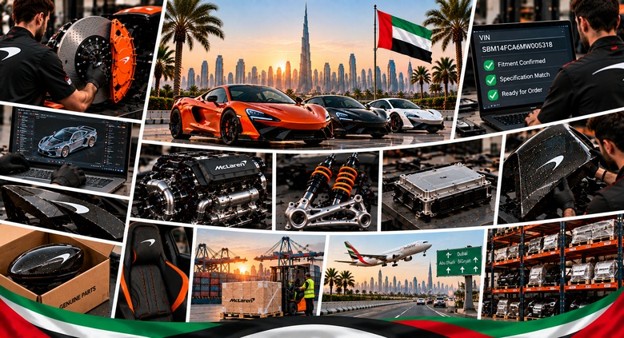
This is an underrated sign of competence.
If someone tells you they can certify the complete condition of a complex electronic module, carbon component, gearbox or suspension assembly from two WhatsApp photographs, be cautious.
A photograph can confirm identity.
It rarely proves mechanical condition.
Those are different things.
Genuine, OEM and aftermarket should not be muddled together
“Genuine”, “OEM”, “OEM-equivalent” and “aftermarket” are not interchangeable marketing phrases.
A genuine McLaren part is a manufacturer-supplied part sold as such.
An OEM component may be produced by a supplier to an original-equipment specification, but that does not automatically make it a McLaren-branded genuine replacement.
Aftermarket parts occupy another category again.
The right choice depends on the component, the car, the owner's priorities and the consequences of failure.
Used genuine can make sense — but not everywhere
A used genuine body trim piece with documented provenance is one thing.
A used safety-critical or electronically integrated component with unknown history is another.
This is where sensible sourcing gets slightly boring, which is precisely why it works.
Use used parts selectively.
Use new genuine parts where uncertainty carries disproportionate consequences.
And let the actual component, rather than a blanket “used is cheaper” philosophy, determine the decision.
Don't confuse the part price with the repair price
Suppose the component itself costs AED X.
That is not necessarily the repair cost.
There may be diagnosis, labour, programming, calibration, alignment, consumables, related hardware and post-installation testing.
For a McLaren, this distinction can become especially important when the component is buried behind bodywork or integrated into another system.
A cheaper part can sometimes create a more expensive installation.
The buyer should ask about the installation sequence
This is a surprisingly useful question:
What has to be removed to fit this?
If a small-looking component requires substantial body disassembly, cooling-system access, suspension removal or electronic calibration, labour becomes part of the sourcing decision.
Knowing that before purchase also helps explain why two workshops may quote very different totals for what appears to be the same job.
PartFinder UAE can be useful when the buyer needs sourcing rather than guesswork
For UAE owners looking for genuine, used or otherwise suitable McLaren components, the useful starting point is not simply “find me a cheap part”.
The better request is: identify the correct part for this VIN, establish its condition and provenance, then compare the available supply route at PartFinder UAE.
That is the kind of sourcing process that reduces expensive dead ends.
The UAE heat makes condition checks worth keeping in the conversation
A McLaren parked outside in UAE summer conditions is dealing with a very different environment from a vehicle stored in a cool European workshop.
That does not mean every UAE car has heat-related problems.
It means heat exposure should be considered when evaluating batteries, rubber components, seals, electronics, paint, interior materials and donor-vehicle history.
Storage matters.
Parking matters.
Maintenance history matters more than a dramatic seller description.
A donor car's history can be more valuable than a low price
Imagine two used genuine suspension components.
One comes from a documented low-mileage donor with photographs and clear history.
The other is cheaper but comes with no donor information whatsoever.
The second component is not automatically bad.
But the first has something the second lacks: traceability.
For expensive specialist parts, traceability is a form of evidence.
The “Before You Click Buy” check
Before paying for a McLaren genuine part in the UAE, the useful questions are brutally practical:
- Has the VIN been checked?
- Is the exact part number confirmed?
- Has a superseded number been considered?
- Is the component left- or right-hand specific?
- Is it for the correct body style?
- Is it new, used or reconditioned?
- If used, what is the donor vehicle?
- What mileage is known?
- Is there accident or flood history?
- Are photographs of labels and mounting points available?
- Does installation require coding, programming or calibration?
- Is workshop labour included in the quoted figure?
- What warranty applies to the component?
- What happens if the part arrives and does not match the confirmed application?
If the seller cannot answer several of these, stop.
Not forever. Just until the missing information exists.
A simple decision matrix is more useful than a generic “buy genuine” rule
| Situation | What deserves priority |
| Safety-critical brake component | Exact specification, condition, professional inspection |
| Electronic control module | VIN/application confirmation and programming requirements |
| Carbon-fibre body component | Provenance, mounting-point condition and physical inspection |
| Used suspension component | Donor history, mileage and condition |
| New genuine service component | Correct part identity and supersession check |
| Interior trim | Exact colour, trim code, body style and physical condition |
| Headlamp assembly | Exact specification, included electronics and test/condition evidence |
| Artura high-voltage component | Qualified specialist handling and correct diagnostic procedure |
| Imported component | Correct fitment plus complete landed cost |
| Older McLaren component | Provenance and availability of the correct replacement number |
Why the specialist check is worth paying for
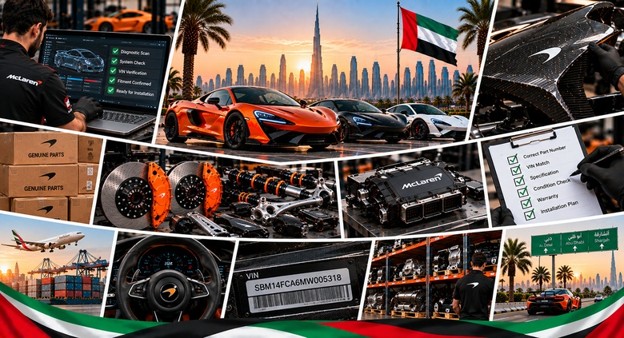
There is a temptation with expensive cars to assume that specialist knowledge is simply another layer of markup.
Sometimes it is.
But when a specialist prevents the wrong component being ordered, identifies a superseded part number, spots a diagnostic misinterpretation or catches a used part with questionable provenance, the value is not really in the ten minutes spent looking at the VIN.
It is in avoiding the next three weeks.
What a proper parts enquiry should look like
A useful UAE parts enquiry is short but specific.
Give the VIN.
State the model and year.
Describe the fault or reason for replacement.
Name the component if known.
Attach photographs.
Mention left/right where relevant.
Ask whether the quoted part is new genuine, used genuine, reconditioned or another category.
Ask whether programming, calibration or additional parts are required.
That is enough information to turn a vague enquiry into something a serious supplier or workshop can actually work with.
McLaren's own parts-support structure reinforces the point
McLaren maintains a dedicated service portal with regional parts-support contacts, including a specific EMEA parts customer-service channel.
That matters because it demonstrates something easy to overlook: parts identification is a formal technical process, not merely an online catalogue exercise.
For unusual, older or difficult-to-identify components, escalation through the appropriate technical or authorised route can be more sensible than relying on a photograph and a marketplace description.
Genuine parts and specialist installation belong together on difficult jobs
McLaren's own Qualified programme connects genuine parts with McLaren-trained technicians and detailed vehicle inspection.
The broader lesson is useful even outside an authorised workshop.
The part and the person fitting it are part of the same repair decision.
A perfect component installed badly is still an expensive problem.
Don't let urgency destroy the checking process
A McLaren sitting in a workshop with a dismantled front end creates pressure.
The owner wants the car back.
The workshop wants the job finished.
The supplier says there is “one available”.
That is exactly when fitment discipline matters most.
A ten-minute VIN and part-number check can feel painfully slow when the car is already on a lift. It is considerably less painful than discovering afterwards that the supposedly correct component belongs to another specification.
The cleanest buying process is surprisingly old-fashioned
Identify the car.
Identify the failure.
Identify the component.
Verify the VIN.
Verify the part number.
Confirm condition.
Confirm what is included.
Confirm installation requirements.
Then buy.
No clever shortcut beats that sequence.
McLaren parts sourcing is really a traceability problem
The best question is rarely “Where can I get this?”
It is:
Can I prove that this is the right part for this car, and can I prove what I am actually buying?
That changes the entire search.
It pushes the conversation away from photographs and vague descriptions and towards VIN records, part numbers, donor information, condition evidence, technical checks and proper installation.
For an ordinary hatchback, that level of scrutiny can feel excessive.
For a McLaren in Dubai, Abu Dhabi, Sharjah or elsewhere in the UAE, it is often simply sensible ownership.
FAQs: McLaren Genuine Parts in UAE
Categories
- Audi
- BMW
- Car Accessories
- Car Tips
- Ford
- Land Rover
- Mazda
- Range Rover
- Top 10
- UAE Car Parts
- Used Car Parts
- Toyota
- Replacement Engines
- Nissan
- Hyundai
- Mitsubishi
- Volkswagen
- Honda
- Kia
- Chevrolet
- Dodge
- Jeep
- Subaru
- Renault
- Lexus
- Mercedes
- Suzuki
- Hummer
- Porsche
- Infiniti
- Peugeot
- GMC
- Mini
- Volvo
- Replacement Gearboxes
- MG
- Jaguar
- Skoda
- Cadillac
- Daihatsu
- Fiat
- German Car Parts
- Japanese Car Parts
- Aftermarket Car Parts
- Genuine Car Parts
- New Car Parts
- Reconditioned Car Parts
- European Car Parts
- American Car Parts
- Korean Car Parts
- British Car Parts
- Chinese Car Parts
- Sports/Exotic Car Parts
- Luxury Car Parts
- Performance Car Parts
- SUV/4x4 Spare Parts
- Truck Spare Parts
- EV Car Parts
- Hybrid Car Parts
- Auto Spare Parts in UAE
- Tesla
- Isuzu
- Ram
- Ferrari
- Bentley
- Lamborghini
- Genesis
- Maserati
- Lincoln
- Chrysler
- Opel
- Citroen
- SsangYong
- Seat
- McLaren