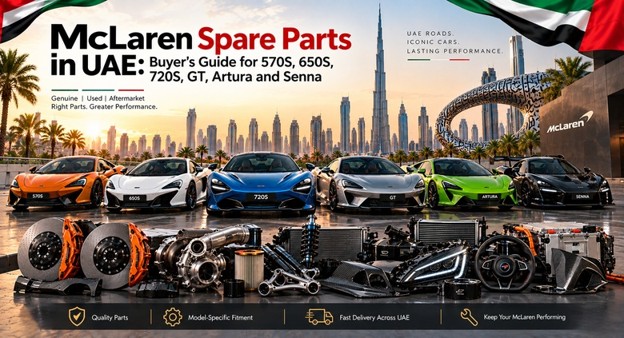
McLaren Spare Parts in UAE: Buyer’s Guide for 570S, 650S, 720S, GT, Artura and Senna
September 24, 2026
With a McLaren, buying the wrong spare part is rarely a cheap mistake. The problem is not simply that these cars are expensive; it is that the specification of a seemingly ordinary component can be tied to the exact model, build, body style, chassis configuration, braking package, transmission, electronics and, increasingly, hybrid system.
That matters in the UAE. A 570S that spends most of its life in Dubai traffic has a very different parts conversation from a 720S used for occasional high-speed runs or a Senna kept primarily for private collection and track use. Heat, dust, long periods of low-speed driving, short journeys and storage conditions all change what deserves attention.
And the six cars in this guide are not interchangeable. The 570S and 650S belong to earlier McLaren generations with twin-turbo V8 powertrains; the 720S moves to a 4.0-litre V8 and Monocage II architecture; the GT brings a more road-focused interpretation of the same engineering philosophy; Artura introduces a plug-in hybrid system; and Senna sits in an altogether more specialised category.
The first rule: identify the McLaren before identifying the part
“McLaren spare parts in UAE or McLaren 720S brake parts” is not enough information for a serious order.
You want the exact model, model year, Coupe or Spider where applicable, VIN, part number if available, and ideally the vehicle build specification. A parts supplier working from those details can distinguish a legitimate match from something that merely appears similar in a catalogue.
That extra five minutes at the beginning can prevent a very expensive return.
Why McLaren parts need tighter fitment checks
McLaren uses extensive carbon-fibre structures, lightweight components, sophisticated suspension systems and model-specific electronic systems. The 720S, for example, uses a Carbon Fibre Monocage II structure, adaptive dampers and Proactive Chassis Control II, while its braking system uses carbon-ceramic discs with six-piston front and four-piston rear aluminium callipers.
That means “same shape” is not the same thing as “same specification”.
A component can physically resemble another part and still have the wrong mounting arrangement, sensor provision, calibration requirement or material specification.
McLaren 570S spare parts in the UAE
The 570S is the sort of McLaren that has now entered a different phase of ownership: older examples can need restoration and preventative replacement as much as routine servicing.
McLaren's official 570S Spider specifications show a 3,799cc twin-turbo V8, dry-sump lubrication, 570 PS and 600 Nm, with the carbon-fibre Monocell structure central to the car's design.
For UAE buyers, the important parts categories include brakes, filters, ignition components, cooling components, suspension hardware, sensors, batteries, body panels, lighting and electronic modules.
What makes the 570S different when ordering parts
The 570S sits within McLaren's Sports Series, so many owners encounter an awkward middle ground: the car can be used regularly, but it remains highly specialised underneath.
That makes consumables relatively straightforward compared with carbon-fibre bodywork, electronic modules or suspension components. A service filter and a structural carbon component should never be treated as the same kind of purchase.
They are not.
McLaren 650S spare parts in the UAE
The 650S uses McLaren's 3,799cc twin-turbo engine and produces 650 PS and 678 Nm in the factory specification. McLaren lists a seven-speed Seamless Shift Gearbox for the car.
For a UAE buyer, that makes transmission-related components, cooling parts, braking hardware, engine ancillaries and electronic components particularly important to verify against the exact vehicle.
The 650S Spider is a separate consideration because of its roof mechanism and body configuration; McLaren specifically engineered the Spider roof system around weight and centre-of-gravity considerations.
650S Coupe versus 650S Spider
Do not order a body, roof or trim component from a photograph alone.
The Coupe and Spider share substantial mechanical DNA, but their body and roof-related components are not automatically interchangeable. McLaren's own technical material distinguishes the two configurations.
For exterior parts, provide the VIN and photographs of the existing component whenever possible.
McLaren 720S spare parts in the UAE
The 720S changes the equation again.
It uses a 4.0-litre twin-turbo V8 producing 720 PS and 770 Nm, with a seven-speed SSG transmission. Its carbon-fibre Monocage II structure and Proactive Chassis Control II are particularly important when discussing suspension, chassis and accident-related repairs.
The official specification also confirms carbon-ceramic brakes and adaptive dampers.
So a 720S parts order should be treated as a specification exercise, not a simple model-name search.
The 720S cooling system deserves serious attention
McLaren describes the 720S front lighting and bodywork as part of its airflow management, with the headlights incorporating intakes that guide air towards the radiators.
That makes cooling-system inspection particularly relevant after front-end damage or poorly executed body repairs.
A replacement bumper is not merely cosmetic if damaged ducting, brackets or airflow components are also involved.
McLaren GT spare parts
The GT was designed around a slightly different ownership brief: long-distance usability without abandoning McLaren's performance architecture.
Its official specification lists a 4.0-litre twin-turbo V8, 620 PS, 630 Nm, a seven-speed SSG and carbon-ceramic brakes with six-piston callipers.
That means its parts requirements overlap with the broader McLaren family in some areas but should never be assumed identical to the 720S.
GT body and luggage-area parts
The GT has a much greater emphasis on luggage capacity, with McLaren listing 150 litres of front storage and 420 litres at the rear.
For UAE owners using the GT as an actual road car, trim, seals, hinges, luggage-area components and interior hardware can therefore matter more than they would on a highly track-focused McLaren.
McLaren Artura spare parts are a different proposition
Artura is where the buyer needs to slow down.
It is a high-performance hybrid rather than simply another turbocharged McLaren. McLaren's current specification lists a 3.0-litre V6, twin electrically actuated turbochargers, a 7.4 kWh refrigerant-cooled lithium-ion battery and an axial-flux electric motor.
That introduces an entirely different class of parts and diagnostic requirements.
Artura hybrid parts should not be treated like ordinary engine parts
Battery, high-voltage electrical, inverter, electric motor and associated cooling components require appropriate diagnostic procedures and safety controls.
A workshop may be excellent at mechanical McLaren work and still need the correct equipment and training for high-voltage hybrid systems.
That distinction matters before you approve a repair.
McLaren Senna spare parts
The Senna belongs in its own category.
McLaren describes it as a road-legal, track-focused car developed around weight reduction and extreme aerodynamic performance. Its 4.0-litre twin-turbo V8 produces 800 PS and 800 Nm, while the car uses active aerodynamic elements including front aero blades and a large rear wing.
A Senna part should therefore be approached with an even stricter originality and provenance standard.
Why Senna carbon-fibre parts are especially sensitive
The Senna's lightweight philosophy means body and aerodynamic components are not just decoration.
Damage to a carbon-fibre panel, splitter, wing element or mounting point can have consequences beyond appearance. A visual inspection should establish whether the component has only cosmetic damage or whether its mounting structure, attachment points or underlying carbon construction has been compromised.
570S, 650S, 720S, GT, Artura and Senna are not one parts catalogue
There is useful family resemblance across McLaren's range. That does not mean universal interchangeability.
The engine architecture, carbon structures, suspension systems, electronics and bodywork vary substantially between these models. McLaren's own technical specifications make those differences clear.
Treating them as one generic “McLaren spare parts” category is where expensive mistakes begin.
Engine parts: start with the engine specification
For the 570S and 650S, the older 3.8-litre twin-turbo V8 architecture is central to parts identification. The 720S and GT use a 4.0-litre V8, while Artura switches to a 3.0-litre V6 hybrid powertrain.
That alone should tell you why a generic “McLaren V8 part” search is not enough.
Turbocharger and charge-air components
Turbocharger-related faults should be diagnosed rather than assumed from a noise.
A workshop should check boost behaviour, intake and charge-air plumbing, relevant sensors, pressure integrity and associated fault codes before replacing an expensive turbocharger.
On a high-performance car, replacing the visible component without establishing why it failed can simply move the problem downstream.
Cooling-system parts in UAE conditions
The UAE climate makes cooling-system condition particularly important, but heat should not become an excuse for replacing parts without diagnosis.
Check coolant level and condition, radiator and heat-exchanger condition, fans, pumps, hoses, clamps, leaks and temperature behaviour. On a McLaren that has suffered front-end damage, inspect the complete airflow and cooling package rather than just the visibly broken component.
Radiators, heat exchangers and airflow
A radiator can be externally damaged while the car still appears to drive normally.
Bent fins, restricted airflow, damaged ducting or a compromised mounting can become more significant under sustained load. This is especially relevant when a car has previously had bumper or front-end work.
In Dubai, where ambient temperatures can be punishing, cooling-system integrity deserves attention before performance driving.
Brake parts: don't buy by diameter alone
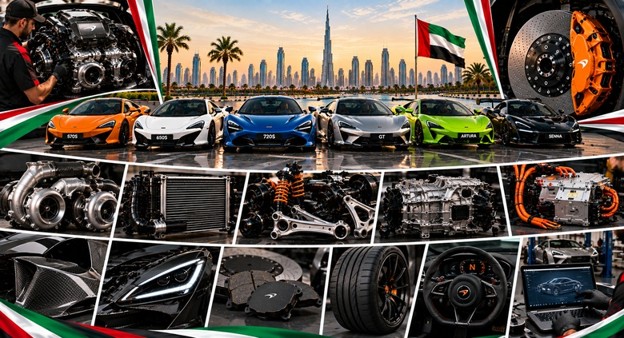
McLaren braking systems can vary by model and specification, and the 720S and GT official specifications confirm carbon-ceramic systems.
Before ordering discs or pads, confirm the exact brake package, disc specification, calliper configuration and sensor/hardware requirements.
“Will it fit?” is only the first question.
Brake pads need the right compound
Road use and track use are not identical.
A pad that works acceptably during ordinary UAE road driving may not be the right choice for repeated high-temperature track use, while an aggressive track compound may be unnecessarily compromised for a road-only car.
Ask what the car actually does before selecting the part.
Suspension parts need more than a visual check
McLaren suspension systems are sophisticated. The 720S, for example, uses double wishbones, adaptive dampers and Proactive Chassis Control II.
If the car develops uneven ride height, unusual noise, steering pull or handling changes, inspect bushes, joints, dampers, hydraulic/electronic systems where applicable, wheel alignment and associated sensors before ordering a complete suspension assembly.
Steering and alignment after suspension work
Replacing a suspension component without checking geometry can leave the car feeling wrong even when the new part is perfectly good.
After significant suspension or steering work, the workshop should establish whether alignment values remain within the required specification and investigate any unequal readings rather than simply adjusting around a damaged component.
Gearbox parts and SSG identification
Several McLaren models use the seven-speed Seamless Shift Gearbox architecture, but that does not make every gearbox component interchangeable.
The 570-series, 650S, 720S and GT need to be identified individually before ordering transmission components. Official McLaren specifications confirm seven-speed SSG configurations for the 570GT, 650S, 720S and GT.
Do not replace the gearbox because of one fault code
A gearbox fault code is evidence, not automatically a diagnosis.
The workshop should consider fluid condition where applicable, electrical supply, sensors, hydraulic or actuator behaviour, clutch operation, software/adaptation status and mechanical symptoms.
Sometimes a smaller component is responsible for a much larger-looking transmission complaint.
Battery and electrical components
A low-voltage battery can create a surprising collection of electrical warnings in a modern supercar.
Before replacing multiple electronic modules, verify battery condition, charging voltage, grounds, connections and fault-code history.
This is particularly important on vehicles that spend long periods parked.
Artura adds a second electrical world
With Artura, the diagnostic process becomes more involved because the vehicle combines a combustion engine with an electric motor and high-voltage battery system. McLaren lists the battery as a 7.4 kWh refrigerant-cooled lithium-ion unit.
A workshop should have appropriate high-voltage procedures before touching those systems.
Headlights and lighting modules
McLaren lighting units can be expensive because they are not simply bulbs inside a generic housing.
Before ordering a complete lamp assembly, establish whether the fault is in the lamp, module, wiring, connector, control unit or communication network.
For a carbon-bodied car, also inspect the surrounding mounting points after any collision.
Body panels and carbon-fibre parts
Carbon-fibre bodywork needs a different inspection mindset from steel or conventional plastic panels.
A panel can look acceptable from a distance while having damage around a mounting point or attachment area. Ask for detailed photographs, the exact part identification and the condition of every mounting point before buying used carbon components.
Used McLaren body parts: provenance matters
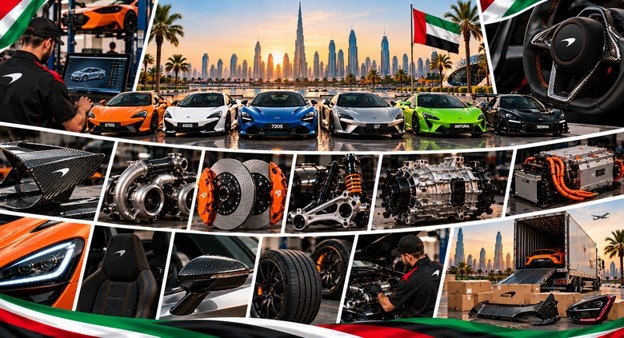
A used bumper or mirror may be perfectly sensible if it is complete, undamaged and correctly identified.
A used structural or safety-related component is another matter.
Ask where it came from, why it was removed, whether the donor car suffered impact damage, whether brackets and fixings are included, and whether the part has been repaired.
Genuine McLaren parts versus OEM alternatives
McLaren itself states that its factory standards use McLaren Genuine Parts, and its extended warranty material says genuine parts are fitted by McLaren-trained technicians at McLaren Retailers.
For an owner, the useful distinction is not simply “genuine or cheap”.
Ask what the part actually is, who manufactured it, whether it carries the required specification, what warranty applies and whether installation requires calibration or programming.
Aftermarket parts require a different level of scrutiny
An aftermarket component can be perfectly legitimate for a particular purpose.
But the buyer needs to know whether it is intended as a direct replacement, a performance modification, a track component or a cosmetic upgrade. Those are four very different purchasing decisions.
Don't confuse “available” with “equivalent”.
Reconditioned parts can make sense in the right category
Reconditioned components can be useful when the underlying part is designed to be rebuilt and the rebuilder can demonstrate what was actually replaced.
Ask for the scope of the rebuild, testing procedure, warranty and identification of the returned core.
If the seller cannot explain what has been done, the word “reconditioned” tells you very little.
Used engines and gearboxes need evidence
For a major McLaren component, mileage alone is not enough.
Ask for donor vehicle information, service history, removal reason, compression or leak-down evidence where appropriate for an engine, diagnostic history, fluid condition, photographs and a clear warranty.
A low-mileage engine with unknown provenance is not automatically a better purchase than a higher-mileage unit with documented history.
Compression testing can be useful for a used engine
If a used combustion engine is being considered, compression testing can provide useful evidence about cylinder condition.
But it should not be treated as a complete health certificate.
Where practical, combine compression figures with leak-down testing, borescope inspection, oil analysis, fault-code history and evidence of oil pressure or other relevant mechanical checks.
UAE heat changes the inspection priorities
Dubai and Abu Dhabi heat can expose marginal cooling, battery and air-conditioning components quickly.
It can also make rubber, seals, hoses, plastics and certain electrical connections more deserving of inspection on older cars.
That does not mean every McLaren in the UAE has heat-related failures. It means the local operating environment should form part of the diagnostic conversation.
Air-conditioning parts deserve attention on road-driven McLarens
A track-focused inspection can easily overlook the fact that many UAE owners still need their car's air conditioning to work properly.
Check compressor operation, refrigerant pressures, condenser condition, fans, leaks and control-system faults before replacing expensive components.
A weak air-conditioning system is not automatically a failed compressor.
Tyres and wheels are part of the parts decision
High-performance McLaren wheels and tyres should be checked as a complete package.
Confirm wheel dimensions, offset, tyre specification, speed rating, load rating and the exact vehicle configuration before ordering.
For cars with previous suspension or accident repairs, inspect wheels carefully for bends or cracks rather than assuming a vibration is caused by tyres alone.
Accident-damaged McLarens need a wider inspection
This is where bargain hunting can go badly wrong.
If a used part comes from a crashed McLaren, establish exactly where the donor vehicle was damaged. A headlamp removed from a rear-impact car is one thing. A suspension assembly removed from a heavily damaged front corner is another.
The donor's accident history changes the risk.
Electronic diagnostics should happen before expensive parts orders
A modern McLaren can store useful diagnostic information across multiple systems.
Before approving an expensive electronic component, ask the workshop to record the relevant fault codes, freeze-frame information where available, voltage conditions, communication faults and the tests used to isolate the component.
“Computer says faulty” is not a sufficiently detailed diagnosis.
Where UAE buyers commonly go wrong
The recurring mistakes are remarkably ordinary: ordering by model name alone, ignoring Coupe/Spider differences, accepting a photograph as proof of fitment, buying an expensive used component without donor information, and confusing a performance upgrade with a replacement part.
None of these errors requires bad intentions.
They simply require better questions.
Buying McLaren spare parts online in the UAE
Online ordering can work very well when the process starts with vehicle identification rather than a generic search box.
Send the VIN, model, year, body style, engine information, part number if available, photographs and the exact fault or repair requirement. A proper parts enquiry should allow the supplier to verify the component before money changes hands.
For UAE owners comparing available sourcing routes, PartFinder UAE can be used as part of that fitment-led search process rather than treating the vehicle model name as sufficient identification.
What information should you send with a parts enquiry?
For a serious enquiry, provide:
- VIN or chassis number
- Exact McLaren model
- Model year
- Coupe or Spider
- Current mileage
- Engine or powertrain information
- Part number, if visible
- Clear photographs
- Left/right/front/rear position where relevant
- Fault symptoms
- Diagnostic codes where available
- Whether the vehicle is road or track used
That turns a vague request into something a supplier can actually work with.
UAE price reality: part price is not repair price
McLaren parts pricing can vary dramatically by component, specification, condition, provenance and availability.
A carbon body panel, brake component, electronic module and engine assembly should not be grouped under one generic “McLaren spare parts price”.
As of September 2026, I would not publish a single UAE price range for these models without a dated, model-specific quotation because that would create false precision. The useful number is the price for the exact part, plus shipping if applicable, plus labour, calibration/programming and any associated components required for installation.
A simple buyer decision matrix
| What you need | Information to verify first | Sensible purchasing focus |
| Routine service part | Model, year, VIN | Correct specification and reputable source |
| Brake component | Brake package, axle, part number | Exact disc/pad/calliper compatibility |
| Suspension component | Model, chassis specification, position | Fitment, calibration/alignment requirements |
| Body panel | Coupe/Spider, side, colour, carbon specification | Condition and mounting points |
| Used engine | Engine identification, donor history | Compression, leak-down, borescope, provenance |
| Used gearbox | Transmission identification | Fault history, condition, warranty |
| Electronic module | Exact module number, fault codes | Diagnosis before replacement |
| Artura hybrid component | VIN, HV system identification | Qualified high-voltage diagnosis |
| Senna carbon/aero part | Exact specification and provenance | Originality, structural condition, mounting integrity |
Before You Click Buy
Stop if the seller cannot answer basic fitment questions.
Can they identify the exact model and generation? Can they confirm the part number? Do they know whether the vehicle is a Coupe or Spider? For a used part, can they explain where it came from? For a major mechanical component, is there a meaningful warranty?
And if the answer to all of that is simply “it should fit”, keep looking.
That phrase has cost plenty of exotic-car owners money.
When genuine parts make more sense
For structural, safety-critical, electronically integrated or highly model-specific components, genuine parts may offer the clearest route to known specification and compatibility.
McLaren's own ownership material places strong emphasis on Genuine Parts and McLaren-trained technicians.
That does not mean every non-genuine component is automatically unsuitable. It means the burden of proof is higher when the component is critical to the vehicle's engineered system.
When a quality used part can be sensible
Used genuine parts can make sense for selected body, trim and non-wear components, particularly on older 570S and 650S vehicles where owners are balancing restoration cost against originality.
The important word is selected.
Do not apply the same buying logic to a mirror housing, an electronic control module and a safety-critical brake component.
McLaren's own ownership guidance supports planned maintenance
McLaren currently offers extended service plans for eligible vehicles aged two to 15 years and describes fixed-rate planned maintenance as one way of protecting long-term value.
That is relevant to UAE buyers because preventative maintenance can be more economical than waiting for a high-value component to fail completely.
On an exotic car, “I'll deal with it when it gets worse” can be an expensive strategy.
The sensible way to buy McLaren spare parts in the UAE
Start with the car, not the part.
Identify the exact model and build. Verify the VIN and component number. Establish whether the issue is actually the component you are about to buy. Decide whether genuine, OEM-quality, aftermarket, used or reconditioned is appropriate for that particular part. Then compare the complete repair cost, not merely the headline price of the box.
For 570S and 650S, pay particular attention to age, donor history and restoration-related parts. For 720S and GT, carbon structure, cooling, braking and electronic systems deserve careful fitment checks. For Artura, hybrid-system competence becomes essential. For Senna, originality and provenance can matter as much as availability.
That is the real McLaren parts-buying rule in the UAE: the cheapest component is not necessarily the cheapest repair.
Frequently Asked Questions
Categories
- Audi
- BMW
- Car Accessories
- Car Tips
- Ford
- Land Rover
- Mazda
- Range Rover
- Top 10
- UAE Car Parts
- Used Car Parts
- Toyota
- Replacement Engines
- Nissan
- Hyundai
- Mitsubishi
- Volkswagen
- Honda
- Kia
- Chevrolet
- Dodge
- Jeep
- Subaru
- Renault
- Lexus
- Mercedes
- Suzuki
- Hummer
- Porsche
- Infiniti
- Peugeot
- GMC
- Mini
- Volvo
- Replacement Gearboxes
- MG
- Jaguar
- Skoda
- Cadillac
- Daihatsu
- Fiat
- German Car Parts
- Japanese Car Parts
- Aftermarket Car Parts
- Genuine Car Parts
- New Car Parts
- Reconditioned Car Parts
- European Car Parts
- American Car Parts
- Korean Car Parts
- British Car Parts
- Chinese Car Parts
- Sports/Exotic Car Parts
- Luxury Car Parts
- Performance Car Parts
- SUV/4x4 Spare Parts
- Truck Spare Parts
- EV Car Parts
- Hybrid Car Parts
- Auto Spare Parts in UAE
- Tesla
- Isuzu
- Ram
- Ferrari
- Bentley
- Lamborghini
- Genesis
- Maserati
- Lincoln
- Chrysler
- Opel
- Citroen
- SsangYong
- Seat
- McLaren