Mercedes E300 Engine Replacement UAE: Uncovering the Mechanical Evidence Behind Rising Repair Costs
June 11, 2026
Every major engine replacement begins with a clue.
Sometimes it is a faint ticking sound during a cold start.
Sometimes it is a warning light that appears briefly before disappearing.
Sometimes it is a small coolant loss that seems too insignificant to matter.
Owners often dismiss these clues.
The vehicle continues driving.
The problem appears manageable.
Life moves on.
Then months later, a workshop quotation arrives carrying a figure that changes the entire ownership conversation.
This is why Mercedes E300 engine replacement stories rarely begin with catastrophic failure.
They usually begin with evidence.
Small pieces of evidence.
Evidence that was visible long before the replacement-engine discussion ever started.
The purpose of this guide is not simply to discuss replacement-engine costs.
It is to investigate the mechanical story behind those costs.
Because when owners understand the evidence trail, they often make significantly better ownership decisions.
Particularly in the UAE.
Dubai traffic.
Abu Dhabi motorway driving.
Sharjah stop-start congestion.
Summer temperatures exceeding 45°C.
These conditions place unique stress on executive vehicles such as the Mercedes E300.
The result is that engine replacement decisions should never be viewed as isolated repair events.
They should be viewed as the final chapter of a much longer mechanical investigation.
Opening the Case File: Why Rising Mercedes E300 Repair Costs Rarely Appear Without Warning
One of the first discoveries made during almost every major engine investigation is that warning signs existed long before the major failure occurred.
The engine rarely fails without leaving clues.
The challenge is recognising them.
Common Early Evidence
- Increased oil consumption
- Minor coolant loss
- Intermittent warning lights
- Rough cold starts
- Reduced fuel efficiency
- Occasional overheating concerns
Individually, these symptoms may appear harmless.
Together, they often form a pattern.
Mechanical Evidence Risk Scale
| Evidence Found | Investigation Priority |
| Slight Oil Consumption | Moderate |
| Repeated Coolant Loss | Elevated |
| Consistent Warning Lights | High |
| Rough Running | High |
| Overheating Incidents | Critical |
The earlier the evidence is examined, the more ownership options usually remain available.
The First Clues at the Scene: Early Warning Signs Many Mercedes E300 Owners Overlook
A mechanical detective never starts with conclusions.
The process begins with clues.
The Mercedes E300 often provides these clues months before a replacement-engine discussion emerges.
Frequently Ignored Symptoms
- Small oil leaks
- Unusual engine vibrations
- Delayed throttle response
- Intermittent power reduction
- Minor coolant top-ups
- Engine-management warnings
Many owners postpone investigation because the vehicle remains driveable.
That decision often proves expensive later.
Real UAE Ownership Scenario
A Dubai executive notices coolant levels dropping slightly every few weeks.
The vehicle continues operating normally.
No immediate action is taken.
Six months later:
- Cooling-system stress increases
- Additional components become affected
- Repair costs rise significantly
The original clue was small.
The resulting invoice was not.
Following the Evidence Trail: How Minor Mechanical Symptoms Escalate Into Major Engine Problems
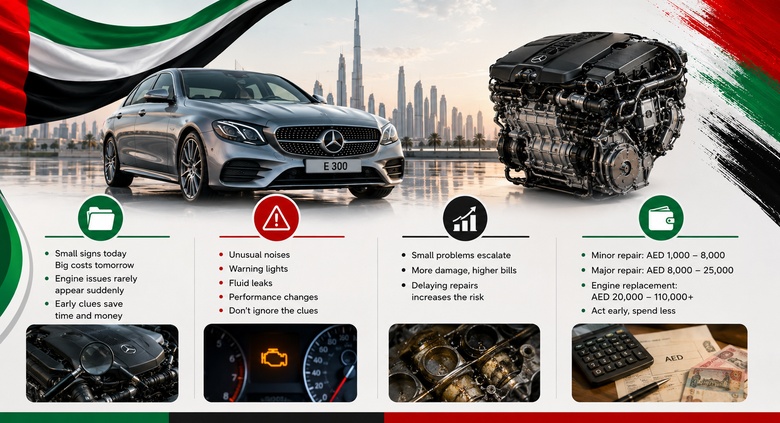
One of the most important lessons in automotive ownership is understanding escalation.
Mechanical problems rarely remain static.
Typical Escalation Pattern
Minor Symptom
↓
Temporary Workaround
↓
Repeated Occurrence
↓
Component Wear
↓
Secondary Damage
↓
Major Mechanical Exposure
↓
Engine Replacement Discussion
The cost difference between early intervention and delayed intervention can be substantial.
Cost Escalation Analysis
| Stage | Typical Cost Range (AED) |
| Initial Diagnostic Inspection | 300 – 1,500 |
| Minor Mechanical Repair | 1,000 – 8,000 |
| Major Engine Repair | 8,000 – 25,000 |
| Replacement Engine Project | 20,000 – 90,000+ |
The investigation repeatedly reveals the same conclusion.
The most expensive repairs often begin as inexpensive problems.
The Cost-of-Delay Investigation: What Happens When Mechanical Evidence Is Ignored
Perhaps the most expensive clue in any ownership journey is the clue that receives no attention.
Ignoring evidence rarely eliminates risk.
It usually transfers risk into the future.
And future risk is often more expensive.
Common Consequences of Delay
- Increased repair complexity
- Secondary component damage
- Additional labour requirements
- Reduced reliability
- Lower resale confidence
Cost-of-Delay Comparison
| Decision Timing | Potential Financial Exposure |
| Early Investigation | Low |
| Planned Repair | Moderate |
| Delayed Action | High |
| Failure Response | Very High |
This is especially relevant in UAE summer conditions where elevated temperatures accelerate existing weaknesses.
The Financial Forensics Report: Hidden Costs Discovered During Engine Replacement Projects
The replacement engine itself is only part of the financial story.
Investigations frequently uncover additional costs.
These supporting expenses often surprise owners.
Hidden Cost Suspects
- Engine mounts
- Cooling-system components
- Water pumps
- Sensors
- ECU programming
- Wiring repairs
- Fluids and filters
Hidden Cost Breakdown
| Component | Typical Cost (AED) |
| Engine Mounts | 1,500 – 6,000 |
| Cooling Components | 2,000 – 12,000 |
| Water Pump | 1,000 – 5,000 |
| Sensors | 500 – 6,000 |
| ECU Programming | 500 – 3,500 |
| Fluids & Filters | 500 – 2,500 |
Many owners budget for the engine.
Successful owners budget for the investigation's full findings.
UAE Labour Cost Investigation: Where Installation Costs Differ Across Emirates
Labour costs represent a significant part of every replacement-engine project.
Yet many buyers underestimate regional variations.
Typical Labour Cost Comparison
| Emirate | Labour Cost Range (AED) |
| Dubai | 6,000 – 18,000 |
| Abu Dhabi | 6,000 – 17,000 |
| Sharjah | 4,500 – 14,000 |
| Ajman | 4,000 – 12,000 |
| Ras Al Khaimah | 4,000 – 11,000 |
| Fujairah | 4,000 – 11,000 |
| Umm Al Quwain | 4,000 – 10,000 |
Labour pricing varies based on:
- Workshop reputation
- Mercedes expertise
- Engine complexity
- Documentation standards
- Diagnostic requirements
The cheapest labour quotation rarely tells the complete story.
Suspect Identification: Which Engine Components Most Commonly Contribute to Mercedes E300 Engine Failure
Every investigation eventually reaches the same question:
What actually caused the problem?
The answer is rarely a single component.
Instead, failures often involve interconnected systems.
Common Failure Contributors
- Cooling-system weaknesses
- Lubrication issues
- Timing-related wear
- Turbocharger stress
- Sensor-related faults
- Carbon accumulation
Failure Probability Matrix
| Component Area | Investigation Frequency |
| Cooling System | Very High |
| Lubrication System | Very High |
| Sensors & Electronics | High |
| Turbo System | High |
| Timing Components | Moderate to High |
Understanding the likely suspects helps owners evaluate future risk more effectively.
Mercedes E300 Engine Cost Comparison Investigation
Not all replacement-engine options carry the same financial profile.
Mercedes E300 Engine Comparison
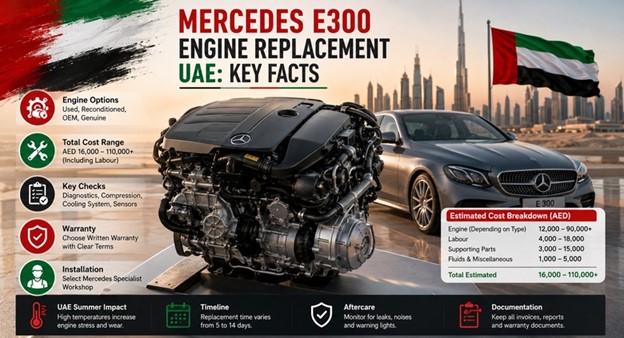
| Engine Type | Engine Cost (AED) | Installation (AED) | Estimated Total (AED) |
| Used Engine | 12,000 – 25,000 | 4,000 – 18,000 | 16,000 – 43,000 |
| Reconditioned Engine | 20,000 – 40,000 | 5,000 – 18,000 | 25,000 – 58,000 |
| OEM Engine | 35,000 – 60,000 | 6,000 – 18,000 | 41,000 – 78,000 |
| Genuine Mercedes Engine | 50,000 – 90,000+ | 6,000 – 20,000 | 56,000 – 110,000+ |
The investigation at this stage becomes less about cost alone.
It becomes about value, reliability and future ownership confidence.
The First Conclusion of the Investigation
The evidence gathered so far points toward a recurring pattern.
Major Mercedes E300 engine replacement costs rarely emerge suddenly.
They develop gradually.
The clues are often present.
The evidence exists.
The question is whether it is recognised in time.
Owners who investigate early generally retain more options.
Owners who wait for definitive failure often inherit larger costs, greater risks and fewer choices.
Mileage Evidence Analysis: What Odometer Readings Reveal About Future Engine Risk
Every mechanical investigation includes a timeline.
In automotive ownership, mileage often provides that timeline.
Mileage does not automatically determine engine condition.
However, it frequently reveals risk patterns.
A well-maintained Mercedes E300 with higher mileage can sometimes present lower risk than a poorly maintained example with significantly fewer kilometres.
The objective is understanding what the evidence suggests.
Mercedes E300 Mileage Risk Assessment
| Mileage Range | Investigation Findings | Risk Level |
| Under 80,000 km | Typically lower wear exposure | Low |
| 80,000 – 150,000 km | Increased inspection required | Moderate |
| 150,000 – 220,000 km | Detailed diagnostics recommended | Elevated |
| Above 220,000 km | Comprehensive investigation essential | High |
Mileage should never be viewed in isolation.
Investigators also examine:
- Service records
- Oil-change history
- Cooling-system condition
- Previous repairs
- Ownership behaviour
The strongest evidence often comes from combining these clues.
The UAE Climate Investigation: How Extreme Temperatures Leave Mechanical Evidence Behind
Few factors influence engine longevity more consistently than climate.
And few climates are as demanding as the UAE.
Summer temperatures regularly place additional stress on:
- Cooling systems
- Lubrication systems
- Sensors
- Turbochargers
- Electronic components
The evidence often accumulates gradually.
Common UAE Summer Failure Patterns
- Cooling-system fatigue
- Premature hose deterioration
- Increased oil degradation
- Higher thermal stress
- Sensor-related failures
Climate Exposure Matrix
| Operating Environment | Mechanical Stress Level |
| Mild Climate Operation | Moderate |
| UAE Winter Driving | Moderate |
| UAE Summer Highway Use | High |
| UAE Urban Congestion | Very High |
| Prolonged Idling + Summer Heat | Critical |
This is why two identical Mercedes E300 vehicles can experience dramatically different ownership outcomes.
The operating environment becomes part of the evidence.
Engine Replacement Suspects Compared: Used, Reconditioned, OEM and Genuine Engines Under Investigation
Every replacement-engine investigation eventually arrives at the same question.
Which engine option presents the lowest ownership risk?
The answer depends on:
- Budget
- Ownership duration
- Reliability expectations
- Future resale plans
Used Engine Investigation
Potential Advantages:
- Lower acquisition cost
- Faster availability
Potential Risks:
- Unknown operating history
- Higher uncertainty
Reconditioned Engine Investigation
Potential Advantages:
- Refreshed internals
- Balanced investment profile
Potential Risks:
- Quality varies by rebuilder
OEM Engine Investigation
Potential Advantages:
- Strong compatibility
- Reliable sourcing
Potential Risks:
- Higher purchase price
Genuine Mercedes Engine Investigation
Potential Advantages:
- Maximum confidence
- Strong resale support
Potential Risks:
- Largest capital requirement
Engine Evidence Comparison
| Engine Type | Reliability Outlook | Warranty Confidence | Resale Support |
| Used | Variable | Lower | Moderate |
| Reconditioned | Moderate to High | Moderate | Good |
| OEM | High | Strong | Very Good |
| Genuine | Very High | Strongest | Excellent |
The cheapest suspect is not always the most innocent.
Supporting Parts Investigation: Components That Should Be Examined Before Installation
Many replacement-engine projects focus exclusively on the engine itself.
The investigation frequently reveals additional components requiring attention.
Ignoring these supporting systems can create future problems.
Supporting Parts Replacement Checklist
✓ Radiator
✓ Water pump
✓ Thermostat
✓ Engine mounts
✓ Cooling hoses
✓ Belts
✓ Sensors
✓ Filters
✓ Fluids
✓ Turbo-related components (where applicable)
Supporting-Part Cost Comparison
| Component | Typical Cost (AED) |
| Radiator | 1,500 – 6,000 |
| Water Pump | 1,000 – 5,000 |
| Thermostat | 500 – 2,500 |
| Engine Mounts | 1,500 – 6,000 |
| Sensors | 500 – 6,000 |
| Belts & Hoses | 500 – 3,000 |
These items often represent the difference between a successful project and recurring workshop visits.
Workshop Detective Work: How Installation Quality Influences the Outcome of the Case
A replacement engine can only perform as well as its installation.
This reality appears repeatedly throughout ownership investigations.
Characteristics of Strong Installations
- Comprehensive diagnostics
- Professional testing procedures
- Documentation transparency
- Proper calibration
Characteristics of Higher-Risk Installations
- Limited testing
- Incomplete records
- Minimal post-installation inspection
- Unclear sourcing
Workshop Risk Assessment
| Workshop Profile | Risk Level |
| Low-Cost General Workshop | High |
| Independent Mercedes Specialist | Moderate |
| Premium European Specialist | Lower |
| Fully Documented Professional Installation | Lowest |
The investigation often reveals that installation quality influences reliability more than many owners expect.
The Documentation Evidence File: Records Every Buyer Should Examine Before Approving an Engine Project
A mechanical detective never relies solely on verbal assurances.
Documentation matters.
Documentation creates accountability.
Documentation supports resale value.
Documentation protects ownership interests.
Documentation Verification Checklist
✓ Engine purchase invoice
✓ Engine serial number
✓ Import documentation
✓ Warranty certificate
✓ Compression-test results
✓ Workshop invoice
✓ Diagnostic reports
✓ Installation records
Documentation Risk Matrix
| Documentation Status | Ownership Risk |
| Complete Records | Low |
| Strong Documentation | Low to Moderate |
| Partial Records | Moderate |
| Missing Evidence | High |
Future buyers frequently trust paperwork more than promises.
Warranty Clue Analysis: Warning Signs That Suggest Future Ownership Risks
Not all warranties provide equal protection.
Investigations often reveal warning signs before problems occur.
Warranty Red Flags
- Verbal-only warranties
- Extremely short coverage periods
- No written conditions
- No labour coverage
- Exclusions that remove practical protection
Warranty Confidence Comparison
| Warranty Profile | Risk Level |
| Comprehensive Written Warranty | Low |
| Limited Written Warranty | Moderate |
| Short-Term Warranty | Elevated |
| Verbal Warranty Only | High |
A weak warranty can transform a small issue into a significant ownership expense.
Poor Installation Warning Signs: Clues That Should Never Be Ignored
The investigation does not end once the engine is installed.
In fact, some evidence only appears afterwards.
Common Post-Installation Warning Signs
- Persistent warning lights
- Fluid leaks
- Rough idle
- Excessive vibration
- Cooling-system instability
- Abnormal noises
Installation Quality Indicators
| Observation | Investigation Priority |
| Stable Performance | Low |
| Minor Irregularity | Moderate |
| Repeated Warning Lights | High |
| Fluid Leaks | High |
| Overheating | Critical |
These clues should never be dismissed.
They often represent the earliest evidence of future complications.
A Family Ownership Perspective Often Missing From Engine Investigations
The Mercedes E300 is not simply a machine.
For many UAE owners it is:
- A family vehicle
- A daily commuter
- A business transport solution
- A long-distance travel vehicle
Reliability therefore carries consequences beyond repair bills.
Unexpected downtime affects:
- Family schedules
- Business commitments
- Travel plans
- Ownership confidence
This is why many experienced owners evaluate replacement-engine decisions through the lens of reliability rather than cost alone.
The Investigation's Second Major Discovery
At this stage, the evidence points toward a clear conclusion.
Engine failures rarely emerge from a single cause.
Instead, they develop through a combination of:
- Mechanical wear
- Climate exposure
- Maintenance decisions
- Documentation quality
- Installation standards
For buyers researching Mercedes E300 engine for sale, the most valuable lesson may be this:
Do not investigate only the engine.
Investigate the entire ownership story surrounding the engine.
That is usually where the most important evidence is found.
Post-Installation Surveillance: Monitoring the First 1,000 Kilometres for New Evidence
Every mechanical detective understands one important principle.
A successful repair must be verified.
The first 1,000 kilometres after a Mercedes E300 engine replacement represent a surveillance period.
This is where assumptions become evidence.
The objective is confirming that:
- Installation quality is acceptable
- Cooling systems operate correctly
- Electronic systems communicate properly
- No secondary issues emerge
Surveillance Checklist
✓ Monitor coolant levels
✓ Monitor oil consumption
✓ Watch operating temperatures
✓ Check for warning lights
✓ Inspect for leaks
✓ Perform diagnostic scans
High-Priority Monitoring Areas
| Inspection Area | Priority |
| Cooling System | Critical |
| Oil Management | Critical |
| Diagnostics | Very High |
| Fluid Leaks | Very High |
| Engine Mount Stability | High |
The investigation does not end at installation.
It continues through verification.
Resale Value Investigation: How Future Buyers Interpret the Evidence Behind a Replacement Engine
Many owners worry that a replacement engine automatically reduces resale value.
The evidence suggests a more nuanced reality.
Buyers do not evaluate only the engine.
They evaluate confidence.
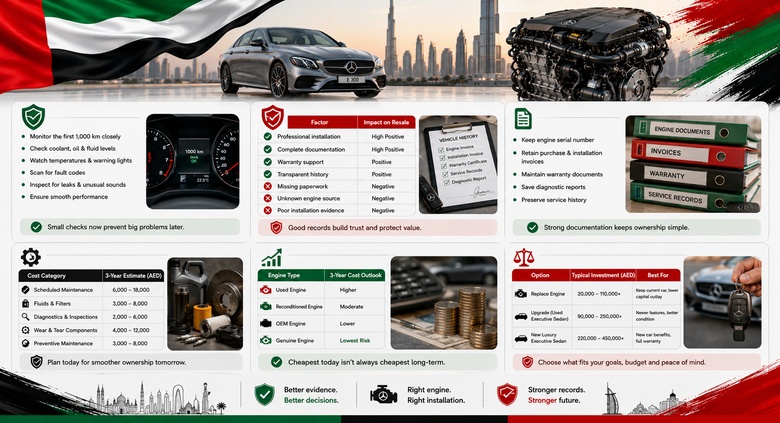
Factors Supporting Strong Resale Value
- Professional installation
- Complete documentation
- Warranty support
- Transparent ownership history
- Consistent servicing
Factors Creating Buyer Concern
- Missing paperwork
- Unknown engine source
- Poor installation evidence
- Limited maintenance records
Resale Value Comparison Table
| Vehicle Profile | Resale Outlook |
| Genuine Engine + Full Records | Excellent |
| OEM Engine + Documentation | Very Good |
| Reconditioned Engine + Records | Good |
| Used Engine + Limited Records | Moderate |
| Unknown Engine History | Weak |
The investigation repeatedly shows that documentation often influences value as much as the engine itself.
Insurance, Registration and Documentation Considerations
One of the least discussed areas of engine replacement projects involves administrative evidence.
Yet this evidence can become extremely important later.
Documentation Owners Should Retain
✓ Engine serial number
✓ Purchase invoice
✓ Installation invoice
✓ Warranty paperwork
✓ Diagnostic reports
✓ Service records
Administrative Considerations
Depending on circumstances, owners may need to:
- Retain engine identification records
- Maintain installation documentation
- Preserve warranty evidence
- Keep supporting ownership records
The investigation frequently finds that strong paperwork simplifies future ownership discussions.
Ownership Cost Forecasting: Projecting Future Financial Exposure After Engine Replacement
A replacement engine solves a present-day problem.
Owners should also examine future exposure.
Estimated Three-Year Ownership Forecast
| Year | Expected Cost Range (AED) |
| Year 1 | 3,000 – 12,000 |
| Year 2 | 2,000 – 10,000 |
| Year 3 | 2,000 – 12,000 |
Typical Three-Year Categories
- Scheduled maintenance
- Fluids and filters
- Diagnostic inspections
- Wear-and-tear components
- Preventive maintenance
Multi-Year Exposure Comparison
| Engine Type | Three-Year Cost Outlook |
| Used Engine | Higher |
| Reconditioned Engine | Moderate |
| OEM Engine | Lower |
| Genuine Engine | Lowest Risk |
The cheapest solution at installation may not remain the cheapest solution over three years.
The Alternative Suspect: Should the Engine Be Replaced or Should the Vehicle Be Replaced?
Every major investigation eventually reaches a final decision point.
Is replacing the engine still justified?
Or is replacing the vehicle the better option?
Engine Replacement Scenario
Advantages:
- Lower capital requirement
- Retention of vehicle familiarity
- Reduced replacement-market exposure
Vehicle Replacement Scenario
Advantages:
- New ownership cycle
- Newer technology
- Potential warranty benefits
Financial Comparison
| Option | Typical Investment (AED) |
| Replacement Engine | 20,000 – 110,000+ |
| Used Executive Sedan Upgrade | 90,000 – 250,000+ |
| New Luxury Executive Sedan | 220,000 – 450,000+ |
The evidence often supports engine replacement when:
- Overall vehicle condition remains strong
- Ownership plans are long-term
- Documentation quality is excellent
Real UAE Ownership Case Files
Case File: Dubai Executive Owner
Vehicle:
Mercedes E300
Situation:
Minor coolant-loss evidence ignored for several months.
Outcome:
Cooling-system issues expanded into a significantly larger repair project.
Lesson:
Early investigation would have reduced financial exposure.
Case File: Abu Dhabi Long-Distance Driver
Vehicle:
Mercedes E300
Situation:
Consistent maintenance and early diagnostics.
Outcome:
Minor issues resolved before significant engine damage occurred.
Lesson:
Evidence interpreted early often costs less.
Case File: Sharjah Budget-Conscious Owner
Vehicle:
Mercedes E300
Situation:
Lowest-cost engine option selected without complete documentation.
Outcome:
Future resale discussions became more difficult.
Lesson:
Documentation often has financial value.
Common Buyer Mistakes Discovered During Investigations
The same mistakes appear repeatedly.
Common Ownership Errors
- Buying purely on price
- Ignoring documentation
- Skipping diagnostics
- Delaying investigations
- Selecting workshops solely on labour cost
- Overlooking warranty conditions
Mistake Impact Assessment
| Mistake | Potential Consequence |
| Ignoring Diagnostics | Higher Repair Costs |
| Weak Documentation | Reduced Resale Confidence |
| Poor Workshop Selection | Reliability Issues |
| Delayed Action | Cost Escalation |
| Warranty Neglect | Financial Exposure |
Most expensive mistakes begin as small decisions.
Competitor Ownership Investigation
Many executive-saloon buyers compare ownership economics before making decisions.
Executive Sedan Comparison
| Vehicle | Engine Replacement Cost Outlook | Ownership Complexity |
| Mercedes E300 | Moderate to High | Moderate |
| BMW 530i | High | Higher |
| Audi A6 | Moderate to High | Moderate |
| Lexus ES350 | Lower | Lower |
The investigation suggests that long-term ownership outcomes often depend more on maintenance behaviour than brand selection alone.
Final Evidence Review: Critical Mechanical and Financial Clues Owners Must Evaluate Before Deciding
Before reaching a verdict, investigators review all available evidence.
Mechanical Evidence
- Compression results
- Cooling-system condition
- Oil-consumption patterns
Reliability Evidence
- Service history
- Diagnostic reports
- Maintenance consistency
Documentation Evidence
- Engine records
- Warranty records
- Installation invoices
Financial Evidence
- Project budget
- Future ownership costs
- Resale-value expectations
The Final Verdict: Building a Mercedes E300 Ownership Strategy Based on Facts Rather Than Assumptions
The investigation reveals a recurring pattern.
Engine replacement decisions rarely fail because of a lack of information.
They fail because available evidence is ignored.
The clues usually exist.
The warning signs often appear.
The documentation can be verified.
The risks can be measured.
Successful ownership therefore depends on interpretation.
Not luck.
For owners researching solutions through PartFinder UAE, the strongest strategy is not simply finding a replacement engine.
It is understanding the complete mechanical story surrounding that engine.
Final Mercedes E300 Decision Matrix
| Evidence Category | Positive Indicator |
| Mechanical Condition | Strong Diagnostics |
| Reliability Outlook | Consistent Maintenance |
| Documentation Quality | Complete Records |
| Warranty Protection | Written Coverage |
| Workshop Selection | Proven Expertise |
| Future Ownership Plans | Long-Term Alignment |
When the evidence supports these areas, engine replacement often becomes a logical investment rather than a financial gamble.
The best mechanical detectives do not wait for catastrophic failure.
They follow the clues early.
And that approach frequently saves both money and ownership stress throughout the life of the vehicle.
Frequently Asked Questions
Categories
- Audi
- BMW
- Car Accessories
- Car Tips
- Ford
- Land Rover
- Mazda
- Range Rover
- Top 10
- UAE Car Parts
- Used Car Parts
- Toyota
- Replacement Engines
- Nissan
- Hyundai
- Mitsubishi
- Volkswagen
- Honda
- Kia
- Chevrolet
- Dodge
- Jeep
- Subaru
- Renault
- Lexus
- Mercedes
- Suzuki
- Hummer
- Porsche
- Infiniti
- Peugeot
- GMC
- Mini
- Volvo
- Replacement Gearboxes
- MG
- Jaguar
- Skoda
- Cadillac
- Daihatsu
- Fiat
- German Car Parts
- Japanese Car Parts
- Aftermarket Car Parts
- Genuine Car Parts
- New Car Parts
- Reconditioned Car Parts
- European Car Parts
- American Car Parts
- Korean Car Parts
- British Car Parts
- Chinese Car Parts
- Sports/Exotic Car Parts
- Luxury Car Parts
- Performance Car Parts
- SUV/4x4 Spare Parts
- Truck Spare Parts
- EV Car Parts
- Hybrid Car Parts
- Auto Spare Parts in UAE
- Tesla
- Isuzu
- Ram
- Ferrari
- Bentley
- Lamborghini
- Genesis
- Maserati
- Lincoln
- Chrysler
- Opel
- Citroen
- SsangYong
- Seat
- McLaren
- Aston Martin
- Rolls Royce
- Maybach
- Alfa Romeo
- Bugatti
- Scion
- Abu Dhabi Car Parts
- Ajman Car Parts
- Al Khan Car Parts
- Al Sajaa Car Parts
- Deira Car Parts
- Dubai Car Parts
- Fujairah Car Parts
- Industrial Area 6 Car Parts
- Mussafah Car Parts
- Ras Al Khaimah Car Parts
- Sharjah Car Parts
- Umm Al Quwain Car Parts
- Acura
- BYD
- Chery
- Dacia
- DS
- Geely Emgrand
- EXEED
- GAC
- GAC Gonow
- Geely
- Gonow
- Great Wall
- Haima
- Haval
- Holden