Mini Cooper and Countryman Spare Parts in UAE: Common Parts Owners Need
September 10, 2026
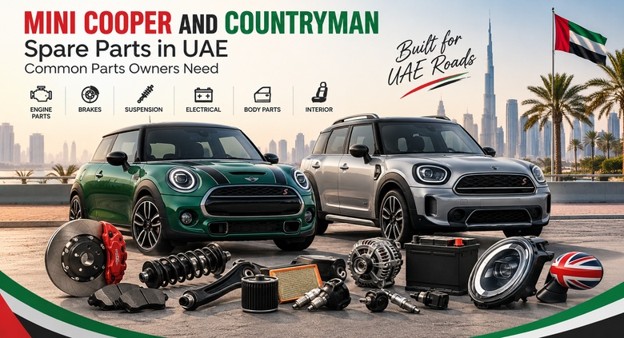
MINI Cooper and Countryman Parts Overview
Mini Cooper and Countryman Spare Parts in UAE: Common Parts Owners Need
MINI parts don't all wear out in the same way, and that's the first thing an owner needs to understand before opening a parts catalogue.
A brake pad is a wear item. A thermostat is a different sort of headache. An engine mount can deteriorate quietly for months before the vibration becomes impossible to ignore, while an electronic module may appear completely healthy until the car refuses to communicate with it properly.
Then there is the UAE factor.
A MINI running every weekday between Dubai and Sharjah spends a lot of time crawling, stopping, accelerating again and sitting in intense heat. Another Countryman might spend most of its life doing shorter Abu Dhabi journeys with fewer kilometres. Same badge. Very different workload.
That changes how parts should be assessed.
The parts owners most commonly need tend to fall into a few broad groups:
- Engine service and maintenance parts
- Brake pads, discs and wear sensors
- Suspension arms, bushes, links and dampers
- Batteries and charging-system parts
- Cooling-system parts
- Ignition coils and spark plugs
- Filters and belts
- Wheel bearings
- Engine mounts
- Sensors
- Air-conditioning parts
- Lights and mirrors
- Body panels and exterior trim
- Electrical modules
- Gearbox and clutch-related parts
But don't search for these parts using only “MINI Cooper” or “MINI Countryman”.
That is where online buying starts going wrong.
A later F-series MINI is not simply an upgraded version of an older R-series car from a parts-identification point of view. The R50/R53, R56, F55, F56, F54 and F60 families have different applications, and even within one generation the engine, transmission, body style, production period and equipment can change what is fitted.
A Countryman F60, for example, needs to be identified separately from an F56 Hatch even where the underlying technology appears familiar. Drivetrain, body dimensions, suspension requirements and equipment can all affect parts selection.
So the first rule is brutally simple:
Find the exact car before finding the exact part.
Common MINI Cooper and Countryman Parts by Risk
Not every replacement deserves the same level of investigation.
| Part category | Examples | Typical buying concern | Checking priority |
| Service parts | Oil, air and cabin filters, spark plugs | Correct engine/application | Medium |
| Braking | Pads, discs, wear sensors | Correct brake specification | High |
| Suspension | Control arms, bushes, links, shocks | Chassis and specification | High |
| Cooling | Thermostat, pump, hoses, radiator | Exact engine and leak diagnosis | High |
| Ignition | Coils, plugs | Engine compatibility | Medium |
| Electrical | Sensors, modules, alternator | Part number and vehicle coding | Very high |
| Body | Bumper, mirror, bonnet, door | Body style and facelift | High |
| Lighting | Headlamp, rear lamp, modules | Equipment and connector configuration | Very high |
| Engine | Turbo, injectors, complete engine | Engine code and condition | Very high |
| Transmission | Gearbox, clutch-related parts | Transmission code and drivetrain | Very high |
That last column is important.
It is not saying that a filter is unimportant. It is saying that the cost of identifying it incorrectly is normally much lower than getting an expensive gearbox or electronic module wrong.
A filter that doesn't fit can usually be identified immediately.
A gearbox can travel across the UAE, sit in a workshop, be installed, filled with fluid and then reveal the mistake only after the vehicle is tested.
Now the cheap online deal doesn't look so cheap.
Which MINI Cooper Spare Parts Are Most Commonly Replaced?
Start with the boring stuff.
It is usually the boring stuff that keeps the car usable.
MINI Cooper owners regularly deal with normal maintenance and wear items such as filters, spark plugs, brake pads, discs, ignition coils, suspension links, bushes, control arms, batteries and various cooling-system parts. The exact failure rate changes with generation and engine, so pretending that every MINI has one universal weak point would be misleading.
Workshop diagnosis matters more.
For example, a MINI that develops a rough idle does not automatically need new ignition coils. A failing coil is one possibility. Spark plugs, intake leaks, fuel delivery, sensor faults and other issues can create similar symptoms. The same principle applies to cooling faults: seeing a coolant warning does not mean you should immediately order the most expensive cooling-system part listed online.
Find the fault. Then buy the part.
That sounds obvious, but online parts shopping encourages the opposite behaviour because search results put the part name directly in front of you.
UAE driving adds another layer.
Brake parts experience repeated heat cycles. Suspension parts deal with speed humps, uneven surfaces and heavy urban use. Air-conditioning systems work hard for much of the year. Cooling systems have little room for neglect when ambient temperatures climb and the vehicle is sitting in traffic.
A MINI used for long daily commuting therefore deserves a different maintenance mindset from one used occasionally at weekends.
What MINI Cooper Owners Commonly Look For
Brakes: Pads and discs are straightforward wear items, but the correct specification still needs checking. Some owners replace only pads because the discs “look okay”, even though disc thickness, surface condition and manufacturer limits should be assessed properly.
Suspension: Control arms, bushes, drop links and shock absorbers can produce noises or handling changes that gradually become normal to the driver. They shouldn't.
Cooling: Thermostats, water pumps, hoses, expansion-tank-related parts and other cooling-system items deserve prompt attention when temperatures, coolant levels or warning messages become abnormal.
Ignition: Spark plugs and coils are common diagnostic suspects when a MINI develops misfires or rough running, but the fault should be confirmed before replacing a set of parts simply because an online listing is inexpensive.
Battery and charging: Modern MINIs rely heavily on electrical systems, so battery condition and charging performance can influence more than simply whether the engine starts.
Engine mounts: A worn mount can show up as vibration, clunks or harshness rather than a dramatic mechanical failure. It is one of those repairs that owners often postpone because the car still moves.
And that phrase — the car still moves — has probably delayed more repairs than it has solved.
UAE Workshop Evidence: Why the Same Part Can Wear Differently
Consider two MINI Coopers.
One is used mostly for short urban trips around Sharjah and Dubai. The driver spends a lot of time in slow traffic, repeatedly braking and accelerating, and the car encounters speed humps several times a day.
The second is driven fewer days each month and spends more time cruising at steady speed.
Their odometers might eventually show similar figures. Their parts can still tell different stories.
A workshop should therefore look at usage pattern, mileage, age and symptoms together.
That is a much better E-E-A-T approach than saying something vague like “MINI parts can wear over time”.
Of course they can.
The useful question is which part, under what conditions, and with what evidence?
For example:
- Uneven tyre wear alongside steering pull can strengthen the case for investigating suspension or alignment.
- Coolant loss requires leak diagnosis rather than blind replacement.
- Misfire data can help determine whether ignition, fuelling or another engine issue needs attention.
- A battery-related fault should be assessed alongside charging-system performance.
- A gearbox complaint should be investigated before buying a replacement transmission.
The workshop diagnosis should become part of the buying information.
Keep it.
If you later need to order a replacement part, the technician's description, fault findings, original part number and photographs can make the online search dramatically more precise.
Which MINI Countryman Spare Parts Do Owners Commonly Need?
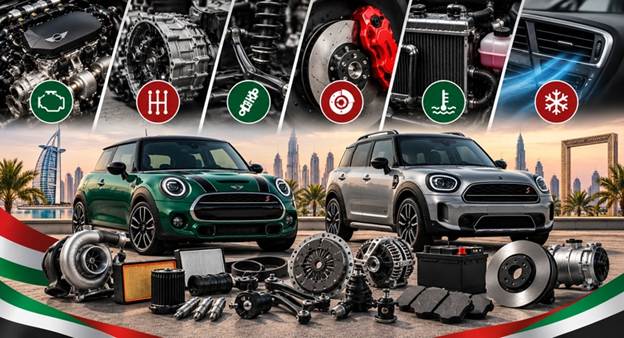
The Countryman deserves its own section because it isn't simply a MINI Cooper Hatch with extra space.
It is larger, heavier and available in different configurations across its generations. Depending on the model and year, the Countryman can have different engine, transmission and drivetrain arrangements, including versions with four-wheel-drive hardware.
That matters when ordering parts.
Suspension, braking, drivetrain and body parts should be treated as vehicle-specific until proven otherwise.
A Countryman owner might commonly need:
- Brake pads and discs
- Suspension arms and bushes
- Shock absorbers
- Wheel bearings
- Engine mounts
- Filters
- Spark plugs
- Ignition coils
- Cooling-system parts
- Sensors
- Batteries
- Alternator or starter-related parts
- Air-conditioning parts
- Engine-related parts
- Exterior lamps
- Mirrors
- Bumpers
- Door and body hardware
- Interior switches and trim
- Electronic control modules
The body is another obvious distinction.
A Countryman's rear bumper, tailgate trim or exterior lighting cannot be selected simply because an online listing says “MINI”. Body shape matters. Facelift matters. Parking sensors and other equipment matter. Left-hand versus right-hand position matters.
And used parts introduce another question:
What happened to the donor vehicle?
A used bumper removed from a rear-end accident may be perfectly useful if the bumper itself was undamaged. A headlamp from a flooded vehicle is another matter altogether. A gearbox from a high-mileage donor needs a different level of scrutiny again.
This is why donor history is not a nice extra when buying expensive used parts.
It is evidence.
Countryman Parts That Need Extra Attention
Some repairs deserve more than a quick catalogue match.
Suspension: Check the exact chassis, drivetrain and equipment specification before ordering. Do not assume every F60 uses identical suspension hardware.
Brakes: Confirm disc dimensions, caliper application and the vehicle's exact specification.
Drivetrain: Four-wheel-drive-related parts are especially unsuitable for casual “looks the same” buying.
Engine parts: Match the exact engine application and part number. Similar engine families do not automatically make every associated part interchangeable.
Electronics: Hardware number, vehicle configuration and coding requirements can all matter.
Body parts: Confirm the generation, facelift, body style, side and equipment.
For an expensive Countryman part, the safest online conversation is not:
“Do you have a Countryman turbo?”
It is:
“Here is the VIN, engine specification, original part number and photograph. Please confirm the replacement application.”
Much less glamorous.
Much safer.
MINI Cooper vs Countryman Spare Parts: Which Parts Are Shared?
Some parts can be shared.
That's true.
But shared technology does not mean universal fitment.
This is where buyers get caught because the two cars can look closely related, particularly when both belong to the same broader MINI generation. The seller may even have a part description covering several models. That still needs checking against the actual vehicle.
A sensible compatibility hierarchy looks like this:
VIN → generation → engine/drivetrain → production period → body style → equipment → part number.
The more expensive or electronically complicated the part, the more important the complete chain becomes.
| Part type | May be shared? | Why verification is still required |
| Filters | Yes, in some applications | Engine and filter specification |
| Spark plugs | Sometimes | Exact engine requirement |
| Ignition coils | Sometimes | Engine/application |
| Brake parts | Sometimes | Brake package and dimensions |
| Suspension parts | Sometimes | Chassis, drivetrain and load |
| Sensors | Sometimes | Engine/system and connector |
| Electrical modules | Occasionally | Hardware number and coding |
| Headlights | Less straightforward | Body, equipment and electronics |
| Bumpers | Usually model/body dependent | Body style and facelift |
| Gearboxes | Highly specific | Transmission and drivetrain |
| Engine assemblies | Highly specific | Engine code and vehicle application |
What About Price Differences Between Cooper and Countryman Parts?
The Countryman's larger size does not mean every Countryman part costs more. That would be far too simplistic.
Prices depend on the actual part, brand, specification, availability, generation and whether the item is genuine, OEM, aftermarket, used or reconditioned.
Still, the total repair cost can move noticeably when the part requires more workshop time, programming or supporting work.
A useful UAE planning table is therefore better than a fake “average MINI parts price”.
| Repair situation | Main cost elements to consider |
| Brake replacement | Parts + fitting + wear sensor where required |
| Suspension repair | Parts + labour + alignment where required |
| Cooling-system repair | Main part + coolant + related seals/hoses + labour |
| Electrical module | Part + diagnosis + coding/programming if required |
| Used engine | Engine + inspection/testing + fluids + seals + labour + supporting parts |
| Gearbox replacement | Gearbox + fluid + labour + adaptation/coding where applicable |
| Body part | Part + delivery + paint + fitting + alignment of panels |
These aren't fixed UAE retail prices, and they shouldn't be presented as such. A Dubai workshop and an Abu Dhabi specialist may quote differently; a used part may also vary wildly depending on donor mileage and availability.
The important figure is the fitted repair cost.
That is where buyers often get caught.
An online seller advertises a part for AED 900. Another asks AED 1,250. The first looks cheaper. Then the cheaper part needs additional work, arrives from another emirate, turns out to require coding, or does not match the vehicle.
Suddenly the gap has disappeared.
So when comparing MINI Cooper and Countryman parts in the UAE, ask four questions before paying:
Is it definitely the right part?
Is its condition known?
What additional work does installation require?
What happens if it turns out to be wrong?
If the seller can answer all four clearly, you're already making a much better purchase decision than someone who simply sorts an online catalogue from low price to high price.
Mechanical Parts Owners Replace Most
MINI Cooper and Countryman Engine Parts: Common Replacement Needs
Engine-related parts are where MINI owners need to stop shopping by appearance and start shopping by engine identification.
That sounds obvious until you see how many online listings are titled simply “MINI Cooper engine part”. It might fit. It might not. And with MINI, the difference between the two can be one letter in an engine code, a production change, or a completely different engine family.
R-series and F-series cars need to be separated first. Then identify the exact engine fitted to the vehicle. A Cooper, Cooper S and Countryman can have different engine applications depending on generation and year, so the VIN and original part number should sit at the centre of the search.
Common engine-related replacement parts include:
- Engine mounts
- Thermostats and thermostat housings
- Water pumps
- Cooling hoses
- Radiators and expansion-system parts
- Ignition coils
- Spark plugs
- Injectors
- Turbocharger-related parts
- Crankcase ventilation parts
- Sensors
- Belts and tensioners
- Gaskets and seals
- Intake and charge-air parts
But here's where workshop evidence matters.
If a MINI arrives with an overheating complaint, an experienced technician does not simply open an online catalogue and order a water pump. The cooling system gets checked first. Coolant level, leaks, pressure, thermostat operation and related areas need investigation. Otherwise, the owner can spend money replacing a perfectly good part while the actual leak sits somewhere else.
The same goes for misfires.
A fault code can point toward an ignition circuit, but it does not automatically prove that every ignition part needs replacing. Diagnosis comes first.
For used engines, the checks become much stricter. Establish the engine code, donor vehicle, mileage, compression condition where appropriate, visible leaks, oil contamination, included ancillaries and warranty terms. Find out exactly what you're buying.
A “complete engine” isn't always complete in the way you expect.
Does it include the turbo? Injectors? Alternator? Starter? Wiring? Sensors? Intake equipment?
Ask.
Otherwise, the headline price can look wonderfully small right up until the workshop starts moving parts from the old engine across to the replacement.
MINI Engine Repair Cost in the UAE
Engine work also needs a broader budget than the online part price.
| Engine-related job | Costs that may need consideration |
| Spark plugs/coils | Parts + diagnosis + labour |
| Thermostat/cooling repair | Part + coolant + seals + labour |
| Turbo-related repair | Turbo/related part + gaskets + oil/fluid work + labour |
| Engine mount | Mount + labour |
| Used engine replacement | Engine + fluids + seals + labour + supporting parts |
| Major engine repair | Diagnosis + internal parts + machining where required + labour |
These are cost categories rather than fixed UAE prices, because the final bill depends heavily on MINI generation, engine, workshop and the condition of the vehicle.
A good estimate should tell you what is included.
A vague “engine replacement AED X” quote isn't enough.
MINI Cooper and Countryman Gearbox and Clutch Parts
Gearbox shopping is not the place for guesswork.
A transmission can look almost identical to another unit while having a different application, ratio, control arrangement or specification. For automatic MINIs, electronic communication and adaptation can also enter the picture. For manual cars, clutch, flywheel and hydraulic parts need to be considered alongside the gearbox itself.
First identify the transmission.
Then establish whether the issue is actually inside the gearbox.
A slipping clutch on a manual MINI doesn't automatically mean the gearbox needs replacement. Likewise, a transmission warning on an automatic car should be diagnosed before somebody orders a used gearbox because the dashboard has produced a frightening message.
That distinction can save thousands.
Common transmission-related parts include:
- Manual gearboxes
- Automatic transmissions
- Clutch kits
- Dual-mass flywheels where applicable
- Clutch hydraulic parts
- Gear selectors
- Transmission mounts
- Driveshaft-related parts
- Transmission control modules
- Seals and service parts
For a used gearbox, request the transmission code, donor mileage, donor model and testing information. Ask whether the unit was removed from a running vehicle. If it was removed from a damaged car, find out where the impact occurred.
A front-end crash and a flood-damaged donor tell very different stories.
Also check what is actually included.
A used gearbox may arrive without certain sensors, brackets, mounts or ancillary hardware. Your workshop may be able to transfer some of these parts from the old unit, but that work takes time and sometimes exposes another worn part.
Gearbox Replacement: The Hidden UAE Cost
This is where a simple comparison can become misleading.
Imagine two used transmissions:
- Unit A: lower purchase price, uncertain history
- Unit B: higher price, known donor, documented testing and clearer warranty
Unit A wins the spreadsheet.
Unit B may win the repair.
| Cost item | Why it matters |
| Gearbox price | Initial purchase cost |
| Delivery | Heavy transmission may require special handling |
| Fluid | Replacement may require fresh fluid |
| Seals | Sensible to inspect/replace during installation |
| Labour | Removal and installation can be substantial |
| Adaptation/coding | May apply depending on transmission/system |
| Supporting parts | Mounts, clutch or related hardware may need attention |
| Return logistics | Important if the gearbox is incorrect or defective |
For a daily driver in Dubai, downtime itself has a cost. For a fleet or business vehicle, it can be even more obvious.
That's why the better question isn't “Which gearbox is cheapest?”
Ask:
“Which gearbox gives me the lowest realistic total repair risk?”
Much better.
MINI Cooper Suspension and Steering Parts: Common UAE Wear
Suspension complaints often arrive quietly.
A knock over a speed hump. A faint clunk when turning. A steering wheel that doesn't feel quite as settled. Tyres wearing strangely. Nothing dramatic, so the owner keeps going.
Then six months later the workshop finds several worn parts at once.
MINI Cooper and Countryman suspension systems can require attention to:
- Control arms
- Bushes
- Ball joints
- Drop links
- Shock absorbers
- Top mounts
- Wheel bearings
- Steering links
- Tie-rod-related parts
- Springs
- Mounting hardware
The Countryman deserves particular care because its larger body and different configurations mean suspension parts cannot simply be selected from a generic MINI listing.
The UAE environment doesn't help worn suspension either. Speed humps, uneven road transitions, aggressive kerb approaches and heavy urban traffic repeatedly load the front end. Add age and mileage, and rubber bushes eventually stop behaving like fresh rubber.
Here's a workshop clue worth remembering:
Don't diagnose suspension from noise alone.
A mechanic should inspect the relevant joints and bushes, check for play, examine tyre wear and consider alignment. A noise can come from more than one place, and replacing the first part that looks suspicious isn't always the cleanest repair.
For used suspension parts, be especially cautious with rubber bushes and dampers. Their remaining life is difficult to establish visually.
For some suspension items, new reputable-quality parts make more sense than second-hand parts, even when the used price looks tempting.
Why save AED 150 on an old bush if the workshop has to dismantle the same area again shortly afterwards?
That's false economy.
MINI Cooper Brakes, Cooling and Air-Conditioning Parts
Three systems. Three very different failure patterns.
Brakes are wear-driven. Pads and discs gradually lose material, surfaces change and braking performance can deteriorate. Wear sensors, where fitted, also need to be considered.
Cooling is more unforgiving. A small leak ignored during UAE summer can turn into a much bigger problem when the vehicle spends an afternoon idling in traffic. A coolant warning should not be treated as an invitation to keep driving until the next service.
Air-conditioning is its own world. In the UAE, the system works hard for much of the year. Weak cooling might involve refrigerant level, compressor operation, condenser condition, fans, sensors, leaks or other faults. Replacing the compressor without proper diagnosis is an expensive gamble.
For these systems, parts should be matched to the exact vehicle and diagnosis.
| System | Common parts | Important check |
| Braking | Pads, discs, wear sensors | Brake specification and condition |
| Cooling | Thermostat, pump, radiator, hoses | Locate the actual fault first |
| Air-conditioning | Compressor, condenser, fan, sensors | Pressure/performance diagnosis |
| Suspension | Arms, bushes, links, dampers | Check physical wear and play |
| Steering | Tie rods, links, related joints | Inspect alongside alignment and tyre wear |
And here's the part owners sometimes miss: supporting parts.
A cooling-system repair may require fresh coolant and seals. Brake work may reveal a damaged wear sensor. Suspension work can expose a worn tyre or alignment issue. Air-conditioning repairs can require leak testing and other service work.
The replacement part is only one piece of the bill.
For UAE ownership, that distinction is important because labour isn't free, and workshop time becomes more expensive when a job has to be repeated.
A good technician doesn't just replace what failed.
They look at why it failed, what else has been affected, and what is likely to fail next.
That's the difference between fixing today's warning light and actually putting the MINI back into dependable daily use.
Electrical, Body and Interior Parts
MINI Cooper and Countryman Electrical Parts: Sensors, Modules and Batteries
Electrical faults on a MINI can be deceptively simple. The car may show a warning light, refuse to start, lose an electrical function or suddenly display several unrelated messages, yet the failed part may be something much smaller than the dashboard suggests.
That is why replacing electrical parts by fault-code name alone can become expensive.
A MINI Cooper or Countryman may need a battery, alternator, starter motor, ignition coil, sensor, wiring repair, control module, switch or charging-system part. The correct choice depends heavily on the generation, engine, equipment level and software configuration.
The battery deserves particular attention in the UAE. Heat accelerates battery ageing, while heavy air-conditioning use, short urban journeys and repeated stop-start driving put additional demand on the charging system. A weak battery can also create strange electrical behaviour that looks like a larger electronic fault.
Common electrical parts include:
| Electrical area | Parts commonly involved | What should be checked |
| Starting | Battery, starter motor | Battery voltage and starting current |
| Charging | Alternator, belt, charging connections | Charging output and belt condition |
| Ignition | Coils, plugs, ignition wiring | Misfire data and cylinder-specific diagnosis |
| Sensors | Temperature, oxygen, pressure and position sensors | Live data and fault-code context |
| Cooling control | Fans, fan control parts, temperature sensors | Actual coolant temperature and fan operation |
| Electronics | Control modules, switches, wiring | Communication faults and power supply |
| Lighting | Headlamp modules, bulbs, wiring | Power, connectors and moisture ingress |
The important distinction is between a fault code and a failed part. They are not always the same thing.
For example, a sensor-related code may result from damaged wiring, poor voltage supply or an actual sensor failure. Similarly, several dashboard warnings appearing together can point towards low system voltage rather than several modules failing simultaneously.
On older MINI models, connector condition, wiring repairs and previous aftermarket electrical work deserve a close look. A used control module may physically fit but still require the correct specification, coding or programming.
This is where a proper diagnosis saves money. Test first. Order second.
MINI Cooper Body Parts, Headlights, Mirrors and Exterior Trim
Body parts are different from mechanical parts because mileage tells you very little about their condition. A low-mileage MINI that has spent years parked outside can have tired exterior plastics, faded trim, damaged seals or sun-affected surfaces, while a higher-mileage car may have perfectly usable body parts.
UAE exposure makes this distinction even more important. Strong sunlight, high temperatures, dust and occasional moisture can gradually affect rubber seals, plastic trim, headlamp lenses and exterior finishes.
For accident repairs, fitment becomes the bigger concern.
MINI Cooper and Countryman body parts can vary according to generation, facelift, body style and equipment. A headlamp from one production period may look almost identical to another but use different mounting points, wiring or electronic control arrangements. The same problem appears with mirrors, bumpers, grilles and exterior lighting.
Commonly requested body and exterior parts include:
- Front and rear bumpers
- Bonnet and wings
- Doors and door shells
- Grilles and exterior trim
- Headlights and rear lamps
- Door mirrors and mirror covers
- Wheel-arch liners
- Undertrays and splash shields
- Door handles
- Windscreen and weather seals
- Number-plate mounting parts
- Exterior badges and trim pieces
Used body parts can make financial sense, particularly for an older MINI where replacing every damaged panel with new genuine parts would push the repair bill up sharply. But colour matching is not guaranteed. A used panel from a donor vehicle may have the correct shape yet still require paintwork.
Headlights require another layer of caution. Modern lighting assemblies can contain electronics, motors or control circuitry, so the cheapest-looking used unit is not necessarily the cheapest installed solution.
For accident-damaged MINIs, compare panel price + paint + fitting + alignment + clips/brackets + lighting or electrical work rather than comparing panel prices alone.
That little calculation changes the buying decision surprisingly often.
MINI Countryman Interior Parts: Seats, Panels, Switches and Controls
Interior parts usually fail less dramatically than engine or cooling parts, but they are among the most visible signs of how a MINI has been treated.
A Countryman used for daily family transport can develop different wear from a lightly used weekend car. Driver-seat bolsters, steering-wheel controls, door handles, window switches, centre-console trim and interior plastics are particularly easy to judge by condition.
The challenge is finding the exact specification.
Countryman interiors can differ by generation, trim level, seat design, upholstery, steering-wheel configuration and optional equipment. A replacement switch or trim panel may look correct in a photograph and still be wrong for the vehicle.
Common interior replacement needs include:
- Seats and seat trim
- Door cards and interior panels
- Dashboard trim
- Centre-console parts
- Window switches
- Door handles
- Steering-wheel controls
- Gear selectors and surrounding trim
- Air-conditioning controls
- Instrument-cluster-related parts
- Floor and boot trim
- Seat belts and associated fittings
Safety-related interior parts deserve a separate approach. Seats, seat belts and airbag-related parts should never be selected simply because they physically fit. Correct specification, condition and the vehicle's safety system configuration matter.
For used interior parts, inspect photographs carefully and ask about cracks, broken mounting tabs, stains, sun damage and previous repairs. A small broken clip can turn an apparently cheap trim panel into an annoying workshop job.
There is also a practical UAE issue: heat can make older plastics brittle. Interior parts that have spent years in direct sunlight may appear acceptable until a technician removes them and discovers that the clips or mounting points have become fragile.
For a daily-use Countryman, a clean used original interior part can sometimes be a much better proposition than a poor-quality replacement. But condition matters more than the word “used”.
MINI Cooper Service Parts: Filters, Spark Plugs, Belts and Other Maintenance Items
Service parts are the unglamorous side of MINI ownership, but they are where sensible maintenance prevents larger bills.
Oil filters, air filters, cabin filters, spark plugs, ignition coils, belts, tensioners, brake-wear items and other scheduled maintenance parts are repeatedly replaced throughout a car's life. These are not parts to choose purely on the basis of the lowest advertised price.
The correct specification still matters.
A MINI's engine generation, engine code and production period should be established before ordering service parts. This is particularly important when the same model name covers different engines or mechanical revisions.
| Service area | Typical parts | Why specification matters |
| Engine oil service | Oil filter, oil, drain-plug parts | Correct filter and oil specification |
| Air intake | Air filter | Correct housing and engine fitment |
| Cabin | Cabin/pollen filter | Correct dimensions and filter design |
| Ignition | Spark plugs, coils | Correct heat range and engine specification |
| Drive system | Belts, tensioners | Correct length and pulley arrangement |
| Braking | Pads, discs, wear sensors | Brake-system and axle specification |
| Cooling | Coolant-related service parts | Correct system and coolant requirements |
Spark plugs are a good example of where guesswork causes trouble. A misfire does not automatically mean the plugs are the cause, and fitting the wrong plug does not solve the underlying problem. The same applies to belts: if a belt has deteriorated, the technician should also inspect the tensioner, pulleys and related drive parts rather than simply fitting a new belt and sending the car out.
For UAE owners, service intervals also deserve realistic interpretation. Stop-start traffic, high ambient temperatures, frequent air-conditioning use and dusty conditions can make routine inspection more important than simply waiting for a warning light.
A good service order should identify the exact MINI, engine, required part and reason for replacement. That sounds basic. It isn't always done.
And when comparing genuine, OEM and reputable aftermarket service parts, look beyond the box price. A slightly cheaper filter that requires another workshop visit is not cheaper in any meaningful sense.
This is also where a focused supplier such as PartFinder UAE can fit into the buying process: the useful question is not simply whether a MINI part is available, but whether the exact part can be matched to the vehicle before money is spent.
The best buying habit remains wonderfully boring: match the part number, confirm the VIN, check the specification, then buy.
Buying the Right Parts in the UAE
Genuine, OEM, Used or Aftermarket MINI Parts: What Should You Buy?
There is no single “best” MINI spare parts in UAE. The sensible choice depends on what has failed, how old the car is, how long you plan to keep it, and what the price difference looks like after fitting.
A genuine part is usually the straightforward choice when exact specification, finish and long-term confidence matter most. OEM parts can offer a sensible middle ground when the manufacturer behind the part is known and the specification matches the vehicle. Used original parts can be particularly useful for older MINIs, especially body panels, interior trim, selected electrical parts and certain mechanical assemblies where a good donor part is available.
Aftermarket parts are more complicated because quality varies enormously between manufacturers.
| Part type | Usually worth considering | Main reason |
| Engine sensors | Genuine/OEM/reputable aftermarket | Incorrect readings can create further faults |
| Brake pads and discs | Genuine/OEM/reputable aftermarket | Safety, braking feel and durability |
| Body panels | Used/genuine/aftermarket | Condition and fitment matter |
| Headlights | Genuine/quality used/OEM | Electronics and physical fit |
| Interior trim | Good used/genuine | Original appearance and fit |
| Engine assembly | Tested used/reconditioned/genuine replacement | Condition and warranty are critical |
| Suspension parts | Genuine/OEM/reputable aftermarket | Wear life and handling |
| Filters and plugs | Genuine/OEM/reputable aftermarket | Correct specification |
The UAE changes the calculation slightly. For an older MINI used every day between Dubai and Sharjah, paying considerably more for a genuine part may make sense for a critical mechanical or electronic item. For a discontinued interior trim piece, however, a clean used original part could be the smarter purchase.
The key is not the label on the box. It is provenance, specification, condition and total installed cost.
A cheap part that fails early, damages another part or requires another round of labour is not a bargain. It is just a delayed invoice.
How to Check MINI Cooper and Countryman Spare-Part Compatibility Using VIN
VIN verification should happen before ordering, not after the wrong part arrives at the workshop.
A MINI's model name alone is not enough. “Cooper” or “Countryman” covers multiple generations, engines, production periods and equipment combinations. Even two cars carrying the same badge can use different versions of a particular part.
The VIN gives the workshop or parts specialist a much stronger starting point.
For a proper compatibility check, have these details available:
- Full VIN
- Model and body style
- Production year or production period
- Engine code where available
- Gearbox type
- Drive configuration, particularly for Countryman variants
- Existing part number
- Photograph of the original part when useful
- Relevant equipment or option information
The original part number is particularly valuable. If the old part is still available, photograph its label before throwing it away. Numbers printed or stamped on the part can help resolve a fitment question that a model name cannot.
For electronic parts, go further. Check whether the replacement requires coding, programming or vehicle-specific configuration. Physical fitment does not automatically mean electronic compatibility.
The same principle applies to used engines and gearboxes. Confirm the engine or transmission identification rather than relying on “fits MINI Cooper” in a listing.
| Check | Why it matters |
| VIN | Confirms vehicle identity |
| Generation | Prevents cross-generation mistakes |
| Engine | Determines mechanical and electronic specification |
| Gearbox | Important for transmission and related parts |
| Part number | Strongest direct fitment reference |
| Production period | Helps identify revisions |
| Equipment | Can affect electrical and body parts |
| Photos | Helps compare physical design and connectors |
One extra precaution is worth taking with imported or modified MINIs: do not assume the vehicle's current configuration is identical to its original factory specification. Previous repairs, engine swaps and aftermarket modifications can change what is actually fitted.
VIN first. Part number second. Catalogue description last.
MINI Cooper and Countryman Spare Parts Buying Checklist for UAE Owners
Buying the right MINI part should be a short process. Buying the wrong one can become an afternoon of phone calls, another delivery charge and a car sitting on a workshop lift while everyone works out what happened.
Before ordering, run through the basics.
MINI spare-parts buying checklist:
- Confirm the full VIN.
- Identify the exact MINI generation.
- Confirm the engine and gearbox.
- Check the original part number where possible.
- Confirm whether the part is for Cooper, Countryman or another body variant.
- Check whether the vehicle has been modified or had a previous major repair.
- For electrical parts, ask whether coding or programming is required.
- For used parts, establish donor vehicle, mileage and condition.
- Ask exactly what is included with an assembly.
- Check whether seals, brackets, sensors, wiring or mounting hardware are supplied.
- Compare the total fitted cost, not just the part price.
- Confirm return conditions before installation.
- Keep the invoice and part-number information.
- For safety-critical parts, favour verified specification and known condition over the lowest price.
For UAE owners, add one more question: how quickly do I actually need the car back?
That matters more than people think. A cheaper used gearbox that takes several days to source, then needs additional seals, fluid and coding, may ultimately cost more than a readily available replacement with clearer warranty terms.
The same applies to body repairs. A cheap used bumper may need extensive preparation and paintwork, while a better-condition panel could reduce workshop time.
Think in terms of part + delivery + labour + supporting parts + coding + consumables + downtime.
That is the real price.
For a MINI Cooper or Countryman that is regularly driven through Dubai, Sharjah, Abu Dhabi or other UAE emirates, keeping records is also worthwhile. Save the VIN, original part numbers, invoices and warranty paperwork. The next repair becomes easier, and future technicians have something concrete to work from rather than reconstructing the car's history from memory.
Most importantly, don't order because a photograph looks right.
Verify first. Buy second. Fit third.
That order is boring—and it is exactly why it works.
FAQs About MINI Cooper and Countryman Spare Parts in UAE
Categories
- Audi
- BMW
- Car Accessories
- Car Tips
- Ford
- Land Rover
- Mazda
- Range Rover
- Top 10
- UAE Car Parts
- Used Car Parts
- Toyota
- Replacement Engines
- Nissan
- Hyundai
- Mitsubishi
- Volkswagen
- Honda
- Kia
- Chevrolet
- Dodge
- Jeep
- Subaru
- Renault
- Lexus
- Mercedes
- Suzuki
- Hummer
- Porsche
- Infiniti
- Peugeot
- GMC
- Mini
- Volvo
- Replacement Gearboxes
- MG
- Jaguar
- Skoda
- Cadillac
- Daihatsu
- Fiat
- German Car Parts
- Japanese Car Parts
- Aftermarket Car Parts
- Genuine Car Parts
- New Car Parts
- Reconditioned Car Parts
- European Car Parts
- American Car Parts
- Korean Car Parts
- British Car Parts
- Chinese Car Parts
- Sports/Exotic Car Parts
- Luxury Car Parts
- Performance Car Parts
- SUV/4x4 Spare Parts
- Truck Spare Parts
- EV Car Parts
- Hybrid Car Parts
- Auto Spare Parts in UAE
- Tesla
- Isuzu
- Ram
- Ferrari
- Bentley
- Lamborghini
- Genesis
- Maserati
- Lincoln
- Chrysler
- Opel
- Citroen
- SsangYong
- Seat
- McLaren
- Aston Martin
- Rolls Royce
- Maybach
- Alfa Romeo
- Bugatti
- Scion
- Abu Dhabi Car Parts
- Ajman Car Parts
- Al Khan Car Parts
- Al Sajaa Car Parts
- Deira Car Parts
- Dubai Car Parts
- Fujairah Car Parts
- Industrial Area 6 Car Parts
- Mussafah Car Parts
- Ras Al Khaimah Car Parts
- Sharjah Car Parts
- Umm Al Quwain Car Parts
- Acura
- BYD
- Chery
- Dacia
- DS
- Geely Emgrand
- EXEED
- GAC
- GAC Gonow
- Geely
- Gonow
- Great Wall
- Haima
- Haval
- Holden
- Iveco
- JAC
- Jaecoo
- Jetour
- Lotus
- Omoda
- Proton
- Renault Samsung
- Roewe
- Lucid
- Replacement Headlight
- Replacement Bumper