Mini Cooper Replacement Engine Cost UAE: The Clues, Misdiagnoses and Hidden Problems Behind Major Engine Failures
June 11, 2026
What Really Happened Before the Engine Failed and Why the Warning Signs Were Missed?
Most replacement-engine stories begin at the wrong point in the timeline. Owners usually start the story with the breakdown because that is when the inconvenience became impossible to ignore.
Workshops start much earlier.
The breakdown is rarely the crime scene.
It is usually the final piece of evidence.
A Mini Cooper arrives at a UAE workshop on a recovery truck. The owner believes the engine failed yesterday.
The technician often discovers that the engine started failing months earlier.
Perhaps a small coolant leak appeared.
Perhaps oil consumption increased slightly.
Perhaps an occasional warning light appeared and then disappeared.
The clues were present.
Nobody recognised them as clues.
That is one reason Mini Cooper engine replacements can surprise owners. The vehicle often provides a trail of evidence before major damage develops.
The challenge is interpretation.
Symptoms rarely arrive with explanations attached.
Common Clues Found During Workshop Investigations
✓ Gradual oil consumption increases
✓ Intermittent warning lights
✓ Occasional overheating
✓ Rough idle conditions
✓ Reduced fuel efficiency
✓ Timing-chain noises
✓ Coolant loss
✓ Cold-start irregularities
✓ Minor performance reduction
Individually these clues may appear harmless.
Collectively they often tell a different story.
UAE Workshop Observation
One of the most expensive assumptions in the automotive world is believing that an engine failure begins on the day the vehicle stops moving.
Most failures begin long before that moment.
Early Investigation Risk Matrix
| Evidence Found | Investigation Priority |
| Minor Oil Loss | Moderate |
| Rough Idle | Moderate |
| Warning Light | High |
| Timing-Chain Noise | Very High |
| Repeated Coolant Loss | Very High |
| Overheating Event | Critical |
The earlier the evidence is examined, the smaller the repair bill usually becomes.
Mechanical systems rarely reward delay.
The First Clue Nobody Took Seriously: Early Symptoms That Often Predict Major Engine Trouble
Every experienced technician has heard some version of the same sentence.
"It was doing that for a while."
That sentence often appears near the beginning of expensive conversations.
The problem is not negligence.
It is familiarity.
Owners become accustomed to small changes. Minor noises become part of the background.
Small performance differences feel normal.
Warning lights disappear.
The vehicle continues operating.
Life continues.
The clue remains.
Mini Cooper engines frequently provide subtle warnings before major failures develop. Those warnings rarely create immediate breakdowns.
That is exactly why they are ignored.
Commonly Overlooked Early Clues
✓ Slight ticking sounds
✓ Delayed starting
✓ Small coolant reductions
✓ Brief overheating episodes
✓ Increased oil consumption
✓ Occasional smoke from exhaust
✓ Reduced throttle response
✓ Unusual engine vibrations
A single clue rarely proves anything.
Several clues appearing together deserve attention.
Cost Comparison: Early Action vs Delayed Action
| Repair Stage | Estimated Cost (AED) |
| Early Diagnostic Inspection | 300 – 1,000 |
| Cooling-System Repair | 800 – 4,000 |
| Timing-Chain Repair | 3,000 – 10,000 |
| Internal Engine Repair | 6,000 – 18,000 |
| Replacement Engine Project | 12,000 – 45,000+ |
The evidence usually becomes more expensive the longer it remains unexamined.
That pattern appears repeatedly in UAE workshops.
Warning Lights, Dashboard Messages and Mechanical Evidence: Understanding What the Vehicle Was Trying to Tell You
Modern Mini Coopers generate enormous amounts of information.
The dashboard merely translates a small portion of it.
Many owners see warning lights as annoyances. Technicians see them as witness statements.
The warning light itself is rarely the problem.
It is evidence that another problem exists.
A coolant warning may indicate a leak.
An engine-management light may reveal sensor irregularities.
An oil-pressure warning may signal lubrication concerns.
The dashboard is communicating.
The question is whether anyone is listening.
High-Priority Dashboard Warnings
✓ Oil-pressure warnings
✓ Engine-management lights
✓ Cooling-system warnings
✓ Temperature warnings
✓ Misfire alerts
✓ Charging-system faults
These alerts do not automatically confirm severe engine damage.
They do justify immediate investigation.
Diagnostic Cost Guide UAE
| Service | Estimated Cost (AED) |
| Basic Scan | 200 – 500 |
| Advanced Diagnostics | 500 – 1,500 |
| Specialist Mini Diagnostics | 800 – 2,500 |
| Comprehensive Investigation | 1,000 – 4,000 |
A diagnostic report may feel expensive.
It often costs less than guessing.
Workshop Detective Principle
Fault codes identify where to investigate.
They do not always identify the criminal.
That distinction matters.
The Overheating Mystery: Following the Cooling-System Evidence from Minor Faults to Catastrophic Engine Damage
Few investigations lead to more serious consequences than overheating.
The reason is simple.
Heat damages everything.
A coolant leak may appear insignificant.
A thermostat may seem inexpensive.
A weakened radiator hose may look unimportant.
Individually these issues appear manageable.
Together they can become destructive.
The cooling system protects the engine from conditions it cannot tolerate indefinitely. Once cooling efficiency begins declining, temperatures increase across multiple components.
Oil temperatures rise.
Lubrication effectiveness declines.
Internal wear accelerates.
The chain reaction begins.
Cooling-System Investigation Pathway
Coolant Leak
↓
Reduced Cooling Efficiency
↓
Temperature Increase
↓
Lubrication Stress
↓
Internal Wear
↓
Performance Reduction
↓
Engine Damage
↓
Replacement Engine Decision
This sequence does not happen every time.
It happens often enough that experienced workshops treat overheating evidence seriously.
Cooling-System Repair Cost Comparison UAE
| Component | Estimated Cost (AED) |
| Coolant Service | 200 – 600 |
| Thermostat Replacement | 600 – 2,000 |
| Water Pump Replacement | 1,000 – 4,500 |
| Radiator Replacement | 1,500 – 6,000 |
| Cooling Fan Assembly | 1,000 – 5,000 |
| Head-Gasket Repair | 5,000 – 15,000 |
| Replacement Engine Project | 12,000 – 45,000+ |
The cooling system rarely receives attention when it works properly.
The repair invoices arrive when it doesn't.
The Oil Consumption Investigation: Where Did the Lubrication Go and What Damage Did It Leave Behind?
Oil disappears for a reason.
The investigation begins there.
Many Mini Cooper owners initially focus on the need to add oil. Technicians focus on understanding why oil is disappearing in the first place.
Consumption can occur through leaks.
It can occur through internal wear.
It can occur through combustion-related issues.
The source matters because the consequences differ.
Oil performs several critical jobs simultaneously.
It reduces friction.
It manages heat.
It protects internal components.
It carries contaminants away from sensitive areas.
Reduced oil availability affects every one of those functions.
The consequences accumulate gradually.
Then suddenly.
Oil Consumption Investigation Checklist
✓ External leak inspection
✓ Turbocharger inspection
✓ Compression testing
✓ Combustion analysis
✓ PCV system inspection
✓ Oil-quality assessment
✓ Service-history review
Investigations often reveal that oil consumption was a clue rather than the main problem.
The clue simply arrived first.
Oil-Related Repair Cost Comparison
| Repair Item | Estimated Cost (AED) |
| Minor Leak Repair | 300 – 2,000 |
| PCV System Repairs | 500 – 3,000 |
| Turbo-Related Repairs | 2,000 – 10,000 |
| Internal Engine Repairs | 6,000 – 20,000 |
| Replacement Engine Project | 12,000 – 45,000+ |
Small oil problems rarely stay small forever.
The investigation becomes easier before damage accumulates.
The Timing Chain Case: When a Small Noise Reveals a Bigger Story About Engine Reliability
Every workshop has its own version of this story.
A customer reports a faint rattling noise.
The vehicle still drives normally.
Performance remains acceptable.
The owner decides to monitor the situation.
Months later the investigation becomes significantly more serious.
Timing-chain issues are among the most important clues Mini Cooper owners should understand. A chain problem rarely begins with catastrophic failure.
It usually begins with sound.
A brief rattle.
An unusual start-up noise.
A change in mechanical rhythm.
The engine is effectively announcing that something has changed.
Common Timing-Chain Clues
✓ Cold-start rattling
✓ Irregular engine noise
✓ Engine-management warnings
✓ Timing-related fault codes
✓ Reduced performance
✓ Rough idle conditions
These clues should be investigated rather than observed.
Observation does not repair timing components.
Timing-Chain Cost Escalation Analysis
| Stage | Estimated Cost (AED) |
| Early Inspection | 300 – 1,500 |
| Timing-Chain Service | 3,000 – 10,000 |
| Valve Damage Repairs | 6,000 – 20,000 |
| Major Engine Repairs | 10,000 – 30,000 |
| Replacement Engine Project | 12,000 – 45,000+ |
The investigation often begins with a sound.
The invoice often depends on how quickly that sound was taken seriously.
The Misdiagnosis Files: Repairs That Solved Symptoms but Failed to Address the Root Cause
Every workshop keeps mental records of cases that should have been straightforward.
Many were not.
A Mini Cooper arrives with an overheating complaint. A thermostat is replaced.
The overheating returns.
The owner spends more money.
The symptom changes slightly.
The problem remains.
That is the nature of misdiagnosis.
The repair itself may be technically correct. It simply addressed the wrong part of the story.
Experienced technicians understand a crucial distinction.
Symptoms and causes are rarely identical.
A coolant leak may create overheating.
The leak itself may be caused by pressure issues.
The pressure issue may originate elsewhere.
The investigation therefore moves beyond symptoms.
The evidence must lead the diagnosis.
Common Mini Cooper Misdiagnosis Patterns
✓ Replacing sensors without investigating underlying faults
✓ Treating oil consumption as normal ageing
✓ Replacing thermostats while ignoring radiator restrictions
✓ Addressing warning lights without identifying root causes
✓ Replacing batteries when charging-system faults exist
✓ Repairing leaks without investigating pressure abnormalities
Every incorrect assumption extends the investigation.
The invoice usually follows.
Cost Comparison: Correct Diagnosis vs Repeated Repairs
| Scenario | Estimated Cost (AED) |
| Early Comprehensive Diagnosis | 500 – 2,500 |
| Multiple Incorrect Repairs | 3,000 – 15,000 |
| Extended Misdiagnosis Sequence | 8,000 – 25,000 |
| Engine Replacement Following Delayed Diagnosis | 12,000 – 45,000+ |
The most expensive repair is often the one performed repeatedly.
Correct diagnosis remains one of the cheapest investments in vehicle ownership.
UAE Summer Evidence: How Extreme Heat, Traffic Conditions and Driving Habits Alter the Investigation
A Mini Cooper operating in Europe and a Mini Cooper operating in Dubai may share identical engineering.
Their daily experiences differ dramatically.
The UAE climate becomes part of every investigation.
Heat influences everything.
Rubber components age faster.
Cooling systems work harder.
Lubricants experience greater stress.
Electronic systems operate under more demanding conditions.
The mechanical environment becomes less forgiving.
Many owners assume heat alone causes failures.
Workshops often see a more complicated picture.
Heat rarely creates problems independently.
It usually accelerates existing weaknesses.
Common UAE Heat-Related Evidence
✓ Cooling-system fatigue
✓ Accelerated hose deterioration
✓ Increased oil degradation
✓ Sensor ageing
✓ Cooling-fan workload increases
✓ Repeated thermal cycling
The weakness existed.
The climate exposed it sooner.
UAE Operating Condition Comparison
| Driving Environment | Engine Stress Level |
| Winter Highway Driving | Low |
| Mixed Daily Driving | Moderate |
| Summer Highway Driving | High |
| Urban Summer Congestion | Very High |
| Repeated Overheating Exposure | Critical |
Mini Cooper owners frequently underestimate the influence of stop-start traffic.
The engine rarely does.
Family Ownership Investigation
School runs.
Shopping trips.
Urban congestion.
Frequent short journeys.
These driving patterns create different stress profiles compared with long-distance highway driving.
The evidence reflects that difference.
Following the Money Trail: The Cost Escalation Clues Owners Often Miss Before Engine Replacement Becomes Necessary
Financial investigations often mirror mechanical investigations.
Small problems become larger ones.
The progression is rarely dramatic.
That is why it is dangerous.
A coolant leak appears.
The repair is postponed.
Cooling efficiency declines.
Temperatures increase.
Lubrication suffers.
Internal wear accelerates.
Eventually the replacement-engine discussion begins.
The original repair may have cost a few hundred dirhams.
The final consequence may cost tens of thousands.
Typical Cost Escalation Pathway
Coolant Leak
AED 300 – 1,500
↓
Cooling-System Repairs
AED 1,000 – 5,000
↓
Head-Gasket Repairs
AED 5,000 – 15,000
↓
Internal Engine Repairs
AED 8,000 – 25,000
↓
Replacement Engine Project
AED 12,000 – 45,000+
The investigation frequently reveals the same pattern.
The earliest clue was the cheapest.
Hidden Costs Often Ignored
✓ Recovery charges
✓ Rental vehicle expenses
✓ Additional diagnostics
✓ Lost time
✓ Supporting-component replacement
✓ Reduced resale confidence
The repair invoice rarely tells the entire story.
Ownership consequences continue beyond the workshop.
Suspect Line-Up: Used, Reconditioned, OEM and Genuine Engines Under Investigation
Every investigation eventually reaches a decision point.
Which replacement engine deserves consideration?
Owners often focus on purchase prices.
Technicians focus on risk profiles.
Those approaches produce different conclusions.
Used Engines
The lowest initial investment.
The highest uncertainty.
Documentation quality becomes critical.
Reconditioned Engines
The middle ground.
Better confidence than many used engines while remaining significantly more affordable than genuine alternatives.
OEM Engines
Strong balance between reliability and value.
Frequently chosen by long-term owners seeking predictable outcomes.
Genuine Mini Engines
The premium option.
Highest purchase cost.
Strongest confidence.
Engine Comparison Table
| Engine Type | Estimated Cost (AED) |
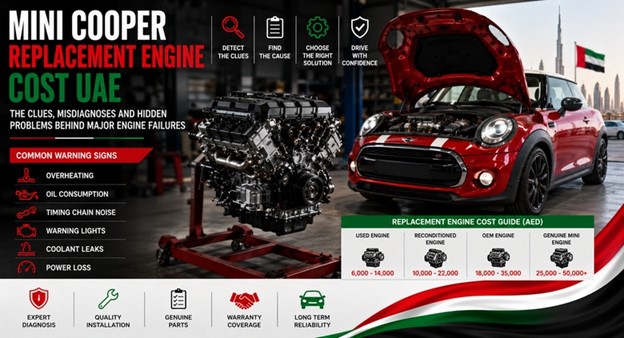
| Used Engine | 6,000 – 14,000 |
| Reconditioned Engine | 10,000 – 22,000 |
| OEM Engine | 18,000 – 35,000 |
| Genuine Engine | 25,000 – 50,000+ |
The correct choice depends on ownership goals.
The cheapest option and the best value option are not always the same thing.
Reliability Investigation Matrix
| Engine Type | Risk Level | Long-Term Confidence |
| Used | High | Moderate |
| Reconditioned | Moderate | Good |
| OEM | Low | Very Good |
| Genuine | Lowest | Excellent |
For buyers researching Mini Cooper engine for sale, the investigation should extend beyond pricing. Service history, compression-test results, supplier reputation and warranty coverage often reveal more than mileage claims alone.
The Workshop Report: Why Labour Quality, Installation Standards and Technical Expertise Change the Final Verdict
Two owners purchase similar engines.
Six months later their experiences differ dramatically.
The investigation often points towards installation quality.
The engine may be identical.
The workmanship is not.
Mini Cooper engine replacements require careful diagnostics, precise installation procedures and detailed post-installation verification. Small mistakes can create consequences that appear much later.
Those consequences frequently receive blame that belongs elsewhere.
Common Installation-Related Issues
✓ Wiring errors
✓ Cooling-system bleeding problems
✓ Sensor calibration faults
✓ Fluid leaks
✓ Improper mounting procedures
✓ Torque-specification errors
✓ ECU communication issues
The replacement engine inherits every installation decision.
Good or bad.
UAE Labour Cost Analysis by Emirate
| Emirate | Labour Cost Range (AED) |
| Dubai | 3,500 – 12,000 |
| Abu Dhabi | 3,500 – 11,000 |
| Sharjah | 3,000 – 10,000 |
| Ajman | 2,500 – 8,500 |
| Ras Al Khaimah | 2,500 – 8,000 |
| Fujairah | 2,500 – 8,000 |
| Umm Al Quwain | 2,000 – 7,500 |
Labour costs vary.
The consequences of poor workmanship often cost more than labour savings.
Workshop Evaluation Checklist
✓ Mini Cooper experience
✓ Diagnostic capability
✓ Warranty support
✓ Installation history
✓ Post-installation testing
✓ Cooling-system expertise
✓ Electronic-system expertise
A workshop should be evaluated like a long-term partner.
Not simply a line item on an invoice.
Hidden Accomplices: Supporting Components That Frequently Contribute to Engine Failure and Replacement Costs
Many investigations uncover a familiar pattern.
The engine was not acting alone.
Supporting components frequently contribute to the final outcome.
A replacement engine entering an unhealthy cooling system faces many of the same risks as the engine that failed before it.
The environment matters.
Sometimes more than the engine itself.
Common Supporting Components Requiring Investigation
✓ Water pumps
✓ Thermostats
✓ Radiators
✓ Cooling fans
✓ Sensors
✓ Engine mounts
✓ Hoses
✓ Ignition components
✓ Filters
✓ Electronic modules
These parts rarely attract attention.
Until they become evidence.
Supporting Component Cost Comparison
| Component | Estimated Cost (AED) |
| Water Pump | 800 – 4,000 |
| Thermostat | 500 – 2,000 |
| Radiator | 1,000 – 5,000 |
| Cooling Fan | 800 – 4,500 |
| Engine Mounts | 1,000 – 5,000 |
| Sensors | 300 – 3,500 |
| Ignition Components | 500 – 4,000 |
Replacing the engine while ignoring contributing systems can create a familiar outcome.
A second investigation.
The Mileage Mystery: Why Odometer Readings Alone Don't Always Reveal the True Condition of an Engine
Every workshop investigation eventually reaches the mileage question.
How many kilometres has the engine travelled?
The question matters.
It simply does not matter as much as many buyers think.
A Mini Cooper engine with 180,000 kilometres of disciplined maintenance can often present fewer risks than another engine showing 90,000 kilometres with an unknown history. The odometer records distance.
It does not record neglect.
It does not record overheating.
It does not record missed oil services.
It does not record poor-quality repairs.
Technicians know that mileage is evidence.
It is not the verdict.
Evidence More Important Than Mileage
✓ Complete service history
✓ Oil-change frequency
✓ Cooling-system maintenance
✓ Previous overheating incidents
✓ Compression-test results
✓ Diagnostic records
✓ Previous repairs
✓ Driving conditions
The best investigations examine all available evidence.
Not just the easiest number to find.
Mileage Evaluation Guide
| Mileage Range | General Risk Level |
| Under 60,000 km | Low |
| 60,000 – 120,000 km | Moderate |
| 120,000 – 180,000 km | Moderate to High |
| 180,000 – 250,000 km | High |
| Above 250,000 km | Very High |
Mileage starts the conversation.
Documentation finishes it.
Investigation Principle
A documented engine with a transparent history is often safer than a lower-mileage engine surrounded by uncertainty.
Experienced buyers understand that distinction.
The Warranty Investigation: What Protection Really Exists After Engine Installation and What Owners Should Verify
Every investigation eventually arrives at a document many owners trust without reading carefully.
The warranty.
The word sounds reassuring.
The details determine whether it actually is.
A warranty is essentially a transfer of risk. The important question is not whether a warranty exists.
The important question is which risks remain with the owner.
That distinction changes everything.
Essential Warranty Questions
✓ Does coverage include labour?
✓ Are diagnostics covered?
✓ Are cooling-system failures excluded?
✓ Is overheating damage excluded?
✓ Are sensors covered?
✓ What maintenance records are required?
✓ Are consequential damages covered?
✓ Does warranty support exist throughout the UAE?
Many disputes begin because assumptions replaced verification.
The paperwork usually contains the answers.
Warranty Comparison Matrix
| Warranty Type | Protection Level |
| Verbal Promise | Very Low |
| Limited Parts Warranty | Low |
| Parts-Only Warranty | Moderate |
| Parts and Labour Warranty | High |
| Comprehensive Coverage | Very High |
Strong warranties reduce uncertainty.
Weak warranties merely postpone it.
Ownership Perspective
A warranty should be evaluated before installation.
Not after a problem appears.
The First 1,000 Kilometres: Monitoring the Evidence After Installation to Confirm a Successful Replacement
Many owners believe the investigation ends when the replacement engine is installed.
Workshops know the opposite is often true.
The first 1,000 kilometres frequently reveal details that workshop testing cannot. Real-world traffic, highway journeys and UAE summer conditions place the engine under stresses that expose hidden weaknesses.
This period matters.
A lot.
Small coolant leaks emerge.
Sensor inconsistencies appear.
Fluid levels stabilise.
Electronic systems adapt.
The engine effectively introduces itself.
Post-Installation Monitoring Checklist
✓ Coolant levels
✓ Oil consumption
✓ Fluid leaks
✓ Engine temperatures
✓ Dashboard warnings
✓ Idle quality
✓ Fuel economy
✓ Unusual noises
✓ Starting behaviour
The goal is not paranoia.
The goal is verification.
First 1,000 km Risk Assessment
| Observation | Risk Level |
| Stable Operation | Low |
| Minor Leak | Moderate |
| Warning Light | High |
| Temperature Fluctuation | Very High |
| Overheating | Critical |
Most successful engine projects establish confidence during this period.
Most unsuccessful projects reveal warning signs here as well.
The Resale Evidence File: How Documentation, Service Records and Transparency Influence Future Buyer Confidence
Buyers rarely purchase mechanical components.
They purchase confidence.
That reality explains why documentation influences resale value so heavily.
A replacement engine supported by invoices, warranty records and service documentation tells a clear story. A replacement engine without documentation forces future buyers to create their own explanations.
The market rarely rewards uncertainty.
Documentation Checklist
✓ Engine purchase invoice
✓ Installation records
✓ Warranty paperwork
✓ Service history
✓ Mileage verification
✓ Diagnostic reports
✓ Supplier information
✓ Post-installation inspections
Each document answers a future question.
Missing documents create new ones.
Resale Value Investigation Matrix
| Documentation Quality | Resale Impact |
| Complete Records | Positive to Neutral |
| Strong Records | Minimal Impact |
| Partial Records | Moderate Reduction |
| Limited Records | Significant Reduction |
| No Records | Severe Reduction |
The replacement itself is rarely the problem.
The missing evidence often is.
Executive Ownership Perspective
Executives frequently prioritise convenience and future flexibility.
Good documentation supports both.
Solving the Wrong Crime: When Engine Replacement Doesn't Fix the Original Problem Behind the Failure
This may be the most important discovery in the entire investigation.
Sometimes the replacement engine is not the solution.
It is simply the newest victim.
A cooling-system weakness damages the original engine.
The engine is replaced.
The cooling-system weakness remains.
The underlying problem survives.
The investigation starts again.
This pattern appears more often than many owners realise.
The engine receives attention because it is expensive.
The root cause deserves attention because it created the expense.
Common Root Causes That Survive Replacement
✓ Cooling-system failures
✓ Electrical faults
✓ Sensor issues
✓ Poor maintenance habits
✓ Lubrication problems
✓ Repeated overheating
✓ Faulty diagnostic procedures
Replacing the engine without addressing these issues can recreate the same story.
The characters change.
The plot remains familiar.
Root Cause Correction Matrix
| Strategy | Long-Term Outcome |
| Engine Only | Uncertain |
| Engine + Root Cause Repair | Good |
| Engine + Supporting Components | Very Good |
| Complete System Rehabilitation | Best |
Workshops solve problems.
Replacing parts alone does not always accomplish that goal.
Closing the Investigation: The Complete UAE Workshop Detective Blueprint for Long-Term Mini Cooper Engine Reliability
After examining warning signs, misdiagnoses, overheating evidence, timing-chain clues, warranty documentation and replacement-engine options, the investigation reaches its conclusion.
The evidence points toward a simple truth.
Most catastrophic engine failures are not sudden.
They are accumulated.
They begin with clues.
Those clues become patterns.
The patterns become consequences.
The consequences become invoices.
The owners who experience the strongest outcomes are rarely the luckiest. More often, they are the people who recognise evidence early and respond before minor problems become major investigations.
The Complete Reliability Blueprint
✓ Investigate warning lights immediately
✓ Monitor coolant levels regularly
✓ Track oil consumption carefully
✓ Follow service intervals consistently
✓ Address timing-chain noise early
✓ Verify diagnostic findings
✓ Maintain documentation
✓ Inspect supporting components
✓ Choose workshops carefully
✓ Review warranty terms thoroughly
✓ Monitor the first 1,000 kilometres
✓ Correct root causes rather than symptoms
These actions appear simple.
Their long-term impact is not.
Buyer Decision Matrix
| Buyer Priority | Recommended Direction |
| Lowest Initial Cost | Used Engine |
| Balanced Value | Reconditioned Engine |
| Long-Term Ownership | OEM Engine |
| Maximum Confidence | Genuine Engine |
The best engine is not automatically the most expensive.
It is the option that matches the ownership plan.
First-Year Ownership Forecast
| Category | Estimated Cost (AED) |
| Maintenance | 1,500 – 5,000 |
| Diagnostics | 500 – 2,000 |
| Fluid Services | 500 – 2,500 |
| Unexpected Repairs | 1,000 – 5,000 |
Three-Year Ownership Forecast
| Category | Estimated Cost (AED) |
| Scheduled Maintenance | 4,000 – 12,000 |
| Diagnostics | 1,500 – 5,000 |
| Preventative Repairs | 2,000 – 10,000 |
Five-Year Ownership Forecast
| Engine Type | Ownership Outlook |
| Used Engine | Variable |
| Reconditioned Engine | Good |
| OEM Engine | Very Good |
| Genuine Engine | Excellent |
For readers researching PartFinder UAE, the strongest engine replacement outcomes consistently come from thorough investigation, careful documentation, proper workshop selection and proactive maintenance rather than simply choosing the lowest-priced option.
Final Verdict
The Mini Cooper rarely hides the truth completely.
It usually leaves clues.
A warning light.
A temperature fluctuation.
A timing-chain rattle.
A small coolant loss.
An increase in oil consumption.
Each clue forms part of a larger story.
The workshop detective's job is to reconstruct that story before the evidence becomes an engine replacement. The owner's advantage lies in recognising the clues early enough that the investigation ends with a repair rather than a replacement.
In the UAE, where heat, traffic and demanding operating conditions accelerate mechanical stress, the difference between those two outcomes can easily represent tens of thousands of dirhams.
The evidence is usually there.
The real question is whether it is examined in time.
Frequently Asked Questions
Categories
- Audi
- BMW
- Car Accessories
- Car Tips
- Ford
- Land Rover
- Mazda
- Range Rover
- Top 10
- UAE Car Parts
- Used Car Parts
- Toyota
- Replacement Engines
- Nissan
- Hyundai
- Mitsubishi
- Volkswagen
- Honda
- Kia
- Chevrolet
- Dodge
- Jeep
- Subaru
- Renault
- Lexus
- Mercedes
- Suzuki
- Hummer
- Porsche
- Infiniti
- Peugeot
- GMC
- Mini
- Volvo
- Replacement Gearboxes
- MG
- Jaguar
- Skoda
- Cadillac
- Daihatsu
- Fiat
- German Car Parts
- Japanese Car Parts
- Aftermarket Car Parts
- Genuine Car Parts
- New Car Parts
- Reconditioned Car Parts
- European Car Parts
- American Car Parts
- Korean Car Parts
- British Car Parts
- Chinese Car Parts
- Sports/Exotic Car Parts
- Luxury Car Parts
- Performance Car Parts
- SUV/4x4 Spare Parts
- Truck Spare Parts
- EV Car Parts
- Hybrid Car Parts
- Auto Spare Parts in UAE
- Tesla
- Isuzu
- Ram
- Ferrari
- Bentley
- Lamborghini
- Genesis
- Maserati
- Lincoln
- Chrysler
- Opel
- Citroen
- SsangYong
- Seat
- McLaren
- Aston Martin
- Rolls Royce
- Maybach
- Alfa Romeo
- Bugatti
- Scion
- Abu Dhabi Car Parts
- Ajman Car Parts
- Al Khan Car Parts
- Al Sajaa Car Parts
- Deira Car Parts
- Dubai Car Parts
- Fujairah Car Parts
- Industrial Area 6 Car Parts
- Mussafah Car Parts
- Ras Al Khaimah Car Parts
- Sharjah Car Parts
- Umm Al Quwain Car Parts
- Acura
- BYD
- Chery
- Dacia
- DS
- Geely Emgrand
- EXEED
- GAC
- GAC Gonow
- Geely
- Gonow
- Great Wall
- Haima
- Haval
- Holden
- Iveco
- JAC
- Jaecoo
- Jetour
- Lotus
- Omoda
- Proton
- Renault Samsung
- Roewe
- Lucid