Mitsubishi Lancer EX Replacement Gearbox Cost in UAE: Mechanic-Approved Solutions for Reliable, Compatible and Long-Lasting Performance
July 6, 2026
Diagnose Before You Replace
The Most Common Mitsubishi Lancer EX Gearbox Problems Professional UAE Mechanics See
Every gearbox tells a story before it fails.
Experienced transmission specialists hear that story through delayed gear changes, unusual noises, warning lights and subtle changes in driving behaviour long before complete gearbox failure occurs.
The challenge is that many owners don't recognise those early warning signs.
Instead, they continue driving until a relatively small transmission problem develops into a major repair.
Across workshops throughout Dubai, Abu Dhabi, Sharjah and the other Emirates, Mitsubishi Lancer EX models remain popular because they combine practicality, dependable performance and comfortable daily driving. Like every automatic transmission, however, the gearbox is subjected to constant heat, hydraulic pressure, electronic control and mechanical load.
Eventually, wear becomes unavoidable.
The important question isn't whether wear will happen.
It's how early it's identified.
Professional mechanics rarely begin by recommending a replacement gearbox.
They begin by understanding the fault.
That distinction protects both the vehicle and the owner's budget.
Some Mitsubishi Lancer EX owners first notice a hesitation when selecting Drive or Reverse.
Others report that the engine revs increase without corresponding acceleration.
Gear changes may become rough.
The transmission warning light might appear intermittently.
A vibration may develop during acceleration.
Sometimes there is a noticeable transmission fluid leak beneath the vehicle after parking.
Each symptom provides useful diagnostic information.
None automatically confirms that the gearbox requires complete replacement.
Modern Mitsubishi transmissions rely on mechanical components, hydraulic circuits, electronic control modules, sensors and shift solenoids operating together with remarkable precision.
A single failing component can produce symptoms that resemble major gearbox failure even when most internal parts remain serviceable.
That's exactly why professional workshops insist on evidence before recommending expensive repairs.
A proper transmission assessment normally includes manufacturer-level diagnostic scanning, live data analysis, transmission fluid inspection, hydraulic performance evaluation and road testing under controlled conditions.
Only after those inspections have been completed can technicians determine whether repair, rebuilding or replacement represents the most appropriate solution.
This method isn't about delaying repairs.
It's about avoiding unnecessary ones.
Throughout this guide, you'll learn how experienced UAE transmission specialists compare used, reconditioned, OEM and genuine gearbox options, explain replacement costs, verify compatibility, identify hidden expenses, evaluate workshop standards and help owners choose the right Mitsubishi Lancer EX gearbox for sale with confidence.
Workshop Quick Assessment
Before approving any gearbox replacement, experienced mechanics normally confirm the following:
- The fault has been professionally diagnosed.
- Diagnostic trouble codes have been analysed.
- Transmission fluid condition has been inspected.
- Hydraulic performance has been evaluated.
- VIN compatibility has been verified.
- Gearbox identification code has been confirmed.
- Supporting components have been inspected.
- A written repair recommendation has been prepared.
Professional diagnosis always comes before professional replacement.
Mitsubishi Lancer EX Replacement Gearbox Overview
| Workshop Assessment | Typical Information |
| Typical replacement project cost | AED 8,500–22,500+ |
| Typical labour charges | AED 1,800–3,500 |
| Common replacement options | Used, Reconditioned, OEM and Genuine |
| Average replacement timeframe | 2–4 working days |
| Typical warranty availability | 3–24 months |
| Most commonly recommended option | Professionally reconditioned gearbox |
| Premium long-term option | OEM or Genuine gearbox |
| Essential first step | Complete professional diagnostics |
Early Warning Signs Your Mitsubishi Lancer EX Gearbox May Need Professional Attention
Professional mechanics often identify gearbox problems before owners realise how serious they have become.
That isn't luck.
It's experience.
Common warning signs include delayed gear engagement, harsh shifting, transmission slipping, unusually high engine revolutions during acceleration, dashboard warning lights, vibration, transmission fluid leaks and unfamiliar mechanical noises.
Some owners also report hesitation when moving away from junctions or slower response while overtaking.
These symptoms should never be dismissed simply because the vehicle continues driving.
Early diagnosis frequently expands the available repair options and helps prevent secondary internal damage.
Waiting rarely improves gearbox condition.
Why Professional Gearbox Diagnostics Should Always Come Before Replacement
Replacing a gearbox without confirming the actual cause of the fault is rather like replacing an entire electrical system because one light bulb stopped working.
It might solve the problem.
It might also be completely unnecessary.
Professional diagnostics eliminate assumptions.
Using specialist diagnostic equipment together with mechanical inspection, technicians determine precisely what has failed, how extensive the damage is and whether repair, rebuilding or replacement offers the best long-term value.
This disciplined approach protects owners from paying for unnecessary components while ensuring genuine gearbox failures receive the attention they require.
It's one of the reasons experienced transmission workshops achieve consistently better long-term results.
Accurate diagnosis isn't an optional extra.
It's the foundation of every successful gearbox replacement.
Think Like a Professional Technician
Repair, Rebuild or Replace? A Workshop-Approved Decision Guide
One of the biggest misconceptions in the automotive world is that every gearbox problem ends with a replacement.
Professional transmission specialists know better.
The first question in a reputable workshop isn't, "Which gearbox should we install?"
It's usually much simpler.
"What has actually failed?"
That question changes everything.
An experienced mechanic doesn't diagnose a transmission by listening to one symptom or taking a short drive around the block. Modern gearboxes are complex systems made up of hydraulic circuits, electronic control modules, valve bodies, clutch packs, bearings, sensors and precision-machined components. When one area begins to fail, the symptoms often resemble a much larger problem.
That's why professional workshops rely on evidence rather than assumptions.
If diagnostics reveal a faulty speed sensor, damaged wiring or a valve body issue while the rest of the transmission remains healthy, a targeted repair may be all that's required.
If technicians discover moderate internal wear but the gearbox casing and major assemblies remain serviceable, rebuilding can often restore reliable operation without replacing the entire unit.
Replacement becomes the preferred option when inspection confirms widespread internal damage, severe overheating, repeated transmission failure or repair costs that approach the value of a professionally prepared replacement gearbox.
There isn't a universal answer.
There shouldn't be.
Every Mitsubishi Lancer EX arrives at the workshop with a different service history, driving pattern and mechanical condition.
A technician's responsibility is to recommend the solution that fits the evidence—not the invoice.
Workshop Decision Matrix
| Recommended Solution | Usually Appropriate When | Typical Workshop Time |
| Repair | Localised electronic or hydraulic fault | Lowest |
| Rebuild | Internal wear with serviceable gearbox casing | Moderate |
| Replacement | Extensive internal damage or severe wear | Usually fastest once parts are available |
Professional recommendations are built on inspection, not guesswork.
Is It Safe to Continue Driving with a Faulty Mitsubishi Lancer EX Gearbox?
Owners ask this almost every day.
"The car still drives. Can I use it for another week?"
Sometimes the answer is yes.
Sometimes that extra week turns a manageable repair into a complete gearbox replacement.
Gearboxes rarely fail in a single moment.
They usually deteriorate gradually.
Transmission fluid begins losing its protective qualities.
Hydraulic pressure becomes less stable.
Clutch materials wear.
Heat increases.
Metal particles circulate through the transmission.
Each additional journey can allow the damage to spread.
This is particularly relevant in the UAE.
Heavy traffic in Dubai and Sharjah, extended motorway driving between Emirates and prolonged summer temperatures all place additional demands on automatic transmissions.
Professional mechanics generally recommend arranging an inspection immediately if you notice:
- Delayed engagement when selecting Drive or Reverse.
- Gear slipping during acceleration.
- Harsh or unpredictable gear changes.
- Transmission warning lights.
- Burning smells.
- Transmission fluid leaks.
- Grinding or whining noises.
- Noticeable vibration during driving.
Ignoring these symptoms rarely reduces repair costs.
More often, it reduces your repair options.
Why Professional Gearbox Diagnostics Should Always Come Before Replacement
A gearbox replacement is one of the largest mechanical investments many owners will make.
Approving that work without proper diagnostics simply isn't good workshop practice.
Professional transmission specialists use manufacturer-level diagnostic equipment to retrieve fault codes, monitor live transmission data, evaluate hydraulic performance, inspect transmission fluid and perform controlled road testing.
Those inspections answer the questions that matter most:
Has the gearbox genuinely failed?
Is the fault electronic rather than mechanical?
Can the transmission be repaired?
Would rebuilding provide better value?
Is replacement genuinely the most reliable long-term solution?
Accurate diagnosis doesn't slow the repair process.
Quite the opposite.
It often prevents unnecessary delays because technicians know exactly which components require attention before work begins.
What Experienced UAE Transmission Specialists Check Before Recommending a New Gearbox
Walk into a professional transmission workshop and you'll notice something interesting.
Experienced technicians don't focus immediately on the gearbox itself.
They look at the entire system.
Before recommending replacement, they typically inspect:
- Vehicle Identification Number (VIN) and gearbox specification.
- Diagnostic trouble codes.
- Live transmission operating data.
- Transmission fluid condition.
- Hydraulic pressure performance.
- Valve body operation.
- Electrical connectors and wiring.
- Gearbox mounts.
- Transmission cooling system.
- Torque converter performance.
- Signs of previous repair work.
- Road test findings.
Only after combining all of this information does a workshop arrive at a recommendation.
Professional Workshop Inspection Checklist
| Inspection Area | Why Mechanics Check It |
| VIN verification | Confirm correct gearbox compatibility |
| Gearbox code | Prevent incorrect replacement |
| Diagnostic fault codes | Identify electronic issues |
| Live transmission data | Assess gearbox behaviour |
| Transmission fluid | Detect wear and overheating |
| Hydraulic pressure | Evaluate internal performance |
| Valve body | Check shift control |
| Gearbox mounts | Identify vibration sources |
| Cooling system | Prevent overheating |
| Road testing | Confirm real-world performance |
Good mechanics don't replace gearboxes because symptoms suggest a problem.
They replace them because careful inspection proves it.
That's the standard owners should expect from any workshop handling a Mitsubishi Lancer EX gearbox replacement in the UAE.
Understand Every Replacement Option
Mitsubishi Lancer EX Replacement Gearbox Cost in UAE: Complete Price Guide for Used, Reconditioned, OEM and Genuine Gearboxes
Walk into five different transmission workshops across the UAE and there's a good chance you'll receive five different quotations for the same Mitsubishi Lancer EX.
At first, that can seem confusing.
It isn't necessarily a sign that one workshop is right and another is wrong.
More often, they're quoting for different gearbox options, different levels of labour, different warranty packages or different replacement procedures.
Professional mechanics don't judge value by gearbox price alone.
They evaluate the entire repair.
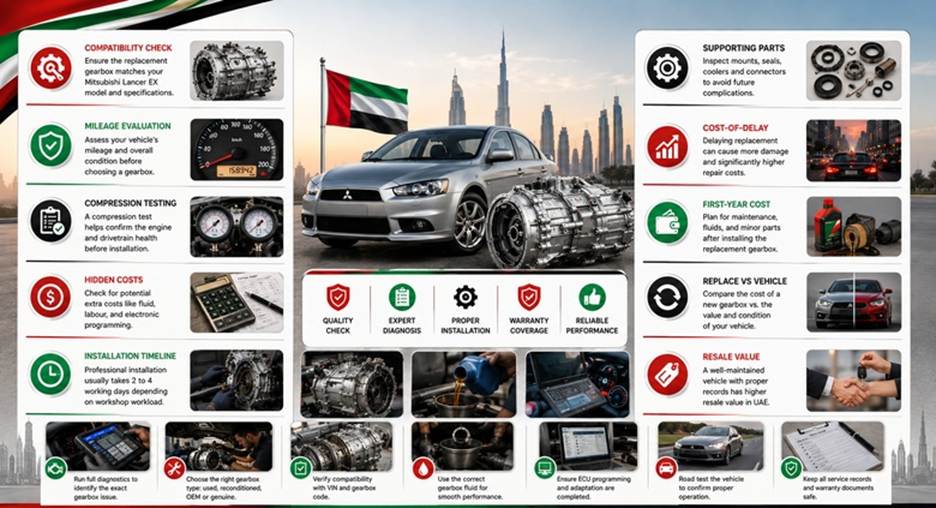
A replacement gearbox is only one part of a successful transmission project. Diagnostics, compatibility checks, installation quality, ECU programming, transmission fluid, road testing and post-installation support all influence the final result.
That's why experienced workshops explain the complete project before discussing costs.
Across the UAE, replacement gearboxes generally fall into four categories.
Professionally inspected used gearboxes.
Professionally reconditioned gearboxes.
OEM gearboxes manufactured to original equipment specifications.
Genuine Mitsubishi gearboxes supplied through authorised channels.
Each has a place.
A professionally inspected used gearbox often suits owners working within a tighter budget.
Reconditioned gearboxes remain the option many transmission specialists recommend because worn internal components have been renewed while keeping costs sensible.
OEM gearboxes provide excellent long-term reliability for owners planning to keep their vehicle for many years.
Genuine Mitsubishi gearboxes offer factory-level confidence where availability allows.
The right decision depends on the vehicle, not simply the price list.
Typical Mitsubishi Lancer EX Replacement Gearbox Prices in the UAE
| Gearbox Type | Typical UAE Cost (AED) | Workshop Recommendation |
| Used | 8,000–11,000 | Suitable when professionally inspected |
| Reconditioned | 10,000–14,000 | Recommended for most owners |
| OEM | 13,000–17,000 | Excellent long-term investment |
| Genuine | 16,000–21,000+ | Maximum factory confidence |
Professional workshops compare quality before cost.
Used vs Reconditioned vs OEM vs Genuine Mitsubishi Lancer EX Gearboxes: Which Option Do Professional Mechanics Recommend?
Mechanics rarely ask, "Which gearbox is cheapest?"
Instead, they ask several more useful questions.
How long does the owner intend to keep the vehicle?
What is the annual mileage?
Has the car been maintained regularly?
Will it be driven mainly in city traffic or on long motorway journeys?
Those answers influence the recommendation.
A professionally inspected used gearbox can be an appropriate solution for vehicles nearing the end of ownership.
A professionally reconditioned gearbox is frequently regarded as the strongest overall balance between cost, reliability and warranty protection.
OEM gearboxes are attractive for owners expecting long-term service.
Genuine Mitsubishi gearboxes remain the premium option where factory specification is the highest priority.
No single gearbox suits everyone.
Experienced workshops recommend the option that best matches the owner's circumstances.
Professional Comparison
| Replacement Option | Initial Cost | Expected Reliability | Mechanic's View |
| Used | Lowest | Good | Acceptable when inspected thoroughly |
| Reconditioned | Moderate | Very Good | Best overall balance |
| OEM | Higher | Excellent | Excellent long-term choice |
| Genuine | Highest | Outstanding | Premium solution |
Choosing correctly today usually prevents unnecessary workshop visits tomorrow.
Complete UAE Labour Costs, Installation Charges and Total Replacement Project Cost
Replacing a gearbox involves considerably more than removing one transmission and fitting another.
Professional workshops follow a structured procedure designed to protect reliability.
Typical labour includes:
- Confirming diagnostics.
- Verifying VIN compatibility.
- Removing the original gearbox.
- Inspecting supporting components.
- Installing the replacement gearbox.
- Replacing transmission fluid.
- Completing ECU programming where required.
- Carrying out comprehensive road testing.
Each stage contributes to long-term gearbox performance.
Skipping one may reduce today's invoice.
It can increase tomorrow's repair bill.
Typical Labour Charges
| Workshop Activity | Typical Cost (AED) |
| Professional diagnostics | 250–600 |
| Gearbox removal | 900–1,600 |
| Gearbox installation | 900–1,600 |
| ECU programming | 300–800 |
| Road testing and quality inspection | Usually included |
| Typical Total Labour Cost | 1,800–3,500 |
Estimated Complete Project Cost
| Replacement Item | Typical UAE Cost (AED) |
| Replacement gearbox | 8,000–21,000+ |
| Labour | 1,800–3,500 |
| ECU programming | 300–800 |
| Transmission fluid | 500–900 |
| Diagnostics | 250–600 |
| Supporting components (if required) | 500–2,500+ |
| Estimated Total Project Cost | 11,350–29,300+ |
Professional quotations explain where every dirham goes.
What's Included in a Professional Gearbox Replacement? Diagnostics, ECU Programming, Transmission Fluid and Road Testing Explained
Experienced mechanics don't define gearbox replacement by the component being installed.
They define it by the quality of the finished repair.
A professional replacement package commonly includes:
- Manufacturer-level diagnostics.
- VIN and gearbox compatibility verification.
- Professional gearbox installation.
- Fresh transmission fluid.
- ECU programming and adaptation.
- Final road testing.
- Quality inspection before delivery.
If technicians discover worn gearbox mounts, leaking seals, damaged cooling lines or other supporting components, these should be explained before additional work begins.
Unexpected repairs shouldn't become unexpected invoices.
Clear communication remains part of professional workmanship.
Common Mitsubishi Lancer EX Gearbox Fault Codes and Their Most Likely Causes
Modern automatic transmissions monitor their own operation continuously.
When something moves outside its expected operating range, the transmission control system records a diagnostic fault code.
Professional mechanics treat these codes as valuable clues—not final conclusions.
Some indicate shift solenoid problems.
Others suggest hydraulic pressure irregularities, speed sensor issues, excessive transmission temperature or electronic communication faults.
Fault codes point technicians in the right direction.
Mechanical inspection confirms the actual cause.
That's why diagnostic scanning should always be combined with live data analysis, transmission fluid inspection and practical road testing before replacement decisions are made.
How UAE Heat, Heavy Traffic and Daily Driving Affect Mitsubishi Lancer EX Gearbox Life
Mechanics working across the UAE see the same pattern every summer.
Higher temperatures.
Greater transmission stress.
More overheated transmission fluid.
More gearbox complaints.
The Mitsubishi Lancer EX performs well in UAE conditions, but constant stop-start traffic, prolonged idling, motorway commuting and sustained high ambient temperatures all increase transmission workload.
Heat is particularly significant because transmission fluid performs three critical tasks simultaneously.
It lubricates.
It cools.
It transmits hydraulic pressure.
As fluid deteriorates, each of those functions becomes less effective.
Routine servicing therefore becomes one of the most valuable preventative maintenance practices available.
From a workshop perspective, preventing gearbox failure is always preferable to replacing one.
That's why experienced mechanics encourage owners to investigate early warning signs promptly rather than waiting for complete transmission failure.
Early action usually creates more repair options, shorter workshop time and lower overall ownership costs.
Workshop-Approved Buying Advice
How Professional Mechanics Select the Correct Mitsubishi Lancer EX Replacement Gearbox
A professional mechanic rarely starts by asking, "Which gearbox is available today?"
The first question is usually far more important.
"Which gearbox was this vehicle built to use?"
That difference in thinking separates a workshop that simply replaces parts from one that solves problems.
Every Mitsubishi Lancer EX arrives with its own mechanical history. Some have covered modest mileage with regular servicing. Others have spent years in heavy traffic, endured missed maintenance intervals or experienced previous repairs that weren't completed to factory standards.
Treating every vehicle the same is rarely good workshop practice.
Experienced transmission specialists begin by confirming the Vehicle Identification Number (VIN), gearbox identification code, engine specification, production year and transmission software compatibility. These checks establish the exact transmission configuration before replacement options are discussed.
Only after compatibility has been confirmed do mechanics compare gearbox choices.
A professionally inspected used gearbox may suit an owner looking for a practical budget-conscious repair.
A professionally reconditioned gearbox is frequently recommended because it combines renewed internal components with dependable reliability and sensible long-term value.
OEM gearboxes are commonly chosen for owners intending to keep the vehicle for several more years.
Genuine Mitsubishi gearboxes provide factory-level specification where availability permits.
Professional workshops don't recommend gearboxes because they're easiest to sell.
They recommend them because they suit the vehicle.
Workshop Selection Checklist
Before ordering any gearbox, experienced mechanics usually verify:
- Complete diagnostic assessment.
- VIN confirmation.
- Gearbox identification code.
- Engine specification.
- Production year.
- ECU compatibility.
- Replacement gearbox condition.
- Warranty availability.
- Estimated completion time.
A correctly selected gearbox prevents many future workshop visits.
Why VIN Matching and Gearbox Compatibility Checks Prevent Expensive Mistakes
One of the most preventable gearbox replacement problems has nothing to do with mechanical failure.
It starts before installation even begins.
Incorrect compatibility.
To the untrained eye, two Mitsubishi Lancer EX gearboxes may appear almost identical.
Externally, they often look remarkably similar.
Internally and electronically, however, important differences may exist.
Gear ratios.
Control software.
Sensor configurations.
Electronic communication.
Even small production updates can influence compatibility.
Professional workshops therefore insist on confirming:
- Vehicle Identification Number (VIN).
- Gearbox code.
- Engine specification.
- Model year.
- ECU calibration.
- Factory transmission configuration.
These inspections usually require only a short amount of time.
Correcting compatibility errors afterwards may require several additional days of labour.
Compatibility Verification Guide
| Inspection | Workshop Purpose |
| VIN confirmation | Identify factory specification |
| Gearbox code verification | Prevent incorrect transmission selection |
| Engine compatibility | Maintain intended vehicle performance |
| Model year confirmation | Account for production updates |
| ECU compatibility | Ensure electronic communication |
| Final technical inspection | Reduce installation risks |
Good workshops eliminate uncertainty before installation begins.
Generation Differences and Gearbox Variations Every Buyer Should Understand
Although the Mitsubishi Lancer EX maintained a consistent overall design during much of its production life, transmission specifications evolved through different production years and engine configurations.
Those differences are important.
A gearbox suitable for one version may not be appropriate for another.
Professional mechanics therefore avoid assumptions.
Instead, they verify every technical detail before sourcing replacement components.
This approach reduces delays, improves installation accuracy and protects long-term reliability.
Owners occasionally become frustrated when workshops spend extra time confirming specifications.
From a mechanic's perspective, those few additional minutes often prevent several days of unnecessary corrective work later.
Accuracy is almost always faster than repeating the same repair twice.
Supporting Components That Experienced Mechanics Inspect During Gearbox Replacement
A gearbox replacement creates an excellent opportunity to inspect surrounding drivetrain components.
Ignoring that opportunity simply isn't good workshop practice.
Once the transmission has been removed, technicians gain direct access to components that would otherwise remain difficult to inspect.
Professional workshops commonly assess:
- Torque converter.
- Gearbox mounts.
- Oil seals.
- Transmission cooler.
- Cooling lines.
- Driveshaft seals.
- Electrical connectors.
- Flexplate.
Some of these components may remain in excellent condition.
Others may already show early signs of deterioration.
Replacing genuinely worn items during the same repair frequently reduces future labour costs because the gearbox has already been removed.
Experienced mechanics focus on preventative reliability rather than repeat repairs.
Supporting Component Inspection
| Component | Reason for Inspection |
| Torque converter | Confirm efficient power transfer |
| Gearbox mounts | Reduce vibration |
| Oil seals | Prevent transmission fluid leaks |
| Cooling lines | Maintain fluid circulation |
| Transmission cooler | Prevent overheating |
| Electrical connectors | Ensure reliable communication |
| Driveshaft seals | Prevent oil loss |
| Flexplate | Verify structural condition |
Thorough inspection is one of the strongest indicators of professional workmanship.
The Complete Workshop Inspection Checklist Before Ordering a Replacement Gearbox
Professional workshops rely on structured procedures rather than memory.
A consistent inspection process reduces mistakes and ensures every important detail receives attention before replacement begins.
Mechanic-Approved Inspection Checklist
| Inspection Item | Verified |
| Diagnostic assessment completed | ✓ |
| VIN confirmed | ✓ |
| Gearbox code verified | ✓ |
| Engine specification confirmed | ✓ |
| Correct gearbox identified | ✓ |
| ECU compatibility checked | ✓ |
| Supporting components inspected | ✓ |
| Warranty explained | ✓ |
| Labour quotation prepared | ✓ |
| Transmission fluid included | ✓ |
| Road testing planned | ✓ |
| Estimated completion date confirmed | ✓ |
Professional mechanics don't rely on guesswork.
They rely on procedure.
That's precisely why experienced workshops consistently achieve better long-term gearbox reliability.
For Mitsubishi Lancer EX owners across Dubai, Abu Dhabi, Sharjah, Ajman, Ras Al Khaimah, Fujairah and Umm Al Quwain, choosing a workshop that follows disciplined inspection standards often proves just as important as choosing the replacement gearbox itself.
The correct gearbox.
Verified compatibility.
Methodical inspection.
Professional installation.
Those four principles form the foundation of every successful transmission replacement.
Professional Installation Standards
Step-by-Step: How a Professional Mitsubishi Lancer EX Gearbox Replacement Is Performed
The quality of a replacement gearbox matters.
The quality of its installation matters just as much.
Experienced transmission specialists often say that even an excellent gearbox can deliver disappointing results if it is installed without following proper workshop procedures. On the other hand, a correctly prepared and professionally installed transmission has the best opportunity to provide reliable long-term performance.
For that reason, reputable UAE workshops follow a structured process rather than rushing straight to installation.
The job begins with verification.
Before any mechanical work starts, technicians review the diagnostic findings, confirm the Vehicle Identification Number (VIN), check the gearbox code and compare the replacement transmission against the vehicle's original factory specification. This final confirmation prevents compatibility problems before valuable workshop time is invested.
Once compatibility has been confirmed, the vehicle is raised safely and the original gearbox is removed using manufacturer-approved workshop procedures. During removal, mechanics carefully inspect surrounding components because many important drivetrain parts become accessible only after the transmission has been separated from the engine.
This stage is particularly valuable.
Professional workshops don't simply remove and replace components.
They inspect.
They measure.
They verify.
Only after the surrounding components have been assessed is the replacement gearbox prepared for installation.
Fresh transmission fluid is used.
Electrical connectors are inspected.
Mounting points are checked.
The gearbox is aligned carefully before final installation.
Where required, electronic programming and adaptation procedures are completed so the transmission control system communicates correctly with the newly installed gearbox.
The final stage involves comprehensive road testing under different driving conditions together with a complete quality inspection before the vehicle is returned to its owner.
Every stage exists for a reason.
Skipping procedures rarely saves time in the long run.
Professional Installation Process
| Workshop Stage | Purpose |
| Review diagnostics | Confirm replacement remains appropriate |
| Verify VIN and gearbox code | Prevent compatibility issues |
| Remove original gearbox | Prepare vehicle correctly |
| Inspect surrounding components | Identify additional wear |
| Install replacement gearbox | Restore drivetrain operation |
| Replace transmission fluid | Protect gearbox internals |
| ECU programming and adaptation | Ensure correct electronic operation |
| Road testing | Confirm shift quality and performance |
| Final inspection | Verify repair quality before delivery |
Professional installation is a process, not simply a task.
Critical Components That Should Always Be Inspected During Installation
Experienced mechanics understand that gearbox reliability depends on more than the gearbox itself.
Several supporting components directly influence transmission performance.
Ignoring them increases the likelihood of future repairs.
Professional workshops commonly inspect:
- Torque converter.
- Gearbox mounts.
- Transmission oil seals.
- Cooling lines.
- Transmission cooler.
- Driveshaft seals.
- Electrical connectors.
- Flexplate.
- Wiring harnesses.
- Mounting brackets.
Some components remain perfectly serviceable.
Others may already show signs of ageing or wear.
Replacing genuinely worn parts while the gearbox is already removed often saves considerable labour later.
Good workshops explain every recommendation before proceeding.
Transparency remains an essential part of professional workmanship.
Supporting Component Inspection Guide
| Component | Reason for Inspection |
| Torque converter | Ensure efficient power transfer |
| Gearbox mounts | Minimise vibration |
| Oil seals | Prevent transmission fluid leaks |
| Cooling lines | Maintain correct fluid circulation |
| Transmission cooler | Control operating temperatures |
| Electrical connectors | Ensure reliable communication |
| Driveshaft seals | Prevent lubricant loss |
| Flexplate | Confirm structural integrity |
| Wiring harness | Eliminate electrical faults |
| Mounting brackets | Maintain gearbox alignment |
Preventative inspection often prevents repeat repairs.
How to Identify a Professional Transmission Workshop in the UAE
Choosing the right workshop can be just as important as choosing the right gearbox.
Professional transmission specialists tend to follow consistent working practices.
They perform detailed diagnostics before recommending replacement.
They explain technical findings clearly.
They verify VIN compatibility.
They provide written quotations.
They discuss warranty coverage openly.
They communicate realistic repair times.
Most importantly, they encourage questions.
A workshop that welcomes discussion generally demonstrates confidence in its own procedures.
Consider asking:
- Why is replacement recommended instead of repair?
- Has compatibility been confirmed?
- What warranty is included?
- Does the quotation include labour, transmission fluid and ECU programming?
- Will the vehicle be road tested before collection?
Clear answers usually indicate organised workshop processes.
Professional Installation vs Low-Cost Installation: What Mechanics Recommend
Lower quotations naturally attract attention.
Professional mechanics look beyond the headline price.
A complete installation package generally includes proper diagnostics, compatibility verification, fresh transmission fluid, ECU programming where required, careful installation, comprehensive road testing and a final quality inspection.
Budget installations may not always include every stage.
That difference often explains why quotations vary.
A slightly higher price that includes every essential procedure frequently delivers better long-term value than a lower quotation requiring additional charges later.
Installation Comparison
| Installation Standard | Initial Cost | Long-Term Reliability |
| Budget installation | Lower | Moderate |
| Professional workshop installation | Higher | Excellent |
Experienced mechanics rarely recommend cutting corners on installation quality.
How Long Does Mitsubishi Lancer EX Gearbox Replacement Usually Take?
Owners understandably want realistic expectations before leaving their vehicle at a workshop.
Assuming the correct replacement gearbox is already available and compatibility has been confirmed, professional gearbox replacement commonly requires between two and four working days.
Several factors may influence that schedule.
Availability of replacement components.
Supporting parts requiring replacement.
Software updates.
Unexpected wear discovered during inspection.
Workshop workload.
Professional mechanics generally prefer providing accurate completion estimates rather than optimistic promises.
Typical Workshop Timeline
| Repair Stage | Estimated Time |
| Professional diagnostics | 2–4 hours |
| Gearbox removal | Approximately 1 working day |
| Supporting component inspection | 2–3 hours |
| Gearbox installation | Approximately 1 working day |
| ECU programming | 1–2 hours |
| Transmission fluid replacement | Around 1 hour |
| Road testing and final quality inspection | 2–3 hours |
| Typical total project time | 2–4 working days |
From a workshop perspective, successful gearbox replacement is never measured simply by how quickly the vehicle leaves the workshop.
It's measured by how reliably it performs afterwards.
Accurate diagnostics.
Verified compatibility.
Methodical installation.
Thorough testing.
Clear communication.
Those are the standards experienced transmission specialists work towards every day across the UAE, and they're the standards every Mitsubishi Lancer EX owner should expect when investing in a replacement gearbox.
Maximise Gearbox Life
How Long Should a Replacement Mitsubishi Lancer EX Gearbox Last Under UAE Conditions?
One question every experienced transmission specialist hears repeatedly is:
"How long should the replacement gearbox last?"
The honest answer is the same one good mechanics have given for years.
It depends.
Not because technicians are avoiding the question.
Because gearbox lifespan is influenced by several factors working together rather than one simple figure on a mileage chart.
The quality of the replacement gearbox.
The standard of installation.
Routine maintenance.
Driving habits.
Traffic conditions.
Operating temperatures.
All of these influence long-term reliability.
Across the UAE, Mitsubishi Lancer EX models experience conditions that are considerably more demanding than those found in cooler climates. Daily stop-start traffic, sustained motorway speeds, high ambient temperatures and prolonged idling while air conditioning systems operate continuously all increase transmission workload.
Professional mechanics don't see these conditions as unusual.
They simply factor them into their maintenance advice.
A professionally installed gearbox that receives routine servicing, operates with clean transmission fluid and has any developing faults addressed promptly can continue providing dependable performance for many years.
Neglected maintenance usually shortens gearbox life far more quickly than mileage alone.
Workshop Factors That Influence Gearbox Life
| Factor | Workshop Assessment |
| Professional installation | Essential |
| Correct transmission fluid | Essential |
| Routine servicing | Very High Importance |
| Early fault diagnosis | Very High Importance |
| Heavy urban traffic | Moderate additional wear |
| High UAE temperatures | Increased operating stress |
| Aggressive driving | Accelerated internal wear |
| Ignored warning signs | High risk of major failure |
From a mechanic's perspective, maintenance protects gearboxes more effectively than repairs ever can.
The First 1,000 Kilometres After Gearbox Replacement: Workshop Recommendations
The period immediately following gearbox replacement is important.
Not because the gearbox is delicate.
Because technicians want to confirm that every component is operating exactly as intended under normal driving conditions.
Professional workshops usually recommend driving smoothly during the first thousand kilometres.
Avoid abrupt acceleration whenever practical.
Allow the transmission to shift naturally.
Bring the vehicle to a complete stop before changing between Drive and Reverse.
Pay attention to any warning lights, unusual noises or unexpected changes in gear quality.
Most owners never experience any problems.
If something does feel unusual, contacting the workshop promptly allows technicians to investigate before a minor concern develops into a larger issue.
Good workshops would always prefer to inspect a gearbox unnecessarily than overlook the early signs of a genuine problem.
Daily Driving Habits That Professional Mechanics Recommend for Longer Gearbox Life
Mechanics often notice that vehicles driven gently tend to remain mechanically healthier for longer.
That isn't coincidence.
It's the cumulative effect of thousands of sensible driving decisions.
Simple habits make a measurable difference.
Accelerate progressively rather than aggressively.
Allow the gearbox to complete each gear change before demanding maximum acceleration.
Avoid holding the vehicle on the accelerator when stationary on steep inclines where safer alternatives are available.
Respond promptly to dashboard warning lights.
Arrange servicing at the recommended intervals.
None of these habits is complicated.
Together, they significantly reduce unnecessary transmission stress.
Workshop Driving Advice
| Driving Habit | Mechanical Benefit |
| Progressive acceleration | Reduces clutch and gear wear |
| Complete stop before changing direction | Protects internal transmission components |
| Respond to warning lights early | Prevents secondary damage |
| Routine gearbox servicing | Improves long-term reliability |
| Check occasionally for fluid leaks | Supports early fault detection |
| Use the correct transmission fluid | Maintains hydraulic performance |
Professional maintenance begins with professional driving habits.
Why Preventative Gearbox Servicing Saves Thousands in Future Repairs
Experienced technicians rarely describe routine servicing as an expense.
They describe it as risk management.
During preventative servicing, mechanics typically:
- Perform diagnostic scanning.
- Inspect transmission fluid condition.
- Check for leaks.
- Assess gearbox cooling performance.
- Evaluate electronic operation.
- Conduct a road test where appropriate.
Each inspection provides an opportunity to identify developing problems before major internal damage occurs.
A small hydraulic issue discovered during servicing may prevent complete transmission failure several months later.
That is precisely why preventative maintenance consistently costs less than corrective repairs.
Preventative Maintenance Schedule
| Workshop Procedure | Purpose |
| Diagnostic scan | Detect electronic issues early |
| Transmission fluid inspection | Maintain lubrication and cooling |
| Leak inspection | Prevent fluid loss |
| Cooling system inspection | Reduce overheating risk |
| Road test | Confirm gearbox operation |
Preventative servicing protects both the gearbox and the owner's budget.
Can a Replacement Gearbox Restore Fuel Economy, Performance and Driving Comfort?
When a worn transmission has been slipping or shifting inefficiently, owners frequently notice immediate improvements after professional replacement.
Gear changes become smoother.
Acceleration becomes more predictable.
Engine speed corresponds more closely with vehicle speed.
Noise and vibration often decrease.
Fuel efficiency may also improve where the previous gearbox had been operating inefficiently.
Professional mechanics usually explain these improvements carefully.
A replacement gearbox restores the vehicle's intended performance.
It doesn't increase performance beyond factory design.
That distinction helps owners maintain realistic expectations while appreciating the benefits of a correctly functioning transmission.
How a Healthy Gearbox Improves Reliability for Everyday UAE Driving
Reliability is ultimately what every professional workshop aims to achieve.
Not simply completing today's repair.
Preventing tomorrow's breakdown.
A healthy gearbox allows the Mitsubishi Lancer EX to perform consistently whether navigating morning traffic in Dubai, commuting across Abu Dhabi, travelling through Sharjah or covering longer distances between the Emirates.
Smooth gear changes reduce driver fatigue.
Consistent power delivery improves driving confidence.
Reliable transmission performance reduces the likelihood of unexpected workshop visits.
Professional installation is only the beginning.
Routine servicing, careful driving, early diagnosis and proper maintenance determine how successfully that investment performs over the years ahead.
From a mechanic's viewpoint, the most reliable gearbox is rarely the newest one.
It's the one that has been correctly diagnosed, professionally installed and consistently maintained throughout its working life.
Long-Term Workshop Maintenance
How Often Should You Service a Replacement Mitsubishi Lancer EX Gearbox?
One of the most common assumptions mechanics hear is that a newly installed gearbox won't need attention for a long time.
From a workshop perspective, that's the wrong way to think about it.
A replacement gearbox should be viewed as a fresh start—not a maintenance-free component.
Every experienced transmission technician knows that long-term reliability is built through routine inspections rather than emergency repairs.
The Mitsubishi Lancer EX is well suited to daily driving in the UAE, but local operating conditions are demanding. High ambient temperatures, frequent stop-start traffic, extended idling with air conditioning running and regular motorway journeys all place continuous demands on automatic transmissions.
These conditions make preventative servicing even more valuable.
During routine gearbox maintenance, professional workshops generally inspect transmission fluid condition, perform manufacturer-level diagnostic scans, check for leaks, examine cooling system performance and evaluate gearbox operation during a controlled road test.
The objective isn't simply to find faults.
It's to identify wear before it develops into failure.
Mechanics understand that early intervention almost always costs less than major transmission repairs.
Recommended Workshop Maintenance Schedule
| Workshop Procedure | Recommended Timing | Purpose |
| Visual gearbox inspection | During routine vehicle servicing | Identify external wear or leaks |
| Diagnostic system scan | Scheduled maintenance | Detect electronic faults early |
| Transmission fluid inspection | At recommended service intervals | Maintain lubrication and cooling |
| Cooling system inspection | During gearbox servicing | Reduce overheating risk |
| Road test | Whenever gearbox behaviour changes | Confirm transmission performance |
Routine maintenance doesn't eliminate wear.
It prevents wear from becoming expensive.
A Real UAE Workshop Case Study: How Early Diagnosis Prevented Major Gearbox Failure
Consider a situation familiar to many transmission specialists.
A Mitsubishi Lancer EX arrives with a complaint of slightly delayed gear engagement each morning.
The owner mentions that the problem comes and goes.
No unusual noises.
No warning lights.
The vehicle still drives normally.
Some owners might continue driving for several more months.
An experienced mechanic thinks differently.
The gearbox is connected to diagnostic equipment.
Live transmission data is analysed.
Fluid condition is inspected.
Hydraulic performance is evaluated.
The investigation identifies deteriorating transmission fluid together with an early valve body concern.
The internal gearbox remains healthy.
The required repair is relatively straightforward.
Now imagine the same vehicle continuing to operate for another several thousand kilometres without inspection.
Hydraulic performance declines further.
Internal clutch wear increases.
Heat builds.
Eventually, replacement becomes the most practical solution.
The difference wasn't good fortune.
It was timely diagnosis supported by proper workshop procedures.
Understanding Gearbox Warranties: Advice from Experienced UAE Mechanics
Many owners focus almost entirely on gearbox price.
Professional workshops encourage equal attention to warranty protection.
A good warranty isn't simply a marketing feature.
It's evidence that the supplier has confidence in the product being installed.
Before approving replacement, experienced mechanics recommend understanding:
- Warranty duration.
- Covered components.
- Labour coverage.
- Required servicing conditions.
- Claim procedures.
- Documentation requirements.
If any part of the warranty remains unclear, ask for clarification before work begins.
Reliable workshops expect those questions.
Transparent answers build long-term confidence.
Mechanic's Warranty Checklist
| Warranty Item | Reason to Confirm |
| Warranty duration | Understand protection period |
| Covered gearbox components | Avoid misunderstandings |
| Labour coverage | Clarify future repair costs |
| Maintenance requirements | Preserve warranty validity |
| Claim procedure | Simplify future support |
| Supporting documentation | Strengthen warranty claims |
Good documentation supports good workmanship.
Warning Signs After Gearbox Replacement That Should Never Be Ignored
Professional installation significantly reduces the likelihood of future problems.
Even so, mechanics advise every owner to remain attentive during the weeks following replacement.
Arrange a workshop inspection promptly if you notice:
- Delayed engagement.
- Harsh or inconsistent gear changes.
- Gear slipping.
- Dashboard warning lights.
- Transmission fluid leaks.
- Unusual mechanical noises.
- Persistent vibration.
- Burning smells.
These symptoms don't automatically indicate gearbox failure.
They do indicate that further inspection is worthwhile.
Professional workshops would always rather investigate an early concern than repair avoidable secondary damage later.
Why Complete Workshop Service Records Protect Your Vehicle's Resale Value
Mechanics often remind owners that maintenance doesn't end when the vehicle leaves the workshop.
Neither does documentation.
Complete service records demonstrate responsible ownership and provide valuable technical history for future buyers.
Keep copies of:
- Diagnostic reports.
- VIN compatibility confirmation.
- Gearbox purchase invoice.
- Labour invoice.
- Warranty documents.
- ECU programming records.
- Transmission service history.
- Maintenance invoices.
- Workshop inspection reports.
Well-organised documentation helps support warranty claims, simplifies future servicing and increases buyer confidence if the vehicle is eventually sold.
From a workshop perspective, successful gearbox ownership follows a straightforward pattern.
Professional diagnosis.
Accurate compatibility checks.
Methodical installation.
Routine servicing.
Prompt attention to warning signs.
Comprehensive documentation.
These practices help ensure a replacement Mitsubishi Lancer EX gearbox delivers dependable performance, lower long-term ownership costs and reliable operation throughout years of driving across the UAE.
Compare Suppliers Like a Professional
The Most Important Checks Before Buying Any Mitsubishi Lancer EX Replacement Gearbox
Ask any experienced transmission technician what causes the biggest gearbox problems after replacement and the answer probably won't be, "Poor-quality gearboxes."
More often, it's poor preparation.
The correct gearbox fitted to the wrong vehicle.
Incomplete diagnostics.
Skipped compatibility checks.
Supporting components left uninspected.
Professional workshops work differently.
Before recommending or ordering a replacement gearbox, mechanics gather evidence first and parts second.
They confirm the original diagnosis, verify the Vehicle Identification Number (VIN), identify the gearbox code, inspect supporting systems and then compare replacement options that match the vehicle's exact specification.
This process may seem methodical.
That's because it is.
A structured inspection reduces unnecessary risks and helps avoid repeat repairs.
Professional mechanics also evaluate the complete replacement package rather than focusing solely on the gearbox itself.
Questions commonly considered include:
- Has compatibility been confirmed?
- Does the quotation include labour?
- Will fresh transmission fluid be supplied?
- Is ECU programming included?
- What warranty accompanies the gearbox?
- Will the vehicle receive a comprehensive road test before collection?
When those questions receive clear answers, choosing between suppliers becomes considerably easier.
Mechanic's Pre-Purchase Checklist
| Inspection Item | Workshop Reason |
| Professional diagnostics completed | Confirm correct repair strategy |
| VIN verified | Ensure correct gearbox compatibility |
| Gearbox code confirmed | Prevent incorrect replacement |
| Gearbox professionally inspected | Improve long-term reliability |
| Written quotation prepared | Increase pricing transparency |
| Warranty explained | Protect future ownership |
| ECU programming included | Restore correct transmission operation |
| Road testing confirmed | Verify installation quality |
| Supporting components inspected | Reduce future repair risk |
| After-sales support available | Improve long-term confidence |
Professional preparation usually produces professional results.
Essential Questions Professional Mechanics Recommend Asking Before Approving a Quote
A quotation should answer questions.
Not create new ones.
Before approving gearbox replacement, experienced technicians encourage owners to ask:
- What exactly has failed?
- Why is replacement recommended instead of repair?
- Has the gearbox been matched using the VIN?
- Which gearbox type is being supplied?
- What warranty is included?
- Does the quotation include diagnostics, labour, ECU programming and transmission fluid?
- Will supporting components be inspected?
- How long is the expected repair?
- Will the gearbox be road tested before delivery?
- What maintenance is recommended after installation?
Professional workshops rarely object to informed questions.
In fact, they often appreciate them.
Good communication reduces misunderstandings throughout the repair process.
A Workshop Comparison Checklist for Choosing the Right Supplier and Installer
When comparing several gearbox suppliers, consistency is essential.
Rather than relying on memory, professional mechanics often compare every quotation against the same technical criteria.
Workshop Comparison Checklist
| Assessment Item | Verified |
| Diagnostics completed | ✓ |
| VIN compatibility confirmed | ✓ |
| Gearbox code verified | ✓ |
| Correct gearbox identified | ✓ |
| Warranty documentation provided | ✓ |
| Labour itemised clearly | ✓ |
| ECU programming included | ✓ |
| Transmission fluid included | ✓ |
| Supporting components inspected | ✓ |
| Road testing included | ✓ |
| Completion schedule confirmed | ✓ |
| After-sales workshop support available | ✓ |
Using a consistent checklist often makes the strongest supplier easier to identify.
Premium vs Budget Replacement Gearboxes: Which Offers Better Long-Term Value?
Professional mechanics rarely judge value by today's invoice alone.
They consider reliability over the years ahead.
A lower-priced gearbox may appear attractive initially.
A higher-quality gearbox may require fewer repairs, provide smoother operation and deliver stronger warranty protection throughout ownership.
Neither option is automatically correct.
The recommendation depends upon the owner's objectives.
Vehicles expected to remain in service for many years often justify greater investment.
Vehicles approaching the end of ownership may suit more economical alternatives.
The role of the workshop is not to choose for the owner.
It is to explain every option honestly.
Long-Term Workshop Comparison
| Gearbox Type | Initial Cost | Expected Reliability | Workshop Recommendation |
| Used | Lowest | Good | Suitable when professionally inspected |
| Reconditioned | Moderate | Very Good | Recommended for most owners |
| OEM | Higher | Excellent | Strong long-term choice |
| Genuine | Highest | Outstanding | Premium factory solution |
Professional advice should always match the owner's circumstances.
Complete UAE Cost Comparison Including Gearbox Price, Labour, ECU Programming and Hidden Costs
Experienced workshops understand that unexpected costs damage trust.
That's why reputable quotations explain the entire replacement project rather than only the gearbox price.
Typical project costs include:
- Replacement gearbox.
- Professional diagnostics.
- Labour.
- ECU programming.
- Transmission fluid.
- Final road testing.
- Quality inspection.
Additional costs may occasionally arise if inspection identifies worn gearbox mounts, damaged oil seals, cooling line problems or other supporting components.
These findings should always be discussed before additional work begins.
Typical Complete Project Costs
| Workshop Item | Typical UAE Cost (AED) |
| Used gearbox | 8,000–11,000 |
| Reconditioned gearbox | 10,000–14,000 |
| OEM gearbox | 13,000–17,000 |
| Genuine gearbox | 16,000–21,000+ |
| Labour | 1,800–3,500 |
| ECU programming | 300–800 |
| Transmission fluid | 500–900 |
| Diagnostics | 250–600 |
| Supporting components (if required) | 500–2,500+ |
| Estimated Total Project Cost | 11,350–29,300+ |
Transparent quotations allow meaningful comparisons.
How Professional Workshops Compare Multiple Gearbox Suppliers Without Compromising Quality
Professional transmission specialists don't simply buy the first gearbox they find.
They compare suppliers using consistent technical standards.
Availability.
Compatibility.
Condition.
Warranty.
Inspection history.
Supplier reputation.
Technical support.
These factors collectively determine whether a gearbox deserves professional recommendation.
Price remains important.
It simply isn't the only consideration.
Across Dubai, Abu Dhabi, Sharjah, Ajman, Ras Al Khaimah, Fujairah and Umm Al Quwain, PartFinder UAE enables Mitsubishi Lancer EX owners to compare compatible replacement gearboxes from multiple suppliers, making it easier to review availability, pricing, warranty support and suitable gearbox options before making a workshop decision.
The strongest gearbox replacement projects rarely happen by accident.
They result from careful diagnosis, disciplined workshop procedures, accurate compatibility checks and informed purchasing decisions.
That's precisely the approach experienced mechanics follow every day—and it's the approach every Mitsubishi Lancer EX owner should expect when investing in a replacement gearbox.
Make the Right Workshop Decision
The Biggest Mistakes Owners Make During Gearbox Replacement and How Mechanics Avoid Them
Experienced transmission specialists often notice something interesting.
Most gearbox failures don't begin with poor workmanship.
Most expensive gearbox repairs don't begin with catastrophic mechanical failure either.
Instead, they usually start with small decisions.
A warning light ignored for several weeks.
A transmission fluid leak considered insignificant.
A quotation accepted without checking what was actually included.
A replacement gearbox ordered before confirming compatibility.
Individually, these decisions may appear harmless.
Collectively, they can increase repair costs considerably.
Professional workshops reduce these risks by following structured procedures rather than shortcuts.
They diagnose before replacing.
They confirm compatibility before ordering parts.
They inspect supporting components while the gearbox is removed.
They complete ECU programming where required.
They road-test every vehicle before handing over the keys.
This systematic approach explains why reputable transmission specialists consistently achieve reliable long-term results.
Owners can follow the same principles.
Ask questions.
Request written quotations.
Understand warranty coverage.
Confirm what is included within the repair.
Choose workshops that explain recommendations clearly instead of relying on vague technical language.
Good decisions rarely depend upon luck.
They usually depend upon good information.
Common Mistakes Professional Mechanics Help Owners Avoid
- Delaying professional diagnosis after early warning signs appear.
- Approving gearbox replacement without confirming the fault.
- Ignoring VIN and gearbox compatibility.
- Comparing gearbox prices instead of complete repair packages.
- Overlooking labour, ECU programming and transmission fluid costs.
- Choosing suppliers based only on price.
- Ignoring preventative servicing after installation.
- Misplacing warranty and maintenance documentation.
Avoiding these mistakes often protects both the gearbox and the ownership budget.
Five-Year Ownership Cost Comparison Between Used, Reconditioned, OEM and Genuine Gearboxes
Professional workshops rarely evaluate gearbox value using purchase price alone.
Long-term ownership costs often tell a different story.
A gearbox costing less initially may require additional maintenance later.
A higher-quality gearbox may reduce workshop visits, improve reliability and provide stronger warranty support.
Considering the complete ownership period rather than the first invoice usually results in a more balanced financial decision.
Estimated Five-Year Ownership Comparison
| Gearbox Type | Typical Purchase Cost (AED) | Estimated Five-Year Maintenance (AED) | Workshop Assessment |
| Used | 8,000–11,000 | 2,500–5,000 | Good |
| Reconditioned | 10,000–14,000 | 2,000–4,000 | Excellent |
| OEM | 13,000–17,000 | 1,800–3,500 | Excellent |
| Genuine | 16,000–21,000+ | 1,500–3,000 | Outstanding |
Mechanics often recommend looking beyond the first repair bill.
How to Reduce Gearbox Replacement Costs Without Compromising Reliability or Safety
Saving money doesn't necessarily require choosing the cheapest gearbox.
Professional workshops generally recommend reducing unnecessary costs by improving decision-making instead.
Arrange diagnostics as soon as symptoms appear.
Compare complete quotations rather than gearbox prices alone.
Verify VIN compatibility before ordering parts.
Understand warranty conditions.
Replace genuinely worn supporting components while access is available.
Continue preventative servicing after installation.
These straightforward habits frequently reduce long-term ownership costs while maintaining dependable gearbox performance.
Workshop Cost-Control Checklist
- Investigate gearbox symptoms early.
- Approve repairs only after professional diagnostics.
- Confirm gearbox compatibility.
- Compare complete repair packages.
- Understand warranty protection.
- Maintain routine gearbox servicing.
- Keep comprehensive maintenance records.
Preventative decisions generally cost less than corrective repairs.
The Complete Mechanic-Approved UAE Buyer's Guide to Choosing the Right Mitsubishi Lancer EX Replacement Gearbox
Replacing a gearbox is one of the most significant mechanical investments many vehicle owners make.
Professional workshops approach that responsibility methodically.
Accurate diagnosis comes first.
Compatibility is confirmed.
Replacement options are explained clearly.
Installation follows structured workshop procedures.
Every stage is tested before the vehicle returns to the road.
Owners benefit from adopting the same disciplined approach.
Ask questions.
Understand the diagnosis.
Compare complete quotations.
Choose technical quality over unnecessary shortcuts.
Maintain the gearbox properly after installation.
Whether your Mitsubishi Lancer EX is driven daily through Dubai, regularly commutes across Abu Dhabi, operates around Sharjah or covers long journeys between Ajman, Ras Al Khaimah, Fujairah and Umm Al Quwain, the same workshop principles apply.
Across the UAE, PartFinder UAE helps owners compare compatible replacement gearboxes from multiple suppliers, making it easier to evaluate pricing, stock availability, warranty support and suitable gearbox options before committing to a repair.
The best gearbox replacement is rarely defined by the lowest price.
From a mechanic's perspective, it's the repair that combines accurate diagnosis, verified compatibility, professional installation, transparent communication and consistent maintenance.
Those principles have guided experienced transmission specialists for years, and they remain the strongest foundation for reliable Mitsubishi Lancer EX ownership across the UAE.
Frequently Asked Questions About Mitsubishi Lancer EX Replacement Gearboxes in the UAE
Categories
- Audi
- BMW
- Car Accessories
- Car Tips
- Ford
- Land Rover
- Mazda
- Range Rover
- Top 10
- UAE Car Parts
- Used Car Parts
- Toyota
- Replacement Engines
- Nissan
- Hyundai
- Mitsubishi
- Volkswagen
- Honda
- Kia
- Chevrolet
- Dodge
- Jeep
- Subaru
- Renault
- Lexus
- Mercedes
- Suzuki
- Hummer
- Porsche
- Infiniti
- Peugeot
- GMC
- Mini
- Volvo
- Replacement Gearboxes
- MG
- Jaguar
- Skoda
- Cadillac
- Daihatsu
- Fiat
- German Car Parts
- Japanese Car Parts
- Aftermarket Car Parts
- Genuine Car Parts
- New Car Parts
- Reconditioned Car Parts
- European Car Parts
- American Car Parts
- Korean Car Parts
- British Car Parts
- Chinese Car Parts
- Sports/Exotic Car Parts
- Luxury Car Parts
- Performance Car Parts
- SUV/4x4 Spare Parts
- Truck Spare Parts
- EV Car Parts
- Hybrid Car Parts
- Auto Spare Parts in UAE
- Tesla
- Isuzu
- Ram
- Ferrari
- Bentley
- Lamborghini
- Genesis
- Maserati
- Lincoln
- Chrysler
- Opel
- Citroen
- SsangYong
- Seat
- McLaren
- Aston Martin
- Rolls Royce
- Maybach
- Alfa Romeo
- Bugatti
- Scion
- Abu Dhabi Car Parts
- Ajman Car Parts
- Al Khan Car Parts
- Al Sajaa Car Parts
- Deira Car Parts
- Dubai Car Parts
- Fujairah Car Parts
- Industrial Area 6 Car Parts
- Mussafah Car Parts
- Ras Al Khaimah Car Parts
- Sharjah Car Parts
- Umm Al Quwain Car Parts
- Acura
- BYD
- Chery
- Dacia
- DS
- Geely Emgrand
- EXEED
- GAC
- GAC Gonow
- Geely
- Gonow
- Great Wall
- Haima
- Haval
- Holden
- Iveco
- JAC
- Jaecoo
- Jetour
- Lotus
- Omoda
- Proton
- Renault Samsung
- Roewe
- Lucid