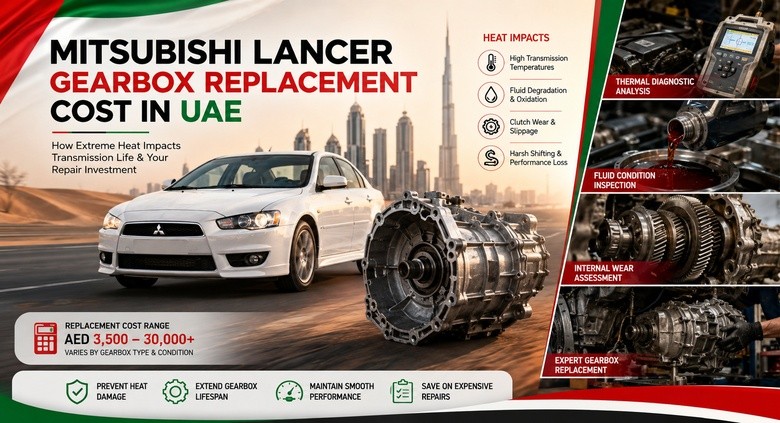
Mitsubishi Lancer Gearbox Replacement Cost in UAE: How Extreme Heat Impacts Transmission Life and Your Repair Investment
June 17, 2026
Mitsubishi Lancer Gearbox Replacement Cost in UAE: Why Every Transmission Decision Must Begin with a Heat Stress Investigation
In the UAE, a Mitsubishi Lancer gearbox does not operate in ordinary conditions. It operates inside a relentless thermal environment where desert temperatures, scorching road surfaces, prolonged traffic queues and continuous air-conditioned city driving create a hidden mechanical burden that many owners never actually see.
The gearbox may appear normal from the outside.
Inside is a different story.
Transmission fluid is constantly absorbing heat, hydraulic circuits are working under pressure, clutch materials are engaging and releasing thousands of times, and microscopic wear particles are gradually accumulating with every extreme temperature cycle.
This is why experienced transmission specialists do not immediately ask whether the gearbox should be repaired or replaced. The more intelligent question comes first:
How much thermal degradation has already taken place inside the transmission system?
A professional heat stress assessment typically includes:
- Transmission temperature behaviour analysis.
- Electronic fault history review.
- Transmission fluid degradation inspection.
- Cooling system performance checks.
- Hydraulic pressure examination.
- Gear engagement response analysis.
- Internal wear prediction based on heat exposure history.
A gearbox suffering from early-stage heat stress may require only a targeted repair. However, a transmission exposed to years of uncontrolled overheating may reach a point where rebuilding or complete replacement becomes the only economically sensible solution.
Mitsubishi Lancer Heat Diagnostic Cost Comparison in UAE
| Heat Analysis Procedure | Typical UAE Price (AED) | Heat-Related Purpose |
| Initial transmission inspection | 150–500 | Detects external overheating evidence |
| Advanced computer diagnostics | 250–1,000 | Identifies temperature-related faults |
| Live thermal road testing | 300–1,200 | Measures real operating heat conditions |
| Transmission fluid examination | 200–800 | Detects oxidation and contamination |
| Complete thermal assessment | 500–1,800 | Determines repair or replacement strategy |
The final repair invoice is often decided long before the gearbox actually fails.
It is decided by years of accumulated heat.
The Thermal Science Behind Mitsubishi Lancer Gearbox Failure in UAE Conditions
Every automatic transmission produces heat. That fact cannot be avoided.
Friction between clutch plates generates heat. The torque converter generates heat. Hydraulic pressure creates additional thermal energy. Continuous stop-start movement multiplies the temperature load.
Under controlled conditions, transmission fluid removes this heat and maintains mechanical stability.
But UAE driving conditions change the equation.
A vehicle parked outside under intense summer sunlight may begin its journey already surrounded by extreme ambient temperatures. Add congested traffic, repeated acceleration, slow movement and prolonged idling, and the transmission can spend hours operating under continuous thermal pressure with limited opportunities to reduce its temperature.
The damage rarely appears immediately.
That is what makes heat dangerous.
A gearbox can survive hundreds of small overheating cycles while its fluid slowly loses viscosity, protective additives break down and internal surfaces experience increasing friction.
Eventually, the symptoms arrive.
UAE Driving Environment and Thermal Load Analysis
| Driving Condition | Transmission Heat Stress |
| Open highway with consistent speed | Low |
| Mixed daily driving | Moderate |
| Urban stop-and-go traffic | High |
| Summer congestion with extended idling | Very High |
| Poorly maintained transmission under extreme heat | Critical |
The gearbox usually does not fail because of one extremely hot day. It fails because thousands of hot days quietly accelerate wear until the mechanical margin finally disappears.
How Extreme Temperature Changes Transmission Fluid and Starts a Chain Reaction of Internal Damage
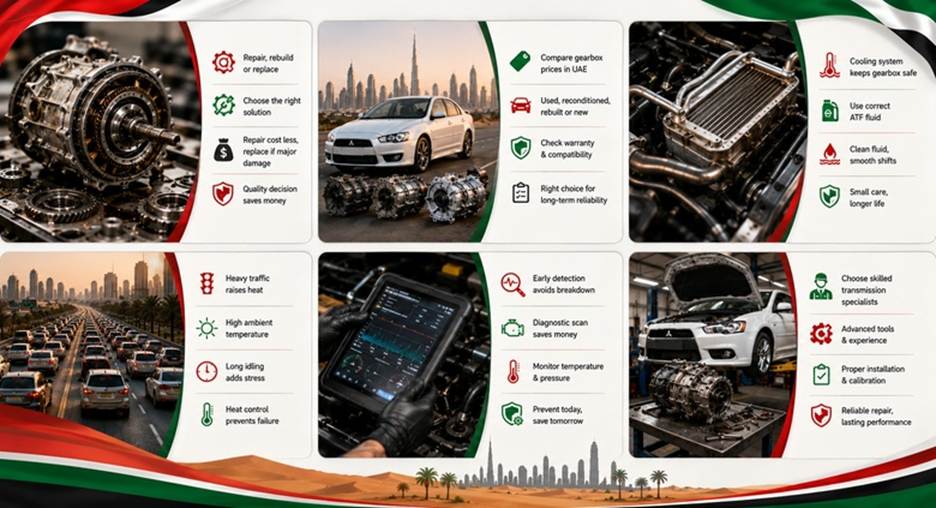
Transmission fluid is the gearbox’s primary cooling and protective medium.
When fresh and operating within the correct temperature range, it lubricates bearings, controls hydraulic pressure, reduces friction and carries heat away from delicate components.
Heat changes everything.
Excessive temperatures cause oxidation, chemical breakdown and reduced lubrication efficiency. The fluid becomes darker, the protective compounds deteriorate and harmful deposits begin forming inside narrow hydraulic passages.
The consequences spread throughout the gearbox:
- Increased friction between moving components.
- Faster clutch material deterioration.
- Reduced hydraulic efficiency.
- Greater stress on seals and internal components.
- Higher possibility of slipping and harsh gear changes.
Transmission Fluid Heat Damage Stages
| Fluid Condition | Thermal Damage Level |
| Clean fluid with normal properties | Minimal |
| Darkened fluid | Moderate heat exposure |
| Burnt smell and heavy contamination | Severe thermal degradation |
| Metal particles present | Advanced internal damage |
A neglected transmission fluid problem is rarely just a fluid problem.
It is often the first visible sign of a much larger heat-related mechanical failure developing beneath the surface.
Early Heat-Related Mitsubishi Lancer Gearbox Symptoms That Indicate Rising Thermal Stress
Heat damage rarely arrives with a dramatic warning. There is no single moment when a Mitsubishi Lancer gearbox announces that its internal temperature has crossed the boundary between normal operation and mechanical deterioration.
The process is much quieter. Much more deceptive.
A transmission may continue shifting, accelerating and functioning during everyday journeys while microscopic friction increases, clutch surfaces slowly lose their original characteristics and transmission fluid gradually loses its ability to control temperature and pressure.
The owner feels small changes first.
A slight hesitation before the vehicle moves into Drive. A harsher shift after sitting in traffic for an extended period. A noticeable increase in engine RPM before acceleration catches up. These symptoms may appear temporarily, disappear during cooler hours and then return again when the transmission experiences another severe heat cycle.
This changing behaviour is one of the biggest reasons heat-related gearbox damage is often diagnosed too late.
Common Heat Stress Symptoms and Their Mechanical Meaning
| Driver Observation | Possible Heat-Related Cause |
| Delayed gear engagement | Reduced hydraulic pressure, worn internal seals or degraded fluid |
| Jerky or aggressive shifting | Overheated fluid, valve body stress or solenoid problems |
| Gear slipping during acceleration | Worn clutch materials due to excessive thermal exposure |
| Burning smell | Fluid oxidation and overheating |
| Warning lights | Temperature sensors or transmission control faults |
| Vibrations or unusual noises | Advanced internal wear caused by prolonged heat cycles |
Many owners make a dangerous assumption: the gearbox still moves, therefore the gearbox is healthy.
Thermally damaged transmissions do not always fail immediately. They gradually surrender performance while internal temperatures continue damaging the components responsible for smooth operation.
Heat Damage Progression Versus Repair Cost in UAE
| Heat Damage Stage | Typical Repair Cost (AED) |
| Early diagnosis and fluid correction | 150–2,000 |
| Sensor, seal or minor component repair | 500–3,500 |
| Valve body and solenoid repairs | 1,500–8,000 |
| Internal transmission rebuilding | 8,000–18,000 |
| Complete gearbox replacement | 10,000–30,000+ |
The difference between a small workshop visit and a major gearbox investment is often measured not in kilometres, but in temperature cycles.
Professional Thermal Diagnostics: How UAE Specialists Measure Heat Damage Before Recommending Replacement
Modern gearbox diagnosis has moved far beyond simply driving a vehicle around the block and listening for unusual noises.
That approach belonged to an earlier era.
Today, a professional transmission workshop analyses how a Mitsubishi Lancer behaves when subjected to real thermal conditions. The objective is not merely to confirm that a fault exists, but to understand how heat has changed the internal operating environment of the gearbox.
Technicians typically carry out:
- Live transmission temperature monitoring during road tests.
- Electronic scanning for stored overheating and pressure faults.
- Hydraulic performance analysis.
- Transmission fluid contamination inspection.
- Cooling system efficiency checks.
- Shift adaptation and electronic control evaluation.
An important reality often surprises owners: two Mitsubishi Lancer vehicles with identical symptoms can require completely different repair solutions.
Why?
Because the external symptom is only the final expression of a much deeper thermal history.
One gearbox may have suffered temporary overheating caused by old fluid or a minor cooling issue. Another may have experienced thousands of uncontrolled heat cycles that have permanently altered clutch materials, seals and internal hydraulic passages.
The repair invoice reflects that history.
Thermal Diagnostic Procedure and UAE Cost Analysis
| Diagnostic Method | Typical UAE Cost (AED) | Technical Purpose |
| Computer temperature analysis | 250–1,000 | Detects overheating records and sensor abnormalities |
| Extended road thermal testing | 300–1,200 | Measures gearbox performance under real heat loads |
| Fluid condition analysis | 200–800 | Identifies oxidation, contamination and metallic wear |
| Hydraulic pressure testing | 500–1,500 | Evaluates internal mechanical efficiency |
| Complete heat stress report | 800–2,500 | Determines the most suitable repair strategy |
A gearbox should never be replaced simply because it shows symptoms.
It should be replaced because thermal evidence proves that the internal damage has reached a level where repair no longer makes financial or mechanical sense.
What Engineers Discover Inside an Overheated Mitsubishi Lancer Gearbox After Disassembly
Opening a gearbox that has endured years of UAE heat is like reading a mechanical history book.
Every component records the story.
The transmission fluid reveals how often excessive temperatures occurred. The clutch materials reveal how much friction they endured. The seals reveal whether prolonged heat caused hardening and leakage. Even small metal particles trapped inside the fluid can expose a long period of internal deterioration.
Common discoveries inside severely heat-stressed gearboxes include:
- Burnt and glazed clutch friction plates.
- Darkened transmission fluid containing carbon deposits.
- Hardened or cracked rubber seals.
- Worn bearings caused by insufficient lubrication.
- Damaged valve body passages.
- Metal particles from excessive component wear.
- Reduced hydraulic sealing efficiency.
Internal Thermal Damage and Recommended Repair Direction
| Internal Condition | Recommended Solution |
| Mild fluid contamination | Fluid replacement and preventive maintenance |
| Localised component wear | Targeted gearbox repair |
| Multiple damaged internal components | Complete professional rebuild |
| Severe heat destruction across the transmission | Full gearbox replacement |
The most expensive gearbox failures are rarely sudden mechanical accidents.
They are slow thermal failures that have been developing quietly through years of extreme UAE conditions.
The Components Inside a Mitsubishi Lancer Gearbox That Suffer the Most Under Extreme Heat
Not every transmission component reacts to heat equally.
Some parts have very little tolerance for continuous temperature abuse, especially when cooling efficiency decreases and transmission fluid loses its protective chemistry.
The components most vulnerable to thermal stress include:
- Transmission fluid and its additive package.
- Clutch packs and friction surfaces.
- Rubber seals and O-rings.
- Valve body channels and control valves.
- Solenoids exposed to continuous high temperatures.
- Bearings and rotating assemblies.
Heat Sensitivity Comparison of Gearbox Components
| Component | Vulnerability to UAE Heat |
| Transmission fluid | Extreme |
| Clutch friction materials | Very High |
| Rubber seals | High |
| Valve body components | High |
| Solenoids | Moderate to High |
| Bearings and gears | Moderate |
Heat is not simply another operating condition for a Mitsubishi Lancer transmission in the UAE.
It is the invisible mechanical force that determines how quickly fluid degrades, how rapidly components wear and ultimately whether the owner pays for preventive maintenance or a complete gearbox replacement.
Mitsubishi Lancer Gearbox Repair, Rebuild or Replacement After Heat Damage: Which Investment Actually Makes Sense in UAE Conditions?
The moment a Mitsubishi Lancer gearbox starts showing heat-related symptoms, most owners immediately jump to the most frightening possibility: the entire transmission needs replacement.
Sometimes that fear is justified.
Quite often, it is not.
Heat is a remarkably complicated enemy because it does not attack every gearbox in the same way. Two Mitsubishi Lancer vehicles can spend years driving through identical UAE summers, sitting in similar traffic and enduring the same brutal afternoon temperatures, yet one transmission might recover with a fluid service and a minor repair, while the other may need to be stripped down completely because the heat has quietly cooked its internal components beyond reliable recovery.
That is the uncomfortable reality of thermal damage.
A professional technician does not simply ask, “Is the gearbox broken?” The real investigation goes much deeper. How much friction material has been lost? Has the transmission fluid merely degraded, or has it become contaminated with metal particles? Are the hydraulic passages still operating correctly, or has excessive heat changed the internal behaviour of the entire system?
Those answers determine the financial direction of the repair.
Heat Damage Repair Strategy and Typical UAE Costs
| Repair Approach | Estimated UAE Cost (AED) | When It Makes Sense |
| Fluid replacement and heat-related service | 500–2,000 | Early overheating with no internal damage |
| Sensor or electrical component repair | 500–3,500 | Temperature sensor or control issues |
| Solenoid or valve body repair | 1,500–8,000 | Heat affecting hydraulic control systems |
| Partial gearbox repair | 4,000–10,000 | Limited internal component failure |
| Complete gearbox rebuild | 8,000–18,000 | Multiple damaged internal parts |
| Complete gearbox replacement | 10,000–30,000+ | Severe thermal destruction or total failure |
The cheapest solution is not always the most economical one.
A quick repair on a severely overheated gearbox may feel like saving money today, only for the same transmission to return a few months later with more serious internal failure. Heat has a long memory.
The Real Mitsubishi Lancer Gearbox Replacement Cost in UAE: The Price You See Is Rarely the Price You Pay
Many owners search online for gearbox prices and believe they have discovered the total cost.
That is usually where the first misunderstanding begins.
A gearbox sitting on a warehouse shelf is only one piece of the financial picture. The transmission still has to be removed, inspected, fitted, calibrated and tested. Fresh fluid is required. Seals may need replacing. Software adjustments may be necessary. Small details, perhaps—but these small details have an irritating habit of becoming expensive when ignored.
A complete replacement cost may include:
- Replacement gearbox unit.
- Labour for removal and installation.
- Transmission fluid and related consumables.
- New seals, gaskets and small components.
- Electronic diagnosis and programming.
- Adaptation reset and calibration.
- Road testing under real operating temperatures.
- Additional repairs discovered during installation.
Complete Mitsubishi Lancer Gearbox Replacement Cost Breakdown
| Expense Category | Typical UAE Cost (AED) |
| Used gearbox purchase | 3,500–8,000 |
| Reconditioned gearbox | 5,000–12,000 |
| Professionally rebuilt gearbox | 8,000–18,000 |
| Brand-new gearbox | 15,000–30,000+ |
| Removal and installation labour | 1,500–5,000 |
| Transmission fluid and filters | 400–1,500 |
| Programming and diagnostics | 300–2,000 |
| Seals, mounts and supporting parts | 500–3,000+ |
The final invoice does not care about your original budget. It reflects the actual mechanical condition of the vehicle.
Mitsubishi Lancer Gearbox for Sale in UAE: Why Heat History Matters More Than a Cheap Price Tag
A used gearbox can look perfect from the outside.
Clean casing. No visible damage. Attractive price.
And that is exactly why many buyers get caught out.
A transmission can carry years of hidden thermal fatigue without displaying obvious external evidence. The previous vehicle may have spent countless hours in heavy summer traffic, with overheated fluid slowly wearing away clutch materials and hardening internal seals.
The damage remains invisible—until it becomes your problem.
Before buying a Mitsubishi Lancer gearbox for sale in the UAE, a careful inspection should include:
- Exact gearbox code compatibility.
- Vehicle history when available.
- Mileage of the donor vehicle.
- Fluid condition.
- Evidence of overheating.
- Supplier testing reports.
- Warranty coverage.
- Installation recommendations.
Used, Reconditioned, Rebuilt and New Gearbox Comparison
| Gearbox Type | Typical Price (AED) | Reliability Under UAE Heat |
| Used gearbox | 3,500–8,000 | Moderate and dependent on previous history |
| Reconditioned gearbox | 5,000–12,000 | Good when prepared by a trusted specialist |
| Rebuilt gearbox | 8,000–18,000 | Very high due to renewed internal components |
| Brand-new gearbox | 15,000–30,000+ | Excellent but the highest investment |
Oddly enough, the most expensive gearbox is not always the one with the highest purchase price.
Sometimes it is the cheap unit that fails twice.
Cooling Systems, Correct Transmission Fluid and Professional Installation: The Hidden Defence Against UAE Heat
Replacing a gearbox while ignoring the reasons it overheated in the first place is a little like replacing a damaged roof while leaving the hole that caused the leak.
The new component enters the same harsh environment. The same temperatures. The same mechanical pressures.
The cycle starts again.
Professional workshops therefore investigate the entire heat management system. They check cooling lines, inspect heat exchangers, confirm fluid specifications and make sure electronic controls are responding correctly.
Critical heat-control elements include:
- Manufacturer-approved transmission fluid.
- Efficient transmission cooling components.
- Correct fluid quantity.
- Working temperature sensors.
- Accurate electronic calibration.
- Proper installation procedures.
Heat Protection Components and Their Importance
| Component | Importance for Gearbox Lifespan |
| Correct transmission fluid | Critical |
| Cooling system efficiency | Critical |
| Temperature sensors | Very High |
| Electronic transmission controls | High |
| Professional installation | Very High |
| Regular fluid monitoring | Essential |
A new gearbox installed with old fluid, poor cooling performance or incorrect calibration is not really a fresh start.
It is a countdown.
Common Driving Habits and Workshop Mistakes That Increase Mitsubishi Lancer Gearbox Temperature
Some heat is unavoidable.
Unnecessary heat is not.
Many transmission failures in the UAE are accelerated by everyday habits that owners do not realise are damaging the gearbox.
Common causes of excessive thermal stress include:
- Ignoring old transmission fluid.
- Continuing to drive despite slipping or harsh shifts.
- Aggressive acceleration when the transmission is already hot.
- Skipping diagnostic checks.
- Using incorrect transmission fluids.
- Installing poor-quality replacement components.
- Failing to inspect cooling systems after a gearbox repair.
Then there are workshop mistakes. A rushed installation, an incorrect fluid level or a skipped calibration procedure may not create an immediate failure. The car might drive away feeling completely normal.
For a while.
Months later, the gearbox begins to shift strangely, temperatures rise again and the owner finds themselves back where they started—except this time with a much larger bill.
Heat is patient. It waits.
Closing Observation
A Mitsubishi Lancer gearbox should never be judged only by whether it changes gears today. The more important question is whether it can continue surviving tomorrow's heat cycles without rapidly deteriorating.
The smartest repair decision is not automatically the cheapest repair or the most expensive replacement. It is the option that understands the gearbox’s thermal history, corrects the root cause of overheating and prepares the transmission to withstand the demanding reality of UAE roads.
Real UAE Heat Damage Cases: What Mitsubishi Lancer Gearboxes Reveal After Years of Fighting Extreme Temperatures
The most revealing part of any gearbox repair begins when the transmission is opened.
Before that moment, everything is speculation. The warning lights, delayed shifts, unusual noises and rough gear changes are merely clues scattered across the surface. Then the gearbox comes apart, and the hidden history of heat exposure finally shows itself.
A Mitsubishi Lancer that spent years travelling through UAE summer traffic often carries a very specific pattern of thermal fatigue. The transmission fluid may appear dark and burnt, carrying the sharp smell of prolonged overheating. Clutch materials may show glazing and excessive wear. Rubber seals, which once remained flexible and capable of maintaining hydraulic pressure, may have hardened after thousands of exposure cycles to elevated temperatures.
And here is the frustrating part for many owners: the final failure often happens suddenly, but the damage itself has been developing quietly for years.
Real Heat Damage Scenarios and Typical Repair Outcomes
| Heat Damage Scenario | Workshop Discovery | Typical UAE Cost (AED) |
| Early overheating caught quickly | Fluid degradation with minimal internal damage | 500–3,000 |
| Repeated high-temperature operation | Solenoid, valve body or seal deterioration | 1,500–8,000 |
| Long-term thermal stress | Burnt clutch packs and internal wear | 8,000–18,000 |
| Severe overheating and metal contamination | Extensive mechanical destruction requiring replacement | 10,000–30,000+ |
A gearbox does not usually lose the battle against heat in a single day.
It loses it one hot journey at a time.
Preventive Heat Management: The Small Decisions That Protect a Mitsubishi Lancer Gearbox
Most owners think about the gearbox only when something goes wrong. That approach makes sense emotionally; after all, a transmission hidden beneath the vehicle is easy to forget.
Mechanically, however, it is a costly habit.
Heat management starts long before a warning light appears. A well-maintained Mitsubishi Lancer transmission has a much better chance of surviving harsh UAE conditions because technicians are controlling the small factors that gradually add up to major mechanical consequences.
Important preventive measures include:
- Checking transmission fluid condition regularly.
- Replacing degraded fluid before it loses protective qualities.
- Investigating even minor shift irregularities.
- Carrying out electronic diagnostic scans during servicing.
- Ensuring cooling components operate correctly.
- Avoiding aggressive acceleration during extreme temperatures.
- Repairing leaks before fluid levels become dangerously low.
A few hundred dirhams spent on prevention can sometimes prevent tens of thousands of dirhams in replacement expenses. It sounds almost unfair. Yet workshops witness this pattern repeatedly.
Early Heat Management Versus Delayed Gearbox Failure: The Financial Reality
Many gearbox replacements begin with a sentence technicians hear far too often:
“I noticed the problem months ago, but the car was still driving.”
That single decision can dramatically alter the repair bill.
A transmission can continue moving the vehicle even while internal friction increases, fluid chemistry breaks down and microscopic particles circulate through delicate hydraulic passages. The car drives. The damage continues.
Cost Comparison Between Early Action and Delayed Repair
| Maintenance or Repair Stage | Typical UAE Cost (AED) |
| Preventive inspection and temperature analysis | 150–1,500 |
| Fluid replacement and minor correction | 500–3,500 |
| Electrical, sensor or hydraulic repairs | 1,000–8,000 |
| Complete gearbox rebuilding | 8,000–18,000 |
| Full gearbox replacement | 10,000–30,000+ |
The cruel irony is obvious: the repair that owners try hardest to avoid often becomes the repair they eventually pay for because they waited too long.
Why Advanced Heat Stress Analysis Prevents Unnecessary Mitsubishi Lancer Gearbox Replacement
A damaged gearbox and an overheated gearbox are not always the same thing.
This distinction matters. A lot.
An inexperienced diagnosis may see a slipping transmission and immediately recommend replacement. A specialist who understands thermal behaviour may slow down, examine fluid condition, analyse electronic data, test hydraulic performance and identify whether the problem is temporary heat-related degradation or irreversible internal damage.
That difference can save thousands of dirhams.
Professional thermal analysis usually examines:
- Live transmission temperature readings.
- Historical fault records.
- Fluid oxidation and contamination.
- Hydraulic pressure behaviour.
- Solenoid and valve body operation.
- Cooling efficiency.
- Mechanical wear indicators.
The objective is simple: replace a gearbox only when evidence proves that replacement is the most sensible mechanical and financial decision.
The Final Thermal Road Test: Confirming the Gearbox Can Handle UAE Conditions Again
Repairing a transmission is only half the story.
The real examination happens when the gearbox returns to the environment that damaged it in the first place.
UAE roads.
Professional workshops perform extended testing because a gearbox that behaves perfectly inside a cool workshop may reveal completely different behaviour after prolonged operation in heavy traffic and high external temperatures.
Final testing generally includes:
- Monitoring transmission temperature under load.
- Checking shift smoothness during different driving conditions.
- Confirming correct hydraulic response.
- Inspecting for fluid leaks.
- Running electronic scans for hidden faults.
- Evaluating gearbox behaviour after reaching operating temperature.
A successful repair is not measured by whether the car leaves the workshop.
It is measured by whether it stays away.
Choosing the Right UAE Transmission Specialist: The Difference Between Repairing Symptoms and Understanding Heat
Every workshop can replace parts.
Not every workshop can understand why those parts failed.
That difference becomes extremely important with a heat-stressed Mitsubishi Lancer gearbox because replacing damaged components without investigating cooling performance, fluid condition and thermal history simply invites the same failure to return.
A capable transmission specialist should provide:
- Advanced diagnostic equipment.
- Thermal and electronic analysis.
- Clear explanation of damage.
- Quality replacement components.
- Proper transmission fluid specification.
- Calibration and adaptation procedures.
- Road testing and post-repair verification.
- Written repair records and warranty information.
The cheapest quotation on the table is not always a bargain. Sometimes it is merely a smaller number attached to a larger future problem.
Using PartFinder UAE to Compare Mitsubishi Lancer Gearbox Options More Intelligently
When replacement becomes unavoidable, many owners turn to PartFinder UAE to compare Mitsubishi Lancer gearbox options, evaluate available units and understand the differences between used, reconditioned, rebuilt and new transmissions.
Price alone should never control the decision.
A cheaper gearbox with a questionable thermal history may carry hidden internal wear from years of overheating. A properly tested and documented unit may initially cost more, but it can provide better long-term reliability under demanding UAE temperatures.
The intelligent purchase considers:
- Compatibility.
- Previous usage history.
- Supplier credibility.
- Testing reports.
- Warranty availability.
- Expected lifespan under UAE driving conditions.
A gearbox is not simply a part. It is a mechanical investment exposed to one of the world's most demanding automotive climates.
Final Report: The Long-Term Strategy for Mitsubishi Lancer Gearbox Survival in the UAE
The harsh truth about transmission failure is that the final breakdown is usually only the last chapter of a story that started many summers earlier.
Heat builds. Fluid deteriorates. Friction increases. Components slowly give up.
The process is quiet.
Then the invoice arrives.
The smartest Mitsubishi Lancer owners are not necessarily the ones who spend the most money on repairs. They are the ones who understand heat, monitor the early warnings, choose accurate diagnostics and make decisions based on mechanical evidence rather than waiting for complete failure.
In the UAE, controlling transmission temperature is not an optional maintenance habit.
It is a survival strategy.
Frequently Asked Questions
Categories
- Audi
- BMW
- Car Accessories
- Car Tips
- Ford
- Land Rover
- Mazda
- Range Rover
- Top 10
- UAE Car Parts
- Used Car Parts
- Toyota
- Replacement Engines
- Nissan
- Hyundai
- Mitsubishi
- Volkswagen
- Honda
- Kia
- Chevrolet
- Dodge
- Jeep
- Subaru
- Renault
- Lexus
- Mercedes
- Suzuki
- Hummer
- Porsche
- Infiniti
- Peugeot
- GMC
- Mini
- Volvo
- Replacement Gearboxes
- MG
- Jaguar
- Skoda
- Cadillac
- Daihatsu
- Fiat
- German Car Parts
- Japanese Car Parts
- Aftermarket Car Parts
- Genuine Car Parts
- New Car Parts
- Reconditioned Car Parts
- European Car Parts
- American Car Parts
- Korean Car Parts
- British Car Parts
- Chinese Car Parts
- Sports/Exotic Car Parts
- Luxury Car Parts
- Performance Car Parts
- SUV/4x4 Spare Parts
- Truck Spare Parts
- EV Car Parts
- Hybrid Car Parts
- Auto Spare Parts in UAE
- Tesla
- Isuzu
- Ram
- Ferrari
- Bentley
- Lamborghini
- Genesis
- Maserati
- Lincoln
- Chrysler
- Opel
- Citroen
- SsangYong
- Seat
- McLaren
- Aston Martin
- Rolls Royce
- Maybach
- Alfa Romeo
- Bugatti
- Scion
- Abu Dhabi Car Parts
- Ajman Car Parts
- Al Khan Car Parts
- Al Sajaa Car Parts
- Deira Car Parts
- Dubai Car Parts
- Fujairah Car Parts
- Industrial Area 6 Car Parts
- Mussafah Car Parts
- Ras Al Khaimah Car Parts
- Sharjah Car Parts
- Umm Al Quwain Car Parts
- Acura
- BYD
- Chery
- Dacia
- DS
- Geely Emgrand
- EXEED
- GAC
- GAC Gonow
- Geely
- Gonow
- Great Wall
- Haima
- Haval
- Holden
- Iveco
- JAC
- Jaecoo
- Jetour
- Lotus
- Omoda
- Proton
- Renault Samsung
- Roewe
- Lucid
- Replacement Headlight
- Replacement Bumper