Mitsubishi Pajero Bumpers in UAE: OEM and Aftermarket Choices
October 21, 2026
A Pajero bumper is not the place to guess
A Mitsubishi Pajero clips a concrete pillar while squeezing into a basement car park in Dubai. The corner splits, a few clips scatter across the floor, and the owner starts looking for a replacement before the paint has even stopped flaking.
There are bargains out there. Some are perfectly reasonable. Others turn into a second repair because the cover does not line up, the lower trim is missing or the brackets behind it have taken a knock as well.
The Pajero makes this a particularly important distinction. It has been sold across different generations and specifications, and the familiar name does not guarantee that every bumper will fit every vehicle. A part for a 2008–2012 model, for instance, is not automatically suitable for a later facelift.
The right approach is straightforward: identify the vehicle, establish exactly which part is damaged, then compare genuine Mitsubishi and aftermarket options on a like-for-like basis. That is more useful than chasing the lowest number on a listing, whether you are buying a bumper or checking fitment for Mitsubishi Pajero bumbers in UAE.
Which Pajero generation are you buying for?
The Pajero’s long production history means that buyers may encounter several body designs in the used-parts market. The V80/V90-series models sold across much of the 2006–2021 period are common references in parts catalogues, but the production range alone does not settle fitment. Equipment and bumper design can vary within it.
Older Pajeros may have a simpler bumper arrangement, while later versions can have different fascia shapes, grille details and trim. The Pajero Sport is a separate model line, so do not assume that a part advertised for a Pajero Sport will fit a full-size Pajero.
Before ordering, confirm the model year, chassis or generation code, trim, market specification and whether you need the front or rear part. Use the VIN or chassis number to help verify the original fitment, especially if the vehicle was imported or modified.
Front or rear bumper? Start with the damaged section
The front bumper often gets scraped against kerbs, parking barriers and rough desert approaches. The rear takes its share of reversing knocks and trailer-related scrapes. Yet the visible cover may be only one part of the job.
Mitsubishi parts catalogues list separate bumper faces, reinforcements, brackets, grilles and clips for relevant Pajero applications. That means a replacement cover does not necessarily include the fittings needed to install it correctly.
| Part | What to confirm |
| Front bumper cover | Exact model, year and grille arrangement |
| Front grille or lower section | Whether included or sold separately |
| Rear bumper cover | Upper, lower or side section required |
| Reinforcement and brackets | Whether damaged or reusable |
| Clips and retainers | Whether the old fittings remain serviceable |
| Fog-lamp or trim surrounds | Whether the replacement has matching openings |
| Sensor holders | Whether the vehicle is equipped with parking sensors |
Ask the seller to show the actual part and everything included in the sale. A catalogue image of a complete bumper is not proof that the delivered item includes every piece shown.
Genuine Mitsubishi or aftermarket: what is the real difference?
A genuine Mitsubishi bumper is sold as a manufacturer-branded part, identified by its applicable part number. An aftermarket bumper comes from another supplier. The latter is not automatically poor quality, just as a genuine part is not automatically the best economic choice for every older Pajero.
The key differences are fitment accuracy, surface finish, material quality, availability and warranty. A well-made aftermarket cover may suit a daily-driven vehicle with cosmetic damage. For a newer or unusually specified Pajero, a genuine part may be worth considering if the correct reference is available and the price is acceptable.
Be wary of listings that say “OEM quality” without identifying the manufacturer or giving a part number. The phrase is easy to type. Evidence is more useful.
OEM terminology can get slippery
In everyday parts trading, “OEM” is sometimes used to mean a part made by an original-equipment supplier, but it can also appear as a loose marketing label. It does not, on its own, establish that a bumper is genuine Mitsubishi or identical to the factory-fitted part.
Ask the seller to clarify what is being offered. Is it Mitsubishi-branded? Is there a recognised manufacturer and reference number? Is it an aftermarket replacement designed to fit the original mounting points? Those are different claims and should be priced accordingly.
If the listing cannot answer these questions, treat the description cautiously. You are buying a physical part, not a label.
What UAE listings reveal about aftermarket prices
Advertised prices for Pajero bumper parts in the UAE vary with model year, position and whether the item is a complete cover or a smaller section. A UAE-facing parts catalogue reviewed for this article lists the following references for older Pajero applications.
| Advertised part | Model range shown | Listed price |
| Front bumper, matte black | 2008–2012 | AED 321 |
| Front bumper grille | 2008–2012 | AED 85 |
| Rear bumper upper section | 2008–2012 | AED 170 |
| Rear bumper lower section | 2008–2012 | AED 150 |
| Front bumper, matte black | 2013–2014 | AED 190 |
| Rear bumper upper section | 2013–2014 | AED 160 |
| Rear bumper lower section | 2013–2014 | AED 170 |
These are catalogue prices, not confirmed fitted quotations. The listings identify several items as matte-black replacement parts and give manufacturing origins, but they do not establish that every item is currently in stock or suitable for every trim. Confirm the exact application and final sale price before ordering.
One detail is worth noticing: the front grille and rear upper and lower sections are listed separately. If you compare one seller’s complete assembly with another seller’s single section, the apparent saving means very little.
Genuine bumper prices can be much higher
The price gap between aftermarket and genuine parts can be substantial. A UAE parts catalogue lists a genuine Mitsubishi front bumper face kit for Pajero/Montero V88W/V98W models from 2006–2011 at AED 2,573.12 including VAT. The catalogue describes it as a bumper face kit and notes that it may come primed for painting, with holes that may vary by application.
That is a different price category from the AED 321 aftermarket front bumper listed for 2008–2012 models. But the two figures should not be treated as a direct comparison until the precise application, included fittings, condition and scope of supply are confirmed.
A genuine part may have a stronger case where factory fit and finish are priorities, or where a particular bumper design is difficult to source elsewhere. On an older Pajero with a modest cosmetic knock, however, the extra cost may not make financial sense. The vehicle’s condition, intended use and repair budget should decide.
Why the part number matters more than a broad year range
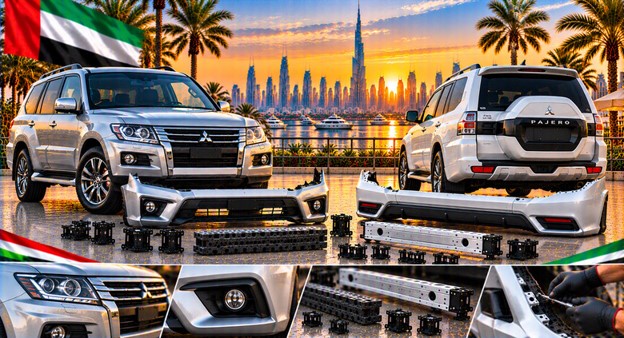
A listing that says “Pajero 2007–2015” may cover several applications, or it may be using an approximate range to attract searches. Either way, do not treat the headline as a fitment guarantee.
For the V80/V90-series, genuine catalogues distinguish bumper faces, reinforcement, side brackets and grille parts. They also show different front-bumper arrangements, including versions with the lower grille integrated or separated.
Give the supplier the VIN or chassis number where appropriate, model year, trim and a photograph of the existing bumper. Ask for the matching part number or written fitment confirmation. If the vehicle has been modified, the seller also needs to know what is fitted now, not just what left the factory.
The front bumper: cover, grille and supporting parts
A front bumper can appear to be one large moulded piece, but it may be made up of several separately supplied items. Depending on the Pajero’s specification, the repair may involve the main bumper face, grille, side brackets, reinforcement, clips or fog-lamp surrounds.
The important question is whether the visible damage is confined to the cover. If the bumper has been pushed in or torn away from its mountings, the brackets and reinforcement should be inspected as appropriate. Replacing the cover while leaving a broken retainer in place can produce poor alignment and another visit to the workshop.
Ask for an itemised quote. If the seller is supplying only the fascia, make sure the remaining parts are available and reusable before the car is dismantled.
The rear bumper may come in sections
Some Pajero rear bumper arrangements use separate upper, lower or side pieces. UAE catalogue listings for 2008–2012 models, for example, identify upper and lower rear bumper parts separately, while later listings show upper, lower and side sections for 2013–2014 applications.
That matters when a corner has been damaged. You may need only one section rather than the full rear arrangement, provided the remaining parts and mounting points are sound.
Check the opposite side as well. A bumper that looks intact from behind may have a cracked retainer or damaged mounting tab underneath. If the impact was substantial, ask the workshop to inspect the relevant supporting structure rather than judging the repair from the painted surface alone.
Used genuine bumpers: when they make sense
A used genuine bumper can be a sensible buy for an older Pajero, particularly if the original design is hard to find or the owner wants to preserve factory styling without paying for a new genuine part.
Condition is everything. Inspect the reverse side, corners, screw holes and mounting tabs. Look for plastic welding, glue repairs, distorted edges and old paintwork that has been applied to hide damage. If the bumper has been repaired before, ask what was done and whether the fixing points remain sound.
Paint is another consideration. A used bumper in the correct factory colour may still look different beside the vehicle because of fading, previous resprays or differences in finish. Budget for repainting if appearance matters.
Reconditioned bumpers: ask what has been repaired
“Reconditioned” can describe a professional repair or little more than a cosmetic tidy-up. The word itself does not tell you how durable the work is.
Ask whether cracks were repaired, whether broken tabs were rebuilt, whether the cover was reshaped and what preparation was carried out before painting. If the damage is around a mounting point, a sensor holder or another area that needs to sit accurately, the quality of the repair matters particularly.
Request photographs before and after the work where available, plus written warranty terms. If the seller cannot explain what has been done, compare the price against a new aftermarket cover or a sound used original rather than paying extra for an undefined label.
Repair or replace the existing bumper?
A scuff or shallow scrape may need no replacement at all. Localised damage can sometimes be repaired and refinished, while extensive cracking, distortion or broken mounting points may make a new or used cover the better choice.
There is no universal rule. The material, location and severity of the damage matter.
Ask the workshop to explain why it recommends repair or replacement. Can the crack be repaired properly? Are the mounting tabs intact? Has the impact damaged anything behind the cover? What will the finished repair cost, including paint?
If the existing bumper is badly warped or has several failed mounts, do not keep throwing money at cosmetic repairs simply because the first quote looks cheaper. Get a replacement estimate too and compare the complete jobs.
Pajero use in the UAE changes the buying decision
A Pajero used mainly for school runs and commuting around Dubai has different demands from one regularly driven on sandy tracks outside the city. Both need a properly fitted bumper, but off-road use can leave lower sections scraped, brackets strained and the underside exposed to repeated contact.
Heat and strong sunlight can also fade paint and affect ageing plastics, while dust and road debris leave scuffs that become more obvious on darker finishes. These conditions do not automatically make an aftermarket bumper unsuitable, but they make material condition and fit worth checking carefully.
If the Pajero is used for desert trips, inspect the lower bumper and mounting points rather than focusing only on the front face. A part that looks tidy in a warehouse may reveal cracks or repairs once it is turned over.
Paint, finish and the problem of a near-match
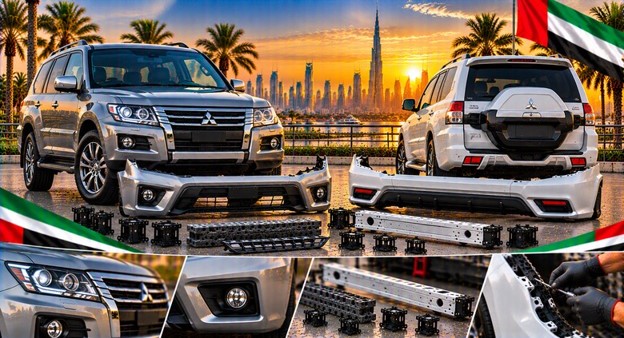
A replacement bumper may arrive in matte black, primed or ready for preparation, depending on the part. Do not assume that a primed cover is painted, or that a used bumper in the correct colour will match your Pajero perfectly.
The paint code is a useful starting point, but years of sunlight and previous repairs can alter the appearance of the existing finish. Metallic and pearlescent colours can be particularly difficult to match, while textured black trim may require a different finishing approach from a painted cover.
Ask whether the quote includes preparation, primer, paint and final fitting. If the replacement is supplied in a different colour or finish, agree on the work before installation. A bargain can lose its appeal if the bumper stands out from the rest of the vehicle.
What should a complete bumper quote include?
A low advertised price is useful only when you know what sits behind it. Ask for the bumper itself, any separate grille or lower section, brackets, clips, paint, labour and delivery to be itemised. If VAT applies, confirm whether it is included.
| Cost item | What to clarify |
| Bumper cover or section | Genuine, aftermarket, used or reconditioned? |
| Grille and trim | Included or purchased separately? |
| Brackets and clips | Reusable, damaged or included in the quote? |
| Paint | Primed, unpainted or fully painted? |
| Labour | Does fitting include transferring reusable parts? |
| Delivery | Included, or charged separately? |
| VAT | Included in the advertised amount? |
| Warranty | Does it cover the part, paint or installation? |
| Additional damage | How will the workshop seek approval for extra work? |
The most useful quote is the one that describes the whole repair clearly. If one supplier prices a bare cover and another includes paint and fitting, comparing the two totals without adjusting for the difference will lead you astray.
Labour and installation time
A straightforward bumper replacement may be completed within part of a working day once the correct part is available. That is only a rough planning guide, not a guaranteed turnaround. Painting, damaged brackets, missing trim or a part that has to be ordered can extend the job.
Ask the workshop to distinguish between fitting time and the time the vehicle will be off the road. Those are two different things. A cover may take relatively little time to install but require extra time for preparation and paint to cure.
For a family relying on the Pajero every day, or a business using it for regular trips between Abu Dhabi and Dubai, the delay matters. Confirm that the part is actually available before booking the vehicle in.
Hidden damage behind the bumper
A bumper cover can crack while the reinforcement and mounting area remain sound. It can also hide damage that is not visible from outside. The severity of the impact determines how far the inspection should go.
Look for uneven gaps, a bumper that sits lower on one side, or adjacent panels that no longer line up. These signs do not prove structural damage, but they are reasons to investigate. After a substantial collision, the workshop should inspect relevant brackets, reinforcement, absorbers and nearby bodywork as appropriate.
Do not accept “it clips back on” as the full diagnosis if the impact was hard enough to distort the cover or push it out of position. A new bumper cannot correct a bent mounting point by itself.
Sensor and lighting equipment
Depending on the Pajero’s year and specification, the bumper may have fog-lamp openings, parking-sensor mounts or other equipment that needs to be transferred to the replacement. Confirm the arrangement before ordering.
If sensors are fitted, the new bumper must provide the correct openings and mounting positions. Improvised holes or poorly positioned holders can affect operation. The workshop should check the relevant systems after installation and follow the appropriate repair procedure if diagnostic work or calibration is required.
Not every Pajero has the same equipment, so avoid paying for work that has not been established as necessary. Equally, do not ignore a warning light that appears after the repair. Ask for a diagnosis and an explanation before approving additional parts.
Off-road modifications and aftermarket bumper conversions
Some Pajero owners fit protective accessories or change the bumper arrangement for off-road use. That can alter the mounting points, clearance, weight and compatibility with lighting or other equipment.
Before buying a replacement, establish whether the vehicle still has its original bumper configuration. A standard cover may not fit a vehicle modified with a custom guard or altered brackets. Returning it to factory specification may require additional parts that are not included in the bumper price.
Check the suitability of the proposed accessory and the applicable UAE requirements before fitting a substantial conversion. A part being offered for sale does not mean it is suitable for every road-use configuration.
Buying for an imported or previously modified Pajero
An imported Pajero may have a different specification from a locally supplied vehicle, and a previous owner may have changed the bumper, grille or lower trim. The original factory specification is useful, but it may not describe what is currently fitted.
Send the supplier clear photographs of the front or rear, both corners and the underside where possible. Include the model year, trim, chassis details and any visible part number. Mention any aftermarket conversion.
If the seller cannot confirm fitment, ask for more evidence before paying. It is far easier to resolve a compatibility question while the bumper is still at the supplier than after the vehicle has been dismantled.
How to inspect an aftermarket bumper before painting
Check the replacement before authorising paintwork. Look for transport cracks, rough moulding, warped edges, missing tabs and holes that do not line up with the required fittings.
Where practical, have the workshop check the fit before finishing the surface. If the cover is the wrong shape or the mounting points are inaccurate, resolve the issue before spending money on paint and labour.
Read the warranty and return conditions as well. Some sellers cover manufacturing defects but exclude damage during fitting or any paintwork carried out before a fitment problem is reported. Get that distinction clear in advance.
Insurance and repair records
If the bumper damage followed a collision, check the insurer’s process before authorising repairs. Depending on the policy and circumstances, an accident report, inspection, approved repairer or prior authorisation may be required.
Keep the estimate, approval, final invoice and any relevant diagnostic records. If you are paying privately, compare the complete repair cost with the policy excess and other implications before deciding.
For a business or fleet vehicle, record the part fitted and the work completed. Clear paperwork helps with later maintenance, resale and any questions about the vehicle’s repair history.
Will an aftermarket bumper affect resale value?
Not automatically. A correctly fitted aftermarket bumper with a good finish may be perfectly reasonable on an older Pajero. What tends to worry a prospective buyer is poor alignment, mismatched paint, loose trim or evidence that collision damage has not been dealt with properly.
For a newer or particularly well-kept vehicle, a genuine part may be easier to explain to a buyer, especially when supported by an invoice and a clear part reference. But a genuine badge cannot compensate for poor workmanship.
Keep the repair records and make sure any relevant warning lights or equipment faults are resolved. The quality of the completed job matters more than the sales pitch attached to the part.
Workshop red flags
Be cautious if a seller guarantees fitment without asking for the model year or specification, or if the quote does not explain whether the price covers a full assembly or one section. The same applies when a workshop recommends replacement without explaining whether repair is viable, or refuses to itemise paint and labour.
Other warning signs include:
- No clear return policy for incorrect fitment.
- Unexplained changes to the quote.
- Reused brackets that are visibly cracked or distorted.
- Pressure to approve extra work without evidence.
- No check of relevant sensors or lighting equipment after fitting.
A good workshop should explain what it knows, what needs inspection and which costs remain uncertain. That is sensible practice, not fussiness.
A practical decision matrix for Pajero owners
The best choice depends on the damage, the vehicle’s age and how you use it. There is no point paying for a premium replacement when a sound repair will do, but nor is it wise to fit a poorly matched cover simply because it saves a little money upfront.
| Your situation | Option to investigate | What must be checked |
| Small scrape or localised crack | Repair and repaint | Plastic condition and mounting points |
| Older Pajero with a badly damaged cover | Used genuine or aftermarket | Exact fitment and condition |
| Newer or well-maintained Pajero | Genuine or well-documented aftermarket | Part number, finish and warranty |
| Only the rear lower section is damaged | Replace the affected section | Whether it is sold separately for your version |
| Off-road bumper or guard fitted | Compatible replacement or conversion parts | Current mounting arrangement and suitability |
| Used bumper in matching colour | Used original | Previous repairs, fading and mounting tabs |
Treat this as a shortlist, not a final diagnosis. The damage and exact specification should decide which route makes sense.
Pre-installation and post-installation checks
Before the bumper goes on, confirm the part number or fitment, inspect the cover for damage and check that the necessary brackets, clips and trim pieces are available. If paintwork is required, resolve fitment issues before the cover is refinished.
After installation, walk around the Pajero in daylight. Check the gaps, corners and alignment with adjacent panels. Make sure the bumper is secure and that any transferred fog lamps, reflectors or sensors operate correctly.
If the impact was substantial, ask what was inspected behind the cover. Keep the invoice and any relevant diagnostic report, particularly if the repair involved electronic equipment or collision damage.
A quick final check can save another workshop visit. Do it before collecting the keys.
The Pajero bumper buyer’s checklist
Use this list when comparing genuine Mitsubishi and aftermarket offers.
- Confirm the Pajero generation, model year, trim and market specification.
- Identify the exact front or rear section required.
- Check the part number or obtain written fitment confirmation.
- Establish whether the grille, lower section, finishers and clips are included.
- Inspect used and reconditioned parts for cracks, repairs and distorted tabs.
- Confirm whether the bumper is primed, painted or supplied in a different finish.
- Compare the complete fitted cost, including labour, delivery and VAT.
- Read the warranty and return conditions before paying.
- Ask for an appropriate inspection of hidden damage after a significant impact.
- Check any relevant lighting, sensors or other equipment after fitting.
- Retain the invoice and repair records.
Give each supplier the same vehicle details and ask for the same scope of work. That way, you can compare the offers without mistaking a cheaper bare cover for a cheaper complete repair.
When comparing genuine, OEM-equivalent and aftermarket bumper options, PartFinder UAE can serve as a relevant search phrase for buyers looking to narrow down replacement-part choices for their Mitsubishi Pajero
UAE Price Reference Update: 20 October 2026
The prices below were visible in UAE-facing parts catalogues during research for this article. They are advertised references, not a guarantee of current availability or a complete fitted cost.
| Advertised item | Listed price | Qualification |
| Aftermarket front bumper, Pajero 2008–2012 | AED 321 | Matte black; exact trim fitment requires confirmation |
| Front bumper grille, Pajero 2008–2012 | AED 85 | Separate part, not the complete bumper |
| Rear bumper upper section, Pajero 2008–2012 | AED 170 | Listed separately from the lower section |
| Rear bumper lower section, Pajero 2008–2012 | AED 150 | Separate section |
| Aftermarket front bumper, Pajero 2013–2014 | AED 190 | Confirm the exact vehicle application |
| Rear bumper upper section, Pajero 2013–2014 | AED 160 | Separate section |
| Rear bumper lower section, Pajero 2013–2014 | AED 170 | Separate section |
| Genuine Mitsubishi front bumper face kit, Pajero/Montero V88W/V98W, 2006–2011 | AED 2,573.12 including VAT | Catalogue listing; painting and exact fitment require confirmation |
The aftermarket references come from Pajero parts catalogues, while the genuine figure is listed for a specified V88W/V98W application.
These figures should not be treated as a direct quality comparison: the parts may differ in construction, coverage, finish and included fittings. Nor do they establish a reliable market-wide price for used or reconditioned bumpers.
For a current quote, confirm availability, exact part number, condition, VAT, delivery, paint, labour and warranty. Ask the supplier to identify what is included in writing. The price worth comparing is the cost of getting the correct part fitted properly, not simply the number shown beside a catalogue photograph.
Frequently Asked Questions About Mitsubishi Pajero Bumpers in UAE
Categories
- Audi
- BMW
- Car Accessories
- Car Tips
- Ford
- Land Rover
- Mazda
- Range Rover
- Top 10
- UAE Car Parts
- Used Car Parts
- Toyota
- Replacement Engines
- Nissan
- Hyundai
- Mitsubishi
- Volkswagen
- Honda
- Kia
- Chevrolet
- Dodge
- Jeep
- Subaru
- Renault
- Lexus
- Mercedes
- Suzuki
- Hummer
- Porsche
- Infiniti
- Peugeot
- GMC
- Mini
- Volvo
- Replacement Gearboxes
- MG
- Jaguar
- Skoda
- Cadillac
- Daihatsu
- Fiat
- German Car Parts
- Japanese Car Parts
- Aftermarket Car Parts
- Genuine Car Parts
- New Car Parts
- Reconditioned Car Parts
- European Car Parts
- American Car Parts
- Korean Car Parts
- British Car Parts
- Chinese Car Parts
- Sports/Exotic Car Parts
- Luxury Car Parts
- Performance Car Parts
- SUV/4x4 Spare Parts
- Truck Spare Parts
- EV Car Parts
- Hybrid Car Parts
- Auto Spare Parts in UAE
- Tesla
- Isuzu
- Ram
- Ferrari
- Bentley
- Lamborghini
- Genesis
- Maserati
- Lincoln
- Chrysler
- Opel
- Citroen
- SsangYong
- Seat
- McLaren
- Aston Martin
- Rolls Royce
- Maybach
- Alfa Romeo
- Bugatti
- Scion
- Abu Dhabi Car Parts
- Ajman Car Parts
- Al Khan Car Parts
- Al Sajaa Car Parts
- Deira Car Parts
- Dubai Car Parts
- Fujairah Car Parts
- Industrial Area 6 Car Parts
- Mussafah Car Parts
- Ras Al Khaimah Car Parts
- Sharjah Car Parts
- Umm Al Quwain Car Parts
- Acura
- BYD
- Chery
- Dacia
- DS
- Geely Emgrand
- EXEED
- GAC
- GAC Gonow
- Geely
- Gonow
- Great Wall
- Haima
- Haval
- Holden
- Iveco
- JAC
- Jaecoo
- Jetour
- Lotus
- Omoda
- Proton
- Renault Samsung
- Roewe
- Lucid
- Replacement Headlight
- Replacement Bumper