New Car Parts in UAE: When Should You Choose New Parts Over Used?
July 17, 2026
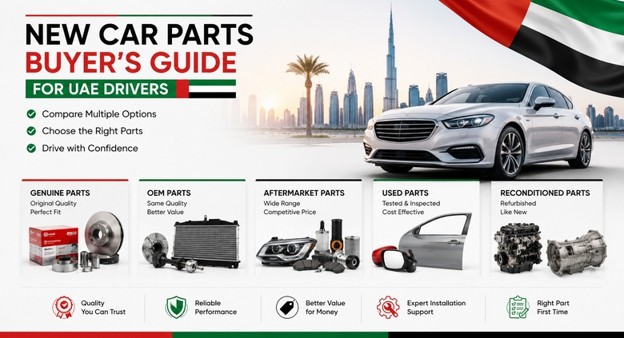
Understanding New Car Parts in the UAE
Key Takeaways
| What You'll Learn | Why It Matters |
| When new car parts are worth the extra cost | Make smarter buying decisions |
| How new parts compare with used, OEM, genuine and reconditioned options | Choose the best value for your repair |
| Which parts should never be compromised | Improve safety and reliability |
| Why VIN verification and part numbers matter | Avoid expensive compatibility mistakes |
| How UAE driving conditions affect replacement parts | Increase component lifespan |
| How to compare suppliers confidently | Get the best balance of price, warranty and quality |
Workshop Tip: Buying the most expensive replacement part doesn't always give the best value. Buying the correct replacement part for your vehicle and ownership plans almost always does.
Why More UAE Drivers Still Choose New Car Parts
Your mechanic has confirmed the fault.
The replacement options are ready.
One quotation recommends a brand-new part.
Another suggests an OEM alternative.
A third recommends a professionally inspected used component.
Which option should you choose?
There isn't one answer that suits every repair.
The correct decision depends on:
Safety.
Reliability.
Budget.
Vehicle age.
Expected ownership period.
Warranty requirements.
Component type.
Across the UAE, thousands of drivers choose brand-new replacement parts every day because they want maximum reliability, complete manufacturer specifications and full warranty support.
At the same time, many experienced vehicle owners know that not every repair requires a brand-new component.
The smartest buyers compare every available option before making a decision.
This guide will help you understand when investing in new car parts genuinely provides better value and when another option may be equally suitable.
Whether you drive:
Nissan.
Hyundai.
Kia.
BMW.
Mercedes-Benz.
Audi.
Volkswagen.
Lexus.
Porsche.
Ford.
Chevrolet.
Mitsubishi.
Land Rover.
Or any other vehicle sold in the UAE, choosing the right replacement part begins with understanding all available options—not simply choosing the highest or lowest price.
Real Buyer Scenario
A Dubai commuter needed a replacement radiator after discovering a coolant leak.
The workshop offered three options.
A genuine new radiator.
An OEM replacement.
A professionally inspected used original radiator.
Because the vehicle was only two years old and still covered by an extended maintenance plan, the owner selected the new genuine radiator to maintain warranty compliance and long-term reliability.
Why Many UAE Drivers Choose New Parts
| Reason | Benefit |
| Maximum reliability | Reduced risk of early failure |
| Full manufacturer specifications | Exact compatibility |
| Warranty coverage | Better financial protection |
| Long expected service life | Lower long-term ownership cost |
| Latest engineering updates | Improved durability |
| Better availability for newer vehicles | Faster repairs |
| Professional support | Greater buying confidence |
| Peace of mind | Reliable everyday driving |
What New Car Parts Are and How They Differ from Other Options
The term "new car part" sounds simple.
In reality, it covers several different categories.
Many buyers mistakenly assume every new replacement component is identical.
It isn't.
A new replacement part may be:
A genuine manufacturer part.
An OEM component.
A premium aftermarket replacement.
Each has different advantages depending on your repair.
Understanding these differences helps you avoid unnecessary spending while maintaining your vehicle properly.
Genuine Parts
Supplied through the vehicle manufacturer.
Built to original factory specifications.
Ideal for safety-critical and warranty-sensitive repairs.
OEM Parts
Manufactured by the original equipment supplier.
Often identical in quality to genuine parts but sold without the vehicle manufacturer's branding.
Usually offer excellent value.
Premium Aftermarket Parts
Produced by independent manufacturers.
Available in various quality levels.
Premium brands can provide excellent performance for many routine repairs.
Used Parts
Original factory components removed from donor vehicles after professional inspection.
Often ideal for selected repairs where safety and compatibility are not compromised.
Reconditioned Parts
Original components professionally rebuilt using new internal parts where required.
Commonly used for engines, gearboxes, steering racks and turbochargers.
Workshop Insight
Professional technicians rarely recommend one replacement option for every repair.
Instead, they evaluate the vehicle, the failed component and the customer's long-term ownership plans before making a recommendation.
Replacement Part Comparison
| Part Type | Best For | Main Advantage |
| Genuine | Warranty and safety-critical repairs | Original factory specification |
| OEM | Everyday premium repairs | Excellent quality and value |
| Premium aftermarket | Routine maintenance | Competitive pricing |
| Used | Older vehicles and selected repairs | Lower repair costs |
| Reconditioned | Major mechanical assemblies | Renewed performance with lower replacement cost |
Did You Know?
Many OEM manufacturers also produce the genuine parts supplied to vehicle manufacturers. The difference is often the branding, packaging and distribution channel rather than the manufacturing process.
Genuine vs OEM vs New vs Used vs Reconditioned vs Aftermarket Parts Explained
One repair.
Six replacement options.
Which should you choose?
The answer depends entirely on the component being replaced.
Some parts should almost always be purchased new.
Others can safely be sourced as professionally inspected used or reconditioned components.
Instead of asking:
"Which part is best?"
Ask:
"Which option offers the best balance between safety, reliability, warranty and value?"
That question leads to much better purchasing decisions.
Multi-Option Choice Matrix
| Replacement Option | Reliability | Warranty | Cost | Best Use |
| Genuine | Excellent | Excellent | Highest | Safety-critical systems |
| OEM | Excellent | Very Good | Moderate | Most routine repairs |
| Premium Aftermarket | Good to Excellent | Varies | Moderate | Maintenance components |
| Used | Depends on inspection | Limited | Low | Cosmetic and selected mechanical repairs |
| Reconditioned | Very Good | Good | Moderate | Engines and gearboxes |
| New (non-genuine) | Good | Varies | Moderate | Depending on manufacturer |
Expert Recommendation
There is no universal "best" replacement part.
The best choice depends on:
Vehicle age.
Mileage.
Repair cost.
Ownership plans.
Safety importance.
Supplier reputation.
Professional diagnosis should always come before selecting the replacement option.
When Paying More for New Car Parts Actually Saves Money
Many buyers focus on the purchase price.
Experienced vehicle owners focus on the total ownership cost.
Sometimes paying more today reduces expenses over the next five years.
This is especially true for:
Brake components.
Suspension components.
Timing components.
Electronic safety systems.
Cooling system components on newer vehicles.
These parts directly influence:
Vehicle safety.
Reliability.
Fuel efficiency.
Resale value.
Future repair costs.
For older vehicles, however, investing in expensive new components may not always be the most sensible financial decision.
A professionally inspected used or OEM alternative may provide similar results at a considerably lower cost.
Real Buyer Scenario
An Abu Dhabi family owned an eight-year-old SUV requiring a replacement front door after a minor collision.
A brand-new genuine door would have significantly increased the repair cost.
After comparing several options, they selected a professionally inspected original used door with matching colour and specifications.
The repair restored the vehicle's appearance while saving thousands of dirhams.
Workshop Tip
Think beyond today's invoice.
A slightly higher-quality replacement part often reduces repeat labour charges, unexpected breakdowns and future maintenance costs.
When New Parts Make the Most Sense
| Repair Situation | Recommended Choice |
| Airbags and safety systems | Genuine new parts |
| Brake master cylinder | Genuine or OEM |
| Steering components | Genuine or premium OEM |
| Timing components | Genuine or OEM |
| Engine sensors on newer vehicles | Genuine or OEM |
| Cosmetic body panels for older vehicles | Compare new and used |
| Engine replacement | Compare new, reconditioned and used |
| Gearbox replacement | Compare new, reconditioned and used |
Choosing new car parts in UAE is rarely about buying the most expensive option—it is about selecting the replacement that offers the right balance of safety, reliability, warranty and long-term value. Whether you're comparing new, genuine, OEM, used, reconditioned or premium aftermarket parts, understanding the strengths of each option helps you make informed decisions. For vehicle owners across Dubai, Abu Dhabi, Sharjah, Ajman, Ras Al Khaimah, Fujairah and Umm Al Quwain, the smartest repairs begin with a professional diagnosis, VIN verification, original part number confirmation and careful comparison of every available replacement choice.
Choosing Between New and Used Parts
Which Car Parts Should Always Be Bought New?
Your mechanic has given you two options.
A brand-new replacement.
A used original component.
Both will fit your vehicle.
Both cost very different amounts.
So, which one should you choose?
The answer begins with one important question.
Is the component safety-critical?
If the part directly affects braking, steering, occupant protection or engine timing, buying new is usually the safest investment.
Some components simply have no room for uncertainty.
Professional workshops across the UAE generally recommend buying new for:
Brake master cylinders.
Brake hoses.
Brake pads.
Brake discs.
Airbags.
Seat belt pretensioners.
Timing belts.
Timing chains where replacement is required.
Water pumps fitted during timing service.
Spark plugs.
Engine oil filters.
Cabin filters.
Air filters.
Rubber seals.
Gaskets.
These parts experience continuous wear or directly influence vehicle safety.
Choosing new reduces the likelihood of unexpected failures and helps maintain manufacturer performance standards.
Safety Alert
Never compromise on parts responsible for stopping, steering or protecting occupants during a collision. The additional investment is often small compared with the potential consequences of failure.
Workshop Tip
If a major repair involves removing the timing belt or timing chain, replace related service components such as tensioners, idlers, seals and water pumps simultaneously.
Components That Should Usually Be Purchased New
| Replacement Part | Why New Is Recommended |
| Brake pads | Maximum braking performance |
| Brake discs | Consistent stopping power |
| Brake master cylinder | Critical safety component |
| Brake hoses | Prevent fluid failure |
| Airbags | Occupant protection |
| Seat belt pretensioners | Collision safety |
| Timing belt | Prevent engine damage |
| Timing kit | Long-term reliability |
| Filters | Protect major systems |
| Rubber seals and gaskets | Prevent future leaks |
Real Buyer Scenario
A Sharjah driver required front brake repairs.
A used braking system would have reduced the repair cost.
Instead, the workshop recommended new brake discs, pads and hoses because these directly affected stopping performance.
The customer spent slightly more initially but gained greater safety, longer service life and improved peace of mind.
Which Parts Are Safe to Buy Used?
Not every repair requires a brand-new component.
Some original factory parts continue performing exceptionally well long after being removed from donor vehicles.
The key is choosing components that have been professionally inspected and properly matched to your vehicle.
Examples commonly suitable for professionally inspected used replacements include:
Doors.
Bonnets.
Tailgates.
Front wings.
Wing mirrors.
Headlights.
Tail lights.
Alternators.
Starter motors.
Air conditioning compressors.
Steering columns.
Interior trim.
Dashboard components.
Original factory body panels often provide better fit and finish than lower-quality aftermarket alternatives.
For older vehicles, professionally inspected used engines and gearboxes may also represent excellent value when compared with brand-new replacements.
Workshop Insight
Experienced dismantlers reject thousands of unsuitable components every year. A reputable supplier only sells parts that meet acceptable inspection standards.
Components Commonly Purchased Used
| Component | Why Used Can Be a Good Choice |
| Doors | Original factory fit |
| Bonnets | Better panel alignment |
| Bumpers | Cost-effective repair |
| Tailgates | Original quality |
| Mirrors | Lower replacement cost |
| Headlights | Factory compatibility |
| Alternators | Good value when tested |
| Starter motors | Reliable after inspection |
| Interior trim | Excellent cosmetic solution |
| Air conditioning compressor | Lower repair cost |
Expert Recommendation
For cosmetic damage and selected mechanical repairs, professionally inspected original used parts often deliver the strongest balance between cost, quality and reliability.
How VIN Verification Helps You Buy the Correct New Part
Finding a new replacement part is easy.
Finding the correct new replacement part is what matters.
Even brand-new components can be incompatible if they are ordered without proper verification.
The safest way to identify the correct replacement is by using your Vehicle Identification Number (VIN).
The VIN confirms:
Vehicle specification.
Engine type.
Transmission.
Trim level.
Production date.
Factory-installed equipment.
Regional configuration.
Professional suppliers use this information before preparing quotations.
This process prevents:
Incorrect orders.
Installation delays.
Repeat labour costs.
Electronic compatibility problems.
Whether you choose genuine, OEM or aftermarket components, VIN verification should always be the first step.
Did You Know?
Two vehicles produced in the same month can still require different replacement parts because manufacturers introduce engineering updates throughout production.
Benefits of VIN Verification
| Verification Step | Benefit |
| Vehicle specification | Exact compatibility |
| Engine confirmation | Correct mechanical fit |
| Transmission verification | Reliable installation |
| Factory options | Accurate replacement |
| Production date | Correct engineering revision |
| Electronic configuration | Fewer compatibility issues |
| Supplier accuracy | Better quotations |
| Reduced ordering errors | Faster repairs |
Real Buyer Scenario
An Abu Dhabi customer ordered a brand-new LED headlight online using only the vehicle model.
After providing the VIN, the supplier discovered the vehicle required a different adaptive lighting module.
The correction prevented an expensive return and several days of workshop delay.
Understanding Original Part Numbers Before Ordering
Every factory component has its own identification number.
This number is far more valuable than many buyers realise.
Original part numbers identify:
Engineering revision.
Material specification.
Electronic version.
Connector type.
Software compatibility.
Manufacturer updates.
Professional suppliers compare the original part number alongside the VIN to confirm exact compatibility.
This is particularly important for:
Electronic control units.
Sensors.
Lighting systems.
Turbochargers.
Air conditioning modules.
Gearboxes.
Suspension electronics.
Ordering purely by appearance often leads to expensive mistakes.
Workshop Tip
If possible, photograph the original manufacturer label before removing the faulty component. This makes future identification much easier.
Why Part Numbers Matter
| Part Number Function | Benefit |
| Exact identification | Correct replacement |
| Engineering revision | Better compatibility |
| Software version | Reliable electronic operation |
| Supplier search | Faster quotations |
| Warranty support | Easier documentation |
| Future servicing | Simplified maintenance |
| Reduced returns | Lower repair costs |
| Better confidence | Smarter purchasing |
How to Check Compatibility Before Purchasing New Car Parts
Many buyers assume that every new replacement part automatically fits their vehicle.
Unfortunately, this is not always true.
Professional workshops verify compatibility using several factors.
These include:
VIN.
Original part number.
Engine code.
Gearbox code.
Fuel type.
Production date.
Body style.
Trim specification.
Optional equipment.
Regional market.
Skipping even one of these checks can result in ordering the wrong component.
Compatibility becomes especially important for:
Electronic modules.
LED headlights.
Air suspension.
Sensors.
Cooling system components.
Transmission parts.
Hybrid vehicle systems.
Multi-Option Choice Matrix
| Replacement Option | Compatibility Verification Required |
| Genuine | VIN and part number |
| OEM | VIN and OEM reference |
| Premium aftermarket | VIN and manufacturer compatibility |
| Used | VIN and donor vehicle specification |
| Reconditioned | VIN and original component code |
Workshop Insight
Professional suppliers spend more time verifying compatibility than preparing quotations because accurate identification prevents expensive mistakes later.
Common Buying Mistakes When Choosing Between New and Used Parts
Most purchasing mistakes are avoidable.
They usually happen because buyers focus on price instead of value.
Common mistakes include:
Ignoring VIN verification.
Not checking the original part number.
Buying from unknown suppliers.
Choosing the cheapest quotation.
Ignoring warranty terms.
Skipping compatibility checks.
Overlooking labour costs.
Ignoring supporting components.
Failing to compare multiple options.
Selecting the wrong replacement type for the repair.
A brand-new component is not automatically the best solution.
Likewise, a used component is not automatically the cheapest once installation, warranty and lifespan are considered.
Professional buyers evaluate the complete ownership cost before making a decision.
Common Mistakes to Avoid
| Mistake | Possible Consequence |
| Buying without VIN verification | Incorrect part supplied |
| Ignoring part numbers | Compatibility problems |
| Choosing only on price | Poor long-term value |
| Ignoring warranty | Increased financial risk |
| Buying from unknown suppliers | Lower quality assurance |
| Skipping installation planning | Higher labour costs |
| Ignoring supporting parts | Repeat workshop visits |
| Not comparing options | Overspending |
Expert Recommendation
Whenever you receive a quotation, ask the supplier to explain why they recommend a genuine, OEM, new, used or reconditioned option. An experienced supplier should be able to justify the recommendation based on your vehicle, your budget and your long-term ownership plans—not simply on what they have available in stock.
Choosing between new car parts in UAE should never be based on price alone. By evaluating safety, reliability, warranty, compatibility, expected lifespan and total ownership cost, you can select the replacement option that genuinely suits your vehicle. Whether you're buying from suppliers in Dubai, Abu Dhabi, Sharjah, Ajman, Ras Al Khaimah, Fujairah or Umm Al Quwain, combining VIN verification, original part number confirmation, professional advice and careful comparison of genuine, OEM, new, used and reconditioned parts helps ensure every repair delivers the best possible long-term value.
Safety, Reliability and Performance
Why Safety-Critical Components Should Usually Be New
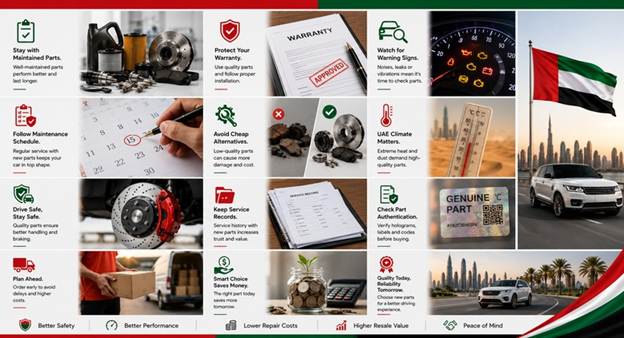
Your vehicle can still drive with worn tyres.
It may still move with noisy brakes.
It might even continue running with worn suspension.
That doesn't mean it is safe.
Some vehicle components perform one critical task.
They protect lives.
These parts should rarely become a compromise between saving money and maintaining safety.
Professional workshops across the UAE generally recommend buying new genuine or OEM components for systems directly responsible for:
Braking.
Steering.
Airbag deployment.
Seat belt restraint.
Suspension stability.
Driver assistance systems.
Although professionally inspected used parts have their place, safety-critical systems deserve the highest level of confidence possible.
Safety Alert
If the component could directly affect your ability to stop, steer or protect passengers during an accident, choosing a new replacement is usually the safest long-term investment.
Workshop Tip
Always replace safety-related components in pairs where appropriate, such as brake pads, brake discs and suspension parts. This maintains balanced vehicle performance.
Safety-Critical Parts Comparison
| Component | Recommended Choice | Reason |
| Brake pads | New Genuine or OEM | Maximum stopping performance |
| Brake discs | New Genuine or OEM | Consistent braking |
| Brake hoses | New Genuine | Prevent fluid failure |
| Airbags | New Genuine | Occupant protection |
| Seat belt pretensioners | New Genuine | Collision safety |
| Steering rack components | New OEM or Genuine | Steering precision |
| Suspension control arms | New OEM | Vehicle stability |
| ABS sensors | New Genuine or OEM | Accurate braking control |
Real Buyer Scenario
A family in Dubai required front suspension repairs before a long holiday trip.
Although professionally inspected used suspension components were available, the workshop recommended new OEM control arms and bushes because they directly affected steering precision and passenger safety.
The slightly higher investment delivered smoother handling and greater confidence on long motorway journeys.
New Brake Components vs Used Brake Components
Brakes are the most important safety system on your vehicle.
Every journey depends on them.
When replacing braking components, many owners ask whether used parts can reduce repair costs.
The answer depends entirely on the component.
Some braking parts naturally wear throughout their service life.
Others can remain serviceable after careful inspection.
Generally Recommended as New
Brake pads.
Brake discs.
Brake hoses.
Brake fluid.
Wear sensors.
Master cylinders.
Components That May Be Suitable After Professional Inspection
Brake calipers.
Brake backing plates.
Brake brackets.
Parking brake assemblies.
Professional workshops inspect every reusable braking component before recommending installation.
Workshop Insight
Replacing worn brake pads without inspecting the brake discs often reduces the lifespan of both components.
Brake Component Decision Matrix
| Brake Component | Best Choice | Reason |
| Brake pads | New | Wear component |
| Brake discs | New | Maximum braking efficiency |
| Brake hoses | New | Safety-critical |
| Brake fluid | New | Moisture protection |
| Brake caliper | Professionally inspected used or reconditioned | Durable housing |
| Brake bracket | Professionally inspected used | Minimal wear |
| Parking brake assembly | Depends on inspection | Condition varies |
| ABS module | Genuine or OEM | Electronic safety |
Expert Recommendation
When replacing major braking components, consider the entire braking system rather than a single part. Balanced braking improves both safety and component lifespan.
New Suspension and Steering Parts vs Used Alternatives
Every bump.
Every corner.
Every emergency manoeuvre.
Your suspension and steering systems work continuously.
These systems influence:
Vehicle stability.
Tyre wear.
Ride comfort.
Steering accuracy.
Driver confidence.
Some suspension components experience continuous wear.
Others remain structurally sound for many years.
Professional workshops commonly recommend new replacement parts for:
Bushes.
Ball joints.
Shock absorbers.
Steering tie rods.
Steering boots.
Professionally inspected used components may be appropriate for:
Subframes.
Crossmembers.
Steering columns.
Control arms in excellent condition.
Complete axle assemblies.
Did You Know?
The UAE's combination of speed humps, kerbs, potholes and high summer temperatures accelerates suspension wear faster than many owners realise.
Suspension Comparison
| Component | Recommended Choice | Reason |
| Shock absorbers | New | Wear component |
| Ball joints | New | Steering safety |
| Bushes | New | Ride quality |
| Tie rods | New | Steering precision |
| Subframe | Used after inspection | Structural component |
| Steering column | Used after inspection | Durable assembly |
| Crossmember | Used after inspection | Limited wear |
| Control arm | Depends on condition | Professional inspection required |
Workshop Tip
Always perform a wheel alignment after replacing suspension or steering components. Proper alignment protects tyres and improves handling.
New Airbags, Sensors and Electronic Safety Systems
Modern vehicles rely on advanced electronic safety technology.
Many of these systems communicate constantly.
One faulty sensor can affect several others.
For this reason, professional workshops generally recommend new or genuine replacement components for:
Airbags.
Crash sensors.
Occupant detection sensors.
Seat belt pretensioners.
ADAS cameras.
Radar sensors.
Lane assistance modules.
Emergency braking systems.
Electronic stability control sensors.
Although some electronic modules may be sourced as professionally inspected used components, safety systems deserve maximum reliability.
Workshop Insight
Modern safety systems often require electronic programming after installation. Compatibility is just as important as physical fitment.
Electronic Safety Component Guide
| Component | Recommended Choice |
| Airbags | New Genuine |
| Crash sensors | Genuine or OEM |
| Occupancy sensors | Genuine |
| Seat belt pretensioners | Genuine |
| Radar sensors | Genuine |
| ADAS camera | Genuine |
| Parking sensors | OEM or Genuine |
| Stability control sensor | Genuine |
Safety Alert
Never install safety-related electronic components without confirming VIN compatibility and calibration requirements.
Engine Components: When New Parts Are Worth the Investment
An engine contains hundreds of moving parts.
Some wear naturally.
Others can last the life of the vehicle.
Understanding the difference helps avoid unnecessary spending.
New replacement components are often recommended for:
Timing belts.
Timing chains.
Water pumps.
Oil pumps.
Spark plugs.
Glow plugs.
Sensors.
Seals.
Gaskets.
Engine mounts.
Meanwhile, professionally inspected used parts may remain suitable for:
Cylinder heads after inspection.
Engine covers.
Intake manifolds.
Alternators.
Starter motors.
Accessory brackets.
Real Buyer Scenario
An Abu Dhabi driver required a timing belt replacement.
Instead of replacing only the belt, the workshop recommended a complete timing kit including the water pump and tensioners.
Although the initial invoice increased slightly, the owner avoided paying the same labour costs again later.
Engine Component Decision Matrix
| Component | Recommended Choice |
| Timing belt | New |
| Water pump | New |
| Spark plugs | New |
| Engine sensors | Genuine or OEM |
| Oil seals | New |
| Alternator | Professionally inspected used or OEM |
| Starter motor | Professionally inspected used |
| Intake manifold | Used after inspection |
Expert Recommendation
Whenever the engine is dismantled for major repairs, replace all inexpensive wear components at the same time. Labour usually costs far more than the replacement parts themselves.
Gearbox Components: Repair, New or Reconditioned?
Few repairs generate larger quotations than gearbox replacement.
Fortunately, buying a brand-new gearbox is not always the only solution.
Several replacement options exist.
Each suits different ownership goals.
Option One – Brand-New Gearbox
Best for:
Nearly new vehicles.
Warranty-sensitive repairs.
Maximum lifespan.
Option Two – Reconditioned Gearbox
Best for:
Long-term ownership.
Balanced cost and reliability.
Professional rebuilding.
Option Three – Professionally Inspected Used Gearbox
Best for:
Older vehicles.
Budget-conscious repairs.
Original factory quality.
Workshop Tip
Always replace gearbox fluid, filters and seals during installation regardless of which gearbox option you choose.
Gearbox Comparison
| Option | Cost | Reliability | Best For |
| New | Highest | Excellent | New vehicles |
| Reconditioned | Moderate | Very Good | Long-term ownership |
| Used | Lowest | Depends on inspection | Older vehicles |
Air Conditioning Components for UAE Summer Conditions
Summer temperatures across the UAE place enormous demands on every air conditioning system.
When cooling performance declines, buyers often compare:
New compressor.
OEM compressor.
Professionally inspected used compressor.
Reconditioned compressor.
The correct choice depends upon:
Vehicle age.
Repair budget.
Component condition.
Expected ownership.
Cooling system condition.
Many supporting components should also be inspected, including:
Condenser.
Expansion valve.
Receiver dryer.
Cooling fans.
Pressure sensors.
Workshop Insight
Replacing only the compressor without inspecting the rest of the air conditioning system often results in repeat repairs.
Air Conditioning Options
| Component | Recommended Choice |
| Compressor | Compare New, OEM and Used |
| Condenser | New or OEM |
| Cooling fan | OEM or Used after inspection |
| Pressure sensor | Genuine or OEM |
| Expansion valve | New |
| Receiver dryer | New |
Electrical Parts: Should You Choose New or Used?
Modern vehicles depend on electronics more than ever before.
Fortunately, not every electrical component must be purchased new.
Many original electrical parts continue operating reliably after professional inspection.
Examples include:
Alternators.
Starter motors.
Window motors.
Mirror motors.
Switches.
Body control modules.
However, electronic compatibility remains essential.
Always verify:
VIN.
Original part number.
Software version.
Programming requirements.
Multi-Option Choice Matrix
| Electrical Component | Best Option | Reason |
| Alternator | Used, OEM or New | Depends on condition |
| Starter motor | Used or OEM | Excellent value |
| ECU | Genuine or OEM | Programming critical |
| Body control module | Genuine or OEM | Vehicle integration |
| Window motor | Used after inspection | Low wear |
| Mirror motor | Used after inspection | Reliable component |
| Battery sensor | Genuine | Electronic accuracy |
| Fuse box | Used after inspection | Durable assembly |
Final Workshop Advice
Every repair deserves its own solution.
The best replacement is not automatically new, used, OEM, genuine or reconditioned.
The best replacement is the one that matches your vehicle, your ownership plans, your budget and the importance of the component being replaced.
For drivers across Dubai, Abu Dhabi, Sharjah, Ajman, Ras Al Khaimah, Fujairah and Umm Al Quwain, comparing new, genuine, OEM, used and reconditioned car parts provides the clearest route to a safe, reliable and cost-effective repair. By evaluating safety, reliability, warranty, expected lifespan, VIN compatibility and total ownership cost, you can confidently choose the replacement option that delivers the greatest long-term value rather than simply the lowest purchase price.
Cost, Warranty and Long-Term Value
Understanding the True Cost of New Car Parts
Your workshop has diagnosed the problem.
Now the quotations begin arriving.
One supplier offers a genuine replacement.
Another recommends an OEM component.
A third suggests a premium aftermarket alternative.
The prices vary dramatically.
Which quotation offers the best value?
Many buyers compare only the purchase price.
Experienced vehicle owners compare the total ownership cost.
The true cost of a replacement part includes far more than the invoice itself.
You should also consider:
Expected lifespan.
Warranty.
Labour costs.
Compatibility.
Maintenance requirements.
Fuel efficiency where applicable.
Future resale value.
Downtime.
Reliability.
A genuine part may cost more initially but require fewer replacements over the life of the vehicle.
An OEM part may deliver almost identical performance while reducing the initial investment.
A lower-priced alternative may seem attractive until repeat labour costs outweigh the original saving.
Workshop Tip
Always compare the total cost over several years rather than today's purchase price. A higher-quality replacement often becomes the cheaper option in the long run.
Total Cost Comparison
| Factor | Genuine | OEM | Premium Aftermarket | Used | Reconditioned |
| Initial price | Highest | Moderate | Moderate | Lowest | Moderate |
| Expected lifespan | Excellent | Excellent | Good to Very Good | Depends on condition | Very Good |
| Warranty | Excellent | Very Good | Varies | Limited | Good |
| Future repair risk | Lowest | Low | Moderate | Moderate | Low |
| Long-term value | Excellent | Excellent | Good | Depends on inspection | Very Good |
Real Buyer Scenario
A BMW owner in Dubai required a replacement water pump.
A genuine pump cost more than an aftermarket alternative.
However, because replacing the pump required several hours of labour, the owner selected the genuine part to minimise the likelihood of repeating the same labour-intensive repair in the future.
Why the Cheapest Part Isn't Always the Best Choice
Finding a lower quotation feels satisfying.
Finding the correct quotation is far more important.
The cheapest replacement part often excludes important factors such as:
Warranty.
Inspection.
Technical support.
Manufacturer reputation.
Updated engineering.
Professional advice.
Compatibility verification.
Installation support.
A lower purchase price may also result in:
Earlier replacement.
Additional labour.
Unexpected breakdowns.
Reduced fuel efficiency.
Vehicle downtime.
Instead of asking,
"Which option is cheapest?"
Ask,
"Which option provides the greatest value over the next five years?"
That simple change in thinking often produces a much better buying decision.
Workshop Insight
Professional workshops rarely recommend replacement parts based solely on price.
They recommend components that reduce repeat repairs and maximise customer satisfaction.
Price vs Value Matrix
| Buying Priority | Best Choice |
| Maximum reliability | Genuine |
| Best overall value | OEM |
| Budget-conscious repair | Premium Aftermarket |
| Older vehicle | Used after inspection |
| Major mechanical repair | Reconditioned |
| Long-term ownership | Genuine or OEM |
| Short-term ownership | Depends on repair |
| Difficult-to-find component | Compare all available options |
Expert Recommendation
When labour costs are high, spending slightly more on a better-quality replacement often provides significantly better long-term value.
New Parts vs Used Parts: Long-Term Ownership Cost Comparison
The purchase price tells only part of the story.
Ownership continues long after the repair has been completed.
Comparing long-term costs provides a much clearer picture.
For example:
A genuine suspension component may cost considerably more initially.
However, it may last twice as long while improving handling and reducing tyre wear.
A professionally inspected used body panel may provide identical appearance at a much lower cost.
Each repair should be evaluated individually.
Multi-Option Choice Matrix
| Replacement Option | Initial Cost | Expected Lifespan | Best Ownership Scenario |
| Genuine | Highest | Longest | New and premium vehicles |
| OEM | Moderate | Excellent | Most daily drivers |
| Premium Aftermarket | Moderate | Good | Routine maintenance |
| Used | Lowest | Varies | Older vehicles |
| Reconditioned | Moderate | Very Good | Engines and gearboxes |
Real Buyer Scenario
A delivery company in Abu Dhabi operated several commercial vans.
For body repairs, professionally inspected used panels reduced repair costs considerably.
For braking systems and steering components, the fleet manager consistently chose new OEM parts because vehicle safety and daily reliability remained top priorities.
Workshop Tip
Not every repair requires the same replacement strategy. Match the component to the vehicle's age, usage and ownership plans.
Warranty Differences Between New, OEM and Used Parts
Warranty is often overlooked until something goes wrong.
Understanding warranty coverage before purchasing helps avoid future disputes.
Generally:
Genuine Parts
Usually provide the most comprehensive manufacturer-backed warranty.
OEM Parts
Often include excellent warranty protection through the original equipment manufacturer.
Premium Aftermarket Parts
Warranty varies depending on the manufacturer.
Professionally Inspected Used Parts
Many reputable suppliers provide limited warranty coverage after inspection.
Reconditioned Parts
Frequently include warranties because internal components have been professionally rebuilt.
Before purchasing, always confirm:
Warranty duration.
Coverage.
Exclusions.
Installation requirements.
Claim procedure.
Written documentation.
Workshop Insight
A written warranty provides much greater protection than verbal promises. Always request documentation before making payment.
Warranty Comparison
| Replacement Option | Typical Warranty Level |
| Genuine | Excellent |
| OEM | Very Good |
| Premium Aftermarket | Good to Very Good |
| Used | Limited but varies |
| Reconditioned | Good |
Did You Know?
Some warranties require installation by a qualified workshop. Reading the conditions before fitting the component can prevent future claim issues.
Expected Lifespan of New Car Parts
Every replacement part eventually wears.
The question is how long it should last.
Several factors influence lifespan.
These include:
Manufacturing quality.
Installation quality.
Driving conditions.
Maintenance.
Vehicle load.
Road conditions.
Climate.
Driving style.
The UAE's environment creates additional challenges.
Extreme heat.
Sand.
Dust.
Heavy traffic.
Long-distance motorway driving.
Choosing high-quality replacement parts and maintaining them correctly significantly improves service life.
Lifespan Comparison
| Replacement Option | Typical Longevity |
| Genuine | Excellent |
| OEM | Excellent |
| Premium Aftermarket | Good to Very Good |
| Used | Depends on previous wear |
| Reconditioned | Very Good |
Workshop Tip
Even the highest-quality replacement part cannot achieve its expected lifespan without proper servicing and routine inspections.
Hidden Costs Buyers Often Forget to Consider
Many repair budgets focus only on the replacement component.
The final invoice often includes several additional costs.
Examples include:
Professional diagnostics.
Labour.
Programming.
Coding.
Shipping.
Engine oil.
Gearbox fluid.
Coolant.
Filters.
Oil seals.
Gaskets.
Supporting brackets.
Wheel alignment.
Road testing.
Ignoring these items often leads to inaccurate budgeting.
Professional suppliers and workshops explain these costs before work begins.
Real Buyer Scenario
A Sharjah customer purchased a new steering rack online because it appeared less expensive.
After adding shipping, wheel alignment, new power steering fluid, installation and calibration, the final repair cost was considerably higher than expected.
Planning for these additional items from the beginning would have produced a far more accurate budget.
Hidden Cost Breakdown
| Additional Cost | Reason |
| Diagnostics | Confirm the fault |
| Labour | Professional installation |
| Programming | Electronic compatibility |
| Shipping | Delivery charges |
| Fluids | Protect replacement components |
| Filters | Prevent contamination |
| Oil seals and gaskets | Leak prevention |
| Supporting components | Complete repair |
| Wheel alignment | Suspension repairs |
| Road testing | Quality assurance |
Expert Recommendation
If you're comparing several suppliers, PartFinder UAE allows you to request quotations from multiple verified suppliers across the UAE for genuine, OEM, premium aftermarket, professionally inspected used and reconditioned car parts. Comparing multiple offers helps you evaluate pricing, warranty coverage, stock availability, delivery times and supplier expertise, allowing you to choose the replacement option that provides the best overall value rather than simply the lowest purchase price.
Choosing new car parts in UAE is about understanding the complete financial picture rather than focusing on today's invoice alone. By comparing genuine, OEM, premium aftermarket, used and reconditioned options, reviewing warranty coverage, estimating long-term ownership costs and identifying hidden expenses before purchasing, you can make smarter repair decisions that protect both your vehicle and your budget. For drivers across Dubai, Abu Dhabi, Sharjah, Ajman, Ras Al Khaimah, Fujairah and Umm Al Quwain, evaluating every available replacement option ensures the best balance between safety, reliability, performance and long-term value.
Buying New Car Parts in the UAE
Where to Buy New Car Parts Near You in the UAE
Your vehicle needs a replacement part.
Now comes another important decision.
Where should you buy it?
A dealership?
An independent supplier?
An OEM specialist?
An online marketplace?
The best answer depends on the type of repair, your budget and how quickly you need the component.
Across the UAE, buyers have several purchasing options.
Each offers different advantages.
Dealerships
Best for:
Warranty-sensitive repairs.
Latest manufacturer updates.
Safety-critical components.
OEM Specialists
Best for:
Excellent quality.
Competitive pricing.
Reliable daily repairs.
Independent Parts Suppliers
Best for:
Large stock availability.
Multiple replacement options.
Fast sourcing.
Online Supplier Networks
Best for:
Comparing multiple quotations.
Finding difficult-to-source parts.
Nationwide delivery.
Saving time.
Rather than relying on a single supplier, experienced buyers often compare several options before making a decision.
Workshop Tip
A supplier with excellent technical knowledge is often more valuable than one offering the lowest price. Accurate recommendations reduce costly ordering mistakes.
Multi-Option Choice Matrix
| Buying Source | Best For | Advantages |
| Dealership | Genuine parts | Factory specification and warranty |
| OEM supplier | Premium repairs | Excellent value and quality |
| Independent supplier | Multiple brands | Wide product selection |
| Online supplier network | Comparing options | Competitive quotations |
| Specialist importer | Luxury vehicles | Rare part availability |
| Commercial fleet supplier | Business vehicles | Bulk ordering support |
Real Buyer Scenario
A Lexus owner in Dubai required a replacement adaptive headlight.
The dealership quoted a genuine component.
An OEM specialist supplied the identical manufacturer-produced unit at a lower price.
After confirming the VIN and original part number, the owner selected the OEM option, achieving substantial savings without compromising quality.
How to Compare Supplier Quotations Effectively
Receiving several quotations is only the beginning.
The real value comes from knowing how to compare them.
Many buyers focus entirely on price.
Professional workshops compare much more.
Every quotation should be evaluated using:
Part type.
Manufacturer.
VIN compatibility.
Original part number.
Warranty.
Delivery time.
Availability.
Technical support.
Return policy.
Supplier reputation.
Sometimes the second or third quotation delivers far better long-term value despite a slightly higher initial price.
Workshop Insight
Professional workshops often maintain relationships with several suppliers because availability, engineering revisions and delivery times constantly change.
Supplier Comparison Table
| Comparison Point | Supplier A | Supplier B | Supplier C |
| Genuine available | ✔ | ✘ | ✔ |
| OEM available | ✔ | ✔ | ✔ |
| VIN verification | ✔ | ✔ | ✘ |
| Warranty | 12 Months | 6 Months | Varies |
| Delivery | Same Day | Next Day | 3 Days |
| Technical support | ✔ | ✔ | Limited |
| Return policy | Flexible | Standard | Limited |
| Overall value | Excellent | Very Good | Moderate |
Expert Recommendation
Never compare quotations using price alone. Compare the complete ownership package, including warranty, supplier expertise and technical support.
Buying New Car Parts Online: What You Should Know
Online purchasing has transformed the UAE automotive parts market.
Instead of visiting multiple suppliers across different Emirates, buyers can now compare replacement options within minutes.
Buying online offers several advantages.
You can:
Compare genuine and OEM options.
Review product specifications.
Verify compatibility.
Request VIN confirmation.
Read warranty terms.
Compare delivery times.
Review supplier ratings.
Request multiple quotations.
However, online buying also requires careful verification.
Always confirm:
Original manufacturer.
Part number.
Vehicle compatibility.
Warranty.
Return policy.
Product photographs where applicable.
Did You Know?
Many professional workshops now source replacement parts online because digital supplier networks provide faster availability and broader inventory than local stock alone.
Benefits of Buying Online
| Benefit | Why It Helps |
| Multiple quotations | Better buying decisions |
| Wider product choice | More replacement options |
| VIN verification | Correct compatibility |
| Faster comparison | Saves valuable time |
| Nationwide delivery | Greater convenience |
| Transparent pricing | Easier budgeting |
| Technical information | Better purchasing confidence |
| Customer reviews | Improved supplier selection |
Real Buyer Scenario
A customer in Fujairah required a new air conditioning condenser before summer.
Rather than waiting for local stock, they compared several online suppliers, verified the VIN and selected an OEM condenser with fast delivery and full warranty support.
How to Identify Genuine New Parts and Avoid Counterfeits
Not every new replacement part is genuine.
Unfortunately, counterfeit automotive components remain a challenge worldwide.
Knowing how to identify authentic parts protects both your investment and your vehicle.
Always check:
Manufacturer packaging.
Original manufacturer labels.
Part numbers.
Security labels.
Supplier reputation.
Invoice documentation.
Warranty information.
Professional suppliers willingly explain the origin of every component they sell.
If important information is missing, continue your search.
Safety Alert
Counterfeit safety-related components such as brake parts, airbags and steering components should never be installed under any circumstances.
Genuine vs Counterfeit Checklist
| Authentic Part | Warning Sign |
| Original manufacturer packaging | Poor-quality packaging |
| Correct part number | Missing identification |
| Security markings | Missing security labels |
| Professional invoice | No documentation |
| Manufacturer warranty | No warranty |
| Reputable supplier | Unknown seller |
| Clear product information | Vague descriptions |
| Proper finish | Poor manufacturing quality |
Workshop Tip
If the price appears dramatically lower than every other supplier, ask why. Genuine products rarely differ significantly in price without a clear reason.
Questions You Should Always Ask Before Buying
Experienced buyers ask questions before placing an order.
Those questions often determine whether the repair succeeds the first time.
Important questions include:
Is this genuine, OEM or aftermarket?
Can you verify my VIN?
Does the original part number match?
Is the part currently in stock?
What warranty is included?
How quickly can it be delivered?
What is the return policy?
Has this part been updated by the manufacturer?
Are there alternative options?
Do you recommend replacing supporting components?
The answers reveal both the quality of the supplier and the quality of the replacement part.
Workshop Insight
The best suppliers educate customers instead of simply processing orders. Technical advice often prevents expensive purchasing mistakes.
Buyer Questions Checklist
| Question | Why It Matters |
| Is it genuine or OEM? | Understand product quality |
| Can you verify my VIN? | Ensure compatibility |
| Does the part number match? | Prevent ordering errors |
| What warranty is included? | Financial protection |
| Is it immediately available? | Reduce downtime |
| Can you deliver quickly? | Faster repairs |
| What is the return policy? | Buyer protection |
| Are supporting parts required? | Complete repair planning |
Delivery, Returns and Buyer Protection Explained
Receiving the correct part on time is just as important as selecting it.
Professional suppliers understand this.
Before purchasing, review:
Delivery timeframe.
Shipping charges.
Packaging quality.
Tracking availability.
Return conditions.
Exchange policy.
Warranty claims.
Technical support.
A transparent supplier explains these details before payment.
That transparency reduces uncertainty and increases buying confidence.
Real Buyer Scenario
A Sharjah business owner required several new suspension components for a fleet vehicle.
By choosing a supplier with same-day dispatch, clear warranty documentation and flexible returns, the repair was completed without delaying business operations.
Buyer Protection Comparison
| Protection Feature | Benefit |
| Fast delivery | Reduced vehicle downtime |
| Secure packaging | Prevents transport damage |
| Tracking service | Delivery visibility |
| Flexible returns | Easier exchanges |
| Warranty support | Long-term confidence |
| Technical assistance | Installation guidance |
| Professional documentation | Better ownership records |
| Responsive customer service | Faster issue resolution |
Expert Recommendation
If you're comparing genuine, OEM, premium aftermarket, used and reconditioned car parts, PartFinder UAE enables you to request quotations from multiple verified suppliers across the UAE through one enquiry. Instead of contacting individual suppliers separately, you can compare pricing, warranty coverage, availability, delivery times, product options and supplier expertise, helping you choose the replacement that best suits your vehicle, repair priorities and budget.
Multi-Option Buyer Decision Matrix
| Your Priority | Recommended Option |
| Maintain manufacturer warranty | Genuine parts |
| Best balance of quality and price | OEM parts |
| Routine maintenance | Premium aftermarket |
| Older vehicle repairs | Compare OEM and professionally inspected used |
| Major engine or gearbox repair | Compare new, OEM and reconditioned |
| Fastest availability | Compare multiple verified suppliers |
| Maximum long-term reliability | Genuine or OEM |
| Best overall value | Compare every available option before buying |
Buying new car parts in UAE is no longer limited to visiting the nearest dealership. Today's buyers can compare genuine, OEM, premium aftermarket, used and reconditioned options from trusted suppliers across Dubai, Abu Dhabi, Sharjah, Ajman, Ras Al Khaimah, Fujairah and Umm Al Quwain. By evaluating quality, warranty, VIN compatibility, original part numbers, delivery times, supplier reputation and total ownership cost, you can confidently select the replacement part that offers the best combination of performance, reliability and long-term value rather than simply choosing the first option available.
Installation and Maintenance
Should You Install New Parts Yourself or Use a Professional Workshop?
Your new replacement part has arrived.
The packaging looks perfect.
The part number matches.
Everything appears ready for installation.
But one important decision remains.
Should you install it yourself or let a professional workshop handle the job?
The answer depends on the component.
Some parts are relatively straightforward.
Others require specialist tools, manufacturer procedures and advanced diagnostic equipment.
Parts Suitable for Experienced DIY Installation
If you have the correct tools and mechanical experience, these components may be suitable:
Engine air filters.
Cabin filters.
Wiper blades.
Interior trim.
Floor mats.
Mirror covers.
Certain lighting bulbs where applicable.
Simple battery replacement on older vehicles.
Parts Best Left to Professionals
Professional installation is strongly recommended for:
Brake systems.
Steering components.
Suspension systems.
Airbags.
ADAS sensors.
Electronic control units (ECUs).
Automatic gearboxes.
Engines.
Timing belt replacement.
Timing chain replacement.
Air conditioning systems.
Hybrid and electric vehicle components.
Modern vehicles rely heavily on electronic communication between systems.
A correctly fitted component may still fail if software calibration or programming is overlooked.
Workshop Tip
A correctly installed OEM component often performs better than a poorly installed genuine part. Installation quality is just as important as the replacement part itself.
Installation Decision Matrix
| Replacement Part | DIY | Professional Workshop |
| Air filter | ✔ | Optional |
| Cabin filter | ✔ | Optional |
| Wiper blades | ✔ | Optional |
| Battery (older vehicles) | ✔ | Optional |
| Brake pads | ✘ | ✔ |
| Steering rack | ✘ | ✔ |
| Suspension components | ✘ | ✔ |
| Engine replacement | ✘ | ✔ Specialist |
| Gearbox replacement | ✘ | ✔ Specialist |
| ECU | ✘ | ✔ Diagnostic Specialist |
Real Buyer Scenario
A Nissan Patrol owner in Abu Dhabi purchased a genuine steering rack.
Although several independent installers offered lower labour costs, the owner selected a specialist workshop experienced with four-wheel-drive vehicles.
The steering system was correctly aligned, calibrated and road-tested, ensuring reliable performance both on city roads and desert trips.
Why Professional Installation Protects Your Investment
Buying a quality replacement part is only half the repair.
Installation determines whether that investment delivers its expected lifespan.
Professional workshops follow structured procedures that include:
Pre-installation inspection.
Compatibility verification.
Manufacturer torque specifications.
Electronic diagnostics.
Software programming where required.
Fluid replacement.
Road testing.
Final inspection.
These additional steps reduce the likelihood of:
Premature failure.
Warning lights.
Fluid leaks.
Poor performance.
Repeat labour.
Many manufacturers also require professional installation to maintain warranty eligibility.
Workshop Insight
The majority of repeat repairs are caused by installation errors, missing supporting components or incorrect diagnosis rather than faulty replacement parts.
Benefits of Professional Installation
| Workshop Service | Customer Benefit |
| VIN verification | Correct installation |
| Torque specifications | Reliable assembly |
| Diagnostic scanning | Early fault detection |
| Software programming | Full system compatibility |
| Fluid replacement | Longer component life |
| Road testing | Performance verification |
| Warranty documentation | Better protection |
| Technical expertise | Reduced repair risk |
Expert Recommendation
When replacing expensive components such as engines, gearboxes or electronic modules, professional installation almost always delivers better long-term value than attempting to reduce labour costs.
Supporting Components You Should Replace at the Same Time
Many repairs involve more than replacing one faulty component.
Experienced workshops recommend replacing supporting items while the vehicle is already dismantled.
This reduces future labour costs and improves reliability.
Common supporting components include:
Engine oil.
Gearbox fluid.
Coolant.
Oil filters.
Air filters.
Cabin filters.
Drive belts.
Timing kits.
Water pumps.
Rubber seals.
Gaskets.
Engine mounts.
Gearbox mounts.
Fasteners where specified by the manufacturer.
Although these items increase the initial invoice slightly, they often prevent expensive repeat repairs.
Workshop Tip
Replacing a £20 seal during a major repair is significantly cheaper than paying several hours of labour to replace the same seal later.
Supporting Components Checklist
| Supporting Part | Reason for Replacement |
| Engine oil | Protect new engine components |
| Gearbox fluid | Improve transmission longevity |
| Oil filter | Prevent contamination |
| Coolant | Maintain cooling efficiency |
| Water pump | Avoid repeat labour |
| Timing tensioners | Complete timing service |
| Engine mounts | Reduce vibration |
| Gearbox mounts | Improve drivetrain stability |
| Gaskets | Prevent leaks |
| Rubber seals | Increase long-term reliability |
Real Buyer Scenario
A Toyota Land Cruiser owner in Dubai replaced the timing belt.
Rather than replacing only the belt, the workshop installed a complete timing kit, water pump and fresh coolant.
Although the repair cost increased slightly, future labour costs were avoided because all wear components were replaced together.
Common Installation Mistakes That Reduce Part Lifespan
Even premium replacement parts can fail prematurely if installed incorrectly.
Professional workshops avoid several common mistakes that inexperienced installers sometimes overlook.
These include:
Incorrect torque settings.
Skipping diagnostic procedures.
Reusing damaged seals.
Ignoring software updates.
Using incorrect lubricants.
Failing to replace supporting components.
Incorrect wheel alignment.
Incomplete bleeding of brake or cooling systems.
Ignoring manufacturer installation procedures.
Every one of these mistakes can shorten component lifespan and increase ownership costs.
Did You Know?
Many modern electronic components require coding before they communicate correctly with the rest of the vehicle. Installation alone is often not enough.
Common Installation Mistakes
| Mistake | Possible Result |
| Incorrect torque | Component damage |
| Reused seals | Oil or coolant leaks |
| Incorrect fluids | Premature wear |
| No diagnostic scan | Hidden faults remain |
| No software coding | Warning lights |
| Skipped wheel alignment | Uneven tyre wear |
| Incomplete bleeding | Reduced braking or cooling efficiency |
| Poor workmanship | Repeat labour costs |
Workshop Insight
Professional installation follows manufacturer procedures because modern vehicles have become significantly more complex than earlier models.
Maintenance Tips to Maximise the Life of New Car Parts
Installing a new replacement part is an investment.
Protecting that investment requires regular maintenance.
Many components reach their full service life simply because they receive routine care.
Important maintenance includes:
Regular servicing.
Oil changes.
Coolant inspections.
Brake inspections.
Wheel alignments.
Battery testing.
Diagnostic scanning.
Tyre pressure checks.
Air conditioning servicing.
Cleaning cooling systems.
Suspension inspections.
Following manufacturer service intervals.
The UAE's driving environment creates additional challenges.
Extreme heat.
Heavy traffic.
Long motorway journeys.
Fine desert dust.
High air conditioning usage.
Routine maintenance becomes even more valuable under these conditions.
Workshop Tip
Never ignore small warning signs such as unusual noises, vibrations or dashboard alerts. Early diagnosis usually prevents much larger repair bills.
Maintenance Schedule Benefits
| Maintenance Task | Long-Term Benefit |
| Engine servicing | Longer engine life |
| Gearbox servicing | Smoother transmission performance |
| Brake inspection | Improved safety |
| Wheel alignment | Extended tyre life |
| Cooling system service | Prevent overheating |
| Diagnostic scanning | Detect faults early |
| Battery testing | Reliable starting |
| Suspension inspection | Better ride quality |
| Air conditioning service | Improved summer performance |
| Regular cleaning | Reduced corrosion and dirt build-up |
Multi-Option Choice Matrix
| Vehicle Situation | Recommended Replacement Option |
| Nearly new vehicle under warranty | Genuine parts |
| Daily commuter vehicle | OEM parts |
| Family SUV | Genuine or OEM |
| Luxury vehicle | Genuine or OEM with specialist installation |
| Older vehicle | Compare OEM, premium aftermarket and selected used parts |
| Engine replacement | Compare New, OEM and Reconditioned |
| Gearbox replacement | Compare New, Reconditioned and Professionally Inspected Used |
| Cosmetic body repair | Compare New and Original Used Panels |
Final Workshop Advice
The quality of a repair depends on more than the replacement part.
Success comes from combining the right component, professional installation, correct supporting parts and regular maintenance.
Whether you choose genuine, OEM, premium aftermarket, reconditioned or professionally inspected used parts, proper installation and ongoing servicing determine how well your vehicle performs in the years ahead.
For vehicle owners across Dubai, Abu Dhabi, Sharjah, Ajman, Ras Al Khaimah, Fujairah and Umm Al Quwain, comparing every available replacement option while investing in skilled installation and preventative maintenance delivers the best combination of safety, reliability, performance and long-term ownership value.
Smart Buying Decisions
Real Buyer Scenarios: When New Parts Make the Most Sense
No two vehicle repairs are exactly the same.
A family SUV.
A luxury saloon.
A commercial van.
A performance car.
Each requires a different approach.
Instead of asking,
"Should I always buy new parts?"
Ask,
"Which replacement option makes the most sense for my situation?"
Professional workshops evaluate every repair individually rather than recommending the same solution every time.
Scenario One – Nearly New Vehicle
A two-year-old SUV requires a replacement steering rack after accident damage.
Best choice: Genuine new steering rack.
Reason: The vehicle is relatively new, warranty protection may still apply and steering is a safety-critical system.
Scenario Two – Family Daily Driver
A six-year-old saloon requires a replacement air conditioning compressor before summer.
Best choice: Compare OEM and genuine.
Reason: Both provide excellent reliability while balancing repair costs.
Scenario Three – Older High-Mileage Vehicle
A twelve-year-old hatchback needs a replacement front door.
Best choice: Professionally inspected original used door.
Reason: Factory fit, excellent value and significantly lower repair cost.
Scenario Four – Premium German Vehicle
A BMW requires a replacement LED headlight.
Best choice: Compare Genuine and OEM.
Reason: Modern lighting systems require precise electronic compatibility and calibration.
Scenario Five – Commercial Fleet Vehicle
A delivery van requires a replacement alternator.
Best choice: OEM or professionally tested original alternator.
Reason: Reliable daily operation while keeping operating costs under control.
Workshop Tip
The best replacement part depends on the vehicle's age, repair type, ownership plans and safety requirements—not simply on the purchase price.
Multi-Option Choice Matrix
| Vehicle Situation | Recommended Option | Why |
| New vehicle | Genuine | Maintain manufacturer standards |
| Family vehicle | OEM or Genuine | Long-term reliability |
| Luxury vehicle | Genuine or OEM | Advanced technology compatibility |
| Older vehicle | Compare OEM and Used | Better value |
| Fleet vehicle | OEM | Lower operating costs |
| Cosmetic repairs | Compare New and Used | Cost-effective restoration |
| Safety systems | Genuine | Maximum protection |
| Major mechanical repairs | Compare New, OEM and Reconditioned | Best ownership value |
Real Buyer Scenario
A Mercedes-Benz owner in Abu Dhabi required a replacement adaptive cruise radar sensor.
Although a cheaper alternative was available, the workshop recommended a genuine replacement because the radar system directly interacted with emergency braking and driver assistance technologies.
The owner chose the genuine option to maintain system accuracy and long-term safety.
When OEM Parts Offer Better Value Than Genuine Parts
Many buyers believe genuine parts are always the only sensible choice.
In reality, OEM components often provide almost identical quality.
OEM stands for Original Equipment Manufacturer.
These companies frequently manufacture the same components supplied to vehicle manufacturers during production.
The main difference is often the branding and packaging.
OEM parts are particularly attractive when:
The vehicle is no longer under manufacturer warranty.
The repair is not warranty-sensitive.
You want premium quality at a lower cost.
The OEM manufacturer has an excellent reputation.
Examples include:
Cooling system components.
Suspension parts.
Engine sensors.
Alternators.
Starters.
Air conditioning compressors.
Many experienced workshops recommend OEM components because they provide outstanding value without sacrificing reliability.
Did You Know?
Many genuine parts and OEM parts are manufactured on the same production lines. The most noticeable difference may simply be the packaging and branding.
Genuine vs OEM Comparison
| Comparison | Genuine | OEM |
| Manufacturing quality | Excellent | Excellent |
| Compatibility | Excellent | Excellent |
| Manufacturer branding | Yes | No |
| Warranty | Excellent | Very Good |
| Price | Highest | More competitive |
| Long-term reliability | Excellent | Excellent |
| Availability | Good | Often wider |
| Overall value | Excellent | Outstanding |
Expert Recommendation
If your vehicle is outside its manufacturer warranty and a trusted OEM alternative is available, it often provides one of the best combinations of quality, reliability and value.
When Used or Reconditioned Parts Are the Smarter Choice
Not every repair justifies buying a brand-new component.
Sometimes choosing a professionally inspected used or professionally reconditioned part is the more sensible financial decision.
Professionally inspected used parts are commonly recommended for:
Doors.
Bumpers.
Mirrors.
Bonnets.
Tailgates.
Lighting assemblies.
Interior trim.
Certain mechanical assemblies.
Professionally reconditioned parts are often excellent choices for:
Automatic gearboxes.
Manual gearboxes.
Engines.
Turbochargers.
Steering racks.
Differentials.
The decision depends upon:
Vehicle age.
Repair cost.
Expected ownership.
Component importance.
Budget.
Professional diagnosis.
Workshop Insight
Reconditioned major assemblies often combine the strength of original engineering with professionally renewed internal components, making them an attractive option for long-term ownership.
Multi-Option Comparison
| Replacement Type | Best Used For | Main Benefit |
| New Genuine | Safety systems | Maximum reliability |
| OEM | Routine mechanical repairs | Premium value |
| Premium Aftermarket | Scheduled maintenance | Competitive pricing |
| Used | Body and selected mechanical parts | Lower repair costs |
| Reconditioned | Engines and gearboxes | Renewed performance |
Real Buyer Scenario
A Sharjah driver owned a ten-year-old SUV requiring a replacement automatic gearbox.
Instead of purchasing a costly brand-new transmission, the workshop compared professionally reconditioned and professionally inspected used gearboxes.
After reviewing warranty coverage, mileage and inspection records, the owner selected the reconditioned unit because it offered the strongest balance between reliability, warranty and overall repair cost.
Decision Matrix: Choosing the Right Replacement for Every Repair
Choosing replacement parts becomes much easier when you evaluate the repair logically.
Instead of asking which option is "best," compare each replacement according to your priorities.
If Your Priority Is Maximum Safety
Choose:
- Genuine
- OEM where manufacturer-approved
If Your Priority Is Best Overall Value
Choose:
- OEM
- Premium aftermarket from recognised manufacturers
If Your Priority Is Lowest Repair Cost
Choose:
- Professionally inspected used components where appropriate
If Your Priority Is Long-Term Ownership
Choose:
- Genuine
- OEM
- Professionally reconditioned major assemblies where suitable
If Your Priority Is Fast Repairs
Choose:
- The highest-quality option that is immediately available and fully compatible
Final Decision Matrix
| Your Priority | Best Option | Reason |
| Manufacturer warranty | Genuine | Full manufacturer compliance |
| Premium quality with lower cost | OEM | Excellent balance |
| Cosmetic repair | Used Original | Factory fit and lower cost |
| Major engine repair | Compare New and Reconditioned | Better financial value |
| Gearbox replacement | Compare New, Reconditioned and Used | Multiple cost-effective options |
| Routine servicing | OEM or Premium Aftermarket | Reliable daily performance |
| Safety-critical systems | Genuine | Maximum confidence |
| Older vehicle | Compare OEM, Used and Reconditioned | Avoid unnecessary spending |
Workshop Tip
Before making a final decision, ask your workshop to explain why they recommend a particular replacement option. A good technician will discuss safety, expected lifespan, warranty, compatibility, future maintenance and total ownership cost, helping you choose the solution that genuinely suits your vehicle.
Common Decision Mistakes to Avoid
Many buyers unintentionally increase repair costs by making one of these common mistakes:
- Choosing the cheapest option without considering quality.
- Buying genuine parts for repairs where OEM provides identical performance.
- Purchasing used parts for safety-critical systems.
- Ignoring VIN verification and original part numbers.
- Failing to compare multiple supplier quotations.
- Overlooking labour costs and supporting components.
- Assuming every aftermarket product offers the same quality.
- Ignoring warranty conditions before purchasing.
Avoiding these mistakes helps maximise both reliability and long-term value.
Final Workshop Advice
Every repair presents several possible solutions.
The smartest buyers compare genuine, OEM, premium aftermarket, professionally inspected used and professionally reconditioned options before making a decision. Rather than focusing only on the purchase price, evaluate safety, compatibility, warranty, expected lifespan, installation requirements and total ownership cost.
If you're comparing multiple suppliers, PartFinder UAE allows you to request quotations from verified suppliers across the UAE for every major replacement option. Comparing availability, pricing, warranty, delivery times and technical support makes it easier to identify the solution that best matches both your vehicle and your budget.
For vehicle owners throughout Dubai, Abu Dhabi, Sharjah, Ajman, Ras Al Khaimah, Fujairah and Umm Al Quwain, informed decisions consistently produce better results than expensive decisions. By choosing the replacement option that fits your vehicle's age, repair requirements and long-term ownership goals, you can achieve the ideal balance of safety, reliability, performance and value.
Complete UAE Buyer's Guide
Complete New Car Parts Buyer's Checklist
You've compared several replacement options.
You've received quotations from different suppliers.
You've decided whether genuine, OEM, premium aftermarket, used or reconditioned parts best suit your repair.
Now comes the final step.
Before placing your order, complete one final inspection of your buying decision.
Professional buyers rarely purchase a replacement part without verifying every important detail.
That extra five minutes can prevent days of delays and thousands of dirhams in unnecessary repair costs.
Before making payment, confirm:
Vehicle VIN.
Original manufacturer part number.
Engine code where applicable.
Transmission specification.
Manufacturer or brand.
Warranty coverage.
Supplier reputation.
Delivery time.
Return policy.
Installation requirements.
Supporting components.
Workshop availability.
Following a structured checklist reduces mistakes while improving the overall quality of the repair.
Workshop Tip
Ask your supplier to confirm the replacement part in writing using both your VIN and the original manufacturer part number. This provides additional confidence before installation begins.
Complete Buyer's Checklist
| Before Buying | Verify |
| VIN confirmed | ✔ |
| Original part number matched | ✔ |
| Engine or gearbox specification checked | ✔ |
| Genuine, OEM or other option confirmed | ✔ |
| Warranty reviewed | ✔ |
| Supplier reputation checked | ✔ |
| Delivery schedule confirmed | ✔ |
| Return policy understood | ✔ |
| Installation workshop booked | ✔ |
| Supporting components identified | ✔ |
Real Buyer Scenario
A customer in Ras Al Khaimah required a replacement radiator.
Rather than purchasing immediately, they compared a genuine radiator, an OEM equivalent and a premium aftermarket option.
After reviewing warranty coverage, supplier reputation and expected lifespan, they selected the OEM radiator because it offered factory-level quality at a more competitive price.
The repair was completed successfully without exceeding the planned budget.
Frequently Asked Questions About New Car Parts in the UAE
Every repair raises new questions.
Fortunately, most experienced workshops hear the same concerns every day.
Understanding these answers makes buying decisions much easier.
Should I always buy genuine parts?
Not necessarily.
Genuine parts are often the best choice for safety-critical systems and newer vehicles, while OEM parts frequently provide excellent value for many routine repairs.
Are OEM parts reliable?
Yes.
Many OEM manufacturers produce the same components originally installed during vehicle production.
When are used parts a better option?
Professionally inspected used body panels, mirrors, lighting components and selected mechanical assemblies often provide excellent value, particularly for older vehicles.
Can premium aftermarket parts be a good choice?
Yes.
Premium aftermarket manufacturers can offer high-quality alternatives for many maintenance and service items.
How important is VIN verification?
It is one of the most important steps in the buying process because it confirms compatibility before installation begins.
Did You Know?
Many expensive ordering mistakes occur because buyers search only by vehicle model instead of confirming the VIN and original manufacturer part number.
Quick Buying Guide
| Question | Recommended Answer |
| Should I verify my VIN? | Always |
| Are OEM parts reliable? | Yes |
| Do genuine parts last longer? | Often, depending on the component |
| Can used parts be reliable? | Yes, after professional inspection |
| Should I compare quotations? | Always |
| Is professional installation recommended? | For most major repairs |
| Should warranty influence my decision? | Absolutely |
| Is the cheapest option always best? | No |
Workshop Expert Tips for Buying New Car Parts with Confidence
Professional technicians purchase replacement parts every day.
Their buying process follows the same principles regardless of vehicle brand.
Those habits help minimise mistakes while improving repair quality.
Experienced workshops recommend:
Begin with a professional diagnosis.
Verify the VIN before requesting quotations.
Confirm the original manufacturer part number.
Compare genuine, OEM, premium aftermarket, used and reconditioned options.
Understand warranty conditions.
Choose suppliers with technical knowledge.
Replace supporting components during installation.
Keep all invoices and service records.
Schedule follow-up inspections after major repairs.
These habits consistently produce better ownership outcomes.
Workshop Insight
Professional buyers focus on compatibility and quality before price because incorrect parts almost always cost more than correct ones.
Expert Buying Tips
| Professional Advice | Benefit |
| Verify VIN first | Correct compatibility |
| Compare all replacement options | Better value |
| Request original part numbers | Fewer ordering mistakes |
| Review warranty carefully | Better protection |
| Choose experienced suppliers | Higher quality support |
| Replace supporting parts | Longer component lifespan |
| Retain documentation | Improved resale value |
| Book post-installation inspection | Early fault detection |
Future Trends in New Car Parts and Automotive Repairs in the UAE
The UAE automotive industry continues evolving rapidly.
Vehicle owners now expect more than simply finding a replacement part.
Today's buyers want:
Digital quotations.
VIN-based searches.
Real-time stock availability.
Fast nationwide delivery.
Professional technical advice.
Transparent pricing.
Online warranty information.
Secure payment options.
Artificial intelligence and digital inventory systems are helping suppliers identify compatible parts more accurately than ever before.
At the same time, hybrid and electric vehicles are increasing demand for specialist replacement components, advanced diagnostic equipment and manufacturer-approved repair procedures.
The future will place even greater emphasis on:
Electronic compatibility.
Software updates.
Advanced driver assistance systems.
Sustainable vehicle repairs.
Professional technical support.
Future Industry Developments
| Trend | Benefit for Buyers |
| VIN-based ordering | More accurate part matching |
| Digital supplier networks | Faster quotations |
| Real-time inventory | Better availability |
| Nationwide delivery | Reduced downtime |
| Online warranty management | Greater transparency |
| Hybrid and EV support | More specialised repair options |
| AI-assisted compatibility checks | Fewer ordering errors |
| Improved logistics | Faster repairs |
Expert Recommendation
As vehicle technology continues advancing, selecting knowledgeable suppliers and experienced workshops will become just as important as selecting the replacement part itself.
Final Buyer's Guide: How to Choose the Right New Car Part Without Overspending
Choosing the right replacement part is no longer a simple decision between new and used.
Today's buyers have several excellent options.
Genuine.
OEM.
Premium aftermarket.
Professionally inspected used.
Professionally reconditioned.
Each has situations where it represents the smartest choice.
The best decision always begins with:
Professional diagnosis.
VIN verification.
Original manufacturer part number confirmation.
Comparison of every suitable replacement option.
Evaluation of warranty coverage.
Review of total ownership cost.
Professional installation.
Routine maintenance after the repair.
Following this process allows you to balance:
Safety.
Reliability.
Performance.
Budget.
Expected ownership.
Future maintenance.
Rather than paying more than necessary—or less than you should—you invest in the solution that genuinely suits your vehicle.
Multi-Option Choice Decision Matrix
| Your Main Priority | Recommended Replacement Option |
| Manufacturer warranty | Genuine |
| Premium quality with better value | OEM |
| Routine servicing | Premium Aftermarket |
| Cosmetic repairs | Professionally Inspected Used |
| Engine replacement | Compare New, OEM and Reconditioned |
| Gearbox replacement | Compare New, Reconditioned and Used |
| Older vehicle ownership | Compare OEM and Used |
| Maximum long-term reliability | Genuine or OEM |
Real Buyer Scenario
A Toyota owner in Fujairah required a replacement alternator.
The dealership quoted a genuine unit.
An OEM supplier offered the same manufacturer-produced alternator at a lower price.
A professionally tested used alternator was also available.
After comparing warranty, expected lifespan and ownership plans, the driver selected the OEM option because it delivered the strongest balance between reliability, cost and warranty protection.
Common Buying Mistakes to Avoid
Before completing any purchase, avoid these common mistakes:
- Buying without confirming the VIN.
- Ignoring the original manufacturer part number.
- Assuming genuine is always the only correct option.
- Choosing the cheapest quotation without comparing warranty.
- Ignoring labour and installation costs.
- Forgetting supporting components.
- Buying from suppliers without technical expertise.
- Skipping professional installation for safety-critical repairs.
Avoiding these mistakes can significantly reduce future repair costs while improving long-term reliability.
Final Workshop Advice
There is no single replacement option that suits every vehicle or every repair.
The smartest buyers compare genuine, OEM, premium aftermarket, professionally inspected used and professionally reconditioned components before making a decision.
If you're looking to compare multiple suppliers efficiently, PartFinder UAE allows you to request quotations from verified suppliers across the UAE for a wide range of replacement options. Comparing prices, warranty coverage, stock availability, delivery times, product choices and supplier expertise helps you identify the solution that offers the best combination of quality, reliability and long-term value.
Whether you own a city hatchback, family SUV, executive saloon, luxury performance vehicle or commercial fleet, choosing new car parts in UAE should always involve more than comparing prices. By evaluating safety, compatibility, warranty, reliability, expected lifespan, total ownership cost and professional installation, drivers across Dubai, Abu Dhabi, Sharjah, Ajman, Ras Al Khaimah, Fujairah and Umm Al Quwain can confidently select the replacement option that keeps their vehicles performing safely and efficiently for many years to come.
Frequently Asked Questions (FAQs)
Categories
- Audi
- BMW
- Car Accessories
- Car Tips
- Ford
- Land Rover
- Mazda
- Range Rover
- Top 10
- UAE Car Parts
- Used Car Parts
- Toyota
- Replacement Engines
- Nissan
- Hyundai
- Mitsubishi
- Volkswagen
- Honda
- Kia
- Chevrolet
- Dodge
- Jeep
- Subaru
- Renault
- Lexus
- Mercedes
- Suzuki
- Hummer
- Porsche
- Infiniti
- Peugeot
- GMC
- Mini
- Volvo
- Replacement Gearboxes
- MG
- Jaguar
- Skoda
- Cadillac
- Daihatsu
- Fiat
- German Car Parts
- Japanese Car Parts
- Aftermarket Car Parts
- Genuine Car Parts
- New Car Parts
- Reconditioned Car Parts
- European Car Parts
- American Car Parts
- Korean Car Parts
- British Car Parts
- Chinese Car Parts
- Sports/Exotic Car Parts
- Luxury Car Parts
- Performance Car Parts
- SUV/4x4 Spare Parts
- Truck Spare Parts
- EV Car Parts
- Hybrid Car Parts
- Auto Spare Parts in UAE
- Tesla
- Isuzu
- Ram
- Ferrari
- Bentley
- Lamborghini
- Genesis
- Maserati
- Lincoln
- Chrysler
- Opel
- Citroen
- SsangYong
- Seat
- McLaren
- Aston Martin
- Rolls Royce
- Maybach
- Alfa Romeo
- Bugatti
- Scion
- Abu Dhabi Car Parts
- Ajman Car Parts
- Al Khan Car Parts
- Al Sajaa Car Parts
- Deira Car Parts
- Dubai Car Parts
- Fujairah Car Parts
- Industrial Area 6 Car Parts
- Mussafah Car Parts
- Ras Al Khaimah Car Parts
- Sharjah Car Parts
- Umm Al Quwain Car Parts
- Acura
- BYD
- Chery
- Dacia
- DS
- Geely Emgrand
- EXEED
- GAC
- GAC Gonow
- Geely
- Gonow
- Great Wall
- Haima
- Haval
- Holden
- Iveco