Nissan Pathfinder Gearbox Replacement in UAE: The Fleet Manager's Guide to Reducing Downtime and Repair Costs
June 15, 2026
A Nissan Pathfinder Gearbox Failure Rarely Starts with the Gearbox
Most fleet managers discover a transmission problem long after the gearbox has started waving warning flags.
That's the frustrating part.
The vehicle may still move. Drivers keep carrying on with their routes. Daily operations continue. Customers remain unaware. Everything appears manageable until, quite suddenly, it isn't.
A Nissan Pathfinder operating across Dubai, Abu Dhabi, Sharjah or Al Ain rarely suffers a catastrophic gearbox failure without leaving clues behind. The clues are usually subtle at first. A slightly delayed shift during a morning pickup. A hesitation while pulling away from traffic lights. A driver mentioning that the vehicle "doesn't feel quite right" and then forgetting about it until the next week.
The problem? Fleet operations are built around utilisation. Vehicles are expected to stay on the road, complete schedules and generate value. Small mechanical warnings often get pushed aside because there are always more urgent priorities competing for attention.
Yet gearbox failures seldom arrive as surprises.
They arrive as ignored conversations.
They arrive as postponed workshop visits.
They arrive as "we'll deal with it next month."
And next month tends to be expensive.
For UAE fleet operators managing airport transfers, executive transport, construction support vehicles, tourism operations or corporate mobility fleets, gearbox replacement decisions are rarely technical decisions alone. They become operational decisions, financial decisions and occasionally reputation-management decisions.
One unavailable vehicle can create consequences far beyond the workshop invoice.
That is where gearbox economics become interesting.
Why Fleet Managers Across UAE Fear Downtime More Than Repair Bills
Ask a private vehicle owner about gearbox replacement and they'll probably ask about cost first.
Ask a fleet manager and a different question usually appears.
"How long will the vehicle be off the road?"
Because the gearbox invoice tells only part of the story.
Imagine a Nissan Pathfinder used for executive transport in Dubai Marina, airport runs to Dubai International Airport, or daily corporate movements between Abu Dhabi and Dubai. Once the vehicle becomes unavailable, costs begin multiplying in directions that accounting systems don't always capture neatly.
You may face:
- Lost bookings.
- Driver idle time.
- Rental replacement costs.
- Customer dissatisfaction.
- Route disruption.
- Administrative overhead.
- Schedule reallocation.
A gearbox may cost several thousand dirhams.
Downtime can cost considerably more.
This is why experienced fleet managers often approve gearbox replacement earlier than private owners would. They are not necessarily spending more money. Quite the opposite. They're protecting operational continuity before a manageable repair develops into a much larger business problem.
The cheapest repair decision can occasionally become the most expensive operational decision.
Fleet managers learn this lesson quickly.
The Early Warning Signs That Usually Appear Weeks Before Complete Transmission Failure
The Nissan Pathfinder has built a reputation across UAE roads for practicality, passenger capacity and versatility. Yet like any vehicle operating under sustained heat, traffic congestion and high annual mileage, transmission wear eventually arrives.
Sometimes slowly.
Sometimes all at once.
Common warning signs include:
| Symptom | Severity | Fleet Impact |
| Delayed gear engagement | Medium | Reduced driver confidence |
| Gear slipping | High | Increased breakdown risk |
| Harsh shifting | Medium | Accelerated internal wear |
| Transmission warning light | High | Immediate inspection recommended |
| Fluid leaks | High | Risk of catastrophic failure |
| Burning smell | High | Potential overheating issues |
| Unusual noises | High | Internal gearbox damage possible |
The challenge is that many of these symptoms remain tolerable for a period.
Drivers adapt.
Operations continue.
The vehicle stays productive.
Which creates a dangerous illusion that nothing urgent is happening.
Meanwhile internal wear continues accumulating.
Quietly.
How UAE Heat, Traffic and Stop-Start Driving Quietly Shorten Gearbox Life
The UAE creates conditions that many global gearbox maintenance guides simply do not account for.
Transmission systems dislike heat.
Dubai summers generate plenty of it.
A Nissan Pathfinder spending hours in Sheikh Zayed Road congestion, construction-zone traffic around Sharjah, or prolonged idling near airport pickup areas operates under stresses that differ significantly from those experienced in cooler climates.
Heat affects:
- Transmission fluid efficiency.
- Internal seal longevity.
- Friction material durability.
- Electronic control systems.
- Cooling effectiveness.
Then there is stop-start driving.
Every gear change creates wear.
Every acceleration cycle adds stress.
Every traffic jam quietly contributes to long-term degradation.
Individually these events seem insignificant.
Collectively they become the story.
Fleet vehicles accumulate thousands of these small moments.
And gearboxes remember every one.
What One Broken Nissan Pathfinder Can Really Cost a Fleet in Lost Productivity
Many replacement decisions focus exclusively on workshop invoices.
That can be a mistake.
Consider the broader picture.
Fleet Downtime Impact Example
| Cost Factor | Estimated Impact |
| Vehicle unavailable for 7 days | Operational disruption |
| Replacement vehicle hire | Additional expense |
| Driver reassignment | Productivity reduction |
| Delayed customer schedules | Service quality risk |
| Emergency procurement | Higher purchasing costs |
The actual numbers vary from business to business.
The principle remains remarkably consistent.
Downtime creates secondary costs.
Secondary costs frequently exceed repair costs.
That is why sophisticated fleet management increasingly focuses on uptime rather than simply minimising repair invoices.
Repair or Replace? The Decision Matrix Most Fleet Operators Eventually Face
This decision rarely feels comfortable.
Repairing appears cheaper.
Replacing appears safer.
Reality sits somewhere in between.
Repair vs Replace Decision Matrix
| Situation | Repair | Replace |
| Minor sensor issue | ✓ | |
| Solenoid fault | ✓ | |
| Internal clutch damage | ✓ | |
| Multiple previous repairs | ✓ | |
| High-mileage gearbox | ✓ | |
| Recurring slipping issues | ✓ | |
| Minor fluid leak | ✓ | |
| Catastrophic internal failure | ✓ |
An experienced fleet manager evaluates not only today's invoice but also future reliability.
A gearbox that requires repeated workshop visits can become far more expensive than a replacement unit that performs reliably for years.
Reliability has value.
Predictability has value.
Fleet managers understand both.
When Repeated Gearbox Repairs Stop Making Financial Sense
This is where emotion sometimes enters a conversation that should remain financial.
Businesses occasionally become attached to previous repair investments.
After spending thousands on diagnostics, sensors, fluid services and partial repairs, there is a temptation to continue investing simply because so much has already been spent.
The numbers do not care.
A gearbox either delivers reliable service or it does not.
Once repeated repairs begin appearing every few months, decision-makers should step back and assess the bigger picture.
Questions worth asking include:
- How many repair visits occurred during the past year?
- How many days has the vehicle spent off the road?
- How many customer schedules were disrupted?
- What is the expected future repair trajectory?
- How much confidence do drivers have in the vehicle?
At a certain point, continued repair spending stops being maintenance and starts becoming avoidance.
And avoidance can be surprisingly expensive.
Used, Reconditioned or Brand-New Nissan Pathfinder Gearbox: Which Option Fits Your Fleet Strategy?
Not every fleet requires a brand-new gearbox.
Not every fleet should buy the cheapest used unit either.
The correct answer depends on operational strategy.
Gearbox Price Comparison Table UAE
| Gearbox Option | Typical Price Range (AED) | Fleet Suitability |
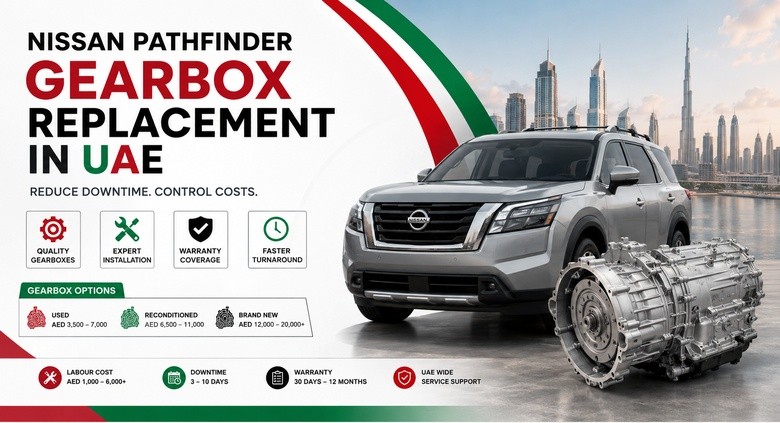
| Used Gearbox | 3,500 – 7,000 | Short-term ownership |
| Reconditioned Gearbox | 6,500 – 11,000 | Balanced fleet strategy |
| Brand-New Gearbox | 12,000 – 20,000+ | Long-term retention |
Used Gearbox Advantages
- Lower acquisition cost.
- Faster sourcing in many cases.
- Suitable for vehicles approaching fleet retirement.
Reconditioned Gearbox Advantages
- Better reliability profile.
- Refreshed internal parts.
- Strong balance between cost and longevity.
Brand-New Gearbox Advantages
- Maximum reliability.
- Longest expected service life.
- Strongest long-term operational confidence.
The right choice depends less on the gearbox itself and more on what role that Pathfinder plays inside your business.
A vehicle leaving the fleet within twelve months deserves a different investment strategy than one expected to remain productive for another five years.
And that distinction changes everything.
The Hidden Costs That Often Get Ignored During Gearbox Budget Planning
The gearbox invoice receives all the attention.
Strangely, it is often the least interesting number in the entire exercise.
What catches experienced fleet managers off guard isn't necessarily the replacement unit itself. It's everything orbiting around it. The supporting expenses. The operational leakage. The seemingly minor items that quietly accumulate until the finance department starts asking uncomfortable questions.
A Nissan Pathfinder gearbox replacement in UAE may begin with a straightforward quotation. Then additional requirements start appearing.
Transmission fluid.
Programming.
Diagnostic scans.
Mounts.
Cooler inspection.
Torque converter assessment.
Labour adjustments.
Additional parts discovered after disassembly.
The invoice grows. Gradually. Then suddenly.
Common Hidden Costs During Gearbox Replacement
| Expense Category | Typical UAE Cost Range (AED) |
| Diagnostic Inspection | 200 – 800 |
| Transmission Fluid | 400 – 1,500 |
| Gearbox Programming | 300 – 1,200 |
| Transmission Mounts | 300 – 1,500 |
| Cooler Flushing | 250 – 1,000 |
| Additional Sensors | 250 – 2,000+ |
| Vehicle Recovery | 250 – 1,500 |
And yet even these numbers tell only part of the story.
The larger expense often emerges elsewhere.
Downtime.
Because a gearbox sitting on a workshop floor isn't generating revenue.
How Long Can a Nissan Pathfinder Stay Off the Road During Gearbox Replacement in UAE?
This question matters more than many realise.
A fleet operator with twenty vehicles can usually absorb one vehicle's absence.
A fleet operator with five vehicles feels every missing unit immediately.
The replacement timeline depends on several factors:
- Gearbox availability.
- Model year.
- Workshop scheduling.
- Supplier responsiveness.
- Additional repairs discovered during installation.
- Programming requirements.
Typical UAE Replacement Timeline
| Replacement Stage | Estimated Time |
| Diagnosis | 1 Day |
| Sourcing Gearbox | 1–7 Days |
| Installation | 1–3 Days |
| Programming & Testing | 1 Day |
| Quality Checks | 1 Day |
Total Estimated Downtime
| Scenario | Estimated Downtime |
| Ideal Case | 2–4 Days |
| Average Case | 5–8 Days |
| Complex Case | 10–14+ Days |
Notice something interesting.
The physical gearbox installation is rarely the longest stage.
Waiting is.
Waiting for stock.
Waiting for approvals.
Waiting for parts.
Waiting for someone else's delay to become your problem.
That is why procurement strategy matters.
The Fleet Manager's Checklist Before Approving a Gearbox Replacement
A surprising number of replacement decisions are approved without answering the questions that genuinely matter.
Not because fleet managers lack experience.
Because operations move quickly.
Because schedules are packed.
Because everyone wants the vehicle back on the road.
Yet haste has a habit of becoming expensive.
Pre-Approval Checklist
Before authorising replacement, verify:
- Correct gearbox code.
- VIN compatibility.
- Supplier reputation.
- Warranty coverage.
- Mileage documentation.
- Installation timeline.
- Labour quotation.
- Fluid replacement policy.
- Torque converter inspection.
- Transmission cooler condition.
- Workshop experience with Nissan Pathfinder models.
- Post-installation support.
If even three of those answers remain unclear, pause.
A delayed approval is frustrating.
An incorrect gearbox is worse.
Much worse.
Why Cheap Gearbox Deals Frequently Become Expensive Operational Mistakes
Everybody loves a bargain.
Until the bargain starts demanding attention every few months.
Across Dubai, Sharjah and Ajman, fleet operators regularly encounter gearbox quotations that appear dramatically cheaper than competing offers.
Sometimes the savings are genuine.
Sometimes.
Other times the lower figure simply shifts costs into the future.
Consider what may not appear in the quotation:
- Unknown gearbox history.
- Excessive mileage.
- Limited testing.
- Minimal warranty.
- Incomplete refurbishment.
- Poor storage conditions.
- Missing ancillary parts.
The difference between a gearbox costing AED 4,500 and another costing AED 7,500 can seem significant on paper.
The difference between three years of reliable operation and three unexpected failures is far more significant.
Fleet managers don't buy parts.
They buy predictability.
That distinction matters.
Driver Behaviour, Driver Training and Their Surprising Impact on Transmission Longevity
Not every gearbox failure begins inside the gearbox.
Some begin behind the steering wheel.
An uncomfortable truth.
A truthful one nevertheless.
Vehicles assigned to careful drivers frequently achieve noticeably longer transmission life than identical vehicles operating under aggressive driving patterns.
Repeated hard acceleration.
Abrupt gear engagement.
Constant stop-start aggression.
Towing beyond recommendations.
Extended idling followed by sudden acceleration.
These behaviours accumulate.
Gearboxes remember them.
Common Driver Habits That Accelerate Wear
- Aggressive acceleration.
- Frequent heavy-load operation.
- Delayed maintenance reporting.
- Ignoring warning lights.
- Continuous stop-start driving.
- Poor towing practices.
The gearbox rarely receives the blame it deserves.
Drivers rarely receive the blame they deserve either.
Reality tends to sit somewhere in the middle.
The UAE Workshop Red Flags Every Fleet Operator Should Watch For
Not every workshop specialises in transmissions.
Some claim they do.
That isn't always the same thing.
Watch carefully when discussing gearbox replacement.
Pay attention to how questions are answered.
Or avoided.
Workshop Red Flags
- No gearbox code verification.
- Vague warranty explanations.
- No written quotations.
- No diagnostic evidence.
- Pressure for immediate approval.
- Unrealistically low pricing.
- No discussion regarding supporting parts.
- Limited testing procedures.
A workshop that cannot clearly explain its process often reveals more than intended.
Competent specialists tend to welcome questions.
Inexperienced operators tend to rush past them.
How to Evaluate the Mileage, History and Condition of a Replacement Gearbox
Mileage matters.
Not always as much as buyers think.
But it matters.
A gearbox with moderate mileage and excellent maintenance history may outperform a supposedly lower-mileage unit that endured years of abuse.
That is why fleet managers should evaluate:
- Mileage records.
- Donor vehicle history.
- Fluid condition.
- Internal inspection reports.
- Supplier documentation.
- Warranty length.
- Testing procedures.
Mileage Evaluation Framework
| Gearbox Mileage | Risk Level |
| Under 80,000 km | Lower Risk |
| 80,000–150,000 km | Moderate Risk |
| 150,000–220,000 km | Higher Risk |
| Over 220,000 km | Significant Evaluation Required |
Mileage tells part of the story.
Maintenance tells another.
Usage patterns tell a third.
Good decisions emerge when all three align.
What Should Be Replaced Alongside the Nissan Pathfinder Gearbox?
This is one of the most overlooked decisions in gearbox replacement.
The gearbox comes out.
The opportunity appears.
Yet many operators choose to reinstall ageing supporting parts simply because they haven't failed yet.
That can be a false economy.
Recommended Supporting Parts Inspection Checklist
- Torque converter.
- Transmission mounts.
- Cooler lines.
- Transmission cooler.
- Wiring connections.
- Sensors.
- Filters.
- Seals.
- Gaskets.
- Fluid.
Replacing a gearbox while ignoring a contaminated cooler can resemble installing a new heart while leaving clogged arteries untouched.
The comparison may sound dramatic.
Occasionally it isn't.
The First 1,000 Kilometres After Gearbox Installation Can Determine Everything
Many fleet operators assume the hard part ends when the vehicle leaves the workshop.
Actually, the monitoring phase is only beginning.
The first thousand kilometres reveal a great deal.
Shift quality.
Fluid behaviour.
Temperature stability.
Electronic adaptation.
Potential leaks.
Emerging fault codes.
All of it starts revealing itself.
First 1,000 km Monitoring Checklist
- Check fluid levels.
- Inspect for leaks.
- Monitor shift quality.
- Scan fault codes.
- Verify transmission temperature.
- Record driver feedback.
- Review unusual noises.
- Schedule follow-up inspection.
A gearbox replacement should not be treated as a single event.
The strongest fleet operations treat it as a managed process.
That mindset often separates stable fleets from constantly reactive ones.
Building a Long-Term Fleet Reliability Strategy Instead of Waiting for the Next Breakdown
There are two types of fleet operations.
The first reacts.
The second anticipates.
One spends much of its time chasing failures, moving vehicles between workshops, rearranging drivers, apologising to customers and wondering why operating costs never seem to stabilise.
The other looks surprisingly boring from the outside.
Vehicles receive inspections before they become urgent.
Drivers report issues early.
Transmission fluid services happen on schedule.
Replacement decisions occur before catastrophic failure forces the issue.
Boring can be profitable.
Very profitable.
The Nissan Pathfinder occupies an interesting position in many UAE fleets because it often serves multiple purposes simultaneously. Executive transport one day. Airport transfer duties the next. Long-distance inter-emirate journeys throughout the week. All while operating under conditions that place considerable stress on drivetrain systems.
The gearbox is not merely a mechanical part.
It is an operational asset.
Treating it that way changes the conversation.
Nissan Pathfinder Gearbox Replacement Cost in UAE: What Fleet Managers Should Budget For
This is usually the first question.
Oddly enough, it is rarely the most important one.
Still, budgets matter.
Approvals matter.
Procurement departments certainly think so.
Nissan Pathfinder Gearbox Price Comparison UAE
| Gearbox Type | Estimated Price Range (AED) |
| Used Gearbox | 3,500 – 7,000 |
| Low-Mileage Used Gearbox | 5,500 – 9,000 |
| Reconditioned Gearbox | 6,500 – 11,000 |
| Premium Reconditioned Unit | 8,500 – 14,000 |
| Brand-New Gearbox | 12,000 – 20,000+ |
Notice the overlap.
That overlap is where many procurement mistakes occur.
A poor-quality reconditioned unit can occasionally cost more than a carefully sourced used gearbox.
Conversely, a properly rebuilt transmission may deliver significantly greater value than a cheaper alternative that returns to the workshop six months later.
The cheapest quotation rarely tells the entire story.
Sometimes it barely tells any of it.
Typical Additional Replacement Costs
- Diagnostic inspection: AED 200–800
- Transmission fluid: AED 400–1,500
- Cooler flushing: AED 250–1,000
- Programming and coding: AED 300–1,200
- Recovery charges: AED 250–1,500
- Supporting parts: AED 500–3,000+
- Post-installation testing: workshop dependent
A gearbox replacement budget should account for the complete ecosystem surrounding the repair.
Not just the gearbox.
UAE Labour Cost Comparison: Why the Cheapest Gearbox Installation Is Rarely the Cheapest Outcome
Labour discussions often become uncomfortable because they expose a reality many businesses would prefer to avoid.
Technical expertise costs money.
The absence of technical expertise frequently costs more.
UAE Labour Cost Comparison Table
| Workshop Type | Labour Cost Range (AED) |
| Independent General Workshop | 1,000 – 2,500 |
| Mid-Level Specialist Workshop | 2,000 – 4,000 |
| Transmission Specialist | 3,000 – 6,000 |
| Premium Dealer-Level Facility | 5,000 – 10,000+ |
At first glance, the cheapest option appears attractive.
Then another question emerges.
What happens if the installation goes wrong?
A transmission that requires removal twice is no longer a bargain.
A vehicle that spends two additional weeks off the road because corners were cut is no longer saving money.
Fleet managers understand a principle that private owners occasionally overlook.
Cost and value are not interchangeable concepts.
Dubai vs Abu Dhabi vs Sharjah: Understanding UAE Market Differences
Not every emirate operates under identical market conditions.
Dubai tends to offer wider supplier networks, faster availability and greater competition.
Abu Dhabi frequently provides strong specialist support, particularly for corporate and government-linked fleet operations.
Sharjah remains one of the most active automotive parts markets in the region, creating attractive sourcing opportunities.
Ajman and Ras Al Khaimah occasionally offer surprisingly competitive alternatives, particularly when supplier inventory becomes limited elsewhere.
Many fleet operators also use platforms such as PartFinder UAE to compare supplier availability and gearbox sourcing options across multiple emirates before making procurement decisions.
Regional Pricing Overview
| Emirate | Availability | Pricing Competitiveness |
| Dubai | Excellent | High |
| Abu Dhabi | Strong | Moderate |
| Sharjah | Excellent | Very High |
| Ajman | Moderate | High |
| Ras Al Khaimah | Moderate | Moderate |
| Fujairah | Limited | Variable |
A smart fleet manager rarely restricts sourcing to a single city.
The UAE market rewards flexibility.
The Cost of Delaying a Nissan Pathfinder Gearbox Replacement
This section tends to make finance departments uncomfortable.
For good reason.
Immediate Replacement vs Delayed Replacement
| Factor | Immediate Action | Delayed Action |
| Vehicle Reliability | Improved | Declining |
| Downtime Planning | Controlled | Unpredictable |
| Secondary Damage Risk | Lower | Higher |
| Emergency Costs | Reduced | Increased |
| Fleet Stability | Stronger | Weaker |
The mistake is assuming the gearbox remains static while the decision is postponed.
It doesn't.
Internal wear continues.
Fluid contamination spreads.
Heat accumulates.
Associated components become involved.
The repair bill rarely stays where it started.
The problem grows while management debates.
That's often the most expensive phase of all.
Fleet Downtime Scenario: When One Pathfinder Stops Earning
Imagine a tourism operator based in Dubai.
One Nissan Pathfinder supports airport pickups, hotel transfers and sightseeing operations.
Transmission failure occurs on a Thursday.
Replacement sourcing takes six days.
Installation takes another three.
Testing adds one more.
Ten days disappear.
Now calculate:
- Lost bookings.
- Replacement vehicle costs.
- Driver schedule disruption.
- Customer service impact.
- Administrative management time.
Suddenly the gearbox invoice looks remarkably small.
Downtime has a talent for hiding in plain sight.
Which Gearbox Option Fits Your Fleet Strategy?
No single answer applies universally.
That is precisely why decision-making becomes difficult.
Fleet Procurement Framework
| Fleet Situation | Recommended Option |
| Vehicle Leaving Fleet Within 12 Months | Used Gearbox |
| Budget-Constrained Operation | Quality Used or Reconditioned |
| Vehicle Retained 2–4 Years | Reconditioned Gearbox |
| Executive Transport Fleet | Premium Reconditioned or New |
| High-Utilisation Commercial Fleet | Reconditioned or New |
| Long-Term Ownership Strategy | New Gearbox |
The correct decision depends less on the gearbox and more on the fleet strategy surrounding it.
Context matters.
Always.
The Most Common Fleet Manager Mistakes During Gearbox Replacement
Experience helps.
It does not make anyone immune.
The most frequent mistakes include:
- Selecting suppliers solely on price.
- Ignoring gearbox compatibility codes.
- Underestimating downtime impact.
- Skipping cooler inspection.
- Reusing worn supporting parts.
- Accepting vague warranties.
- Failing to monitor post-installation performance.
- Delaying replacement after repeated failures.
Many of these mistakes appear minor when viewed individually.
Collectively they create significant operational risk.
Quick Fleet Manager Decision Guide
Choose a Used Gearbox If:
- Budget is the primary concern.
- Vehicle disposal is approaching.
- Reliable documentation exists.
- Downtime requirements are flexible.
Choose a Reconditioned Gearbox If:
- Fleet retention plans extend beyond two years.
- Reliability matters.
- Balanced ownership costs are important.
- Long-term operational stability is desired.
Choose a New Gearbox If:
- Vehicle remains strategically important.
- Downtime risk must be minimised.
- Long-term ownership is planned.
- Fleet image and reliability are critical.
Frequently Asked Questions
Categories
- Audi
- BMW
- Car Accessories
- Car Tips
- Ford
- Land Rover
- Mazda
- Range Rover
- Top 10
- UAE Car Parts
- Used Car Parts
- Toyota
- Replacement Engines
- Nissan
- Hyundai
- Mitsubishi
- Volkswagen
- Honda
- Kia
- Chevrolet
- Dodge
- Jeep
- Subaru
- Renault
- Lexus
- Mercedes
- Suzuki
- Hummer
- Porsche
- Infiniti
- Peugeot
- GMC
- Mini
- Volvo
- Replacement Gearboxes
- MG
- Jaguar
- Skoda
- Cadillac
- Daihatsu
- Fiat
- German Car Parts
- Japanese Car Parts
- Aftermarket Car Parts
- Genuine Car Parts
- New Car Parts
- Reconditioned Car Parts
- European Car Parts
- American Car Parts
- Korean Car Parts
- British Car Parts
- Chinese Car Parts
- Sports/Exotic Car Parts
- Luxury Car Parts
- Performance Car Parts
- SUV/4x4 Spare Parts
- Truck Spare Parts
- EV Car Parts
- Hybrid Car Parts
- Auto Spare Parts in UAE
- Tesla
- Isuzu
- Ram
- Ferrari
- Bentley
- Lamborghini
- Genesis
- Maserati
- Lincoln
- Chrysler
- Opel
- Citroen
- SsangYong
- Seat
- McLaren
- Aston Martin
- Rolls Royce
- Maybach
- Alfa Romeo
- Bugatti
- Scion
- Abu Dhabi Car Parts
- Ajman Car Parts
- Al Khan Car Parts
- Al Sajaa Car Parts
- Deira Car Parts
- Dubai Car Parts
- Fujairah Car Parts
- Industrial Area 6 Car Parts
- Mussafah Car Parts
- Ras Al Khaimah Car Parts
- Sharjah Car Parts
- Umm Al Quwain Car Parts
- Acura
- BYD
- Chery
- Dacia
- DS
- Geely Emgrand
- EXEED
- GAC
- GAC Gonow
- Geely
- Gonow
- Great Wall
- Haima
- Haval
- Holden
- Iveco