Nissan Patrol and Altima Spare Parts in UAE: Common Parts Owners Replace
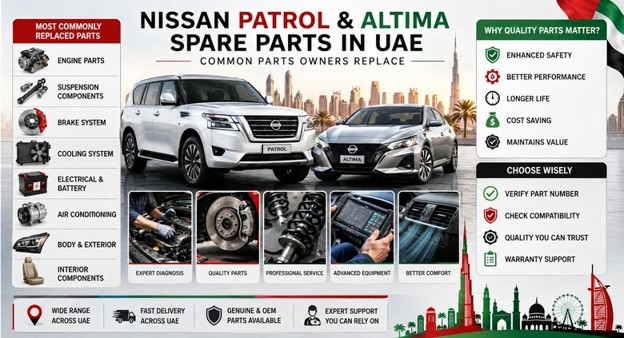
August 3, 2026
Understanding Nissan Patrol and Altima Maintenance
Key Takeaways
The Nissan Patrol and Nissan Altima are built for very different purposes.
One is renowned for tackling long motorway journeys, family adventures and demanding off-road conditions. The other has become one of the UAE's most popular executive saloons, valued for its comfort, fuel efficiency and dependable daily performance.
Despite these differences, both vehicles share one reality.
Every mechanical component has a service life.
Knowing which parts commonly require replacement—and recognising the warning signs before complete failure—helps owners reduce repair costs, minimise downtime and protect long-term vehicle reliability.
Across Dubai, Abu Dhabi, Sharjah, Ajman, Ras Al Khaimah, Fujairah and Umm Al Quwain, experienced Nissan owners understand that preventative maintenance is considerably less expensive than emergency repairs.
Nissan Patrol vs Nissan Altima Maintenance Overview
| Vehicle | Typical Usage | Common Maintenance Priority |
| Nissan Patrol | Family travel, off-road driving, towing | Suspension, cooling system, drivetrain |
| Nissan Altima | Daily commuting, motorway driving | Transmission, braking system, engine servicing |
Walk into any experienced Nissan workshop across the UAE and one thing quickly becomes obvious.
Patrol owners and Altima owners ask different questions.
A Patrol driver may be concerned about suspension wear after repeated desert trips.
An Altima owner is more likely to ask whether unusual transmission behaviour should be investigated before it becomes a costly repair.
Different vehicles.
Different driving habits.
Different maintenance priorities.
Yet the objective remains identical.
Keeping the vehicle dependable without spending unnecessarily.
That begins with understanding which components naturally wear over time.
Why Nissan Patrol and Altima Owners Replace Spare Parts More Frequently
Neither vehicle is unreliable.
They simply operate under demanding conditions.
Daily commuting through heavy traffic.
Long-distance motorway driving.
Summer temperatures exceeding 45°C.
Dust entering filters.
Stop-start city journeys.
Occasional off-road adventures.
Every one of these conditions places additional stress on mechanical systems.
Over thousands of kilometres, natural wear becomes unavoidable.
Replacing components at the correct time protects the rest of the vehicle from unnecessary damage.
Ignoring early warning signs often produces a much larger repair bill.
Common Driving Conditions That Affect Parts Lifespan in UAE
The UAE offers excellent roads.
It also presents one of the world's toughest operating environments for vehicles.
Several local conditions accelerate component wear.
These include:
- Extreme summer temperatures.
- Heavy urban traffic.
- Long motorway journeys.
- Fine desert sand.
- Coastal humidity in some regions.
- Frequent air-conditioning use.
- Occasional towing and off-road driving.
These factors commonly affect:
- Radiators.
- Air-conditioning systems.
- Batteries.
- Suspension components.
- Brake systems.
- Rubber bushes.
- Cooling hoses.
Regular inspections become increasingly valuable under these conditions.
Differences Between Patrol and Altima Maintenance Requirements
Although both vehicles carry the Nissan badge, their maintenance priorities differ considerably.
Nissan Patrol
Owners commonly monitor:
- Suspension components.
- Steering system.
- Differential assemblies.
- Transfer case.
- Cooling system.
- Brake components.
Vehicles used for desert driving often require more frequent inspection of suspension and drivetrain components.
Nissan Altima
Routine attention is frequently focused on:
- Transmission performance.
- Engine servicing.
- Braking system.
- Air-conditioning.
- Electrical components.
- Suspension wear.
Daily commuting creates consistent mechanical demand even without off-road use.
Understanding these differences allows owners to prepare for maintenance rather than reacting to unexpected breakdowns.
Genuine vs OEM vs Used vs Aftermarket Parts for Patrol and Altima
Every replacement part falls into one of several categories.
Choosing the right option depends upon the repair, budget and long-term ownership plans.
Genuine Nissan Parts
Offer:
- Factory specifications.
- Excellent compatibility.
- Consistent reliability.
Often preferred for:
- Engine components.
- Electronic modules.
- Safety-related systems.
OEM Parts
Provide:
- Original-equipment quality.
- Competitive pricing.
- Excellent fitment.
Suitable for many routine maintenance requirements.
Used Genuine Parts
Professionally inspected original Nissan components.
Frequently represent excellent value for:
- Body panels.
- Interior trim.
- Mirrors.
- Selected mechanical assemblies.
Aftermarket Parts
Produced by independent manufacturers.
Quality varies significantly.
Selecting reputable brands remains essential.
The smartest buyers compare quality before comparing price.
Warning Signs That Replacement Parts Are Needed
Vehicles rarely fail without providing warnings.
Owners should pay attention to:
- Dashboard warning lights.
- Unusual vibrations.
- Knocking sounds.
- Reduced braking performance.
- Heavy steering.
- Fluid leaks.
- Engine overheating.
- Slower acceleration.
- Air-conditioning becoming less effective.
- Excessive tyre wear.
Early diagnosis frequently prevents much larger repairs.
Waiting rarely reduces costs.
Why Preventative Maintenance Always Costs Less
Experienced workshops rarely recommend replacing parts unnecessarily.
They do recommend replacing worn components before they damage surrounding systems.
For example:
Replacing worn brake pads protects brake discs.
Replacing a leaking hose protects the engine.
Replacing worn suspension bushes protects steering components.
Small repairs often prevent major mechanical failures.
That principle applies equally to both the Patrol and the Altima.
Workshop Story
A Nissan Patrol owner from Ras Al Khaimah visited a workshop after noticing a slight knocking noise over uneven roads.
The suspension still felt acceptable.
The vehicle remained fully driveable.
Inspection revealed worn control arm bushes.
The workshop recommended replacing them before they caused uneven tyre wear and additional suspension damage.
During the same week, a Nissan Altima owner from Dubai arrived with a minor transmission hesitation.
Diagnostic testing identified deteriorating transmission fluid rather than internal gearbox damage.
After servicing the transmission, normal performance returned.
Both owners avoided considerably larger repair bills.
Before leaving, the Patrol owner smiled.
"I thought it was too early to replace anything."
The technician replied,
"The best replacement is often the one completed before something else breaks."
That philosophy explains why preventative maintenance consistently reduces ownership costs.
Patrol and Altima Maintenance Comparison
| Maintenance Area | Nissan Patrol | Nissan Altima |
| Suspension Wear | High | Moderate |
| Cooling System | High | Medium |
| Transmission Attention | Medium | High |
| Brake Maintenance | High | High |
| Air-Conditioning | High | High |
| Electrical Components | Medium | Medium |
Each vehicle has different priorities.
Neither should be maintained using identical assumptions.
Buyer Decision Matrix
| Your Vehicle Usage | Recommended Maintenance Focus |
| Daily city commuting | Brakes, transmission, cooling system |
| Long motorway journeys | Suspension, tyres, engine servicing |
| Desert driving | Suspension, steering, drivetrain |
| Family vehicle | Preventative maintenance and cooling system |
| Commercial use | Reliability, brakes and scheduled servicing |
| Long-term ownership | Genuine or quality OEM replacement parts with complete service records |
Suggested Blog Visual
Infographic Theme: Common Nissan Patrol and Altima Parts That Need Replacement
Include realistic visuals of:
- Nissan Patrol.
- Nissan Altima.
- Suspension assembly.
- Brake discs and pads.
- Radiator.
- Air-conditioning compressor.
- Transmission.
- Battery.
- Engine.
- Mechanic inspecting a vehicle.
- Diagnostic scanner.
- UAE skyline featuring Dubai, Abu Dhabi and Sharjah with subtle red, green, white and black accents inspired by the national flag.
Keep wording extremely limited.
Let the visuals communicate preventative maintenance, reliability and common replacement parts.
Smart Buyer's Checklist
Before replacing any Nissan Patrol or Altima component:
- Confirm the fault through professional diagnosis.
- Verify the VIN.
- Match the Nissan part number.
- Compare genuine, OEM and quality replacement options.
- Check warranty coverage.
- Ask whether supporting components should also be replaced.
- Compare complete repair costs rather than part prices alone.
- Keep invoices and service records.
- Inspect new components before installation.
- Follow the recommended maintenance schedule after the repair.
Replacing the right component at the right time is one of the simplest ways to extend the life of both the Nissan Patrol and the Nissan Altima.
Key Takeaways
The Nissan Patrol and Nissan Altima may serve different purposes, but both rely on timely maintenance to remain dependable in the demanding UAE environment. Understanding which components wear most frequently, recognising early warning signs and selecting the right replacement parts all contribute to lower ownership costs and improved long-term reliability.
Engine and Transmission Components
Key Takeaways
The engine and transmission represent the heart of every Nissan Patrol and Nissan Altima.
When these systems perform properly, the vehicle feels refined, responsive and dependable. When they begin to wear, even minor symptoms can gradually develop into expensive mechanical failures if ignored.
Fortunately, most serious repairs do not occur without warning.
Recognising the early signs, understanding which components commonly wear and choosing quality replacement parts at the right time can dramatically reduce long-term ownership costs.
Professional workshops rarely wait for complete failure.
They intervene while repairs remain manageable.
Engine and Transmission Overview
| Vehicle System | Nissan Patrol | Nissan Altima |
| Engine Cooling | High Priority | High Priority |
| Transmission | Medium Priority | Very High Priority |
| Fuel System | Medium | Medium |
| Ignition Components | Medium | High |
| Engine Mounts | High | Medium |
| Turbo Components (where applicable) | Medium | Low |
Two vehicles.
Two different engineering philosophies.
The Patrol is designed to cope with demanding loads, extended journeys and challenging terrain.
The Altima is engineered for smooth daily driving, fuel efficiency and refined performance.
Both rely on engines and transmissions operating within precise tolerances.
When maintenance is delayed...
Those tolerances gradually disappear.
That is why workshops encourage preventative replacement rather than waiting for complete failure.
Common Engine Parts Nissan Patrol Owners Replace
The Patrol's larger engine and heavier operating demands naturally place greater stress on several components.
Common replacement items include:
- Water pumps.
- Radiators.
- Thermostats.
- Engine mounts.
- Alternators.
- Starter motors.
- Drive belts.
- Cooling hoses.
- Fuel injectors.
- Air filters.
Vehicles used for towing or frequent desert driving often require more regular cooling system inspections.
Heat remains one of the biggest challenges for large-capacity engines operating in the UAE.
Maintaining cooling efficiency protects every major engine component.
Frequently Replaced Engine Parts on Nissan Altima
The Altima has earned an excellent reputation for dependable everyday driving.
Like every vehicle, however, routine wear eventually affects several components.
Common replacements include:
- Spark plugs.
- Ignition coils.
- Alternators.
- Engine mounts.
- Radiators.
- Thermostats.
- Air-conditioning compressors.
- Oxygen sensors.
- Fuel pumps.
- Air filters.
Most of these components wear gradually.
Routine servicing usually identifies developing problems before they become expensive failures.
Gearbox and Transmission Components That Commonly Wear Out
Transmission maintenance differs significantly between the Patrol and the Altima.
Patrol owners often focus on:
- Automatic gearbox servicing.
- Transfer case maintenance.
- Differential lubrication.
- Driveshaft components.
Altima owners frequently monitor:
- CVT performance.
- Transmission fluid condition.
- Valve body operation.
- Transmission mounts.
Warning signs may include:
- Delayed gear engagement.
- Jerking during acceleration.
- Slipping gears.
- Unusual noises.
- Transmission warning lights.
Early diagnosis frequently prevents complete transmission replacement.
Cooling System Components That Require Regular Replacement
Few systems work harder in the UAE than the cooling system.
Summer temperatures create continuous mechanical stress.
Components commonly replaced include:
- Radiators.
- Cooling fans.
- Expansion tanks.
- Thermostats.
- Water pumps.
- Coolant hoses.
- Radiator caps.
- Temperature sensors.
Cooling system failures rarely remain isolated.
Ignoring a small coolant leak today may result in serious engine damage tomorrow.
Professional workshops inspect cooling systems carefully before summer begins.
Turbocharger, Fuel System and Ignition Components
Certain Patrol variants include turbocharged engines.
Turbochargers require:
- Clean engine oil.
- Correct servicing intervals.
- Reliable lubrication.
- Proper cooling.
Fuel system components requiring replacement may include:
- Fuel injectors.
- Fuel pumps.
- Fuel filters.
Ignition-related components commonly replaced include:
- Spark plugs.
- Ignition coils.
- Crankshaft sensors.
- Camshaft sensors.
Small ignition faults often affect fuel economy before noticeably reducing performance.
Replacing worn components early maintains smoother engine operation.
Choosing Quality Engine and Transmission Replacement Parts
The quality of replacement components directly influences reliability.
Engine and transmission repairs involve considerable labour.
Installing low-quality components simply to reduce the purchase price rarely produces genuine savings.
Professional workshops usually recommend:
- Genuine Nissan parts.
- High-quality OEM components.
- Professionally inspected genuine used assemblies where appropriate.
Major repairs deserve components that match the quality of the workmanship.
Reliability should always outweigh short-term savings.
Signs That Immediate Attention Is Needed
Drivers should never ignore symptoms such as:
- Engine overheating.
- Persistent warning lights.
- Coolant leaks.
- Transmission slipping.
- Burning smells.
- Unusual knocking.
- Excessive vibration.
- Loss of power.
- Difficult starting.
- Heavy fuel consumption.
Many of these symptoms begin gradually.
Prompt inspection prevents them from developing into major failures.
Workshop Story
A Nissan Altima owner from Abu Dhabi noticed a slight hesitation when accelerating from traffic lights.
The vehicle still drove normally.
Instead of waiting for the problem to worsen, the owner booked a workshop inspection.
Diagnostic testing revealed ageing transmission fluid and a partially blocked transmission filter.
Both were replaced during routine servicing.
The transmission returned to smooth operation.
Later that week, a Patrol owner from Sharjah arrived with a minor coolant leak.
Inspection identified a deteriorating radiator hose before engine overheating occurred.
The hose was replaced during the same visit.
Both owners avoided significantly larger repair bills.
Before leaving, the Patrol owner remarked,
"I expected something much worse."
The technician smiled.
"Most expensive repairs begin as small ones."
That simple observation explains why experienced workshops emphasise early diagnosis.
Engine and Transmission Comparison
| Component | Patrol Replacement Frequency | Altima Replacement Frequency |
| Radiator | High | Medium |
| Water Pump | Medium | Medium |
| Engine Mount | High | Medium |
| Spark Plugs | Medium | High |
| Ignition Coils | Medium | High |
| Transmission Fluid | High Importance | Very High Importance |
Regular servicing keeps both vehicles operating efficiently.
Ignoring maintenance accelerates wear.
Buyer Decision Matrix
| Your Situation | Recommended Approach |
| Cooling system warning | Inspect immediately before overheating occurs. |
| Transmission hesitation | Perform professional diagnostics without delay. |
| High-mileage Patrol | Inspect cooling and drivetrain components regularly. |
| Daily-driven Altima | Follow transmission and engine service schedules carefully. |
| Major engine repair | Choose genuine or high-quality OEM replacement parts. |
| Long-term ownership | Replace worn components before secondary damage develops. |
Suggested Blog Visual
Infographic Theme: Common Engine and Transmission Parts Replaced on Nissan Patrol and Altima
Include realistic visuals of:
- Nissan Patrol.
- Nissan Altima.
- Engine assembly.
- Automatic gearbox.
- CVT transmission.
- Radiator.
- Water pump.
- Alternator.
- Ignition coils.
- Fuel injectors.
- Cooling fan.
- Professional mechanic performing engine diagnostics.
- UAE skyline featuring Dubai, Abu Dhabi and Sharjah with subtle red, green, white and black accents inspired by the national flag.
Keep wording extremely limited.
Allow the visuals to communicate preventative maintenance, cooling system care and reliable engine performance.
Smart Buyer's Checklist
Before purchasing engine or transmission components:
- Confirm the diagnosis professionally.
- Verify the VIN.
- Match the Nissan part number.
- Check engine and transmission specifications.
- Compare genuine, OEM and inspected used options.
- Review warranty coverage.
- Replace supporting seals and fluids where required.
- Confirm workshop labour costs.
- Inspect components before installation.
- Keep all invoices and maintenance records.
A well-maintained engine and transmission rarely become expensive unexpectedly.
Most major failures begin with small warnings that attentive owners choose not to ignore.
Key Takeaways
The engine and transmission are among the most valuable systems on both the Nissan Patrol and Nissan Altima. Regular servicing, early diagnosis and timely replacement of worn components help prevent expensive mechanical failures while maintaining performance, fuel efficiency and reliability in the demanding UAE climate.
Suspension, Steering and Braking Systems
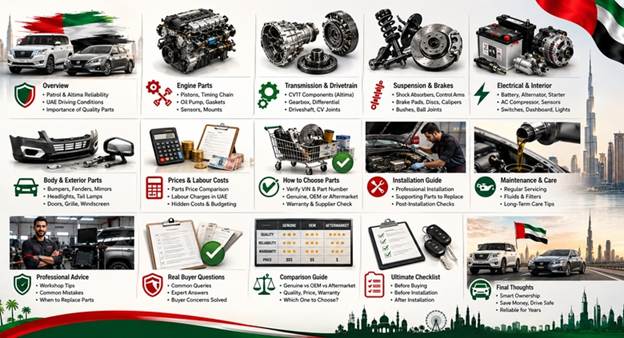
Key Takeaways:
The suspension, steering and braking systems determine how a Nissan Patrol or Nissan Altima feels on the road.
They influence far more than comfort.
They affect stability, braking distance, tyre wear, steering precision and overall safety.
Unlike engine components, these systems operate continuously whenever the vehicle is moving. Every corner, speed bump, motorway journey and rough road gradually contributes to normal wear.
Across the UAE, changing road surfaces, heavy traffic, high temperatures and occasional off-road driving accelerate the ageing of these components.
Understanding which parts commonly require replacement allows owners to plan maintenance before small issues become major repairs.
Suspension, Steering and Brake System Overview
| System | Nissan Patrol | Nissan Altima |
| Suspension | Heavy-duty workload | Daily road comfort |
| Steering | High stress during off-road use | Consistent city driving |
| Braking System | Large vehicle braking demands | Frequent stop-start traffic |
| Wheel Bearings | Moderate wear | Moderate wear |
| Bushes & Joints | High inspection priority | Medium inspection priority |
Many owners notice suspension problems gradually.
The vehicle feels slightly different.
Steering becomes less precise.
Road noise increases.
Tyres begin wearing unevenly.
Months later...
The repair becomes much larger than it needed to be.
Professional workshops rarely wait that long.
They inspect these systems during routine servicing because suspension wear rarely improves on its own.
Suspension Parts That Wear Out on Nissan Patrol
The Patrol is engineered for demanding conditions.
Its suspension regularly absorbs:
- Desert terrain.
- Heavy towing.
- Family travel.
- Long-distance motorway journeys.
- Uneven surfaces.
As mileage increases, commonly replaced components include:
- Shock absorbers.
- Control arms.
- Suspension bushes.
- Ball joints.
- Stabiliser links.
- Coil springs.
- Wheel bearings.
- Suspension mounts.
Vehicles used regularly away from paved roads generally require more frequent inspections.
Off-road capability depends heavily upon suspension condition.
Common Steering Components Replaced on Nissan Altima
The Altima spends much of its life in urban traffic.
Frequent steering input gradually affects several components.
Common replacements include:
- Steering racks.
- Tie rod ends.
- Steering bushes.
- Steering column joints.
- Power steering hoses.
- Electric steering components where applicable.
Warning signs include:
- Loose steering.
- Knocking noises.
- Uneven steering effort.
- Steering vibration.
- Poor directional stability.
Early repairs usually prevent additional tyre wear.
Brake Components That Need Regular Inspection
Few systems deserve more attention than brakes.
Regardless of model, braking performance should never be compromised.
Common replacement items include:
- Brake pads.
- Brake discs.
- Brake calipers.
- Brake hoses.
- Brake fluid.
- ABS sensors.
- Master cylinders.
Typical warning signs include:
- Squealing noises.
- Longer stopping distances.
- Brake vibration.
- Soft brake pedal.
- Dashboard warning lights.
Replacing brake pads before they wear completely often protects the brake discs.
That simple decision significantly reduces repair costs.
Wheel Bearings, Hubs and Bushes
These components rarely receive much attention.
Until they begin making noise.
Wheel bearings gradually wear through normal use.
Suspension bushes deteriorate with age, heat and constant movement.
Common symptoms include:
- Humming sounds.
- Clunking over bumps.
- Steering instability.
- Uneven tyre wear.
- Suspension vibration.
Replacing worn bushes often restores vehicle refinement surprisingly quickly.
Small rubber components frequently have a significant influence on driving quality.
Power Steering Components and Hydraulic Parts
Steering systems operate under considerable pressure.
Over time, several components naturally age.
These include:
- Steering pumps.
- Hydraulic hoses.
- Steering reservoirs.
- Seals.
- Rack boots.
Fluid leaks should never be ignored.
Loss of hydraulic pressure can quickly affect steering performance.
Routine inspections identify leaks before major damage develops.
How to Verify Compatibility Before Ordering Replacement Parts
Suspension and steering components often appear identical.
Small design differences can prevent correct installation.
Before ordering replacement parts, always verify:
- VIN.
- Nissan part number.
- Production year.
- Engine specification.
- Suspension configuration.
- Steering system type.
Professional suppliers routinely perform these checks.
Private buyers benefit from doing exactly the same.
Correct fitment always saves more money than repeat deliveries.
Common Warning Signs Drivers Should Never Ignore
Drivers should arrange an inspection if they notice:
- Steering pulling to one side.
- Suspension knocking.
- Excessive body roll.
- Uneven tyre wear.
- Brake vibration.
- Metallic braking noises.
- Fluid leaks beneath the vehicle.
- Steering wheel vibration.
- Reduced braking performance.
- Vehicle instability at motorway speeds.
Many of these symptoms begin gradually.
Responding early prevents additional component damage.
Workshop Story:
A Nissan Patrol owner from Fujairah reported a slight knocking sound while driving across uneven roads.
The vehicle still handled well.
Inspection revealed worn stabiliser links and deteriorating suspension bushes.
Both components were replaced during one workshop visit.
Several days later, a Nissan Altima owner from Ajman complained about steering vibration during motorway driving.
The workshop discovered worn tie rod ends and slight wheel bearing wear.
After replacement and wheel alignment, the steering returned to normal.
Both owners expected complicated repairs.
Instead...
Small components restored the vehicles.
Before leaving, the Patrol owner remarked,
"The suspension feels new again."
The technician replied,
"Small suspension parts often make the biggest difference."
That lesson applies to almost every high-mileage vehicle.
Suspension and Steering Comparison
| Component | Patrol Replacement Frequency | Altima Replacement Frequency |
| Shock Absorbers | High | Medium |
| Control Arms | High | Medium |
| Suspension Bushes | High | Medium |
| Tie Rod Ends | Medium | High |
| Steering Rack | Medium | Medium |
| Brake Pads | High | High |
Routine inspections dramatically extend the service life of surrounding components.
Buyer Decision Matrix:
| Driving Situation | Recommended Maintenance Focus |
| Daily city driving | Brakes, steering and tyre condition |
| Desert driving | Suspension, control arms and bushes |
| Long motorway journeys | Wheel bearings, steering alignment and brakes |
| Towing | Suspension and braking system inspections |
| High-mileage Patrol | Full suspension inspection every service |
| High-mileage Altima | Steering and brake system inspection at regular intervals |
Suggested Blog Visual:
Infographic Theme: Common Suspension, Steering and Brake Parts Replaced on Nissan Patrol and Altima
Include realistic visuals of:
- Nissan Patrol.
- Nissan Altima.
- Shock absorber.
- Brake disc and brake pads.
- Steering rack.
- Tie rod end.
- Wheel bearing.
- Suspension control arm.
- Hydraulic steering hose.
- Mechanic inspecting suspension.
- Wheel alignment machine.
- UAE skyline featuring Dubai, Abu Dhabi and Sharjah with subtle red, green, white and black accents inspired by the national flag.
Keep wording extremely limited.
Allow the visuals to demonstrate suspension safety, steering precision and brake maintenance.
Smart Buyer's Checklist:
Before purchasing suspension, steering or braking components:
- Confirm the diagnosis professionally.
- Verify the VIN.
- Match the Nissan part number.
- Inspect surrounding wear components.
- Compare genuine, OEM and quality replacement options.
- Replace worn bushes and joints together where appropriate.
- Check warranty coverage.
- Arrange professional wheel alignment after steering or suspension repairs.
- Inspect new components before installation.
- Keep all repair invoices and maintenance records.
Small suspension and steering components are inexpensive compared with the cost of ignoring them.
Replacing them at the correct time protects safety, improves driving comfort and prevents much larger repairs.
Key Takeaways:
Suspension, steering and braking systems experience constant wear on both the Nissan Patrol and Nissan Altima, particularly under demanding UAE driving conditions. Routine inspections and timely replacement of worn components improve vehicle stability, braking performance, tyre life and overall safety while preventing minor issues from developing into expensive repairs.
Owners who respond promptly to warning signs, verify compatibility before ordering replacement parts and choose quality components consistently achieve better reliability and lower long-term ownership costs.
Electrical, Lighting and Interior Components
Key Takeaways:
Modern Nissan Patrol and Nissan Altima models rely on sophisticated electrical systems to deliver performance, comfort and safety.
From starting the engine to operating advanced driver-assistance features, hundreds of electronic components communicate continuously while the vehicle is in use.
Unlike many mechanical parts, electrical components often deteriorate gradually before failing completely.
A weak alternator may initially cause dim headlights.
An ageing battery may only struggle during hot afternoons.
An air-conditioning compressor may slowly lose efficiency before stopping altogether.
Recognising these warning signs early helps owners replace components before they cause unexpected breakdowns, particularly during the demanding UAE summer.
Electrical System Overview
| Component | Nissan Patrol | Nissan Altima |
| Battery | High Replacement Frequency | High Replacement Frequency |
| Alternator | Medium | Medium |
| Starter Motor | Medium | Medium |
| Air-Conditioning System | Very High Priority | Very High Priority |
| Dashboard Electronics | Medium | High |
| Lighting Components | High | High |
Modern vehicles contain far more electronics than many owners realise.
A single faulty sensor can influence several vehicle systems.
That is why professional diagnosis should always come before replacing electrical components.
Frequently Replaced Electrical Components
Electrical systems naturally experience wear throughout the vehicle's life.
The components most commonly replaced include:
- Batteries.
- Alternators.
- Starter motors.
- Ignition switches.
- Relays.
- Fuses.
- Wiring connectors.
- Electronic sensors.
- Engine control sensors.
- Charging system components.
Replacing the correct component after an accurate diagnosis prevents unnecessary repairs.
Batteries, Alternators and Starter Motors
These three components work together every time the engine starts.
The battery provides initial electrical power.
The starter motor cranks the engine.
The alternator restores battery charge while driving.
Common warning signs include:
- Slow engine cranking.
- Battery warning light.
- Flickering headlights.
- Clicking during engine start.
- Repeated flat batteries.
- Electrical accessories operating inconsistently.
Extreme UAE temperatures reduce battery lifespan considerably.
Routine battery testing before summer helps prevent unexpected failures.
Headlights, Tail Lamps and Fog Lights
Lighting systems play a critical role in road safety.
Modern Nissan models often include advanced LED lighting technology.
Components commonly requiring replacement include:
- LED headlight assemblies.
- Halogen bulbs.
- Tail lamps.
- Fog lamps.
- Daytime running lights.
- Number plate lights.
- Indicator units.
- Headlight control modules.
Moisture inside lighting assemblies should never be ignored.
Condensation frequently indicates damaged seals that may eventually affect electrical performance.
Dashboard Electronics and Instrument Clusters
Modern dashboards provide continuous information about vehicle performance.
Electronic systems monitor:
- Engine operation.
- Fuel economy.
- Tyre pressure.
- Battery charging.
- Warning indicators.
- Driver assistance systems.
Frequently replaced electronic components include:
- Instrument clusters.
- Infotainment displays.
- Steering wheel switches.
- Climate control panels.
- Dashboard control modules.
- Parking sensor controllers.
Professional diagnostic equipment identifies faults far more accurately than replacing components through trial and error.
Air Conditioning Components for UAE Weather
Reliable air conditioning is essential throughout the UAE.
Continuous operation places heavy demands on cooling components.
Common replacement parts include:
- Air-conditioning compressors.
- Condensers.
- Evaporators.
- Expansion valves.
- Blower motors.
- Cabin filters.
- Refrigerant pressure sensors.
- Cooling fans.
Weak cooling performance often develops gradually.
Early servicing usually prevents complete compressor failure.
Interior Trim and Convenience Features
Interior components also experience daily wear.
Although they rarely stop the vehicle from operating, they contribute significantly to comfort and resale value.
Frequently replaced interior components include:
- Window switches.
- Electric window motors.
- Door lock actuators.
- Seat adjustment switches.
- Interior door handles.
- Gear selector trim.
- Dashboard panels.
- USB charging ports.
A clean, fully functional interior reflects careful ownership.
Preventing Electrical Problems Before They Develop
Preventative maintenance reduces many electrical failures.
Owners should:
- Test battery condition regularly.
- Keep battery terminals clean.
- Replace cabin filters on schedule.
- Inspect exterior lighting.
- Respond to warning lights immediately.
- Check charging system performance.
- Inspect wiring after accident repairs.
- Replace ageing batteries before summer.
Simple preventative checks often prevent inconvenient breakdowns.
Common Warning Signs That Require Immediate Attention
Electrical faults usually provide early warnings.
Arrange a professional inspection if you notice:
- Slow engine starting.
- Battery warning light.
- Flickering headlights.
- Weak air conditioning.
- Dashboard warning messages.
- Power windows operating slowly.
- Burning electrical smell.
- Repeated blown fuses.
- Intermittent sensor warnings.
- Infotainment system restarting unexpectedly.
Ignoring these symptoms frequently leads to larger repair costs.
Workshop Story:
A Nissan Patrol owner from Abu Dhabi noticed the battery warning light illuminating briefly during motorway driving.
Although the vehicle continued operating normally, the workshop inspected the charging system immediately.
Testing confirmed that the alternator output had fallen below specification.
Replacing the alternator restored proper charging before the battery became permanently damaged.
Later that week, a Nissan Altima owner from Sharjah reported that the air conditioning was cooling inconsistently during afternoon traffic.
Inspection revealed a partially worn compressor together with a heavily blocked cabin filter.
Replacing both components restored full cooling performance before peak summer temperatures arrived.
Before leaving the workshop, the Altima owner smiled.
"I expected a much bigger repair."
The technician replied,
"Small electrical problems become expensive only when they're ignored."
That advice applies to almost every modern vehicle.
Electrical System Comparison
| Component | Patrol Replacement Frequency | Altima Replacement Frequency |
| Battery | High | High |
| Alternator | Medium | Medium |
| Starter Motor | Medium | Medium |
| Air-Conditioning Compressor | High | High |
| Dashboard Electronics | Medium | Medium |
| Window Motor | Medium | Medium |
Routine inspections significantly improve long-term reliability.
Buyer Decision Matrix:
| Vehicle Symptom | Recommended Action |
| Slow starting | Test battery and charging system immediately. |
| Battery warning light | Inspect alternator before replacing the battery. |
| Weak air conditioning | Check compressor, refrigerant and cabin filter. |
| Dashboard warning lights | Perform professional diagnostic scanning. |
| Lighting fault | Inspect bulbs, wiring and control modules. |
| Electrical accessories malfunctioning | Verify battery health before replacing components. |
Suggested Blog Visual:
Infographic Theme: Common Electrical and Interior Parts Replaced on Nissan Patrol and Altima
Include realistic visuals of:
- Nissan Patrol.
- Nissan Altima.
- Battery.
- Alternator.
- Starter motor.
- Air-conditioning compressor.
- LED headlight.
- Dashboard display.
- Window motor.
- Diagnostic scanner.
- Professional mechanic testing battery voltage.
- UAE skyline featuring Dubai, Abu Dhabi and Sharjah with subtle red, green, white and black accents inspired by the national flag.
Keep wording extremely limited.
Allow the visuals to communicate electrical reliability, air-conditioning performance and preventative maintenance.
Smart Buyer's Checklist:
Before purchasing electrical or interior replacement parts:
- Confirm the fault using professional diagnostics.
- Verify the VIN.
- Match the Nissan part number.
- Test the charging system.
- Inspect wiring and connectors.
- Compare genuine, OEM and quality replacement options.
- Review warranty coverage.
- Replace supporting electrical components where necessary.
- Inspect parts before installation.
- Keep invoices and maintenance records.
Electrical systems rarely fail without warning.
Recognising those warnings early helps owners avoid unnecessary repair costs and unexpected vehicle downtime.
Key Takeaways:
Electrical, lighting and interior systems are essential to the everyday reliability of both the Nissan Patrol and Nissan Altima. Batteries, alternators, starter motors, air-conditioning components and dashboard electronics naturally wear over time, particularly under demanding UAE operating conditions. Early diagnosis, routine inspections and quality replacement parts help prevent inconvenient failures while protecting comfort, safety and long-term reliability.
Body Parts and Exterior Components
Key Takeaways:
The body and exterior of a Nissan Patrol or Nissan Altima do far more than create visual appeal.
They protect occupants, support structural strength, improve aerodynamics and house numerous safety systems including lighting, parking sensors and cameras.
Across the UAE, these components face constant exposure to intense sunlight, motorway debris, minor parking incidents and, for many Patrol owners, demanding off-road environments.
Understanding which exterior components are most commonly replaced helps owners maintain both the appearance and long-term value of their vehicle while avoiding unnecessary repair costs.
Body and Exterior Components Overview
| Component | Nissan Patrol | Nissan Altima |
| Front Bumper | High Replacement Frequency | Medium Replacement Frequency |
| Rear Bumper | Medium | Medium |
| Side Mirrors | Medium | Medium |
| Bonnet | Medium | Low |
| Headlights | Medium | Medium |
| Windscreen | Medium | Medium |
Many owners assume body repairs are purely cosmetic.
Professional workshops know otherwise.
A damaged bumper may hide broken mounting brackets.
A cracked headlight may allow moisture to enter electronic systems.
A bent bonnet can affect alignment and cooling airflow.
Small exterior damage often deserves closer inspection than it first appears.
Bumpers, Bonnets and Body Panels
The front bumper is among the most frequently replaced exterior components on both vehicles.
For the Patrol, off-road driving and larger vehicle dimensions increase the likelihood of minor impact damage.
For the Altima, city parking and heavy traffic create different challenges.
Commonly replaced components include:
- Front bumpers.
- Rear bumpers.
- Bonnets.
- Front wings.
- Rear quarter panels.
- Grilles.
- Splash shields.
- Underbody protection panels.
Minor damage should always be inspected professionally before deciding between repair and replacement.
Side Mirrors and Door Components
Side mirrors experience constant exposure.
They are particularly vulnerable in narrow parking spaces and busy urban traffic.
Frequently replaced parts include:
- Complete mirror assemblies.
- Mirror glass.
- Electric folding motors.
- Indicator units.
- Door handles.
- Door locks.
- Window weather strips.
- Door hinges.
Modern mirrors often contain cameras, blind-spot sensors and heating elements.
Compatibility should always be verified before ordering replacements.
Grilles, Radiators and Cooling Panels
The front section of every vehicle performs multiple functions.
It manages airflow while protecting important cooling components.
Components commonly requiring replacement include:
- Front grilles.
- Radiator supports.
- Cooling panels.
- Air guides.
- Lower engine covers.
- Stone guards.
Even relatively minor front-end collisions may affect cooling efficiency if these components become damaged.
Proper alignment remains just as important as appearance.
Windscreens, Wipers and Washer Components
Clear visibility contributes directly to safe driving.
The UAE's dusty environment increases wear on visibility-related components.
Owners commonly replace:
- Windscreens.
- Wiper blades.
- Washer pumps.
- Washer reservoirs.
- Spray nozzles.
- Wiper motors.
Small windscreen chips should never be ignored.
Heat and vibration often cause them to spread into larger cracks.
Replacing inexpensive wiper blades regularly also helps protect the windscreen itself.
Exterior Accessories That Commonly Need Replacement
Many accessories experience gradual wear during normal ownership.
Frequently replaced exterior items include:
- Roof rails.
- Running boards.
- Mud flaps.
- Wheel arch trims.
- Tow hook covers.
- Parking sensor brackets.
- Exterior mouldings.
- Number plate brackets.
Although these items rarely affect drivability, they contribute significantly to the vehicle's appearance and resale value.
Well-maintained exterior trim reflects careful ownership.
Repair or Replace Damaged Body Parts
One question appears in almost every body shop.
Should the damaged component be repaired?
Or replaced?
The answer depends upon:
- Extent of damage.
- Structural integrity.
- Repair cost.
- Replacement cost.
- Paint requirements.
- Safety considerations.
- Insurance requirements.
Body Repair Decision Guide
| Damage Type | Recommended Solution |
| Minor surface scratches | Professional repair |
| Small dents | Repair where practical |
| Cracked bumper mounting | Replacement often recommended |
| Broken headlight housing | Replacement |
| Bent bonnet affecting alignment | Replacement |
| Structural body damage | Professional assessment before repair |
Professional evaluation almost always provides the safest recommendation.
Protecting Exterior Components in UAE Conditions
The UAE climate accelerates cosmetic ageing.
Continuous sunlight, airborne sand and high temperatures affect paintwork and plastics throughout the year.
Owners should:
- Wash the vehicle regularly.
- Remove sand promptly.
- Protect paintwork.
- Inspect underbody panels.
- Check headlight lenses.
- Replace damaged weather seals.
- Inspect parking sensors.
- Repair chips before corrosion develops.
Preventative care preserves both appearance and long-term value.
Common Warning Signs That Exterior Components Need Attention
Many problems become visible long before major repairs are required.
Arrange an inspection if you notice:
- Loose bumpers.
- Misaligned body panels.
- Condensation inside headlights.
- Broken mirror housings.
- Windscreen cracks.
- Excessive paint damage.
- Loose underbody covers.
- Water entering the cabin.
- Parking sensors malfunctioning.
- Door alignment issues.
Addressing these concerns early usually reduces repair costs.
Workshop Story:
A Nissan Patrol owner from Abu Dhabi returned from a weekend desert trip after hearing a slight scraping noise beneath the front bumper.
The bumper appeared undamaged.
During inspection, the workshop discovered a cracked lower splash shield together with broken mounting clips.
Replacing these inexpensive components restored proper airflow beneath the vehicle and prevented further damage.
Later the same week, a Nissan Altima owner from Sharjah visited the workshop after noticing moisture inside one headlamp.
Although the light still functioned correctly, a damaged housing seal had allowed water to enter the assembly.
Replacing the headlight before internal corrosion developed prevented a much larger electrical repair.
Before leaving, the Altima owner commented,
"I thought it was only a little condensation."
The technician replied,
"Small exterior problems rarely stay small for long."
That advice applies to almost every body component.
Exterior Components Comparison
| Component | Patrol Replacement Frequency | Altima Replacement Frequency |
| Front Bumper | High | Medium |
| Side Mirror | Medium | Medium |
| Headlight Assembly | Medium | Medium |
| Windscreen | Medium | Medium |
| Door Handle | Medium | Medium |
| Grille | Medium | Low |
Regular inspections preserve appearance while reducing long-term repair costs.
Buyer Decision Matrix:
| Vehicle Condition | Recommended Action |
| Minor cosmetic damage | Obtain a professional repair assessment. |
| Cracked lighting assembly | Replace immediately to prevent moisture damage. |
| Loose bumper | Inspect mounting brackets before driving long distances. |
| Damaged mirror | Verify compatibility before ordering a replacement. |
| Windscreen chip | Repair before it develops into a larger crack. |
| Multiple damaged panels | Compare complete repair and replacement costs before proceeding. |
Suggested Blog Visual:
Infographic Theme: Common Body and Exterior Parts Replaced on Nissan Patrol and Altima
Include realistic visuals of:
- Nissan Patrol.
- Nissan Altima.
- Front bumper.
- Rear bumper.
- Bonnet.
- Side mirror.
- LED headlight.
- Front grille.
- Windscreen.
- Wiper blades.
- Parking sensor.
- Mechanic inspecting exterior damage.
- UAE skyline featuring Dubai, Abu Dhabi and Sharjah with subtle red, green, white and black accents inspired by the national flag.
Keep wording extremely limited.
Allow the visuals to communicate exterior maintenance, accident repairs and preventative care.
Smart Buyer's Checklist:
Before purchasing body or exterior replacement parts:
- Confirm the exact area of damage.
- Verify the VIN.
- Match the Nissan part number.
- Check paint compatibility if required.
- Confirm sensor and camera compatibility.
- Compare genuine, OEM and quality replacement options.
- Inspect mounting brackets and supporting components.
- Review warranty coverage.
- Inspect parts before installation.
- Keep invoices and repair documentation.
Replacing damaged exterior components promptly protects more than appearance.
It preserves structural integrity, improves safety and helps maintain the long-term resale value of both the Nissan Patrol and the Nissan Altima.
Key Takeaways:
Body and exterior components experience continuous exposure to demanding UAE conditions, making bumpers, mirrors, lighting assemblies, windscreens and exterior trim among the most commonly replaced parts on both the Nissan Patrol and Nissan Altima. Early inspection and timely replacement prevent minor cosmetic damage from developing into more expensive structural or electrical repairs.
Owners who verify compatibility, choose quality replacement parts and maintain the exterior proactively protect not only the appearance of their vehicle but also its safety, reliability and resale value.
Prices, Labour and Buying Costs
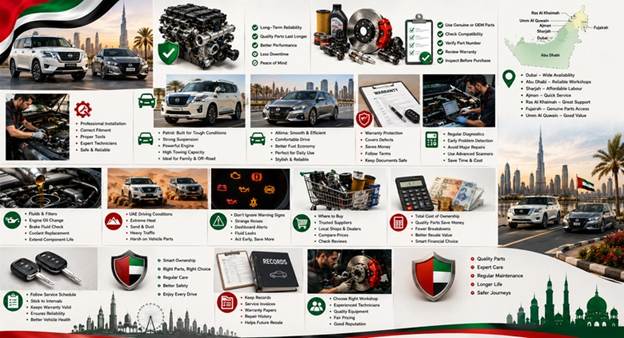
Key Takeaways:
Buying replacement parts for a Nissan Patrol or Nissan Altima is about much more than comparing prices.
The cost of the replacement component is only one part of the overall repair bill.
Labour charges, diagnostic testing, supporting parts, fluids and installation all contribute to the total ownership cost.
Understanding these expenses helps owners plan maintenance properly, avoid unexpected invoices and make smarter financial decisions throughout the life of the vehicle.
Whether you own a Nissan Patrol for family travel or a Nissan Altima for daily commuting, knowing the complete repair cost is just as important as selecting the correct replacement part.
Spare Parts Cost Overview
| Cost Category | Nissan Patrol | Nissan Altima |
| Replacement Parts | High | Medium |
| Labour Charges | High | Medium |
| Diagnostic Charges | Medium | Medium |
| Cooling System Repairs | High | Medium |
| Suspension Repairs | High | Medium |
| Routine Servicing | Medium | Medium |
Many owners compare only the advertised price of a replacement part.
Professional workshops never do.
They calculate the complete repair budget before beginning any work.
That approach prevents unexpected costs later.
Nissan Patrol Spare Parts Price Guide
The Patrol is a larger and heavier vehicle.
Naturally, some replacement components cost more because they are designed for demanding workloads.
Frequently replaced components include:
- Shock absorbers.
- Control arms.
- Brake discs.
- Brake pads.
- Radiators.
- Water pumps.
- Alternators.
- Steering racks.
- Air-conditioning compressors.
- Suspension bushes.
Routine maintenance helps extend the life of these components and reduces long-term ownership costs.
Nissan Altima Spare Parts Price Guide
The Altima generally costs less to maintain than the Patrol.
However, neglecting routine servicing can quickly increase repair expenses.
Common replacement components include:
- Brake pads.
- Spark plugs.
- Ignition coils.
- Alternators.
- Engine mounts.
- CVT transmission service components.
- Radiators.
- Suspension links.
- Batteries.
- Air-conditioning compressors.
Replacing ageing components before complete failure usually keeps maintenance affordable.
Labour Costs Across the UAE
Labour charges vary depending on:
- Workshop experience.
- Repair complexity.
- Vehicle model.
- Equipment required.
- Workshop location.
Typical Labour Cost Comparison
| Repair | Typical Labour Cost (AED) |
| Brake Pad Replacement | 150–400 |
| Alternator Replacement | 250–600 |
| Radiator Replacement | 350–800 |
| Suspension Repair | 400–1,000 |
| Steering Rack Replacement | 900–2,200 |
| Gearbox Installation | 2,000–4,500 |
| Engine Replacement | 3,000–7,000 |
Choosing an experienced workshop often saves money over the long term because quality workmanship reduces repeat repairs.
Hidden Costs Buyers Often Overlook
Many repair quotations include expenses that owners do not initially consider.
Additional costs may include:
- Diagnostic scanning.
- Engine oil.
- Coolant.
- Brake fluid.
- Transmission fluid.
- Seals.
- Gaskets.
- Mounting clips.
- Electronic programming.
- Wheel alignment.
- Delivery charges.
Individually these costs may appear small.
Together they can significantly increase the final repair bill.
Total Repair Budget Planning
Professional workshops prepare complete repair estimates before starting work.
A complete repair budget should include:
- Replacement part.
- Labour.
- Diagnostic testing.
- Fluids.
- Supporting components.
- Delivery charges.
- VAT where applicable.
Example Repair Budget
| Item | Estimated Cost (AED) |
| Steering Rack | 2,100 |
| Labour | 1,200 |
| Wheel Alignment | 250 |
| Steering Fluid | 180 |
| Supporting Components | 220 |
| Total Estimated Budget | 3,950 |
Knowing the complete repair cost before authorising work allows owners to make informed financial decisions.
Reducing Long-Term Maintenance Costs
The lowest-priced repair is not always the most economical over several years.
Owners reduce long-term costs by:
- Following service schedules.
- Replacing worn parts early.
- Choosing quality replacement components.
- Keeping complete service records.
- Using experienced workshops.
- Inspecting related components during repairs.
Preventative maintenance almost always costs less than emergency repairs.
Repair Costs Across Different Emirates
Labour costs vary slightly across the UAE.
| Emirate | Typical Labour Cost Level |
| Dubai | Medium to High |
| Abu Dhabi | Medium to High |
| Sharjah | Medium |
| Ajman | Medium |
| Ras Al Khaimah | Medium |
| Fujairah | Medium |
| Umm Al Quwain | Medium to Low |
Price alone should never determine where a repair is completed.
Experience and workmanship provide better long-term value.
Cost of Delaying Repairs
Small problems rarely remain small.
Delaying repairs may result in:
- Secondary component damage.
- Additional labour.
- Increased downtime.
- Higher fuel consumption.
- Larger repair bills.
- Reduced vehicle reliability.
Replacing a worn suspension bush today may prevent replacing an entire control arm tomorrow.
Small repairs often prevent major expenses.
Workshop Story:
A Nissan Altima owner from Dubai delayed replacing worn brake pads because braking performance still felt acceptable.
Several weeks later, inspection revealed damaged brake discs as well.
The repair now required additional parts and increased labour costs.
At the same time, a Nissan Patrol owner from Abu Dhabi approved replacement of ageing radiator hoses during routine servicing.
A few weeks later, temperatures exceeded 45°C across the UAE.
The Patrol completed several long journeys without experiencing overheating.
Before leaving the workshop, the owner smiled.
"Replacing those hoses early turned out to be a good decision."
The technician replied,
"Preventative maintenance almost always costs less than emergency repairs."
That principle remains true for almost every vehicle.
Cost Comparison
| Maintenance Strategy | Immediate Cost | Long-Term Ownership Cost |
| Cheapest Available Parts | Lowest | Highest |
| Quality OEM Parts | Medium | Low |
| Genuine Nissan Parts | Highest | Lowest |
| Preventative Maintenance | Medium | Lowest Overall |
Looking beyond today's repair bill consistently produces the best ownership value.
Buyer Decision Matrix:
| Ownership Situation | Recommended Financial Strategy |
| Daily commuting | Maintain regular servicing. |
| High-mileage Patrol | Budget for suspension and cooling system inspections. |
| High-mileage Altima | Prioritise transmission servicing and brake maintenance. |
| Family vehicle | Invest in quality safety-related components. |
| Long-term ownership | Compare complete repair costs rather than individual part prices. |
| Older vehicle | Balance repair costs with overall vehicle value before major repairs. |
Suggested Blog Visual:
Infographic Theme: Nissan Patrol and Altima Maintenance Costs in UAE
Include realistic visuals of:
- Nissan Patrol.
- Nissan Altima.
- Calculator.
- AED currency symbol.
- Brake components.
- Suspension parts.
- Radiator.
- Engine.
- Mechanic preparing a repair quotation.
- Invoice.
- Warranty certificate.
- UAE skyline featuring Dubai, Abu Dhabi and Sharjah with subtle red, green, white and black accents inspired by the national flag.
Keep wording extremely limited.
Allow the visuals to demonstrate repair budgeting, labour costs and long-term ownership planning.
Smart Buyer's Checklist:
Before approving any major repair:
- Confirm the diagnosis.
- Request an itemised quotation.
- Verify the VIN.
- Match the Nissan part number.
- Understand labour charges.
- Budget for fluids and supporting components.
- Review warranty conditions.
- Compare complete repair costs.
- Keep all invoices.
- Follow the recommended maintenance schedule after repairs.
The total cost of ownership is determined by every maintenance decision, not by a single repair.
Key Takeaways:
Maintaining a Nissan Patrol or Nissan Altima involves much more than purchasing replacement parts. Labour charges, diagnostics, fluids, supporting components and preventative servicing all contribute to the total cost of ownership. Owners who understand these expenses can budget more effectively while avoiding unnecessary surprises.
Investing in quality replacement parts, choosing experienced workshops and following regular maintenance schedules consistently delivers lower long-term ownership costs, greater reliability and stronger resale value across the UAE.
Buying the Right Spare Parts Online
Key Takeaways:
Finding the correct replacement part for a Nissan Patrol or Nissan Altima involves much more than searching by vehicle model.
Many components appear identical.
Some even share similar product photographs.
Yet a small difference in production year, engine specification, trim level or transmission can make one component completely incompatible with another vehicle.
Professional workshops rarely order parts using appearance alone.
They rely on VIN verification, Nissan part numbers and supplier expertise to ensure every replacement component fits correctly the first time.
That same approach helps owners avoid unnecessary delays, returns and additional labour costs.
Spare Parts Verification Overview
| Verification Method | Importance |
| VIN Verification | Essential |
| Nissan Part Number | Essential |
| Production Year | High |
| Engine Specification | High |
| Transmission Type | High |
| Supplier Confirmation | Very High |
Ordering the correct replacement part begins long before payment.
It begins with identifying the vehicle accurately.
Owners who spend a few extra minutes verifying compatibility usually save hours of inconvenience later.
Using VIN to Find Compatible Parts
Every Nissan Patrol and Nissan Altima carries a unique Vehicle Identification Number.
The VIN provides detailed information including:
- Production year.
- Engine specification.
- Transmission type.
- Factory equipment.
- Original build configuration.
- Market specification.
Professional suppliers request the VIN because it dramatically reduces compatibility errors.
Supplying the VIN is one of the simplest ways to receive the correct replacement component.
Understanding Nissan Part Numbers
Every genuine Nissan component carries its own identification number.
This number removes guesswork from the buying process.
Matching the correct part number confirms:
- Exact compatibility.
- Factory specification.
- Correct replacement version.
- Suitable production revision.
Two alternators may look identical.
Only one may fit your specific vehicle.
The Nissan part number confirms the difference.
Comparing Online Spare Parts Suppliers
The internet offers thousands of replacement parts.
Not every supplier offers the same level of service.
When comparing suppliers, consider:
- Product availability.
- Warranty coverage.
- Delivery times.
- Customer reviews.
- Technical support.
- Return policy.
- Compatibility assistance.
If you're comparing multiple suppliers before placing an order, platforms such as PartFinder UAE can help you request quotations from different spare parts suppliers, making it easier to compare availability, pricing and compatibility before making a final decision.
Choosing a knowledgeable supplier often proves more valuable than choosing the cheapest quotation.
Common Online Buying Mistakes
Most expensive ordering mistakes are entirely preventable.
The most common errors include:
- Ordering without the VIN.
- Ignoring Nissan part numbers.
- Selecting components using photographs only.
- Buying purely on price.
- Overlooking warranty conditions.
- Forgetting delivery costs.
- Ordering incorrect production revisions.
- Ignoring supporting components.
Correct information prevents costly mistakes.
Assumptions usually create them.
Warranty, Returns and Delivery Policies
Warranty protection reflects the supplier's confidence in the product.
Before placing an order, buyers should understand:
- Warranty duration.
- Claim procedures.
- Return conditions.
- Delivery schedule.
- Exchange policy.
- Packaging standards.
A slightly higher purchase price may provide considerably stronger after-sales support.
That additional protection often proves worthwhile.
Why Supporting Components Should Be Purchased Together
Replacing one component frequently creates an opportunity to renew other wear items.
Examples include:
- Brake pads with brake discs.
- Radiator hoses with radiators.
- Transmission fluid with gearbox servicing.
- Bushes with suspension arms.
- Mounts with engine replacements.
- Seals with steering components.
Replacing related parts together often reduces future labour costs.
It also improves long-term reliability.
Inspecting Replacement Parts Before Installation
The delivery has arrived.
Installation should not begin immediately.
Inspect the component for:
- Transport damage.
- Cracks.
- Broken connectors.
- Corrosion.
- Missing hardware.
- Incorrect labels.
- Damaged packaging.
If any concern exists, contact the supplier before installation.
Most return policies require the component to remain unused.
Inspection first.
Installation second.
Building Relationships with Reliable Suppliers
Many experienced workshops continue purchasing from the same suppliers for years.
The reason is simple.
Consistency.
Reliable suppliers provide:
- Accurate advice.
- Faster support.
- Better compatibility.
- Strong warranty assistance.
- Dependable delivery.
Trust becomes increasingly valuable during major repairs.
A reliable supplier contributes to successful ownership.
Workshop Story:
A Nissan Altima owner from Sharjah ordered a replacement alternator after comparing several online advertisements.
The lowest-priced option looked identical to the original component.
Before completing the purchase, the workshop requested the VIN.
The advertised alternator belonged to a different engine specification.
A specialist supplier identified the correct replacement within minutes.
The alternator arrived the following morning.
Installation proceeded without modification.
During the same week, a Patrol owner from Dubai required replacement suspension control arms.
The workshop compared three suppliers.
The chosen supplier verified the VIN, confirmed availability and supplied matching components for both sides of the vehicle.
The repair was completed during a single visit.
Before leaving, the Patrol owner commented,
"I didn't realise such similar-looking parts could be completely different."
The technician smiled.
"The right information is usually worth far more than the lowest price."
That simple principle explains why professional workshops verify compatibility before every major order.
Spare Parts Buying Comparison
| Buying Method | Risk Level | Overall Reliability |
| Search by Photograph | High | Moderate |
| Search by Model Only | Medium | Good |
| Nissan Part Number | Low | Excellent |
| VIN Verification | Very Low | Outstanding |
| VIN + Part Number + Supplier Confirmation | Lowest | Maximum Confidence |
The more information available before ordering, the lower the likelihood of compatibility problems.
Buyer Decision Matrix:
| Buying Situation | Recommended Action |
| Engine replacement | Verify VIN, engine code and part number before ordering. |
| Transmission repair | Match transmission specification carefully. |
| Suspension replacement | Confirm production year and suspension configuration. |
| Electrical component purchase | Verify software and connector compatibility. |
| Body panel replacement | Match trim level and factory equipment. |
| Routine servicing | Confirm genuine or OEM compatibility before purchasing. |
Suggested Blog Visual:
Infographic Theme: How to Buy the Correct Nissan Spare Parts in UAE
Include realistic visuals of:
- Nissan Patrol.
- Nissan Altima.
- VIN identification plate.
- Genuine Nissan part number label.
- Laptop comparing suppliers.
- Smartphone displaying spare parts listings.
- Delivery parcel.
- Warranty certificate.
- Mechanic checking compatibility.
- Suspension arm.
- Alternator.
- Radiator.
- UAE skyline featuring Dubai, Abu Dhabi and Sharjah with subtle red, green, white and black accents inspired by the national flag.
Keep wording extremely limited.
Allow the visuals to communicate compatibility verification, supplier comparison and confident online purchasing.
Smart Buyer's Checklist:
Before ordering any Nissan Patrol or Altima spare part online:
- Confirm the vehicle diagnosis.
- Verify the VIN.
- Match the Nissan part number.
- Confirm engine and transmission specifications.
- Compare multiple suppliers.
- Review customer feedback.
- Understand warranty conditions.
- Inspect delivery and return policies.
- Check the replacement part immediately after delivery.
- Keep all purchase invoices and warranty documents.
Buying the correct replacement component once is almost always less expensive than ordering the wrong one twice.
Key Takeaways:
Choosing the correct spare part for a Nissan Patrol or Nissan Altima depends on accurate verification rather than guesswork. VIN confirmation, Nissan part numbers, supplier expertise and careful comparison of warranty and delivery policies all contribute to successful repairs while reducing unnecessary costs and delays.
Owners who follow a structured buying process consistently enjoy smoother repairs, greater reliability and stronger long-term ownership value.
Long-Term Ownership and Preventative Maintenance
Key Takeaways:
Owning a Nissan Patrol or Nissan Altima is about much more than repairing components when they fail.
The most reliable vehicles are usually maintained before problems become serious.
Preventative maintenance extends component lifespan, improves safety, reduces unexpected breakdowns and lowers overall ownership costs. In the demanding UAE climate, where extreme temperatures and long journeys place continuous pressure on every mechanical system, routine maintenance becomes one of the smartest financial decisions an owner can make.
Professional workshops rarely wait for parts to fail completely.
They identify ageing components early and replace them before they damage surrounding systems.
Long-Term Maintenance Overview
| Maintenance Area | Nissan Patrol | Nissan Altima |
| Cooling System | Very High Priority | High Priority |
| Suspension | High Priority | Medium Priority |
| Transmission | High Priority | Very High Priority |
| Brake System | High Priority | High Priority |
| Air Conditioning | Very High Priority | Very High Priority |
| Electrical System | Medium Priority | Medium Priority |
Every kilometre driven affects the vehicle.
Most wear occurs gradually.
Not suddenly.
That gradual wear gives owners an opportunity.
Replacing ageing components early often costs considerably less than repairing major failures later.
Preventative Maintenance for Nissan Patrol
The Patrol is designed for demanding conditions.
Its maintenance schedule should reflect that capability.
Owners should regularly inspect:
- Suspension components.
- Cooling system.
- Transfer case.
- Differentials.
- Brake system.
- Steering components.
- Engine mounts.
- Underbody protection.
Vehicles used for towing or off-road driving require even more frequent inspections.
Heavy workloads accelerate normal wear.
Preventative Maintenance for Nissan Altima
The Altima rewards consistent servicing.
Routine maintenance helps preserve smooth performance and fuel efficiency.
Key maintenance areas include:
- Engine oil and filters.
- CVT transmission servicing.
- Brake components.
- Cooling system.
- Battery health.
- Air-conditioning performance.
- Suspension links.
- Ignition components.
Ignoring routine servicing often leads to much larger repair bills later.
Small maintenance tasks produce significant long-term savings.
Protecting Your Vehicle in UAE Conditions
Few climates challenge vehicles as consistently as the UAE.
Daily exposure to high temperatures places additional strain on many systems.
The environment commonly affects:
- Radiators.
- Coolant hoses.
- Air-conditioning compressors.
- Batteries.
- Rubber bushes.
- Tyres.
- Brake fluid.
- Plastic exterior trim.
Regular inspections before and during summer help identify ageing components before failures occur.
Heat rarely causes problems instantly.
It accelerates existing wear.
Service Intervals That Help Prevent Major Repairs
Manufacturers design service schedules for good reason.
Routine servicing allows technicians to identify developing faults before they become expensive.
Regular servicing should include:
- Engine oil replacement.
- Filter replacement.
- Brake inspection.
- Suspension inspection.
- Battery testing.
- Cooling system checks.
- Fluid level inspection.
- Diagnostic scanning where appropriate.
Skipping scheduled servicing often shortens component lifespan.
Consistency remains one of the best forms of preventative maintenance.
Replacing Supporting Components Together
Many repairs involve more than one worn component.
Replacing related items during the same workshop visit often reduces future labour costs.
Examples include:
- Brake discs with brake pads.
- Radiator hoses with radiator replacement.
- Engine mounts during engine repairs.
- Suspension bushes with control arms.
- Transmission fluid during gearbox servicing.
- Wheel bearings during hub replacement.
Professional workshops frequently recommend this approach because it improves long-term reliability.
Protecting Resale Value Through Proper Maintenance
A well-maintained Nissan attracts stronger buyer confidence.
Future owners appreciate vehicles with documented maintenance histories.
Keep records of:
- Service invoices.
- Replacement parts.
- Warranty documents.
- Diagnostic reports.
- Workshop inspections.
- Fluid changes.
- Brake servicing.
- Major repairs.
Complete documentation demonstrates responsible ownership.
It also supports stronger resale negotiations.
Small Repairs Prevent Larger Expenses
One worn component often affects another.
A leaking radiator hose may eventually overheat the engine.
Worn brake pads can damage brake discs.
Ageing suspension bushes may accelerate tyre wear.
Replacing small components early protects:
- Engine reliability.
- Transmission performance.
- Steering precision.
- Braking efficiency.
- Suspension geometry.
- Fuel economy.
Minor repairs rarely remain minor when ignored.
Building a Long-Term Maintenance Strategy
Experienced owners rarely maintain their vehicles by reacting to failures.
Instead...
They follow a structured plan.
An effective maintenance strategy includes:
- Scheduled servicing.
- Seasonal inspections.
- Quality replacement parts.
- Reliable workshops.
- Organised maintenance records.
- Early diagnosis.
- Preventative repairs.
Long-term planning reduces emergency repairs.
Emergency repairs usually cost more.
Workshop Story:
A Nissan Patrol owner from Al Ain prepared the vehicle for a family holiday involving long motorway journeys and mountain roads.
Although the Patrol performed normally, the workshop recommended replacing ageing coolant hoses and worn front brake pads during a scheduled service.
The owner approved the work.
Several weeks later, another Patrol arrived after overheating on a similar journey because a deteriorated hose had burst unexpectedly.
During the same period, a Nissan Altima owner from Dubai authorised a routine transmission service despite experiencing no obvious problems.
Inspection revealed early signs of fluid contamination.
Fresh transmission fluid and a filter replacement restored smooth operation and helped prevent premature wear.
When collecting the vehicle, the owner commented,
"It felt unnecessary before the service."
The technician replied,
"Preventative maintenance usually feels unnecessary—until the day it prevents a breakdown."
That philosophy explains why experienced workshops encourage early intervention.
Long-Term Maintenance Comparison
| Maintenance Strategy | Immediate Cost | Five-Year Ownership Cost | Reliability |
| Reactive Repairs Only | Low | Highest | Moderate |
| Scheduled Maintenance | Medium | Low | Excellent |
| Genuine or Quality OEM Parts | Medium to High | Very Low | Outstanding |
| Preventative Repairs | Medium | Lowest Overall | Outstanding |
The most economical ownership strategy rarely involves delaying maintenance.
Buyer Decision Matrix:
| Ownership Goal | Recommended Maintenance Strategy |
| Daily commuting | Follow every scheduled service interval. |
| Family vehicle | Prioritise cooling, brakes and suspension inspections. |
| Desert driving | Increase suspension and underbody inspections. |
| High-mileage Altima | Monitor transmission and cooling systems closely. |
| High-mileage Patrol | Inspect drivetrain and steering components regularly. |
| Long-term ownership | Maintain complete service records and replace ageing components proactively. |
Suggested Blog Visual:
Infographic Theme: Preventative Maintenance for Nissan Patrol and Altima
Include realistic visuals of:
- Nissan Patrol.
- Nissan Altima.
- Engine oil service.
- Brake inspection.
- Radiator.
- Battery.
- Air-conditioning compressor.
- Suspension components.
- Mechanic performing routine servicing.
- Service history folder.
- Shield representing long-term reliability.
- UAE skyline featuring Dubai, Abu Dhabi and Sharjah with subtle red, green, white and black accents inspired by the national flag.
Keep wording extremely limited.
Allow the visuals to communicate preventative maintenance, long-term ownership and vehicle reliability.
Smart Buyer's Checklist:
Before planning your next maintenance visit:
- Review the manufacturer's service schedule.
- Inspect cooling system components.
- Check brake condition.
- Test battery performance.
- Monitor transmission behaviour.
- Replace worn supporting components together.
- Keep every maintenance invoice.
- Use quality replacement parts.
- Arrange inspections before summer.
- Address minor faults before they become major repairs.
Preventative maintenance is not an additional expense.
It is one of the most effective ways to reduce the total cost of owning a Nissan Patrol or Nissan Altima.
Key Takeaways:
Preventative maintenance remains the most effective strategy for extending the life of both the Nissan Patrol and Nissan Altima. Regular servicing, early diagnosis and timely replacement of ageing components help owners avoid expensive breakdowns while maintaining reliability, safety and performance in demanding UAE driving conditions.
Owners who follow structured maintenance schedules, keep organised service records and invest in quality replacement parts consistently achieve lower long-term ownership costs and stronger resale value.
Smart Ownership Strategies
Key Takeaways:
Owning a Nissan Patrol or Nissan Altima successfully is not simply about replacing worn components.
It is about developing habits that reduce breakdowns, improve reliability and protect the vehicle's long-term value.
Experienced owners rarely wait until something fails completely.
They maintain organised service records, build relationships with trusted workshops and make informed decisions about whether to repair or replace ageing components.
Across the UAE, these habits consistently reduce ownership costs while improving reliability throughout the life of the vehicle.
Smart Ownership Overview
| Ownership Strategy | Long-Term Benefit |
| Complete Service History | Higher resale value |
| Trusted Workshop | Better repair quality |
| Preventative Maintenance | Fewer unexpected failures |
| Quality Replacement Parts | Longer component lifespan |
| Early Fault Diagnosis | Lower repair costs |
| Organised Documentation | Easier warranty claims |
Every repair tells part of a vehicle's story.
A well-maintained Nissan usually reaches high mileage with fewer unexpected problems.
The difference rarely comes from luck.
It comes from consistency.
Building a Complete Service History
Service records are among the most valuable documents a vehicle owner can keep.
They demonstrate responsible ownership while providing valuable maintenance information.
Maintain records of:
- Routine servicing.
- Brake replacements.
- Suspension repairs.
- Cooling system maintenance.
- Transmission servicing.
- Battery replacement.
- Major engine repairs.
- Electrical diagnostics.
A complete service history increases buyer confidence when the vehicle is eventually sold.
Documentation protects value.
Comparing Repair Costs with Replacement Costs
Every owner eventually faces the same decision.
Should the damaged component be repaired?
Or replaced?
The answer depends on several factors.
Consider:
- Overall component condition.
- Labour costs.
- Remaining service life.
- Warranty availability.
- Vehicle mileage.
- Safety implications.
- Future maintenance requirements.
Repair vs Replacement Comparison
| Situation | Better Choice |
| Minor cosmetic damage | Repair |
| Structural damage | Replace |
| Repeated mechanical failure | Replace |
| Safety-related component | Replace |
| Minor electrical fault | Professional diagnosis first |
| Wear item approaching service limit | Planned replacement |
Making the correct decision often reduces ownership costs significantly.
Choosing Trusted Workshops
The quality of the workshop influences every repair.
An experienced technician does more than replace parts.
They identify developing faults before they become expensive.
Look for workshops that offer:
- Professional diagnostics.
- Experienced technicians.
- Clear quotations.
- Genuine or quality OEM parts.
- Warranty support.
- Transparent communication.
Good workmanship protects every replacement component.
Fleet Maintenance Advice for Nissan Patrol
Many Patrol vehicles serve commercial operators, security companies and businesses throughout the UAE.
Fleet operators prioritise reliability above everything else.
Successful fleet maintenance includes:
- Scheduled inspections.
- Planned component replacement.
- Driver feedback.
- Consistent servicing.
- Preventative repairs.
- Organised maintenance records.
Downtime often costs more than replacement parts.
Keeping vehicles operational remains the primary objective.
Daily Driver Maintenance Tips for Nissan Altima
The Altima is frequently used for commuting.
Daily stop-start traffic creates predictable maintenance requirements.
Owners should monitor:
- Brake wear.
- Transmission performance.
- Cooling system efficiency.
- Battery condition.
- Tyre wear.
- Suspension comfort.
- Engine warning lights.
Responding quickly to minor changes usually prevents major repairs.
Routine observation becomes part of responsible ownership.
Maximising Long-Term Ownership Value
Every maintenance decision contributes to the vehicle's future value.
Owners improve long-term value by:
- Following service schedules.
- Using quality replacement parts.
- Keeping detailed invoices.
- Repairing faults promptly.
- Maintaining a clean interior and exterior.
- Choosing experienced workshops.
Vehicles with organised maintenance histories consistently attract greater buyer confidence.
Reliability enhances resale value.
Building Long-Term Relationships with Suppliers and Workshops
Many experienced owners continue using the same workshop for years.
The same principle applies to spare parts suppliers.
Trusted relationships often provide:
- Better technical advice.
- Faster parts sourcing.
- Accurate compatibility checks.
- Reliable warranty support.
- Consistent repair quality.
Long-term relationships create confidence.
Confidence reduces ownership stress.
Planning Maintenance Instead of Reacting to Breakdowns
Reactive maintenance often proves expensive.
Planned maintenance usually proves economical.
A smart ownership plan includes:
- Annual inspections.
- Seasonal cooling system checks.
- Brake inspections before long journeys.
- Battery testing before summer.
- Suspension inspections after off-road driving.
- Fluid replacements at recommended intervals.
Preparation reduces emergency repairs.
Emergency repairs usually cost more.
Workshop Story:
A Nissan Patrol owner from Dubai kept detailed maintenance records from the day the vehicle was purchased.
Every service, inspection and replacement component was documented.
After several years of ownership, the vehicle developed a minor steering vibration.
Because previous repairs were well documented, the workshop quickly identified that the steering rack had already been replaced recently.
Further inspection revealed worn suspension bushes instead.
The correct repair was completed immediately.
Meanwhile, a Nissan Altima owner from Sharjah arrived with no maintenance records after purchasing the vehicle privately.
The workshop needed additional diagnostic time simply to determine which components had previously been replaced.
The repair took longer and cost more.
Before leaving, the Patrol owner commented,
"Keeping records seemed unnecessary at first."
The technician smiled.
"Good documentation saves time long after the repair has been completed."
That lesson applies to every vehicle owner.
Ownership Strategy Comparison
| Ownership Approach | Immediate Cost | Long-Term Value | Reliability |
| Reactive Maintenance | Low | Moderate | Moderate |
| Scheduled Servicing | Medium | Excellent | Excellent |
| Preventative Repairs | Medium | Outstanding | Outstanding |
| Quality Parts with Complete Records | Medium to High | Maximum | Outstanding |
Careful planning almost always reduces long-term ownership costs.
Buyer Decision Matrix:
| Ownership Goal | Recommended Strategy |
| Daily commuting | Follow every scheduled service interval. |
| Family ownership | Prioritise preventative maintenance and quality repairs. |
| Commercial Patrol | Minimise downtime through planned servicing. |
| High-mileage Altima | Monitor transmission, cooling and braking systems closely. |
| Preparing for resale | Maintain complete documentation and repair records. |
| Long-term ownership | Build relationships with trusted workshops and suppliers. |
Suggested Blog Visual:
Infographic Theme: Smart Ownership for Nissan Patrol and Altima
Include realistic visuals of:
- Nissan Patrol.
- Nissan Altima.
- Service history folder.
- Mechanic inspecting a vehicle.
- Brake components.
- Suspension system.
- Cooling system.
- Warranty certificate.
- Calculator representing ownership costs.
- Trusted workshop environment.
- UAE skyline featuring Dubai, Abu Dhabi and Sharjah with subtle red, green, white and black accents inspired by the national flag.
Keep wording extremely limited.
Allow the visuals to communicate organised maintenance, trusted workshops and long-term ownership planning.
Smart Buyer's Checklist:
To maximise long-term ownership value:
- Keep complete maintenance records.
- Follow scheduled servicing.
- Repair faults early.
- Use quality replacement parts.
- Choose experienced workshops.
- Inspect the vehicle before long journeys.
- Replace ageing wear components proactively.
- Retain every invoice and warranty document.
- Monitor warning lights immediately.
- Think about long-term reliability rather than short-term savings.
The most reliable Nissan Patrols and Altimas rarely receive emergency repairs.
They receive consistent maintenance.
Key Takeaways:
Smart ownership is built on planning rather than reacting. Keeping detailed service records, following preventative maintenance schedules, choosing trusted workshops and investing in quality replacement parts all contribute to lower repair costs, greater reliability and stronger resale value throughout the ownership journey.
Owners who adopt these habits consistently enjoy fewer unexpected breakdowns and better long-term value from both the Nissan Patrol and Nissan Altima.
Professional Advice from UAE Workshops
Key Takeaways:
Every experienced workshop follows one principle.
Prevent problems before they become expensive repairs.
Professional technicians work on hundreds of Nissan Patrols and Nissan Altimas every year. Over time, they begin to recognise predictable wear patterns, common owner mistakes and maintenance habits that consistently improve vehicle reliability.
Their recommendations are rarely based on theory.
They come from real repairs, real vehicles and real UAE driving conditions.
Owners who follow professional workshop advice often spend less on repairs over the lifetime of their vehicle while enjoying greater reliability and stronger resale value.
Professional Workshop Advice Overview
| Professional Recommendation | Long-Term Benefit |
| Routine Inspections | Early fault detection |
| Scheduled Servicing | Reduced repair costs |
| Quality Replacement Parts | Greater reliability |
| Correct Diagnosis | Prevents unnecessary repairs |
| Preventative Maintenance | Longer component lifespan |
| Complete Documentation | Higher resale value |
Professional workshops rarely wait until a vehicle breaks down.
They identify warning signs long before complete component failure occurs.
That proactive approach protects both the vehicle and the owner's budget.
Common Workshop Advice for Patrol Owners
The Nissan Patrol is designed for demanding use.
Whether driven on motorways, through city traffic or across desert terrain, it benefits from regular inspections.
Professional technicians recommend checking:
- Suspension components.
- Steering system.
- Cooling system.
- Differential oil.
- Transfer case.
- Brake components.
- Underbody protection.
- Engine mounts.
Heavy-duty vehicles often continue operating despite developing faults.
Routine inspections identify those faults before secondary damage occurs.
Common Workshop Advice for Altima Owners
The Nissan Altima is frequently used for everyday commuting.
Stop-start traffic places continuous stress on several systems.
Experienced workshops usually recommend monitoring:
- CVT transmission performance.
- Cooling system.
- Brake condition.
- Battery health.
- Ignition components.
- Suspension links.
- Engine oil quality.
- Air-conditioning efficiency.
Small performance changes often provide early warning of developing problems.
Prompt diagnosis usually reduces repair costs.
Seasonal Maintenance Before UAE Summer
Summer preparation remains one of the most valuable maintenance habits.
Extreme temperatures affect almost every mechanical system.
Professional pre-summer inspections typically include:
- Battery testing.
- Radiator inspection.
- Coolant condition.
- Air-conditioning performance.
- Cooling fan operation.
- Drive belts.
- Tyre condition.
- Brake fluid inspection.
Preparing before temperatures rise significantly reduces the likelihood of roadside breakdowns.
Mistakes That Increase Repair Costs
Professional workshops regularly encounter the same avoidable mistakes.
The most common include:
- Ignoring warning lights.
- Delaying routine servicing.
- Buying incorrect replacement parts.
- Choosing parts based only on price.
- Skipping transmission servicing.
- Ignoring fluid leaks.
- Postponing brake repairs.
- Failing to inspect supporting components.
These mistakes rarely save money.
They usually increase future repair costs.
Professional Buying Habits That Save Money
Experienced technicians rarely purchase replacement parts impulsively.
Their buying process usually includes:
- VIN verification.
- Nissan part number confirmation.
- Supplier comparison.
- Warranty review.
- Compatibility checks.
- Inspection upon delivery.
Professional preparation prevents expensive ordering errors.
Knowledge reduces unnecessary spending.
When to Replace Instead of Repair
Some components can be repaired successfully.
Others should be replaced.
Professional workshops evaluate several factors before making recommendations.
They consider:
- Safety.
- Structural integrity.
- Labour costs.
- Future reliability.
- Warranty availability.
- Remaining service life.
Replacing severely worn components often provides greater long-term value than repeated repairs.
Professional Maintenance Habits Worth Following
Many successful Nissan owners adopt the same habits as experienced technicians.
They routinely:
- Inspect fluid levels.
- Listen for unusual noises.
- Check tyre condition.
- Monitor warning lights.
- Schedule preventative servicing.
- Keep organised maintenance records.
- Replace wear components before complete failure.
Simple habits consistently prevent expensive repairs.
Consistency remains one of the strongest predictors of long-term reliability.
Why Early Diagnosis Always Wins
Mechanical failures rarely appear without warning.
Professional workshops rely on early diagnosis because it protects surrounding components.
Early inspections commonly prevent:
- Engine overheating.
- Brake disc damage.
- Suspension wear.
- Transmission failure.
- Electrical breakdowns.
- Steering damage.
Finding one worn component early often prevents replacing several others later.
Workshop Story:
A Nissan Patrol owner from Fujairah prepared for an extended family trip across the UAE.
Although the vehicle performed normally, the workshop suggested a routine inspection before departure.
Testing revealed an ageing battery and worn front brake pads.
Both components were replaced before the journey.
The owner completed more than a thousand kilometres without difficulty.
A few days later, a Nissan Altima owner from Abu Dhabi ignored an intermittent battery warning light because the vehicle continued starting normally.
Eventually, the alternator failed during evening traffic.
The battery discharged completely before reaching the workshop.
The repair required additional recovery costs that could easily have been avoided.
When collecting the Patrol, the owner commented,
"That inspection probably saved the holiday."
The technician smiled.
"Routine inspections rarely seem important until they prevent a breakdown."
That simple philosophy explains why experienced workshops recommend preventative maintenance rather than reactive repairs.
Professional Advice Comparison
| Workshop Approach | Short-Term Cost | Long-Term Benefit |
| Reactive Repairs | Low | Moderate |
| Scheduled Inspections | Medium | Excellent |
| Preventative Maintenance | Medium | Outstanding |
| Quality Parts with Professional Installation | Medium to High | Maximum Reliability |
Experienced workshops focus on reducing total ownership costs rather than simply completing individual repairs.
Buyer Decision Matrix:
| Ownership Situation | Professional Recommendation |
| Daily commuting | Follow every scheduled service interval. |
| Desert driving | Increase suspension and cooling system inspections. |
| Family vehicle | Prioritise brake and tyre safety before long journeys. |
| High-mileage Patrol | Monitor drivetrain and steering components regularly. |
| High-mileage Altima | Maintain the transmission and cooling system proactively. |
| Preparing for summer | Complete a full preventative inspection before extreme temperatures arrive. |
Suggested Blog Visual:
Infographic Theme: Professional Workshop Advice for Nissan Patrol and Altima Owners
Include realistic visuals of:
- Nissan Patrol.
- Nissan Altima.
- Professional mechanic performing diagnostics.
- Brake inspection.
- Battery testing.
- Radiator and cooling system.
- Suspension components.
- Diagnostic scanner.
- Warranty folder.
- Service checklist.
- UAE skyline featuring Dubai, Abu Dhabi and Sharjah with subtle red, green, white and black accents inspired by the national flag.
Keep wording extremely limited.
Allow the visuals to communicate preventative maintenance, professional inspections and long-term reliability.
Smart Buyer's Checklist:
Before leaving the workshop after any major repair:
- Review the completed work.
- Request replaced components if appropriate.
- Confirm warranty coverage.
- Check all fluid levels.
- Verify warning lights are cleared.
- Test-drive the vehicle.
- Keep the repair invoice.
- Schedule the next recommended inspection.
- Monitor vehicle performance over the following days.
- Report unusual symptoms immediately.
Professional maintenance is not about repairing more components.
It is about replacing the right components at the right time.
Key Takeaways:
Professional workshops consistently reduce ownership costs by focusing on early diagnosis, preventative maintenance and accurate repairs rather than waiting for complete mechanical failure. Their experience shows that routine inspections, quality replacement parts and structured servicing significantly improve the reliability and lifespan of both the Nissan Patrol and Nissan Altima.
Owners who adopt these professional habits enjoy fewer unexpected breakdowns, lower long-term repair costs and greater confidence in their vehicles throughout the demanding driving conditions found across the UAE.
Final Buyer's Guide and Expert Advice
Key Takeaways:
Every Nissan Patrol and Nissan Altima will eventually require replacement parts.
That is perfectly normal.
What separates inexpensive ownership from expensive ownership is not how often parts are replaced.
It is how intelligently those replacements are planned.
Throughout this guide, we've explored the components most commonly replaced, how UAE driving conditions affect vehicle lifespan, how to choose compatible parts, how to budget for repairs and why preventative maintenance consistently delivers better long-term value.
The final step is bringing all of that knowledge together into one practical ownership strategy.
Real Buyer Questions:
Professional workshops across the UAE hear similar questions every day.
Below are some of the most common concerns raised by Patrol and Altima owners.
Is the Nissan Patrol more expensive to maintain than the Altima?
Generally, yes.
The Patrol is a larger, heavier vehicle with more complex suspension and drivetrain components.
Routine servicing remains affordable, but major repairs typically cost more than comparable work on the Altima.
Should genuine Nissan parts always be my first choice?
For major mechanical, electrical and safety-related systems, genuine components remain an excellent investment.
Quality OEM parts can also provide outstanding reliability when sourced from reputable manufacturers.
Professionally inspected genuine used components may represent excellent value for selected repairs.
How can I avoid ordering the wrong replacement part?
Always verify:
- VIN.
- Nissan part number.
- Engine specification.
- Transmission type.
- Production year.
Professional compatibility checks reduce ordering mistakes dramatically.
How often should suspension be inspected?
For normal UAE driving, suspension inspections during scheduled servicing are recommended.
Vehicles used for towing or regular off-road driving should be inspected more frequently.
Is preventative maintenance really worth the cost?
Almost always.
Replacing a worn component before complete failure usually prevents additional damage to surrounding systems.
Preventative maintenance consistently lowers total ownership costs.
Future Trends in Nissan Spare Parts Availability in UAE:
The UAE automotive market continues to evolve rapidly.
Owners can expect:
- Faster nationwide delivery.
- Improved online stock visibility.
- Better VIN compatibility tools.
- Wider availability of genuine and OEM components.
- More transparent pricing.
- Enhanced warranty support.
- Improved diagnostic technology.
These developments will make maintaining Nissan Patrols and Altimas increasingly efficient over the coming years.
Complete Spare Parts Comparison Table:
| Spare Parts Type | Initial Cost | Reliability | Best Application |
| Genuine Nissan Parts | Highest | Outstanding | Major mechanical and safety systems |
| OEM Parts | Medium | Excellent | Routine maintenance and repairs |
| Genuine Used Parts | Medium | Very Good | Body panels and selected mechanical components |
| Quality Aftermarket Parts | Low to Medium | Good | Suitable non-critical applications from reputable brands |
The correct choice depends on the repair rather than price alone.
Long-term reliability should always influence the final decision.
Ultimate Nissan Patrol and Altima Buying Checklist:
Before purchasing any replacement part:
- Confirm the diagnosis.
- Verify the VIN.
- Match the Nissan part number.
- Check engine and transmission specifications.
- Compare several trusted suppliers.
- Review warranty conditions.
- Calculate the complete repair budget.
- Inspect supporting components.
- Examine replacement parts before installation.
- Keep every invoice and maintenance record.
Preparation consistently produces better ownership outcomes.
Workshop Story:
A Nissan Patrol owner from Dubai and a Nissan Altima owner from Abu Dhabi arrived at the same workshop on the same morning.
Both vehicles required replacement brake components.
The Patrol owner had maintained detailed service records and approved preventative brake servicing before any warning lights appeared.
The repair was completed quickly because every required component had already been identified.
The Altima owner had delayed replacing worn brake pads until braking performance noticeably deteriorated.
Inspection revealed damaged brake discs in addition to worn pads.
The repair required additional parts and more labour.
When both vehicles were collected later that afternoon, the Patrol owner asked whether replacing the pads early had really made a difference.
The workshop manager smiled.
"You replaced inexpensive parts before they damaged expensive ones."
The Altima owner nodded.
"Next time I'll pay attention sooner."
That conversation summarises the difference between preventative maintenance and reactive repairs.
One protects the vehicle.
The other simply responds after damage has already occurred.
Ownership Strategy Comparison:
| Ownership Style | Immediate Cost | Five-Year Cost | Reliability |
| Reactive Repairs | Lowest | Highest | Moderate |
| Routine Servicing | Medium | Low | Excellent |
| Preventative Maintenance | Medium | Lowest Overall | Outstanding |
| Genuine or Quality OEM Parts with Professional Installation | Medium to High | Excellent | Outstanding |
Thinking beyond today's repair bill consistently produces the lowest ownership costs over time.
Buyer Decision Matrix:
| Ownership Objective | Recommended Strategy |
| Daily commuting | Follow every scheduled service interval and monitor warning lights. |
| Family ownership | Prioritise brakes, cooling system and suspension inspections. |
| Commercial Patrol | Reduce downtime through planned maintenance and quality components. |
| High-mileage Altima | Service the transmission and cooling system proactively. |
| Preparing for resale | Maintain complete service documentation and repair records. |
| Long-term ownership | Invest in preventative maintenance and trusted workshops rather than reactive repairs. |
Suggested Blog Visual:
Infographic Theme: Complete Nissan Patrol and Altima Spare Parts Buying Guide
Include realistic visuals of:
- Nissan Patrol.
- Nissan Altima.
- Engine.
- Suspension assembly.
- Brake discs.
- Radiator.
- Battery.
- Air-conditioning compressor.
- VIN identification plate.
- Warranty certificate.
- Service history folder.
- Professional mechanic carrying out a final inspection.
- UAE skyline featuring Dubai, Abu Dhabi, Sharjah and subtle red, green, white and black accents inspired by the national flag.
Keep wording extremely limited.
Allow the visuals to summarise the complete ownership journey, from selecting the correct spare parts to maintaining long-term vehicle reliability.
Smart Buyer's Checklist:
Before making your final buying decision:
- Confirm the fault professionally.
- Verify the VIN.
- Match the Nissan part number.
- Compare genuine, OEM and quality replacement options.
- Review supplier reputation.
- Check warranty and return policies.
- Budget for labour and supporting components.
- Inspect the replacement part upon delivery.
- Keep complete maintenance records.
- Continue following preventative maintenance after installation.
A successful repair is never measured by the day the vehicle leaves the workshop.
It is measured by how reliably that repair performs over the following years.
Final Expert Verdict:
The Nissan Patrol and Nissan Altima remain among the most dependable and widely owned Nissan models in the UAE, but like every vehicle, they rely on timely maintenance and quality replacement parts to continue performing at their best. Understanding which components commonly wear, recognising early warning signs and choosing compatible parts through careful verification allow owners to reduce repair costs while maintaining safety, comfort and reliability.
Whether maintaining a family Patrol, a daily-driven Altima or a commercial fleet vehicle, the same principle always applies: preventative maintenance consistently delivers better value than reactive repairs. By following structured servicing schedules, working with experienced workshops, selecting high-quality replacement components and keeping detailed maintenance records, owners across Dubai, Abu Dhabi, Sharjah, Ajman, Ras Al Khaimah, Fujairah and Umm Al Quwain can maximise reliability, protect resale value and enjoy lower long-term ownership costs for many years to come.
Frequently Asked Questions:
Categories
- Audi
- BMW
- Car Accessories
- Car Tips
- Ford
- Land Rover
- Mazda
- Range Rover
- Top 10
- UAE Car Parts
- Used Car Parts
- Toyota
- Replacement Engines
- Nissan
- Hyundai
- Mitsubishi
- Volkswagen
- Honda
- Kia
- Chevrolet
- Dodge
- Jeep
- Subaru
- Renault
- Lexus
- Mercedes
- Suzuki
- Hummer
- Porsche
- Infiniti
- Peugeot
- GMC
- Mini
- Volvo
- Replacement Gearboxes
- MG
- Jaguar
- Skoda
- Cadillac
- Daihatsu
- Fiat
- German Car Parts
- Japanese Car Parts
- Aftermarket Car Parts
- Genuine Car Parts
- New Car Parts
- Reconditioned Car Parts
- European Car Parts
- American Car Parts
- Korean Car Parts
- British Car Parts
- Chinese Car Parts
- Sports/Exotic Car Parts
- Luxury Car Parts
- Performance Car Parts
- SUV/4x4 Spare Parts
- Truck Spare Parts
- EV Car Parts
- Hybrid Car Parts
- Auto Spare Parts in UAE
- Tesla
- Isuzu
- Ram
- Ferrari
- Bentley
- Lamborghini
- Genesis
- Maserati
- Lincoln
- Chrysler
- Opel
- Citroen
- SsangYong
- Seat
- McLaren
- Aston Martin
- Rolls Royce
- Maybach
- Alfa Romeo
- Bugatti
- Scion
- Abu Dhabi Car Parts
- Ajman Car Parts
- Al Khan Car Parts
- Al Sajaa Car Parts
- Deira Car Parts
- Dubai Car Parts
- Fujairah Car Parts
- Industrial Area 6 Car Parts
- Mussafah Car Parts
- Ras Al Khaimah Car Parts
- Sharjah Car Parts
- Umm Al Quwain Car Parts
- Acura
- BYD
- Chery
- Dacia
- DS
- Geely Emgrand
- EXEED
- GAC
- GAC Gonow
- Geely
- Gonow
- Great Wall
- Haima
- Haval
- Holden
- Iveco