Nissan Patrol Bumpers in UAE: Front and Rear Options
21 October 2026
A Nissan Patrol bumper is more than a piece of plastic
A Patrol noses into a tight parking space in Dubai, catches a concrete pillar at walking pace, and comes away with a cracked bumper corner. Annoying, certainly. But the crack itself tells you very little about what needs replacing.
On a large SUV such as the Nissan Patrol, the visible bumper cover sits alongside a collection of brackets, absorbers, reinforcement structures, lamps and, depending on the model year and specification, parking sensors or other driver-assistance equipment. A small knock may damage only the outer cover. A harder impact can leave the cover looking almost respectable while bending the parts behind it.
That distinction matters when shopping for Nissan Patrol bumpers in UAE. The cheapest advertised cover may not be the cheapest repair once paint, fitting, clips and sensor transfers enter the bill.
There is another trap. The Patrol name covers several generations and a wide spread of trims, from relatively simple specifications to high-end versions with different bumper styling and electronic equipment. A part that looks right in a photograph can still be wrong for the vehicle.
The sensible starting point is not price. It is fitment.
Nissan Patrol Bumpers in UAE: Front and Rear Options
Last updated: 20 October 2026
1. A Patrol bumper can look fine and still hide an expensive problem
A Nissan Patrol clips a parking barrier in Abu Dhabi. The driver gets out, looks at the front bumper and finds a split near the corner. No warning lights. No obvious damage to the bonnet. The Patrol still drives normally, so the temptation is to order a replacement cover and get on with the week.
Hold on a moment.
The outer bumper is only the visible part of the repair. Behind it may be damaged retainers, broken clips, bent brackets, a distorted absorber or a reinforcement bar that has taken more of the impact than its appearance suggests. On a high-specification Patrol, parking sensors and other driver-assistance equipment can add another layer of work.
That is why shopping for Nissan Patrol bumpers in UAE should start with the vehicle’s exact specification, not the first cheap listing that appears on a phone screen.
There is also a sizeable difference between the Patrol generations. The older Y61 Super Safari, the Y62 and the newer-generation Patrol do not share one universal bumper design. Even within the Y62 range, model year, trim and equipment can alter the fitment. A bumper advertised simply as “Nissan Patrol, 2010 onwards” needs more scrutiny, not less.
Front or rear bumper: which part actually needs replacing?
The front bumper takes the brunt of many low-speed parking knocks, kerb scrapes and off-road encounters. Its shape also has to accommodate the grille, lighting details, air openings and, where fitted, sensors or radar equipment. A replacement may therefore need to match more than the outer outline.
Rear damage often comes from a different sort of incident. A vehicle reverses into a bollard, a trailer swings too close, or another car nudges the Patrol in a crowded car park. The cover can crack around the corners or become detached from its side retainers.
| What you notice | What may be damaged | What to check |
| Crack in the front cover | Cover, tabs or nearby brackets | Whether the crack can be repaired safely and neatly |
| One corner sticking out | Side retainer, clip or bracket | Whether the mounting points remain straight |
| Rear bumper sagging | Broken retainers or distorted mounts | Whether the cover is sitting squarely on both sides |
| Parking sensors suddenly misbehave | Sensor, wiring, mounting or calibration | Diagnostic scan and sensor position |
| Gaps have changed after an impact | Brackets, reinforcement or body mounting points | A proper inspection behind the cover |
| Paint has split but the plastic is intact | Paint layer or underlying plastic | Whether preparation and refinishing will last |
A scuffed surface does not automatically justify replacement. Nor does a bumper that clips back into place prove the repair is complete. Ask the workshop to identify the damaged part and explain why it needs replacing.
Nissan Patrol Y61, Y62 and the newer generation are not interchangeable
The Patrol’s long production history is useful when sourcing used parts, but it also creates confusion. A dismantler may have several Patrol bumpers in stock, all apparently similar, yet only one may match your vehicle.
The Y61 Super Safari has its own styling and mounting details. The Y62 has been sold in different forms over a long production run, with changes to the front and rear design, trim details and equipment. The newer generation introduced another distinct body design, so it should not be treated as a facelifted Y62 for parts-shopping purposes.
The safest fitment check uses the VIN or chassis number, model year, trim and market specification. If a seller cannot confirm the exact application, request the part number or a clear photograph of the rear mounting points and all relevant openings before paying.
Do not rely on registration year alone. A vehicle registered in one year may belong to a different production specification, and imported Patrols can differ from Gulf-market versions.
Why the trim level matters more than the badge
Two Patrols parked side by side may both say Nissan Patrol on the registration, but their bumper arrangements can still differ. A standard-looking bumper, a sportier trim, a Nismo-style design and an off-road conversion may have different shapes, finishers, lower sections or mounting arrangements.
The difference is not always obvious in a cropped online photograph.
Check whether your existing bumper has fog-lamp openings, parking-sensor holes, camera apertures, radar-related provisions, chrome or painted finishers, and any distinctive lower trim. If the replacement is supplied without those pieces, ask whether your original parts can be transferred and whether they are undamaged.
For a modified Patrol, establish whether the current bumper is factory equipment or an aftermarket conversion. Otherwise, you may order a standard replacement that does not line up with the vehicle’s altered brackets or body kit.
The front bumper: cover, grille openings and lower sections
A front bumper is often sold as a single cover, but the actual assembly can include several separately listed parts. Depending on the specification, that may mean upper or lower finishers, fog-lamp surrounds, side retainers, licence-plate brackets, clips and other fittings.
The genuine parts catalogue for the Y62, for example, lists separate front fascia, retainers, side brackets, fog-lamp finishers and fasteners. It also shows that bumper arrangements can vary by grade and equipment. That is a practical reminder that a fascia alone is not necessarily a complete front-end repair.
Before ordering, ask one plain question: What exactly is included in the price?
If the quote covers only the outer cover, it should say so. If it includes the lower section, grilles, retainers or sensor holders, those should be listed too. You do not want the Patrol sitting on a workshop ramp while someone searches for three missing clips and a small finisher that was never included.
The rear bumper: check the corners and the fittings underneath
Rear bumper covers can suffer damage at the corners, around the number-plate area and near parking-sensor mounts. The impact may also affect the lower trim or reflectors, depending on the model and specification.
If the cover has pulled away from one side, look for broken tabs or a damaged retainer before assuming the whole bumper must be replaced. A cracked mounting point can make a sound cover sit badly, and fitting another cover to the same broken bracket will not solve the problem.
Ask the workshop to inspect the rear reinforcement and mounting area after a meaningful impact. The cover is not designed to tell you the full story of a collision. If the tailgate gap has changed, the rear bodywork looks uneven or the impact was forceful, a more thorough inspection is warranted.
Genuine, OEM, aftermarket and used: what are you buying?
These labels are often thrown around as if they mean the same thing. They do not.
| Description | What it generally means | What to verify |
| Genuine Nissan | Sold as a Nissan-branded replacement part | Correct part number, packaging and application |
| OEM | Usually refers to original-equipment manufacturing, but sellers use the term inconsistently | Who made it and whether it is genuinely equivalent to the original part |
| Aftermarket | Made by a non-Nissan supplier | Fit, material, finish, mounting accuracy and warranty |
| Used | Removed from another vehicle | Previous damage, cracks, repaired tabs and condition |
| Reconditioned | Repaired or refurbished before resale | What was repaired, how it was repaired and what warranty applies |
| Unbranded replacement | Manufacturer or provenance may be unclear | Material quality, return terms and fitment evidence |
A genuine bumper is not automatically the best economic choice for every Patrol, just as a low-priced aftermarket cover is not automatically poor. The important question is whether the part fits the vehicle, performs as required and comes with clear terms.
Be cautious when a listing says “OEM quality” but provides no manufacturer, part number or evidence of compatibility. That phrase is a claim, not proof.
Is a used Nissan Patrol bumper worth buying?
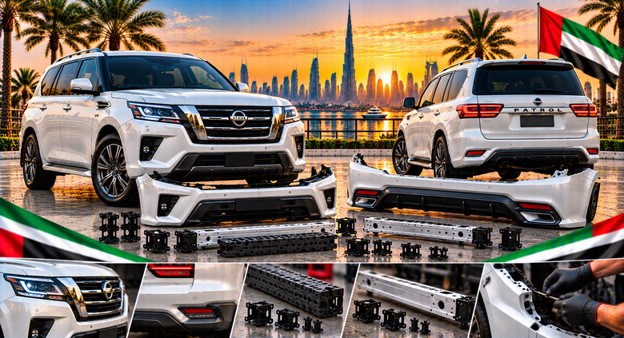
It can be, particularly if the Patrol is older, the damage is cosmetic and a clean, correctly specified used cover is available. A used genuine bumper may also retain factory contours and mounting details that are difficult to match with a cheaper replacement.
But inspect it properly. Look at the back as well as the painted face. Search for hairline cracks around screw holes, plastic tabs that have been glued back, heat-warped areas and old filler beneath the paint. A shiny surface can conceal a rough history.
Colour deserves attention too. A used bumper from a white Patrol may not match your white Patrol. Sun exposure, repainting and years of washing can shift the shade, so allow for refinishing if a near-perfect match matters.
Ask the seller for photographs of the entire part, including its edges and mounting points, and agree on the return conditions before payment. If the bumper has already been repaired, find out where and how. A small saving is less attractive when the cover has to come off again.
Can a cracked Patrol bumper be repaired instead?
Sometimes. A shallow scuff, a localised scrape or a crack in a repairable area may be suitable for plastic repair and refinishing. The answer depends on the material, the location and the extent of the damage.
A crack running through a sensor mounting area is a different proposition from a scrape on a plain outer surface. Likewise, a bumper that has stretched, distorted or lost several mounting tabs may be difficult to restore to a durable, factory-like fit.
Ask for a repair-versus-replacement assessment rather than a blanket recommendation. A useful quote should explain how the plastic will be repaired, how the surface will be prepared and whether the repaired area is likely to remain stable through heat and everyday use.
There is no virtue in replacing a sound bumper unnecessarily. Equally, repeatedly patching a badly damaged cover can turn a small repair into a longer, more expensive nuisance.
What UAE heat, sun and dust do to bumper condition
The Gulf climate makes exterior plastics work hard. Prolonged sun exposure can fade paint and trim, while repeated heating and cooling put stress on aged plastic. Dust, sand and road debris add scratches, and off-road use can leave marks on lower sections that never quite polish out.
Dubai’s daily traffic brings another kind of wear: tight parking spaces, kerbs, basement ramps and the occasional careless nudge. In Abu Dhabi and the northern emirates, long-distance driving and desert trips can add stone chips and abrasion. None of this means every Patrol bumper will fail in the heat, but it does mean condition deserves a close look when buying used.
Check whether the plastic has become brittle, especially around mounting points. Look for fading that differs sharply between the cover and adjoining bodywork, and ask whether a previous repair used materials suitable for automotive plastics.
A bumper that looks acceptable in a shaded warehouse may show its flaws under the hard afternoon sun.
Parking sensors and cameras must be treated as part of the repair
Some Patrol specifications use parking sensors or cameras, while other driver-assistance equipment depends on the exact year and trim. The correct replacement must preserve the required openings and mounting positions. A sensor that sits at the wrong angle may give misleading readings, even if it appears to fit the hole.
Before removing the old bumper, the workshop should identify the equipment fitted to the vehicle and check for existing faults. After installation, it should verify that the sensors and cameras operate correctly. If the collision affected radar or other driver-assistance hardware, the technician must follow the appropriate manufacturer procedure rather than assuming a visual check is enough.
Do not let anyone drill sensor holes by eye without confirming the specified positions. Nor should a damaged sensor holder be glued into place and treated as a permanent fix without assessing the repair.
Ask for the final checks to be recorded on the job card.
Off-road Patrols need a different bumper conversation
A Patrol that spends weekends on sand dunes or rocky tracks may need a different solution from one used mainly for school runs and city commuting. The lower bumper can catch on steep approaches, while repeated contact with sand, rocks or recovery equipment may damage brackets and trim.
Some owners consider aftermarket off-road bumpers, guards or protective additions. These can change weight, clearance, approach angle and the way accessories are mounted. They may also affect parking sensors, cameras, lighting and the vehicle’s overall road suitability.
Before fitting a metal bumper or a substantial body-kit conversion, check the design, installation requirements and applicable UAE vehicle rules with a qualified workshop and the relevant authority where necessary. Do not assume that a part being sold locally is automatically approved for every road-use configuration.
And if the Patrol is still used for family transport, consider the everyday trade-off. A bulky accessory may be useful in the desert but awkward in a multi-storey car park.
How to confirm the correct part before paying
Get the seller to confirm the application in writing. A useful fitment check should cover:
- VIN or chassis number, where required for identification.
- Model generation and production year.
- Trim and market specification.
- Front or rear position.
- Relevant part number or confirmed cross-reference.
- Sensor, camera, fog-lamp and trim openings.
- Whether brackets, clips and finishers are included.
- Whether the bumper is supplied painted, unpainted or ready for preparation.
If the seller cannot establish compatibility, ask for more evidence before ordering. Clear photographs can help, but they are not a substitute for checking the part number and vehicle specification.
This is particularly important for imported Patrols, vehicles with Nismo-style conversions and cars whose bumpers have been changed previously. The VIN can help identify the original specification, but a modified vehicle still needs a physical check of what is currently fitted.
Paint matching: the colour code is only the beginning
A bumper may be listed in the correct colour and still look different once installed. Paint fades with sunlight, repairs may have used a slightly different shade, and the plastic surface can reflect light differently from adjacent metal panels.
An unpainted cover usually needs preparation, suitable primer and refinishing. A pre-painted used bumper may save time, but only if its colour and condition are acceptable. Ask whether the price includes preparation, paint, blending where needed and any finishing work on adjoining panels.
For metallic or pearlescent finishes, a small mismatch can be surprisingly visible under direct UAE sunlight. White is not always an easy match either; there can be differences between shades and between old and freshly painted panels.
A sensible workshop should inspect the paint code and the vehicle itself, then explain how it intends to achieve the match. “Same colour” is not the same as “same finish”.
What should a complete bumper quote include?
A headline price is just the start. The proper comparison is between complete repair quotes that cover the same work.
| Cost item | What to ask |
| Bumper cover | Is it genuine, aftermarket, used or reconditioned? |
| Additional trim | Are grilles, finishers, reflectors and lower sections included? |
| Brackets and clips | Are damaged fittings included or charged separately? |
| Paint and preparation | Is the part supplied painted, and what refinishing is required? |
| Removal and fitting | Does labour include transfer of reusable parts? |
| Sensors and wiring | Will the workshop inspect and test them? |
| Calibration or diagnostics | Is any required procedure included? |
| Delivery | Is delivery to the workshop included? |
| VAT | Is the quoted amount inclusive of the applicable VAT? |
| Warranty | Does it cover the part, paint, fitment or all three? |
A quote that excludes several of these items may still be fair, provided the exclusions are clear. The problem starts when one workshop prices a bare cover and another prices a fitted, painted assembly, then the cheaper option wins on paper before the real costs emerge.
Ask for the final total in writing.
What do Nissan Patrol bumpers cost in the UAE?
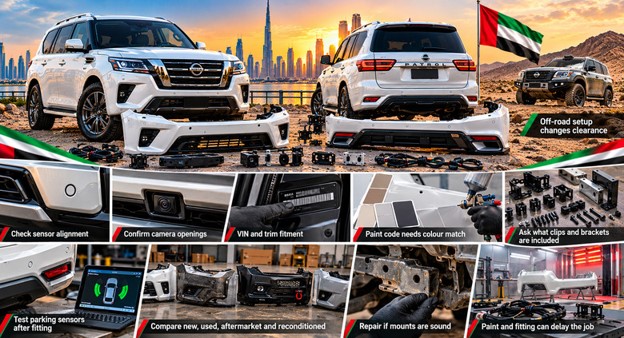
Advertised prices offer a starting point, but they are not directly comparable unless the product and fitment match.
A UAE-facing listing reviewed for this article advertised a front bumper for a 2020–2023 Patrol at AED 400, unpainted. The same listing showed a front bumper for 2009–2019 models from AED 350. A separate listing advertised a rear bumper cover for Patrol models from 2010–2019 and 2020 onwards from AED 250. These are advertised prices, not verified fitted quotations, and the listing details do not establish that every listed bumper fits every trim.
A separate UAE listing priced a Y62 rear bumper cover for 2020–2024 at AED 320, stating that 5% VAT was included. It describes the product as an OEM-style replacement, not a Nissan-branded genuine part. The listing’s broad compatibility claim should be confirmed against the specific vehicle before purchase.
| Advertised item | Published price | What it does not establish |
| Patrol front bumper, 2020–2023, unpainted | AED 400 | Paint, labour, clips, sensors or exact trim fitment |
| Patrol front bumper, 2009–2019 | From AED 350 | Which precise generation, trim and included fittings apply |
| Patrol rear bumper cover, broad year range | From AED 250 | Exact generation, condition, paint or complete fitted cost |
| Y62 rear bumper cover, 2020–2024 | AED 320 | Fitment to every grade or the cost of installation and paint |
These are observed advertised prices, not a market-wide average. No comparable set of current UAE quotations was established for the same Patrol generation and trim across genuine, aftermarket, used and reconditioned options. Treat the figures as a limited reference, not a promise of stock or a final repair budget.
Genuine Nissan pricing needs a part-number check
Genuine parts catalogues show why a single “Patrol bumper price” can be misleading. For the Y62, the front bumper listings distinguish between fascia, retainers, side brackets, fog-lamp finishers and other small fittings. Some entries also identify different arrangements for particular equipment or bumper types.
That detail matters when comparing a genuine replacement with a low-priced cover. The cheaper listing may not include the parts that make the assembly complete, while the genuine quote may contain more than the outer fascia.
Ask for the Nissan part number and a written description of what is included. If the part is being sourced from overseas, check shipping, delivery time, return restrictions and any additional charges before approving the order.
Do not assume that a part number from a Patrol sold in another market automatically fits a UAE-specification vehicle. It is a reference to verify, not a reason to skip verification.
New, used or reconditioned: compare the real cost
The best choice depends on the vehicle’s age, the extent of damage and how long you intend to keep the Patrol. A newer, high-value model with sensor equipment may justify a new part and a carefully documented installation. An older daily driver with cosmetic damage may be better served by a clean used cover.
| Option | Main attraction | Main risk | Best question to ask |
| New genuine | Factory-branded replacement and clear identification | Higher purchase cost | Is the exact part number confirmed? |
| New aftermarket | Potentially lower upfront price | Variable fit and finish | What warranty and fitment evidence are available? |
| Used genuine | May preserve original design and mounting details | Hidden cracks, repairs or sun damage | Can I inspect the back and mounting tabs? |
| Reconditioned | May restore a damaged original or used cover | Repair quality can vary | What work was done, and is it warranted? |
| Repair existing cover | Avoids buying another cover | May not be suitable for severe damage | Is the damage repairable without compromising fit or function? |
The lowest purchase price is only one part of the calculation. A poorly fitting cover can need extra labour, repainting or replacement, erasing the original saving.
Repair or replace: use the damage, not guesswork
Repair may make sense when the damage is localised, the plastic remains suitable for repair and the mounting points are sound. Replacement becomes more attractive when the cover is badly split, distorted, missing substantial sections or damaged around critical sensor mounts.
There is no universal rule that every crack requires a new bumper. Nor is every plastic cover a good candidate for repair.
Ask the workshop to separate the visible damage from the underlying structural findings. If the impact was significant, the reinforcement and mounting area should be checked as appropriate. Where the bumper is part of a repair following a collision, follow the vehicle maker’s repair procedures rather than relying on cosmetic appearance.
The quote should explain why repair is or is not recommended. If the only answer is “replacement is easier”, ask what that means for the cost, finish and expected durability.
Labour and installation time: what can delay the job?
A straightforward cover replacement may be completed within part of a working day once the correct part is available. That is not a guaranteed turnaround. A complicated trim, missing brackets, damaged wiring, sensor faults or a bumper that needs painting can extend the job.
Painting often creates the main scheduling delay. The part may need surface preparation, colour matching, curing and final fitting. If a replacement is being shipped from outside the UAE, delivery can become the largest uncertainty of all.
Ask the workshop to distinguish between hands-on fitting time and total time the vehicle will be off the road. Those are not the same thing.
Before approving the repair, confirm whether the workshop has the bumper in hand, whether paint is included, and whether it has checked all necessary fittings. A vehicle can be immobilised for a surprisingly small missing part if the workshop has not planned ahead.
Hidden costs that turn a cheap bumper into an expensive repair
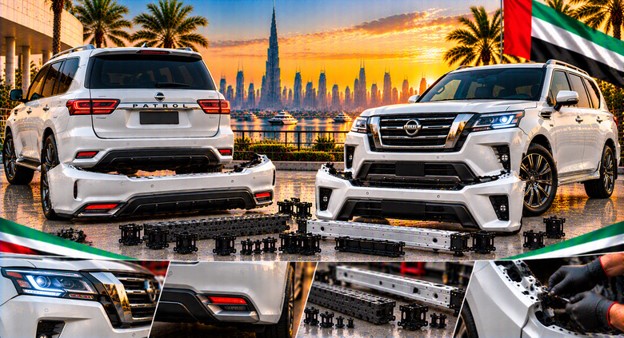
A low-priced bumper can be a reasonable purchase. It becomes a false economy when the final bill grows through items that were never discussed.
Common extras include:
- Broken clips and side retainers discovered during removal.
- Fog-lamp finishers, grilles, reflectors or lower trim not included with the cover.
- Sensor holders that need replacement.
- Paint preparation and colour matching.
- Transfer of old fittings and removal of damaged adhesive or repair material.
- Delivery, urgent sourcing or return shipping.
- Diagnostic checks or calibration where required.
- Additional bodywork if the impact has moved a mounting point.
Ask for a written estimate that separates confirmed work from possible additional work. If the bumper is not yet removed, the workshop may not be able to price every hidden fault accurately; that is fair enough, provided it explains how it will seek approval before adding substantial costs.
A small contingency is sensible. An open-ended bill is not.
What a bumper replacement should not conceal
A new cover can make a Patrol look repaired. It cannot, by itself, prove that the vehicle has been properly repaired.
If the impact was more than a light scrape, ask the technician to check the reinforcement, mounting points and nearby bodywork as appropriate. Inspect whether the bonnet, grille, headlights, tailgate or adjacent panels now sit unevenly. Look for fresh paint or signs of previous repairs if you are buying a used Patrol rather than repairing your own.
A bumper that fits only after forceful adjustment deserves another look. So does a large, inconsistent gap between the cover and the body.
Do not confuse a cosmetic improvement with evidence of a sound repair. The job should restore correct fitment and operation, not merely hide the damage from a passing glance.
Parking sensors and driver-assistance systems after fitting
Once the bumper is installed, check the functions that depend on it. Test parking sensors, cameras and any relevant warning systems in a safe environment, and have the workshop carry out the required diagnostic or calibration procedure if the vehicle’s equipment or repair instructions call for one.
A sensor may be undamaged but incorrectly positioned. A camera may work while its view is obstructed by a poorly fitted trim piece. A warning that appears after the repair should be investigated rather than dismissed as an unrelated nuisance.
Ask for confirmation of the checks performed, particularly if the bumper was removed following a collision. If the workshop identifies a fault, request a diagnosis before agreeing to replace parts that may still be serviceable.
Will a replacement bumper affect resale value?
It can, but the effect depends on the quality of the repair and the vehicle’s wider history. A correctly fitted, well-painted replacement cover is not automatically a major resale problem. Poor colour matching, loose trim, unexplained sensor warnings or evidence of a badly repaired impact can raise questions.
For a Patrol that is otherwise in good condition, keep the invoice, part description and any relevant diagnostic report. If the repair followed an insurance claim, retain the paperwork. Clear records help the next buyer distinguish a cosmetic repair from unresolved collision damage.
On a higher-value trim, a genuine replacement may be easier to explain to a cautious buyer, but the badge on the part is not a substitute for workmanship. A badly fitted genuine cover can look worse than a well-fitted aftermarket one.
Insurance, accident paperwork and repair approval
If the bumper damage followed a collision, check the insurer’s requirements before authorising work. Depending on the circumstances and policy, you may need an accident report, an approved repairer, an inspection or prior authorisation. Do not assume that every policy will reimburse any replacement you choose.
Ask whether the insurer has specified a repair method or part type, and keep the estimate, approval and final invoice. If you intend to pay privately, compare the complete repair cost with the excess and any other implications under your policy before making a decision.
For fleet operators, make sure the repair is recorded against the vehicle and that any safety-related checks are documented. A quick cosmetic fix may get a vehicle back on the road, but it should not leave the next driver guessing what was repaired.
Buying a bumper for a modified or imported Patrol
A modified Patrol needs more than a routine year-and-trim check. Previous owners may have fitted an aftermarket bumper, changed the grille, added a guard or altered mounting points. An imported vehicle may also differ from a Gulf-market model even when the body shape appears identical.
Photograph the existing bumper from the front or rear, both corners and underneath where possible. Record any visible part numbers and identify the sensor or camera openings. Give that information to the seller before ordering.
If the vehicle has a winch, steel bumper, custom lighting or an aftermarket body kit, tell the workshop before it quotes. A standard cover may not fit the modified arrangement, and converting the vehicle back to factory specification could cost more than expected.
Workshop red flags: when to slow the job down
Be wary if a seller guarantees fitment from a single photograph, refuses to identify the part’s condition or cannot explain what the price includes. The same applies to a workshop that promises a perfect colour match without inspecting the vehicle, or says sensors will “just work” without checking which systems are fitted.
Other warning signs include:
- No written breakdown of parts, labour and paint.
- No clear return terms for an incorrectly supplied bumper.
- Pressure to approve extra repairs without evidence or explanation.
- Reused brackets that are visibly cracked or distorted.
- No final check of sensor and camera functions where fitted.
- A quote that changes substantially without the workshop explaining why.
A good repairer should be able to tell you what it knows, what it still needs to inspect and which costs remain uncertain. That is not hesitation. It is sensible workshop practice.
The Patrol bumper buyer’s checklist
Before paying, run through these checks. They are simple, but they prevent many of the avoidable mistakes that make replacement jobs drag on.
- Confirm the Patrol’s generation, model year, trim and market specification.
- Establish whether the part is for the front or rear.
- Verify the part number or fitment against the VIN or chassis details where possible.
- Check whether the cover includes grilles, finishers, brackets and sensor holders.
- Inspect used parts for cracks, repaired tabs, distortion and uneven paint.
- Confirm whether the bumper is painted, unpainted or supplied in a different colour.
- Ask for the complete price, including VAT, delivery, labour and paint where applicable.
- Agree on return terms before ordering.
- Ask the workshop to inspect hidden damage before fitting the replacement.
- Confirm that parking sensors, cameras and other affected equipment will be checked.
- Obtain a written invoice and keep any repair or diagnostic records.
If you are comparing several suppliers, use the same specification and the same list of included work for each quote. Otherwise, you are not comparing like with like.
When sourcing through PartFinder UAE, the same principle applies: give the supplier enough vehicle detail to establish the correct part, then verify what the quoted price actually includes before committing.
UAE Price Reference Update: 20 October 2026
The advertised prices reviewed for this article provide a limited snapshot of the UAE replacement market. They do not establish a complete price range for every Nissan Patrol generation, trim or bumper type.
| Part advertised | Reference price | Important qualification |
| Front bumper for Patrol, 2020–2023 | AED 400 | Advertised unpainted; fitting and paint not established |
| Front bumper for Patrol, 2009–2019 | From AED 350 | Exact trim and included fittings require confirmation |
| Rear bumper cover for Patrol, broad year range | From AED 250 | Exact fitment and final fitted cost require confirmation |
| Y62 rear bumper cover, 2020–2024 | AED 320 | Advertised with 5% VAT included; not a confirmed fitted quotation |
The listing details behind these references are cited in Section 16. Prices and availability can change, so obtain a current written quotation before making a decision.
What remains unverified: a like-for-like set of current UAE quotations covering genuine Nissan, new aftermarket, used and reconditioned bumpers for the same Patrol generation, trim and specification. There is also no verified universal labour rate or installation time that can responsibly be applied to every Patrol.
For an accurate total, request separate figures for the bumper, additional trim and brackets, paint, labour, delivery and any necessary diagnostic or calibration work. Confirm whether VAT is included. If the part is advertised as genuine or OEM, ask for the part number and clarification of the claim.
The useful number is not the cheapest price on a product page. It is the amount you will actually pay to get the correct bumper fitted properly.
Frequently Asked Questions About Nissan Patrol Bumpers in UAE
Categories
- Audi
- BMW
- Car Accessories
- Car Tips
- Ford
- Land Rover
- Mazda
- Range Rover
- Top 10
- UAE Car Parts
- Used Car Parts
- Toyota
- Replacement Engines
- Nissan
- Hyundai
- Mitsubishi
- Volkswagen
- Honda
- Kia
- Chevrolet
- Dodge
- Jeep
- Subaru
- Renault
- Lexus
- Mercedes
- Suzuki
- Hummer
- Porsche
- Infiniti
- Peugeot
- GMC
- Mini
- Volvo
- Replacement Gearboxes
- MG
- Jaguar
- Skoda
- Cadillac
- Daihatsu
- Fiat
- German Car Parts
- Japanese Car Parts
- Aftermarket Car Parts
- Genuine Car Parts
- New Car Parts
- Reconditioned Car Parts
- European Car Parts
- American Car Parts
- Korean Car Parts
- British Car Parts
- Chinese Car Parts
- Sports/Exotic Car Parts
- Luxury Car Parts
- Performance Car Parts
- SUV/4x4 Spare Parts
- Truck Spare Parts
- EV Car Parts
- Hybrid Car Parts
- Auto Spare Parts in UAE
- Tesla
- Isuzu
- Ram
- Ferrari
- Bentley
- Lamborghini
- Genesis
- Maserati
- Lincoln
- Chrysler
- Opel
- Citroen
- SsangYong
- Seat
- McLaren
- Aston Martin
- Rolls Royce
- Maybach
- Alfa Romeo
- Bugatti
- Scion
- Abu Dhabi Car Parts
- Ajman Car Parts
- Al Khan Car Parts
- Al Sajaa Car Parts
- Deira Car Parts
- Dubai Car Parts
- Fujairah Car Parts
- Industrial Area 6 Car Parts
- Mussafah Car Parts
- Ras Al Khaimah Car Parts
- Sharjah Car Parts
- Umm Al Quwain Car Parts
- Acura
- BYD
- Chery
- Dacia
- DS
- Geely Emgrand
- EXEED
- GAC
- GAC Gonow
- Geely
- Gonow
- Great Wall
- Haima
- Haval
- Holden
- Iveco
- JAC
- Jaecoo
- Jetour
- Lotus
- Omoda
- Proton
- Renault Samsung
- Roewe
- Lucid
- Replacement Headlight
- Replacement Bumper
- bugatti chiron