Nissan Spare Parts in UAE: Complete Guide for Patrol, Altima, Sunny, Maxima, X-Trail and Pathfinder
August 1, 2026
Understanding Nissan Spare Parts in the UAE
Quick Summary
| Topic | Why It Matters |
| Nissan's Popularity | Explains why Nissan remains one of the UAE's best-selling automotive brands. |
| UAE Spare Parts Market | Understand where demand comes from and what buyers should expect. |
| Genuine vs OEM vs Aftermarket | Learn the real differences before spending money. |
| Used vs Second-Hand vs Reconditioned Parts | Discover which option suits different budgets and ownership goals. |
| Popular Nissan Models | Identify the models that generate the highest spare parts demand. |
| Choosing the Right Parts | Protect reliability, safety and resale value. |
Walk through almost any residential community in Dubai.
Drive across Abu Dhabi during rush hour.
Visit construction sites in Sharjah.
Travel through the mountain roads of Fujairah.
Head towards the deserts surrounding Al Ain.
One pattern becomes impossible to ignore.
Nissan vehicles are everywhere.
Some are transporting families.
Others are carrying contractors to remote work sites.
Some spend their lives inside city traffic.
Others spend weekends climbing dunes that challenge even experienced drivers.
That remarkable variety explains something important.
There isn't one Nissan owner in the UAE.
There are thousands of different ownership stories.
And every one of those stories eventually reaches the same destination.
Finding the right spare parts.
The difference between enjoyable ownership and expensive ownership rarely begins with a major engine failure.
It usually begins with a much smaller decision.
Which replacement part should I buy?
Why Nissan Vehicles Are So Popular in the UAE
Few manufacturers have earned the level of trust that Nissan enjoys across the Emirates.
That reputation wasn't built through advertising alone.
It was built over decades of daily use.
Owners appreciate different qualities depending on the model.
A Nissan Patrol earns admiration for its durability on highways and desert terrain.
A Nissan Sunny becomes a favourite among commuters because of its economical running costs.
The Altima attracts professionals wanting comfort without excessive ownership expenses.
Families often choose the X-Trail because it balances practicality with efficiency.
Meanwhile, the Pathfinder continues serving households needing additional space without sacrificing everyday drivability.
Different vehicles.
Different purposes.
One common requirement.
Reliable replacement parts.
Popularity creates another advantage.
Because so many Nissan vehicles operate across Dubai, Abu Dhabi, Sharjah, Ajman, Ras Al Khaimah, Fujairah and Umm Al Quwain, the demand for replacement components remains consistently strong.
That helps improve availability throughout the UAE.
Understanding the Nissan Spare Parts Market in the UAE
The UAE spare parts market has changed dramatically over the past decade.
Years ago, owners often relied on a limited number of suppliers.
Choice was relatively restricted.
Today, buyers can compare numerous options before making a purchase.
The market now includes:
- Genuine Nissan parts.
- OEM replacement parts.
- Premium aftermarket components.
- Used Nissan spare parts.
- Reconditioned assemblies.
- Imported replacement components.
Greater choice sounds like excellent news.
Usually it is.
But wider availability also creates new challenges.
Not every component advertised online matches the vehicle it claims to fit.
Not every bargain represents genuine value.
And not every expensive component automatically offers superior quality.
Modern buyers require something more valuable than a low price.
They require accurate information.
Genuine vs OEM vs Aftermarket Nissan Spare Parts
This question appears repeatedly in workshops throughout the UAE.
"Should I buy genuine parts or something less expensive?"
The answer depends entirely upon the component being replaced.
Genuine Nissan Spare Parts
Genuine components are supplied through Nissan's authorised parts network.
They are manufactured according to the exact specifications intended for the vehicle.
Advantages include:
- Factory compatibility.
- Consistent quality.
- Strong reliability.
- Correct fitment.
- Manufacturer-backed standards.
For safety-critical systems and complex electronic components, genuine parts often provide valuable peace of mind.
OEM Nissan Spare Parts
OEM stands for Original Equipment Manufacturer.
These companies frequently manufacture components for vehicle manufacturers themselves.
Many OEM parts deliver the same engineering quality while being distributed under a different brand.
For many owners, OEM products offer an excellent balance between performance and overall ownership costs.
Aftermarket Nissan Spare Parts
The word aftermarket sometimes receives unfair criticism.
In reality, aftermarket quality varies enormously.
Some manufacturers produce components that perform exceptionally well.
Others focus primarily on reducing production costs.
Quality depends upon the manufacturer rather than the label itself.
Routine maintenance components such as filters, brake pads and suspension parts often have excellent aftermarket alternatives when sourced carefully.
The key word is carefully.
Used vs Second-Hand vs Reconditioned Nissan Parts Explained
Many buyers assume these descriptions all mean the same thing.
They don't.
Understanding the difference prevents expensive misunderstandings.
Used Nissan Spare Parts
Used components are removed directly from another vehicle.
Their condition depends upon:
- Previous maintenance.
- Vehicle mileage.
- Driving conditions.
- Storage.
- Overall wear.
Inspection becomes particularly important.
Second-Hand Nissan Parts
Second-hand parts generally follow the same principle as used components.
The terminology often changes between suppliers rather than the component itself.
Buyers should focus less on the wording and more on documented condition.
Reconditioned Nissan Spare Parts
Reconditioned parts undergo professional inspection before being offered for sale.
Depending on the component, worn internal sections may be replaced, tolerances restored and performance tested.
Popular reconditioned items include:
- Engines.
- Gearboxes.
- Steering racks.
- Turbochargers.
- Alternators.
Professionally reconditioned components often provide excellent value for owners seeking a balance between cost and long-term reliability.
Most Popular Nissan Models That Require Spare Parts
Every vehicle develops its own ownership pattern.
Some spend years covering motorway mileage.
Others work daily in demanding urban traffic.
Certain Nissan models consistently generate strong demand for replacement components across the UAE.
Among the most searched models are:
- Nissan Patrol.
- Nissan Altima.
- Nissan Sunny.
- Nissan Maxima.
- Nissan X-Trail.
- Nissan Pathfinder.
Each has different maintenance priorities.
A Patrol owner may frequently search for suspension and drivetrain components after years of off-road use.
Sunny owners commonly focus on routine servicing and economical maintenance.
X-Trail buyers often prioritise family reliability and preventative servicing.
Understanding those differences helps buyers choose replacement parts more intelligently.
Why Choosing the Right Nissan Parts Matters
One incorrect part can create an unexpectedly expensive chain of events.
An incompatible sensor triggers warning lights.
Incorrect brake components reduce braking performance.
Poor-quality cooling parts shorten engine life.
A low-cost suspension component wears prematurely.
The original saving disappears remarkably quickly.
The opposite is equally true.
Correctly selected replacement parts often improve:
- Reliability.
- Safety.
- Fuel efficiency.
- Driving comfort.
- Long-term ownership costs.
- Vehicle resale value.
Buying a spare part isn't simply replacing something that has worn out.
It's investing in every kilometre that follows.
The Biggest Myth About Nissan Spare Parts
Let's challenge one of the most common assumptions.
"The cheapest part saves the most money."
It sounds logical.
Until labour enters the equation.
Imagine replacing an inexpensive suspension arm.
Six months later it fails.
The owner now pays for:
- Another replacement component.
- Additional labour.
- Wheel alignment.
- Lost time.
- Vehicle downtime.
The original saving quietly disappears.
Experienced workshops rarely judge parts by purchase price alone.
They judge them by ownership cost.
That's a far more useful measurement.
Workshop Story
A Nissan Altima owner from Ajman visited a workshop after noticing a persistent vibration during motorway driving.
Another garage had already recommended replacing several suspension components.
Before ordering parts, technicians completed a detailed inspection.
The suspension itself remained in good condition.
The actual issue?
A worn engine mounting that transferred vibration through the chassis under load.
Replacing a single mounting restored the smooth driving experience.
Collecting the vehicle later that afternoon, the owner smiled.
"I thought I needed half the front suspension."
The technician replied,
"Modern cars often hide simple problems behind complicated symptoms."
The most expensive repair isn't always the biggest one.
Sometimes it's simply the wrong diagnosis.
Nissan Spare Parts Comparison Table
| Part Type | Best For | Key Consideration |
| Genuine | Safety-critical and electronic components | Maximum compatibility |
| OEM | Long-term value | Excellent quality with competitive pricing |
| Aftermarket | Routine maintenance items | Choose reputable manufacturers |
| Used | Budget-conscious repairs | Verify condition carefully |
| Reconditioned | Major mechanical assemblies | Review testing and warranty |
Buyer Decision Matrix
| Your Situation | Recommended Choice |
| Long-term ownership | Genuine or OEM components |
| Daily commuter vehicle | Quality OEM or trusted aftermarket parts |
| Budget repair | Professionally inspected used or reconditioned parts |
| Complex electrical repair | Genuine parts with confirmed compatibility |
| Buying online | Verify VIN compatibility before ordering |
| Unsure about quality | Request documentation and warranty details |
Suggested Visual Callout
"Understanding Nissan Spare Parts in the UAE"
Create a premium infographic featuring:
- Nissan Patrol, Altima, Sunny, Maxima, X-Trail and Pathfinder.
- Genuine, OEM, aftermarket, used and reconditioned parts.
- Engine, gearbox, brakes, suspension and electrical components.
- UAE skyline with subtle flag-inspired red, green, white and black accents.
- Simple comparison icons showing quality, value, compatibility and reliability.
Keep text minimal and allow realistic vehicle and parts imagery to communicate the message visually.
Smart Buyer's Checklist
Before purchasing any Nissan spare part:
- Confirm the exact model and production year.
- Verify compatibility using the VIN.
- Compare genuine, OEM and aftermarket options.
- Request warranty information.
- Inspect used or reconditioned parts carefully.
- Prioritise quality over the lowest price.
- Choose experienced Nissan parts suppliers.
- Ask for professional installation where appropriate.
The most successful Nissan owners rarely spend the least.
They simply spend more wisely.
Key Takeaways
Nissan has earned a strong reputation across the UAE by offering vehicles suited to a wide variety of drivers, from city commuters to large families and off-road enthusiasts. That popularity has created a mature spare parts market with genuine, OEM, aftermarket, used and reconditioned options available for almost every model. Understanding the differences between these choices allows owners to make informed purchasing decisions rather than relying solely on price.
The strongest ownership experience begins with choosing the correct replacement parts for the vehicle's intended use and maintenance history. Buyers who focus on compatibility, quality and accurate diagnosis generally avoid unnecessary expenses while protecting long-term reliability, safety and resale value.
Essential Nissan Spare Parts Every UAE Owner Should Understand
Quick Summary
| Component | Why It Matters |
| Engine Components | Keep performance, fuel economy and reliability at their best. |
| Gearbox & Transmission | Deliver smooth power while protecting long-term drivability. |
| Suspension & Steering | Improve comfort, stability and safety on UAE roads. |
| Brake System | Essential for confident stopping power in all conditions. |
| Cooling System | Protects the engine from extreme UAE temperatures. |
| Electrical Components | Control everything from starting the engine to modern safety features. |
Every vehicle is a collection of thousands of components.
Some receive constant attention.
Others remain almost invisible.
Until they fail.
Ask a Nissan owner what matters most.
Many immediately answer,
"The engine."
Ask an experienced technician.
The reply becomes rather more interesting.
"Everything that keeps the engine healthy."
That's the difference between repairing cars...
...and living with them every day.
A failed water pump may destroy an otherwise healthy engine.
A neglected gearbox mount may shorten transmission life.
A faulty sensor can convince perfectly healthy mechanical components that something is wrong.
Modern vehicles rarely suffer because one major part suddenly gives up.
They usually suffer because several smaller parts quietly stop doing their jobs.
Understanding those components is one of the smartest investments any Nissan owner can make.
Nissan Engine Components
The engine remains the heart of every petrol-powered Nissan.
Whether it's a Patrol tackling desert tracks or a Sunny navigating daily traffic, the engine depends upon dozens of supporting components working together with remarkable precision.
Among the most important are:
- Pistons.
- Cylinder head.
- Timing components.
- Valves.
- Fuel injectors.
- Gaskets.
- Oil pump.
- Water pump.
None work independently.
Every combustion cycle depends upon perfect timing.
Perfect lubrication.
Perfect cooling.
The moment one supporting component begins struggling, the entire engine notices.
That's why experienced workshops rarely replace engine parts without inspecting surrounding systems first.
The visible failure often isn't where the original problem began.
Nissan Gearbox and Transmission Parts
A smooth transmission rarely attracts compliments.
People notice it only when something changes.
Gear shifts become hesitant.
Acceleration feels inconsistent.
Unusual noises appear.
Automatic transmissions and manual gearboxes both depend upon carefully engineered internal components.
These include:
- Clutch assemblies.
- Torque converters.
- Valve bodies.
- Bearings.
- Seals.
- Transmission mounts.
- Gear selectors.
Modern Nissan automatic transmissions also rely heavily on electronic communication.
Mechanical strength alone is no longer enough.
Software.
Sensors.
Hydraulic pressure.
Everything works together.
Ignoring early transmission symptoms often increases repair costs dramatically.
Small problems rarely remain small inside a gearbox.
Suspension and Steering Components
Drive across perfectly smooth roads and suspension seems almost unnecessary.
The UAE doesn't offer only perfectly smooth roads.
Speed humps.
Construction zones.
Roundabouts.
Motorway expansion joints.
Desert excursions.
Every journey asks something different from the suspension.
Major components include:
- Shock absorbers.
- Springs.
- Control arms.
- Ball joints.
- Bushes.
- Steering rack.
- Tie rods.
- Anti-roll bar links.
Together they determine how confidently the vehicle responds to driver inputs.
Comfort matters.
Safety matters more.
A worn suspension component rarely announces itself dramatically.
Instead, steering gradually feels less precise.
Tyres begin wearing unevenly.
Braking stability changes subtly.
Those quiet changes deserve attention long before they become obvious.
Nissan Brake System Parts
Few systems receive greater responsibility than the brakes.
They perform exactly the same task every single journey.
Stopping safely.
Whether descending mountain roads near Hatta or navigating dense evening traffic in Dubai Marina, reliable braking remains non-negotiable.
Core braking components include:
- Brake pads.
- Brake discs.
- Brake callipers.
- Brake fluid.
- Master cylinder.
- Brake hoses.
- ABS sensors.
Many owners focus exclusively on brake pads.
Understandably.
They're replaced regularly.
But braking performance depends upon the condition of the entire system.
Fresh pads fitted to damaged discs rarely deliver the results owners expect.
Braking should always be evaluated as one complete system rather than a collection of separate parts.
Nissan Cooling System Components
If one system quietly determines how long an engine survives in the UAE...
This is probably it.
Temperatures regularly exceed forty degrees during summer.
Traffic keeps engines operating for extended periods.
Air conditioning increases thermal demand.
Cooling systems therefore work exceptionally hard.
Key components include:
- Radiator.
- Cooling fan.
- Thermostat.
- Water pump.
- Coolant reservoir.
- Radiator hoses.
- Temperature sensors.
None appear especially exciting.
Yet each protects one of the vehicle's most expensive assemblies.
Cooling problems often begin invisibly.
A small coolant leak.
A partially blocked radiator.
An ageing thermostat.
Months later...
The engine begins paying the price.
Nissan Electrical and Electronic Parts
Today's Nissan vehicles contain considerably more electronics than many owners realise.
Modern electrical systems control:
- Engine management.
- Lighting.
- Air conditioning.
- Safety systems.
- Infotainment.
- Charging systems.
- Fuel delivery.
- Driver assistance technologies.
Common replacement components include:
- Alternators.
- Starter motors.
- Batteries.
- Ignition coils.
- Sensors.
- Control modules.
- Wiring connectors.
Interestingly, electrical faults often imitate mechanical problems.
A faulty crankshaft sensor may resemble engine failure.
A weak battery may trigger multiple warning lights.
Electronic diagnosis has therefore become just as important as mechanical inspection.
The Components Owners Often Forget
Some of the most important Nissan parts rarely appear on shopping lists.
Engine mounts.
Transmission mounts.
Drive belts.
Vacuum hoses.
Rubber bushes.
Small seals.
They're inexpensive compared with engines or gearboxes.
Yet they influence vibration, reliability and long-term wear throughout the vehicle.
Experienced workshops routinely inspect these supporting components because they understand something many owners don't.
Large repairs frequently begin with remarkably small parts.
Replacing those parts early often prevents much larger invoices later.
How UAE Driving Conditions Affect Nissan Components
A Patrol exploring Liwa faces different challenges from an Altima commuting through Abu Dhabi.
A Sunny delivering food around Sharjah experiences different wear from an X-Trail carrying a family across the Emirates every weekend.
Driving environment changes everything.
Common UAE influences include:
- Extreme heat.
- Fine airborne dust.
- Heavy stop-start traffic.
- Long motorway journeys.
- Occasional off-road driving.
- High annual mileage.
These conditions place additional stress on:
- Cooling systems.
- Suspension components.
- Air filters.
- Brake systems.
- Batteries.
- Tyres.
Maintenance schedules should reflect those realities rather than relying solely on mileage figures.
Why Cheap Parts Sometimes Cost More
Imagine two identical Nissan vehicles.
One owner buys the least expensive brake pads available.
The other chooses high-quality components designed for the vehicle.
Initially...
The first owner spends less.
Months later...
Brake dust increases.
Stopping distances change.
Noise develops.
Replacement becomes necessary again.
Meanwhile, the second owner continues driving without concern.
The cheaper purchase quietly became the more expensive ownership decision.
Price measures today.
Quality often measures tomorrow.
That's a distinction worth remembering.
Workshop Story
A Nissan X-Trail arrived at a workshop in Abu Dhabi after its owner complained of poor fuel economy and sluggish acceleration.
Another repair centre had suggested replacing several engine components.
Before ordering anything, technicians completed a full inspection.
Compression remained excellent.
Fuel pressure appeared normal.
The culprit proved surprisingly ordinary.
A severely restricted engine air filter combined with ageing spark plugs had gradually reduced engine efficiency.
Routine service items had created symptoms resembling far more serious mechanical problems.
Replacing them restored performance almost immediately.
Collecting the vehicle, the owner laughed.
"I was preparing for an engine rebuild."
The technician smiled.
"Sometimes engines simply need the basics done properly."
The most valuable repairs aren't always the biggest ones.
They're often the most accurate.
Essential Nissan Parts Comparison Table
| Component | Primary Function | Inspection Priority |
| Engine Components | Generate power | Very High |
| Gearbox & Transmission | Deliver smooth power | Very High |
| Suspension & Steering | Stability and handling | High |
| Brake System | Safe stopping | Very High |
| Cooling System | Temperature control | Very High |
| Electrical Components | Vehicle management and reliability | High |
Buyer Decision Matrix
| Your Situation | Recommended Action |
|---|---|
| Engine warning light appears | Complete diagnostics before replacing components |
| Gear shifts become rough | Inspect transmission early rather than delaying repairs |
| Vehicle pulls to one side | Check suspension and steering immediately |
| Engine temperature rises | Inspect the complete cooling system |
| Multiple warning lights appear | Test battery and electrical systems first |
| Planning preventative maintenance | Prioritise cooling, braking and suspension inspections |
Suggested Visual Callout
"Essential Nissan Components That Keep Your Vehicle Reliable"
Create a premium infographic featuring:
- Nissan engine.
- Automatic gearbox.
- Brake system.
- Suspension assembly.
- Radiator and cooling fan.
- Alternator and battery.
- Steering rack.
- Sensors and electronic control modules.
Use realistic workshop illustrations with subtle UAE-inspired red, green, white and black accents.
Keep text minimal and allow arrows to show how each system supports the others.
Smart Buyer's Checklist
Before replacing any major Nissan component:
- Confirm the fault through professional diagnostics.
- Inspect related supporting components.
- Verify compatibility using the VIN.
- Compare genuine and OEM options.
- Replace worn service items at the same time where appropriate.
- Request warranty information.
- Avoid delaying cooling or braking repairs.
- Choose technicians experienced with Nissan vehicles.
A Nissan doesn't become reliable by chance.
It becomes reliable because dozens of essential components continue working together exactly as they were designed to.
Key Takeaways
Every Nissan relies on a network of interconnected systems rather than a single major component. The engine, gearbox, suspension, brakes, cooling system and electrical equipment all depend on one another, meaning a fault in a relatively inexpensive supporting part can quickly affect much larger and more expensive assemblies. Understanding these relationships helps owners recognise the value of preventative maintenance and accurate diagnosis.
For Nissan owners across the UAE, environmental conditions make these essential components work even harder. Heat, dust, heavy traffic and long-distance driving increase the importance of regular inspections and quality replacement parts. Owners who maintain these core systems consistently are far more likely to enjoy dependable performance, lower repair costs and stronger long-term resale value.
Nissan Model-Specific Spare Parts Guide – Patrol, Altima, Sunny, Maxima, X-Trail and Pathfinder
Quick Summary
| Nissan Model | Typical Spare Parts Demand |
| Nissan Patrol | Suspension, cooling, drivetrain and braking components |
| Nissan Altima | Engine service parts, transmission and sensors |
| Nissan Sunny | Routine maintenance and economical replacement parts |
| Nissan Maxima | Suspension, steering and electronic components |
| Nissan X-Trail | Cooling, suspension, brakes and drivetrain parts |
| Nissan Pathfinder | Transmission, suspension and family-use wear items |
Every Nissan has its own personality.
A Patrol lives a very different life from a Sunny.
An X-Trail experiences different stresses compared with a Maxima.
A Pathfinder carrying seven passengers every weekend won't wear components in the same way as an Altima commuting between Dubai and Sharjah every morning.
That's why buying spare parts based purely on the Nissan badge rarely works.
The badge stays the same.
The engineering priorities change.
Understanding those differences is one of the easiest ways to reduce ownership costs over the lifetime of the vehicle.
Nissan Patrol Spare Parts Guide
The Patrol has earned legendary status throughout the UAE.
It comfortably handles city roads during the week before heading into desert terrain at the weekend.
That versatility naturally places additional demands on several components.
Common replacement parts include:
- Shock absorbers.
- Suspension bushes.
- Control arms.
- Brake discs and pads.
- Radiators.
- Water pumps.
- Drive belts.
- Differential components.
- Wheel bearings.
Desert driving introduces unique challenges.
Fine sand.
Continuous vibration.
Higher cooling demands.
Heavy suspension movement.
None automatically shorten component life.
They simply increase the importance of preventative inspections.
A Patrol that receives regular maintenance often delivers exceptional long-term durability.
Nissan Altima Spare Parts Guide
The Altima has become one of the UAE's most popular executive saloons.
Most spend their lives covering significant motorway mileage mixed with urban congestion.
As a result, workshops frequently inspect:
- Engine mounts.
- Air filters.
- Spark plugs.
- Cooling fans.
- CVT-related service components.
- Brake components.
- Suspension links.
- Ignition coils.
- Oxygen sensors.
The Altima rewards routine servicing.
Delayed maintenance, particularly involving cooling or transmission systems, usually proves considerably more expensive later.
Smooth daily driving depends upon consistent maintenance rather than occasional major repairs.
Nissan Sunny Spare Parts Guide
Few vehicles have earned the reputation for affordability enjoyed by the Sunny.
Taxi operators.
Students.
Small businesses.
Daily commuters.
The Sunny serves an extraordinarily broad range of owners.
Routine replacement parts commonly include:
- Engine oil filters.
- Air filters.
- Brake pads.
- Suspension bushes.
- Shock absorbers.
- Batteries.
- Alternators.
- Clutch components on manual models.
Because many Sunnys accumulate high annual mileage, preventative maintenance often delivers remarkable financial value.
Small servicing decisions repeated consistently frequently postpone major repairs for years.
Nissan Maxima Spare Parts Guide
The Maxima blends comfort with performance.
Owners typically expect refined driving characteristics throughout every journey.
That expectation makes suspension and steering components particularly important.
Frequently replaced parts include:
- Steering rack components.
- Suspension arms.
- Brake components.
- Engine sensors.
- Cooling system parts.
- Wheel bearings.
- Ignition system components.
- Engine mounts.
The Maxima often communicates developing faults subtly.
Slight vibration.
Minor steering changes.
Occasional warning lights.
Addressing those symptoms early generally prevents more expensive repairs later.
Nissan X-Trail Spare Parts Guide
Family vehicles experience a different kind of workload.
School runs.
Shopping.
Weekend travel.
Holiday journeys.
Daily commuting.
The X-Trail often performs all of them.
Common replacement components include:
- Brake pads.
- Suspension components.
- Cooling fans.
- Radiators.
- Wheel bearings.
- CV joints.
- Engine filters.
- Air-conditioning components.
Because many X-Trails regularly carry passengers and luggage, suspension inspections become especially worthwhile during scheduled servicing.
The additional weight gradually influences component wear.
Regular inspections simply keep that wear under control.
Nissan Pathfinder Spare Parts Guide
The Pathfinder combines practicality with impressive long-distance capability.
Large families frequently depend upon it throughout the year.
That responsibility places particular emphasis on reliability.
Frequently inspected replacement parts include:
- Suspension assemblies.
- Brake discs.
- Steering components.
- Cooling system parts.
- Transmission service components.
- Driveshaft joints.
- Engine sensors.
- Fuel system components.
A well-maintained Pathfinder usually remains exceptionally dependable.
Ignoring routine servicing eventually affects both comfort and reliability.
Like many larger SUVs, preventative maintenance almost always proves cheaper than reactive repairs.
One Nissan Badge. Six Completely Different Ownership Stories
It's tempting to assume every Nissan follows the same maintenance schedule.
Reality tells a different story.
A Patrol may require closer suspension inspections because of regular off-road use.
A Sunny may consume routine service items simply because of high mileage.
An Altima owner may prioritise transmission servicing.
An X-Trail owner may focus on suspension and braking after years of family use.
Understanding how each model is actually driven matters far more than simply recognising its name.
Vehicles age according to workload.
Not reputation.
Why Service History Matters More Than Model Choice
Buyers often ask,
"Which Nissan model is the most reliable?"
It's an understandable question.
Perhaps not the most useful one.
A carefully maintained Pathfinder usually proves a better purchase than a neglected Patrol.
A properly serviced Altima often outlasts a poorly maintained Sunny.
Maintenance history consistently outweighs assumptions.
That's why experienced buyers request:
- Service invoices.
- Parts replacement records.
- Diagnostic reports.
- Cooling system maintenance.
- Brake servicing history.
Paperwork tells stories that shiny paintwork never can.
Choosing the Correct Parts for Each Model
One mistake appears surprisingly often.
Owners search only for,
"Nissan brake pads."
Or,
"Nissan radiator."
Those descriptions are rarely specific enough.
Production years change.
Engine options differ.
Transmission types vary.
The safest approach always includes:
- Exact model.
- Production year.
- Engine specification.
- VIN verification.
- Original part number where available.
Platforms such as PartFinder UAE allow buyers to compare compatible replacement components from multiple suppliers before making a purchasing decision, helping reduce the risk of ordering incorrect parts.
Compatibility is never something worth guessing.
Workshop Story
A Nissan Patrol owner from Ras Al Khaimah arrived at a specialist workshop after noticing increasing vibration while driving at motorway speeds.
Friends suggested replacing the suspension.
Another garage suspected wheel bearings.
Technicians completed a systematic inspection before ordering any components.
The suspension remained healthy.
Wheel bearings showed no excessive wear.
Instead, one ageing engine mount had collapsed internally, allowing vibration to travel throughout the chassis under acceleration.
Replacing that single component transformed the vehicle.
Collecting the Patrol later that day, the owner smiled.
"I thought I was about to rebuild the front suspension."
The technician laughed.
"The correct diagnosis is usually cheaper than the biggest quotation."
That sentence applies to almost every Nissan model.
Nissan Model Comparison Table
| Model | Best Known For | Maintenance Priority |
| Patrol | Durability and off-road capability | Suspension and cooling |
| Altima | Comfortable daily commuting | Transmission and engine servicing |
| Sunny | Low ownership costs | Routine maintenance |
| Maxima | Refinement and performance | Suspension and electronics |
| X-Trail | Family practicality | Brakes, cooling and suspension |
| Pathfinder | Large family transport | Transmission, suspension and cooling |
Buyer Decision Matrix
| Your Situation | Recommended Approach |
| Buying a used Patrol | Inspect suspension, cooling and drivetrain carefully |
| Purchasing an Altima | Review transmission servicing history |
| Choosing a Sunny | Focus on maintenance records rather than mileage alone |
| Considering a Maxima | Inspect steering and electronic systems |
| Buying an X-Trail | Check suspension and braking components thoroughly |
| Evaluating a Pathfinder | Review cooling and transmission maintenance history |
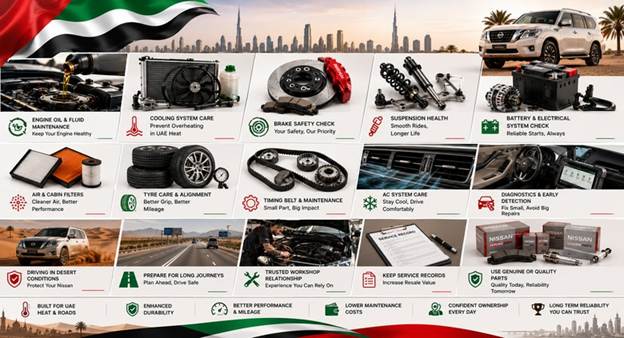
Suggested Visual Callout
"Popular Nissan Models and Their Most Important Spare Parts"
Create a premium infographic showing:
- Nissan Patrol.
- Nissan Altima.
- Nissan Sunny.
- Nissan Maxima.
- Nissan X-Trail.
- Nissan Pathfinder.
Highlight the major replacement areas for each model using:
- Engine.
- Gearbox.
- Suspension.
- Brakes.
- Cooling system.
- Electrical components.
Use realistic workshop illustrations with subtle UAE-inspired red, green, white and black accents.
Keep text minimal while using icons and arrows to explain the maintenance priorities visually.
Smart Buyer's Checklist
Before buying spare parts for any Nissan model:
- Confirm the exact model and production year.
- Verify compatibility using the VIN.
- Match the component to the correct engine and transmission.
- Review previous maintenance history.
- Compare quality before comparing price.
- Replace supporting service items where appropriate.
- Request warranty information.
- Use experienced Nissan parts specialists.
Every Nissan tells a different ownership story.
The smartest buyers simply learn to listen before ordering parts.
Key Takeaways
Although Nissan vehicles share the same manufacturer, each model has distinct maintenance priorities shaped by its engineering, intended use and typical driving environment. The Patrol, Altima, Sunny, Maxima, X-Trail and Pathfinder all develop different wear patterns, making model-specific knowledge essential when selecting replacement parts or planning preventative maintenance. Accurate diagnosis and proper compatibility checks remain just as important as choosing high-quality components.
Across the UAE, environmental conditions such as heat, heavy traffic and long-distance driving make routine inspections even more valuable. Owners who understand the specific needs of their Nissan model, maintain detailed service records and choose correctly matched replacement parts consistently enjoy lower running costs, stronger reliability and better long-term ownership value.
The Most Common Nissan Problems and the Spare Parts That Usually Solve Them
Quick Summary
| Problem Area | Most Common Replacement Parts |
| Engine Problems | Spark plugs, ignition coils, sensors, gaskets, timing components |
| Transmission Issues | Transmission mounts, valve body components, filters, seals |
| Suspension Wear | Shock absorbers, control arms, bushes, ball joints |
| Cooling System Failures | Radiator, thermostat, water pump, cooling fan |
| Electrical Problems | Battery, alternator, starter motor, sensors |
| Dashboard Warning Lights | Sensors, electrical components or supporting mechanical systems |
Every vehicle eventually develops problems.
That isn't a sign of poor engineering.
It's simply what happens when thousands of moving parts spend years working together.
The interesting question isn't,
"Will something wear out?"
Of course it will.
A far better question is,
"What usually wears out first?"
Experienced Nissan technicians rarely panic when warning lights appear.
Patterns begin to emerge after repairing the same vehicles for years.
Certain faults repeat themselves.
Certain components consistently deserve attention.
Understanding those patterns allows owners to act before relatively small problems become unexpectedly expensive repairs.
That's where long-term savings usually begin.
Most Common Nissan Engine Problems
The engine often receives the blame.
Oddly enough...
It's not always guilty.
Modern Nissan engines are generally dependable when serviced correctly.
However, surrounding components naturally wear over time.
Common issues include:
- Ignition coil deterioration.
- Worn spark plugs.
- Engine oil leaks.
- Air intake restrictions.
- Faulty oxygen sensors.
- MAF sensor contamination.
- Timing component wear.
- PCV valve problems.
One neglected sensor can reduce fuel economy.
An ageing ignition coil may create rough running.
Restricted airflow quietly increases fuel consumption.
Drivers sometimes assume catastrophic engine failure.
Technicians often discover routine maintenance items instead.
That's why diagnostics should always come before replacing expensive engine components.
Nissan Transmission Problems and Replacement Parts
Few repair quotations concern owners quite like transmission repairs.
Understandably so.
Gearboxes represent one of the most sophisticated systems inside any vehicle.
Early symptoms may include:
- Hesitant gear changes.
- Delayed acceleration.
- Unusual vibration.
- Transmission warning lights.
- Jerking during take-off.
- Unfamiliar noises.
The underlying cause isn't always internal gearbox damage.
Common replacement parts may include:
- Transmission mounts.
- Oil seals.
- Valve body components.
- Solenoids.
- Filters.
- Sensors.
One overlooked service interval occasionally creates problems that appear considerably more serious than they actually are.
Ignoring early symptoms almost always increases repair costs.
Suspension Components That Wear Out Most Frequently
UAE roads continue improving every year.
Even so...
Suspension components never enjoy an easy life.
Speed humps.
Construction zones.
Heavy traffic.
Occasional off-road driving.
Every journey gradually contributes to wear.
Frequently replaced components include:
- Shock absorbers.
- Control arms.
- Ball joints.
- Suspension bushes.
- Anti-roll bar links.
- Steering tie rods.
Most suspension deterioration happens gradually.
Drivers slowly adapt without noticing.
Until they drive another well-maintained Nissan.
Only then do they realise how much precision disappeared over time.
Cooling System Failures in UAE Conditions
If there is one system that deserves constant respect in the Emirates...
It's the cooling system.
Summer temperatures place exceptional demands upon:
- Radiators.
- Cooling fans.
- Water pumps.
- Thermostats.
- Coolant hoses.
- Temperature sensors.
Cooling problems often begin quietly.
A small coolant leak.
An ageing thermostat.
A partially blocked radiator.
Nothing immediately dramatic.
Months later, overheating begins appearing during traffic congestion.
Engines rarely overheat without warning.
The warning signs simply arrive much earlier than most owners expect.
Electrical Problems Nissan Owners Experience
Modern Nissan vehicles rely on electronic communication for almost everything.
Starting the engine.
Charging the battery.
Monitoring emissions.
Operating safety systems.
Managing fuel delivery.
Consequently, electrical faults can create remarkably varied symptoms.
Frequently replaced electrical components include:
- Batteries.
- Alternators.
- Starter motors.
- Crankshaft sensors.
- Camshaft sensors.
- ABS sensors.
- Wheel-speed sensors.
- Wiring connectors.
Electrical diagnosis has become every bit as important as mechanical repair.
Replacing components without testing them first usually wastes both money and time.
Dashboard Warning Signs That Should Never Be Ignored
Dashboard lights aren't designed to frighten drivers.
They're designed to start conversations.
Conversations between the vehicle...
And whoever is willing to listen.
Common warning lights include:
- Check Engine.
- Battery.
- ABS.
- Oil Pressure.
- Engine Temperature.
- Airbag.
- Brake System.
None automatically indicate severe failure.
Equally...
None deserve ignoring.
A warning light doesn't necessarily explain the fault.
It simply explains that investigation should begin.
Treating warning lights as suggestions rather than priorities often leads to much larger repair bills later.
Why One Fault Often Creates Three Different Symptoms
This is where modern Nissan diagnosis becomes particularly interesting.
Imagine an ageing ignition coil.
Combustion becomes inconsistent.
Fuel economy falls.
Acceleration weakens.
The Check Engine light eventually appears.
From the driver's perspective...
Three different problems.
From the technician's perspective...
One replacement component.
The opposite also happens.
One warning light.
Several possible causes.
That's precisely why professional diagnostics remain indispensable.
Symptoms tell stories.
They don't always reveal the ending.
Small Parts That Prevent Major Repairs
Owners naturally focus on expensive components.
Engines.
Gearboxes.
Suspension assemblies.
Yet remarkably inexpensive parts often determine whether those larger systems remain healthy.
Examples include:
- Engine air filters.
- Cabin filters.
- Drive belts.
- Coolant.
- Engine oil.
- Transmission fluid.
- Rubber hoses.
- Seals.
Ignoring these components rarely saves money.
It merely postpones spending until the invoice becomes considerably larger.
Routine maintenance quietly protects major mechanical systems.
That's one of the oldest lessons in vehicle ownership.
It remains one of the most valuable.
The Real Cost of Ignoring Early Symptoms
Let's imagine a driver notices a slight coolant smell.
Nothing obvious appears beneath the vehicle.
The temperature gauge remains normal.
Life becomes busy.
Weeks pass.
Months pass.
Eventually the coolant leak worsens.
The engine begins overheating during traffic.
A simple hose replacement evolves into a far more complicated repair.
The original fault didn't suddenly become expensive.
Time made it expensive.
That's worth remembering every time a vehicle begins behaving differently.
Workshop Story
A Nissan Sunny arrived at a workshop in Sharjah after its owner complained about poor acceleration and noticeably higher fuel consumption.
Friends suggested injector problems.
Another garage suspected internal engine wear.
Technicians began with the basics.
Diagnostic equipment quickly identified repeated ignition misfires.
Further inspection revealed worn spark plugs and a failing ignition coil.
Both components had exceeded their recommended service life.
After replacement, the engine immediately returned to smooth, efficient operation.
Collecting the vehicle, the owner smiled.
"I thought the engine was worn out."
The technician replied,
"Engines often receive blame for problems caused by much smaller parts."
Simple diagnosis had prevented unnecessary expense.
Once again.
Common Nissan Problems Comparison Table
| Problem | Likely Replacement Parts | Inspection Priority |
| Engine Misfire | Spark plugs, ignition coils, sensors | Very High |
| Rough Gear Changes | Transmission mounts, solenoids, sensors | Very High |
| Steering Vibration | Suspension bushes, ball joints, wheel bearings | High |
| Overheating | Radiator, thermostat, water pump | Very High |
| Battery Warning | Battery, alternator, charging system | High |
| Dashboard Warning Lights | Diagnostic inspection before replacing parts | Essential |
Buyer Decision Matrix
| Your Situation | Recommended Action |
| Engine warning light appears | Complete a professional diagnostic scan immediately |
| Vehicle overheats in traffic | Inspect the entire cooling system rather than topping up coolant repeatedly |
| Gear shifts become inconsistent | Arrange a transmission inspection before further driving |
| Fuel economy drops noticeably | Check ignition, filters and engine sensors |
| Steering feels unstable | Inspect suspension and steering components |
| Multiple warning lights appear together | Test battery voltage and charging system before replacing electronic modules |
Suggested Visual Callout
"The Most Common Nissan Problems Explained"
Create a premium infographic showing:
- Engine.
- Gearbox.
- Suspension.
- Cooling system.
- Brake system.
- Battery.
- Dashboard warning lights.
Use icons to connect each symptom with its most likely replacement components.
Apply subtle UAE-inspired red, green, white and black accents with realistic workshop imagery.
Keep text minimal and let the illustrations explain the diagnostic process.
Smart Buyer's Checklist
When your Nissan develops a fault:
- Don't assume the most expensive component has failed.
- Request a complete diagnostic report.
- Investigate supporting systems before replacing major assemblies.
- Repair cooling issues immediately.
- Never ignore dashboard warning lights.
- Replace worn service items on schedule.
- Use compatible replacement parts.
- Choose workshops experienced with Nissan vehicles.
Vehicles almost never become expensive overnight.
They become expensive because small warnings quietly become large repairs.
Key Takeaways
Most Nissan faults develop progressively rather than appearing without warning. Engine misfires, transmission concerns, suspension wear, cooling system issues and electrical problems all tend to provide early symptoms that allow owners to act before significant damage occurs. Accurate diagnosis remains the foundation of every successful repair, ensuring that the true cause of the problem is identified before unnecessary components are replaced.
For Nissan owners throughout the UAE, extreme temperatures, heavy traffic and long-distance driving make early intervention even more important. Paying attention to warning lights, unusual noises, changing driving characteristics and routine maintenance schedules consistently reduces repair costs while protecting reliability, safety and long-term ownership value.
How to Buy Nissan Spare Parts in the UAE Without Making Costly Mistakes
Quick Summary
| Buying Factor | Why It Matters |
| Identifying Genuine Parts | Protects reliability, safety and resale value |
| VIN Compatibility | Prevents ordering incorrect components |
| Avoiding Counterfeit Parts | Reduces repair risks and unnecessary expenses |
| Questions to Ask Suppliers | Helps assess product quality and credibility |
| Online vs Local Suppliers | Understand the strengths of each buying method |
| Common Buying Mistakes | Learn how to avoid expensive purchasing decisions |
Buying a replacement part sounds straightforward.
Find the component.
Pay the supplier.
Install it.
Drive away.
If only it were always that simple.
Every week, workshops across the UAE receive vehicles fitted with perfectly good...
...but completely incompatible parts.
Sometimes the dimensions differ by only a few millimetres.
Sometimes the electrical connector isn't quite right.
Occasionally the part belongs to the same Nissan model...
...but a different production year.
The result remains the same.
Lost time.
Additional labour.
Frustrated owners.
Buying spare parts successfully isn't simply about finding availability.
It's about finding certainty.
How to Identify Genuine Nissan Spare Parts
The word genuine carries considerable importance.
Unfortunately, it also attracts misunderstanding.
A genuine Nissan part is manufactured to meet Nissan's original engineering specifications and is supplied through authorised distribution channels.
Several indicators help buyers verify authenticity.
Look for:
- Correct manufacturer packaging.
- Original part numbers.
- Professional labelling.
- Consistent build quality.
- Proper finishing.
- Supplier documentation where available.
Equally important...
Avoid judging authenticity by packaging alone.
Counterfeit products have become increasingly convincing.
Professional verification remains far more valuable than visual appearance.
VIN Number and Parts Compatibility Guide
Perhaps the most important sequence of characters on your vehicle...
Isn't the registration plate.
It's the VIN.
The Vehicle Identification Number contains detailed information about:
- Production year.
- Engine specification.
- Transmission type.
- Manufacturing details.
- Equipment variations.
Two Nissan Altimas built in different years may require different sensors.
Two Patrols with different engines may use completely different cooling components.
The VIN removes uncertainty.
Experienced suppliers rarely rely solely on model names.
They verify compatibility before recommending replacement parts.
That simple step prevents many expensive mistakes.
How to Avoid Buying Fake Nissan Parts
Counterfeit automotive components remain a challenge in every major market.
The UAE is no exception.
Most counterfeit products share one characteristic.
They focus on appearance.
Rather than engineering.
Common warning signs include:
- Prices that seem unrealistically low.
- Missing documentation.
- Poor packaging quality.
- Inconsistent branding.
- No warranty.
- Reluctance to answer technical questions.
Remember...
The purchase price appears only once.
The consequences of a poor-quality part may continue for years.
Suspension.
Braking.
Cooling.
Steering.
These systems deserve genuine confidence rather than unnecessary compromise.
Questions to Ask Before Buying Nissan Spare Parts
Experienced buyers ask questions before opening their wallets.
Not afterwards.
Useful questions include:
- Is this part compatible with my VIN?
- Is it genuine, OEM or aftermarket?
- Does it include a warranty?
- Has the component been tested?
- Is this the latest revision?
- Are supporting parts recommended during installation?
- What is the expected service life?
- Can I inspect the component before purchase?
A trustworthy supplier usually welcomes informed questions.
Knowledgeable conversations often reveal knowledgeable businesses.
Online vs Local Nissan Parts Suppliers
The buying process has changed dramatically.
Many owners now compare suppliers online before making a decision.
Others still prefer visiting physical businesses.
Both approaches offer advantages.
Online Suppliers
Benefits include:
- Wider selection.
- Easy price comparison.
- Convenient enquiries.
- Multiple supplier quotations.
- Home or workshop delivery.
Potential considerations:
- Compatibility must be confirmed carefully.
- Product photographs may not tell the complete story.
- Delivery times vary.
Local Suppliers
Advantages include:
- Physical inspection.
- Immediate collection.
- Face-to-face technical discussions.
- Faster problem resolution.
- Easier exchanges when necessary.
Neither option is automatically better.
The best choice depends upon the urgency of the repair, the complexity of the component and the supplier's reputation.
Common Buying Mistakes Nissan Owners Make
Patterns appear remarkably consistent.
Owners rarely lose money because they cared too much.
They usually lose money because they assumed too much.
Common mistakes include:
- Buying solely on price.
- Ignoring VIN compatibility.
- Assuming every model shares identical components.
- Mixing incompatible replacement parts.
- Ignoring warranty conditions.
- Delaying purchases until failures become urgent.
- Choosing unknown brands without research.
- Replacing parts before confirming the diagnosis.
The cheapest quotation often becomes surprisingly expensive after incorrect installation, repeat labour or premature failure.
Why the Cheapest Part Is Rarely the Cheapest Decision
Imagine two identical Nissan X-Trails.
Owner A purchases the least expensive radiator available.
Owner B selects a proven replacement from a reputable supplier.
Initially...
Owner A saves money.
Months later...
Cooling efficiency declines.
Engine temperatures begin rising during heavy traffic.
Replacement becomes necessary again.
Labour is paid twice.
Coolant is replaced twice.
Time is lost twice.
The original saving quietly disappears.
Value isn't measured only by purchase price.
It's measured across the entire ownership experience.
Understanding Warranties Before You Buy
Many buyers ask whether a part includes a warranty.
Fewer ask what that warranty actually covers.
Important details include:
- Warranty duration.
- Manufacturing defects.
- Installation requirements.
- Claim procedures.
- Exclusions.
- Supporting documentation.
A longer warranty doesn't automatically mean better quality.
A clear warranty, backed by a reputable supplier, often provides far greater reassurance.
Read the details before installation.
Not after a problem develops.
Workshop Story
A Nissan Pathfinder owner from Dubai ordered a replacement cooling fan after finding an exceptionally low online price.
The photographs looked convincing.
The description appeared accurate.
After installation, the fan operated intermittently and failed to maintain proper cooling during heavy traffic.
Inspection revealed that the electrical connector and motor specification differed from the original component despite looking almost identical.
The incorrect part had matched the vehicle visually...
But not technically.
After replacing it with the correct specification, cooling performance returned to normal.
The technician offered a simple observation.
"Modern vehicles don't recognise bargains.
They only recognise compatibility."
The owner never forgot the lesson.
Nissan Spare Parts Buying Comparison Table
| Buying Method | Advantages | Considerations |
| Genuine Parts | Maximum compatibility and reliability | Higher purchase price |
| OEM Parts | Excellent balance of quality and value | Verify manufacturer |
| Aftermarket Parts | Competitive pricing and wide availability | Choose established brands |
| Online Suppliers | Easy comparison and broad selection | Confirm VIN compatibility |
| Local Suppliers | Immediate inspection and collection | Selection may vary |
| Used or Reconditioned Parts | Lower cost for major components | Inspect condition and warranty |
Buyer Decision Matrix
| Your Situation | Recommended Choice |
| Long-term ownership | Genuine or high-quality OEM parts |
| Routine servicing | Genuine, OEM or trusted aftermarket components |
| Major engine or gearbox repair | Prioritise compatibility and warranty over price |
| Emergency replacement | Confirm VIN before purchasing locally |
| Buying online | Request detailed compatibility confirmation |
| Unsure between two options | Seek advice from an experienced Nissan specialist |
Suggested Visual Callout
"Buying Nissan Spare Parts with Confidence"
Create a premium infographic featuring:
- VIN verification.
- Genuine parts packaging.
- OEM components.
- Online ordering.
- Local supplier.
- Warranty certificate.
- Inspection checklist.
- Quality approval icons.
Use realistic workshop visuals with subtle UAE-inspired red, green, white and black accents.
Keep text minimal while visually illustrating the safe buying process.
Smart Buyer's Checklist
Before purchasing any Nissan spare parts in UAE:
- Verify the VIN.
- Confirm the exact model and production year.
- Compare genuine, OEM and aftermarket options.
- Ask about warranty coverage.
- Confirm compatibility before payment.
- Avoid unusually cheap offers without verification.
- Inspect the component where possible.
- Buy from experienced and reputable suppliers.
Good buyers don't simply compare prices.
They compare confidence.
That's usually what separates a successful purchase from an expensive mistake.
Key Takeaways
Buying Nissan spare parts successfully involves much more than finding the lowest price. Correct VIN verification, understanding the differences between genuine, OEM and aftermarket components, checking warranty terms and choosing reputable suppliers all play an important role in achieving reliable, cost-effective repairs. The right purchasing process helps prevent incorrect fitment, repeat labour costs and premature component failure.
Across the UAE, owners who take time to verify compatibility and evaluate supplier credibility consistently enjoy smoother repairs and lower long-term ownership costs. Every replacement part should be viewed as an investment in the vehicle's future performance rather than simply an immediate expense.
Nissan Spare Parts Cost Guide in the UAE – What Should You Expect to Pay?
Quick Summary
| Cost Category | What You Should Know |
| Engine Parts | Prices vary significantly depending on component complexity. |
| Transmission Parts | Early repairs are usually less expensive than complete replacements. |
| Suspension & Steering | Routine wear items are generally affordable when replaced on time. |
| Electrical Components | Diagnostic accuracy prevents unnecessary spending. |
| Genuine vs OEM vs Used | The lowest purchase price doesn't always mean the lowest ownership cost. |
| Hidden Costs | Labour, fluids, programming and supporting parts affect the final bill. |
Every Nissan owner eventually asks the same question.
"How much is this going to cost?"
It's a perfectly reasonable question.
Unfortunately...
It's also one of the hardest to answer with a single number.
Why?
Because no repair invoice is built around only one component.
A replacement radiator may also require fresh coolant.
Brake discs may require new pads.
A suspension repair often includes wheel alignment.
A gearbox service might involve filters, seals and specialist transmission fluid.
The part itself is only one piece of the financial picture.
Understanding the complete cost helps owners make better decisions before work begins.
Nissan Engine Parts Price Guide
The engine contains hundreds of individual components.
Some cost very little.
Others represent major investments.
Common engine replacement parts include:
- Spark plugs.
- Ignition coils.
- Air filters.
- Oil filters.
- Water pumps.
- Timing components.
- Gaskets.
- Fuel injectors.
- Engine mounts.
Routine service items generally remain affordable because they are designed to be replaced regularly.
Major internal engine components naturally require a larger investment due to their engineering complexity and installation time.
The encouraging news?
Many expensive engine repairs begin as inexpensive maintenance items that were simply delayed for too long.
Nissan Gearbox and Transmission Parts Cost
Transmission repairs often concern owners before they even receive an inspection.
The assumption is understandable.
Gearboxes are sophisticated mechanical systems.
However, not every transmission problem requires a complete replacement.
Common replacement components include:
- Transmission filters.
- Oil seals.
- Solenoids.
- Valve body components.
- Mounts.
- Sensors.
- Clutch assemblies for manual models.
Early intervention frequently limits repair costs.
Waiting until significant internal damage develops usually changes the financial conversation entirely.
Transmission servicing should therefore be viewed as preventative maintenance rather than an unnecessary expense.
Brake, Suspension and Steering Parts Prices
These components experience continuous wear.
Fortunately, most are designed for periodic replacement.
Typical maintenance items include:
- Brake pads.
- Brake discs.
- Shock absorbers.
- Suspension bushes.
- Ball joints.
- Control arms.
- Steering tie rods.
Many owners delay replacing worn suspension components because the vehicle still feels drivable.
That decision often creates additional wear elsewhere.
Tyres wear unevenly.
Steering precision declines.
Braking stability changes.
Replacing wear items at the correct interval usually proves considerably more economical than repairing multiple damaged components later.
Electrical Components and Sensor Costs
Modern Nissan vehicles rely heavily on electronics.
Fortunately, many electrical repairs involve replacing relatively compact components rather than complete systems.
Common electrical replacements include:
- Batteries.
- Alternators.
- Starter motors.
- Crankshaft sensors.
- Camshaft sensors.
- ABS sensors.
- Oxygen sensors.
- Ignition coils.
The component itself is only part of the equation.
Accurate diagnosis remains equally valuable.
Replacing three perfectly healthy sensors to discover the fourth was responsible rarely represents good value.
Professional diagnostics usually reduce overall repair costs.
Genuine vs OEM vs Used Parts Cost Comparison
Price always matters.
Value matters even more.
Different replacement options suit different ownership goals.
| Part Type | Initial Cost | Long-Term Value | Best For |
| Genuine | Highest | Excellent | Long-term ownership and critical systems |
| OEM | Moderate | Excellent | Daily drivers seeking quality and value |
| Aftermarket | Moderate to Low | Varies by manufacturer | Routine maintenance with trusted brands |
| Used | Low | Depends on condition | Budget-conscious repairs |
| Reconditioned | Moderate | Very Good | Major mechanical components |
A higher purchase price occasionally reduces future repair costs.
Likewise...
A lower purchase price occasionally creates additional labour, repeat repairs and further downtime.
The true cost of ownership extends well beyond the invoice issued on installation day.
Hidden Costs of Cheap Nissan Spare Parts
This is where many repair budgets become inaccurate.
Owners often budget for the replacement component.
They forget everything surrounding it.
Hidden costs may include:
- Labour charges.
- Diagnostic testing.
- Programming or calibration.
- Fresh engine oil.
- Coolant replacement.
- Transmission fluid.
- Gaskets and seals.
- Wheel alignment.
- Fasteners.
- Additional supporting components discovered during installation.
None of these should be considered unnecessary.
They're often essential for completing the repair correctly.
The cheapest quotation sometimes excludes these items.
The final invoice then becomes much higher than expected.
Labour Costs Across the UAE
Labour charges naturally vary between workshops depending on:
- Technician experience.
- Equipment.
- Vehicle complexity.
- Repair duration.
- Workshop location.
In larger cities such as Dubai and Abu Dhabi, specialist facilities may charge higher labour rates because of advanced diagnostic equipment and manufacturer-specific expertise.
Independent workshops in Sharjah, Ajman, Ras Al Khaimah, Fujairah and Umm Al Quwain often provide competitive pricing while maintaining excellent technical standards.
The objective shouldn't be finding the cheapest labour.
It should be finding the most accurate repair.
Correct diagnosis saves considerably more money than low hourly rates ever can.
Why Preventative Maintenance Is Always Cheaper
Imagine two Nissan Patrol owners.
Owner A replaces coolant, drive belts and the water pump during scheduled maintenance.
Owner B postpones everything because the vehicle still feels fine.
Months later...
A cooling hose fails.
The engine overheats.
Recovery costs appear.
Additional labour becomes necessary.
Several supporting components now require replacement.
Owner A spent money earlier.
Owner B spent considerably more later.
Maintenance rarely competes with repairs.
It prevents them.
Cost of Delay Analysis
Many owners ask whether a repair can wait another few weeks.
Sometimes it can.
Sometimes it absolutely shouldn't.
Consider these examples:
| Delayed Repair | Possible Consequence |
| Worn brake pads | Damaged brake discs and longer stopping distances |
| Coolant leak | Engine overheating and severe engine damage |
| Suspension bush wear | Additional steering and tyre wear |
| Weak battery | Starting failures and charging system strain |
| Ignition misfire | Catalytic converter damage and higher fuel consumption |
| Oil leak | Low lubrication leading to engine wear |
The cost of delay is rarely visible immediately.
It accumulates quietly.
Workshop Story
A Nissan Maxima owner from Abu Dhabi requested a quotation after noticing a slight coolant leak beneath the vehicle.
The workshop recommended replacing a deteriorating radiator hose and refreshing the coolant.
Wanting to save money, the owner postponed the repair.
Several weeks later, while driving through heavy afternoon traffic, the hose failed completely.
The engine overheated before the vehicle could be stopped safely.
The final repair included:
- New radiator hose.
- Coolant replacement.
- Thermostat.
- Additional labour.
- Inspection of the cooling system for heat-related damage.
The technician explained gently,
"The first quotation was for maintenance.
The second one was for consequences."
The owner nodded.
No further explanation was necessary.
Nissan Spare Parts Cost Comparison Table
| Category | Typical Cost Trend | Ownership Advice |
| Engine Service Parts | Low to Moderate | Replace on schedule |
| Internal Engine Components | High | Prevent through regular maintenance |
| Transmission Service Parts | Moderate | Service early to avoid major repairs |
| Suspension Components | Moderate | Replace wear items before related damage develops |
| Electrical Components | Low to Moderate | Diagnose accurately before replacing |
| Cooling System Components | Moderate | Never delay overheating-related repairs |
Buyer Decision Matrix
| Your Situation | Recommended Financial Decision |
| Planning long-term ownership | Invest in genuine or quality OEM parts |
| Daily commuting vehicle | Prioritise preventative maintenance |
| Budget repair | Focus on the highest-quality option within budget rather than the cheapest |
| Major repair quotation | Request a detailed breakdown of labour and supporting parts |
| Comparing suppliers | Compare total repair cost, not just component price |
| Unsure whether to repair now | Ask what the likely cost of delaying the repair would be |
Suggested Visual Callout
"Understanding the True Cost of Nissan Spare Parts"
Create a premium infographic illustrating:
- Engine.
- Gearbox.
- Brakes.
- Suspension.
- Cooling system.
- Electrical components.
Use layered pricing icons to represent:
- Replacement part.
- Labour.
- Fluids.
- Diagnostics.
- Supporting components.
- Long-term ownership savings.
Incorporate subtle UAE-inspired red, green, white and black accents with realistic workshop imagery.
Keep text minimal while visually explaining that the total repair cost extends beyond the replacement component itself.
Smart Buyer's Checklist
Before approving any repair estimate:
- Request an itemised quotation.
- Confirm whether labour is included.
- Ask about fluids, seals and supporting parts.
- Compare total repair costs rather than individual component prices.
- Understand warranty coverage.
- Ask whether preventative replacements are recommended while access is available.
- Avoid delaying cooling and braking repairs.
- Choose long-term value over short-term savings.
A repair bill tells only part of the story.
The real financial question is how much today's decision will influence tomorrow's ownership costs.
Key Takeaways
The cost of Nissan spare parts in the UAE depends on far more than the price of the replacement component. Labour, diagnostics, fluids, supporting parts and installation complexity all contribute to the total repair cost, making it essential to evaluate complete quotations rather than individual prices. Preventative maintenance remains one of the most effective ways to reduce long-term ownership expenses and avoid major mechanical failures.
For Nissan owners across the Emirates, understanding the relationship between purchase price, installation costs and future reliability leads to more informed financial decisions. Investing in quality parts, accurate diagnosis and timely repairs consistently delivers better value than postponing maintenance or selecting components based solely on the lowest advertised price.
Essential Nissan Maintenance and Service Guide for Long-Term Reliability
Quick Summary
| Maintenance Area | Why It Matters |
| Service Schedule | Prevents expensive mechanical failures before they develop. |
| Engine Oil & Filters | Protect engine performance and extend engine life. |
| Cooling System | Essential for surviving UAE summer temperatures. |
| Brakes & Suspension | Maintains safety, comfort and handling. |
| Battery & Charging System | Ensures reliable starting and electrical performance. |
| Preventative Maintenance | Reduces lifetime ownership costs and unexpected breakdowns. |
Most vehicle owners think about maintenance only when something goes wrong.
A warning light appears.
The engine sounds different.
Braking no longer feels quite as reassuring.
The air conditioning becomes weaker.
By that stage...
Maintenance has already become repair.
Experienced Nissan owners usually follow a different philosophy.
They service the vehicle before it asks for attention.
That simple habit often explains why one Patrol comfortably exceeds hundreds of thousands of kilometres while another begins developing avoidable problems much earlier.
Reliability isn't luck.
It's usually the result of hundreds of small maintenance decisions made over many years.
Essential Nissan Maintenance Schedule
Every Nissan model has its own recommended servicing intervals.
However, UAE driving conditions often require owners to think beyond the manufacturer's standard schedule.
Extreme temperatures.
Heavy traffic.
Fine desert dust.
Long motorway journeys.
Frequent idling.
Each places additional stress on mechanical components.
A comprehensive maintenance programme should include:
- Engine oil replacement.
- Oil filter replacement.
- Air filter inspection.
- Cabin filter replacement.
- Brake inspection.
- Suspension inspection.
- Cooling system inspection.
- Battery testing.
- Tyre condition and pressure checks.
- Fluid level inspections.
Rather than viewing servicing as a routine expense, experienced owners see it as preventative investment.
Every inspection creates an opportunity to detect problems while they remain relatively inexpensive.
Engine Oil, Filters and Fluids
If mechanics were asked to name the single most important maintenance item...
Many would answer without hesitation.
Engine oil.
Oil performs far more than simple lubrication.
It also helps:
- Reduce friction.
- Carry away heat.
- Prevent internal corrosion.
- Remove contaminants.
- Protect moving components.
Equally important are:
- Oil filters.
- Engine air filters.
- Cabin air filters.
- Fuel filters where applicable.
Fresh oil flowing through a blocked filter cannot deliver its full protective benefits.
Each component supports the others.
Fluids deserve similar attention.
Regular inspection of:
- Coolant.
- Brake fluid.
- Transmission fluid.
- Power steering fluid where applicable.
helps maintain long-term reliability throughout the vehicle.
Cooling System Maintenance
Few systems work harder in the UAE than the cooling system.
Summer temperatures frequently exceed forty degrees.
Vehicles spend long periods stationary in traffic.
Air conditioning increases thermal load.
The cooling system rarely receives a break.
Routine inspection should include:
- Radiator condition.
- Coolant level.
- Thermostat operation.
- Water pump.
- Cooling fan.
- Radiator hoses.
- Expansion reservoir.
Small coolant leaks deserve immediate attention.
Waiting for overheating to occur rarely benefits anyone.
Replacing a hose costs considerably less than repairing heat-related engine damage.
Cooling maintenance protects far more than temperature.
It protects the engine itself.
Brake and Suspension Inspection Guide
Drivers naturally become accustomed to gradual changes.
That's why suspension wear often escapes notice.
Handling becomes slightly less precise.
The steering requires a little more correction.
Braking feels subtly different.
None appear dramatic individually.
Together...
They quietly change how the vehicle behaves.
Routine inspections should include:
- Brake pads.
- Brake discs.
- Brake fluid.
- Shock absorbers.
- Ball joints.
- Suspension bushes.
- Steering components.
- Wheel bearings.
Replacing worn components promptly maintains:
- Vehicle stability.
- Tyre life.
- Passenger comfort.
- Emergency braking performance.
Good suspension doesn't simply improve comfort.
It improves confidence.
Battery, Alternator and Starter Maintenance
Modern Nissan vehicles rely heavily on electrical systems.
Without a healthy charging system, even perfectly maintained engines struggle to operate reliably.
Routine inspection should cover:
- Battery voltage.
- Charging output.
- Alternator condition.
- Starter motor performance.
- Battery terminals.
- Earth connections.
UAE heat naturally shortens battery life compared with cooler climates.
Preventative battery testing before summer often prevents inconvenient roadside breakdowns.
Many electrical failures begin long before the vehicle refuses to start.
Early testing identifies those weaknesses.
Preventative Maintenance That Saves Money
One of the most common misconceptions in vehicle ownership sounds perfectly reasonable.
"I'll replace it when it breaks."
Sometimes that approach works.
Sometimes it becomes extremely expensive.
Imagine replacing a worn drive belt before failure.
The repair remains simple.
Now imagine the same belt snapping unexpectedly.
Cooling stops.
Charging stops.
Engine temperature rises.
Recovery becomes necessary.
The repair has changed entirely.
Preventative maintenance doesn't eliminate spending.
It changes when and how money is spent.
Usually in the owner's favour.
First 1,000 Kilometres After Installing New Parts
Major replacement components require time to settle.
Whether fitting suspension components, brake parts or cooling system assemblies, the first few weeks remain important.
Owners should:
- Listen for unusual noises.
- Monitor dashboard warning lights.
- Check fluid levels regularly.
- Observe braking performance.
- Inspect for leaks.
- Return for follow-up inspection if recommended.
Many workshops include complimentary post-installation inspections because they understand that small adjustments occasionally become necessary.
Early follow-up helps ensure every component performs exactly as intended.
Seasonal Maintenance for UAE Drivers
Unlike many countries, the UAE presents unique seasonal challenges.
Summer places exceptional stress on:
- Cooling systems.
- Batteries.
- Air conditioning.
- Tyres.
Winter, although comparatively mild, often encourages:
- Long-distance travel.
- Desert camping.
- Family road trips.
Preparing the vehicle before each season helps reduce unexpected mechanical issues.
Seasonal inspections should become part of every annual maintenance plan rather than an afterthought.
Fleet Maintenance vs Private Ownership
Commercial vehicles rarely receive gentle treatment.
Taxi operators.
Delivery services.
Corporate fleets.
Construction companies.
Mileage accumulates rapidly.
Fleet managers understand something private owners sometimes overlook.
Preventative servicing costs less than unexpected downtime.
The same principle applies to individual ownership.
Whether a Nissan covers 20,000 kilometres or 80,000 kilometres annually, regular maintenance protects reliability far more effectively than reactive repairs.
The mathematics remain surprisingly similar.
Workshop Story
A Nissan Patrol owner from Fujairah visited a workshop before planning a family road trip across several Emirates.
The vehicle showed no obvious problems.
Some friends questioned the need for a preventative inspection.
Technicians nevertheless completed a comprehensive service.
During the inspection they discovered an ageing upper radiator hose beginning to soften internally.
From the outside...
It appeared almost new.
Replacing the hose required less than an hour.
The technician explained,
"It probably would have survived today's journey.
I'm less certain about next month's."
The owner approved the replacement.
Several weeks later, while driving through mountainous roads during exceptionally hot weather, he remembered that conversation.
Sometimes the best repair is the one you never need because maintenance happened first.
Essential Nissan Maintenance Checklist
| Component | Recommended Inspection Priority | Why It Matters |
| Engine Oil | Very High | Protects engine longevity |
| Oil & Air Filters | Very High | Maintains efficiency and cleanliness |
| Cooling System | Very High | Prevents overheating |
| Brake System | Very High | Ensures safe stopping performance |
| Suspension | High | Preserves stability and tyre life |
| Battery & Charging System | High | Prevents starting and electrical issues |
Buyer Decision Matrix
| Your Situation | Recommended Maintenance Approach |
| Daily city driving | Increase brake and cooling inspections |
| Frequent motorway travel | Monitor tyres, fluids and suspension regularly |
| Desert or off-road driving | Inspect suspension, cooling and air filtration more frequently |
| High annual mileage | Shorten maintenance intervals where appropriate |
| Family vehicle | Prioritise braking, cooling and steering inspections |
| Preparing for a long journey | Complete a full preventative inspection before departure |
Suggested Visual Callout
"Essential Nissan Maintenance for UAE Drivers"
Create a premium infographic featuring:
- Engine oil service.
- Air filter replacement.
- Cooling system inspection.
- Brake inspection.
- Suspension check.
- Battery testing.
- Tyre inspection.
- Seasonal maintenance calendar.
Use realistic workshop illustrations with subtle UAE-inspired red, green, white and black accents.
Keep text minimal while using icons to show a logical maintenance sequence.
Smart Owner's Maintenance Checklist
To maximise the life of your Nissan:
- Follow a consistent service schedule.
- Replace engine oil and filters on time.
- Inspect the cooling system before summer.
- Monitor brake and suspension wear.
- Test the battery regularly.
- Replace worn belts and hoses before failure.
- Check all essential fluids frequently.
- Address unusual noises or warning lights immediately.
- Keep detailed service records.
- Use quality replacement parts installed correctly.
Reliable Nissan ownership rarely depends on dramatic repairs.
It depends on dozens of routine maintenance decisions that quietly protect the vehicle year after year.
Key Takeaways
Regular maintenance is the foundation of dependable Nissan ownership, particularly in the demanding climate of the UAE. Consistent servicing of the engine, cooling system, brakes, suspension, battery and essential fluids allows minor wear to be identified before it develops into major mechanical failure. Preventative maintenance not only improves reliability but also reduces long-term running costs and helps preserve resale value.
Owners who adapt their maintenance schedules to local driving conditions—such as extreme heat, heavy traffic, desert dust and high annual mileage—are far more likely to enjoy trouble-free motoring. Viewing servicing as an investment rather than an expense leads to fewer unexpected breakdowns, better vehicle performance and greater confidence on every journey.
Should You Repair or Replace Nissan Parts? Making the Smart Financial Decision
Quick Summary
| Decision Area | Best Approach |
| Engine Components | Repair minor issues early; replace severely damaged assemblies. |
| Transmission | Service and repair when possible before major internal damage occurs. |
| Suspension | Replace worn components promptly to prevent additional wear. |
| Electrical Components | Diagnose accurately before replacing expensive modules. |
| Used vs Reconditioned Parts | Choose according to budget, warranty and long-term ownership plans. |
| Genuine Parts | Best suited for safety-critical and complex electronic systems. |
One of the hardest decisions any Nissan owner faces isn't identifying a fault.
It's deciding what happens next.
Should the part be repaired?
Should it be replaced?
Or...
Should the vehicle itself be reconsidered?
The answer rarely depends upon one factor.
Workshop technicians evaluate several questions before making recommendations.
How severe is the damage?
What is the vehicle's overall condition?
How long does the owner intend to keep it?
Will repairing one component simply postpone replacing another?
Those questions matter far more than finding the cheapest quotation.
The smartest financial decision isn't always the least expensive one today.
It's the one that delivers the greatest value over the years ahead.
Repair or Replace Engine Components?
Engines are remarkably durable when maintained correctly.
Many issues can be resolved without replacing the complete engine.
Typical repair situations include:
- Replacing ignition coils.
- Installing new spark plugs.
- Renewing gaskets.
- Repairing coolant leaks.
- Replacing water pumps.
- Installing timing components.
However, replacement becomes more practical when major internal damage affects:
- Crankshafts.
- Connecting rods.
- Cylinder blocks.
- Multiple internal components after severe overheating.
- Extensive lubrication failure.
Repairing isolated faults often makes excellent financial sense.
Rebuilding a severely damaged engine may not.
The decision should always consider the vehicle's remaining value and expected future service life.
Repair or Replace the Transmission?
Transmission problems often sound more frightening than they actually are.
Not every rough gear change requires a replacement gearbox.
Many issues originate from:
- Transmission mounts.
- Solenoids.
- Valve body components.
- Fluid contamination.
- Electronic sensors.
- Control modules.
Early diagnosis frequently limits repairs to relatively straightforward component replacement.
When extensive internal wear affects multiple gears, bearings or clutch packs, replacement or professional reconditioning may provide better long-term value.
Delaying transmission inspections rarely improves the outcome.
Gearboxes usually communicate developing faults well before complete failure.
Listening early reduces both cost and downtime.
Repair or Replace Suspension Parts?
Suspension systems are designed with replacement in mind.
Most components naturally wear during normal driving.
These include:
- Shock absorbers.
- Suspension bushes.
- Ball joints.
- Control arms.
- Anti-roll bar links.
- Steering tie rods.
Repairing individual wear items usually restores handling effectively.
Replacing the complete suspension assembly is rarely necessary unless widespread deterioration exists.
Many workshops recommend replacing components in pairs where appropriate.
Balanced suspension improves handling, tyre wear and braking stability.
Repair or Replace Electrical Components?
Electrical diagnosis has transformed dramatically over the last decade.
Replacing components based on assumptions no longer makes financial sense.
Modern testing equipment identifies faults with remarkable accuracy.
Common repair decisions involve:
- Batteries.
- Alternators.
- Starter motors.
- Sensors.
- Wiring connectors.
- Electronic control units.
Sometimes replacing one inexpensive sensor restores the entire system.
Sometimes several interconnected components require attention.
Professional diagnostics determine the difference.
Guesswork simply increases repair costs.
When Used or Reconditioned Parts Make Sense
Not every repair requires a brand-new component.
Used and professionally reconditioned parts often provide excellent value in the right circumstances.
Suitable applications may include:
- Engines.
- Gearboxes.
- Steering racks.
- Alternators.
- Air-conditioning compressors.
The key consideration isn't simply the purchase price.
Buyers should also evaluate:
- Inspection records.
- Warranty.
- Testing procedures.
- Mileage where applicable.
- Supplier reputation.
A professionally reconditioned component frequently provides greater peace of mind than an unknown used alternative.
Documentation matters almost as much as the component itself.
When Genuine Parts Are Worth the Extra Cost
Owners occasionally ask whether genuine parts justify the additional investment.
The answer depends upon the component.
Genuine parts often represent the strongest choice for:
- Airbag systems.
- ABS components.
- Engine management sensors.
- Electronic control modules.
- Cooling system components.
- Critical engine parts.
Routine service items may offer excellent OEM alternatives.
Safety-related systems deserve considerably less compromise.
The objective isn't spending more money.
It's reducing unnecessary risk.
Repair Cost vs Replacement Cost
The following question appears regularly in workshops.
"At what point should I stop repairing the vehicle?"
There isn't a universal answer.
However, several considerations help.
Ask yourself:
- Is the vehicle structurally sound?
- Has it been maintained consistently?
- Are repairs addressing isolated issues or repeated failures?
- Will the repair significantly extend useful service life?
- Does replacing the vehicle introduce even higher costs?
Replacing a vehicle often involves:
- Registration.
- Insurance.
- Financing.
- Unknown maintenance history.
- Depreciation.
Repairing a well-maintained Nissan sometimes proves the more economical decision despite a sizeable repair bill.
Context always matters.
First-Year Ownership Cost Analysis After Major Repairs
Many owners focus exclusively on today's invoice.
Experienced buyers think one year ahead.
Imagine replacing a professionally diagnosed transmission.
The initial cost may appear substantial.
However, the following twelve months may involve:
- Reliable daily operation.
- Reduced unexpected downtime.
- Lower emergency repair risk.
- Improved resale confidence.
- Better fuel efficiency if the previous fault affected performance.
Now compare that with postponing repairs.
Unexpected breakdowns.
Recovery charges.
Emergency workshop visits.
Additional damaged components.
The cheapest path today isn't always the least expensive path over the coming year.
Replace the Vehicle or Continue Maintaining It?
Perhaps the most emotional decision of all.
Owners often assume an older Nissan automatically deserves replacement.
Reality isn't always so simple.
A well-maintained Patrol with documented servicing may continue delivering dependable service for many years.
A carefully maintained Altima may cost significantly less to maintain than financing a replacement vehicle.
Before making the decision, compare:
- Total repair costs.
- Vehicle market value.
- Maintenance history.
- Expected annual mileage.
- Insurance costs.
- Replacement vehicle costs.
Sometimes replacing the vehicle is sensible.
Sometimes maintaining it remains the smarter financial strategy.
Only careful comparison reveals which option creates the greatest long-term value.
The Hidden Cost of Delaying Big Decisions
Indecision has its own price.
Imagine a cooling system fault.
The owner postpones repairs while deciding whether to keep the vehicle.
Weeks become months.
Eventually the engine overheats.
Now the original cooling repair has evolved into major engine work.
The delay—not the fault—created the largest expense.
Whether repairing or replacing, timely decisions almost always reduce overall ownership costs.
Workshop Story
A Nissan Pathfinder owner from Abu Dhabi visited a workshop after receiving quotations from two garages.
One recommended replacing the complete steering assembly.
The other advised changing only two worn steering rack bushes.
The owner authorised a detailed inspection before making a decision.
Measurements confirmed that the steering rack itself remained in excellent condition.
Only the bushes had deteriorated.
Replacing those components restored steering precision completely.
As the owner prepared to leave, he asked the technician,
"So I didn't need an entire steering system?"
The reply was simple.
"Good workshops replace problems.
They don't replace possibilities."
That distinction saved the owner a considerable amount of money.
Repair vs Replacement Comparison Table
| Situation | Repair Recommended | Replacement Recommended |
| Minor engine oil leak | ✔ | |
| Worn suspension bushes | ✔ | |
| Failing alternator | ✔ | |
| Spark plugs and ignition coils | ✔ | |
| Severe engine overheating with internal damage | ✔ | |
| Extensive gearbox internal failure | ✔ | |
| Multiple recurring failures after previous repairs | ✔ | |
| Safety-critical components beyond service limits | ✔ |
Buyer Decision Matrix
| Your Situation | Recommended Approach |
| Minor mechanical fault | Repair promptly before additional damage develops |
| Major engine issue | Compare repair costs with replacement options |
| Gearbox concerns | Diagnose early before internal wear increases |
| Long-term ownership planned | Invest in quality repairs and genuine or OEM parts |
| Budget limitations | Consider professionally reconditioned components with warranty |
| Unsure whether to keep the vehicle | Compare one-year ownership costs before deciding |
Suggested Visual Callout
"Repair or Replace? The Nissan Owner's Decision Guide"
Create a premium infographic showing:
- Engine.
- Gearbox.
- Suspension.
- Electrical system.
- Cooling system.
- Genuine parts.
- OEM parts.
- Reconditioned parts.
Include a visual decision pathway:
Diagnose → Inspect → Compare Costs → Choose Repair or Replacement → Verify Warranty → Professional Installation
Use realistic workshop imagery with subtle UAE-inspired red, green, white and black accents.
Keep text minimal while using icons to explain each decision stage.
Smart Buyer's Checklist
Before approving any major repair:
- Confirm the diagnosis with professional testing.
- Compare repair and replacement costs.
- Consider the vehicle's overall condition.
- Review maintenance history.
- Evaluate warranty options.
- Ask about reconditioned alternatives where appropriate.
- Consider future ownership plans.
- Make decisions before minor faults become major failures.
The best repair decision isn't always the cheapest.
It's the one that keeps your Nissan reliable, safe and financially sensible for the years ahead.
Key Takeaways
Choosing whether to repair or replace Nissan components requires more than comparing quotations. The correct decision depends on the severity of the fault, the vehicle's overall condition, maintenance history, future ownership plans and the long-term value each option provides. Minor faults affecting engines, transmissions, suspension and electrical systems can often be repaired economically when diagnosed early, while severe mechanical damage may justify replacement with genuine or professionally reconditioned components.
For Nissan owners across the UAE, delaying important decisions frequently increases repair costs as relatively small issues spread to neighbouring systems. Evaluating total ownership costs rather than immediate expenditure helps owners make confident, financially sound decisions that maximise reliability, safety and long-term value.
Complete Nissan Spare Parts Buying Checklist for UAE Vehicle Owners
Quick Summary
| Buying Step | Why It Matters |
| Inspect the Part | Helps identify damage, excessive wear or poor-quality manufacturing. |
| Verify VIN Compatibility | Ensures the component matches your Nissan perfectly. |
| Understand Part Numbers | Prevents ordering incorrect replacement parts. |
| Review Warranty | Protects your investment after installation. |
| Choose a Trusted Supplier | Improves product quality and after-sales support. |
| Avoid Common Mistakes | Saves money, time and unnecessary repairs. |
Buying a Nissan spare part shouldn't feel like a gamble.
Yet for many owners...
It still does.
Two suppliers may offer what appears to be the same component.
One costs significantly less.
Both claim compatibility.
Both promise quality.
So which one deserves your money?
Experienced buyers don't begin by comparing prices.
They begin by reducing uncertainty.
That's exactly what a proper buying checklist achieves.
It transforms purchasing from guesswork into a logical process.
Whether you're replacing a brake pad or sourcing a complete engine, the principles remain remarkably similar.
The better your preparation...
The better your purchase.
Complete Nissan Spare Parts Inspection Checklist
Before purchasing any replacement component, perform a careful inspection wherever possible.
Look beyond appearance.
Pay attention to engineering quality.
Check for:
- Physical damage.
- Cracks.
- Corrosion.
- Broken mounting points.
- Damaged connectors.
- Signs of previous repairs.
- Manufacturing consistency.
- Packaging condition.
Used and reconditioned components deserve additional attention.
Inspect:
- Wear patterns.
- Evidence of professional refurbishment.
- Surface condition.
- Fluid contamination where applicable.
An extra five minutes of inspection often prevents weeks of frustration later.
How to Verify Parts Before Purchase
One of the biggest misconceptions in the automotive industry is that visual similarity guarantees compatibility.
It doesn't.
Many Nissan components appear almost identical.
Internally...
They may be completely different.
Before buying, always confirm:
- Exact Nissan model.
- Production year.
- Engine specification.
- Transmission type.
- VIN compatibility.
- Original part number if available.
Even minor production changes may affect:
- Electrical connectors.
- Sensor calibration.
- Mounting positions.
- Cooling capacity.
- Software compatibility.
Accuracy matters more than appearance.
Understanding Manufacturer Part Numbers
Part numbers often receive surprisingly little attention.
They deserve much more.
Every manufacturer assigns unique identification codes to specific components.
Those numbers eliminate uncertainty.
Matching the correct part number helps avoid:
- Incorrect fitment.
- Repeat labour charges.
- Delayed repairs.
- Electrical incompatibility.
- Ordering errors.
Experienced workshops verify part numbers before installation.
Professional suppliers do the same before dispatch.
It's one of the simplest quality-control procedures in the entire buying process.
Warranty and Return Policy Guide
Every buyer likes hearing the word,
"Warranty."
Far fewer buyers read the details.
Before completing a purchase, clarify:
- Warranty duration.
- Manufacturing defect coverage.
- Installation requirements.
- Return conditions.
- Exchange procedures.
- Documentation requirements.
Some warranties require professional installation.
Others become invalid if supporting components aren't replaced.
Understanding these conditions beforehand prevents disappointment later.
A warranty protects only when its terms are understood.
How to Choose a Trusted Nissan Parts Supplier
The quality of the supplier often matters almost as much as the quality of the part.
A knowledgeable supplier usually provides:
- Accurate compatibility advice.
- Transparent product descriptions.
- Clear warranty information.
- Honest recommendations.
- Technical support.
- Reliable communication.
Warning signs include:
- Unusually vague answers.
- Reluctance to verify VIN details.
- No documentation.
- Pressure to buy immediately.
- Prices that appear unrealistically low.
Trust develops through consistency rather than promises.
Professional suppliers rarely need exaggerated sales language.
Their knowledge speaks for them.
Mistakes That Increase Long-Term Ownership Costs
Many expensive repairs begin with surprisingly small purchasing mistakes.
Common examples include:
- Choosing the lowest price without checking quality.
- Ignoring compatibility.
- Buying parts without confirming the diagnosis.
- Mixing different-quality components.
- Delaying replacement after identifying wear.
- Ignoring supplier reputation.
- Forgetting to replace supporting service items.
- Overlooking warranty conditions.
Individually...
None appear particularly serious.
Together...
They quietly increase ownership costs year after year.
Good buying decisions usually prevent expensive repair decisions later.
Why Documentation Matters More Than Many Owners Realise
Imagine buying two identical-looking alternators.
One includes:
- Inspection records.
- Warranty paperwork.
- Compatibility confirmation.
- Supplier support.
The other includes none of those.
Mechanically...
Both may perform equally well.
Financially...
They're completely different purchases.
Documentation creates confidence.
Confidence reduces risk.
Risk influences long-term ownership costs.
That's why experienced buyers value paperwork almost as highly as the component itself.
Building Your Own Spare Parts History
One habit separates organised vehicle owners from everyone else.
Record keeping.
Maintain a file containing:
- Service invoices.
- Parts invoices.
- Warranty certificates.
- Installation dates.
- Mileage at replacement.
- Workshop reports.
Years later, these records become remarkably valuable.
Future repairs become easier.
Warranty claims become simpler.
Vehicle resale becomes stronger.
Good documentation increases confidence for both current and future owners.
Buying for Long-Term Ownership vs Short-Term Repairs
Not every buyer has identical priorities.
Someone planning to keep a Nissan Patrol for another ten years may happily invest in premium-quality components.
Someone preparing a vehicle for resale may focus on dependable, cost-effective solutions.
Neither approach is automatically right or wrong.
The important point is ensuring the buying strategy matches the ownership plan.
Buying decisions should support future goals rather than simply solving today's problem.
Workshop Story
A Nissan X-Trail owner from Dubai ordered replacement brake discs after comparing prices online.
The components looked correct.
Measurements appeared similar.
Installation began smoothly.
Then technicians noticed the mounting specification differed slightly from the original equipment.
The discs belonged to another production variant.
Fortunately, installation stopped before damage occurred.
Using the VIN, the supplier identified the correct components immediately.
The technician later commented,
"Most incorrect parts aren't poor quality.
They're simply intended for another vehicle."
That distinction saved both time and unnecessary labour.
Nissan Spare Parts Buying Checklist Table
| Buying Step | Action | Importance |
| Vehicle Identification | Verify VIN and model details | Essential |
| Compatibility | Match engine, gearbox and production year | Essential |
| Part Number | Confirm manufacturer reference | Very High |
| Inspection | Examine condition and finish | Very High |
| Warranty | Review coverage and conditions | High |
| Supplier | Choose an experienced and reputable business | Very High |
| Installation | Use qualified technicians where appropriate | High |
| Documentation | Keep invoices and warranty records | High |
Buyer Decision Matrix
| Your Situation | Recommended Buying Strategy |
| Purchasing routine service items | Compare genuine, OEM and trusted aftermarket options |
| Buying expensive mechanical components | Prioritise compatibility, testing and warranty |
| Ordering online | Verify VIN before payment |
| Buying used parts | Inspect carefully and request documentation |
| Unsure about compatibility | Confirm the original part number before ordering |
| Planning long-term ownership | Invest in quality rather than the lowest advertised price |
Suggested Visual Callout
"The Ultimate Nissan Spare Parts Buying Checklist"
Create a premium infographic featuring:
- VIN verification.
- Part number confirmation.
- Physical inspection.
- Warranty document.
- Supplier comparison.
- Installation.
- Service history file.
- Final quality approval.
Present these as a step-by-step journey using icons connected by arrows.
Use realistic workshop imagery with subtle UAE-inspired red, green, white and black accents.
Keep text minimal while allowing the illustrations to communicate the buying process clearly.
Smart Buyer's Checklist
Before completing any Nissan spare parts purchase:
- Confirm the VIN.
- Verify the exact production year.
- Match the manufacturer part number.
- Inspect the component thoroughly.
- Request warranty details.
- Understand the return policy.
- Keep every invoice and service record.
- Replace supporting parts where recommended.
- Confirm professional installation if required.
- Buy with long-term ownership in mind rather than immediate savings.
Successful Nissan ownership doesn't begin when the repair is finished.
It begins when the correct part is chosen.
Key Takeaways
Buying Nissan spare parts confidently requires a structured approach rather than relying on price or appearance alone. Careful inspection, VIN verification, manufacturer part number matching, warranty review and supplier evaluation all contribute to a successful purchase. These simple checks dramatically reduce the risk of incorrect fitment, repeat labour and premature component failure.
For Nissan owners throughout the UAE, maintaining organised records and choosing parts that match long-term ownership goals can significantly improve reliability and reduce future maintenance costs. A disciplined buying process protects not only the current repair but also the overall value and dependability of the vehicle.
Expert Nissan Ownership Advice for UAE Drivers
Quick Summary
| Ownership Advice | Why It Matters |
| UAE Climate Effects | Heat, dust and humidity accelerate component wear. |
| Extending Component Life | Small maintenance habits significantly improve reliability. |
| Fleet & Commercial Maintenance | Reduces downtime and operating costs. |
| Preparing for Long Journeys | Prevents unexpected breakdowns away from home. |
| Reducing Maintenance Costs | Smart planning saves more than reactive repairs. |
| After Installing New Parts | Proper follow-up protects your investment. |
Owning a Nissan in the UAE is very different from owning one in many other parts of the world.
The vehicle doesn't simply travel from one destination to another.
It survives.
Summer temperatures.
Heavy traffic.
Fine desert dust.
Long motorway journeys.
Weekend off-road adventures.
Daily school runs.
Business deliveries.
Every kilometre asks something slightly different from the vehicle.
That's why experienced Nissan owners rarely think only about repairs.
They think about preservation.
Preserving reliability.
Preserving performance.
Preserving resale value.
Most importantly...
Preserving peace of mind.
Because confidence behind the wheel is built long before anything breaks.
How UAE Weather Affects Nissan Spare Parts
Climate shapes vehicle ownership more than many people realise.
A Nissan operating in Northern Europe experiences completely different conditions from one driving between Dubai, Abu Dhabi and Al Ain.
The UAE presents several unique challenges.
These include:
- Prolonged extreme temperatures.
- Intense sunlight.
- Airborne sand and dust.
- High engine operating temperatures.
- Long periods of idling.
- Occasional coastal humidity.
These conditions naturally affect:
- Cooling systems.
- Rubber hoses.
- Suspension bushes.
- Batteries.
- Tyres.
- Air filters.
- Engine fluids.
Heat accelerates ageing.
Dust increases contamination.
Heavy traffic limits airflow through the radiator.
Understanding these realities helps owners maintain their vehicles proactively instead of reactively.
Extending the Life of Your Nissan Components
Vehicle longevity rarely depends upon one dramatic maintenance decision.
It depends upon hundreds of ordinary ones.
Simple habits make a remarkable difference.
For example:
- Warm the engine gently before demanding full performance.
- Check tyre pressures regularly.
- Replace filters before they become heavily restricted.
- Keep coolant at the correct level.
- Wash the underbody after frequent desert driving.
- Address unusual noises immediately.
- Inspect fluid levels routinely.
These actions require relatively little effort.
Yet together they can extend the life of major components considerably.
Mechanical sympathy often costs nothing.
Ignoring it can become expensive.
Fleet and Commercial Nissan Maintenance Tips
Commercial vehicles operate under very different conditions.
A delivery Nissan may cover more kilometres in one month than a family vehicle covers in six.
Taxi operators.
Construction companies.
Corporate fleets.
Rental businesses.
They all share one objective.
Maximum uptime.
Fleet managers therefore focus on:
- Preventative servicing.
- Scheduled inspections.
- Driver reporting.
- Predictive maintenance.
- Service history management.
Unexpected downtime affects far more than repair costs.
It interrupts business operations.
Private owners may not manage fleets.
The same maintenance principles still apply.
A dependable vehicle creates fewer interruptions in everyday life.
Preparing Your Nissan for Long Journeys
The UAE encourages road travel.
From Dubai to Fujairah.
Abu Dhabi to Ras Al Khaimah.
Sharjah to Hatta.
Long journeys become routine.
Before travelling, inspect:
- Engine oil.
- Coolant.
- Brake fluid.
- Tyre condition.
- Tyre pressures.
- Battery.
- Windscreen washer fluid.
- Lighting.
- Belts and hoses.
These checks require only a short amount of time.
They frequently prevent hours of inconvenience later.
Preparation always travels more comfortably than optimism.
Smart Ways to Reduce Nissan Maintenance Costs
Many owners search for ways to reduce repair bills.
The answer usually isn't buying cheaper parts.
Instead, experienced owners:
- Service the vehicle consistently.
- Replace wear items before failure.
- Choose quality replacement components.
- Keep maintenance records.
- Investigate warning lights immediately.
- Compare suppliers intelligently.
- Use experienced technicians.
The cumulative effect becomes significant.
Small financial decisions repeated consistently often outperform occasional attempts to save large amounts of money.
Vehicle ownership rewards consistency remarkably well.
Best Practices After Installing New Nissan Spare Parts
Many people believe repairs finish the moment the vehicle leaves the workshop.
Professionals know differently.
The days following installation remain important.
Owners should:
- Monitor fluid levels.
- Listen for unusual sounds.
- Observe warning lights.
- Follow any running-in recommendations.
- Attend scheduled follow-up inspections.
- Report changes promptly.
Major components often settle during their first few hundred kilometres.
Minor adjustments occasionally become necessary.
Early communication with the workshop helps maintain optimal performance.
Protecting Your Nissan's Resale Value
Every maintenance decision influences future resale.
Potential buyers look beyond appearance.
They want reassurance.
Comprehensive documentation provides exactly that.
Keep records of:
- Routine servicing.
- Replacement parts.
- Workshop inspections.
- Warranty documentation.
- Diagnostic reports.
A documented maintenance history frequently increases buyer confidence.
Confidence often influences value just as much as mileage.
Well-maintained vehicles tell convincing stories before the engine even starts.
Ownership Habits That Separate Great Owners from Average Ones
After years of observing successful long-term ownership, several habits appear repeatedly.
Great owners:
- Listen to their vehicles.
- Service them consistently.
- Use compatible replacement parts.
- Keep organised records.
- Investigate problems early.
- Avoid postponing essential maintenance.
- Build relationships with trusted workshops.
Average owners often react only after something fails.
Exceptional owners prevent failures from happening in the first place.
That difference explains why similar vehicles sometimes experience dramatically different ownership costs.
The Value of Building a Relationship with One Trusted Workshop
Some owners visit a different garage every time a problem appears.
Others work with one trusted workshop for years.
The second approach offers unexpected advantages.
Technicians become familiar with:
- Previous repairs.
- Service history.
- Driving patterns.
- Recurring concerns.
- Replacement schedules.
Diagnosis often becomes faster.
Maintenance planning becomes more accurate.
The workshop no longer sees only a vehicle.
It understands its history.
Long-term relationships frequently improve repair quality just as much as technical skill.
Workshop Story
A Nissan Patrol owner from Dubai had maintained his SUV with the same independent specialist for nearly eight years.
Every service.
Every inspection.
Every replacement part.
Everything was carefully documented.
Before a planned family trip to Oman, he booked what he described as,
"Just a routine check."
During the inspection, technicians noticed a slight crack developing in an auxiliary drive belt.
The engine was running perfectly.
No warning lights.
No unusual noises.
The belt was replaced as a preventative measure.
A few days later, another Patrol owner travelling the same route experienced a belt failure that left the vehicle stranded in intense summer heat.
When the first owner heard the story, he smiled.
"Sometimes the repair you never see is the most valuable one."
The workshop manager nodded.
"Preventative maintenance rarely makes headlines.
It quietly prevents them."
Expert Ownership Comparison Table
| Ownership Habit | Long-Term Benefit |
| Regular servicing | Greater reliability and lower repair costs |
| Cooling system inspections | Reduced overheating risk |
| Quality replacement parts | Longer component lifespan |
| Detailed service records | Improved resale value |
| Early fault diagnosis | Lower overall ownership costs |
| Trusted workshop relationship | Faster, more accurate repairs |
Buyer Decision Matrix
| Your Situation | Recommended Ownership Strategy |
| Daily commuter | Prioritise routine servicing and cooling inspections |
| High-mileage driver | Increase inspection frequency beyond minimum schedules |
| Family SUV owner | Focus on brakes, suspension and tyres before long journeys |
| Fleet operator | Implement preventative maintenance programmes |
| Desert driving enthusiast | Inspect air filtration, suspension and cooling after off-road trips |
| Planning to sell the vehicle | Maintain complete service documentation and use quality replacement parts |
Suggested Visual Callout
"Expert Nissan Ownership Tips for UAE Drivers"
Create a premium infographic featuring:
- Engine maintenance.
- Cooling system.
- Battery testing.
- Brake inspection.
- Suspension check.
- Desert driving.
- Long-distance travel.
- Service history folder.
- Trusted workshop.
Illustrate a continuous ownership cycle:
Inspect → Service → Monitor → Record → Repeat
Use realistic workshop imagery with subtle UAE-inspired red, green, white and black accents.
Keep text minimal while allowing icons to explain the ownership journey visually.
Smart Owner's Checklist
To maximise the life of your Nissan:
- Service the vehicle on schedule.
- Inspect the cooling system before every summer.
- Replace filters regularly.
- Monitor tyres and suspension.
- Test the battery before extreme weather.
- Investigate unusual noises immediately.
- Keep complete maintenance records.
- Build a relationship with an experienced Nissan workshop.
- Choose quality replacement parts.
- Think long-term rather than simply reducing today's repair bill.
Owning a Nissan successfully isn't about avoiding maintenance.
It's about staying one step ahead of it.
Key Takeaways
Long-term Nissan ownership in the UAE is shaped by proactive maintenance, informed decision-making and an understanding of the region's demanding climate. High temperatures, dust, traffic and long-distance driving all accelerate wear on critical components, making regular inspections and quality replacement parts essential for dependable performance. Owners who adopt consistent maintenance habits generally experience fewer unexpected repairs, lower operating costs and stronger resale values.
Building a complete service history, preparing the vehicle before major journeys and working with experienced technicians further enhances reliability over the life of the vehicle. Rather than reacting to failures, successful Nissan owners focus on preventing them, ensuring that each maintenance decision contributes to years of safe, efficient and confident driving.
Complete Nissan Spare Parts Buyer's Guide, FAQs and Final Expert Verdict
Quick Summary
| Final Topic | Why It Matters |
| Spare Parts Comparison | Helps buyers choose the right replacement option. |
| Real Buyer Questions | Answers the concerns Nissan owners ask most often. |
| Frequently Asked Questions | Covers the most searched Nissan spare parts queries. |
| Future Market Outlook | Explains what to expect from the UAE spare parts market. |
| Genuine vs OEM vs Used | Helps buyers make confident purchasing decisions. |
| Final Expert Verdict | Summarises the smartest long-term ownership strategy. |
Every ownership journey eventually reaches the same destination.
Decision making.
Not because the vehicle has failed.
But because every replacement part asks a question.
Is this the correct choice?
Should I spend more?
Will this component last?
Can I trust this supplier?
Those questions never disappear.
Experienced owners simply become better at answering them.
Throughout this guide we've explored every major aspect of Nissan ownership.
The spare parts market.
Model-specific maintenance.
Common faults.
Buying strategies.
Costs.
Preventative servicing.
Repair versus replacement.
Now it's time to bring everything together.
Complete Nissan Spare Parts Comparison Table
Choosing replacement parts becomes much easier when every option is viewed side by side.
| Replacement Option | Initial Cost | Reliability | Expected Lifespan | Best Suited For |
| Genuine Nissan Parts | Highest | Excellent | Excellent | Long-term ownership, safety-critical systems and electronics |
| OEM Parts | Moderate | Excellent | Excellent | Daily driving and long-term value |
| Premium Aftermarket Parts | Moderate | Very Good | Good to Very Good | Routine servicing and maintenance |
| Professionally Reconditioned Parts | Moderate | Very Good | Good | Engines, gearboxes and major assemblies |
| Used Nissan Parts | Lowest | Varies | Depends on condition | Budget-conscious repairs where condition has been verified |
The table tells an interesting story.
The lowest purchase price rarely delivers the greatest ownership value.
Reliability usually determines long-term cost far more effectively than the original invoice.
Real Buyer Questions
These are some of the questions experienced workshops hear repeatedly from Nissan owners across the UAE.
Is it worth buying genuine Nissan spare parts?
For safety-related systems, electronic modules and complex engine components, genuine parts usually provide the highest level of compatibility and reliability.
For many routine maintenance items, quality OEM alternatives also offer excellent long-term value.
Are used Nissan spare parts reliable?
They certainly can be.
The deciding factors are:
- Previous condition.
- Professional inspection.
- Supplier reputation.
- Compatibility.
- Installation quality.
A carefully inspected used component often performs far better than an unknown low-quality replacement.
Should I replace parts before they fail?
In many cases...
Yes.
Cooling components.
Drive belts.
Suspension bushes.
Brake pads.
These wear gradually.
Replacing them before complete failure frequently prevents significantly larger repair bills.
Why do two suppliers quote completely different prices?
Several factors influence pricing.
These include:
- Part origin.
- Manufacturing quality.
- Warranty.
- Supplier support.
- Stock availability.
- Inspection standards.
Comparing prices without comparing specifications rarely provides the complete picture.
How important is service history?
Exceptionally important.
A well-documented Nissan usually inspires greater buyer confidence, enjoys stronger resale value and often costs less to maintain because previous repairs are properly recorded.
Future of Nissan Spare Parts Availability in the UAE
The UAE automotive industry continues evolving rapidly.
Several developments are already influencing the spare parts market.
These include:
- Faster supplier networks.
- Improved digital inventory systems.
- Greater availability of OEM components.
- Increased demand for professionally reconditioned assemblies.
- Better logistics throughout the Emirates.
- More informed vehicle owners comparing suppliers before purchasing.
The future looks encouraging for Nissan owners.
Competition continues improving both availability and purchasing choice.
Knowledgeable buyers are likely to benefit the most.
The Five Principles of Smart Nissan Ownership
After examining every stage of ownership, five principles consistently appear.
1. Diagnose Before Replacing
Never assume.
Always investigate.
Professional diagnosis frequently identifies surprisingly simple solutions.
2. Buy for Long-Term Value
Purchase decisions should consider future ownership rather than today's invoice.
Quality generally outperforms short-term savings.
3. Maintain Before Problems Develop
Routine servicing consistently costs less than major repairs.
Preventative maintenance remains one of the strongest financial investments any owner can make.
4. Keep Accurate Records
Maintenance documentation improves:
- Resale value.
- Future repairs.
- Warranty claims.
- Buyer confidence.
Organisation becomes surprisingly valuable over time.
5. Choose Experience Over Guesswork
Knowledge matters.
Whether selecting suppliers, workshops or replacement components, experience usually reduces mistakes.
Confidence grows from informed decisions.
Workshop Story
A Nissan Patrol owner from Abu Dhabi visited a specialist workshop after purchasing the vehicle second-hand.
Mechanically, it felt healthy.
However, no maintenance records accompanied the sale.
Rather than waiting for problems to appear, the owner authorised a complete inspection.
Technicians identified several components approaching the end of their service life:
- Brake pads.
- Drive belts.
- Coolant.
- Suspension bushes.
None had failed.
Yet.
Replacing them during one planned visit proved considerably less expensive than facing multiple unexpected breakdowns over the following months.
When collecting the Patrol, the owner asked,
"Did I really need all of that?"
The workshop manager smiled.
"You didn't pay for repairs.
You paid for confidence."
Sometimes confidence becomes the most valuable component fitted to any vehicle.
Final Nissan Ownership Decision Matrix
| Your Situation | Best Recommendation |
| Keeping the vehicle for many years | Invest in genuine or high-quality OEM parts and maintain a consistent service schedule |
| Buying a used Nissan | Prioritise maintenance history over appearance alone |
| High-mileage daily driving | Increase preventative inspection frequency |
| Family ownership | Never delay brake, steering or cooling repairs |
| Fleet or commercial use | Implement structured preventative maintenance programmes |
| Preparing to sell | Maintain complete documentation and address outstanding maintenance before listing the vehicle |
Suggested Visual Callout
"The Complete Nissan Ownership Journey"
Create a premium infographic illustrating the complete ownership cycle:
Purchase → Inspection → Maintenance → Genuine/OEM Parts Selection → Professional Installation → Service Records → Long-Term Reliability → Strong Resale Value
Include visual icons for:
- Engine.
- Gearbox.
- Cooling system.
- Brakes.
- Suspension.
- Battery.
- Warranty.
- Service history.
- Confident owner.
Use realistic workshop imagery with subtle UAE-inspired red, green, white and black accents.
Keep text minimal while allowing the graphics to explain the ownership lifecycle.
Ultimate Nissan Owner's Checklist
Before buying or replacing any Nissan spare part:
- Verify the VIN and production year.
- Confirm the manufacturer part number.
- Diagnose the fault before purchasing components.
- Compare genuine, OEM and trusted aftermarket options.
- Request warranty details.
- Replace supporting service items where recommended.
- Keep every invoice and maintenance record.
- Use experienced Nissan technicians.
- Follow preventative maintenance schedules.
- Think about total ownership costs rather than today's purchase price.
Every successful Nissan owner develops one valuable habit.
They make informed decisions before problems become expensive.
Final Expert Verdict
Nissan has earned its reputation in the UAE by producing vehicles capable of handling everything from daily urban commuting to demanding family travel and challenging off-road conditions. Models such as the Patrol, Altima, Sunny, Maxima, X-Trail and Pathfinder continue to demonstrate impressive durability when maintained correctly, but even the most dependable vehicle relies on timely servicing and correctly matched replacement components to perform at its best.
The UAE's climate places exceptional demands on cooling systems, suspension, braking components, electrical equipment and routine service items. Owners who understand these challenges—and who respond with preventative maintenance rather than reactive repairs—consistently enjoy lower operating costs, stronger reliability and greater peace of mind.
Whether selecting genuine, OEM, aftermarket, used or professionally reconditioned parts, the most successful purchasing decisions are guided by compatibility, quality, accurate diagnosis and long-term ownership value rather than the lowest advertised price. A structured maintenance history, careful supplier selection and professional installation complete the foundation of dependable Nissan ownership.
Ultimately, the smartest investment is rarely the most expensive component.
It's the knowledge that allows every repair, every service and every buying decision to be made with confidence.
Frequently Asked Questions
Categories
- Audi
- BMW
- Car Accessories
- Car Tips
- Ford
- Land Rover
- Mazda
- Range Rover
- Top 10
- UAE Car Parts
- Used Car Parts
- Toyota
- Replacement Engines
- Nissan
- Hyundai
- Mitsubishi
- Volkswagen
- Honda
- Kia
- Chevrolet
- Dodge
- Jeep
- Subaru
- Renault
- Lexus
- Mercedes
- Suzuki
- Hummer
- Porsche
- Infiniti
- Peugeot
- GMC
- Mini
- Volvo
- Replacement Gearboxes
- MG
- Jaguar
- Skoda
- Cadillac
- Daihatsu
- Fiat
- German Car Parts
- Japanese Car Parts
- Aftermarket Car Parts
- Genuine Car Parts
- New Car Parts
- Reconditioned Car Parts
- European Car Parts
- American Car Parts
- Korean Car Parts
- British Car Parts
- Chinese Car Parts
- Sports/Exotic Car Parts
- Luxury Car Parts
- Performance Car Parts
- SUV/4x4 Spare Parts
- Truck Spare Parts
- EV Car Parts
- Hybrid Car Parts
- Auto Spare Parts in UAE
- Tesla
- Isuzu
- Ram
- Ferrari
- Bentley
- Lamborghini
- Genesis
- Maserati
- Lincoln
- Chrysler
- Opel
- Citroen
- SsangYong
- Seat
- McLaren
- Aston Martin
- Rolls Royce
- Maybach
- Alfa Romeo
- Bugatti
- Scion
- Abu Dhabi Car Parts
- Ajman Car Parts
- Al Khan Car Parts
- Al Sajaa Car Parts
- Deira Car Parts
- Dubai Car Parts
- Fujairah Car Parts
- Industrial Area 6 Car Parts
- Mussafah Car Parts
- Ras Al Khaimah Car Parts
- Sharjah Car Parts
- Umm Al Quwain Car Parts
- Acura
- BYD
- Chery
- Dacia
- DS
- Geely Emgrand
- EXEED
- GAC
- GAC Gonow
- Geely
- Gonow
- Great Wall
- Haima
- Haval
- Holden
- Iveco
- JAC
- Jaecoo
- Jetour
- Lotus
- Omoda
- Proton
- Renault Samsung
- Roewe
- Lucid
- Replacement Headlight
- Replacement Bumper