Nissan Tiida Replacement Gearbox Cost in UAE: The Financial Case for Repairing or Replacing an Ageing Hatchback
June 16, 2026
Nissan Tiida Replacement Gearbox Cost in UAE: Assessing the Economic Factors Behind the Repair Decision
The conversation around gearbox replacement usually begins in a workshop.
It probably shouldn't.
It should begin with a calculator.
That might sound cold, particularly when a vehicle suddenly refuses to shift properly on Sheikh Zayed Road, crawls through Abu Dhabi traffic in limp mode, or starts producing noises that make every commute feel like a financial gamble. Yet ageing vehicles do not respond to emotion. They respond to economics.
The Nissan Tiida occupies an interesting position in the UAE market. It was never purchased as a luxury vehicle. It was purchased because it made financial sense.
Years later, the same logic should apply when transmission problems emerge.
The question is not whether the gearbox can be replaced.
The question is whether replacing it creates more value than the alternatives available.
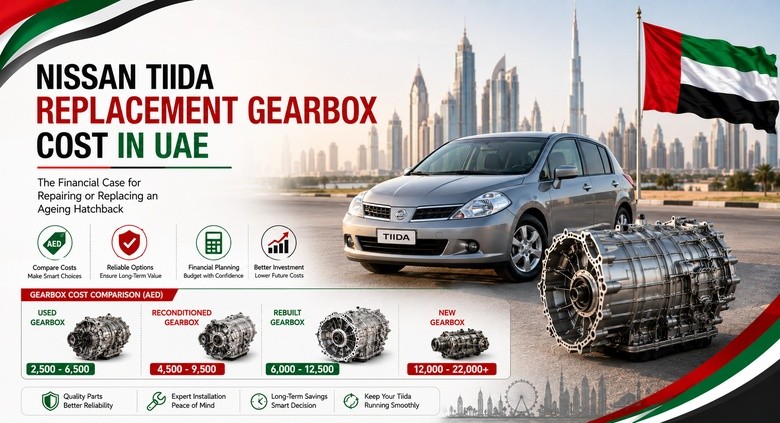
Typical Nissan Tiida Gearbox Cost Range in UAE
| Gearbox Type | Typical Cost Range (AED) |
| Used Gearbox | 2,500–6,500 |
| Reconditioned Gearbox | 4,500–9,500 |
| Rebuilt Gearbox | 6,000–12,500 |
| New Gearbox | 12,000–22,000+ |
At first glance the answer appears obvious.
Choose the cheapest option.
Unfortunately, ownership economics rarely work that way.
A gearbox costing AED 3,500 that requires further repairs twelve months later can easily become more expensive than a gearbox costing AED 8,000 that operates reliably for years.
The purchase price is only one number in a much larger equation.
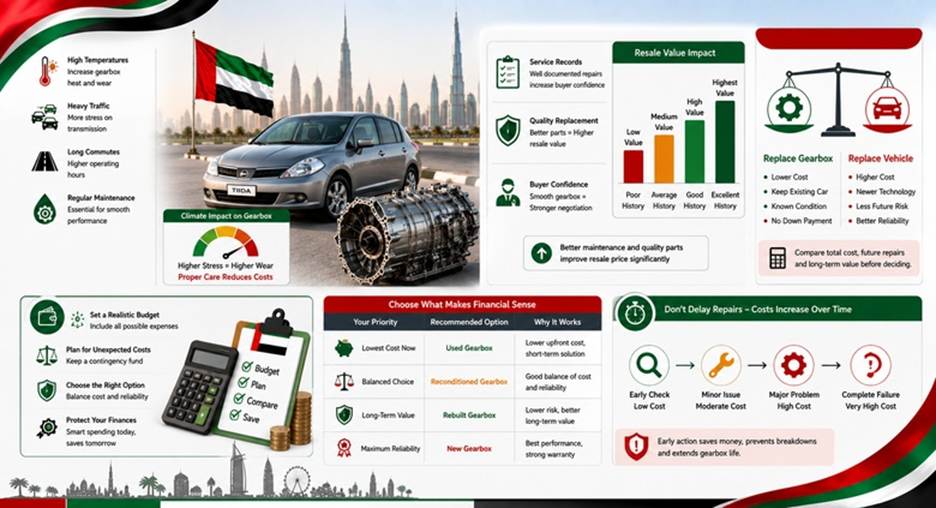
Economic Decision Matrix
| Priority | Financially Rational Direction |
| Lowest Immediate Spending | Used |
| Balanced Cost and Reliability | Reconditioned |
| Long-Term Value | Rebuilt |
| Maximum Reliability | New |
Notice something.
The cheapest option and the best-value option are not always the same thing.
That distinction matters.
Especially in ageing vehicles.
Understanding the Full Expense Structure of a Gearbox Replacement
Many owners believe they are purchasing a gearbox.
They are not.
They are purchasing a gearbox project.
Those two things are very different.
The gearbox itself may represent only part of the final invoice.
Labour.
Programming.
Fluids.
Diagnostics.
Supporting parts.
Unexpected discoveries.
All of these influence the final cost.
Typical Cost Structure
| Expense Category | Typical Cost (AED) |
| Gearbox Unit | 2,500–22,000+ |
| Labour Charges | 1,500–6,500 |
| Diagnostics | 250–1,000 |
| Programming | 300–1,500 |
| Fluid Replacement | 300–1,200 |
| Additional Components | 500–5,000 |
This is where many ownership budgets begin to drift.
The owner plans for the gearbox.
The workshop discovers additional needs.
Suddenly the project looks very different.
The gearbox becomes merely one line item.
Typical Total Project Cost
| Replacement Strategy | Typical Project Cost (AED) |
| Used Gearbox Project | 4,500–10,500 |
| Reconditioned Project | 7,000–14,500 |
| Rebuilt Project | 9,000–18,500 |
| New Gearbox Project | 16,000–30,000+ |
The economic lesson is simple.
Always budget for the project.
Never budget only for the gearbox.
Overlooked Costs That Influence Total Transmission Ownership Expenses
A curious thing happens during gearbox replacement.
Problems hiding quietly in the background suddenly become visible.
Transmission mounts.
Sensors.
Cooling issues.
Wiring faults.
Leaking seals.
Many owners assume these costs are attempts to increase the invoice.
Often they are simply issues revealed once the transmission is removed.
Commonly Overlooked Expenses
- Transmission mounts.
- Wiring repairs.
- Transmission sensors.
- Cooling-system repairs.
- Torque converter inspection.
- Seal replacement.
- Additional fluid requirements.
Hidden Cost Comparison
| Additional Item | Typical Cost (AED) |
| Mount Replacement | 300–2,000 |
| Sensor Replacement | 300–2,500 |
| Wiring Repairs | 300–3,000 |
| Cooling Repairs | 500–4,000 |
| Seal Replacement | 250–1,500 |
| Torque Converter Work | 1,500–5,000 |
A gearbox replacement rarely remains limited to a gearbox.
The older the vehicle becomes, the more likely supporting systems influence the final cost.
That is not pessimism.
It is arithmetic.
Vehicle Depreciation and Current Market Value of the Nissan Tiida
Now comes the uncomfortable part.
The vehicle itself.
Because no gearbox decision should occur without considering what the vehicle is worth.
A gearbox replacement does not exist in isolation.
It exists inside a depreciating asset.
Typical Nissan Tiida Market Position
Depending on age, condition, mileage and service history, many Tiidas now occupy a market value range that creates difficult economic decisions.
Spending AED 12,000 on a vehicle worth AED 15,000 requires a very different thought process than spending AED 12,000 on a vehicle worth AED 60,000.
Depreciation-Based Assessment
| Vehicle Condition | Financial Outlook |
| Excellent Condition | Strong Candidate for Repair |
| Good Condition | Usually Worth Evaluation |
| Average Condition | Detailed Analysis Required |
| Poor Condition | Compare Against Vehicle Replacement |
This is why gearbox replacement should never be evaluated separately from vehicle value.
The economics are interconnected.
Comparing Repair, Reconditioning, and Replacement from an Investment Perspective
The word investment may seem unusual when discussing an ageing hatchback.
Yet every major repair decision is an investment decision.
Money is allocated today in exchange for expected future utility.
That is investment.
The challenge is identifying which path offers the strongest return.
Option 1: Repair
Lowest upfront expenditure.
Potentially attractive if faults remain limited.
Option 2: Recondition
Moderate spending.
Moderate risk.
Moderate reliability.
The middle ground.
Option 3: Full Replacement
Highest confidence.
Highest cost.
Potentially strongest long-term outcome.
Investment Comparison Matrix
| Option | Upfront Cost | Future Risk | Financial Efficiency |
| Repair | Low | Moderate | Variable |
| Recondition | Moderate | Moderate | Good |
| Replacement | High | Low | Very Good |
There is no universal winner.
Only a solution that best fits the owner's objectives.
Identifying the Point Where Gearbox Replacement Delivers Financial Value
Not every gearbox replacement makes economic sense.
That statement makes workshops uncomfortable.
It remains true.
A rational ownership decision compares future benefits against current expenditure.
Factors Supporting Replacement
- Strong engine condition.
- Good maintenance history.
- Reliable body structure.
- Long-term ownership plans.
- Limited additional repair requirements.
Factors Against Replacement
- Multiple major mechanical issues.
- Severe accident history.
- Significant upcoming repair forecasts.
- Extremely poor overall condition.
Value Assessment Matrix
| Vehicle Situation | Economic Recommendation |
| Strong Overall Condition | Replace Gearbox |
| Moderate Condition | Detailed Evaluation |
| Multiple Major Repairs | Compare Alternatives |
| Significant Vehicle Deterioration | Consider Vehicle Replacement |
The gearbox should not be evaluated alone.
The vehicle should be evaluated as a complete financial asset.
Labour Cost Assessment in the UAE: Dealership Services Versus Independent Workshops
Labour costs generate endless debate.
Some owners see dealer rates and immediately reject them.
Others assume cheaper workshops automatically create better value.
Reality is more complicated.
Typical Labour Costs
| Workshop Type | Typical Labour Cost (AED) |
| General Garage | 1,500–3,500 |
| Independent Specialist | 2,500–5,500 |
| Transmission Specialist | 3,500–7,500 |
| Dealership Facility | 5,000–10,000+ |
The cheapest labour cost rarely tells the entire story.
A gearbox installed incorrectly creates costs that exceed the original savings.
This is where ownership economics becomes fascinating.
Paying more today can occasionally reduce spending tomorrow.
Labour Value Matrix
| Priority | Recommended Option |
| Lowest Upfront Cost | General Garage |
| Balanced Value | Independent Specialist |
| Technical Expertise | Transmission Specialist |
| Maximum Documentation | Dealership |
The correct choice depends on risk tolerance as much as budget.
Financial Consequences of Postponing Gearbox Repairs
Delay feels inexpensive.
At first.
A slight hesitation during shifting.
A warning light that appears occasionally.
An intermittent vibration.
Owners often continue driving because the vehicle still moves.
That decision can become costly.
Typical Progression Pattern
Minor symptom.
Moderate wear.
Additional component stress.
Increased repair requirements.
Major failure.
Higher invoice.
The gearbox does not know the owner is postponing the decision.
Wear continues regardless.
Cost of Delay Matrix
| Timing | Potential Financial Outcome |
| Immediate Diagnosis | Lowest Cost Exposure |
| Planned Repair | Controlled Cost Growth |
| Delayed Action | Higher Costs |
| Continued Operation with Severe Symptoms | Significant Cost Increase |
| Complete Failure | Maximum Cost Exposure |
Example Financial Escalation
| Scenario | Typical Cost Range (AED) |
| Early Fluid Service | 300–1,200 |
| Early Repair | 1,500–5,000 |
| Reconditioning Requirement | 4,500–9,500 |
| Full Replacement | 12,000–22,000+ |
The economics are surprisingly clear.
Small problems tend to be relatively affordable.
Large problems rarely are.
And that, ultimately, is the central lesson of Part 1.
The gearbox itself is important.
The economics surrounding the gearbox are even more important.
A rational ownership decision begins not with the transmission, but with the financial consequences attached to every available option.
Used Gearboxes: Lower Initial Spending Compared with Long-Term Risk Exposure
Every economist eventually encounters the same dilemma.
Pay less now.
Or pay more later.
Used gearboxes sit directly at the centre of that debate.
On paper, they often appear to be the strongest financial option. A Nissan Tiida owner facing a major repair bill can reduce immediate expenditure dramatically by selecting a used transmission.
The invoice certainly looks attractive.
The long-term economics are less predictable.
A used gearbox arrives with a history.
The problem is that history is not always visible.
Perhaps it came from a carefully maintained vehicle.
Perhaps it spent years enduring neglected servicing, overheating issues and high-mileage abuse.
The gearbox itself rarely provides those details.
Typical UAE Used Gearbox Costs
| Expense Category | Typical Cost (AED) |
| Used Gearbox | 2,500–6,500 |
| Installation | 1,500–4,500 |
| Fluids and Programming | 500–2,000 |
| Additional Repairs | 500–4,000 |
Financial Assessment Matrix
| Factor | Assessment |
| Initial Cost | Excellent |
| Reliability Predictability | Moderate |
| Warranty Support | Limited |
| Long-Term Risk | High |
| Cost Stability | Moderate |
A used gearbox frequently works best when the vehicle itself occupies the later stages of its ownership lifecycle.
Spending conservatively on an ageing asset can sometimes be entirely rational.
Reconditioned Gearboxes: Balancing Affordability and Dependability
This is where many ownership economists become interested.
Not because reconditioned gearboxes are exciting.
Quite the opposite.
Because they are often boringly sensible.
The reconditioned gearbox occupies the middle ground.
It reduces risk without demanding the substantial expenditure associated with a brand-new transmission.
For many Nissan Tiida owners, particularly those intending to keep the vehicle for several more years, that balance can be financially attractive.
Typical Reconditioned Gearbox Costs
| Cost Area | Typical Cost (AED) |
| Reconditioned Gearbox | 4,500–9,500 |
| Installation | 2,000–5,000 |
| Supporting Components | 500–4,000 |
Economic Evaluation Matrix
| Factor | Assessment |
| Purchase Cost | Good |
| Reliability Outlook | Good |
| Future Risk | Moderate |
| Resale Influence | Positive |
| Five-Year Value Potential | Strong |
Interestingly, reconditioned gearboxes often produce some of the strongest cost-versus-reliability outcomes in older hatchbacks.
Not the cheapest.
Not the most expensive.
Merely balanced.
And balance frequently wins.
Rebuilt Gearboxes: Higher Upfront Investment for Reduced Future Costs
People tend to focus on expenditure.
Economists focus on total expenditure.
Those are not always the same thing.
A rebuilt gearbox costs more initially.
That part is obvious.
The less obvious question is whether the additional spending reduces future financial exposure.
Often it does.
The rebuilt gearbox appeals to owners who view repairs as investments rather than transactions.
Typical Rebuilt Gearbox Costs
| Cost Category | Typical Cost (AED) |
| Rebuilt Gearbox | 6,000–12,500 |
| Labour | 2,000–5,500 |
| Supporting Repairs | 500–4,000 |
Rebuilt Gearbox Economics
| Evaluation Area | Assessment |
| Initial Cost | Higher |
| Reliability | Very Good |
| Future Repair Risk | Low |
| Ownership Stability | Strong |
| Long-Term Cost Efficiency | Very Good |
This option becomes increasingly attractive when owners intend to keep their Nissan Tiida for another three to five years.
The longer the ownership horizon, the more compelling the mathematics become.
Brand-New Gearboxes: Examining the Value of Maximum Reliability
The new gearbox often creates immediate sticker shock.
That reaction is understandable.
The cost can occasionally approach a significant percentage of the vehicle's total market value.
Yet dismissing the option entirely can be a mistake.
Economics is not about finding the cheapest answer.
It is about finding the most rational answer.
Circumstances Supporting a New Gearbox
- Exceptional overall vehicle condition.
- Long-term ownership plans.
- Consistently maintained vehicle history.
- High annual mileage.
- Strong reliability requirements.
New Gearbox Cost Overview
| Category | Typical Cost (AED) |
| New Gearbox | 12,000–22,000+ |
| Installation | 3,000–6,500 |
| Programming | 500–2,000 |
Financial Assessment
| Factor | Assessment |
| Reliability | Excellent |
| Warranty Strength | Excellent |
| Risk Exposure | Lowest |
| Initial Cost | Highest |
| Ownership Confidence | Excellent |
The economic challenge is straightforward.
Does the remaining value of the vehicle justify the investment?
Sometimes yes.
Sometimes absolutely not.
Nissan Tiida Gearbox for Sale: Assessing Supplier Costs, Warranty Coverage, and Ownership Benefits
Many owners searching for a Nissan Tiida replacement gearbox for sale immediately compare purchase prices.
That is understandable.
It is also incomplete.
The gearbox supplier influences far more than the invoice.
Supplier quality affects warranty support.
Documentation.
Technical assistance.
Future claims.
Replacement reliability.
In other words, supplier choice influences ownership economics.
Supplier Evaluation Criteria
- Documentation quality.
- Warranty terms.
- Product history.
- Testing procedures.
- Technical support.
- Market reputation.
Supplier Comparison Matrix
| Evaluation Area | Importance |
| Price | Moderate |
| Documentation | High |
| Warranty | High |
| Testing Standards | High |
| Support Availability | High |
The cheapest supplier occasionally provides the best value.
The challenge is proving that before the purchase.
Comparing Cost Efficiency Per Kilometre Across Gearbox Options
One of the most useful ownership metrics is cost per kilometre.
Because ultimately that is what transportation becomes.
A financial relationship between expenditure and usage.
Cost Efficiency Framework
| Option | Cost Efficiency Potential |
| Used | Variable |
| Reconditioned | Good |
| Rebuilt | Very Good |
| New | Excellent |
Imagine two scenarios.
A used gearbox costs AED 4,000 and provides 40,000 kilometres.
A rebuilt gearbox costs AED 9,000 and provides 140,000 kilometres.
The initial invoice suggests one answer.
The cost-per-kilometre calculation suggests another.
This is why economists often care less about purchase price than lifetime value.
Measuring the Economic Benefits of Gearbox Warranty Protection
Warranties are frequently misunderstood.
Many buyers view them as paperwork.
Economists view them as risk-transfer instruments.
A warranty effectively shifts a portion of future financial risk away from the owner.
That transfer has measurable value.
Warranty Comparison
| Gearbox Type | Warranty Strength |
| Used | Limited |
| Reconditioned | Moderate |
| Rebuilt | Strong |
| New | Strongest |
Financial Protection Matrix
| Coverage Quality | Economic Benefit |
| Limited | Low |
| Moderate | Moderate |
| Strong | High |
| Comprehensive | Very High |
The best warranty is not necessarily the longest.
It is the one most likely to be honoured.
Additional Component Replacements and Their Contribution to Long-Term Value
A curious economic principle applies here.
Small preventative expenditures frequently prevent larger future expenditures.
Supporting components illustrate this perfectly.
Components Commonly Evaluated During Replacement
- Transmission mounts.
- Cooling systems.
- Wiring harnesses.
- Sensors.
- Fluid lines.
- Torque converter.
Typical Supporting-Part Costs
| Component | Typical Cost (AED) |
| Mounts | 300–2,000 |
| Sensors | 300–2,500 |
| Wiring Repairs | 300–3,000 |
| Cooling Repairs | 500–4,000 |
| Torque Converter Work | 1,500–5,000 |
Owners sometimes reject these additional repairs because they increase the invoice.
The irony is that ignoring them often increases future ownership costs.
Long-Term Value Matrix
| Approach | Likely Financial Outcome |
| Replace Gearbox Only | Lower Initial Cost |
| Address Supporting Systems | Higher Long-Term Value |
| Ignore Known Issues | Increased Future Costs |
| Complete Preventive Approach | Strongest Cost Stability |
It ultimately reveals something surprisingly important.
The most economical gearbox option is not always the cheapest gearbox.
It is the gearbox solution that produces the strongest balance between purchase cost, reliability, risk exposure, warranty protection and future ownership expenses.
That balance point differs from owner to owner.
But the mathematics behind it remain remarkably consistent.
Estimating First-Year Expenses After a Gearbox Replacement
The invoice rarely tells the full story.
It only tells the opening chapter.
What matters financially is what happens after the gearbox has been installed and the vehicle returns to daily service.
For many Nissan Tiida owners, the first year determines whether the replacement becomes a good investment or an expensive lesson.
This is where ownership economics becomes far more useful than repair economics.
A gearbox replacement should not simply be judged by purchase cost.
It should be judged by total first-year expenditure.
Typical First-Year Cost Categories
- Gearbox purchase.
- Labour charges.
- Fluid servicing.
- Follow-up inspections.
- Supporting-component repairs.
- Unexpected diagnostic work.
- Preventive maintenance.
First-Year Ownership Forecast
| Expense Category | Used | Reconditioned | Rebuilt | New |
| Initial Purchase | Low | Moderate | Higher | Highest |
| Follow-Up Repair Risk | High | Moderate | Low | Lowest |
| Maintenance Predictability | Low | Moderate | High | Highest |
| Ownership Stability | Moderate | Good | Very Good | Excellent |
Estimated First-Year Budget
| Cost Area | Typical Cost (AED) |
| Routine Maintenance | 500–1,500 |
| Diagnostics | 250–1,000 |
| Supporting Repairs | 500–4,000 |
| Contingency Fund | 1,000–5,000 |
A replacement gearbox should create predictability.
When it does not, the financial case weakens considerably.
Three-Year Cost Comparison of Different Gearbox Solutions
Three years is often where ownership value begins to reveal itself.
Cheap solutions occasionally become expensive.
More expensive solutions occasionally become surprisingly affordable.
Because reliability has economic value.
Every avoided breakdown represents a financial benefit.
Every avoided workshop visit protects time, transport budgets and future repair exposure.
Three-Year Ownership Economics
| Gearbox Option | Upfront Cost | Future Repair Risk | Three-Year Financial Outlook |
| Used | Low | High | Variable |
| Reconditioned | Moderate | Moderate | Good |
| Rebuilt | Higher | Low | Very Good |
| New | Highest | Lowest | Excellent |
Ownership Stability Matrix
| Ownership Goal | Most Rational Option |
| Short-Term Ownership | Used/Reconditioned |
| Medium-Term Ownership | Reconditioned/Rebuilt |
| Long-Term Ownership | Rebuilt/New |
The longer ownership continues, the more reliability influences overall economics.
Five-Year Ownership Forecast and Return on Investment Analysis
Five years changes everything.
The discussion shifts away from repair costs and moves toward return on investment.
Many owners underestimate how dramatically long-term ownership changes financial outcomes.
Five-Year Financial Projection
| Option | Initial Cost | Future Maintenance Risk | Five-Year Value |
| Used | Low | High | Moderate |
| Reconditioned | Moderate | Moderate | Good |
| Rebuilt | Higher | Low | Very Good |
| New | Highest | Lowest | Excellent |
Return-on-Investment Perspective
Imagine two ownership paths.
A used gearbox saves AED 4,000 initially.
A rebuilt gearbox costs more but avoids multiple future repairs.
Over five years, the rebuilt unit may ultimately cost less despite the higher initial expenditure.
That is why economists focus on lifecycle costs rather than invoice costs.
Cost Stability Matrix
| Option | Financial Predictability |
| Used | Low |
| Reconditioned | Moderate |
| Rebuilt | High |
| New | Highest |
Predictability has value.
Particularly for households managing fixed budgets.
The Effect of UAE Weather Conditions on Transmission Reliability and Costs
The UAE presents unique ownership economics.
Heat accelerates wear.
Traffic increases thermal stress.
Long commutes extend operating hours.
All of these factors influence gearbox life.
Climate Factors Affecting Gearbox Economics
- Summer temperatures.
- Urban congestion.
- Highway commuting.
- Continuous air-conditioning use.
- Extended idle periods.
Environmental Stress Matrix
| Driving Condition | Transmission Stress |
| Highway Driving | Moderate |
| Mixed Driving | Moderate |
| Heavy City Traffic | High |
| Daily Congestion | Very High |
This explains why identical vehicles can produce very different ownership costs.
The environment becomes part of the equation.
Ignoring climate influences often leads to inaccurate budgeting.
Protecting Future Resale Value Through the Right Gearbox Choice
The gearbox replacement decision does not end when the vehicle is repaired.
It follows the owner into the future resale market.
Prospective buyers notice transmission history.
Documentation matters.
Service records matter.
Repair quality matters.
Resale Confidence Matrix
| Gearbox Option | Buyer Confidence |
| Used | Moderate |
| Reconditioned | Good |
| Rebuilt | Very Good |
| New | Excellent |
Documentation Impact
| Documentation Quality | Resale Effect |
| Complete Records | Strong Positive |
| Partial Records | Moderate Positive |
| Limited Documentation | Neutral |
| No Documentation | Negative |
A gearbox replacement can either preserve value or weaken value.
The difference often lies in documentation and repair quality.
Financially Comparing Vehicle Replacement Against Gearbox Replacement
This is the question many owners eventually ask.
Should the gearbox be replaced?
Or should the vehicle be replaced?
The answer depends on economics rather than emotion.
Gearbox Replacement Often Makes Sense When
- Engine condition remains strong.
- Body condition remains good.
- Maintenance history is consistent.
- Few additional major repairs are expected.
Vehicle Replacement May Be Worth Considering When
- Multiple systems require major repairs.
- Structural condition is poor.
- Reliability has declined significantly.
- Future repair forecasts remain substantial.
Comparison Matrix
| Scenario | Financial Recommendation |
| Strong Overall Vehicle Condition | Replace Gearbox |
| Moderate Vehicle Condition | Detailed Analysis |
| Several Major Repairs Pending | Compare Both Options |
| Significant Deterioration | Consider Replacement Vehicle |
The gearbox should never be evaluated separately from the vehicle.
Both belong to the same financial asset.
Managing Gearbox Replacement Within a Household Budget Plan
A major automotive repair is rarely an isolated expense.
It affects household budgets.
Savings goals.
Family finances.
Future spending plans.
Responsible ownership requires planning.
Budget Management Strategy
- Obtain multiple quotations.
- Establish contingency funds.
- Evaluate ownership duration.
- Compare repair and replacement scenarios.
- Forecast future maintenance costs.
Household Budget Matrix
| Financial Position | Suggested Strategy |
| Tight Budget | Reconditioned Evaluation |
| Balanced Budget | Rebuilt Assessment |
| Long-Term Ownership Focus | Rebuilt/New Analysis |
| Maximum Reliability Focus | New Gearbox Evaluation |
The objective is not simply repairing the vehicle.
It is protecting financial stability.
Building a Practical Decision Framework for Cost-Effective Ownership
After all the calculations, forecasts and comparisons, the decision becomes surprisingly simple.
The correct gearbox choice depends on ownership objectives.
Not on advertising.
Not on emotion.
Not on workshop pressure.
Final Ownership Decision Matrix
| Owner Profile | Most Rational Direction |
| Lowest Immediate Cost | Used |
| Balanced Ownership Costs | Reconditioned |
| Long-Term Value Focus | Rebuilt |
| Maximum Reliability Focus | New |
Many UAE vehicle owners use PartFinder UAE to compare gearbox suppliers, warranty options, documentation standards and replacement costs before committing to a major transmission investment, helping them evaluate several financial pathways before making a final ownership decision.
Ultimate Economist's Conclusion
The cheapest gearbox is not automatically the most economical gearbox.
The most expensive gearbox is not automatically the smartest investment.
The financially rational decision sits somewhere between cost, reliability, depreciation, resale value, ownership duration and future repair exposure.
That is the central lesson of automotive economics.
Every dirham invested should create measurable value.
And the best gearbox decision is ultimately the one that delivers the strongest balance between today's expenditure and tomorrow's ownership outcomes.
Frequently Asked Questions
Categories
- Audi
- BMW
- Car Accessories
- Car Tips
- Ford
- Land Rover
- Mazda
- Range Rover
- Top 10
- UAE Car Parts
- Used Car Parts
- Toyota
- Replacement Engines
- Nissan
- Hyundai
- Mitsubishi
- Volkswagen
- Honda
- Kia
- Chevrolet
- Dodge
- Jeep
- Subaru
- Renault
- Lexus
- Mercedes
- Suzuki
- Hummer
- Porsche
- Infiniti
- Peugeot
- GMC
- Mini
- Volvo
- Replacement Gearboxes
- MG
- Jaguar
- Skoda
- Cadillac
- Daihatsu
- Fiat
- German Car Parts
- Japanese Car Parts
- Aftermarket Car Parts
- Genuine Car Parts
- New Car Parts
- Reconditioned Car Parts
- European Car Parts
- American Car Parts
- Korean Car Parts
- British Car Parts
- Chinese Car Parts
- Sports/Exotic Car Parts
- Luxury Car Parts
- Performance Car Parts
- SUV/4x4 Spare Parts
- Truck Spare Parts
- EV Car Parts
- Hybrid Car Parts
- Auto Spare Parts in UAE
- Tesla
- Isuzu
- Ram
- Ferrari
- Bentley
- Lamborghini
- Genesis
- Maserati
- Lincoln
- Chrysler
- Opel
- Citroen
- SsangYong
- Seat
- McLaren
- Aston Martin
- Rolls Royce
- Maybach
- Alfa Romeo
- Bugatti
- Scion
- Abu Dhabi Car Parts
- Ajman Car Parts
- Al Khan Car Parts
- Al Sajaa Car Parts
- Deira Car Parts
- Dubai Car Parts
- Fujairah Car Parts
- Industrial Area 6 Car Parts
- Mussafah Car Parts
- Ras Al Khaimah Car Parts
- Sharjah Car Parts
- Umm Al Quwain Car Parts
- Acura
- BYD
- Chery
- Dacia
- DS
- Geely Emgrand
- EXEED
- GAC
- GAC Gonow
- Geely
- Gonow
- Great Wall
- Haima
- Haval
- Holden
- Iveco
- JAC
- Jaecoo
- Jetour
- Lotus
- Omoda
- Proton
- Renault Samsung
- Roewe
- Lucid
- Replacement Headlight
- Replacement Bumper