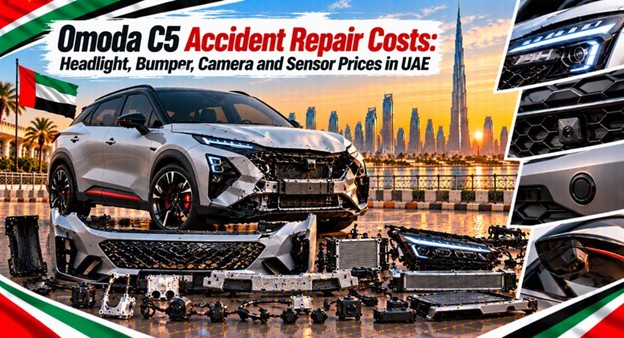
Omoda C5 Accident Repair Costs: Headlight, Bumper, Camera and Sensor Prices in UAE
October 13, 2026
A damaged Omoda C5 front bumper can look like a straightforward body-shop job until the bumper comes off. Then the arithmetic changes. A broken mounting point may sit beside a camera or radar-related component; a headlamp can arrive with damaged brackets or wiring; a seemingly harmless impact can alter the position of a sensor without leaving much evidence on the outside. And once an electronic system has been disturbed, the bill is no longer simply “bumper + paint + labour”.
That is the problem with quoting accident repair from photographs alone.
The 2026 Omoda C5 sold in the UAE spans roughly AED 69,900 to AED 88,400 depending on variant, with the 1.5T/CVT versions and the higher-output 1.6T/7-speed DCT Sport occupying different mechanical and equipment combinations. The Sport also carries a more extensive camera and driver-assistance specification, which matters when calculating accident-repair exposure.
UAE Update Reference: October 2026
Why Omoda C5 accident costs can jump after the first estimate
The first quotation is often built around what can be seen: bumper cover, headlight, grille, paint and perhaps a parking sensor.
The second quotation appears after disassembly.
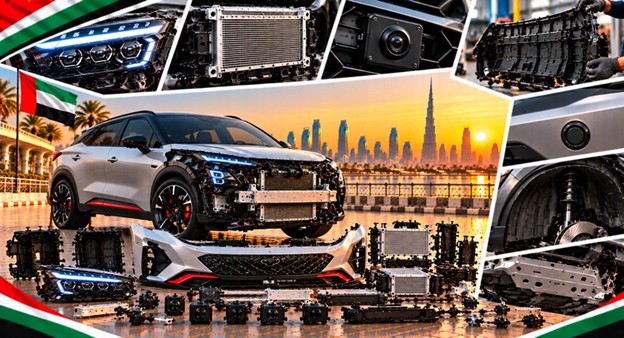
That is where the hidden costs tend to live — broken brackets, distorted mounting points, damaged wiring, condenser or cooling-pack damage, wheel-arch liners, undertrays, crash absorbers, sensor mounts, camera alignment, suspension geometry and electronic faults that were impossible to confirm while the damaged bumper was still covering everything.
A sensible UAE repair estimate therefore needs two stages: an initial visible-damage assessment and a post-disassembly confirmation.
Without that distinction, a cheap quotation can simply be an incomplete quotation.
What a minor Omoda C5 front accident can actually damage
A low-speed front impact can involve far more than the painted bumper skin.
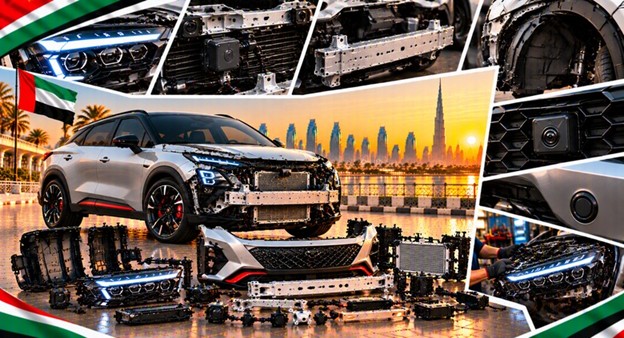
Depending on the collision angle and impact point, the repair may involve the bumper upper body, lower bumper section, grille, trim, brackets, headlamp, daytime-running-light components, parking sensors, wiring, cooling components, wheel-arch liners, underbody protection and sensor mounting hardware.
An OE-referenced catalogue identifies the C5/Omoda 5 upper front bumper body as 602002155AA and the lower bumper body as 602002156AA. Those references are useful as identification clues, but they should never be treated as universal ordering numbers without checking the vehicle's VIN, market specification and exact application.
The important point is almost embarrassingly simple: the bumper cover is only one layer of the front end.
Omoda C5 bumper replacement price in UAE
There is no defensible single UAE retail price for an Omoda C5 bumper because “bumper” can mean several different things.
It might mean the painted outer cover. It might mean an upper or lower bumper section. It might include grille inserts, brackets, sensor holders, trims or other attached components. Then there is paint, preparation and fitting.
Public UAE parts listings currently show an Omoda C5 front bumper category, but some online listings display AED 0 or no live retail amount rather than a meaningful transaction price. That is not evidence that the part costs zero; it is evidence that the public online price data is incomplete.
For that reason, a buyer should resist the temptation to take a generic “UAE bumper price” and treat it as an Omoda quotation.
The upper and lower bumper sections matter
The C5's front bumper assembly is not necessarily one indivisible replacement item.
The OE references publicly catalogued for the upper and lower body sections are different, which means a damaged lower section does not automatically justify replacing the complete upper assembly.
That distinction becomes financially useful after a relatively localised impact.
If only one section, trim or mounting component is damaged and the remaining components are structurally sound, replacing everything may be wasteful. Conversely, trying to save a bumper whose sensor mounts or structural attachment points have distorted can create a false economy.
Repairability has to be judged from the actual damage, not the invoice vocabulary.
Omoda C5 headlight replacement cost
Headlights are where accident estimates can become surprisingly expensive because the visible lens is only the beginning.
A modern LED headlamp may contain its own electronics, control hardware, mounting structures and optical components. If the lamp is cracked, badly displaced, internally damaged or has broken mounting points, a cosmetic repair is not necessarily equivalent to replacement.
Generic UAE market guides place new OEM headlight assemblies broadly around AED 1,000–3,500 across ordinary passenger vehicles, with aftermarket and used units lower, but that is a general market benchmark, not a verified Omoda C5 headlamp price.
For a C5, the sensible quotation should identify the actual lamp assembly, specification, side, condition and whether installation or coding is included.
Why one broken headlight can create several separate charges
Imagine the left headlamp has been pushed backwards in a collision.
The workshop removes it and discovers a broken mounting bracket. The bumper carrier is distorted. The wiring connector has pulled. The lamp itself has a fault. The adjacent panel gap is wrong.
Suddenly the “headlight replacement” is no longer one line.
There is the lamp, mounting hardware, body alignment, electrical inspection, labour and potentially diagnostic work. If an electronic function requires configuration or fault clearing, that needs to be identified before the vehicle is handed back.
This is why accident estimates should separate part cost from installed repair cost.
Camera damage is not always visible
A camera can survive an impact physically while its position, bracket or calibration relationship has changed.
That distinction matters.
A camera system is working from geometry. If the mounting position changes, the system may still display an image while its interpretation of that image is no longer correct. A picture appearing on the screen is therefore not proof that the camera system has returned to proper operation.
The C5's published UAE specification includes advanced driver-assistance functions such as adaptive cruise control, forward collision warning, autonomous emergency braking, lane-departure warning and lane-keeping functions on equipped versions.
Which Omoda C5 versions deserve closer ADAS scrutiny?
This is where trim identification becomes more than a sales specification.
The UAE range includes 1.5T/CVT variants and the 1.6T Sport, while equipment such as camera systems, parking sensors and ADAS varies by version. The Sport specification publicly lists a 540-degree camera system and front/rear parking sensors, while the Comfort specification lists a rear camera and rear parking sensors.
So two C5s that look almost identical after an accident can have different repair requirements.
Before ordering a camera, bumper assembly or sensor, establish the exact trim and VIN.
Omoda C5 camera replacement versus calibration
These are completely different jobs.
Replacement means the camera or its hardware is physically defective and requires replacement.
Calibration means the hardware may be serviceable but its position or system reference needs to be restored according to the vehicle's required procedure.
Replacing a camera without establishing why it failed can waste money. Calibrating a physically damaged camera is equally pointless.
The correct sequence is diagnosis first, then physical inspection, then replacement if necessary, followed by the appropriate configuration or calibration procedure.
That order matters.
Omoda C5 sensor replacement costs in UAE
“Sensor” is too vague to be useful on a repair invoice.
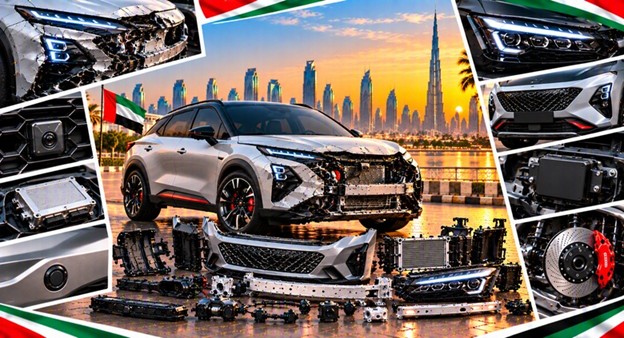
A parking sensor, camera, radar-related component, wheel-speed sensor, blind-spot sensor or other electronic device can have completely different prices and diagnostic requirements.
General UAE calibration-market listings show camera calibration from roughly AED 200–700, radar calibration around AED 500–1,000 and broader ADAS calibration around AED 800–1,800, although these are multi-brand service benchmarks rather than confirmed Omoda C5 prices.
The distinction is crucial: calibration cost is not sensor replacement cost.
Parking sensors are small parts with surprisingly large consequences
A parking sensor may be physically inexpensive compared with a headlamp, but the surrounding bumper work can still affect the final bill.
If the sensor itself is intact but its holder has cracked, replacing the sensor would solve nothing. If the holder has moved, the sensor may sit at the wrong angle. If wiring has been stretched or damaged, an apparently good sensor may still produce a fault.
The proper inspection therefore follows the signal path: sensor, connector, wiring, mounting position, control system and stored faults.
Otherwise the workshop ends up replacing the most obvious component and hoping.
A bumper impact can disturb ADAS without destroying a sensor
This is one of the easiest accident-repair mistakes to make.
The sensor does not have to be smashed to become relevant.
A bumper can deform, a bracket can shift, a mounting point can move or the geometry of the surrounding structure can change. After collision repair, the sensor may need checking and calibration even if its casing looks perfect.
UAE calibration specialists commonly list bumper replacement, collision repair, suspension work and wheel alignment among situations that can require ADAS recalibration, although the exact requirement remains vehicle- and system-specific.
What the workshop should scan before replacing expensive electronics
A proper accident diagnosis should begin with a diagnostic scan rather than a parts catalogue.
The technician should establish which modules have stored faults, whether communication is intact, whether a sensor has an electrical fault, whether a system is reporting implausible data and whether the problem existed before the collision.
That last point is often overlooked.
A damaged vehicle may arrive with unrelated pre-existing faults. Without an initial scan, everything discovered afterwards can be blamed on the accident.
The scan creates a baseline.
The camera image works — so why is there still a problem?
Because image production and system accuracy are different things.
A camera can produce a clear picture while the vehicle's assistance system remains unable to use its information correctly. Calibration establishes the relationship between the camera's physical position and the vehicle's expected geometry.
That is why a post-repair road test and appropriate diagnostic verification matter.
A screen showing a working image is not the same thing as proving that every associated safety function has been restored.
What ADAS calibration can add to the repair bill
Published UAE specialist prices currently show camera, radar and broader ADAS calibration services ranging from several hundred dirhams to above AED 1,000 depending on the system and procedure. One Dubai specialist lists full ADAS recalibration around AED 800–1,200, while another advertises calibration from AED 800. These are general workshop market references, not Omoda C5-specific quotations.
That means a sensible C5 accident budget should keep a separate allowance for:
- diagnostic scanning;
- sensor inspection;
- calibration where required;
- road-test verification;
- programming or configuration if required.
Bundling all of that into “labour” makes the quotation harder to audit.
Headlight, bumper and sensor costs should not be added blindly
Suppose a front bumper is damaged and the headlight is cracked.
It would be tempting to add:
bumper + headlight + sensor + paint + labour.
But that can double-count some operations while missing others.
If bumper removal is already included in body labour, it should not be charged again as separate fitting. If a sensor holder is supplied with a component, it should not automatically appear as another full component. If calibration is required, it should be clearly identified rather than hidden inside an unexplained electrical charge.
The buyer needs a scope of work, not a pile of nouns.
Omoda C5 accident repair price: part price versus total repair cost
These figures should always be kept apart.
| Repair item | What the quoted price may represent |
|---|---|
| Bumper | Component only, or component plus trims |
| Headlight | Lamp assembly only |
| Camera | Hardware only |
| Sensor | Sensor only |
| Paint | Preparation and refinishing |
| Body labour | Removal, repair, fitting and alignment |
| Diagnostics | Scan and fault investigation |
| Calibration | Camera/radar/ADAS procedure where required |
| Programming | Configuration/coding if applicable |
| Alignment | Suspension or wheel-geometry correction |
| Final test | Functional and road-test verification |
A bumper advertised at one price is therefore not comparable with an installed accident-repair quotation at another price.
What a used Omoda C5 headlight should cost
There is no reliable universal UAE used-headlight price that can responsibly be presented as the going rate for every C5.
That is partly because the C5 is still a relatively young model in the UAE market, and public online Omoda C5 spare parts in UAE pricing remains inconsistent.
A used headlamp should instead be assessed by:
part number + side + specification + physical condition + mounting points + lens condition + electronic function + donor history + warranty/return terms.
A cheaper lamp with a broken mounting lug is not cheaper once it has to be removed again.
Used bumper versus new bumper
A used bumper can make sense when the component is clean, structurally sound and correctly specified.
Paint condition is less important if the panel will be refinished. Broken tabs, warped sections, damaged sensor holders and previous poor repairs are much more important.
Ask for photographs of the rear side of the bumper, not just the painted exterior.
That is where damaged tabs, repaired cracks and missing mounts often reveal themselves.
Used parts are not automatically inferior. They are simply parts with a history that has to be understood.
Genuine, aftermarket and used C5 accident parts
There are three separate questions here.
Was the part made for the application?
Was it manufactured to a suitable standard?
And does the part actually meet the functional requirements of the vehicle?
A new aftermarket bumper may be perfectly usable but require adjustment before paint. A used genuine headlamp may fit better but have an uncertain electronic history. A new genuine component may reduce compatibility risk but carry a higher acquisition cost.
The sensible choice depends on the part.
For a painted plastic bumper cover, aftermarket quality and fitment may be acceptable. For an electronically controlled camera or safety-related component, provenance and compatibility deserve much more weight.
Why VIN checking matters after an Omoda C5 accident
The VIN is the quickest way to turn “I need a C5 headlight” into a properly defined parts enquiry.
Give the supplier:
- VIN;
- model year;
- trim;
- engine;
- transmission;
- side of vehicle;
- damaged component;
- photograph of the existing part;
- part number where available.
The public OE catalogue itself recommends using the VIN and photographs where application is uncertain.
That is particularly important when different trims use different camera, parking-sensor or lighting equipment.
The 1.5T and 1.6T C5 should not be treated as identical
The current UAE range includes 1.5T versions producing around 156 hp and using a CVT, while the Sport uses the 1.6 TGDI with around 197 hp and a 7-speed DCT.
For a simple bumper repair this may not matter.
For an accident involving the front structure, cooling system, electrical equipment or trim-specific electronics, it can.
A parts supplier who asks for the VIN is doing the right thing. A buyer who supplies it is making the quotation easier to trust.
Hidden cooling-system damage after a front collision
A bumper can absorb or redirect an impact towards components behind it.
That can include the radiator support, condenser, radiator, cooling fans, mounting brackets and associated lines.
The absence of an immediate overheating warning does not prove the cooling system is undamaged.
After a front impact, the workshop should inspect the cooling pack physically, check for leaks and deformation, examine mounting points and verify operating temperatures and fan behaviour as appropriate.
The goal is to discover a bent cooling component while the car is already apart, rather than after the bumper has been painted and refitted.
Wheel and suspension damage can hide behind a cosmetic repair
A front-corner accident is not only a bodywork problem.
If the wheel, tyre or suspension has taken the impact, the workshop should inspect the wheel, tyre sidewall, steering components, control-arm area, strut and alignment geometry.
This becomes even more relevant where ADAS depends on correct vehicle geometry.
A car can leave the body shop looking immaculate while still pulling slightly under braking or carrying an alignment problem that later interferes with sensor accuracy.
Pretty panel gaps are not a mechanical inspection.
How UAE climate changes the repair decision
The UAE's heat, intense sunlight and dusty operating conditions matter for materials, adhesives, paint curing practices, plastics and electronics, but they should not be turned into a lazy diagnosis.
Heat does not automatically mean a damaged sensor has failed.
Nor does a cloudy headlamp automatically mean the electronics are defective.
The repair should still be based on inspection, diagnostic evidence and the manufacturer's applicable procedures.
Climate is context. It is not a substitute for testing.
Why parts availability matters almost as much as parts price
Omoda and Jaecoo have established a regional spare-parts distribution operation in Jebel Ali, and published logistics information describes rapid UAE distribution and significant parts availability ambitions.
That is useful context for C5 owners, but it should not be translated into a promise that every bumper, headlamp or electronic module is sitting in a UAE warehouse today.
Availability is component-specific.
A body panel may be readily obtainable while a particular electronic module, bracket or trim piece requires an order. The workshop should therefore confirm actual availability and expected delivery time, not simply say “parts are available”.
Insurance repair versus cash repair
The economics change depending on how the accident is being handled.
With an insurance repair, the insurer, approved repairer, parts source and repair scope may determine much of the process.
With a cash repair, the owner has more direct control over whether to use new genuine, aftermarket, used or repaired components — but also carries more responsibility for deciding whether the cheaper route is genuinely sensible.
This is where the cheapest estimate can become the most expensive one.
A second labour charge, a wrongly ordered camera, another calibration, a return shipment or an additional week of downtime can erase a seemingly attractive saving very quickly.
The cost of getting the Omoda C5 repair wrong
Consider a simple front accident.
The bumper is replaced without checking the sensor mounts. The car is painted. A warning appears. The sensor is then replaced. The warning remains because the mounting position is wrong. Calibration is attempted. It fails. The workshop discovers that a bracket behind the bumper was bent.
Now the owner has paid for repeated labour.
That is the hidden economics of accident repair: the wrong diagnosis compounds.
The cheapest component is rarely the most important number on the quotation.
A sensible Omoda C5 accident-repair quotation
Ask the workshop to separate the estimate into at least these categories:
| Category | What to request |
|---|---|
| Body parts | Exact component and part reference |
| Lighting | Side, assembly and specification |
| Sensors/cameras | Exact component and diagnosis |
| Paint | Panels included and finish |
| Labour | Removal, repair and refitting |
| Diagnostics | Initial and final scans |
| Calibration | System and method where required |
| Programming | Whether included or additional |
| Mechanical inspection | Suspension, cooling, steering and wheels |
| Consumables | Clips, brackets, fasteners, fluids where applicable |
| Warranty | Parts and workmanship terms |
| Availability | Confirmed stock/order status |
| Returns | Policy for incorrectly supplied parts |
This format makes two quotations genuinely comparable.
What to check before buying an Omoda C5 accident part
Before paying for a bumper, headlight, camera or sensor, confirm:
VIN: Does the seller have the full VIN?
Part number: Does the reference match the application?
Side: Left and right components are not interchangeable simply because they look similar.
Trim: Is the component correct for Comfort, Luxury or Sport?
Condition: New, used, repaired, aftermarket or reconditioned?
Mounting: Are tabs, brackets and fixing points intact?
Electronics: Has the component been tested?
History: For used electronics, what is known about the donor vehicle?
Warranty: Is there a meaningful replacement or return period?
Availability: Is the part physically available in the UAE?
Installation: Is fitting included?
Calibration: Could the repair require calibration afterwards?
That last question is increasingly important.
When a cheaper Omoda C5 part is actually the more expensive choice
A used bumper for AED 500 may appear attractive beside a new one costing substantially more.
But if the used bumper has broken sensor holders, requires additional repair before paint and arrives with missing trims, the saving can disappear.
Likewise, a cheap camera without a confirmed part reference can become a return-and-reorder exercise.
This is why comparing only component prices is a poor way to compare accident repairs. When using PartFinder UAE to compare replacement options, the useful comparison is the complete installed outcome — component, delivery, VAT where applicable, paint, fitting, diagnostics, calibration, warranty and the risk of discovering additional damage after dismantling.
A practical Omoda C5 accident-repair budget
Public UAE evidence supports a broad approach rather than one invented “average C5 accident price”.
General UAE collision repair services can begin around AED 1,500 for limited bodywork, while published specialist ADAS services commonly range from several hundred dirhams to above AED 1,000 depending on the calibration required. General UAE parts-market benchmarks put ordinary front bumpers and headlamps into broad ranges, but those figures should not be presented as Omoda-specific component prices.
So a useful planning model is:
minor cosmetic damage: bumper/trim + paint + fitting;
bumper plus lighting: add the correct headlamp assembly and electrical inspection;
bumper plus ADAS: add diagnostic and potential calibration;
front-corner impact: inspect suspension, wheel, cooling and mounting geometry;
major front impact: expect the estimate to change after disassembly.
The quotation should become more accurate as evidence improves.
When repairing the bumper makes more sense than replacing it
Plastic bumper repair can make economic sense when the damage is localised, the underlying structure is sound and mounting points remain usable.
Replacement becomes more attractive where there are extensive cracks, distorted sections, missing mounting points or damage around sensor locations.
There is no virtue in repairing a component simply because repair sounds cheaper.
If the repaired bumper leaves a camera or sensor sitting in an uncertain position, the saving has defeated its own purpose.
When a used headlight makes sense
A used genuine headlamp can be a sensible route for an older or out-of-warranty C5, particularly when the donor component is known, undamaged and correctly matched.
But inspect the rear housing, mounting lugs, connectors, lens, condensation evidence and electronic condition.
For a lamp containing complex electronics, the question is not merely:
“Does it fit?”
It is:
“Will it function correctly in this vehicle, with this specification, after installation?”
Those are very different questions.
What the final inspection should prove
The vehicle should not be handed back simply because the bumper gaps look straight.
The final check should establish that:
- warning lights have been investigated;
- relevant fault codes have been cleared or appropriately resolved;
- lights operate correctly;
- cameras and parking sensors function;
- ADAS functions are verified where applicable;
- calibration has been completed where required;
- steering and alignment are correct where impact could have affected them;
- cooling systems are functioning;
- repaired panels and bumper mounts are secure;
- the bonnet, doors and lamps align correctly;
- the vehicle has undergone the appropriate final road test.
The paperwork should tell the story of the repair.
What a buyer should keep after the repair
Keep the quotation, final invoice, part references, diagnostic report and calibration record if one was performed.
For used components, retain whatever donor or warranty information was supplied.
This is useful later, particularly if the car is sold, if an electronic warning reappears, or if another accident occurs and the repair history needs to be understood.
A repair without documentation becomes somebody else's mystery.
The most useful questions to ask a UAE workshop
Instead of asking only, “How much to repair the bumper?”, ask:
What exactly is damaged?
Have you scanned the vehicle before ordering parts?
Have you removed the bumper and checked the mounts?
Are the camera and sensor brackets intact?
Does the headlamp need replacement or is its mounting hardware the real problem?
Has the cooling pack been inspected?
Has the suspension geometry been checked if the impact was near a wheel?
Will calibration be required after the repair?
Is calibration included in the quotation?
Are programming or configuration charges separate?
Which parts are new, used or aftermarket?
What part number are you ordering?
Those questions are worth more than another ten minutes of bargaining over the bumper.
The repair decision should follow the damage, not the price tag
For an Omoda C5 accident in the UAE, the sensible order is remarkably consistent:
identify the vehicle → scan it → inspect the collision area → remove damaged bodywork → identify hidden damage → confirm parts by VIN → repair or replace → refit → calibrate where required → scan again → test the vehicle.
Skipping steps can be cheaper.
Until it isn't.
The C5 is relatively affordable as a new UAE SUV, but its electronic equipment means that the traditional idea of accident repair — straighten the panel, replace the lamp, spray the bumper and send the car out — no longer describes the whole job. Current UAE specifications show increasingly sophisticated assistance and camera equipment, while the local repair market separately prices diagnostics and calibration because those operations require different tools and expertise.
The best quotation is therefore not necessarily the lowest one. It is the one that tells you what was tested, what was damaged, what is being replaced, what still needs calibration, and what you are actually paying for.
FAQ
Categories
- Audi
- BMW
- Car Accessories
- Car Tips
- Ford
- Land Rover
- Mazda
- Range Rover
- Top 10
- UAE Car Parts
- Used Car Parts
- Toyota
- Replacement Engines
- Nissan
- Hyundai
- Mitsubishi
- Volkswagen
- Honda
- Kia
- Chevrolet
- Dodge
- Jeep
- Subaru
- Renault
- Lexus
- Mercedes
- Suzuki
- Hummer
- Porsche
- Infiniti
- Peugeot
- GMC
- Mini
- Volvo
- Replacement Gearboxes
- MG
- Jaguar
- Skoda
- Cadillac
- Daihatsu
- Fiat
- German Car Parts
- Japanese Car Parts
- Aftermarket Car Parts
- Genuine Car Parts
- New Car Parts
- Reconditioned Car Parts
- European Car Parts
- American Car Parts
- Korean Car Parts
- British Car Parts
- Chinese Car Parts
- Sports/Exotic Car Parts
- Luxury Car Parts
- Performance Car Parts
- SUV/4x4 Spare Parts
- Truck Spare Parts
- EV Car Parts
- Hybrid Car Parts
- Auto Spare Parts in UAE
- Tesla
- Isuzu
- Ram
- Ferrari
- Bentley
- Lamborghini
- Genesis
- Maserati
- Lincoln
- Chrysler
- Opel
- Citroen
- SsangYong
- Seat
- McLaren
- Aston Martin
- Rolls Royce
- Maybach
- Alfa Romeo
- Bugatti
- Scion
- Abu Dhabi Car Parts
- Ajman Car Parts
- Al Khan Car Parts
- Al Sajaa Car Parts
- Deira Car Parts
- Dubai Car Parts
- Fujairah Car Parts
- Industrial Area 6 Car Parts
- Mussafah Car Parts
- Ras Al Khaimah Car Parts
- Sharjah Car Parts
- Umm Al Quwain Car Parts
- Acura
- BYD
- Chery
- Dacia
- DS
- Geely Emgrand
- EXEED
- GAC
- GAC Gonow
- Geely
- Gonow
- Great Wall
- Haima
- Haval
- Holden
- Iveco
- JAC
- Jaecoo
- Jetour
- Lotus
- Omoda
- Proton
- Renault Samsung
- Roewe