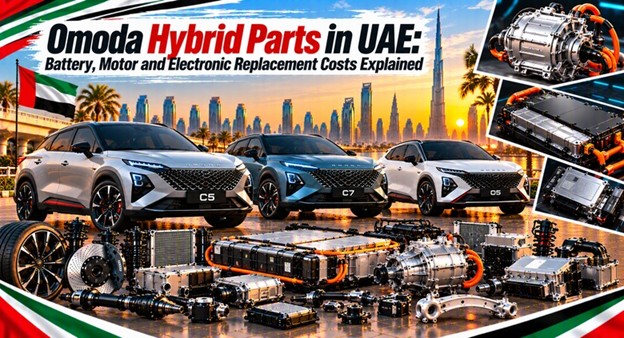
Omoda Hybrid Parts in UAE: Battery, Motor and Electronic Replacement Costs Explained
October 13, 2026
The most expensive Omoda hybrid repair may begin with a warning on the dashboard that looks almost insultingly vague.
Hybrid-system fault. Reduced power. Charging fault. Engine warning. Electric-drive warning.
Then comes the sentence every owner dreads: the battery might need replacing.
Maybe it does. But “hybrid fault” is not a diagnosis, and a battery warning is certainly not proof that an entire high-voltage battery pack has failed.
That distinction matters in the UAE because OMODA's hybrid family is still developing rapidly. The current UAE market includes the C5 HEV, while the newer C7 SHS is now offered as a plug-in hybrid with a 1.5-litre turbocharged engine, dedicated hybrid transmission and electric drive; the C7 SHS is currently listed from AED 114,900. The UAE model range is also changing, with O5 SHS appearing in the current model navigation, so buyers should identify the exact vehicle rather than treating every Omoda hybrid as the same system.
And there is a useful warning hidden inside all this technological progress: the price of a hybrid part cannot sensibly be separated from the diagnosis that led you to it.
A battery module, inverter, motor, DHT component, BMS-related fault or 12V electrical problem can produce overlapping symptoms. Replace the wrong one and the invoice grows while the fault remains.
That is where the real UAE repair decision begins.
Omoda hybrid parts are not one single category
Calling something an “Omoda Hybrid parts in UAE” is rather like calling everything under a petrol bonnet an “engine part”.
The hybrid system has layers.
There is the petrol engine. There is the electric motor. There is the high-voltage battery. There is the dedicated hybrid transmission. There are power-electronics components, control units, cooling circuits, wiring, sensors and the ordinary 12V electrical system sitting alongside all of it.
The C5 HEV uses a fifth-generation 1.5-litre dedicated hybrid engine with a dedicated hybrid transmission and high-performance hybrid battery. The wider SHS architecture combines a petrol engine, electric motor, hybrid transmission and high-voltage battery into one managed system.
So when a quotation says “hybrid battery replacement”, the first useful question is not how much?
It is what exactly has been diagnosed?
Which Omoda hybrids matter in the UAE?
The current UAE model information identifies the C5, C7 and O5 within the OMODA family, while the C5 HEV and C7 SHS have been specifically associated with the brand's hybrid strategy in the UAE. The C7 SHS is currently listed locally as a 1.5 TGDI/DHT front-wheel-drive plug-in hybrid with 347 hp.
That distinction is worth preserving because HEV and PHEV are not interchangeable terms.
The C5 HEV is a hybrid vehicle whose system manages petrol and electric propulsion without making it equivalent to a large plug-in battery vehicle.
The C7 SHS, by contrast, is a plug-in hybrid and has a substantially larger rechargeable battery system. Current published SHS technical material gives the wider architecture an 18.3 kWh lithium-ion battery; the C7 SHS's local specifications identify its DHT powertrain and external charging capability.
Same family.
Different repair problem.
The C5 HEV has a different battery proposition
The C5 HEV is built around the fifth-generation 1.5TDGI dedicated hybrid engine, DHT and a hybrid battery, with the electric motor playing a major role in low-speed propulsion and the system automatically managing the transition between petrol and electric operation.
That means a C5 owner should not assume that poor fuel economy, sluggish acceleration or a hybrid warning automatically points towards battery replacement.
The system is interconnected.
A fault in a sensor, cooling circuit, control system, wiring or motor-related component can change how the battery is used without the battery itself being the failed component.
This is why hybrid diagnostics need a wider lens than a simple parts scan.
The C7 SHS has a much larger high-voltage battery system
The C7 SHS is a plug-in hybrid, and current UAE material places it at AED 114,900 in its Flagship specification. Its published local specification identifies the 1.5 TGDI engine, DHT and 347 hp combined output.
The broader SHS technical architecture uses an 18.3 kWh lithium-ion battery, with cell-to-pack construction and dedicated protection against impact, water intrusion and thermal events.
This changes the economics.
A small HEV battery repair and a PHEV battery-pack replacement should never be treated as though they belong to the same price bracket simply because both cars carry the Omoda badge.
There is no defensible universal UAE battery replacement price
This is the part where many online articles go wrong.
A neat statement such as “Omoda hybrid battery replacement costs AED 15,000–20,000” sounds useful. Unless it is tied to a specific model, battery assembly, condition, warranty status and actual UAE quotation, it is little more than invented precision.
Current public UAE information establishes the C7 SHS specification and the broader SHS battery architecture, but it does not provide a reliable public retail AED price for a complete C5 HEV or C7 SHS replacement battery pack.
So a responsible price article should say exactly that.
The number needs to come from the vehicle's VIN, diagnosed component and current supplier quotation.
Why the battery can be wrongly blamed
Imagine a C7 arrives at a UAE workshop with reduced electric assistance.
The scan reports hybrid-related faults.
The temptation is obvious: blame the battery.
Yet the system could have a problem involving the battery-management system, a temperature sensor, cooling, high-voltage isolation, power electronics, wiring or another control component.
Even a charging complaint can have several possible causes.
The battery is the largest and most frightening component.
That does not make it guilty.
What should be checked before ordering a high-voltage battery?
A proper diagnosis should establish the nature of the fault before the replacement conversation becomes serious.
Depending on the system and manufacturer's procedure, the workshop may need to examine:
- diagnostic trouble codes;
- battery-management data;
- cell/module voltage behaviour;
- state-of-charge information;
- state-of-health information where supported;
- temperature readings;
- insulation/isolation status;
- charging behaviour;
- high-voltage system status;
- cooling-system operation;
- wiring and connectors;
- related control units.
These are diagnostic activities for trained hybrid/high-voltage technicians, not instructions for an owner to open the battery.
High voltage is not a particularly forgiving place to improvise.
Battery state of health is not the same thing as battery charge
This sounds elementary, yet the two are often mixed together.
State of charge tells you roughly how much energy is available now.
State of health concerns the battery's condition and remaining capability relative to its intended performance.
A battery showing 40% charge is not necessarily unhealthy.
A battery showing 90% charge is not automatically healthy.
The workshop needs the appropriate diagnostic data and manufacturer thresholds before declaring the battery defective.
A weak 12V battery can create an enormous amount of confusion
Hybrid cars still have conventional low-voltage electrical systems.
That means a weak or unstable 12V supply can produce electronic warnings and communication problems even though the high-voltage battery is functioning normally.
The temptation is to blame the sophisticated system because the dashboard looks sophisticated.
Sometimes the problem is much less exotic.
The workshop should therefore establish the condition of the 12V system and charging behaviour before condemning expensive hybrid hardware.
This is one of the least glamorous checks.
It can also be one of the most valuable.
The electric motor is another expensive component that should not be guessed at
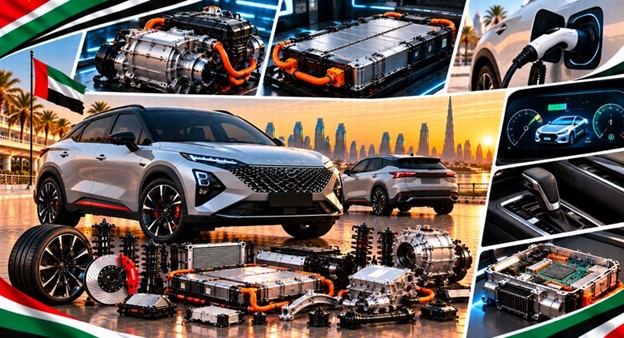
The SHS architecture uses an electric motor alongside the petrol engine, with published system material describing a motor rated at up to 201 hp and 310 Nm within the wider hybrid system. The exact output and integration vary by vehicle.
If an Omoda hybrid develops vibration, reduced electric propulsion or unusual noise, that does not automatically mean the motor itself has failed.
The workshop needs to distinguish:
- motor mechanical fault;
- motor position/speed sensing;
- power electronics;
- wiring;
- cooling;
- DHT-related fault;
- control-system fault.
A motor assembly can be expensive enough that diagnosis should be treated as part of the component's price.
Hybrid transmission problems can look like motor problems
The dedicated hybrid transmission is where several parts of the system's logic meet.
The engine, electric propulsion and transmission are coordinated rather than operating as completely independent machines.
If the car hesitates, shudders, refuses a drive mode or behaves oddly during the transition between electric and petrol propulsion, the workshop should not automatically point at the motor.
Check the transmission control system.
Check sensor data.
Check software and adaptation where applicable.
Check the mechanical side.
Then decide what has actually failed.
Otherwise the workshop is replacing symptoms.
Power electronics are the quiet middlemen
The components between battery and motor matter enormously.
Power electronics manage electrical energy and convert or control it for the propulsion system and other vehicle functions. Depending on the architecture, this can involve inverter/power-control hardware and associated control electronics.
When these components fail, the battery may be perfectly healthy.
The motor may be mechanically sound.
Yet the car can still refuse to deliver electric power.
That is why a hybrid repair quotation should identify the failed assembly, not simply label the entire system “electrical”.
Hybrid cooling deserves particular attention in the UAE
The UAE's climate makes thermal management especially relevant, but it would be lazy to say that every hybrid fault is caused by heat.
The better question is whether the relevant cooling system is functioning correctly.
Depending on the vehicle, the workshop may need to examine coolant levels, circulation, pumps, heat exchangers, temperature sensors and associated control logic.
The broader SHS technical information explicitly describes dedicated protection and thermal-safety engineering for its high-voltage battery systems.
That does not mean a battery should never fail in hot conditions.
It means the cooling and thermal-management system belongs in the diagnosis before a major battery replacement is approved.
Charging faults are not automatically battery faults
This becomes especially important with the C7 SHS because it is a plug-in hybrid.
If the vehicle refuses to charge, investigate the complete charging chain.
That can include:
- charging equipment;
- charging connection;
- vehicle-side charging hardware;
- battery-management system;
- high-voltage control;
- temperature conditions;
- software;
- electrical isolation;
- battery condition.
A charging complaint is a symptom.
The failed component has to be established.
Omoda's SHS battery is not simply a collection of replaceable household cells
The published SHS architecture uses an 18.3 kWh lithium-ion battery pack with cell-to-pack construction. It also describes layered protection against impact, water intrusion and thermal runaway, alongside rapid electrical power isolation.
That matters when somebody suggests that a hybrid battery is “just a few cells”.
The vehicle's battery system is an engineered assembly.
Its enclosure, cooling, monitoring, electrical protection and management electronics are part of the repair equation.
A low-cost cell-level intervention may be technically inappropriate for a particular fault — and a complete pack replacement may be unnecessary for another.
Again, diagnosis decides.
Can a used Omoda hybrid battery be bought in the UAE?
Potentially, but this is one of the categories where used sourcing needs a much higher evidence threshold.
Ask:
- Which vehicle was the battery removed from?
- What was the donor's mileage?
- Why was the donor dismantled?
- Was it accident-damaged?
- Was there water exposure?
- What was the battery's condition before removal?
- Are diagnostic health records available?
- Is the exact battery reference confirmed?
- Is the supplier providing a meaningful warranty?
- Is the installation procedure supported?
“Tested” is a particularly weak word unless the seller explains what was tested and what the result was.
A used hybrid motor needs its own donor history
A motor removed from a crashed C7 could be perfectly serviceable.
A motor removed from a vehicle with an unresolved hybrid fault is another matter.
Ask about the donor's history.
Check the identification label.
Confirm the exact part reference.
Establish whether the motor comes with associated electronics or as a bare assembly.
Then find out what the workshop will need to do after installation.
The cheapest motor is not necessarily the cheapest installed motor.
Electronic modules can be the real source of the headache
Hybrid vehicles depend on multiple electronic control systems communicating correctly.
A replacement control module may therefore require:
- exact hardware compatibility;
- software compatibility;
- configuration;
- coding;
- programming;
- security pairing where applicable;
- system calibration.
This is why “same connector” proves very little.
A used module can look pristine and still be unusable without the correct configuration.
The UAE after-sales network says it uses genuine parts and advanced diagnostics, which is particularly relevant when a fault sits inside a complex electronic system rather than a simple mechanical assembly.
The Omoda C7 SHS warranty can change the entire decision
This is one area where owners should stop shopping for parts and start checking their paperwork.
The UAE operation promoted an eight-year warranty for customers choosing its SHS models in its 2026 Ramadan campaign. The same campaign separately offered longer coverage for petrol models, making clear that the warranty structure differs between powertrain categories and promotional periods.
That does not mean every C7 SHS sold in every circumstance automatically has identical coverage.
It means the owner should establish the exact warranty attached to their VIN and purchase contract before paying privately for a high-voltage component.
A battery quotation obtained too early can be an extremely expensive misunderstanding.
Why warranty documentation matters more with imported hybrids
The UAE market includes officially distributed cars as well as vehicles that may arrive through independent channels.
With a hybrid, that distinction can affect warranty, diagnostics and parts support.
Before buying an imported Omoda hybrid, establish:
- original market;
- VIN;
- warranty provider;
- battery warranty;
- hybrid-system warranty;
- software support;
- parts availability;
- diagnostic support.
A cheaper imported vehicle can become considerably less attractive if a high-voltage fault occurs and the support route is unclear.
Omoda hybrid parts pricing is still developing in the UAE
The brand's UAE footprint has expanded rapidly, with six showrooms reported during its first anniversary period and a growing local after-sales operation.
That matters because hybrid parts economics depend partly on scale.
As more C5 HEVs and C7 SHS vehicles enter the UAE fleet, the independent used-parts pool can become more meaningful, supplier familiarity should improve and more technicians will encounter the architecture.
But that does not justify pretending there is already a transparent public UAE price list for every inverter, motor and battery assembly.
There isn't.
And pretending otherwise is exactly how weak automotive content gets produced.
What does an Omoda hybrid battery replacement actually include?
A battery quotation can refer to very different things.
It might mean:
Complete battery pack
or
battery module/component
or
battery-management component
or
battery cooling component
or
high-voltage wiring/connector
or
diagnostic and isolation fault
These are not interchangeable repairs.
Ask the supplier to identify the exact assembly and part reference.
Then ask whether the quotation includes installation, diagnostics, programming and any required post-installation checks.
Motor replacement has the same problem
“Electric motor — AED X” is not enough.
Is it:
- complete motor assembly?
- motor with inverter?
- motor without power electronics?
- new?
- used?
- reconditioned?
- tested?
- donor mileage known?
- warranty included?
The difference can be enormous.
If the quotation does not define the assembly, the price comparison is not yet meaningful.
Electronics can make a cheap part expensive
Imagine a used control unit costs AED 1,800.
The new unit costs AED 4,000.
The used option looks like a saving of AED 2,200.
Then installation reveals that programming is required.
The module cannot be configured.
A second unit has to be sourced.
The workshop charges removal and installation twice.
The car spends another week waiting.
The saving has disappeared.
This is the cost of getting the wrong hybrid part, and it should be included in every serious comparison.
What should a UAE hybrid specialist check before replacement?
A proper diagnostic path depends on the fault, but a workshop should be able to explain which of the following areas has actually been investigated:
- 12V electrical supply;
- diagnostic trouble codes;
- live hybrid data;
- battery state-of-charge;
- battery health information where supported;
- cell/module behaviour where manufacturer diagnostics permit;
- temperature data;
- insulation/isolation status;
- charging system;
- motor operation;
- power electronics;
- DHT operation;
- coolant circuits;
- wiring and connectors;
- software/configuration;
- post-repair calibration.
You do not need the technician to hand you a 40-page laboratory report.
You do need a reason for the expensive component.
Battery replacement after an accident is a different problem
A hybrid involved in a collision deserves special scrutiny even when the battery warning is absent.
The battery enclosure and high-voltage system need to be assessed according to the manufacturer's collision procedures.
The wider SHS safety architecture specifically identifies protection against impact, water intrusion and thermal runaway as part of the battery system design.
That is not permission to inspect a damaged high-voltage pack yourself.
It is a reason to have a qualified specialist determine whether the vehicle remains safe and whether the battery, enclosure, wiring and associated systems require replacement or further inspection.
A battery can survive an accident.
It can also suffer damage that is not obvious from the driver's seat.
UAE flooding and water exposure deserve attention
Water intrusion is particularly serious for high-voltage systems.
A hybrid that has been exposed to significant flooding, standing water or accident-related water ingress should not be treated like an ordinary used petrol vehicle.
Ask about:
- battery enclosure condition;
- isolation faults;
- connectors;
- wiring;
- control modules;
- corrosion;
- cooling circuits;
- documented inspection.
The SHS system's published battery-safety architecture specifically references protection against water intrusion, but protection is not the same thing as immunity.
For a used hybrid part, donor history therefore matters enormously.
UAE heat changes usage, not the laws of diagnosis
A C5 HEV or C7 SHS operating in Dubai traffic with the air conditioning working hard is placing different thermal demands on the vehicle from a mild-weather laboratory cycle.
That is useful context.
But if a battery fault appears, test the battery.
If a cooling fault appears, test the cooling system.
If the motor loses power, test the motor and its control system.
Climate is a reason to inspect thermal management carefully.
It is not a substitute for diagnosis.
New genuine versus used hybrid components
There is a hierarchy of caution here.
New genuine: highest confidence where the correct application is established, particularly for safety-critical or heavily integrated electronics.
Reconditioned: potentially attractive if the process, replacement components and testing are transparent.
Used genuine: potentially useful, especially for expensive assemblies, but donor history and health evidence matter.
Aftermarket: can be appropriate for some peripheral components, but quality and compatibility need establishing.
Unknown source: the least attractive option for high-voltage or control-system components.
The more expensive and integrated the component, the less useful a large discount becomes if the evidence behind it is weak.
The right way to compare Omoda hybrid repair costs
Use the complete repair equation:
Part price + diagnostics + delivery + labour + programming + calibration + consumables + warranty + downtime + return risk.
For a C7 SHS battery, also ask whether the vehicle's warranty applies.
For a motor, ask whether the quoted assembly includes the relevant associated electronics.
For a control module, ask whether programming is included.
For a charging fault, ask whether the diagnosis has isolated the vehicle from the charger or the charger from the vehicle.
The price beside the component is only the opening number.
A practical UAE Omoda hybrid cost matrix
| Component | What should determine the price | Buying caution |
|---|---|---|
| HEV/PHEV battery pack | Exact pack, model, condition, warranty | Do not buy by visual match |
| Battery module | Battery architecture and diagnosed fault | Verify whether module-level repair is approved |
| Electric motor | Exact motor, donor history, testing | Confirm whether electronics are included |
| DHT | Vehicle version and failed assembly | Diagnose before complete replacement |
| Inverter/power electronics | Exact hardware and software | Programming/configuration may matter |
| BMS/control module | Hardware/software/VIN | Physical fit is insufficient |
| HV cabling | Exact routing and connector | Inspect accident/water damage |
| Cooling components | Battery/motor circuit and fault | Check the cause, not just the symptom |
| 12V battery | Correct low-voltage specification | Test before blaming HV systems |
| Charging hardware | Vehicle-side fault versus charger fault | Establish where the failure actually sits |
This is deliberately more useful than pretending every component has a universal UAE AED price.
The C5 HEV and C7 SHS should not be priced as the same repair
The C5 HEV is built around a hybrid system using a dedicated 1.5TDGI engine, DHT and hybrid battery. The C7 SHS is a plug-in hybrid with a substantially larger rechargeable battery system and a 347 hp published combined output in the UAE.
That means a battery replacement comparison between the two models must account for architecture.
The same goes for motors, control units and charging hardware.
A search result saying “Omoda hybrid battery” is too broad to produce a trustworthy price.
Don't confuse a battery warranty with a battery replacement price
A warranty can make the owner's private replacement cost irrelevant if the failure qualifies.
That is why warranty verification belongs at the beginning of the process.
The UAE's published SHS promotion has included an eight-year warranty offer, while the exact terms applicable to an individual vehicle should be verified against the purchase documentation and VIN.
For an expensive high-voltage fault, this is not paperwork.
It is part of the diagnosis economics.
What should you ask before approving an Omoda hybrid part?
Ask the workshop:
What failed?
What test proves it?
Is the problem in the battery, motor, inverter, DHT, control module, wiring or cooling system?
What is the exact part number?
Does my VIN confirm compatibility?
Is the vehicle under hybrid/battery warranty?
Is programming required?
Is calibration required?
What does the quotation include?
What happens if the replacement does not fix the fault?
Those questions can feel awkward when a car is already dismantled.
They are much less awkward than paying twice.
Where PartFinder UAE fits into an Omoda hybrid purchase
When comparing Omoda hybrid components through PartFinder UAE, the useful comparison is not simply the lowest AED figure; the buyer needs the complete picture — exact model and VIN application, battery or motor specification, component condition, donor history where relevant, warranty, delivery, diagnostics, installation, programming, calibration and the consequences if the component proves unsuitable.
That is particularly important with high-voltage components, where a cheap part with weak provenance can create a much larger bill than its original saving suggests.
The best price is not the lowest number.
It is the lowest credible total repair cost.
The safest buying rule for Omoda hybrid parts in the UAE
For a C5 HEV or C7 SHS, do not buy the expensive component first and ask questions afterwards.
Start with the VIN.
Establish the exact hybrid architecture.
Confirm the fault.
Check warranty.
Identify the OE component.
Obtain the complete installed quotation.
Then compare new genuine, approved repair, reconditioned and verified used options where they are technically appropriate.
And if the proposed repair involves the high-voltage battery or associated high-voltage hardware, use a properly trained specialist and the manufacturer's service procedures rather than treating the system as ordinary 12V automotive electrics.
The C5 HEV and C7 SHS are sophisticated enough that parts shopping can easily become a substitute for diagnosis.
Don't let it.
The expensive component should be the last thing you decide to buy, not the first thing somebody decides to blame.
UAE Update Reference: October 2026 — current UAE Omoda hybrid model information, C5 HEV/C7 SHS specifications, SHS battery architecture, local pricing and published warranty information were checked during preparation. Complete UAE retail prices for major high-voltage replacement assemblies remain quotation-dependent and should not be presented as fixed figures without a VIN-specific source.
FAQ
Categories
- Audi
- BMW
- Car Accessories
- Car Tips
- Ford
- Land Rover
- Mazda
- Range Rover
- Top 10
- UAE Car Parts
- Used Car Parts
- Toyota
- Replacement Engines
- Nissan
- Hyundai
- Mitsubishi
- Volkswagen
- Honda
- Kia
- Chevrolet
- Dodge
- Jeep
- Subaru
- Renault
- Lexus
- Mercedes
- Suzuki
- Hummer
- Porsche
- Infiniti
- Peugeot
- GMC
- Mini
- Volvo
- Replacement Gearboxes
- MG
- Jaguar
- Skoda
- Cadillac
- Daihatsu
- Fiat
- German Car Parts
- Japanese Car Parts
- Aftermarket Car Parts
- Genuine Car Parts
- New Car Parts
- Reconditioned Car Parts
- European Car Parts
- American Car Parts
- Korean Car Parts
- British Car Parts
- Chinese Car Parts
- Sports/Exotic Car Parts
- Luxury Car Parts
- Performance Car Parts
- SUV/4x4 Spare Parts
- Truck Spare Parts
- EV Car Parts
- Hybrid Car Parts
- Auto Spare Parts in UAE
- Tesla
- Isuzu
- Ram
- Ferrari
- Bentley
- Lamborghini
- Genesis
- Maserati
- Lincoln
- Chrysler
- Opel
- Citroen
- SsangYong
- Seat
- McLaren
- Aston Martin
- Rolls Royce
- Maybach
- Alfa Romeo
- Bugatti
- Scion
- Abu Dhabi Car Parts
- Ajman Car Parts
- Al Khan Car Parts
- Al Sajaa Car Parts
- Deira Car Parts
- Dubai Car Parts
- Fujairah Car Parts
- Industrial Area 6 Car Parts
- Mussafah Car Parts
- Ras Al Khaimah Car Parts
- Sharjah Car Parts
- Umm Al Quwain Car Parts
- Acura
- BYD
- Chery
- Dacia
- DS
- Geely Emgrand
- EXEED
- GAC
- GAC Gonow
- Geely
- Gonow
- Great Wall
- Haima
- Haval
- Holden
- Iveco
- JAC
- Jaecoo
- Jetour
- Lotus
- Omoda
- Proton
- Renault Samsung
- Roewe