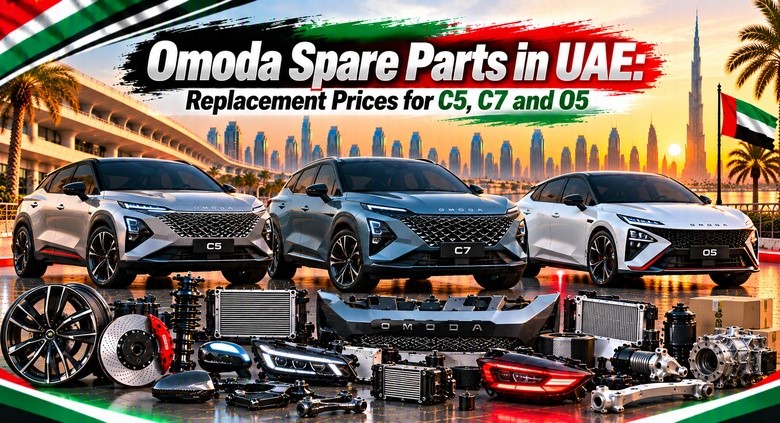
Omoda Spare Parts in UAE: Replacement Prices for C5, C7 and O5
October 13, 2026
An Omoda bumper can look like a straightforward replacement until the workshop removes the damaged one and discovers broken brackets, a displaced camera, damaged radar mounting, wiring damage or a sensor that has survived physically but no longer communicates properly. The same thing happens with headlights, mirrors, grilles and electronic modules: the number printed beside the part is only one part of the bill.
That matters in the UAE because OMODA & JAECOO is still a relatively young local operation. The brand entered the UAE market in February 2025 and, by its first anniversary, said it had exceeded 3,000 sales and expanded to six showrooms across the country. Its Dubai distributor also says it maintains a spare-parts warehouse in Jebel Ali Free Zone.
So the parts story is changing quickly. That is good news for owners, although it also means buyers should be careful with old listings, imported stock and parts catalogues that use different model names.
There is another wrinkle. The current UAE OMODA range clearly includes the C5 and C7, while the UAE website navigation also shows OMODA O5 SHS; the global OMODA site separately lists O5 as a model. Public UAE pricing for the O5 itself is not as clearly published as it is for the C5 and C7, so an O5 price should not simply be guessed from a C5 or C7 listing.
That uncertainty is precisely why Omoda spare parts in UAE should be bought by VIN, model year, powertrain and OE reference, rather than by a photograph that happens to look right.
What Omoda spare parts actually cost in the UAE
There is no single reliable public UAE retail price list covering every Omoda replacement component, and that is worth saying plainly rather than manufacturing a neat-looking table full of false precision.
There are, however, useful reference points.
The official UAE distributor says its after-sales operation uses 100% genuine Omoda and Jaecoo parts, factory-trained technicians and advanced diagnostics. Its Dubai operation separately states that it maintains a large spare-parts warehouse in JAFZA.
For public price evidence, regional Omoda/Chery parts catalogues provide some useful benchmarks. A Saudi OMODA/JAECOO price document, for example, lists OE 602002155AA — the upper front bumper body — at SAR 1,333.90 including VAT. That is roughly AED 1,305 at the prevailing SAR/AED relationship, but it is a Saudi price, not a UAE quotation, so it should be treated as a regional reference rather than a UAE retail price.
That distinction matters.
The 2026 Omoda C5 starts around AED 69,900
The current UAE Omoda C5 sits at the more accessible end of the range, with the official UAE site showing a starting price of AED 69,900. Its published specifications include the 1.5T petrol/CVT configuration, while the Sport version uses the 1.6 TGDI and seven-speed DCT.
A separate UAE pricing database, updated in August 2026 and identifying its prices as sourced from the manufacturer/distributor, places the 2026 C5 range at AED 69,900–88,400 before VAT, depending on variant.
Why does the vehicle price matter in a parts article?
Because a AED 2,000 headlamp means something different on a car bought for AED 70,000 than it does on a much more expensive SUV. The repair has to be judged against the vehicle's value, warranty position and expected ownership period.
C5 parts are not one-size-fits-all
The C5 is a particularly good example of why “Omoda C5 parts” is too broad a search.
The UAE specification includes different powertrains and transmissions across the range. The official UAE page identifies a 1.5T/CVT version and a 1.6 TGDI/7-speed DCT Sport version, with differences in equipment as well.
That means the buyer should not assume that every C5 component is shared across every trim.
This becomes more important with:
- headlights;
- bumpers;
- grilles;
- wheels;
- suspension components;
- cooling assemblies;
- electronic modules;
- ADAS components;
- transmission-related parts.
The badge tells you the family.
The VIN tells you which member of the family you actually own.
C7 parts need even closer identification
The UAE C7 is the newer, larger model in the current Omoda line-up, and public UAE pricing places the petrol C7 from about AED 88,900, while the C7 SHS is listed from AED 114,900. The Dubai distributor's current model information gives the same starting figures.
The C7 range also crosses powertrain boundaries: the UAE distributor describes the C7 with 1.5T/1.6 TGDI petrol configurations and a seven-speed DCT, while the SHS version uses the hybrid system.
So when someone says, “I need a C7 transmission part”, that is nowhere near enough information.
Petrol C7?
SHS?
Which model year?
Which assembly?
Which OE number?
Those questions are not bureaucracy. They are the difference between a part that fits and a part that belongs in somebody else's warehouse.
What about the Omoda O5 in the UAE?
This is where current naming deserves careful treatment.
OMODA's global site lists the O5 separately, and the UAE website's model navigation currently displays OMODA O5 SHS alongside C5 and C7. However, the public UAE pages do not currently expose a clear standalone O5 retail price in the same way they do for the C5 and C7.
That means an article claiming a precise UAE O5 parts price without identifying the exact O5 version would be overconfident.
For an O5 owner, use the VIN, market, production year and powertrain when requesting a quotation, particularly if the vehicle is imported rather than supplied through the current UAE channel.
A model name can travel.
A part number cannot afford to.
O5, O5 SHS and other market names can cause confusion
OMODA's international model structure is changing, and market naming does not always remain perfectly aligned.
The global OMODA site now shows O5 as a distinct model, while UAE navigation has O5 SHS in the model family. The same international material also warns that vehicle configurations can vary by national market and that the actual market release should take precedence.
This is precisely why imported Omodas deserve additional checking.
If a seller says “O5 part”, ask for the VIN and the original component reference before paying.
The most useful C5 price evidence is currently regional
Public UAE part-by-part pricing remains patchy, but the regional evidence is already useful.
The Saudi OMODA/JAECOO parts document lists OE 602002155AA, the upper front bumper body, at SAR 1,333.90 including VAT. It also lists an alternator assembly at SAR 2,235.83 and various smaller electrical and trim components.
These figures are useful because they demonstrate the relative scale of genuine OE components.
They are not UAE retail prices.
For a UAE buyer, the final figure can change through local stock, distributor pricing, VAT treatment, freight, supplier margin, availability and whether the quoted component is actually the same specification.
That is the difference between a benchmark and a quotation.
C5 bumper prices show why OE numbers matter
The Omoda 5/C5 body catalogue identifies the upper front bumper body as 602002155AA, with a separate lower bumper body listed as 602002156AA. It also lists separate left and right bumper trims.
That is important after a UAE parking-lot impact because “front bumper” can mean several different things.
The outer cover may be damaged.
The lower skirt may be damaged.
A trim piece may be broken.
The reinforcement may be bent.
A radar or camera mounting point may have moved.
Ordering the entire bumper assembly when only a replaceable section is damaged can inflate the bill; ordering only the visible section when the underlying mounting structure is distorted can produce the opposite problem.
Look behind the plastic.
C5 headlight replacement can cost more than the lamp
Public Omoda 5 catalogues identify several headlamp OE references, including 605000528AA through 605000531AA, while other listings identify 605000605AA/606AA and 605000557AA/558AA for particular configurations.
That variation is precisely why visual matching is unreliable.
A left headlamp from one specification can look almost identical to another while carrying a different connector, electronics package or mounting arrangement.
One public international listing places an Omoda 5 headlamp around US$99–255 for a particular replacement product, while another catalogue lists an original front halogen headlamp at US$299. These are overseas selling prices and should not be converted into supposed UAE landed prices.
Use them to understand the market range, not to promise a UAE customer a price.
C5 tail lamps have their own OE references
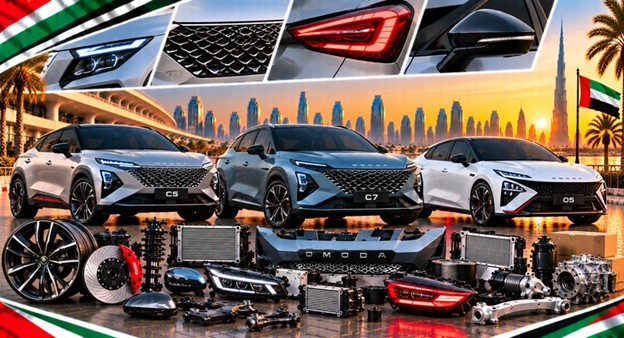
The same Omoda 5 catalogue identifies rear lamp references including 605000524AA and 605000525AA, with separate references for other rear lighting sections.
That distinction matters after a rear-end accident.
A tailgate-mounted lamp, outer rear lamp and associated trim can appear to form one visual assembly, yet they may be separately replaceable.
The workshop should inspect the complete rear corner before ordering.
Otherwise the first delivery arrives, the damaged mounting is discovered, and the vehicle sits on a ramp waiting for another part.
That is how small omissions become downtime.
C7 replacement prices are harder to publish honestly
C7 parts are newer, and publicly indexed UAE part-by-part prices are less developed than the vehicle pricing itself.
There are broad online catalogues showing hundreds of supposed C7-compatible products, but much of that material is generic accessories or universal equipment rather than verified C7 OE replacement components. One Pakistan catalogue, for example, claims hundreds of C7 listings while displaying numerous unrelated LED bulbs, ornaments and accessories.
That is not useful evidence for a UAE C7 headlamp or bumper price.
It illustrates the opposite lesson.
A large parts catalogue is not automatically a good parts catalogue.
The C7 SHS changes the parts equation
The C7 SHS introduces a hybrid powertrain, and OMODA & JAECOO UAE has publicly identified the C7 SHS as part of its Super Hybrid line-up.
That brings additional systems into the repair conversation:
- hybrid battery;
- electric motor hardware;
- power electronics;
- hybrid control systems;
- dedicated cooling;
- high-voltage cabling;
- conventional petrol-engine components;
- transmission/hybrid drive components.
A hybrid C7 should therefore never be treated as merely a petrol C7 with an extra battery.
The parts identification process becomes more exact.
A C7 hybrid component should not be bought from a photograph
This sounds obvious until a damaged hybrid vehicle is sitting in a workshop and somebody finds a cheaper component online.
Do not do it.
For high-voltage or hybrid-related components, confirm the exact vehicle application and follow the manufacturer's service procedure. The official UAE after-sales operation says its technicians use advanced diagnostics and factory-trained procedures, which is particularly relevant where electronic systems are involved.
A component can be physically correct and electronically wrong.
That is an expensive distinction.
Omoda's UAE parts infrastructure is becoming more useful
There is a genuine reason for some optimism here.
OMODA & JAECOO says it has expanded its UAE physical footprint and, in Dubai, its distributor states that a major spare-parts warehouse operates from JAFZA.
That does not mean every C5, C7 or O5 part is permanently sitting on a shelf.
It does mean the local supply infrastructure is materially more established than a purely grey-market import operation.
For buyers, that can affect the calculation between:
wait for official genuine stock
and
buy an imported replacement immediately.
Availability is part of price.
Genuine Omoda parts have a clear place in warranty repairs
The official UAE after-sales material says the company guarantees genuine Omoda and Jaecoo parts for repairs and uses factory-trained technicians with advanced diagnostics.
If the vehicle is within warranty and the fault is potentially warranty-related, investigate that route before sourcing an independent component.
There is little sense in spending AED thousands on an imported control unit and then discovering the original failure could have been dealt with through the manufacturer's support network.
The warranty conversation should happen before the parts hunt.
Used Omoda parts can make sense — but the market is still young
Used Omoda parts are becoming easier to find, but the donor pool is naturally smaller than it is for long-established Toyota, Nissan or European models in the UAE.
That creates an interesting tension.
A used C5 bumper may be perfectly sensible.
A used electronic module with unknown donor history is much harder to justify.
A used engine or gearbox can make sense if the donor vehicle is documented, mileage is known and the component has been tested.
The principle is simple:
The more internally complex and expensive the component, the more evidence you should demand about its previous life.
Body panels are often the easiest place to save money
A used original bonnet, door, wing or bumper can be attractive where the component is straight, undamaged, correctly specified and reasonably priced.
But inspect:
- mounting tabs;
- brackets;
- previous repairs;
- filler;
- corrosion;
- cracks;
- sensor apertures;
- trim mounting points;
- paint condition.
The UAE market is full of used parts, but “used original” is not a synonym for “ready to install”.
Sometimes it is.
Sometimes it is merely the beginning of another repair.
Headlights require a higher evidence threshold
An Omoda headlight contains more than a piece of transparent plastic.
Depending on specification, it can incorporate LED hardware, control electronics, DRL elements and other electrical functions.
A used lamp therefore needs inspection for:
- lens damage;
- housing cracks;
- water ingress;
- broken mounting points;
- connector damage;
- correct OE number;
- electronic compatibility.
The workshop should also check whether any calibration or fault-code clearing is required after installation.
Do not judge the lamp solely because it lights up.
ADAS parts need calibration thinking
The C5's UAE specification includes driver-assistance functions such as adaptive cruise control, forward collision warning, autonomous emergency braking and lane-related systems.
After an accident, the visible damage may therefore be only half the story.
A bumper can be repaired beautifully while a sensor mounting point has moved slightly.
A windscreen can be replaced correctly while the forward camera's relationship to the vehicle has changed.
A grille can look perfect while the hardware behind it is misaligned.
The workshop should determine whether the relevant ADAS system requires calibration after the repair.
Fitment is not calibration.
A bumper quotation should include the hidden parts
Suppose a C5 front bumper is damaged.
The quote should establish whether it includes:
- bumper cover;
- lower section;
- grilles;
- brackets;
- clips;
- reinforcement;
- sensor mounts;
- radar-related brackets;
- parking sensors;
- trim;
- paint;
- labour;
- calibration where applicable.
The public OE catalogue itself demonstrates that what consumers call “the bumper” can consist of several separately identified components.
This is exactly why component-level pricing can be misleading.
Omoda brake parts should be matched by specification
Brakes are not the place for vague compatibility.
The C5's official UAE specification includes ventilated front discs and solid rear discs on the published Comfort specification, while trim and equipment can differ.
Before buying pads or discs, confirm:
- model year;
- trim;
- engine;
- front/rear axle;
- disc dimensions;
- pad shape;
- OE reference;
- sensor arrangement where applicable.
Do not buy because an online listing says “C5 2022–2026”.
The catalogue may be covering several configurations.
Suspension parts should be checked after impact
A UAE pothole, kerb strike or accident can leave a suspension component looking less dramatic than the resulting alignment problem.
If a C5 or C7 has suffered a heavy impact, inspect:
- control arms;
- knuckles;
- hubs;
- wheel bearings;
- tie rods;
- subframe mounting points;
- dampers;
- wheel;
- tyre;
- alignment.
If a replacement part is installed, wheel alignment may be part of the repair rather than an optional extra.
The steering wheel being straight is not proof that the geometry is right.
Engine parts need engine-specific matching
The C5 demonstrates the problem nicely because UAE versions include both 1.5T and 1.6 TGDI powertrains.
A sensor, hose, intercooler, ignition component, turbo-related assembly or engine control component should therefore be matched to the exact engine.
Do not assume that “Omoda C5” is sufficient.
For engine-related parts, provide the VIN and, where possible, the engine identification or original part number.
Transmission parts deserve the same discipline
The UAE C5 range includes CVT and seven-speed DCT configurations depending on variant, while the C7 range also has different powertrain configurations.
That makes gearbox terminology particularly dangerous.
“C5 gearbox” could mean an entire transmission, valve-body component, clutch-related component, sensor, actuator or electronic control module.
Before purchasing, identify the actual failed assembly.
Then identify the transmission.
Then identify the part.
The order matters.
Do not diagnose a sensor from a fault code alone
A dashboard warning or diagnostic trouble code can point towards a system without proving that the named sensor itself has failed.
The workshop should consider:
- wiring;
- connector condition;
- power supply;
- ground;
- communication;
- live data;
- related sensors;
- physical damage;
- software;
- calibration.
This matters particularly on modern Omodas because the cars carry increasingly sophisticated ADAS and electronic systems.
Replacing a sensor without establishing why the system reported the fault is parts roulette.
UAE heat matters, but it should not become a diagnosis
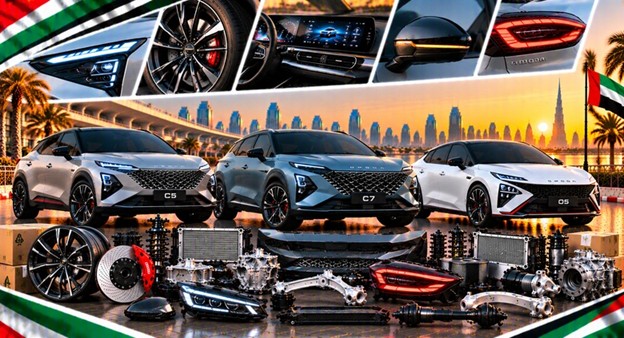
Omoda's Dubai distributor explicitly markets its vehicles as GCC specification and says they are designed and tested for Dubai's heat, sandy conditions and high-speed highways.
That is useful context.
But it does not mean every component failure in the UAE is caused by heat.
A/C complaints, battery problems, cooling issues and electronic faults still require diagnosis.
Climate affects operating conditions.
It does not excuse bad diagnosis.
Imported Omodas require extra parts checking
A grey-import Omoda may differ in specification from the UAE vehicle even when the body shape and model badge appear identical.
Check:
- original market;
- VIN;
- production date;
- powertrain;
- trim;
- lighting configuration;
- infotainment specification;
- ADAS equipment;
- connector configuration;
- software;
- OE part number.
The international OMODA material explicitly notes that vehicle configurations can vary by national market and that the actual country-market release should take precedence.
That sentence has more practical value than a dozen generic “check compatibility” warnings.
What a sensible UAE Omoda price comparison looks like
A buyer comparing parts should create three numbers, not one.
Part price
What does the component itself cost?
Installed price
What will the workshop charge for fitting, fluids, consumables and related work?
Repair-complete price
Does the vehicle also require paint, programming, calibration, alignment, diagnostics or another damaged component?
For example, a bumper quotation of AED 1,500 may sound attractive until paint, clips, radar mounting and calibration push the completed repair considerably higher.
Conversely, a more expensive genuine assembly can sometimes reduce installation uncertainty.
The number on the parts invoice is only the first number.
A practical Omoda parts decision matrix
| Part category | New genuine | Used genuine | Aftermarket | What matters most |
|---|---|---|---|---|
| Bumper cover | Strong choice | Often sensible | Possible | Fit, mounts, sensors, paint |
| Door/bonnet/wing | Strong | Often attractive | Possible | Straightness, repair history |
| Headlamp | Safest | Viable with evidence | Quality-dependent | OE number, electronics, water damage |
| Tail lamp | Strong | Often viable | Quality-dependent | Exact specification |
| Brake pads/discs | Preferred | Generally poor choice | Good if reputable | Correct specification |
| Control arm | Preferred | Possible if inspected | Possible | Impact history, geometry |
| ECU/module | Preferred | High caution | High caution | Programming, VIN, software |
| Engine | Depends on diagnosis | Possible | Rarely first choice | Compression, history, mileage |
| Gearbox | Depends on diagnosis | Possible | Specialist assessment | Code, donor, testing |
| Hybrid component | Specialist route | High caution | High caution | HV safety, diagnosis, compatibility |
| ADAS sensor | Approved route | Only with exact verification | Specialist | Calibration and software |
The table is not a rulebook.
It is a way of forcing the buyer to think beyond the word “cheap”.
Before ordering any Omoda spare part in the UAE
Get the VIN first.
Then confirm the:
model → year → trim → engine/powertrain → transmission → side/location → OE number → supplier specification.
After that, ask for the complete price.
Not just the component.
Ask whether VAT is included, whether delivery is included, whether the part is physically in UAE stock, whether programming is required, whether calibration is required, what warranty applies and what happens if the part does not resolve the problem.
For C5 owners, the current UAE market gives you a relatively clear starting point: the official model begins at AED 69,900, with higher variants reaching AED 88,400 in current published UAE pricing.
For C7, current UAE distributor information places the petrol model from AED 88,900 and C7 SHS from AED 114,900.
For O5, be more cautious about published UAE pricing because the model naming and public UAE model information are still less straightforward. The current UAE website shows O5 SHS in its model navigation, while the global OMODA material lists O5 separately.
And when comparing available Omoda components through PartFinder UAE, the useful comparison is not simply the lowest number beside the part; it is the complete repair equation — verified compatibility, component price, UAE VAT, delivery, fitting, diagnostics, programming, calibration, warranty and the cost of discovering that the first part was wrong.
That is how a spare-part search becomes a repair decision rather than a shopping exercise.
UAE Update Reference: October 2026. Current vehicle pricing, UAE model availability, distributor information and publicly indexed parts evidence were checked during preparation; individual UAE replacement-part prices remain subject to VIN, specification, stock and supplier quotation.
FAQ
Categories
- Audi
- BMW
- Car Accessories
- Car Tips
- Ford
- Land Rover
- Mazda
- Range Rover
- Top 10
- UAE Car Parts
- Used Car Parts
- Toyota
- Replacement Engines
- Nissan
- Hyundai
- Mitsubishi
- Volkswagen
- Honda
- Kia
- Chevrolet
- Dodge
- Jeep
- Subaru
- Renault
- Lexus
- Mercedes
- Suzuki
- Hummer
- Porsche
- Infiniti
- Peugeot
- GMC
- Mini
- Volvo
- Replacement Gearboxes
- MG
- Jaguar
- Skoda
- Cadillac
- Daihatsu
- Fiat
- German Car Parts
- Japanese Car Parts
- Aftermarket Car Parts
- Genuine Car Parts
- New Car Parts
- Reconditioned Car Parts
- European Car Parts
- American Car Parts
- Korean Car Parts
- British Car Parts
- Chinese Car Parts
- Sports/Exotic Car Parts
- Luxury Car Parts
- Performance Car Parts
- SUV/4x4 Spare Parts
- Truck Spare Parts
- EV Car Parts
- Hybrid Car Parts
- Auto Spare Parts in UAE
- Tesla
- Isuzu
- Ram
- Ferrari
- Bentley
- Lamborghini
- Genesis
- Maserati
- Lincoln
- Chrysler
- Opel
- Citroen
- SsangYong
- Seat
- McLaren
- Aston Martin
- Rolls Royce
- Maybach
- Alfa Romeo
- Bugatti
- Scion
- Abu Dhabi Car Parts
- Ajman Car Parts
- Al Khan Car Parts
- Al Sajaa Car Parts
- Deira Car Parts
- Dubai Car Parts
- Fujairah Car Parts
- Industrial Area 6 Car Parts
- Mussafah Car Parts
- Ras Al Khaimah Car Parts
- Sharjah Car Parts
- Umm Al Quwain Car Parts
- Acura
- BYD
- Chery
- Dacia
- DS
- Geely Emgrand
- EXEED
- GAC
- GAC Gonow
- Geely
- Gonow
- Great Wall
- Haima
- Haval
- Holden
- Iveco
- JAC
- Jaecoo
- Jetour
- Lotus
- Omoda
- Proton
- Renault Samsung
- Roewe