Opel Astra and Corsa Spare Parts in UAE: Common Replacement Parts and Fitment Tips
September 22, 2026
The trouble with buying an Opel Astra or Corsa spare part in the UAE is rarely finding a part. There are plenty of them. The harder bit is finding the right part for the exact car sitting outside your house or in the workshop.
That distinction matters because Astra and Corsa parts listings can span several generations, engines, body styles, braking systems and production years. A listing saying “fits Opel Astra” is not, by itself, proof that it fits your Astra. Opel’s own UAE documentation separates vehicles by model year and configuration, while its VIN service uses the vehicle’s 17-character identification number to identify the individual car.
And then there is the UAE factor. Heat, heavy air-conditioning use, dusty roads, stop-start Dubai traffic and long motorway runs can make apparently ordinary replacement parts rather more important than they look on a screen.
Here is how to approach Opel spare parts in UAE without turning a simple brake-pad or filter purchase into an expensive fitment mistake.
Astra and Corsa parts are not interchangeable simply because they are both Opel
This is the first assumption worth killing.
Astra and Corsa share the Opel badge, and some aftermarket catalogues may show cross-brand or cross-model applications, but that does not mean a Corsa component can automatically be fitted to an Astra, or that one Astra generation uses the same component as another.
Even brake-pad catalogues demonstrate how complicated this becomes. One UAE listing for a BSG front pad identifies specific Opel Astra applications and provides several OEM cross-reference numbers, while another listing covers a different Astra J application.
The useful question is not:
“Do you have Astra brake pads?”
It is:
“Which Astra, which year, which engine, which brake system and which OE number?”
That is the level at which a reliable parts search starts.
Know which Astra or Corsa generation you actually own
“Opel Astra” covers multiple generations. So does “Opel Corsa”.
That sounds obvious until you look at the spare-parts market.
Opel UAE currently provides separate documentation for vehicles including the Astra K MY17 and MY18 and Corsa MY17, MY17.5 and MY18. Older Corsa documentation also exists, including the 2009 model.
That matters because the same basic component can change between generations.
A brake disc can have a different diameter or thickness. A suspension component can have a different mounting arrangement. A headlamp can change with facelift equipment. An air filter can differ according to engine. An electronic module may require a completely different software configuration.
So before searching online, write down:
Model → generation → model year → engine → gearbox → body style → VIN.
That little sequence eliminates a remarkable amount of guesswork.
The VIN is more useful than a registration-name search
If there is one fitment detail worth keeping beside you while shopping, it is the VIN.
Opel UAE identifies the VIN as a 17-character vehicle identification number and provides an online VIN-check facility.
For parts purchasing, the VIN can help a supplier or specialist establish the correct vehicle specification where catalogue information is ambiguous.
It becomes particularly important for:
- brake systems
- suspension components
- steering parts
- engine sensors
- ECU and control modules
- body electronics
- headlights
- radiators
- cooling-system components
- transmission components
- model-year-specific trim and body parts
Don't send a supplier a VIN and assume that ends the conversation, though. Ask for the matching OEM/part number as well where possible. The strongest purchase trail is generally VIN + exact vehicle specification + OE number + supplier fitment confirmation.
Brake pads are common Astra and Corsa replacements — but the number matters
Brake pads are a classic example of a part that looks simple until you start comparing applications.
A UAE listing currently shows a BSG front brake pad at AED 74.35, with Opel OEM cross-reference numbers including 13301207, 13374966, 13412272, 1605169 and 542120, and identifies its application as Astra J/Chevrolet Aveo/Cruze-related vehicles. That is a useful illustration of why the cross-reference number matters more than the generic product title.
Another UAE listing identifies FEBEST 1605434 for Opel Astra J and gives a separate group of GM/OPEL cross-reference numbers.
Those aren't interchangeable simply because both advertisements say “Astra”.
Opel itself states that its original brake pads are designed for specific vehicles and recommends replacing pads in axle sets.
So if one front pad listing is AED 74.35 and another is several hundred dirhams, don't immediately conclude that the expensive one is a rip-off or the cheap one is automatically a bargain. They may be different braking systems, brands, specifications or applications.
Brake discs need even more care than pads
A brake disc is not a universal metal plate.
Diameter, thickness, height, centre bore, bolt pattern and braking-system specification can all matter. On some vehicles, there can also be differences according to engine or performance specification.
Opel UAE says its original brake discs are designed for individual vehicle applications and recommends replacing discs in axle pairs.
This is particularly relevant when shopping for an older Astra in the UAE. A seller may have stock labelled for several Astra variants, but the correct choice still needs to be established against the car.
If your mechanic has already removed the old disc, record its dimensions before ordering a replacement where the catalogue fitment is uncertain.
Corsa suspension parts can vary dramatically by generation
The current UAE Corsa parts market is a good demonstration of this.
The listings include a Bilstein front B1 shock absorber for Corsa B at AED 300, a rear B4 shock for Corsa C at AED 480, rear B6/B8 applications for Corsa D at AED 910–940, and a rear B4 application for Corsa E at AED 660. These are specific listed products rather than universal UAE market prices, and the observations were available in September 2026.
That spread isn't evidence that one Corsa is inherently expensive to maintain.
It is evidence that “Corsa shock absorber” isn't a sufficiently precise buying description.
Generation, suspension specification and the exact part number change the equation.
Don't buy a shock absorber from a photograph
This sounds almost painfully obvious, yet online parts shopping encourages exactly this behaviour.
A photograph can show that the part looks like a shock absorber. It cannot prove that its mounting points, dimensions, damping specification and application match your vehicle.
For suspension parts, verify:
- front or rear
- left/right where applicable
- generation
- body style
- suspension package
- engine/weight variant
- manufacturer part number
- OE cross-reference
- supplier's written fitment confirmation
Opel also describes suspension maintenance as important to tyre wear and steering response and states that its original shock absorbers carry an extended two-year manufacturer guarantee.
Air filters are another area where model names are too broad
The air filter sits inside an airbox, so it can look like one of the easiest components to purchase.
It isn't always.
A current UAE listing shows a K&N 33-3040 replacement filter specifically for the Corsa E 1.4-litre application for 2014–2016 at AED 350. Another listing shows a BMC FB934/01 for the Corsa E 1.0 Ecotec DI Turbo at AED 420.
Same model name.
Different engine.
Different filter.
That is exactly why searching only “Opel Corsa air filter UAE” is a poor fitment method.
Cabin filters deserve more attention in the UAE
Cabin filters are easy to ignore because they don't usually stop the car from moving.
In Dubai, Abu Dhabi and other heavily trafficked areas, though, the cabin filter is part of the air entering the passenger compartment. Dust, fine particles, traffic pollution and heavy air-conditioning use make the condition of the filter more relevant to everyday comfort.
Opel UAE recommends replacing its cabin air filter at least annually and describes its carbon-combination filter as being designed to help with gases, fine particles and odours.
For an Astra or Corsa used extensively in urban UAE conditions, don't treat the cabin filter as an afterthought during routine servicing.
Engine oil is not simply about choosing 5W-30
Opel UAE's original-parts information specifies 5W-30 dexos2 for its referenced applications, but oil selection should still be made against the specific engine and manufacturer's specification, not merely because “5W-30” appears on the bottle.
Viscosity and specification are different things.
A workshop should be able to tell you:
- engine code
- required oil specification
- required quantity
- recommended service interval
- whether the vehicle has a diesel particulate filter or other emissions equipment
- whether the oil being supplied actually meets the required specification
This is especially important when an older imported Astra or Corsa has a service history that isn't completely clear.
Batteries can look interchangeable when they aren't
Battery shopping often becomes a numbers game: voltage, Ah, CCA, physical size.
Those numbers matter, but so do the battery technology and vehicle requirements.
Astra and Corsa variants can have different electrical loads and equipment. Some vehicles may also require battery-management procedures or registration after replacement depending on the specific electrical architecture.
Don't order from a photograph of the old battery alone.
Record:
battery technology + capacity + cold-cranking rating + dimensions + terminal arrangement + vehicle specification.
If your vehicle has battery-management electronics, ask the workshop whether battery registration or coding is required after installation.
Cooling-system parts matter more in UAE conditions
Radiators, coolant hoses, thermostats, expansion tanks, cooling fans and water-pump components don't get much sympathy from the climate.
The UAE doesn't create a different Opel engine, obviously, but high ambient temperatures reduce the margin available to a cooling system when the car is stuck in traffic with the air conditioning running.
Opel describes its original radiators as vehicle-specific and designed around the vehicle's cooling requirements.
So if an Astra or Corsa is overheating, don't automatically order a radiator.
First establish why.
A competent diagnostic process may involve checking coolant level and condition, pressure-testing the system, inspecting hoses and the expansion tank, verifying thermostat operation, checking radiator airflow, confirming fan operation and examining temperature readings.
Replacing a radiator when the actual problem is a thermostat, fan-control issue or coolant leak is an expensive way of avoiding diagnosis.
A radiator replacement is not the same repair as a cooling-system diagnosis
This distinction matters.
If the radiator has a visible leak or internal blockage, replacement may be justified.
If the temperature rises only in stationary traffic, however, fan operation becomes particularly relevant. If coolant disappears without an obvious external leak, pressure testing and further investigation may be required. If the engine has overheated severely, compression or other engine-health checks may become relevant depending on symptoms.
The part should follow the diagnosis.
Not the other way around.
Suspension noises need diagnosis before ordering a suspension “kit”
An Astra making a knocking noise over speed humps does not automatically need four shock absorbers.
The sound could involve:
- anti-roll-bar links
- bushes
- top mounts
- ball joints
- control arms
- shock absorbers
- springs
- other mounting hardware
A workshop should inspect the suspension physically rather than using the noise alone to determine the replacement list.
This is where buying a cheap “complete suspension kit” can actually become more expensive. You may pay for components that weren't defective in the first place.
Steering and wheel-bearing parts need exact identification
A wheel-bearing listing might appear under several related Opel, GM or Vauxhall applications.
That doesn't make every listing suitable.
Opel UAE lists wheel hubs and bearings among its original repair parts and emphasises model-specific quality and fitment.
For a suspected wheel bearing, confirm which side is affected, whether the vehicle uses an integrated hub assembly, the generation and the relevant OE number.
And don't diagnose a bearing solely because there is a humming noise. Tyres can produce remarkably similar sounds, especially when wear patterns have developed.
Electrical parts are where “looks identical” becomes dangerous
An Astra or Corsa control module can look perfectly healthy in a seller's photograph.
That tells you very little.
ECUs, BCMs, ABS modules, instrument clusters, steering modules and other electronic components can depend on vehicle configuration, software and coding.
A used module therefore needs more than:
“Same shape, same connector.”
You may need:
- exact part number
- hardware revision
- software compatibility
- vehicle configuration
- coding/programming capability
- donor information
- return policy
A module that physically plugs in but cannot be correctly configured isn't a successful parts purchase.
Headlights and body parts need specification, not just appearance
A headlamp may differ according to:
- halogen or LED configuration
- left-hand/right-hand side
- facelift
- body style
- lighting-control system
- market specification
- sensor or wiring arrangement
The same problem appears with bumpers, grilles, wings and other body panels.
Opel UAE specifically warns that incorrect or imitation body components can lead to poor alignment and additional modification work, while its original-parts catalogue lists bumpers and headlamps as model-specific components.
For used body parts, ask for photographs from several angles rather than relying on a catalogue image.
Used Astra and Corsa parts can make financial sense — if you inspect the right things
Older Astra and Corsa vehicles can be excellent candidates for used genuine components because new dealer parts aren't always the only sensible route.
But used does not mean automatically good value.
For a used component, establish:
Donor vehicle → mileage if known → exact part number → condition → photographs → warranty/return terms → coding requirement → installation requirements.
For a mechanical component such as an engine or gearbox, ask much more.
What mileage did the donor vehicle have?
Was the vehicle running when dismantled?
Is the engine complete?
Are there compression figures or inspection records?
What oil condition was observed?
Has the gearbox been tested?
What warranty is provided?
A cheap engine with no provenance is not necessarily cheaper once fitting and removal costs are included.
Genuine, OEM, aftermarket and used genuine are different buying categories
These terms get mixed together constantly.
Genuine Opel part: supplied as an original-branded vehicle part.
OEM: normally refers to a component made by an original-equipment manufacturer, but the term is used loosely in online marketplaces. Don't treat “OEM” as a magic guarantee.
Quality aftermarket: made by an independent manufacturer for the vehicle's application.
Used genuine: an original component removed from another vehicle.
Reconditioned/remanufactured: a previously used component that has been inspected, rebuilt or refurbished to a stated standard.
The right choice depends on the component.
Saving money on a cabin filter is one conversation.
Saving money on an ABS module, brake component or engine is another.
The cheapest advertised Astra or Corsa part is not necessarily the cheapest repair
Imagine three brake-pad choices:
| Option | Part cost | What still needs checking |
| Budget aftermarket | Lower | Brand, specification, fitment, warranty |
| Quality aftermarket | Medium | Manufacturer, OE cross-reference, application |
| Genuine | Higher | Exact Opel application, availability, warranty |
The part price is only one line on the invoice.
Add labour, fitting hardware, diagnostic time, shipping, VAT where applicable, and any required coding or calibration.
That is why comparing total installed cost is more useful than comparing the product price alone.
Current UAE price observations show why fitment must come first
The following are specific UAE listing observations available around September 2026, not recommended universal market prices:
| Part/listing | Vehicle application shown | Listed price |
| BSG front brake pad | Opel Astra J-related application | AED 74.35 |
| K&N 33-3040 air filter | Corsa E 1.4, 2014–2016 | AED 350 |
| BMC FB934/01 air filter | Corsa E 1.0 Ecotec DI Turbo | AED 420 |
| Bilstein front B1 shock | Corsa B/Tigra | AED 300 |
| Bilstein rear B4 shock | Corsa C | AED 480 |
| Bilstein rear B4 shock | Corsa E | AED 660 |
| Bilstein rear B6/B8 shock | Corsa D | AED 910–940 |
| Ferodo DS2500 front pads | Astra G OPC listing | AED 890 |
These figures come from current UAE listings and illustrate product/application differences rather than establishing a normal retail price for every Astra or Corsa.
Notice what happens when the model name gets more specific: the price comparison becomes meaningful.
Astra G, H, J and K should not be treated as one parts catalogue
For Astra owners, generation is particularly important.
An Astra G is not simply an older Astra J.
Astra H introduces another set of component applications. Astra J brings further changes, including different braking and electronic configurations. Astra K again moves into a different generation of vehicle electronics, engines and equipment.
The UAE parts market itself reflects this separation. AUTO.AE currently lists individual Astra generation categories and specific applications rather than treating every Astra component as universal.
When writing the search query, use the generation whenever you know it.
“Astra J front brake pads” is considerably more useful than “Opel Astra brake pads”.
Corsa B, C, D and E need the same discipline
The Corsa market has the same problem.
Current UAE listings distinguish Corsa B, C, D and E applications, with suspension products and air filters tied to particular generations and engines.
A Corsa D 1.2 is not automatically the same parts application as a Corsa D OPC.
And a Corsa E 1.0 turbo is not automatically the same as a Corsa E 1.4.
That is why generation plus engine is such a useful minimum when ordering.
Performance Astra and Corsa models deserve their own fitment check
OPC, VXR and other performance variants can have different brakes, suspension, intake components and drivetrain specifications.
For example, the UAE parts market contains specific Astra OPC and Corsa D/E OPC listings rather than simply grouping them with standard cars.
Don't assume the standard car's component is suitable for the performance version because the body shell looks similar.
The same applies in reverse: fitting a performance-spec component to a standard car may create compatibility, ride-height, braking-balance or cost issues.
Cross-reference numbers can be more valuable than brand names
Suppose a seller gives you:
Manufacturer: BSG
Part number: 65-200-017
OE references: 13301207, 13374966, 13412272, 1605169, 542120
That information is much more useful than an advert simply saying “Premium Opel brake pads”.
The UAE BSG listing actually provides those cross-reference numbers and technical dimensions.
Use the number to cross-check.
If two suppliers provide different numbers, don't assume they are interchangeable because the photographs look alike. Ask them to explain the cross-reference.
Don't confuse OEM cross-reference with proof of exact fitment
A cross-reference number is useful evidence.
It is not an excuse to stop checking.
Catalogues can contain errors. Marketplace listings can be incorrectly tagged. Sellers can copy descriptions from other listings. Imported vehicles can have specifications that differ from the version originally catalogued for the UAE.
The safest workflow is:
VIN → vehicle specification → OE number → aftermarket cross-reference → supplier confirmation.
When those agree, you have a much stronger fitment case.
UAE heat changes how you should think about certain replacement parts
Not every Astra or Corsa component needs special UAE treatment.
But some deserve closer attention.
Cooling-system components are obvious. Batteries and rubber components also deserve consideration. Air-conditioning-related parts and cabin filtration can become particularly noticeable because climate control is used heavily for much of the year.
Tyres and suspension components also deserve proper inspection because heat, road surfaces and tyre pressures interact with wear.
The mistake is exaggerating climate as an explanation for every failure.
A failed component still needs diagnosis.
If an Astra is overheating, don't order parts from the symptom alone
This deserves repeating because cooling repairs can become expensive quickly.
If the temperature rises, establish:
- when the temperature rises
- whether it happens while stationary or moving
- whether coolant is being lost
- whether the cooling fan operates
- whether the thermostat is functioning
- whether the radiator has adequate airflow
- whether the system holds pressure
- whether there are signs of combustion gases entering the cooling system
If severe overheating occurred, engine-health checks may also be justified.
A new radiator cannot repair a failed head gasket.
If a Corsa is shaking, identify whether the problem is engine, wheel or suspension related
“Car is vibrating” is not a diagnosis.
A vibration at a particular road speed can point the investigation in a different direction from a vibration that appears primarily at idle. Acceleration-related vibration can lead elsewhere again.
Before buying engine mounts, driveshafts, wheel bearings or suspension parts, note:
speed + engine rpm + gear + acceleration/deceleration + steering input + road surface.
Those details can dramatically narrow the diagnostic path.
Timing components should be bought as an application, not just a product
For engines where timing belts are used, don't buy a belt because the listing says “Astra”.
The kit may include a belt, tensioner, idlers and sometimes a water pump, depending on the engine and manufacturer's service strategy.
Verify the engine code and the exact kit contents.
If a timing-chain engine is involved, the same principle applies to chain kits, guides, tensioners and related components.
This is an area where a cheap incomplete kit can create a much more expensive labour bill later.
Spark plugs and ignition components need engine-specific selection
Astra and Corsa petrol engines can use different plugs, heat ranges, electrode configurations and gap requirements.
Coils can also vary between engines.
Don't buy four or three spark plugs simply because the vehicle has four or three cylinders.
Use the exact engine application and manufacturer's specification.
For ignition coils, compare the OE number and connector arrangement rather than buying purely from visual similarity.
Sensors are especially vulnerable to catalogue errors
A temperature sensor, oxygen sensor, crankshaft sensor or camshaft sensor can have a very specific application.
A listing may show several Opel models because the manufacturer uses the same component across multiple applications. That can be legitimate.
But a different engine or connector can invalidate the fitment.
For sensor purchases, provide the old part number wherever it is visible and compare connector design, cable length and OE references.
Gearbox parts should be identified by transmission, not just engine
This is one of the easiest details to miss.
Two Astra vehicles can have the same engine family but different transmissions. Clutches, flywheels, mounts, driveshaft components and transmission-control parts may therefore differ.
When buying a clutch kit, provide:
VIN + engine + gearbox code + transmission type + model year.
For an automatic or automated manual transmission, the requirement becomes even more important because hydraulic, electronic and clutch-actuation components can vary.
Don't buy a used gearbox without asking how it was tested
A used gearbox is one of those parts where the purchase price can be misleading.
Ask:
- donor mileage
- donor vehicle
- gearbox code
- reason for dismantling
- whether the vehicle was running
- whether gears were tested
- whether oil contamination was observed
- whether the unit comes with a warranty
- whether the warranty covers labour or only the component
A gearbox costing AED 2,000 that has to be removed again because it is faulty isn't really an AED 2,000 solution.
Body panels have their own fitment traps
For an Astra or Corsa body panel, check:
- generation
- facelift/pre-facelift
- hatchback/saloon/estate where applicable
- three-door/five-door where relevant
- parking-sensor provisions
- headlamp and grille arrangement
- mounting points
- colour code
- left/right side
A used panel in the correct colour can save painting costs.
A “nearly identical” panel can erase that saving very quickly.
Radiators, condensers and intercoolers should not be confused
They can sit close together at the front of the vehicle, which is precisely why ordering from a photograph can be risky.
A radiator belongs to the engine-cooling system.
An air-conditioning condenser belongs to the refrigerant system.
An intercooler, where fitted, serves the charge-air system.
Their dimensions, connections and mounting arrangements differ.
When a seller asks what front cooling component you need, give the exact component name and application, not simply “the front radiator”.
A workshop should confirm the old part before replacing it
For many Astra and Corsa repairs, the most useful piece of evidence is already sitting on the vehicle.
The mechanic can record:
- old component number
- dimensions
- connector type
- mounting arrangement
- manufacturer
- visible markings
- left/right position
- physical condition
Photograph it.
That gives you a reference when shopping online and can prevent a supplier from interpreting your model description incorrectly.
Online marketplace listings should be treated as starting points, not final authority
A marketplace can be extremely useful because it lets you compare brands, prices and availability.
But catalogue accuracy varies.
Look for listings containing:
- exact vehicle application
- production years
- engine details
- OE numbers
- manufacturer part number
- dimensions where relevant
- fitting position
- actual photographs
- warranty information
A listing that only says “Opel Astra spare part” gives you very little to work with.
Local availability can change the economics of a repair
A part available in Dubai today may be worth more to you than an apparently cheaper component requiring a long wait.
For a daily-driver Astra or Corsa, downtime has a cost.
The UAE market also offers multiple sourcing routes, including specialist suppliers and online marketplaces. Current UAE listings show availability in Dubai, while PartsOnClick also advertises local pickup options in Sharjah and Abu Dhabi for some Opel applications.
So compare:
part price + delivery + waiting time + warranty + return conditions.
Not simply the product price.
Genuine Opel parts have a documented UAE warranty structure
Opel UAE states that Original Parts generally carry a one-year manufacturer's guarantee, with two years for starter batteries, shock absorbers and exhausts, subject to the stated terms.
That doesn't automatically make genuine parts the correct choice for every repair.
It does mean warranty should be part of the comparison when you're weighing a genuine part against an aftermarket or used alternative.
A lower purchase price isn't the whole equation if the cheaper component has poor return protection.
Don't overlook software and recalls when dealing with electronic repairs
Opel UAE's inspection information states that authorised service can include checks for safety enhancements, recalls and software upgrades.
That is relevant if you're buying or replacing an electronic component.
Before spending heavily on a module because of an error code, establish whether the underlying issue is actually the module.
A fault code identifies a system or condition requiring investigation. It does not automatically mean:
“Replace this expensive box.”
What should you ask a UAE parts seller before ordering?
For a routine Astra or Corsa component, send a message containing:
Vehicle: Opel Astra/Corsa
Generation: e.g. Astra J / Corsa D
Model year: exact year
Engine: exact capacity and engine code if known
Gearbox: manual/automatic and code if available
VIN: 17-character VIN
Part required: exact component
Old part number: if available
OE number: if known
Side/position: left/right/front/rear
Question: “Please confirm fitment against this specification.”
That is far more useful than:
“Need Corsa brake pads. Price?”
Before You Click Buy:
Stop for thirty seconds.
Check these in order:
| Check | What you want |
| Vehicle | Astra or Corsa |
| Generation | Exact generation |
| Model year | Exact or compatible production period |
| Engine | Exact engine |
| Gearbox | Where relevant |
| Body style | Hatchback/saloon/estate/3-door/5-door |
| Position | Front/rear/left/right |
| Part number | OE or manufacturer number |
| Fitment | Supplier confirms application |
| Condition | New/used/reconditioned |
| Warranty | Written terms |
| Returns | Especially for electrical or special-order parts |
| Coding | Required for electronic components? |
| Delivery | UAE location and lead time |
| Total cost | Part + delivery + labour + extras |
If three of those boxes are unknown, you're not really ready to order.
A simple buyer decision matrix for Astra and Corsa owners
| Your situation | Sensible starting point | What to prioritise |
| Safety-critical brake repair | Genuine or reputable quality aftermarket | Exact specification + OE cross-reference |
| Routine filter replacement | Quality aftermarket or genuine | Engine-specific fitment |
| Older Astra with expensive discontinued part | Used genuine may be worth investigating | Donor history + part number + warranty |
| Electronic module | Genuine/new or tested specialist-used | Coding + hardware/software compatibility |
| Body panel | Good used genuine can be practical | Generation + body style + condition |
| Cooling-system repair | Genuine/quality aftermarket | Exact application + diagnosis |
| Suspension repair | Quality aftermarket or genuine | Axle, specification and correct damping |
| Engine/gearbox replacement | Tested used/reconditioned or appropriate new component | Provenance + testing + warranty |
| Performance OPC/VXR component | Exact performance application | Part number and vehicle specification |
There is no universal “best” category here. The component and the consequence of failure change the calculation.
Where PartFinder UAE fits into the buying process
For an Astra or Corsa owner, PartFinder UAE can be useful when the job is to compare available spare-parts options without losing sight of the vehicle's exact specification. The important part is still the verification process: start with the VIN and vehicle details, narrow the search to the correct generation and engine, check the OE or manufacturer part number, then compare supplier information, condition, warranty and total cost before ordering.
An online marketplace should make that process easier, not encourage buyers to choose the first product that happens to carry an Opel badge. For older Astra and Corsa models especially, where several generations and engine variants can appear in the same search results, that distinction can save a frustrating return, wasted workshop time and potentially another delivery charge.
For an Astra or Corsa owner, the useful role of an online spare-parts marketplace is not simply to display a pile of products.
It should make comparison easier.
The ideal search begins with the vehicle and component, narrows to the relevant application, then checks the actual part number and supplier information before purchase.
That approach is particularly useful for older Opel models where the search may return genuine, aftermarket and used components from different sellers.
The important thing is to use the marketplace as part of a verification process, not as a substitute for fitment verification.
A genuine part isn't automatically the only sensible choice
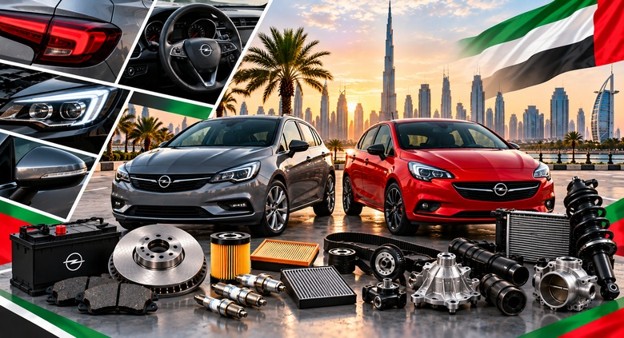
There is a tendency in parts advice to turn “genuine” into the answer to everything.
Real ownership is more complicated.
A genuine brake component may be appropriate when specification and warranty matter most.
A quality aftermarket filter may be perfectly sensible for routine maintenance.
A used genuine body panel may be preferable to a poor-quality reproduction because the used original can offer better fitment.
A tested used electronic module may be economically attractive if its part number and programming requirements are properly established.
The sensible decision depends on the component, vehicle age, repair consequences and evidence available.
An aftermarket part isn't automatically inferior either
The manufacturer's reputation matters.
So does the actual specification.
A reputable aftermarket supplier may manufacture components for many vehicle applications and provide OE cross-reference information. That can be a legitimate alternative to a dealer-supplied part.
But “aftermarket” is an enormous category.
There is a world of difference between a known manufacturer with traceable part numbers and an anonymous component sold through a vague listing with no application data.
Price alone cannot tell you which one you're looking at.
For older Astras and Corsas, condition can matter more than age
A ten-year-old genuine component isn't automatically better than a new aftermarket component.
But neither is a new component automatically better simply because it is new.
For used parts, condition and history matter.
For new parts, manufacturer quality, correct specification and warranty matter.
For an older Astra G or Corsa C, the availability of good used genuine components can sometimes make repairs practical where a dealer-only route would be disproportionately expensive.
That's a case for evidence-based comparison, not a blanket preference for one category.
Keep the old part until the repair is confirmed
This is a surprisingly useful habit.
Don't throw the old component away immediately.
Keep it until:
- the new part has been checked
- the replacement has been installed
- the vehicle operates correctly
- no return is required
- the old part number has been recorded
For an online purchase, the old component can also provide a useful physical reference if something doesn't match.
Keep a parts record for the car
Once you've found the correct component, save:
- VIN
- engine code
- gearbox code
- model year
- old OE numbers
- replacement part numbers
- brand
- date fitted
- mileage
- supplier
- warranty period
Do this once and future searches become much easier.
The next time the Astra needs brake pads, you won't be starting from a blank search box.
Fitment problems are often created before the mechanic sees the part
A workshop can only fit what has been ordered.
If the wrong brake disc arrives, the mechanic doesn't magically make it correct.
If the wrong sensor arrives, the installation may be delayed.
If a body panel doesn't line up, labour can increase while everyone tries to understand why.
That is why the best spare-parts process starts before checkout, not at the workshop ramp.
The Opel UAE manuals are worth keeping bookmarked
Opel UAE provides manuals for various Astra and Corsa model years, including Astra K MY17/MY18 and Corsa MY17/MY17.5/MY18.
The manuals aren't replacement-part catalogues, but they can help establish vehicle-specific information, maintenance procedures and component terminology.
That can make your conversation with a supplier much more precise.
When in doubt, ask for the OE number before asking for a discount
This is probably the most useful practical rule in the whole article.
If the seller says:
“Yes, it fits.”
Ask:
“Please send me the OE/manufacturer part number and confirm it against my VIN.”
That small change turns a vague sales conversation into a traceable fitment check.
If they cannot provide any meaningful identification for a supposedly vehicle-specific component, slow down.
Astra and Corsa ownership becomes easier when you separate maintenance from diagnosis
Filters, wiper blades, routine fluids and some straightforward wear parts can often be purchased predictably.
A warning light, overheating condition, gearbox fault or unusual vibration is different.
Those require diagnosis first.
Don't use a spare-parts catalogue as a diagnostic tool.
A catalogue tells you what can be purchased.
It doesn't tell you what has actually failed.
The real goal is not finding the cheapest Opel part
It is finding the correct component at a sensible total cost with enough evidence that you can trust the purchase.
For an Astra or Corsa in the UAE, that usually means starting with the VIN and exact vehicle specification, identifying the OE number, checking reputable alternatives, comparing warranty and availability, and only then looking closely at price.
Opel's own UAE parts guidance repeatedly stresses vehicle-specific fitment, while its VIN and model-year resources provide the tools for narrowing down the correct specification.
That is the difference between shopping for an Opel part and buying the right part for your Opel.
FAQs
Categories
- Audi
- BMW
- Car Accessories
- Car Tips
- Ford
- Land Rover
- Mazda
- Range Rover
- Top 10
- UAE Car Parts
- Used Car Parts
- Toyota
- Replacement Engines
- Nissan
- Hyundai
- Mitsubishi
- Volkswagen
- Honda
- Kia
- Chevrolet
- Dodge
- Jeep
- Subaru
- Renault
- Lexus
- Mercedes
- Suzuki
- Hummer
- Porsche
- Infiniti
- Peugeot
- GMC
- Mini
- Volvo
- Replacement Gearboxes
- MG
- Jaguar
- Skoda
- Cadillac
- Daihatsu
- Fiat
- German Car Parts
- Japanese Car Parts
- Aftermarket Car Parts
- Genuine Car Parts
- New Car Parts
- Reconditioned Car Parts
- European Car Parts
- American Car Parts
- Korean Car Parts
- British Car Parts
- Chinese Car Parts
- Sports/Exotic Car Parts
- Luxury Car Parts
- Performance Car Parts
- SUV/4x4 Spare Parts
- Truck Spare Parts
- EV Car Parts
- Hybrid Car Parts
- Auto Spare Parts in UAE
- Tesla
- Isuzu
- Ram
- Ferrari
- Bentley
- Lamborghini
- Genesis
- Maserati
- Lincoln
- Chrysler
- Opel