Performance Car Parts vs Standard Replacement Parts in UAE: What's the Difference?
July 31, 2026
Understanding Performance and Standard Car Parts – Which One Is Right for Your Vehicle?
Quick Summary
| Topic | Key Insight |
| Performance Car Parts | Designed to improve power, handling, braking or overall driving dynamics. |
| Standard Replacement Parts | Built to restore the vehicle to its original factory condition. |
| Key Differences | Performance focuses on enhancement, while standard parts focus on replacement and reliability. |
| Who Should Upgrade? | It depends on driving style, vehicle use and ownership goals. |
| UAE Driving Conditions | Heat, highways and daily commuting influence the right choice. |
| Smart Buying Rule | Buy according to your needs—not simply because a part promises more performance. |
Walk into any automotive parts shop or browse an online marketplace, and you'll quickly notice two very different categories of replacement components.
One promises better performance.
The other promises factory reliability.
For many drivers, the difference seems obvious.
Performance parts make a car faster.
Standard parts simply replace worn-out components.
The reality is far more interesting.
Not every performance part increases horsepower.
Not every standard replacement part limits your vehicle's potential.
In fact...
Many luxury cars, sports saloons and performance SUVs already leave the factory with exceptionally capable components.
Upgrading without understanding your vehicle's needs can sometimes waste money.
Occasionally...
It can even reduce comfort, reliability or everyday usability.
Choosing between performance and standard replacement parts isn't about following trends.
It's about making the right decision for the way you actually drive.
Especially in the UAE, where extreme summer temperatures, long motorway journeys, urban congestion and occasional desert driving place unique demands on every vehicle.
Understanding these differences before spending money is the smartest upgrade you can make.
What Are Performance Car Parts?
Performance car parts are components designed to improve one or more aspects of a vehicle beyond its original factory specification.
That improvement may involve:
- Increased engine power.
- Faster acceleration.
- Sharper steering response.
- Improved braking performance.
- Better suspension control.
- Reduced vehicle weight.
- Enhanced cooling efficiency.
Performance upgrades range from relatively simple modifications to comprehensive vehicle transformations.
Common examples include:
- High-performance brake discs and pads.
- Sports suspension systems.
- Cold air intake systems.
- Performance exhaust systems.
- Uprated intercoolers.
- Lightweight alloy wheels.
- Adjustable coilover suspension.
- Performance clutches.
Each serves a different purpose.
Some focus on outright speed.
Others improve confidence behind the wheel.
Many simply make the vehicle more enjoyable to drive.
The important point is this.
Performance parts are designed to enhance.
Not merely replace.
What Are Standard Replacement Parts?
Standard replacement parts perform a different role.
Their objective is straightforward.
Restore the vehicle to the condition intended by the manufacturer.
Nothing more.
Nothing less.
When a brake disc wears out.
When a suspension arm develops excessive play.
When a radiator begins leaking.
Standard replacement parts restore normal operation.
These components generally match the original specifications for:
- Dimensions.
- Materials.
- Performance.
- Safety.
- Reliability.
- Compatibility.
Drivers who prioritise dependable everyday transport often choose standard replacement parts because they preserve the vehicle's original driving characteristics.
In many situations...
That's exactly the right decision.
Factory engineering exists for a reason.
Manufacturers invest thousands of hours testing vehicles under countless operating conditions before approving production components.
Performance Parts vs Standard Parts: The Fundamental Differences
The biggest misunderstanding is believing one category is automatically better.
It isn't.
They're designed for different objectives.
Performance components aim to improve specific characteristics.
Standard parts aim to maintain balance.
Consider brake systems.
A performance brake package may tolerate repeated heavy braking more effectively during enthusiastic driving.
A standard brake system, meanwhile, often delivers quieter operation, lower dust levels and excellent everyday comfort.
Neither is inherently superior.
The better choice depends entirely on how the vehicle is used.
The same principle applies to:
- Suspension.
- Air filters.
- Exhaust systems.
- Clutches.
- Cooling systems.
- Wheels.
Every modification involves trade-offs.
Understanding those trade-offs leads to better buying decisions.
Who Should Consider Performance Upgrades?
Performance upgrades aren't reserved exclusively for racing enthusiasts.
Many ordinary drivers benefit from carefully selected improvements.
For example:
A driver covering long motorway distances may appreciate upgraded braking performance.
Someone regularly towing heavy loads could benefit from enhanced cooling.
Owners who enjoy spirited weekend drives might value sharper suspension and improved steering response.
Performance upgrades often suit:
- Driving enthusiasts.
- Track-day participants.
- High-performance vehicle owners.
- Drivers seeking improved handling.
- Owners planning long-term vehicle ownership.
However...
Installing performance parts purely because they're advertised as "better" rarely produces satisfying results.
Every upgrade should solve a genuine need.
Not create one.
Which Vehicles Benefit Most from Performance Parts in the UAE?
Driving conditions across the Emirates differ considerably from many other markets.
Vehicles frequently experience:
- High ambient temperatures.
- Heavy stop-start traffic.
- Extended motorway journeys.
- Mountain roads.
- Occasional desert excursions.
Some vehicles naturally benefit more from selected performance upgrades.
Examples include:
- Sports cars driven enthusiastically.
- High-powered saloons.
- Performance SUVs.
- Vehicles used for towing.
- Cars operating under consistently demanding conditions.
By contrast...
A family SUV used mainly for school runs and city commuting may gain little practical advantage from expensive performance modifications.
Choosing upgrades based on actual use always delivers better value than choosing them for appearance alone.
Key Takeaways: Choosing Between Performance and Standard Parts
The decision shouldn't begin with the catalogue.
It should begin with your driving habits.
Ask yourself:
- How do I use my vehicle?
- What problem am I trying to solve?
- Is improved performance genuinely necessary?
- Will the upgrade affect comfort or reliability?
- Is this investment worthwhile over long-term ownership?
Honest answers make buying decisions much easier.
Because the best component isn't always the most expensive.
Or the most powerful.
It's the one that best matches the vehicle's purpose.
Workshop Story
A BMW M340i owner from Dubai visited an independent workshop convinced he needed a complete performance brake upgrade.
He'd read glowing reviews online.
The larger brake kit certainly looked impressive.
Before ordering anything, the technician asked a simple question.
"How do you use the car?"
The owner smiled.
"Mostly commuting to work and the occasional motorway trip to Abu Dhabi."
After inspecting the existing braking system, the technician recommended high-quality standard replacement discs paired with premium performance brake pads instead of a full racing brake conversion.
The result?
Excellent braking performance.
Lower cost.
No increase in brake noise.
No unnecessary compromises in everyday comfort.
The owner later admitted,
"I nearly spent twice as much on something I didn't actually need."
Sometimes...
The smartest upgrade isn't the biggest one.
It's the most appropriate one.
Comparison Table
| Feature | Performance Car Parts | Standard Replacement Parts |
| Primary Purpose | Improve performance | Restore factory condition |
| Driving Experience | Sharper and more engaging | Balanced and predictable |
| Comfort | May vary depending on setup | Closely matches original vehicle characteristics |
| Installation Complexity | Often requires specialist knowledge | Usually straightforward replacement |
| Daily Driving | Depends on the modification | Excellent for everyday use |
| Best For | Enthusiasts and specialised applications | Most daily drivers and long-term reliability |
Buyer Decision Matrix
| Your Situation | Recommended Choice |
| Daily commuting | Standard replacement parts |
| Weekend spirited driving | Selected performance upgrades |
| Track-day vehicle | Performance components |
| Family SUV | Standard parts with targeted upgrades where beneficial |
| Long-term ownership | Choose upgrades only when they provide measurable value |
| Unsure which option to choose | Seek professional advice before purchasing |
Suggested Visual Callout
"Choose the Right Path for Your Vehicle"
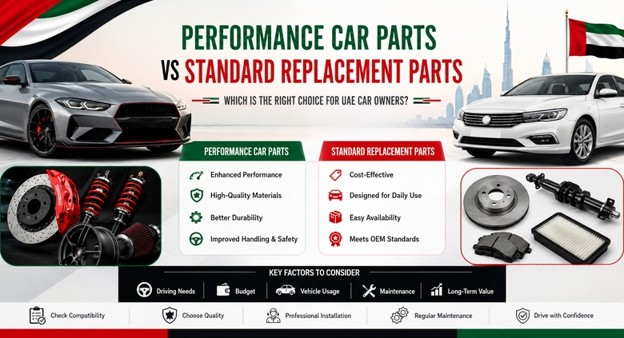
Create a clean infographic split into two sides.
One side shows a factory-standard vehicle with icons representing reliability, comfort, durability and daily driving.
The opposite side shows a performance-focused vehicle with icons representing power, handling, braking and driving enjoyment.
Use minimal text and premium automotive illustrations with subtle UAE-inspired red, green, white and black accents.
Smart Buyer's Checklist
Before choosing between performance and standard replacement parts:
- Identify your driving priorities.
- Confirm the vehicle's actual requirements.
- Verify compatibility using the VIN.
- Consider long-term maintenance costs.
- Think about comfort as well as performance.
- Buy from experienced suppliers.
- Use professional installation whenever modifications are involved.
- Avoid upgrades that don't solve a genuine problem.
The best automotive decisions are informed decisions.
Not impulsive ones.
Key Takeaways
Performance car parts and standard replacement parts are designed with different objectives in mind. Performance components aim to improve handling, braking, power or responsiveness, while standard replacement parts restore the vehicle to its original factory specification with an emphasis on reliability, comfort and balanced everyday driving.
Neither option is universally better. The right choice depends on how the vehicle is used, the driver's expectations and the conditions it faces across the UAE. Understanding these differences before making a purchase helps avoid unnecessary spending and ensures every upgrade delivers genuine value.
Engineering, Design and Build Quality – What Really Separates Performance Parts from Standard Replacement Parts?
Quick Summary
| Topic | Key Insight |
| Materials | Performance parts often use stronger, lighter and more heat-resistant materials. |
| Engineering | Designed for higher loads, greater precision and demanding driving conditions. |
| Manufacturing | Premium performance brands typically use tighter quality control and machining tolerances. |
| UAE Climate | Heat resistance plays a major role in long-term reliability. |
| Weight Reduction | Lighter components can improve handling, braking and efficiency. |
| Durability | Longevity depends on design, quality and intended use—not simply whether a part is labelled "performance". |
Two brake discs.
They look almost identical.
Both fit the same vehicle.
Both bolt onto the same hub.
Yet one costs nearly twice as much.
Why?
Because what you can't see often matters far more than what you can.
The metal composition.
The manufacturing process.
Heat treatment.
Balancing.
Machining accuracy.
Surface finishing.
Every one of these details influences how a component performs over thousands of kilometres.
Performance car parts aren't expensive simply because manufacturers add a sporting badge.
Their engineering is often fundamentally different.
At the same time...
Standard replacement parts shouldn't be underestimated.
Modern factory components are built to exceptionally high standards.
After all...
Manufacturers expect them to cope with years of commuting, traffic, changing weather and countless road conditions.
Understanding the engineering behind both options makes it much easier to spend your money wisely.
Materials Used in Performance Car Parts vs Standard Parts
Material selection is one of the biggest differences between the two categories.
Standard replacement parts are designed to balance:
- Reliability.
- Manufacturing cost.
- Comfort.
- Noise reduction.
- Long service life.
Performance parts focus more heavily on mechanical capability.
Depending on the application, manufacturers may use:
- Forged aluminium.
- High-carbon steel.
- Stainless steel.
- Titanium.
- Carbon fibre composites.
- Aerospace-grade alloys.
- High-temperature ceramic materials.
Take suspension components as an example.
A forged aluminium control arm often weighs considerably less than a conventional cast equivalent.
Reducing weight allows the suspension to react more quickly.
That improves steering response and road control.
Material choice directly affects how a vehicle feels.
Not just how it looks.
Manufacturing Standards and Engineering Differences
Manufacturing quality extends well beyond the raw materials.
The production process itself plays an enormous role.
Premium performance manufacturers often invest heavily in:
- CNC precision machining.
- Laser measurement.
- Dynamic balancing.
- Heat treatment.
- Pressure testing.
- Quality inspection.
Every stage aims to produce greater consistency.
Meanwhile...
Most standard replacement parts follow manufacturing methods designed to replicate original factory specifications.
That isn't a weakness.
It's their purpose.
Factory replacement components prioritise predictable performance across millions of vehicles.
Performance manufacturers often concentrate on extracting every possible improvement from a smaller production volume.
Different objectives.
Different engineering philosophy.
Strength, Precision and Tolerances Compared
Engineers frequently discuss tolerances.
Most drivers never hear the term.
Yet it matters enormously.
Tolerance describes the acceptable variation during manufacturing.
Smaller tolerances generally mean:
- Better fitment.
- Reduced vibration.
- More consistent operation.
- Improved balancing.
- Greater mechanical efficiency.
Performance components often use tighter machining tolerances because they're expected to operate under greater mechanical stress.
Think about a lightweight flywheel.
Even a tiny imbalance can create noticeable vibration at high engine speeds.
Precision manufacturing reduces those risks.
It's engineering measured in fractions of millimetres.
Yet those tiny differences produce very noticeable driving characteristics.
Heat Resistance Under UAE Driving Conditions
Few places challenge vehicles quite like the UAE.
Summer temperatures can push cooling systems to their limits.
Traffic keeps engines running hotter for longer.
Repeated motorway journeys generate continuous mechanical stress.
Brake temperatures climb rapidly.
Turbochargers operate under intense heat.
Performance components frequently incorporate materials specifically selected for thermal stability.
Examples include:
- High-carbon brake discs.
- Performance brake pads.
- Silicone cooling hoses.
- Aluminium radiators.
- Heat-resistant seals.
- Stainless steel exhaust systems.
Heat doesn't simply reduce performance.
It accelerates wear.
Choosing components designed for demanding temperatures often improves long-term reliability.
Particularly in Gulf conditions.
Weight Reduction and Performance Benefits
One phrase appears repeatedly when discussing performance upgrades.
Unsprung weight.
It refers to the parts not supported by the suspension.
Including:
- Wheels.
- Brake assemblies.
- Tyres.
- Hub components.
Reducing unsprung weight allows the suspension to respond more efficiently to uneven road surfaces.
The result may include:
- Better steering feel.
- Improved braking.
- Sharper cornering.
- Increased ride stability.
Weight reduction also benefits rotating components.
Lightweight alloy wheels require less energy to accelerate.
Lighter flywheels allow engines to rev more freely.
These improvements aren't always dramatic.
But together...
They transform the driving experience.
Do Performance Parts Last Longer Than Standard Parts?
This is one of the most common questions workshops receive.
The honest answer?
Sometimes.
Sometimes not.
Durability depends on several factors:
- Component quality.
- Installation.
- Driving style.
- Maintenance.
- Environmental conditions.
A premium performance brake disc may outlast a standard replacement during demanding driving.
However...
A track-focused brake pad may wear more quickly during everyday commuting because it was designed for entirely different operating temperatures.
Likewise...
A standard suspension bush may survive longer than a stiffer polyurethane version on rough city roads.
Longevity isn't determined by marketing.
It's determined by engineering matched to real-world use.
The Hidden Cost of Poor Engineering
Poor-quality components often appear attractive initially.
The purchase price is lower.
The photographs look convincing.
Specifications sound impressive.
Unfortunately...
Inferior engineering usually reveals itself later.
Common problems include:
- Premature wear.
- Excessive vibration.
- Poor fitment.
- Corrosion.
- Cracking.
- Heat distortion.
- Increased noise.
Replacing the same part twice rarely saves money.
Buying quality once usually does.
Why Factory Engineers Don't Always Maximise Performance
Many enthusiasts ask an interesting question.
"If performance parts are better, why doesn't every manufacturer install them at the factory?"
Because vehicle engineering involves compromise.
Manufacturers balance:
- Cost.
- Comfort.
- Fuel economy.
- Emissions.
- Reliability.
- Noise.
- Maintenance.
- Global climate conditions.
A sports-focused brake pad may deliver incredible stopping power.
It may also produce more brake dust.
Greater noise.
And faster wear.
Factory engineers must satisfy millions of different drivers.
Performance manufacturers often target one specific objective instead.
Workshop Story
An Audi S5 owner from Sharjah decided to replace the factory brake discs after noticing vibration during heavy braking.
He discovered two visually similar options online.
One was significantly cheaper.
Both claimed impressive performance.
Unsure which to choose, he visited a specialist workshop.
The technician compared the two components.
The premium discs used high-carbon steel, precision balancing and improved ventilation channels.
The cheaper version relied on conventional casting with basic machining.
The owner selected the higher-quality discs.
Months later...
Repeated motorway journeys and demanding summer temperatures failed to produce the brake judder he'd previously experienced.
He smiled during a routine inspection.
"I finally understand where the extra money went."
Sometimes...
Engineering is invisible until the day you need it.
Engineering Comparison Table
| Feature | Performance Car Parts | Standard Replacement Parts |
| Materials | Lightweight, high-strength and heat-resistant | Designed to match factory specifications |
| Manufacturing | Precision-focused production | Consistent mass-production standards |
| Weight | Often reduced for improved dynamics | Optimised for everyday reliability |
| Heat Management | Enhanced for demanding conditions | Suitable for normal road use |
| Precision | Tighter machining tolerances | Factory-equivalent tolerances |
| Best Application | Enthusiast driving and higher performance demands | Daily driving and dependable long-term ownership |
Buyer Decision Matrix
| Your Priority | Recommended Choice |
| Factory reliability | Standard replacement parts |
| Improved handling | Performance suspension components |
| Heavy motorway driving | Enhanced cooling and braking upgrades |
| Spirited weekend driving | Carefully selected performance parts |
| Everyday commuting | Standard components with targeted upgrades where appropriate |
| Maximum engineering quality | Buy from reputable manufacturers regardless of category |
Suggested Visual Callout
"Inside the Engineering"
Create a split infographic comparing two identical-looking brake discs.
One side reveals the internal engineering of a premium performance disc with improved ventilation, high-carbon material and precision machining.
The opposite side shows a factory-standard replacement disc designed for balanced everyday use.
Use clean cutaway illustrations with minimal text and subtle UAE-inspired red, green, white and black accents.
Smart Buyer's Checklist
Before purchasing any replacement component:
- Compare materials, not just appearance.
- Ask how the part is manufactured.
- Consider UAE operating temperatures.
- Verify compatibility with your vehicle.
- Buy from trusted suppliers.
- Think about your driving habits.
- Avoid choosing purely on price.
- Prioritise engineering quality over marketing claims.
The strongest component isn't always the most expensive.
It's the one engineered for the job it actually needs to perform.
Key Takeaways
Performance car parts and standard replacement parts differ in far more than branding or appearance. Materials, manufacturing methods, machining tolerances, heat resistance and engineering priorities all influence how a component performs, particularly in demanding UAE driving conditions.
Neither category is automatically superior. Standard replacement parts excel at restoring factory reliability and balanced everyday performance, while quality performance components are engineered to deliver specific improvements in handling, braking, durability or thermal management. Choosing the right option depends on matching the engineering behind the part to the way your vehicle is actually driven.
Performance, Driving Experience and Vehicle Dynamics – Do Performance Car Parts Really Make a Difference?
Quick Summary
| Topic | Key Insight |
| Acceleration | Performance parts can improve responsiveness, but results depend on the overall setup. |
| Braking | Upgraded braking systems improve stopping consistency and heat management. |
| Suspension | Performance suspension enhances handling but may affect ride comfort. |
| Engine Response | Selected upgrades improve throttle response and driving engagement. |
| Fuel Economy | Some upgrades help efficiency, while others increase fuel consumption. |
| Everyday Driving | The best setup balances performance with comfort and practicality. |
Every driver wants a better driving experience.
But what does that actually mean?
For some...
It means faster acceleration.
For others...
Sharper steering.
Shorter braking distances.
Greater confidence through corners.
Or simply a car that feels more responsive during the daily commute.
Performance car parts promise all these improvements.
Sometimes they deliver exactly that.
Sometimes...
The difference is barely noticeable.
The truth lies somewhere in between.
A single performance component rarely transforms an ordinary vehicle into a racing machine.
However...
A carefully planned combination of quality upgrades can significantly improve the way a vehicle behaves.
The goal isn't always higher speed.
Often...
It's better control.
Better confidence.
And a more enjoyable drive.
Understanding how different components influence vehicle dynamics helps owners invest where improvements genuinely matter.
Acceleration Improvements: Myth or Reality?
One of the biggest misconceptions surrounding performance parts is that every upgrade automatically increases horsepower.
It doesn't.
Acceleration depends on numerous factors working together.
Including:
- Engine output.
- Vehicle weight.
- Gear ratios.
- Tyre grip.
- Transmission efficiency.
- Aerodynamics.
Some performance upgrades improve acceleration directly.
Examples include:
- Performance air intake systems.
- High-flow exhaust systems.
- ECU optimisation.
- Lightweight flywheels.
Others improve how quickly the vehicle responds to throttle inputs rather than increasing outright power.
That distinction is important.
A vehicle that feels more responsive often feels faster, even when peak horsepower changes very little.
Real performance isn't measured only by numbers.
It's measured by how the vehicle behaves on the road.
Braking Performance Compared
Power means very little without control.
This is why experienced workshops often recommend braking upgrades before engine modifications.
Performance braking systems generally provide:
- Greater heat resistance.
- More consistent stopping performance.
- Reduced brake fade.
- Improved pedal feel.
- Better repeated braking capability.
Standard replacement brakes, meanwhile, are engineered to provide:
- Predictable stopping distances.
- Quiet operation.
- Long service life.
- Everyday comfort.
Neither system is universally better.
A commuter travelling through Dubai traffic every day has different braking requirements from someone regularly driving mountain roads towards Jebel Jais.
Choose brakes that match your driving reality.
Not someone else's.
Suspension Handling and Cornering Stability
Suspension influences nearly every aspect of how a vehicle feels.
It affects:
- Steering precision.
- Ride comfort.
- Body roll.
- Cornering confidence.
- Road stability.
Performance suspension components often include:
- Adjustable coilovers.
- Uprated springs.
- Performance dampers.
- Stiffer anti-roll bars.
- Polyurethane bushes.
These upgrades reduce unwanted body movement.
The result is sharper handling.
More direct steering.
Greater driver confidence.
However...
Every improvement comes with potential compromises.
A suspension setup designed for spirited driving may produce a firmer ride on uneven city roads.
Comfort and performance rarely move in exactly the same direction.
Engine Power, Torque and Throttle Response
Many drivers confuse these three characteristics.
They are closely related.
But not identical.
Horsepower determines how much work the engine can perform.
Torque influences pulling power.
Throttle response describes how quickly the engine reacts when the accelerator is pressed.
Performance upgrades often improve responsiveness through:
- Freer-flowing intake systems.
- Performance exhausts.
- ECU calibration.
- Reduced rotating mass.
These changes can make the vehicle feel more eager.
More alive.
Even if peak power increases remain modest.
Smooth, predictable response often contributes more to driving enjoyment than chasing impressive specification sheets.
Fuel Economy: Performance Parts vs Standard Components
Can performance parts improve fuel economy?
Sometimes.
Many owners are surprised by the answer.
Certain upgrades improve engine efficiency by helping it breathe more effectively.
Examples include:
- High-quality air filters.
- Efficient intake systems.
- Carefully calibrated engine software.
However...
Other modifications encourage more enthusiastic driving.
Greater acceleration naturally consumes more fuel.
Ultimately...
Driving style influences fuel consumption far more than most performance components.
A carefully driven performance vehicle may return excellent efficiency.
An aggressively driven standard vehicle may not.
The driver's right foot remains one of the biggest factors.
Daily Driving Comfort vs Sports Performance
Performance isn't always the best choice for everyday use.
Imagine driving through heavy Abu Dhabi traffic with:
- Extremely stiff suspension.
- Aggressive brake pads.
- Loud performance exhaust.
- Heavy racing clutch.
It may sound exciting.
Living with it every day is another matter.
Factory-standard components are designed for balance.
Comfort.
Refinement.
Low noise.
Reliable long-distance travel.
Many owners discover that selective upgrades produce better results than complete conversions.
Improving one area without sacrificing another often creates the most satisfying ownership experience.
How Different Driving Styles Influence the Right Choice
Every vehicle has a purpose.
So does every owner.
Consider these examples.
A family SUV carrying children to school every morning requires very different priorities from a sports coupe used for weekend driving.
Likewise...
A business executive travelling between Dubai and Abu Dhabi values comfort differently from an enthusiast exploring winding mountain roads.
Performance upgrades should support the vehicle's real-world role.
Not simply imitate professional motorsport.
The best modifications solve genuine problems.
They don't create unnecessary compromises.
Why Balance Matters More Than Maximum Performance
Many first-time modifiers concentrate on a single upgrade.
Perhaps a larger exhaust.
Or stiffer suspension.
Without considering how every component works together.
Vehicle engineering is about balance.
Increasing engine output without improving braking may reduce safety.
Lowering suspension excessively may reduce ride quality.
Installing wider tyres may increase steering effort.
Every modification influences something else.
The most successful performance builds are carefully planned.
Not randomly assembled.
Workshop Story
A Volkswagen Golf GTI owner from Dubai wanted his hatchback to feel more exciting without losing its everyday practicality.
His original plan included extremely stiff suspension, oversized alloy wheels and an aggressive exhaust system.
The workshop discussed how he actually used the car.
Daily commuting.
Weekend motorway trips.
Occasional spirited driving.
Instead of recommending every available upgrade, the technician suggested premium performance brake pads, high-quality dampers and lightweight alloy wheels.
The transformation surprised the owner.
The car felt sharper.
More responsive.
Yet it remained comfortable enough for daily driving.
As he collected the vehicle, he laughed.
"It feels faster everywhere, even though we didn't chase huge power."
The technician nodded.
"Real performance isn't about making the biggest changes. It's about making the right ones."
Driving Experience Comparison Table
| Feature | Performance Car Parts | Standard Replacement Parts |
| Acceleration Response | Sharper and more immediate | Factory-balanced response |
| Braking | Improved consistency under demanding use | Excellent everyday performance |
| Handling | Increased cornering precision | Comfortable and predictable |
| Ride Comfort | May become firmer | Optimised for daily driving |
| Fuel Economy | Depends on modification and driving style | Consistent factory efficiency |
| Overall Character | More engaging and dynamic | Balanced and refined |
Buyer Decision Matrix
| Your Driving Style | Recommended Approach |
| Daily commuting | Standard replacement parts with selective upgrades |
| Long motorway journeys | Improve braking and cooling where appropriate |
| Weekend enthusiast driving | Carefully planned performance upgrades |
| Performance-focused vehicle | Balanced modifications across braking, suspension and engine |
| Family vehicle | Prioritise comfort, reliability and safety |
| Unsure where to start | Upgrade braking and tyres before increasing engine power |
Suggested Visual Callout
"How Performance Changes the Drive"
Create a split automotive illustration showing the same vehicle on two different roads.
One side highlights factory-standard driving with icons representing comfort, stability and quiet operation.
The other side illustrates a performance-enhanced version with icons representing sharper handling, stronger braking, quicker throttle response and improved cornering.
Keep the design clean with minimal text and subtle UAE-inspired red, green, white and black accents.
Smart Buyer's Checklist
Before investing in performance upgrades:
- Decide what you want to improve.
- Consider how you actually use the vehicle.
- Upgrade braking before chasing additional power.
- Maintain balance across the entire vehicle.
- Think about long-term comfort.
- Verify compatibility before purchasing.
- Choose reputable brands and experienced installers.
- Avoid modifications that sacrifice reliability unnecessarily.
A faster car isn't always a better car.
A better-balanced car usually is.
Key Takeaways
Performance car parts can significantly improve acceleration, braking, handling and overall driving enjoyment when selected carefully and installed as part of a balanced upgrade strategy. Standard replacement parts remain the best choice for many drivers who prioritise comfort, reliability and predictable everyday performance.
The right decision depends on how the vehicle is actually driven across the UAE. Rather than chasing the largest power gains, successful owners focus on meaningful improvements that complement the vehicle's intended use, creating a driving experience that is both enjoyable and dependable.
Quality, Durability and Reliability – Which Parts Last Longer in UAE Driving Conditions?
Quick Summary
| Topic | Key Insight |
| Long-Term Reliability | Quality depends more on engineering and manufacturing than whether a part is labelled "performance" or "standard". |
| UAE Climate | Extreme heat, dust and traffic accelerate wear on many vehicle components. |
| High-Mileage Ownership | Driving habits and maintenance often determine lifespan more than the part itself. |
| Maintenance | Performance parts may require more frequent inspections depending on the application. |
| Common Failures | Both performance and standard parts can fail when incorrectly installed or poorly maintained. |
| Smart Buying Rule | Buy the component that matches your driving conditions, not just your expectations. |
Every replacement part comes with one important question.
How long will it last?
It's a fair question.
Whether you're replacing brake discs.
Suspension components.
Cooling system parts.
Or an entire exhaust system.
Nobody wants to repeat the same repair a few months later.
Many drivers assume performance parts automatically last longer.
Others believe factory-standard parts are always more reliable.
Neither assumption is completely accurate.
Durability isn't determined by marketing.
It's determined by engineering.
Material quality.
Installation.
Maintenance.
And perhaps most importantly...
How the vehicle is actually driven.
A premium component installed poorly may fail early.
A standard replacement part fitted correctly and maintained properly may provide years of dependable service.
Reliability isn't an accident.
It's the result of many decisions working together.
Which Parts Offer Better Long-Term Reliability?
Reliability depends on purpose.
A standard replacement component is engineered to provide consistent everyday performance across thousands of different driving situations.
Manufacturers prioritise:
- Predictable operation.
- Low maintenance.
- Long service life.
- Driver comfort.
- Factory reliability.
Performance components follow a different philosophy.
They are often engineered to withstand:
- Higher temperatures.
- Increased loads.
- More aggressive driving.
- Faster response.
- Greater mechanical stress.
Neither design approach is inherently superior.
The better choice depends entirely on the demands placed upon the vehicle.
For example...
A high-performance brake disc may significantly outperform a standard equivalent during repeated hard braking.
Yet that same disc may offer little additional benefit to a driver who spends most of the week commuting through city traffic.
Choosing the correct part begins with understanding how the vehicle is actually used.
Performance Parts in UAE Heat and Harsh Climate
Few environments test automotive components as thoroughly as the UAE.
Summer temperatures regularly exceed 45°C.
Road surfaces become extremely hot.
Traffic congestion keeps engines operating under continuous thermal load.
Dust enters cooling systems and air filters.
Air-conditioning systems work almost constantly.
These conditions accelerate wear on:
- Brake components.
- Rubber bushes.
- Cooling hoses.
- Engine mounts.
- Batteries.
- Tyres.
- Suspension components.
High-quality performance parts frequently use materials designed to tolerate elevated operating temperatures.
Examples include:
- Stainless steel exhaust systems.
- Silicone coolant hoses.
- High-temperature brake compounds.
- Aluminium radiators.
- Performance intercoolers.
However...
Even the best component cannot overcome neglected maintenance.
Heat increases stress.
Maintenance reduces it.
Wear and Tear Comparison Over High Mileage
Every vehicle changes with mileage.
Components gradually experience:
- Friction.
- Fatigue.
- Corrosion.
- Thermal expansion.
- Vibration.
- Environmental exposure.
Performance parts often handle demanding use exceptionally well.
But some may wear faster because they prioritise maximum performance over extended service intervals.
For example:
A track-oriented brake pad may deliver outstanding stopping power.
It may also require replacement sooner during everyday driving.
Conversely...
Many standard replacement components sacrifice ultimate performance in favour of consistent long-term durability.
This is why mileage alone never tells the whole story.
Usage matters just as much.
Maintenance Requirements for Performance Components
Performance upgrades often reward attentive owners.
They also expect more attention.
Depending on the modification, maintenance may include:
- More frequent inspections.
- Higher-quality lubricants.
- Brake fluid replacement.
- Suspension adjustment.
- Wheel alignment checks.
- Cooling system monitoring.
That doesn't make performance ownership difficult.
It simply means maintenance becomes more proactive.
Drivers who enjoy modifying their vehicles generally accept this responsibility.
Because consistent care preserves consistent performance.
Common Failure Patterns in Both Types of Parts
Every workshop sees familiar patterns.
Not because certain parts are inherently poor.
But because common mistakes keep repeating.
Typical causes of premature failure include:
- Incorrect installation.
- Cheap counterfeit components.
- Poor wheel alignment.
- Missed servicing.
- Fluid contamination.
- Ignored warning signs.
- Inferior supporting parts.
Notice something?
Very few failures begin with the words:
"This was a performance part."
Or...
"This was a standard replacement part."
Most failures begin elsewhere.
With maintenance.
Or installation.
Or incorrect diagnosis.
Which Option Provides Better Long-Term Value?
Value is about far more than purchase price.
Imagine two suspension components.
One costs less.
Needs replacing every two years.
The other costs more.
Lasts twice as long.
Which represents better value?
The answer becomes even clearer when labour costs are included.
Removing and replacing the same component repeatedly soon becomes expensive.
Smart buyers calculate:
- Purchase price.
- Installation costs.
- Expected lifespan.
- Maintenance requirements.
- Reliability.
- Downtime.
Long-term ownership is about reducing repeat repairs.
Not simply reducing today's invoice.
Why Driving Style Has the Biggest Influence
Two identical vehicles.
Same model.
Same engine.
Same replacement parts.
Completely different lifespans.
Why?
Because drivers are different.
Aggressive acceleration.
Heavy braking.
Poor road surfaces.
Overloaded vehicles.
Ignoring warning lights.
All increase mechanical stress.
Meanwhile...
Smooth driving.
Regular servicing.
Quality fluids.
Routine inspections.
These habits dramatically extend component life.
Driving style influences durability every single day.
Reliability Is a Complete System
Many owners judge one replacement part in isolation.
Experienced technicians rarely do.
Because every vehicle operates as a complete system.
A new performance clutch still depends on:
- Healthy engine mounts.
- Proper gearbox alignment.
- Good hydraulic components.
- Correct flywheel condition.
Likewise...
Premium suspension components cannot compensate for worn tyres or damaged steering parts.
The strongest repair is always a complete repair.
Not simply the replacement of the obvious fault.
Workshop Story
A Lexus IS F owner from Abu Dhabi installed an expensive set of performance suspension components after reading several enthusiastic online reviews.
Initially...
The handling felt exceptional.
Six months later, unusual tyre wear began appearing.
The owner assumed the suspension had failed.
A specialist workshop inspected the vehicle.
The suspension remained in excellent condition.
The real problem?
Wheel alignment had never been performed after installation.
Following a complete alignment and suspension calibration, tyre wear returned to normal and the handling improved even further.
The owner smiled.
"The suspension wasn't the issue after all."
The technician replied,
"Good parts still depend on good maintenance."
It's a lesson every experienced workshop learns repeatedly.
Durability Comparison Table
| Feature | Performance Car Parts | Standard Replacement Parts |
| Heat Resistance | Often enhanced for demanding conditions | Designed for normal operating temperatures |
| Long-Term Reliability | Excellent when matched to the correct application | Excellent for everyday driving |
| Maintenance | May require more frequent inspections | Usually follows factory service intervals |
| High-Mileage Driving | Depends on driving style and maintenance | Consistent long-term performance |
| Daily Comfort | Varies by component | Closely matches factory refinement |
| Overall Value | High when performance benefits are fully utilised | Outstanding for dependable everyday ownership |
Buyer Decision Matrix
| Your Situation | Recommended Choice |
| High-mileage commuter | High-quality standard replacement parts |
| Enthusiast driver | Premium performance components with regular maintenance |
| Mixed daily and weekend driving | Selective performance upgrades |
| UAE summer driving | Prioritise heat-resistant, high-quality components |
| Long-term ownership | Invest in durable parts from trusted manufacturers |
| Limited maintenance budget | Standard replacement parts with factory service intervals |
Suggested Visual Callout
"Built to Last"
Create a clean split infographic showing two identical vehicles driving through UAE conditions.
One side highlights factory-standard components with icons representing reliability, comfort and long service life.
The other side illustrates performance components with icons representing heat resistance, durability, stronger braking and enhanced handling.
Keep the design highly visual with minimal wording and subtle UAE-inspired red, green, white and black accents.
Smart Buyer's Checklist
Before choosing between performance and standard replacement parts:
- Consider the UAE climate.
- Match the component to your driving style.
- Choose reputable manufacturers.
- Avoid counterfeit products.
- Replace worn supporting components.
- Schedule regular inspections.
- Never ignore unusual noises or warning lights.
- Think about lifetime ownership costs rather than purchase price alone.
The longest-lasting part isn't always the strongest.
It's the one that's correctly engineered, properly installed and consistently maintained.
Key Takeaways
Performance and standard replacement parts can both deliver excellent durability when matched to the correct application. Engineering quality, installation standards, maintenance practices and driving habits all have a far greater influence on reliability than the label printed on the box.
For drivers across the UAE, extreme temperatures, heavy traffic and long-distance motorway travel make quality components and preventative maintenance especially important. Whether you choose performance or standard replacement parts, selecting trusted manufacturers and maintaining the vehicle properly will always produce the best long-term ownership experience.
Tuning Goals and Vehicle Modifications – When Do Performance Car Parts Actually Make Sense?
Quick Summary
| Topic | Key Insight |
| Tuning Goals | Every modification should have a clear purpose rather than being installed for appearance alone. |
| Engine vs Cosmetic Upgrades | Performance improvements should begin with mechanical upgrades before visual modifications. |
| Supporting Modifications | Many upgrades require additional components to operate safely and efficiently. |
| ECU Tuning | Software optimisation should complement mechanical improvements, not replace them. |
| Stage Modifications | Different tuning stages offer different levels of performance, cost and complexity. |
| Smart Buying Rule | Build a balanced vehicle, not simply a more powerful one. |
Performance tuning has changed dramatically over the past decade.
Years ago...
Many enthusiasts believed bigger exhausts and louder engines automatically meant better performance.
Today...
Drivers understand something far more important.
Real performance comes from planning.
Not impulse.
The most successful modified vehicles aren't those with the longest list of upgrades.
They're the ones where every component works together.
A well-balanced car often feels quicker, safer and more enjoyable than one fitted with expensive parts chosen at random.
Whether you're driving a hot hatchback through Dubai, a performance saloon along Sheikh Zayed Road or a sports coupe on the mountain roads of Ras Al Khaimah, your tuning goals should always determine your buying decisions.
Performance parts are tools.
Choosing the right ones depends entirely on what you're trying to achieve.
Understanding Different Performance Tuning Goals
Before buying any upgrade, ask one simple question.
Why am I modifying this vehicle?
Different owners have different objectives.
Common tuning goals include:
- Faster acceleration.
- Improved handling.
- Better braking performance.
- Enhanced reliability under demanding conditions.
- Reduced vehicle weight.
- Sharper throttle response.
- More engaging driving experience.
Some owners prioritise track performance.
Others simply want a more enjoyable daily drive.
Neither objective is wrong.
The mistake is purchasing parts designed for one purpose while expecting results in another.
Successful tuning always begins with a clear plan.
Engine Upgrades vs Cosmetic Performance Parts
Performance modifications generally fall into two categories.
Mechanical upgrades.
And cosmetic upgrades.
Mechanical upgrades include:
- Performance air intake systems.
- Exhaust systems.
- Turbocharger improvements.
- Intercoolers.
- ECU calibration.
- Performance clutches.
- Cooling system upgrades.
Cosmetic upgrades include:
- Body kits.
- Spoilers.
- Alloy wheels.
- Carbon fibre trim.
- Exterior styling accessories.
There's nothing wrong with cosmetic modifications.
Many owners enjoy personalising their vehicles.
However...
If improved performance is the goal, mechanical upgrades should always take priority.
Appearance may attract attention.
Engineering delivers results.
Supporting Modifications Required for Performance Upgrades
One of the biggest mistakes first-time enthusiasts make is upgrading only one component.
Imagine increasing engine output significantly.
Without improving:
- Braking.
- Cooling.
- Suspension.
- Tyres.
The vehicle may become faster.
But not necessarily better.
Performance modifications often require supporting upgrades.
Examples include:
Engine Power Upgrades
Often require:
- Larger intercoolers.
- Improved cooling.
- Stronger clutches.
- Better engine oil.
- Higher-flow intake systems.
Suspension Upgrades
May also require:
- Wheel alignment.
- Adjustable control arms.
- Uprated anti-roll bars.
- Stronger bushes.
Brake Upgrades
Frequently benefit from:
- High-temperature brake fluid.
- Stainless steel brake lines.
- Performance tyres.
Every upgrade should complement the next.
Vehicle engineering works as a system.
Not as individual parts.
ECU Tuning and Performance Components
Modern vehicles rely heavily on software.
An ECU controls:
- Fuel delivery.
- Ignition timing.
- Turbocharger boost.
- Throttle response.
- Transmission behaviour.
This explains why ECU tuning has become so popular.
However...
Software should enhance mechanical capability.
Not exceed it.
For example...
Increasing turbocharger boost without improving cooling may create excessive engine temperatures.
Likewise...
Programming additional power while retaining worn ignition components rarely produces reliable results.
Professional ECU calibration should always consider the complete vehicle.
Not simply chase the highest dyno figure.
Stage 1, Stage 2 and Stage 3 Modifications Explained
Many enthusiasts hear these terms before understanding what they actually mean.
Although definitions vary slightly between manufacturers, they generally follow this pattern.
Stage 1
Typically includes:
- ECU optimisation.
- Performance air filter.
- Basic intake improvements.
Usually requires minimal mechanical changes.
Suitable for many daily-driven vehicles.
Stage 2
Often adds:
- Performance exhaust.
- Larger intercooler.
- Intake upgrades.
- Supporting hardware.
Produces greater gains while requiring additional engineering.
Stage 3
May include:
- Turbocharger replacement.
- Fuel system upgrades.
- Internal engine modifications.
- Transmission improvements.
- Extensive calibration.
Designed for drivers seeking maximum performance.
Requires significant investment and ongoing maintenance.
Choosing the correct stage depends on your expectations.
Not on what someone else has installed.
When Performance Parts Are Not Worth Installing
Performance upgrades aren't always the smartest investment.
Sometimes...
Standard replacement parts remain the better option.
Performance modifications may provide limited value when:
- The vehicle is used solely for short city journeys.
- Comfort is the highest priority.
- Maintenance budgets are limited.
- The car will soon be sold.
- Existing mechanical faults remain unresolved.
Upgrading a poorly maintained vehicle rarely produces satisfying results.
Always repair before modifying.
Strong foundations create better outcomes.
The Importance of Balance
Imagine fitting a powerful turbocharger.
Leaving standard tyres.
Original brakes.
Ageing suspension.
The vehicle accelerates faster.
But stopping distances increase.
Cornering confidence decreases.
Tyre grip becomes the limiting factor.
Performance engineering has always been about balance.
Engineers never focus on one component alone.
Every system influences another.
The most enjoyable vehicles are those where power, braking, handling and reliability improve together.
Common Tuning Mistakes to Avoid
Experienced workshops regularly encounter avoidable mistakes.
Common examples include:
- Buying parts before diagnosing the vehicle.
- Mixing incompatible components.
- Ignoring cooling upgrades.
- Choosing appearance over engineering.
- Installing poor-quality aftermarket products.
- Skipping professional tuning.
- Forgetting suspension geometry.
Fortunately...
Every one of these mistakes can be avoided through careful planning.
Workshop Story
A Ford Mustang GT owner from Dubai wanted noticeably stronger acceleration.
His shopping list included a larger throttle body, sports exhaust and ECU tuning.
Before ordering the parts, the workshop inspected the vehicle.
The technician discovered ageing tyres and brake pads nearing their service limit.
Instead of installing additional engine upgrades immediately, the workshop recommended new performance tyres, upgraded brake pads and fresh suspension bushes first.
Several weeks later, the owner returned for ECU optimisation.
After driving the completed vehicle, he laughed.
"It feels completely different."
The technician smiled.
"Because we improved the whole package, not just the engine."
That single decision transformed the car into a faster...
Safer...
And more confidence-inspiring machine.
Tuning Comparison Table
| Upgrade Type | Main Purpose | Best For |
| ECU Optimisation | Improve engine response and efficiency | Daily drivers and enthusiasts |
| Intake and Exhaust | Enhance airflow and responsiveness | Balanced performance upgrades |
| Suspension Components | Improve handling and stability | Spirited road driving |
| Brake Upgrades | Increase stopping consistency | High-performance and motorway driving |
| Cooling Improvements | Reduce operating temperatures | UAE climate and modified vehicles |
| Cosmetic Upgrades | Personalise appearance | Owners focused on styling |
Buyer Decision Matrix
| Your Goal | Recommended Approach |
| Better daily driving | Stage 1 upgrades with quality standard components where appropriate |
| Sharper handling | Suspension, tyres and braking improvements first |
| Increased engine performance | Upgrade cooling and braking before adding power |
| Weekend enthusiast driving | Balanced Stage 2 package |
| Maximum performance | Comprehensive Stage 3 build with supporting modifications |
| Long-term reliability | Upgrade only where measurable benefits justify the investment |
Suggested Visual Callout
"Build in the Right Order"
Create a clean vertical workflow using premium automotive illustrations.
Display the following sequence:
Healthy Vehicle → Braking → Suspension → Cooling → Engine Upgrades → ECU Calibration → Professional Testing
Use simple icons with minimal wording.
Maintain a premium appearance with subtle UAE-inspired red, green, white and black accents.
Smart Buyer's Checklist
Before modifying your vehicle:
- Define your tuning goal.
- Repair existing faults first.
- Upgrade braking before chasing additional power.
- Improve cooling where necessary.
- Buy compatible components.
- Choose trusted performance brands.
- Use experienced installers and tuners.
- Build the vehicle as a complete system rather than one upgrade at a time.
The best-performing cars are rarely the ones with the most modifications.
They're the ones with the smartest modifications.
Whether you choose performance car parts or standard replacement parts, always verify compatibility, compare quality, and buy from trusted suppliers. Platforms such as PartFinder UAE allow vehicle owners to compare multiple suppliers, helping them find the right components with greater confidence while making more informed purchasing decisions.
Key Takeaways
Performance tuning should always begin with a clear objective rather than a shopping list. Whether your goal is improved acceleration, sharper handling, stronger braking or better reliability under demanding UAE conditions, every upgrade should complement the vehicle as a whole. Balanced engineering consistently delivers better results than isolated modifications.
Standard replacement parts remain the right choice for many owners, particularly when comfort, reliability and low maintenance are the priority. Performance upgrades become worthwhile when they solve a genuine need, are supported by appropriate complementary modifications and are installed and calibrated professionally.
Fitment, Compatibility and Installation – Why Correct Installation Matters More Than the Part Itself
Quick Summary
| Topic | Key Insight |
| OEM vs Performance Fitment | A quality part is only effective when it fits and functions correctly. |
| VIN Verification | The VIN is the safest way to confirm compatibility before purchasing. |
| Compatibility | Similar-looking parts are not always interchangeable. |
| Professional Installation | Correct installation protects reliability, safety and performance. |
| ECU Calibration | Many modern vehicles require software configuration after installation. |
| Smart Buying Rule | Never buy or install a part until compatibility has been confirmed. |
Buying the right performance part feels like the hard part.
It isn't.
The real challenge often begins after the box is opened.
A perfectly engineered brake kit.
A premium suspension system.
An upgraded intercooler.
Even a genuine replacement turbocharger.
Every one of these components depends on one simple requirement.
It must fit correctly.
Unfortunately...
Fitment is where many expensive mistakes happen.
Owners assume two identical-looking parts must fit the same vehicle.
They don't.
Manufacturers regularly change:
- Mounting points.
- Sensors.
- Connectors.
- Control modules.
- Brake sizes.
- Suspension geometry.
Sometimes within the same production year.
A single compatibility mistake can delay repairs, increase labour costs and leave a vehicle off the road for days.
Successful upgrades begin long before installation.
They begin with verification.
OEM Fitment vs Performance Aftermarket Fitment
Factory replacement parts are generally designed to replicate the original component.
That means:
- Matching dimensions.
- Original mounting points.
- Factory clearances.
- Standard connectors.
- Manufacturer specifications.
Installation is usually straightforward.
Performance aftermarket components are different.
Many are intentionally engineered to improve performance rather than duplicate the original design.
Examples include:
- Larger brake calipers.
- Wider alloy wheels.
- Adjustable suspension systems.
- Performance exhausts.
- Oversized intercoolers.
These upgrades often require additional planning.
Some may need:
- Mounting brackets.
- Modified pipework.
- Wheel spacers.
- Alignment adjustments.
- ECU calibration.
Better performance sometimes demands greater installation expertise.
Why VIN Verification Still Matters
One of the most valuable numbers on any vehicle isn't displayed on the dashboard.
It's the Vehicle Identification Number.
The VIN reveals critical information including:
- Production year.
- Engine specification.
- Transmission type.
- Factory options.
- Manufacturing plant.
- Original equipment configuration.
Many luxury and performance vehicles receive updates during production.
Two cars built only weeks apart may use different components.
Ordering by model name alone creates unnecessary risk.
Professional suppliers nearly always request the VIN before confirming major components.
That's not bureaucracy.
It's protection.
Compatibility Issues Buyers Often Ignore
Compatibility involves much more than physical fitment.
A replacement part must also communicate correctly with the vehicle.
Modern cars rely on:
- Electronic sensors.
- Control modules.
- CAN bus communication.
- Safety systems.
- Engine management software.
Consider replacing adaptive headlights.
The housing may fit perfectly.
Without correct electronics...
The system may display warning lights.
Or fail completely.
Other commonly overlooked compatibility issues include:
- Brake disc diameter.
- Wheel offset.
- Suspension height.
- Cooling hose routing.
- Sensor connectors.
- Transmission software versions.
Small differences create big consequences.
Professional Installation vs DIY Installation
Many routine maintenance tasks are suitable for experienced enthusiasts.
However...
Performance upgrades often require specialist knowledge.
Professional workshops understand:
- Torque specifications.
- Manufacturer procedures.
- Diagnostic testing.
- Electronic calibration.
- Safety inspections.
- Performance verification.
Incorrect installation can result in:
- Fluid leaks.
- Brake imbalance.
- Suspension noise.
- Excessive tyre wear.
- Warning lights.
- Premature component failure.
A quality installation protects the investment you've already made.
Calibration, ECU Programming and Sensor Adjustments
Replacing a component doesn't always complete the repair.
Increasingly...
Modern vehicles require electronic configuration after installation.
Common examples include:
- Steering angle sensors.
- Adaptive cruise control.
- Air suspension.
- Electronic dampers.
- Gearbox control modules.
- Radar sensors.
- Parking assistance systems.
Without calibration:
The new part may not perform correctly.
Or may not function at all.
Professional diagnostic equipment allows technicians to:
- Register new components.
- Reset adaptations.
- Update software.
- Clear fault codes.
- Verify system operation.
Mechanical installation is only one stage.
Electronic integration is equally important.
Common Installation Mistakes That Reduce Performance
Performance parts don't fail because they're performance parts.
They fail because mistakes happen.
Experienced workshops regularly encounter:
- Incorrect torque settings.
- Reused seals and gaskets.
- Poor electrical connections.
- Missing alignment procedures.
- Incorrect brake bedding.
- Loose suspension fasteners.
- Untested cooling systems.
Many problems appear days or weeks after installation.
Not immediately.
Attention to detail prevents expensive repeat repairs.
Why Supporting Components Matter
Replacing one component while ignoring surrounding wear often limits the benefits.
For example:
Installing performance brake discs while retaining worn brake fluid.
Or fitting upgraded suspension with ageing tyres.
Supporting components commonly inspected include:
- Bushes.
- Bearings.
- Engine mounts.
- Brake fluid.
- Cooling hoses.
- Wheel bearings.
- Alignment settings.
The strongest repair addresses the complete system.
Not just the failed part.
The Cost of Poor Fitment
Imagine purchasing a premium performance exhaust system.
Installation begins.
Halfway through...
The mounting points don't match.
The workshop must now:
- Source additional hardware.
- Modify pipework.
- Delay the repair.
- Increase labour time.
The original saving quickly disappears.
Correct compatibility checks before ordering prevent these situations.
Preparation always costs less than correction.
Workshop Story
A Mercedes-AMG C 43 owner from Dubai ordered performance suspension online after comparing several attractive prices.
The components arrived quickly.
Visually...
Everything appeared correct.
During installation, however, the workshop discovered the dampers had been manufactured for a different electronic suspension configuration.
The mounting points matched.
The electronics didn't.
The technician contacted the supplier, confirmed the VIN and sourced the correct specification.
Following installation and electronic calibration, the suspension operated exactly as intended.
The owner admitted,
"I thought matching the model name was enough."
The technician smiled.
"On modern performance cars, the VIN tells the real story."
Fitment Comparison Table
| Feature | Performance Car Parts | Standard Replacement Parts |
| Physical Fitment | May require additional modifications | Usually matches factory specifications |
| Compatibility Checks | Essential before purchase | Strongly recommended |
| ECU Programming | Frequently required | Required on many modern vehicles |
| Installation Complexity | Higher | Moderate |
| Professional Fitting | Highly recommended | Recommended for major repairs |
| Long-Term Reliability | Excellent when installed correctly | Excellent when fitted to factory standards |
Buyer Decision Matrix
| Your Situation | Recommended Approach |
| Routine maintenance | Standard replacement parts with verified compatibility |
| Brake upgrades | Confirm wheel clearance and brake dimensions |
| Suspension upgrades | Complete wheel alignment after installation |
| Engine performance upgrades | Verify supporting components before tuning |
| Electronic replacement parts | Ensure programming and calibration are included |
| Unsure about compatibility | Always provide the VIN before ordering |
Suggested Visual Callout
"The Perfect Fit"
Create a clean step-by-step infographic showing:
VIN Verification → Part Number Match → Compatibility Check → Professional Installation → ECU Calibration → Final Road Test
Use premium automotive icons with very little text.
Incorporate subtle UAE-inspired red, green, white and black colours while maintaining a modern, technical appearance.
Smart Buyer's Checklist
Before purchasing or installing performance car parts:
- Verify the VIN.
- Match the OEM part number.
- Confirm electronic compatibility.
- Check whether supporting modifications are required.
- Choose experienced installers.
- Request post-installation diagnostics.
- Complete wheel alignment where necessary.
- Perform a final road test before considering the job complete.
A performance upgrade isn't complete when the part is fitted.
It's complete when every mechanical and electronic system works together exactly as intended.
Key Takeaways
Fitment, compatibility and installation are just as important as the quality of the performance part itself. Even the most advanced components cannot deliver their intended benefits if they are incorrectly matched to the vehicle, installed without following manufacturer procedures or left without the necessary electronic calibration.
Modern vehicles, particularly performance models, rely on precise mechanical engineering and sophisticated electronics working together. Verifying the VIN, confirming compatibility, replacing supporting components where required and using experienced installers all help ensure that every upgrade delivers reliable performance, safety and long-term value.
Road Use, UAE Laws and Practical Ownership – Are Performance Car Parts Suitable for Everyday Driving?
Quick Summary
| Topic | Key Insight |
| UAE Road Legality | Not every performance modification is suitable or approved for public roads. |
| Vehicle Inspections | Certain modifications may require additional attention during inspections. |
| Insurance | Some performance upgrades should be disclosed to your insurer. |
| Manufacturer Warranty | Modifications can influence warranty coverage depending on the vehicle and the upgrade. |
| Everyday Driving | The best upgrades improve the driving experience without reducing practicality. |
| Smart Buying Rule | Choose modifications that suit your lifestyle, not just your wishlist. |
Performance cars naturally attract attention.
Powerful engines.
Aggressive styling.
Sharper handling.
Distinctive exhaust notes.
It's easy to understand why so many owners consider upgrading their vehicles.
But before purchasing performance components...
There's another question worth asking.
Can you actually enjoy those upgrades every day on UAE roads?
The answer depends on far more than horsepower.
It involves:
- Local driving conditions.
- Vehicle inspections.
- Insurance requirements.
- Manufacturer warranty.
- Daily usability.
- Long-term ownership costs.
Many successful modifications are almost invisible.
They improve braking.
Cooling.
Handling.
Reliability.
Without making the vehicle less practical.
Others may deliver impressive specifications while becoming frustrating during daily commuting.
Choosing wisely means understanding where performance fits into real life.
Not just marketing brochures.
Are Performance Car Parts Legal on UAE Roads?
Performance parts themselves are not automatically illegal.
However...
The way they are installed and how they affect the vehicle can determine whether they remain suitable for road use.
Some upgrades are generally intended to improve reliability, handling or braking while maintaining safe operation.
Examples include:
- High-quality brake components.
- Improved suspension parts within appropriate specifications.
- Performance air filters.
- Enhanced cooling systems.
- Lightweight alloy wheels of suitable size.
Other modifications may require greater care because they can affect safety, emissions, noise levels or vehicle operation.
Before making significant changes, owners should ensure that any modifications remain appropriate for road use and comply with applicable local requirements.
A responsible performance build always considers safety before appearance.
UAE Vehicle Inspection and Modification Considerations
Every vehicle must remain roadworthy.
Performance upgrades should never compromise that objective.
During inspections, attention is typically given to areas such as:
- Steering.
- Braking.
- Suspension.
- Lighting.
- Tyres.
- Structural condition.
Poorly installed modifications often create more problems than professionally engineered upgrades.
For example:
An incorrectly lowered suspension may affect wheel alignment.
Oversized wheels may influence steering geometry.
Poor-quality lighting upgrades may reduce visibility.
Professional installation helps ensure that upgrades work with the vehicle rather than against it.
Insurance Implications of Performance Upgrades
Many owners focus entirely on choosing the right parts.
Few think about insurance until something unexpected happens.
Performance modifications can influence how insurers assess a vehicle.
Changes that alter performance or vehicle specification may be relevant when arranging or renewing cover.
Examples include:
- Engine performance upgrades.
- Turbocharger modifications.
- Suspension conversions.
- Brake system upgrades.
- Wheel size changes.
Open communication is usually the safest approach.
Providing accurate information helps avoid misunderstandings later.
Insurance is designed to provide peace of mind.
Transparency supports that goal.
Warranty Considerations Before Modifying Your Vehicle
Manufacturer warranties exist to protect owners against qualifying defects under specific conditions.
Modifying a vehicle does not automatically affect every aspect of warranty coverage.
However...
If a modification directly contributes to a failure, warranty decisions relating to that area may become more complex.
This is particularly relevant for:
- Engine tuning.
- Transmission modifications.
- Electronic software changes.
- Cooling system alterations.
Owners of newer vehicles often prefer carefully selected upgrades that complement factory engineering while preserving long-term reliability.
Before modifying a vehicle still covered by warranty, it is sensible to understand how those changes may affect future support.
Daily Commuting vs Weekend Performance Builds
Not every performance car lives on a racetrack.
Most spend their lives in:
- Morning traffic.
- School runs.
- Motorway commuting.
- Business travel.
- Shopping centres.
- Weekend family trips.
That reality changes everything.
A race-inspired suspension setup may feel outstanding on smooth roads.
It may become tiring during daily city driving.
Similarly...
Aggressive brake compounds often require higher operating temperatures before delivering their best performance.
For many owners, carefully selected upgrades provide a better balance than extreme modifications.
Daily comfort remains important.
Even for enthusiastic drivers.
Performance Parts for Desert, Highway and City Driving
Driving conditions across the UAE vary considerably.
Each environment places different demands on a vehicle.
City Driving
Frequent stopping.
Slow-moving traffic.
Constant braking.
Cooling efficiency and brake performance become especially important.
Motorway Driving
Long distances.
Higher cruising speeds.
Continuous engine operation.
Stable suspension, efficient cooling and reliable braking provide noticeable benefits.
Desert and Challenging Terrain
Vehicles operating in demanding environments benefit from:
- Effective cooling systems.
- Durable suspension components.
- Strong filtration.
- Reliable braking.
- Quality tyres.
Choosing upgrades that match actual driving conditions delivers much better value than copying someone else's build.
Practical Ownership Is About Balance
Many first-time enthusiasts believe more modifications automatically create a better vehicle.
Experienced owners often think differently.
They ask questions like:
Will this improve reliability?
Will it remain comfortable?
Will maintenance become more complicated?
Will I still enjoy driving it every day?
The best performance vehicles often feel completely natural.
Nothing seems exaggerated.
Everything works together.
That's the difference between modification and engineering.
Common Mistakes When Modifying Road Cars
Professional workshops regularly see the same avoidable mistakes.
Including:
- Installing incompatible components.
- Lowering suspension excessively.
- Ignoring wheel alignment.
- Choosing appearance over safety.
- Mixing low-quality aftermarket parts with premium upgrades.
- Forgetting about cooling requirements.
- Skipping post-installation inspections.
Every one of these mistakes reduces the enjoyment of ownership.
Careful planning prevents nearly all of them.
Workshop Story
A Toyota GR Supra owner from Dubai wanted a more aggressive appearance and sharper handling.
His original shopping list included very low suspension, oversized wheels and extremely stiff springs.
Before beginning the work, the workshop discussed how he used the vehicle.
The answer was simple.
Daily commuting.
Regular motorway journeys.
Occasional weekend drives.
Instead of creating an extreme setup, the technicians recommended quality performance dampers, moderate suspension improvements and lightweight alloy wheels matched to the vehicle's original geometry.
Several weeks later, the owner returned for routine servicing.
He smiled.
"It feels sportier without feeling uncomfortable."
The workshop manager nodded.
"That's the goal. Performance should improve your driving—not limit it."
Practical Ownership Comparison Table
| Feature | Performance Car Parts | Standard Replacement Parts |
| Daily Driving | Depends on the type of upgrade | Excellent for everyday use |
| Comfort | May change depending on setup | Factory-balanced refinement |
| Insurance Considerations | May require disclosure depending on modifications | Generally unchanged when replacing like-for-like parts |
| Warranty Impact | Depends on the modification and the affected system | Closely aligned with original vehicle specification |
| Maintenance | May require additional inspections | Typically follows factory service schedules |
| Best Application | Drivers seeking targeted improvements | Owners prioritising reliability and simplicity |
Buyer Decision Matrix
| Your Ownership Goal | Recommended Approach |
| Everyday commuting | Standard replacement parts with selective performance upgrades |
| Long motorway travel | Focus on braking, cooling and stability improvements |
| Weekend enthusiast driving | Balanced performance modifications |
| Newer vehicle under warranty | Plan upgrades carefully and understand warranty implications |
| Long-term ownership | Prioritise reliability and engineering quality |
| Unsure where to begin | Improve safety-related components before increasing performance |
Suggested Visual Callout
"Performance for Real Roads"
Create a wide infographic showing one performance vehicle travelling through three UAE environments:
- City streets.
- Open motorway.
- Desert landscape.
Use icons to highlight braking, suspension, cooling, comfort and reliability.
Keep text minimal and use premium illustrations with subtle UAE-inspired red, green, white and black accents.
Smart Buyer's Checklist
Before installing performance car parts for road use:
- Decide how the vehicle is actually used.
- Prioritise safety before appearance.
- Verify compatibility using the VIN.
- Choose quality components from reputable manufacturers.
- Use professional installation.
- Understand how modifications may affect insurance and warranty.
- Complete post-installation inspections.
- Build a balanced vehicle rather than chasing maximum specifications.
Performance is most enjoyable when it fits naturally into everyday ownership.
The smartest upgrades are often the ones you notice every time you drive...
Not every time you park.
Key Takeaways
Performance car parts can significantly improve the driving experience when chosen with clear objectives and installed correctly. For everyday UAE driving, the most successful upgrades are those that enhance braking, handling, cooling and reliability without compromising comfort, practicality or long-term ownership.
Road use suitability is about balance rather than extremes. By understanding how modifications relate to daily driving, inspections, insurance considerations and vehicle warranties, owners can create a performance-focused vehicle that remains enjoyable, dependable and well suited to life across the UAE.
Cost Analysis and Buying Decisions – Are Performance Car Parts Worth the Extra Money?
Quick Summary
| Topic | Key Insight |
| Initial Purchase Cost | Performance parts usually cost more because of engineering, materials and manufacturing quality. |
| Installation Costs | Performance upgrades often require additional labour, calibration and supporting modifications. |
| Maintenance Costs | Some upgrades increase servicing requirements, while others improve long-term durability. |
| Repair Costs | A balanced build usually reduces expensive secondary failures. |
| Resale Value | Well-planned modifications may appeal to enthusiasts, while standard vehicles generally attract a broader market. |
| Smart Buying Rule | Calculate total ownership cost rather than focusing only on the purchase price. |
Price influences every buying decision.
Whether you're replacing brake pads.
Suspension components.
A turbocharger.
Or planning a complete performance build.
The first question is usually the same.
"How much will it cost?"
The better question is slightly different.
"How much will it cost over the next five years?"
There's a huge difference.
The cheapest component today may become the most expensive choice tomorrow.
Repeated repairs.
Additional labour.
Premature wear.
Unexpected downtime.
These hidden costs often outweigh the initial saving.
Performance car parts are frequently more expensive than standard replacement parts.
That doesn't automatically make them better value.
Likewise...
Standard replacement parts aren't automatically the cheapest option over the life of the vehicle.
Understanding the true cost of ownership helps buyers spend wisely rather than simply spending less.
Initial Purchase Cost Comparison
Performance components generally command higher prices for several reasons.
Manufacturers often invest in:
- Premium materials.
- Advanced machining.
- Lightweight construction.
- Heat-resistant coatings.
- Precision balancing.
- Additional research and development.
Standard replacement parts are typically designed to restore original factory performance while remaining cost-effective for everyday ownership.
Consider two brake disc options.
One is a factory-equivalent replacement.
The other uses high-carbon steel with improved cooling channels.
The second may cost more initially.
But under demanding driving conditions, it may also maintain consistent performance for longer.
Purchase price tells only part of the story.
Engineering completes the picture.
Installation Costs and Labour Differences
Many buyers compare component prices.
Few compare installation costs.
That's a mistake.
Performance upgrades frequently involve additional workshop time.
Examples include:
- Suspension alignment.
- Brake bleeding.
- ECU calibration.
- Performance testing.
- Software updates.
- Custom fabrication.
- Cooling system adjustments.
A straightforward factory replacement often requires fewer installation steps.
Before purchasing any upgrade, ask your workshop:
- How long will installation take?
- Are supporting modifications required?
- Will calibration be necessary?
- Are additional parts recommended?
Understanding labour costs beforehand prevents unexpected surprises later.
Long-Term Maintenance Costs
Performance ownership often requires a more proactive maintenance routine.
Depending on the upgrade, this may include:
- More frequent brake inspections.
- Suspension adjustments.
- Performance tyre replacement.
- Cooling system monitoring.
- High-quality lubricants.
- Regular wheel alignment.
That doesn't mean performance parts are unreliable.
It simply means they are often engineered to operate closer to their performance limits.
Meanwhile...
Many standard replacement components follow factory service schedules with fewer additional maintenance requirements.
Choose the ownership experience that matches your expectations.
Repair Costs After Performance Modifications
One poorly planned modification can increase future repair costs.
Imagine increasing engine output significantly while leaving the original cooling system untouched.
The engine works harder.
Operating temperatures rise.
Mechanical stress increases.
Eventually...
A secondary failure appears.
Not because the performance part was poor.
But because supporting systems weren't upgraded.
Balanced engineering reduces these risks.
Professional workshops always consider the entire vehicle rather than focusing on one component in isolation.
Resale Value: Modified vs Standard Vehicles
Resale value depends on the buyer.
Some enthusiasts actively search for professionally modified vehicles.
Others prefer completely standard examples.
Well-documented upgrades using reputable brands may enhance appeal within enthusiast communities.
However...
Poor-quality modifications.
Unknown brands.
Incomplete paperwork.
Or questionable installation quality.
These often reduce buyer confidence.
Keeping invoices, installation records and maintenance history strengthens resale potential regardless of the type of parts installed.
Documentation builds trust.
Which Option Delivers Better Return on Investment?
Return on investment isn't measured solely by resale price.
It also includes:
- Driving enjoyment.
- Reliability.
- Reduced downtime.
- Improved safety.
- Lower repeat repair costs.
- Long-term ownership satisfaction.
For example...
A quality suspension upgrade may improve tyre wear by maintaining better wheel control.
Premium brake components may reduce fade during repeated motorway driving.
Enhanced cooling may protect expensive engine components from excessive heat.
Some benefits never appear on a receipt.
Yet they save substantial money over time.
Hidden Costs Buyers Often Forget
Many ownership costs remain invisible during the purchasing process.
Examples include:
- Wheel alignment.
- Performance tyres.
- Specialist servicing.
- ECU tuning updates.
- Diagnostic inspections.
- Additional insurance considerations.
- Supporting replacement components.
Ignoring these expenses creates unrealistic budgets.
Successful enthusiasts always budget for the complete project.
Not just the visible parts.
Why Cheap Performance Parts Can Become Expensive
A very low price often attracts attention.
Especially online.
Unfortunately...
Poor-quality components frequently create additional costs.
Common consequences include:
- Premature failure.
- Excessive vibration.
- Poor fitment.
- Increased labour.
- Repeat installation.
- Accelerated wear on surrounding components.
Buying the same part twice rarely saves money.
Buying quality once usually does.
Thinking Beyond Today's Invoice
Imagine two suspension kits.
One costs less.
Requires replacement after several years.
The other costs more.
Delivers better durability, stronger handling and reduced maintenance.
Which represents better value?
The answer depends on:
- Annual mileage.
- Driving conditions.
- Ownership period.
- Maintenance habits.
- Personal priorities.
Smart buyers evaluate ownership costs across years rather than weeks.
That's how experienced workshops approach every recommendation.
Workshop Story
A Nissan Z owner from Abu Dhabi planned to upgrade his braking system before several long summer road trips.
He found an inexpensive performance brake kit advertised online.
The price looked excellent.
Before ordering, he visited a specialist workshop.
The technician compared the low-cost kit with a premium alternative.
The premium package included higher-quality discs, superior brake pads and stainless steel brake lines.
More importantly...
It required fewer future replacements under demanding driving conditions.
The owner initially hesitated.
Several months later, after thousands of motorway kilometres, he returned for routine servicing.
Brake wear remained minimal.
Performance stayed consistent.
He smiled.
"I spent more once instead of spending twice later."
The technician replied,
"That's the difference between buying a price and buying value."
Cost Comparison Table
| Cost Factor | Performance Car Parts | Standard Replacement Parts |
| Initial Purchase Price | Usually higher | Generally lower |
| Installation Cost | Often higher due to additional work | Usually straightforward |
| Maintenance | May require more frequent attention | Typically follows factory schedules |
| Long-Term Durability | Excellent when matched to the application | Excellent for everyday use |
| Repeat Repair Risk | Lower when installed as part of a balanced upgrade | Low when maintained correctly |
| Best Value | Enthusiasts seeking measurable improvements | Drivers prioritising dependable daily ownership |
Buyer Decision Matrix
| Your Ownership Goal | Recommended Approach |
| Lowest upfront cost | High-quality standard replacement parts |
| Long-term ownership | Invest in premium components with proven durability |
| Performance driving | Budget for supporting upgrades and maintenance |
| Daily commuting | Focus on reliability and balanced running costs |
| Enthusiast project | Plan the complete build before purchasing individual parts |
| Maximum value | Compare total ownership cost rather than purchase price alone |
Suggested Visual Callout
"The Real Cost of Ownership"
Create a clean horizontal infographic illustrating the complete ownership journey.
Display the following sequence:
Purchase Price → Installation → Maintenance → Reliability → Resale Value
Use premium automotive icons with minimal wording.
Incorporate subtle UAE-inspired red, green, white and black accents while maintaining a modern technical style.
Smart Buyer's Checklist
Before investing in performance car parts:
- Compare engineering rather than price alone.
- Include installation in your budget.
- Ask about future maintenance requirements.
- Upgrade supporting components where necessary.
- Choose reputable manufacturers.
- Keep detailed service records.
- Think about long-term ownership.
- Buy for value rather than the lowest price.
The cheapest purchase isn't always the least expensive decision.
Long-term thinking almost always produces better results.
Key Takeaways
Performance car parts often require a larger initial investment, but that extra cost frequently reflects higher-quality materials, precision engineering and improved performance under demanding conditions. Standard replacement parts remain an excellent choice for owners who prioritise dependable daily driving, predictable maintenance costs and factory-level reliability.
The smartest buying decisions are based on total ownership cost rather than the price printed on the box. By considering installation, maintenance, durability, supporting modifications and future resale value, drivers across the UAE can choose the option that delivers genuine long-term value rather than short-term savings.
Buying Performance Car Parts in the UAE – How to Choose the Right Supplier and Avoid Costly Mistakes
Quick Summary
| Topic | Key Insight |
| Where to Buy | Purchase from reputable suppliers with proven experience and transparent product information. |
| Genuine vs OEM vs Aftermarket | Each option suits different budgets and ownership goals. |
| Trusted Brands | Reputation, engineering quality and warranty matter more than marketing claims. |
| Counterfeit Parts | Cheap imitations often create expensive repairs later. |
| Questions Before Buying | Always verify compatibility, warranty and installation requirements before ordering. |
| Smart Buying Rule | Buy with confidence, not urgency. Research first, purchase second. |
Buying performance car parts has never been easier.
Or more confusing.
A quick online search produces thousands of results.
Premium brands.
Budget alternatives.
Imported products.
Unknown manufacturers.
Every listing promises exceptional performance.
Outstanding durability.
Unbeatable prices.
Unfortunately...
Not every promise survives installation.
Some parts deliver exactly what they advertise.
Others create compatibility problems, premature failures or disappointing performance.
The challenge isn't finding a performance part.
The challenge is finding the right performance part.
That requires more than comparing prices.
It requires understanding suppliers, brands, product quality and the questions experienced buyers always ask before placing an order.
Where Should You Buy Performance Car Parts?
The supplier often matters just as much as the component itself.
An experienced supplier doesn't simply process an order.
They help confirm:
- Vehicle compatibility.
- Correct specifications.
- Supporting components.
- Warranty information.
- Availability.
- Technical guidance.
When evaluating a supplier, look for:
- Clear product descriptions.
- Accurate compatibility information.
- Professional customer support.
- Transparent warranty policies.
- Experience with performance vehicles.
A knowledgeable supplier reduces the likelihood of ordering the wrong part.
That alone can save considerable time and expense.
Genuine, OEM and Aftermarket Performance Parts
Many buyers confuse these categories.
Understanding the differences makes purchasing decisions much easier.
Genuine Performance Parts
These are supplied through the vehicle manufacturer or approved performance divisions.
Advantages include:
- Factory compatibility.
- Consistent quality.
- Excellent fitment.
- Manufacturer-backed engineering.
They are often the most expensive option.
OEM Performance Parts
OEM manufacturers frequently produce components to original factory standards.
In many cases...
The engineering closely matches factory specifications.
They often provide an excellent balance between quality and value.
Aftermarket Performance Parts
Independent manufacturers develop products with varying objectives.
Some focus on:
- Increased performance.
- Reduced weight.
- Improved durability.
- Better thermal management.
High-quality aftermarket brands produce exceptional products.
However...
Quality varies significantly between manufacturers.
Research is essential.
Choosing Trusted Performance Brands
Well-established manufacturers earn their reputation over many years.
Not through advertising alone.
When comparing brands, consider:
- Engineering history.
- Independent testing.
- Manufacturing standards.
- Warranty support.
- Product consistency.
- Workshop recommendations.
Experienced technicians often recommend brands they've seen perform reliably over thousands of kilometres rather than those with the most aggressive marketing campaigns.
Real-world reliability always speaks louder than promotional claims.
How to Spot Counterfeit Performance Parts
Counterfeit automotive parts remain a significant challenge across global markets.
They often imitate:
- Packaging.
- Branding.
- Product labels.
- Serial numbers.
Unfortunately...
The engineering rarely matches the appearance.
Warning signs may include:
- Prices that seem unrealistically low.
- Poor packaging quality.
- Missing documentation.
- Inconsistent logos.
- Unusual machining marks.
- Incorrect labels.
- No manufacturer warranty.
Counterfeit brake, suspension or engine components can compromise both performance and safety.
Buying from reputable suppliers remains the strongest defence.
Questions Every Buyer Should Ask Before Ordering
Professional workshops ask questions before recommending any component.
Private buyers should do exactly the same.
Useful questions include:
- Is this part compatible with my VIN?
- Does it require supporting modifications?
- Will ECU programming be necessary?
- Is professional installation recommended?
- What warranty is included?
- Are replacement parts readily available?
- Does this upgrade suit my driving style?
The answers often determine whether a purchase becomes a successful investment or an expensive lesson.
Why Reviews Shouldn't Be Your Only Decision
Customer reviews can be useful.
But they rarely tell the complete story.
One owner may praise a suspension kit after driving only a few hundred kilometres.
Another may criticise the same product because it wasn't installed correctly.
Context matters.
Professional advice.
Workshop experience.
Technical specifications.
Independent testing.
These provide a more balanced picture than ratings alone.
Use reviews as one source of information.
Not the only one.
Availability and Future Parts Support
Some performance components are easy to purchase today.
Finding replacement parts several years later can become much more difficult.
Before investing in major upgrades, consider:
- Replacement component availability.
- Service kit availability.
- Manufacturer support.
- Spare hardware.
- Technical documentation.
Long-term ownership becomes easier when replacement components remain readily available.
Planning ahead reduces future downtime.
Why Professional Advice Can Save Money
Many buyers hesitate to seek advice before purchasing.
They assume it increases costs.
In reality...
The opposite is often true.
Experienced workshops identify:
- Compatibility issues.
- Installation challenges.
- Supporting modifications.
- Better-value alternatives.
- Potential reliability concerns.
A short conversation before ordering can prevent hundreds or even thousands of pounds' worth of unnecessary expenditure over the vehicle's lifetime.
Knowledge is often the most valuable upgrade of all.
Workshop Story
A BMW M340i owner from Sharjah planned to purchase a complete performance intake system after reading several enthusiastic online discussions.
The advertised price looked attractive.
Before placing the order, he consulted a specialist workshop.
After reviewing the vehicle's VIN, the technician discovered the advertised kit had been designed for an earlier production version with a different sensor arrangement.
Instead, the workshop recommended a revised intake package fully compatible with his model.
Installation proceeded without complications.
No warning lights.
No calibration issues.
No unnecessary delays.
When collecting the vehicle, the owner smiled.
"I'm glad I asked before buying."
The technician replied,
"The easiest problem to fix is the one you never create."
Performance Parts Buying Comparison Table
| Buying Factor | Genuine Parts | OEM Parts | Quality Aftermarket Parts |
| Factory Compatibility | Excellent | Excellent | Depends on manufacturer |
| Performance Potential | Factory specification | Factory specification | Often enhanced |
| Purchase Price | Highest | Moderate to high | Varies widely |
| Product Choice | Limited | Good | Extensive |
| Engineering Quality | Excellent | Excellent | Brand dependent |
| Best For | Owners seeking original specification | Value-conscious owners wanting factory quality | Enthusiasts seeking targeted performance improvements |
Buyer Decision Matrix
| Your Priority | Recommended Choice |
| Maximum factory compatibility | Genuine performance components |
| Factory quality at better value | OEM parts |
| Improved performance | Premium aftermarket brands |
| Long-term reliability | Buy from established manufacturers with proven workshop reputation |
| Budget-conscious upgrade | Selective OEM and quality aftermarket combination |
| First performance modification | Consult an experienced specialist before purchasing |
Suggested Visual Callout
"Buy Smart, Buy Once"
Create a premium decision-flow infographic showing:
Choose Supplier → Verify VIN → Compare Genuine, OEM and Aftermarket → Confirm Warranty → Professional Installation
Use clean automotive icons with minimal wording.
Apply subtle UAE-inspired red, green, white and black colours while maintaining a modern technical appearance.
Smart Buyer's Checklist
Before purchasing performance car parts:
- Confirm compatibility using the VIN.
- Compare genuine, OEM and aftermarket options.
- Research the manufacturer's reputation.
- Avoid unusually cheap products.
- Verify warranty coverage.
- Ask whether supporting modifications are required.
- Buy from trusted suppliers with technical expertise.
- Keep invoices and installation records for future servicing and resale.
The smartest buyers don't simply purchase the most expensive part.
They purchase the most suitable one.
That's usually the difference between satisfaction and regret.
Key Takeaways
Buying performance car parts successfully is about far more than comparing prices. Genuine, OEM and quality aftermarket components all have their place, but the right choice depends on your vehicle, driving style, ownership plans and budget. Verifying compatibility, researching reputable manufacturers and working with knowledgeable suppliers significantly reduces the risk of costly mistakes.
For drivers across the UAE, choosing trusted suppliers and professionally engineered components provides greater confidence, improved reliability and stronger long-term value. A carefully planned purchase supported by expert advice almost always delivers better results than chasing the lowest price or the biggest advertised performance gains.
Maintenance, Servicing and Long-Term Ownership – Keeping Performance Car Parts Performing at Their Best
Quick Summary
| Topic | Key Insight |
| Regular Servicing | Consistent maintenance protects both performance and reliability. |
| Fluids | High-quality lubricants and fluids are essential for performance components. |
| Brakes, Suspension and Tyres | These systems should always be maintained together rather than individually. |
| Inspection Checklist | Routine inspections help identify wear before expensive failures occur. |
| UAE Climate | Heat, dust and heavy traffic demand more frequent preventative maintenance. |
| Smart Buying Rule | Looking after performance parts properly protects your investment for years to come. |
Installing quality performance parts is only the beginning.
Keeping them working properly is where real ownership begins.
Many enthusiasts spend weeks researching upgrades.
Comparing brands.
Reading reviews.
Planning modifications.
Yet...
Maintenance often receives far less attention.
That's unfortunate.
Because even the finest engineered component will gradually lose its advantage without proper care.
Performance parts don't ask for miracles.
They ask for consistency.
Routine servicing.
Quality fluids.
Regular inspections.
And a little mechanical sympathy.
Drivers who follow these principles usually enjoy years of dependable performance.
Those who ignore them often return to the workshop far sooner than expected.
Why Regular Servicing Matters
Every mechanical component experiences wear.
It doesn't matter whether it's factory-standard or performance-oriented.
Heat.
Pressure.
Friction.
Vibration.
They all leave their mark over time.
Routine servicing allows technicians to identify:
- Early wear.
- Fluid leaks.
- Loose fasteners.
- Bush deterioration.
- Brake wear.
- Cooling issues.
- Tyre irregularities.
Finding these problems early almost always costs less than repairing the damage later.
Preventative maintenance isn't an additional expense.
It's protection.
Choosing the Right Fluids for Performance Vehicles
Performance upgrades frequently increase operating temperatures.
That places additional demands on:
- Engine oil.
- Gearbox oil.
- Brake fluid.
- Coolant.
- Differential lubricants.
- Power steering fluid where applicable.
Using incorrect fluids may reduce the benefits of expensive upgrades.
For example...
Performance brake systems generate higher temperatures.
Standard brake fluid may reach its operating limits sooner under repeated heavy braking.
Likewise...
High-performance engines rely on quality lubricants to maintain stable protection during demanding driving.
Always choose fluids that meet the manufacturer's recommended specifications for the vehicle and its installed components.
Looking After Brakes, Suspension and Tyres Together
Vehicle dynamics depend on balance.
Braking.
Handling.
Ride quality.
They all work as one system.
Imagine installing premium performance brake pads.
But leaving worn tyres fitted.
Stopping performance immediately becomes limited by available grip.
The same applies to suspension.
Replacing dampers while ignoring worn bushes or incorrect wheel alignment rarely delivers the expected results.
These systems should always be inspected together.
Including:
- Brake discs.
- Brake pads.
- Brake fluid.
- Suspension bushes.
- Dampers.
- Springs.
- Wheel bearings.
- Tyres.
- Wheel alignment.
Complete maintenance produces complete performance.
A Practical Inspection Checklist
Routine inspections don't require major repairs.
They require attention.
Experienced workshops often check:
Under the Bonnet
- Fluid levels.
- Cooling hoses.
- Air intake connections.
- Belt condition.
- Battery health.
Suspension and Steering
- Bush wear.
- Ball joints.
- Steering components.
- Shock absorbers.
- Alignment condition.
Braking System
- Pad thickness.
- Disc condition.
- Brake fluid quality.
- Flexible brake hoses.
Wheels and Tyres
- Tyre pressures.
- Uneven wear.
- Sidewall damage.
- Wheel balance.
Small inspections prevent large repairs.
Maintaining Performance Parts in UAE Conditions
The UAE presents unique challenges.
Summer temperatures remain high for extended periods.
Fine dust enters engine bays.
Traffic keeps cooling systems under constant load.
Long motorway journeys generate sustained heat.
Owners should pay particular attention to:
- Cooling efficiency.
- Air filter condition.
- Brake inspections.
- Tyre pressures.
- Coolant quality.
- Engine oil condition.
Vehicles operating in desert environments may also benefit from more frequent inspections of suspension and filtration systems.
Local conditions matter.
Maintenance schedules should reflect them.
Common Ownership Mistakes
Many expensive repairs begin with very small oversights.
Professional workshops regularly encounter:
- Delayed oil changes.
- Ignored warning lights.
- Incorrect tyre pressures.
- Cheap replacement fluids.
- Missed wheel alignments.
- Worn brake components.
- Dirty air filters.
- Skipped inspections after modifications.
None of these problems appear dramatic initially.
Over time...
They become expensive.
Consistency always outperforms neglect.
When Should Performance Parts Be Replaced?
Every component has a service life.
The exact timing depends upon:
- Driving style.
- Annual mileage.
- Road conditions.
- Maintenance quality.
- Climate.
Rather than replacing parts purely according to mileage, technicians also assess:
- Visual wear.
- Operating performance.
- Noise.
- Vibration.
- Heat damage.
- Fluid contamination.
Performance ownership works best when maintenance follows condition as well as schedule.
Signs Your Vehicle Needs Immediate Attention
Don't ignore changes in the way your vehicle feels.
Common warning signs include:
- Increased braking distances.
- Steering vibration.
- Suspension knocking noises.
- Fluid leaks.
- Rising engine temperatures.
- Uneven tyre wear.
- Dashboard warning lights.
- Reduced engine response.
Prompt investigation often prevents secondary failures.
Waiting rarely improves mechanical problems.
Building Good Maintenance Habits
The most reliable performance vehicles usually belong to owners with disciplined routines.
Simple habits include:
- Checking fluid levels regularly.
- Inspecting tyres before long journeys.
- Washing road salt and dirt from underbody components where applicable.
- Listening for unusual noises.
- Keeping detailed service records.
- Following professional maintenance advice.
Performance ownership isn't about constantly repairing the vehicle.
It's about preventing unnecessary repairs.
Workshop Story
A Porsche Macan GTS owner from Abu Dhabi had invested in upgraded brakes, suspension and cooling components over several years.
The vehicle performed exceptionally well.
Every service visit followed the same routine.
Brake inspection.
Cooling system check.
Suspension assessment.
Fluid replacement where required.
One summer afternoon, technicians noticed a small coolant hose beginning to deteriorate.
It hadn't failed.
Yet.
Replacing that inexpensive hose prevented a future overheating incident during a planned family holiday to Fujairah.
When collecting the vehicle, the owner smiled.
"That could have become a much bigger problem."
The service adviser replied,
"That's exactly why preventative maintenance works."
Sometimes...
The repairs you never need become the greatest savings of all.
Maintenance Comparison Table
| Maintenance Area | Performance Car Parts | Standard Replacement Parts |
| Service Frequency | May require closer monitoring depending on use | Generally follows factory service intervals |
| Fluid Quality | Premium specifications strongly recommended | Manufacturer-approved specifications |
| Brake Maintenance | Often inspected more frequently | Standard inspection intervals |
| Suspension Checks | Important after upgrades or alignment changes | Routine inspections |
| Cooling System | Critical for modified vehicles | Essential for all vehicles |
| Long-Term Reliability | Excellent with consistent maintenance | Excellent with regular servicing |
Buyer Decision Matrix
| Your Ownership Style | Recommended Maintenance Approach |
| Daily commuter | Follow manufacturer service schedule and routine inspections |
| Performance enthusiast | Increase inspection frequency, especially for brakes, tyres and fluids |
| High-mileage motorway driver | Prioritise cooling system and tyre maintenance |
| Desert driving | Inspect air filtration, suspension and cooling systems more frequently |
| Weekend performance vehicle | Check critical systems before and after spirited driving |
| Long-term ownership | Maintain complete service records and replace worn components before failure |
Suggested Visual Callout
"Protect Your Investment"
Create a premium maintenance workflow infographic showing:
Routine Inspection → Fluid Check → Brake Inspection → Suspension Check → Tyre Inspection → Cooling System Check → Road Test
Use clean automotive illustrations with minimal wording.
Incorporate subtle UAE-inspired red, green, white and black accents while maintaining a professional technical appearance.
Smart Buyer's Checklist
To maximise the lifespan of your performance car parts:
- Follow a regular servicing schedule.
- Use manufacturer-approved or appropriate high-quality fluids.
- Inspect brakes, suspension and tyres together.
- Monitor cooling system performance during UAE summers.
- Check tyre pressures frequently.
- Address warning signs immediately.
- Keep detailed maintenance records.
- Choose experienced workshops familiar with performance vehicles.
Performance isn't preserved by expensive upgrades alone.
It's preserved through consistent care.
The owners who enjoy the fewest unexpected repairs are usually the ones who pay the closest attention to the smallest details.
Key Takeaways
Performance car parts deliver their greatest benefits when supported by consistent maintenance and professional servicing. Regular inspections, quality fluids, proper wheel alignment, effective cooling and attention to early warning signs all help preserve reliability, safety and driving enjoyment over the long term.
For vehicle owners across the UAE, preventative maintenance is particularly important because high temperatures, dust and demanding driving conditions accelerate wear on many components. Looking after your performance upgrades properly protects both your investment and your driving experience for years to come.
Final Buyer's Guide – Should You Choose Performance Car Parts or Standard Replacement Parts?
Quick Summary
| Topic | Key Insight |
| Buying Checklist | A structured buying process reduces expensive mistakes. |
| Workshop Experience | The best upgrades solve real problems rather than chasing impressive specifications. |
| Frequently Asked Questions | Most buyers ask similar questions before investing in performance parts. |
| Real Buyer Questions | Everyday ownership concerns often matter more than outright performance figures. |
| Final Decision Matrix | The right choice depends on driving habits, budget and ownership goals. |
| Final Verdict | Neither option is universally better. The smartest choice is the one that suits your vehicle and the way you actually use it. |
We've compared engineering.
Materials.
Performance.
Reliability.
Installation.
Costs.
Maintenance.
And long-term ownership.
One conclusion has appeared throughout every section.
There is no single "best" option for every driver.
Some vehicles genuinely benefit from carefully selected performance upgrades.
Others perform perfectly with high-quality standard replacement parts.
The difference lies in understanding your own priorities.
Not following trends.
Not buying the most expensive component.
And certainly not assuming every modification automatically improves a vehicle.
Smart ownership begins with informed decisions.
That's exactly what this final guide is designed to help you make.
Complete Performance Parts Buying Checklist
Before purchasing any performance component, work through the following questions.
Step 1: Define Your Goal
Ask yourself:
- What problem am I trying to solve?
- Do I want better braking?
- Improved handling?
- Faster acceleration?
- Greater reliability?
A clear objective prevents unnecessary spending.
Step 2: Assess the Vehicle
Inspect:
- Current mechanical condition.
- Service history.
- Suspension wear.
- Brake condition.
- Tyres.
- Cooling system.
- Existing modifications.
Never build performance onto neglected maintenance.
Step 3: Verify Compatibility
Always confirm:
- VIN compatibility.
- OEM part numbers.
- Electronic compatibility.
- Supporting hardware requirements.
- ECU programming requirements.
Compatibility prevents expensive delays.
Step 4: Choose Quality
Compare:
- Genuine parts.
- OEM parts.
- Premium aftermarket manufacturers.
Avoid making decisions based purely on price.
Step 5: Plan the Complete Project
Include:
- Labour.
- Wheel alignment.
- Diagnostic programming.
- Fluids.
- Supporting components.
- Future servicing.
Successful upgrades are planned.
Not improvised.
Workshop Case Study: Building a Better Car Instead of a Faster One
A BMW M240i owner from Dubai visited a specialist workshop with one request.
"I want more power."
The workshop didn't begin discussing horsepower.
Instead, the technician asked:
"What don't you like about the car?"
The owner paused.
After thinking for a moment, he replied:
"It feels unsettled when braking hard, and the steering isn't as precise as I'd like."
The conversation changed immediately.
Instead of recommending major engine modifications, the workshop proposed:
- Premium performance brake pads.
- High-quality dampers.
- Lightweight alloy wheels.
- Fresh suspension bushes.
- Professional wheel alignment.
The engine remained untouched.
Several days later, the owner collected the vehicle.
He drove it through Dubai traffic.
Along the motorway.
Then onto quieter roads outside the city.
When he returned, he smiled.
"It feels like a completely different car."
The technician nodded.
"Because we improved how the whole vehicle works—not just how much power it makes."
That story reflects the experience of many successful enthusiasts.
The best performance upgrades often improve confidence rather than simply increasing speed.
Real Buyer Questions
These are the kinds of questions experienced workshops hear every week.
"Should I upgrade my brakes before increasing engine power?"
Almost always.
Improved stopping performance benefits every journey.
"Can I install one performance part at a time?"
Yes.
Provided each upgrade complements the rest of the vehicle.
A phased approach often produces the most balanced results.
"Is the cheapest performance part worth trying?"
Usually not.
Poor-quality engineering often leads to repeat labour, reduced reliability and higher long-term costs.
"Will everyone notice my upgrades?"
Probably not.
And that's often a good sign.
The best performance improvements are usually felt from behind the steering wheel rather than seen from the pavement.
"What's the first upgrade you recommend?"
For most drivers:
- Premium tyres.
- Better brake components.
- Suspension inspection.
- Professional wheel alignment.
These improvements frequently transform how a vehicle feels without introducing unnecessary complexity.
Final Decision Matrix
| If You Prioritise... | Choose Standard Replacement Parts | Choose Performance Car Parts |
| Everyday commuting | ✓ | |
| Factory comfort | ✓ | |
| Predictable maintenance | ✓ | |
| Original driving characteristics | ✓ | |
| Improved braking | ✓ | |
| Sharper handling | ✓ | |
| Enhanced driving engagement | ✓ | |
| Frequent spirited driving | ✓ | |
| Mixed daily and enthusiast use | ✓ Selective upgrades | ✓ Carefully planned modifications |
| Long-term ownership | ✓ High-quality replacements | ✓ When supported by proper maintenance |
Suggested Visual Callout
"Which Option Is Right for You?"
Create a premium decision-tree infographic beginning with:
How Do You Use Your Vehicle?
Then branch into:
Daily Commuting → Standard Replacement Parts
Enthusiast Driving → Selective Performance Upgrades
Regular Performance Driving → Balanced Performance Build
Use clean automotive illustrations with very little text and subtle UAE-inspired red, green, white and black accents.
Smart Buyer's Checklist
Before making your final decision:
- Identify your real driving needs.
- Repair existing faults before upgrading.
- Confirm compatibility using the VIN.
- Compare genuine, OEM and premium aftermarket options.
- Budget for installation and future maintenance.
- Upgrade supporting components where necessary.
- Use experienced workshops for installation and calibration.
- Keep complete maintenance and installation records.
The smartest modification isn't always the biggest.
It's the one that genuinely improves your ownership experience.
Key Takeaways
Performance car parts in UAE and standard replacement parts each have clear strengths. Performance components are designed to enhance braking, handling, responsiveness, cooling and overall driving engagement, making them an excellent choice for enthusiasts and drivers who regularly push their vehicles beyond everyday conditions. Standard replacement parts, meanwhile, continue to offer exceptional reliability, comfort and predictable ownership costs for the vast majority of road users.
Across the UAE, where extreme temperatures, long motorway journeys and demanding traffic conditions place additional stress on vehicles, the most successful ownership experience comes from making informed decisions rather than emotional ones. Buying quality components, verifying compatibility, using experienced installers and maintaining the vehicle consistently will always have a greater impact than simply purchasing the most expensive part available.
Ultimately, the choice isn't between performance and standard replacement parts.
It's between buying with a plan...
Or buying without one.
Owners who understand their vehicle, define clear goals and invest in quality engineering will enjoy safer driving, greater reliability and stronger long-term value—regardless of which path they choose.
Frequently Asked Questions
Categories
- Audi
- BMW
- Car Accessories
- Car Tips
- Ford
- Land Rover
- Mazda
- Range Rover
- Top 10
- UAE Car Parts
- Used Car Parts
- Toyota
- Replacement Engines
- Nissan
- Hyundai
- Mitsubishi
- Volkswagen
- Honda
- Kia
- Chevrolet
- Dodge
- Jeep
- Subaru
- Renault
- Lexus
- Mercedes
- Suzuki
- Hummer
- Porsche
- Infiniti
- Peugeot
- GMC
- Mini
- Volvo
- Replacement Gearboxes
- MG
- Jaguar
- Skoda
- Cadillac
- Daihatsu
- Fiat
- German Car Parts
- Japanese Car Parts
- Aftermarket Car Parts
- Genuine Car Parts
- New Car Parts
- Reconditioned Car Parts
- European Car Parts
- American Car Parts
- Korean Car Parts
- British Car Parts
- Chinese Car Parts
- Sports/Exotic Car Parts
- Luxury Car Parts
- Performance Car Parts
- SUV/4x4 Spare Parts
- Truck Spare Parts
- EV Car Parts
- Hybrid Car Parts
- Auto Spare Parts in UAE
- Tesla
- Isuzu
- Ram
- Ferrari
- Bentley
- Lamborghini
- Genesis
- Maserati
- Lincoln
- Chrysler
- Opel
- Citroen
- SsangYong
- Seat
- McLaren
- Aston Martin
- Rolls Royce
- Maybach
- Alfa Romeo
- Bugatti
- Scion
- Abu Dhabi Car Parts
- Ajman Car Parts
- Al Khan Car Parts
- Al Sajaa Car Parts
- Deira Car Parts
- Dubai Car Parts
- Fujairah Car Parts
- Industrial Area 6 Car Parts
- Mussafah Car Parts
- Ras Al Khaimah Car Parts
- Sharjah Car Parts
- Umm Al Quwain Car Parts
- Acura
- BYD
- Chery
- Dacia
- DS
- Geely Emgrand
- EXEED
- GAC
- GAC Gonow
- Geely
- Gonow
- Great Wall
- Haima
- Haval
- Holden
- Iveco
- JAC
- Jaecoo
- Jetour
- Lotus
- Omoda
- Proton
- Renault Samsung
- Roewe
- Lucid