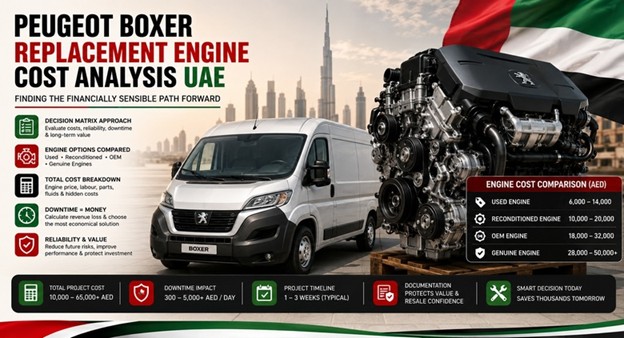
Peugeot Boxer Replacement Engine Cost Analysis UAE: Finding the Financially Sensible Path Forward
June 9, 2026
Commercial vehicle ownership has a habit of exposing uncomfortable truths.
A family car can sit for a week.
A weekend vehicle can wait for parts.
A Peugeot Boxer rarely enjoys that luxury.
When a Boxer stops working, invoices keep moving even when the vehicle does not.
Staff salaries continue.
Deliveries remain scheduled.
Customers still expect service.
Contracts do not pause because an engine failed.
That reality changes everything.
Which is why Peugeot Boxer engine replacement decisions should never begin with a quotation.
They should begin with a decision matrix.
Not an emotional decision.
Not a workshop recommendation.
Not a guess.
A structured assessment.
Because the cheapest option can become the most expensive option remarkably quickly.
Across Dubai, Abu Dhabi, Sharjah, Ajman, Ras Al Khaimah, Fujairah and Umm Al Quwain, commercial operators face the same question every year:
Should this Boxer receive a replacement engine?
Or has the vehicle reached the point where further investment no longer makes financial sense?
The answer usually hides inside the numbers.
Why the Cheapest Peugeot Boxer Engine Decision Is Often the Most Expensive One Later
Business owners naturally focus on immediate costs.
That is understandable.
Cash flow matters.
Budgets matter.
But commercial vehicles create a different challenge.
Today's saving can easily become next year's loss.
A used engine purchased for the lowest possible price may initially appear attractive.
Then unexpected downtime appears.
Then additional repairs appear.
Then delivery disruptions appear.
Suddenly the cheapest decision no longer looks particularly cheap.
This is why experienced fleet managers rarely ask:
"What is the cheapest engine available?"
Instead they ask:
"What is the cheapest solution over the next three years?"
That is a completely different conversation.
Short-Term Thinking
- Lowest purchase price
- Minimal immediate expenditure
- Reduced upfront commitment
Long-Term Thinking
- Reliability
- Downtime reduction
- Operating continuity
- Warranty support
- Predictable costs
One focuses on invoices.
The other focuses on profitability.
Example Decision Matrix
| Option | Initial Cost | Downtime Risk | Long-Term Value |
| Cheap Used Engine | Low | High | Moderate |
| Quality Used Engine | Moderate | Moderate | Good |
| Reconditioned Engine | Higher | Lower | Strong |
| OEM Engine | High | Low | Excellent |
The cheapest figure rarely tells the full story.
Building the Decision Matrix: The Five Financial Variables That Should Be Evaluated Before Spending a Single Dirham
Most poor decisions happen because important variables never entered the conversation.
A proper decision matrix prevents that.
Before approving an engine replacement, experienced operators evaluate five areas.
Vehicle Condition
The engine may be failing.
But what about everything else?
- Transmission condition
- Chassis condition
- Suspension wear
- Electrical reliability
- Cooling-system health
Downtime Costs
What does a day off the road actually cost?
For some businesses:
- AED 300 per day
For others:
- AED 3,000+ per day
The difference matters.
Ownership Horizon
Will the vehicle remain in service for:
- One year?
- Three years?
- Five years?
Longer ownership usually supports stronger engine-investment strategies.
Revenue Contribution
How important is this specific Boxer?
Some vehicles generate occasional revenue.
Others generate revenue daily.
The more critical the vehicle becomes, the more valuable reliability becomes.
Replacement Cost
What would replacing the entire vehicle cost?
Many owners never calculate this.
They should.
Core Decision Variables
| Variable | Importance |
| Vehicle Condition | Very High |
| Downtime Cost | Very High |
| Ownership Period | High |
| Revenue Dependency | Very High |
| Vehicle Replacement Cost | High |
When these factors are analysed together, clearer decisions emerge.
How UAE Climate, Commercial Workloads and Daily Operating Conditions Influence Peugeot Boxer Engine Lifespans
The UAE creates challenges commercial vehicles cannot avoid.
Heat.
Distance.
Traffic.
Payload.
Repetition.
The Boxer may spend years operating under conditions significantly harsher than those found in many European markets.
That matters.
Common UAE Stress Factors
- Extreme summer temperatures
- Heavy urban traffic
- Long motorway journeys
- Continuous air-conditioning use
- Commercial payloads
- Frequent stop-start driving
- Dust contamination
A vehicle delivering goods across Dubai experiences one form of stress.
A vehicle operating between Abu Dhabi and Fujairah experiences another.
A fleet vehicle working continuously throughout Sharjah industrial areas faces something different again.
Eventually these stresses accumulate.
Components Most Affected
| Component | Climate Impact |
| Cooling System | High |
| Turbocharger | High |
| Engine Seals | High |
| Radiator | High |
| Sensors | Moderate |
| Fuel System | Moderate |
| Hoses | High |
The UAE climate rarely causes immediate failure.
It accelerates wear.
And accelerated wear eventually creates financial decisions.
The Warning Signs That Shift a Peugeot Boxer From a Repair Candidate to a Replacement-Engine Candidate
Most engine failures provide warnings.
The problem is that commercial operators are often busy.
Vehicles continue working.
Schedules remain full.
Minor symptoms become background noise.
Then one day they become expensive.
Early Warning Signs
- Increased oil consumption
- Reduced fuel economy
- Excessive exhaust smoke
- Repeated warning lights
- Rough idle conditions
- Power loss
- Coolant loss
- Increased operating temperatures
One symptom is not necessarily alarming.
Several together deserve investigation.
Escalating Warning Signs
- Persistent overheating
- Severe oil consumption
- Internal engine noise
- Compression loss
- Turbocharger failure
- Multiple cylinder issues
At this stage the conversation frequently shifts from repair to replacement.
Risk Progression Matrix
| Condition | Financial Risk |
| Early Symptoms | Low |
| Repeated Symptoms | Moderate |
| Major Performance Loss | High |
| Internal Damage | Very High |
| Catastrophic Failure | Extreme |
The earlier intervention occurs, the more options usually remain available.
Peugeot Boxer Replacement Engine Costs in UAE: Used, Reconditioned, OEM and Genuine Engine Financial Comparisons
Eventually the discussion reaches numbers.
It always does.
But numbers only become useful when viewed alongside reliability expectations.
Used Peugeot Boxer Engine
Typical Cost:
AED 6,000 – AED 14,000
Advantages:
- Lowest acquisition cost
- Fast sourcing opportunities
- Suitable for limited ownership horizons
Potential Drawbacks:
- Unknown history
- Variable wear
- Reduced warranty support
Reconditioned Peugeot Boxer Engine
Typical Cost:
AED 10,000 – AED 20,000
Advantages:
- Better reliability outlook
- Internal refurbishment
- Improved inspection opportunities
OEM Engine
Typical Cost:
AED 18,000 – AED 32,000
Advantages:
- Strong compatibility
- Predictable performance
- Better long-term planning
Genuine Engine
Typical Cost:
AED 28,000 – AED 50,000+
Advantages:
- Highest confidence level
- Maximum reliability potential
- Strong resale support
Engine Cost Comparison Table
| Engine Type | Estimated Cost (AED) |
| Used | 6,000 – 14,000 |
| Reconditioned | 10,000 – 20,000 |
| OEM | 18,000 – 32,000 |
| Genuine | 28,000 – 50,000+ |
Price matters.
Reliability matters more.
For many commercial operators, downtime becomes more expensive than the engine itself.
Labour Costs, Installation Costs and Project Budgets: Understanding the Full Financial Commitment
A replacement engine quotation often captures attention.
The installation budget usually determines reality.
Engine projects involve far more than simply swapping parts.
Diagnostics.
Programming.
Testing.
Fluids.
Supporting components.
Labour.
All contribute.
Labour Cost Estimates
| Labour Category | Typical Cost (AED) |
| Basic Installation | 3,000 – 6,000 |
| Intermediate Project | 6,000 – 10,000 |
| Complex Installation | 10,000 – 15,000+ |
Supporting Costs
| Category | Estimated Cost (AED) |
| Diagnostics | 300 – 2,000 |
| Fluids & Filters | 500 – 2,500 |
| Cooling Components | 1,000 – 6,000 |
| Sensors | 500 – 5,000 |
| Engine Mounts | 500 – 3,000 |
Total Project Budget Comparison
| Project Type | Estimated Total Cost (AED) |
| Budget Project | 10,000 – 20,000 |
| Mid-Range Project | 20,000 – 35,000 |
| Premium Project | 35,000 – 65,000+ |
The key lesson?
An engine replacement is not a parts purchase.
It is a business investment.
And every investment deserves a decision matrix rather than a guess.
Mileage Verification Versus Revenue-Generating Capability: Which Metric Matters More for Commercial Owners?
Many owners become obsessed with mileage.
Commercial operators often focus elsewhere.
Revenue.
A Boxer showing 320,000 kilometres may still be generating consistent income every week.
Another vehicle showing half that mileage may be creating constant repair interruptions.
Which vehicle carries more value?
The answer is rarely found on the odometer.
Factors Often More Important Than Mileage
- Service history
- Revenue generation
- Downtime frequency
- Maintenance quality
- Compression-test results
- Cooling-system condition
- Transmission health
- Overall reliability
Mileage tells a story.
Operational performance tells a bigger one.
And when replacement-engine decisions involve tens of thousands of dirhams, the bigger story is usually the one that matters most.
Compression Testing, Leak-Down Testing and Mechanical Evidence That Should Drive the Decision Matrix
The most expensive words in commercial vehicle ownership are often:
"I think the engine is fine."
Thinking is useful.
Evidence is better.
A decision matrix built on assumptions rarely stays profitable for long.
This is why experienced fleet managers, workshop owners and transport operators rely on testing before approving major spending.
Compression testing reveals whether the engine can still perform its fundamental task.
Creating and maintaining cylinder pressure.
Leak-down testing goes further.
It identifies where performance is being lost.
Together they transform guesswork into evidence.
Compression Testing Can Reveal
- Piston-ring wear
- Cylinder-wall wear
- Valve-sealing problems
- Internal engine fatigue
- Combustion inefficiencies
Leak-Down Testing Can Reveal
- Air escaping through valves
- Piston-ring leakage
- Cylinder wear
- Head-gasket concerns
- Internal sealing failures
Decision Matrix Impact
| Test Result | Business Recommendation |
| Strong & Consistent | Continue Evaluation |
| Minor Variations | Monitor Closely |
| Moderate Variations | Financial Review Required |
| Significant Variations | Replacement Candidate |
| Severe Failures | High-Priority Replacement |
The value of testing is simple.
A few hundred dirhams spent on diagnostics can prevent tens of thousands being spent incorrectly.
Mileage Verification Versus Revenue-Generating Capability: Why Commercial Vehicles Follow Different Rules
Private-car owners often obsess over mileage.
Commercial operators usually focus on something else.
Productivity.
A Boxer delivering goods daily between Dubai and Abu Dhabi may accumulate mileage quickly.
That alone does not make it a poor investment.
What matters is whether the vehicle continues generating reliable income.
Revenue-Focused Assessment Factors
- Downtime frequency
- Maintenance consistency
- Fuel efficiency
- Reliability history
- Delivery performance
- Customer impact
- Operating profitability
Example Comparison
| Vehicle | Mileage | Revenue Reliability |
|---|---|---|
| Boxer A | High | Strong |
| Boxer B | Lower | Weak |
Many decision matrices favour Boxer A.
Mileage tells one story.
Business performance tells another.
The second story often matters more.
Hidden Costs That Frequently Appear After Engine Approval and How They Affect Return on Investment
The engine invoice rarely represents the final invoice.
Commercial operators learn this quickly.
An engine replacement often exposes other components that have aged alongside it.
Not because anyone was dishonest.
Because some wear only becomes visible during dismantling.
Common Hidden Costs
| Component | Typical Cost (AED) |
| Engine Mounts | 500 – 2,500 |
| Cooling Hoses | 500 – 2,000 |
| Water Pump | 500 – 2,500 |
| Radiator | 1,000 – 4,000 |
| Sensors | 500 – 5,000 |
| Turbo Components | 2,000 – 12,000 |
| Wiring Repairs | 500 – 4,000 |
| Diagnostic Labour | 300 – 2,000 |
Typical Additional Project Costs
Budget Scenario:
- AED 2,000 – 5,000
Mid-Level Scenario:
- AED 5,000 – 12,000
Comprehensive Scenario:
- AED 12,000 – 25,000+
Hidden costs are not always bad news.
Sometimes they represent opportunities to improve long-term reliability while access is available.
Supporting Parts Worth Replacing During Installation and the Long-Term Cost Savings They Often Create
Commercial vehicle ownership is a game of prevention.
Reactive maintenance usually costs more.
Particularly when revenue depends on the vehicle remaining operational.
That is why many experienced operators replace certain supporting parts while the engine is already out.
Components Worth Serious Consideration
- Water pump
- Thermostat
- Cooling hoses
- Engine mounts
- Drive belts
- Tensioners
- Sensors
- Turbo oil lines
- Fuel-system components
Supporting-Part Investment Matrix
| Strategy | Estimated Cost (AED) | Future Downtime Risk |
| Minimal Replacement | Low | Higher |
| Balanced Replacement | Moderate | Lower |
| Comprehensive Replacement | Higher | Lowest |
The cheapest supporting-parts strategy often becomes the most expensive downtime strategy later.
Compatibility Checks, ECU Matching and Installation Risks That Can Turn a Good Decision Into a Costly Mistake
A replacement engine may physically fit.
That does not mean it is compatible.
Modern commercial vehicles rely on multiple systems communicating correctly.
Engine control modules.
Sensors.
Wiring harnesses.
Transmission systems.
Compatibility errors create delays.
Delays create costs.
Costs affect profitability.
Areas Requiring Verification
- Engine code matching
- ECU compatibility
- Wiring compatibility
- Sensor integration
- Turbocharger specifications
- Transmission compatibility
- Cooling-system integration
Potential Compatibility Costs
| Issue | Estimated Cost (AED) |
| ECU Programming | 500 – 4,000 |
| Wiring Modifications | 500 – 6,000 |
| Sensor Replacement | 500 – 5,000 |
| Additional Diagnostics | 300 – 2,000 |
Compatibility should always be confirmed before installation begins.
Not after.
Downtime Economics: Calculating the Revenue Lost While a Peugeot Boxer Is Off the Road
This is where decision matrices become interesting.
And sometimes uncomfortable.
Many owners calculate repair costs.
Far fewer calculate downtime costs.
Yet downtime often becomes the largest expense.
Typical Downtime Categories
- Missed deliveries
- Lost contracts
- Staff inefficiencies
- Replacement transport costs
- Customer-service disruptions
- Fleet utilisation losses
Example Daily Revenue Impact
| Business Type | Estimated Daily Impact (AED) |
| Local Delivery Service | 300 – 800 |
| Trade Services Vehicle | 500 – 1,500 |
| Logistics Operations | 1,000 – 3,000+ |
| High-Volume Commercial Fleet | 2,000 – 5,000+ |
Suddenly a higher-quality engine option can appear surprisingly economical.
Because reliability protects revenue.
How Long Does a Peugeot Boxer Engine Replacement Really Take in UAE Workshops?
Commercial operators want certainty.
Workshops deal with reality.
Those two things do not always align perfectly.
Parts availability.
Engine sourcing.
Compatibility verification.
Supporting-part replacement.
All influence timelines.
Typical Timeline Breakdown
| Stage | Estimated Duration |
| Engine Sourcing | 2–14 Days |
| Inspection & Verification | 1–3 Days |
| Engine Removal | 1–3 Days |
| Installation | 2–7 Days |
| Diagnostics & Testing | 1–4 Days |
Total Project Timelines
Best Case:
- One Week
Typical Case:
- Two Weeks
Complex Case:
- Three To Five Weeks
Commercial operators should plan around realistic timelines rather than optimistic ones.
The Cost of Delaying the Decision: When Waiting Becomes More Expensive Than Acting
There is a strange tendency in commercial vehicle ownership.
Owners often delay decisions because they want to save money.
Unfortunately, delay frequently creates the opposite outcome.
Particularly in the UAE.
Summer temperatures are unforgiving.
Cooling systems work harder.
Engines operate under greater stress.
Minor problems escalate.
Common Consequences of Delay
- Complete engine failure
- Turbocharger damage
- Cooling-system collapse
- Increased fuel consumption
- Reduced productivity
- Additional downtime
- Secondary mechanical failures
Cost-of-Delay Matrix
| Stage | Estimated Cost (AED) |
| Early Repair | 1,000 – 8,000 |
| Major Mechanical Repair | 8,000 – 20,000 |
| Engine Replacement | 10,000 – 65,000+ |
| Catastrophic Failure Plus Secondary Damage | 20,000 – 90,000+ |
The cheapest month to act is often the month when the problem first appears.
Why the Decision Matrix Often Favors Reliability Over Purchase Price
An interesting pattern emerges when commercial operators evaluate all variables together.
Engine cost.
Labour.
Downtime.
Revenue loss.
Hidden costs.
Future reliability.
Suddenly the cheapest engine is not always the most attractive option.
And for operators researching buy Peugeot Boxer engines, the strongest financial decision is often the one that protects revenue rather than merely reducing the initial invoice.
Because in commercial ownership, continuity usually beats cheapness.
Every time.
Replace the Engine, Rebuild the Engine or Replace the Vehicle? A Practical UAE Decision Matrix
Eventually every Peugeot Boxer owner reaches the same crossroads.
Three roads.
Three invoices.
Three very different futures.
Repair the existing engine.
Replace the engine.
Replace the vehicle.
What makes the decision difficult is that all three can appear reasonable at first glance.
The trick is identifying which one remains reasonable twelve months later.
Option One: Engine Rebuild
Usually suitable when:
- Internal damage is limited
- Cylinder block remains healthy
- Downtime is manageable
- Long-term ownership remains likely
Typical Cost:
AED 8,000 – AED 20,000
Option Two: Replacement Engine
Usually suitable when:
- Internal damage is severe
- Vehicle condition remains strong
- Downtime costs are significant
- Long-term utilisation remains high
Typical Cost:
AED 10,000 – AED 65,000+
Option Three: Vehicle Replacement
Usually suitable when:
- Multiple major systems are deteriorating
- Structural concerns exist
- Operational reliability is declining
- Future repair costs are escalating
Typical Cost:
AED 60,000 – AED 220,000+
Decision Matrix Comparison
| Factor | Rebuild | Replacement Engine | Replace Vehicle |
| Initial Cost | Lower | Moderate | Highest |
| Downtime | Moderate | Moderate | Low |
| Reliability Potential | Moderate | Strong | Strong |
| Capital Requirement | Lower | Moderate | Highest |
| Business Continuity | Moderate | Strong | Strong |
The cheapest route rarely wins.
The strongest long-term business case usually does.
First-Year Ownership Costs After Engine Replacement and the Expenses Many Operators Ignore
Commercial operators often focus on project costs.
The first year after installation deserves equal attention.
Because ownership continues.
The engine may be new.
Everything else continues ageing.
Typical First-Year Ownership Costs
| Category | Estimated Cost (AED) |
| Scheduled Servicing | 1,000 – 4,000 |
| Fluids & Filters | 500 – 2,000 |
| Diagnostics | 500 – 2,000 |
| Suspension Repairs | 1,000 – 8,000 |
| Tyres | 2,000 – 10,000 |
| Contingency Budget | 2,000 – 10,000 |
First-Year Ownership Scenarios
Conservative Scenario
- Engine Project: AED 15,000
- Running Costs: AED 6,000
Total:
AED 21,000
Balanced Scenario
- Engine Project: AED 28,000
- Running Costs: AED 10,000
Total:
AED 38,000
Comprehensive Scenario
- Engine Project: AED 50,000
- Running Costs: AED 15,000
Total:
AED 65,000
Decision matrices work best when future costs are included.
Not ignored.
Different Decision Matrices for Fleet Managers, Delivery Operators, Tradesmen and Independent Business Owners
The same engine failure can produce entirely different conclusions.
That surprises many owners.
It should not.
The vehicle serves different purposes.
Therefore the financial logic changes.
Fleet Managers
Primary Concerns:
- Fleet uptime
- Asset utilisation
- Cost per kilometre
- Revenue continuity
Decision matrices often favour reliability-focused engine options.
Delivery Operators
Primary Concerns:
- Daily route completion
- Fuel efficiency
- Downtime reduction
- Customer-service continuity
Tradesmen
Primary Concerns:
- Tool transportation
- Worksite access
- Predictable costs
- Vehicle availability
Independent Business Owners
Primary Concerns:
- Cash flow
- Return on investment
- Operating flexibility
- Long-term ownership costs
Different businesses.
Different priorities.
Different answers.
Resale Value, Insurance Documentation and Vehicle Asset Preservation After Engine Replacement
Many owners underestimate documentation.
Until they try to sell the vehicle.
Then everything changes.
A replacement engine without records becomes a question.
A replacement engine with records becomes evidence.
Evidence creates confidence.
Confidence protects value.
Documentation Worth Preserving
- Engine purchase invoice
- Installation invoice
- Compression-test reports
- Diagnostic reports
- Warranty documentation
- Maintenance records
- Serial-number records
Resale-Value Impact Matrix
| Documentation Quality | Buyer Confidence |
| Comprehensive | High |
| Partial | Moderate |
| Limited | Low |
| Missing | Very Low |
The paperwork often becomes almost as valuable as the engine itself.
Insurance and Registration Considerations That Should Enter Every Decision Matrix
Insurance discussions rarely feel urgent.
Until they become urgent.
Registration renewals.
Vehicle transfers.
Warranty disputes.
Ownership changes.
Documentation suddenly becomes valuable.
Essential Records
- Engine origin documentation
- Workshop invoices
- Inspection reports
- Warranty records
- Service history
- Installation evidence
Keeping records organised creates flexibility later.
And flexibility has financial value.
The First 1,000 Kilometres After Installation Often Determine Long-Term Success
Many operators celebrate too early.
The vehicle leaves the workshop.
The project appears complete.
Not quite.
The first thousand kilometres provide critical feedback.
Monitor Closely
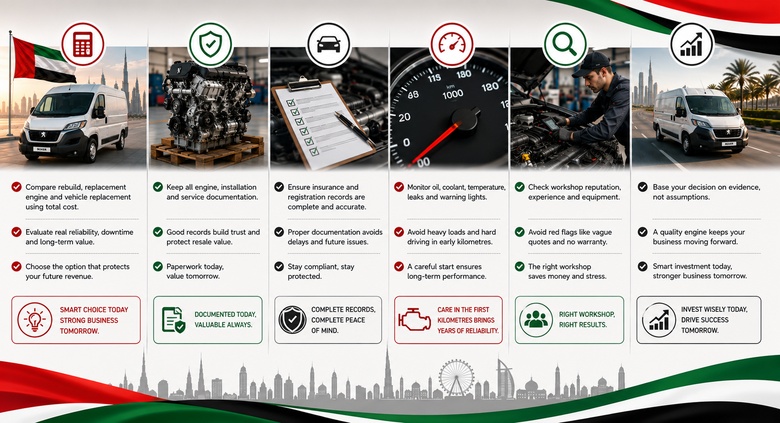
- Oil consumption
- Coolant levels
- Engine temperatures
- Warning lights
- Fuel economy
- Fluid leaks
- Unusual sounds
Avoid During Early Operation
- Maximum payloads
- Extended high-speed runs
- Aggressive acceleration
- Excessive engine loads
The goal is stability.
Not speed.
Workshop Red Flags That Can Completely Change the Financial Outcome
A decision matrix should evaluate workshops as carefully as engines.
The best engine installed badly becomes an expensive problem.
The right workshop often determines whether the investment succeeds.
Common Red Flags
- No written quotations
- No warranty documentation
- No engine history
- No testing evidence
- No post-installation support
- Unclear labour charges
- Pressure-selling tactics
- Refusal to provide diagnostics
Professional operators welcome scrutiny.
Unprofessional operators usually avoid it.
That difference matters.
Final Commercial Decision Matrix: Is a Peugeot Boxer Replacement Engine the Financially Sensible Path Forward?
The answer depends on evidence.
Not optimism.
Not attachment.
Not marketing.
Evidence.
Strong Indicators Supporting Engine Replacement
- Healthy chassis
- Reliable transmission
- Strong service history
- High business utilisation
- Long-term ownership plans
- Positive revenue contribution
Indicators Supporting Vehicle Replacement
- Structural concerns
- Escalating repair frequency
- Multiple major-system failures
- Declining operational reliability
- Poor long-term economics
Final Decision Matrix
| Factor | Engine Replacement Favoured | Vehicle Replacement Favoured |
| Chassis Condition | Strong | Weak |
| Transmission Condition | Healthy | Poor |
| Service History | Complete | Limited |
| Revenue Importance | High | Low |
| Ownership Horizon | Long-Term | Short-Term |
| Downtime Costs | Significant | Minimal |
The more boxes appearing on the left side, the stronger the engine-replacement argument becomes.
The Financially Sensible Path Forward Is Usually the One That Protects Future Revenue Rather Than Today's Budget
Commercial vehicle ownership has a way of exposing short-term thinking.
A cheap decision can feel satisfying today.
Then the breakdown happens.
Then the downtime starts.
Then the real costs arrive.
The Peugeot Boxer is not simply a vehicle.
For many operators across Dubai, Abu Dhabi, Sharjah, Ajman, Ras Al Khaimah, Fujairah and Umm Al Quwain, it is a revenue-producing asset.
That distinction matters.
Assets should be evaluated differently from ordinary vehicles.
They should be assessed through operational performance, reliability potential and future cash-flow contribution.
That is why the strongest decision matrices begin with evidence and end with economics.
Not emotion.
Not assumptions.
For businesses researching replacement options through PartFinder UAE, the goal should never be finding the cheapest engine available.
The goal should be identifying the option that delivers the strongest balance between reliability, operational continuity, capital preservation and long-term profitability.
Because the most financially sensible path forward is rarely the one with the smallest invoice.
It is usually the one that creates the lowest total cost of ownership across the years ahead.
Frequently Asked Questions
Categories
- Audi
- BMW
- Car Accessories
- Car Tips
- Ford
- Land Rover
- Mazda
- Range Rover
- Top 10
- UAE Car Parts
- Used Car Parts
- Toyota
- Replacement Engines
- Nissan
- Hyundai
- Mitsubishi
- Volkswagen
- Honda
- Kia
- Chevrolet
- Dodge
- Jeep
- Subaru
- Renault
- Lexus
- Mercedes
- Suzuki
- Hummer
- Porsche
- Infiniti
- Peugeot
- GMC
- Mini
- Volvo
- Replacement Gearboxes
- MG
- Jaguar
- Skoda
- Cadillac
- Daihatsu
- Fiat
- German Car Parts
- Japanese Car Parts
- Aftermarket Car Parts
- Genuine Car Parts
- New Car Parts
- Reconditioned Car Parts
- European Car Parts
- American Car Parts
- Korean Car Parts
- British Car Parts
- Chinese Car Parts
- Sports/Exotic Car Parts
- Luxury Car Parts
- Performance Car Parts
- SUV/4x4 Spare Parts
- Truck Spare Parts
- EV Car Parts
- Hybrid Car Parts
- Auto Spare Parts in UAE
- Tesla
- Isuzu
- Ram
- Ferrari
- Bentley
- Lamborghini
- Genesis
- Maserati
- Lincoln
- Chrysler
- Opel
- Citroen
- SsangYong
- Seat
- McLaren
- Aston Martin
- Rolls Royce
- Maybach
- Alfa Romeo
- Bugatti
- Scion
- Abu Dhabi Car Parts
- Ajman Car Parts
- Al Khan Car Parts
- Al Sajaa Car Parts
- Deira Car Parts
- Dubai Car Parts
- Fujairah Car Parts
- Industrial Area 6 Car Parts
- Mussafah Car Parts
- Ras Al Khaimah Car Parts
- Sharjah Car Parts
- Umm Al Quwain Car Parts
- Acura
- BYD
- Chery
- Dacia
- DS
- Geely Emgrand
- EXEED
- GAC
- GAC Gonow
- Geely
- Gonow
- Great Wall
- Haima
- Haval
- Holden
- Iveco
- JAC
- Jaecoo
- Jetour
- Lotus
- Omoda
- Proton
- Renault Samsung
- Roewe
- Lucid