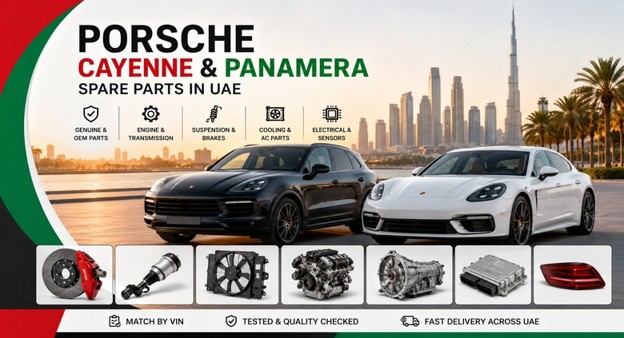
Porsche Cayenne and Panamera Spare Parts in UAE: Common Parts Owners Replace
August 24, 2026
Common Porsche Cayenne Spare Parts Owners Replace
Porsche Cayenne Spare Parts in UAE: Common Replacement Parts Owners Need
A Porsche Cayenne is a heavy, powerful SUV, and UAE roads give its components plenty to deal with. Heat, stop-start traffic, long motorway runs and occasional rough surfaces all leave their mark, although not every worn component needs replacing at the first sign of trouble.
The usual replacement list is fairly broad: brake pads and discs, control arms, bushes, air-suspension components, cooling-system parts, AC components, sensors, engine mounts, batteries, lights and body panels.
Some parts wear gradually. Others fail rather abruptly.
That distinction matters. A tired control arm may give you weeks of warning through steering feel and tyre wear, while an electronic component can decide to throw a fault message on a Tuesday morning and ruin the day's plans.
Cayenne brakes:
Brake pads and discs are among the more predictable replacement Porsche spare parts in UAE. Heavy SUV weight, frequent urban braking and high temperatures can accelerate wear, particularly when the vehicle spends much of its life in Dubai or Abu Dhabi traffic.
Look for squealing, grinding, steering-wheel vibration, longer stopping distances and a brake-wear warning. Don't wait for a metal-on-metal situation.
Cayenne suspension:
Control arms, bushes, stabiliser links, ball joints and dampers can become tired with mileage. UAE roads are generally smooth in the main urban areas, but repeated kerb impacts, speed humps and rougher surfaces still put stress through the suspension.
A knocking noise over small bumps is worth investigating. So is uneven tyre wear.
Cayenne air suspension:
Air-suspension problems deserve a separate diagnosis because the system contains several components. An air spring, compressor, valve block, height sensor or leaking line can create symptoms that look similar from the driver's seat.
If one corner of the Cayenne sits lower after being parked overnight, don't simply order a compressor. Find the leak or failed component first.
Cooling-system parts:
The UAE climate makes cooling components particularly important. Radiators, water pumps, thermostats, coolant pipes, expansion tanks and related components all have to cope with high ambient temperatures.
A rising temperature gauge, coolant warning, sweet coolant smell or visible leak needs attention rather than wishful thinking.
AC components:
A Cayenne that blows lukewarm air in August is not merely inconvenient. It can point towards a failing compressor, condenser, refrigerant leak, blower issue or another climate-control fault.
Diagnose the system before buying the most expensive component on the list.
Engine-related parts:
Not every engine problem means an engine replacement. Ignition coils, spark plugs, sensors, mounts, seals, cooling components and other supporting parts can create symptoms that appear more serious than they actually are.
A proper diagnostic assessment can save a substantial amount of money here.
Electrical components:
Batteries, alternators, starters, sensors, control modules and other electrical parts can all require replacement during a Cayenne's life. Exact part-number matching becomes especially important when electronics are involved.
A component that physically fits is not necessarily electronically compatible.
Body and lighting parts:
Bumpers, headlights, tail lights, mirrors, doors, wings and trim pieces are commonly replaced after accidents or cosmetic damage. Used genuine parts can sometimes reduce the repair bill considerably, provided their condition is checked properly.
The sensible Cayenne approach:
Diagnose first → identify the exact component → check the part number → compare genuine/OEM/used/aftermarket → calculate the complete repair cost.
That sequence is less exciting than clicking “buy now”, but it is usually much cheaper.
Porsche Cayenne Brake Pads and Discs: When Should They Be Replaced?
Brake wear is one of those jobs Cayenne owners should not postpone unnecessarily. The vehicle carries substantial weight, and repeated braking in dense UAE traffic can make a worn braking system noticeable long before it becomes genuinely dangerous.
Common warning signs:
Squealing, grinding, vibration, pulsation, reduced braking response and a brake-wear warning are all reasons to have the system inspected.
A little noise does not automatically mean the discs are finished, though. Brake condition needs to be measured rather than guessed from sound alone.
Brake pads:
Pads gradually become thinner through normal use. Their remaining thickness should be checked alongside the wear pattern, because uneven wear can point towards another issue with the caliper, guide mechanism or related hardware.
Brake discs:
Discs can develop grooves, scoring, heat damage or excessive wear. Measuring disc thickness against the applicable specification is far more useful than deciding from a quick visual glance.
Brake vibration:
If the steering wheel shudders during braking, don't automatically blame the discs. Suspension wear, wheel issues and other factors can also contribute to the sensation.
Performance specifications:
Not every Cayenne uses the same braking equipment. Confirm the exact brake system, axle position and part number before ordering pads or discs online.
Genuine vs OEM vs aftermarket:
A reputable OEM or aftermarket braking component can be worth considering on the right application, particularly for an older Cayenne. For performance-focused specifications, however, the manufacturer's quality and exact fitment deserve much closer scrutiny.
Used brake parts:
Used brake pads and discs are generally a poor place to chase savings because they are wear components. A used caliper or other reusable hardware is a different proposition, but its condition still needs checking.
When replacing brakes:
Ask the workshop to inspect the related components at the same time. Sensors, calipers, hoses and other hardware can influence the final repair cost.
A simple rule:
Never choose Cayenne brake parts from the model name alone.
Use the VIN, brake specification and exact part reference.
Porsche Cayenne Air Suspension Parts: Struts, Compressors and Valve Blocks
Air suspension is brilliant when everything is working properly. The Cayenne sits correctly, absorbs rough surfaces and changes ride height when required.
When it starts misbehaving, however, the system can become an expensive guessing game unless the fault is isolated properly.
Cayenne air-suspension symptoms:
Watch for one corner sitting low, the whole vehicle dropping after parking, slow height adjustment, compressor noise, suspension warnings or an unusually hard ride.
These symptoms do not all point to the same component.
Air springs and struts:
A leaking air spring or damaged air strut can cause the vehicle to settle on one side. Age, rubber deterioration and repeated heat exposure can contribute to failure.
Replacing the leaking unit may solve the problem without touching the compressor.
Air compressor:
The compressor works harder when the system has a leak. This is why a compressor can become damaged as a secondary consequence rather than being the original cause.
So, replacing the compressor without checking the rest of the system can be a costly mistake.
Valve blocks:
The valve block controls the distribution of compressed air through the suspension system. Faults here can produce strange height behaviour and uneven lifting or lowering.
Air lines and leaks:
Small leaks can be difficult to spot because the vehicle may initially appear fine while driving. After sitting overnight, though, one corner may visibly drop.
That is a useful clue.
Height sensors:
The suspension relies on height sensors to understand where the vehicle sits. A faulty sensor can produce warning messages or incorrect ride-height behaviour even when the air springs themselves are healthy.
UAE heat and air suspension:
High temperatures are hard on rubber, seals and other components. The climate does not automatically cause failure, but it is certainly one reason UAE owners should not ignore small leaks or recurring suspension warnings.
Buying used air-suspension parts:
Used genuine components can be considered when the condition and history are clear. For compressors and electronic components especially, ask what was tested and how the warranty works.
Before ordering:
Find the fault first. Then buy the component.
That one habit can prevent an unnecessarily expensive parts bill.
Porsche Cayenne Suspension Parts: Control Arms, Bushes and Dampers
The Cayenne's suspension has to control a large SUV while keeping the vehicle composed enough to feel like a Porsche. That is a demanding job, and worn suspension components can change the way the vehicle feels surprisingly quickly.
Control arms:
Worn control arms or their associated bushes can cause knocking, vague steering and uneven tyre wear. Under braking, the vehicle may also feel less settled than it once did.
Bushes:
Rubber bushes deteriorate with age, mileage and heat exposure. Cracking does not always mean immediate failure, but excessive movement or deterioration should be assessed before it starts damaging related components.
Ball joints:
A worn ball joint can affect steering precision and suspension movement. It is not a component to ignore because the symptoms seem minor.
Stabiliser links:
These relatively small components can produce an irritating knocking noise over bumps. The noise may sound dramatic while the actual part causing it is fairly inexpensive.
That is why diagnosis matters.
Dampers:
Worn dampers can reduce body control and make the Cayenne feel unsettled over undulating roads. Oil leakage, excessive bouncing and uneven tyre wear are useful clues.
PASM-equipped vehicles:
Cayenne variants with electronically controlled suspension need more careful parts identification. Confirm the exact system before ordering dampers or related components.
Uneven tyre wear:
Don't replace tyres and forget the suspension. If the underlying control-arm, bush or alignment issue remains, the new tyres can start wearing incorrectly all over again.
Used suspension parts:
Used genuine suspension components can make sense for selected repairs on older Cayennes, but wear needs to be considered. A second-hand component with unknown mileage is not automatically a bargain.
OEM and aftermarket suspension:
Reputable OEM and aftermarket manufacturers can provide alternatives for suitable applications. The manufacturer's identity, warranty and exact fitment matter more than the word “replacement” on an online listing.
UAE workshop reality:
A Cayenne that feels slightly loose at 100 km/h deserves attention. It is not always dramatic, and that is precisely why owners sometimes put it off until tyre wear, steering behaviour or another component makes the problem more expensive.
Porsche Cayenne Cooling System Parts: Radiators, Water Pumps and Thermostats
Cooling problems deserve respect in the UAE. Summer temperatures are brutal, traffic can keep the engine bay hot for long periods, and a cooling system that is already marginal has very little room for error.
Radiators:
A blocked, damaged or leaking radiator can reduce the system's ability to remove heat. Physical damage, internal restriction and external contamination can all affect performance.
Water pumps:
The water pump circulates coolant through the engine and cooling system. Wear or failure can lead to poor coolant circulation and rising engine temperatures.
Thermostats:
A thermostat regulates coolant flow according to engine temperature. If it sticks or operates incorrectly, the engine may run too hot or fail to reach the intended operating temperature.
Coolant leaks:
Look for visible coolant, a persistent coolant smell, warning messages or unexplained drops in the expansion tank level. A leak should be traced to its source rather than repeatedly topped up and ignored.
Expansion tanks and hoses:
Plastic tanks, hoses and connectors can deteriorate with age and heat cycles. Small cracks may become much larger problems once the system reaches operating pressure.
Cooling fans:
An electrical fan problem can become especially noticeable in slow-moving traffic, when airflow through the radiator is limited. If the vehicle behaves normally at speed but struggles in traffic, the cooling system deserves a proper inspection.
Cooling parts in UAE summer:
This is not the place to buy an anonymous low-quality component simply because it is cheap. A cooling-system failure can lead to far more serious engine damage.
Genuine vs OEM cooling components:
A reputable OEM component may be a sensible alternative to genuine Porsche parts when the manufacturer and specification are verified. For critical cooling components, however, quality should sit ahead of the smallest possible purchase price.
Before buying a Cayenne cooling part:
Confirm the VIN, engine specification, exact part number, manufacturer, warranty and availability.
Then ask what else the workshop recommends replacing while the system is open.
The important point:
A Cayenne cooling problem rarely gets better by itself. Catching a leaking hose, tired water pump or weak cooling component early is usually far cheaper than dealing with the engine damage that can follow an overheated Porsche.
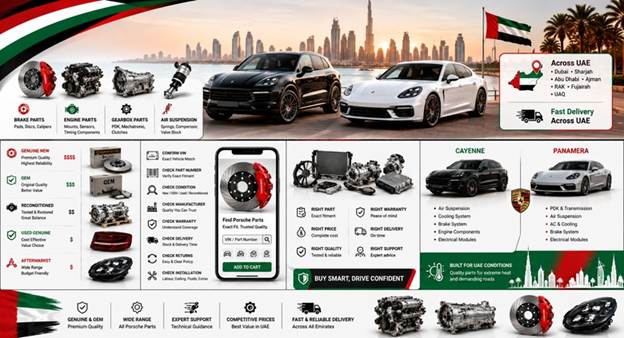
Porsche Cayenne Engine, AC, Electrical and Body Parts
Porsche Cayenne Engine Parts in UAE: Common Components That Wear Out
A Cayenne engine does not usually fail as one giant, dramatic event. More often, smaller components begin complaining first — ignition parts, sensors, mounts, cooling components, seals and other supporting hardware.
That distinction matters because replacing an entire engine when a smaller component has failed is an expensive way to solve the wrong problem.
Engine mounts:
Worn engine mounts can introduce vibration through the cabin, particularly at idle or when selecting drive. Excess movement can also place additional stress on surrounding components.
Ignition coils and spark plugs:
Misfires, rough idle, hesitation and reduced acceleration can point towards ignition problems. These are relatively straightforward components to investigate before assuming the engine itself has internal damage.
Engine sensors:
Modern Cayenne engines rely on numerous sensors to manage fuelling, temperature, pressure and other operating parameters. A faulty sensor can trigger warning lights or strange running behaviour.
Don't buy a sensor from a photograph alone. Exact part-number matching matters.
Engine cooling components:
Water pumps, thermostats, coolant pipes and related parts can become increasingly important as mileage rises. UAE temperatures make cooling-system condition particularly important during summer driving.
Oil leaks and seals:
Small oil leaks can develop around seals, gaskets and other engine areas. A few drops should not automatically lead to panic, but ignoring a growing leak is asking for trouble.
Turbo-related components:
Turbocharged Cayenne variants have additional components that need checking when performance drops or unusual noises appear. A loss of power does not automatically mean the turbocharger itself has failed.
Engine mounts vs engine failure:
A rough-feeling Cayenne can make an owner nervous. Sometimes the culprit is a mount or another external component rather than an internal engine problem.
That is why proper diagnosis comes first.
Used Cayenne engine parts:
Used genuine components can reduce repair costs for older vehicles. Ask about donor mileage, testing, condition and warranty before buying, especially for expensive mechanical assemblies.
OEM engine components:
A reputable OEM manufacturer can provide another route where the exact application is confirmed. Check the manufacturer, part number and warranty rather than accepting “OEM quality” as enough information.
The Cayenne engine rule:
Diagnose the failed component before buying the replacement.
It sounds obvious. Yet this is where plenty of expensive parts decisions go sideways.
Porsche Cayenne Gearbox and Transmission Parts: What Owners Replace
Transmission problems can be expensive, but a gearbox fault does not automatically mean the complete transmission needs replacing. Depending on the diagnosis, the repair could involve fluid, seals, mounts, sensors or another specific component.
Transmission fluid:
Fluid condition and service history should be considered when investigating shifting problems. The correct fluid specification matters; improvising here is not a clever shortcut.
Gearbox mounts:
A worn transmission mount can produce vibration, clunks or excessive movement. It is considerably cheaper to investigate the mounting system before assuming an internal gearbox failure.
Seals and leaks:
Transmission-fluid leaks should be traced rather than repeatedly topped up. A small leak can become a larger problem if the underlying cause is ignored.
Transmission electronics:
Sensors, wiring and control components can influence shifting behaviour. A warning light or unusual gear change should therefore be diagnosed electronically as well as mechanically.
Major gearbox replacement:
If the transmission genuinely requires replacement, compare used, reconditioned and new options rather than accepting the first quotation.
Used gearbox:
Ask for the exact transmission code, donor vehicle, mileage where available, testing and warranty. A gearbox that looks compatible may still have the wrong specification.
Reconditioned gearbox:
Ask what has actually been rebuilt or replaced. “Reconditioned” can cover different levels of work, so the description needs to be specific.
Installation costs:
Transmission replacement involves more than the gearbox itself. Fluids, seals, programming, diagnostics and labour can all affect the final bill.
The real comparison:
Gearbox price + delivery + removal + installation + fluids + diagnostics/programming + warranty risk.
That is the number a Cayenne owner should compare.
Porsche Cayenne AC Parts in UAE: Compressors, Condensers and Cooling Components
A weak Porsche AC system becomes very difficult to ignore in a UAE summer. When the cabin takes too long to cool, don't immediately order a compressor; several different faults can produce similar symptoms.
AC compressor:
Compressor problems can cause weak cooling, unusual noises or complete loss of refrigeration performance. Diagnosis should establish whether the compressor itself has failed or another component is responsible.
Condenser:
The condenser sits at the front of the vehicle and can suffer from physical damage, contamination or leaks. Accident damage can make this particularly relevant when repairing an older Cayenne.
Refrigerant leaks:
A system that repeatedly loses refrigerant has a leak somewhere. Recharging it again and again is not a proper repair.
Blower motor:
If airflow is weak even though the system is producing cold air, investigate the blower system rather than assuming the compressor is at fault.
Cabin filter:
A restricted cabin filter can reduce airflow and make the AC feel weaker. It is a simple item, but it is easy to overlook when owners jump straight towards expensive components.
AC control components:
Sensors, climate-control electronics and actuators can also influence system performance. Exact diagnosis matters because replacing the compressor will not fix a faulty control component.
UAE heat changes the equation:
A marginal AC system can feel acceptable during a mild month and completely inadequate once temperatures climb. For a vehicle used daily in Dubai, Sharjah or Abu Dhabi, reliable cabin cooling is not a luxury.
It's part of normal usability.
Genuine vs aftermarket AC parts:
A reputable aftermarket or OEM component can be considered for suitable applications, particularly on older Cayennes. Check the manufacturer, exact specification and warranty before choosing based on price.
Used AC parts:
Used compressors and condensers require condition checks. Ask about previous use, testing and warranty because installation itself can cost enough to make a failed used component an unpleasant surprise.
Before buying a Cayenne AC part:
Diagnose the fault → identify the exact component → confirm the part number → compare suppliers → calculate installation cost.
Don't let the UAE heat rush the decision.
Porsche Cayenne Electrical Parts: Sensors, Modules, Starters and Alternators
Electrical faults can be frustrating because the symptom is sometimes nowhere near the failed component. A warning light, intermittent starting problem or communication fault can send owners down the wrong path if the diagnosis is rushed.
Battery:
A weak battery can create a surprising number of electrical symptoms. Starting difficulties, warning messages and inconsistent electrical behaviour should make battery condition one of the first checks.
Alternator:
The alternator keeps the electrical system supplied while the engine is running. Charging problems can lead to battery discharge and a collection of seemingly unrelated electrical warnings.
Starter motor:
A Cayenne that clicks but refuses to start may have a starter-related issue, although battery condition and electrical connections should also be checked before ordering a replacement.
Sensors:
Temperature, pressure, position and other sensors feed information to the vehicle's control systems. A faulty sensor can create performance problems or warning messages without any major mechanical failure.
Control modules:
Modules are more complicated. A replacement may need coding, programming or configuration before the Porsche accepts it correctly.
Used electronic parts:
Used modules can save money, but compatibility must be checked carefully. Ask whether the module can be programmed to your vehicle and whether the supplier provides a warranty.
Part-number matching:
This is one area where “it looks identical” is particularly dangerous. Connectors, software versions and internal specifications can differ even when the housing looks exactly the same.
Diagnostic work:
Ask whether the workshop has confirmed the failed component before ordering. Replacing expensive electronics based only on a dashboard message can become a costly guessing game.
Electrical buying checklist:
Fault code → diagnosis → exact module/sensor → part number → compatibility → coding requirement → warranty.
That sequence is worth following every time.
Porsche Cayenne Body Parts in UAE: Bumpers, Lights, Mirrors and Panels
Accident repairs create a different kind of Porsche parts search. The mechanical question may be simple, but appearance, fitment, paint, sensors and hidden mounting damage all become part of the final decision.
Bumpers:
Used genuine bumpers can offer worthwhile savings, especially for older Cayennes. Inspect mounting brackets, cracks, sensor openings and previous repairs before ordering.
Headlights:
Headlights can be expensive, particularly when they contain advanced lighting technology. Confirm the exact specification and check whether programming or calibration is required.
Tail lights:
A used genuine tail light can be a sensible replacement when the housing and connectors are intact. Ask for clear photographs of the actual component rather than relying on a generic listing.
Mirrors:
A complete mirror assembly may include motors, wiring, cameras, heating elements and other electronics. Confirm exactly what is included in the quotation.
Doors and fenders:
Used panels can reduce the initial parts cost, but paint matching and fitting still need to be considered. A cheaper panel that requires substantial preparation may not remain cheaper.
Bonnet and tailgate parts:
Check hinges, mounting areas, trim and sensors where applicable. Accident damage can extend beyond the visible panel.
Used vs aftermarket body parts:
Used genuine parts often provide good value when the condition is strong. Aftermarket body panels can also be considered, but fit and finishing quality should be checked before committing.
Paint costs:
This is one of the easiest hidden costs to forget. The part price may look excellent online, then the workshop adds preparation, paint, blending and installation.
Body-part checklist:
Exact model/generation + side + colour/finish + mounting points + sensors + actual photographs + delivered price + paint/fitting cost.
The Cayenne accident-repair rule:
Don't price the bumper alone.
Price the finished repair.
That means the correct panel, trim, sensors, paint, labour and any hidden damage discovered once the vehicle is dismantled.
Common Porsche Panamera Spare Parts Owners Replace
Porsche Panamera Spare Parts in UAE: Common Replacement Parts
The Panamera is a different proposition from the Cayenne. It is lower, more road-focused and mechanically sophisticated, yet many of the ownership headaches are familiar: suspension faults, brake wear, cooling issues, AC problems, electrical glitches and ageing engine components.
The replacement list changes with generation and engine, so “Panamera parts” is far too broad when ordering online.
Common Panamera replacement parts:
Owners commonly investigate brake pads and discs, air-suspension components, compressors, control arms, cooling parts, AC components, sensors, electronic modules, engine mounts, ignition parts and body panels.
Suspension comes up often:
Air-suspension problems can become noticeable through uneven ride height, warning messages or a car that settles after being parked. A proper inspection should establish whether the fault is the air spring, compressor, valve system, sensor or another component.
Brakes:
The Panamera is heavy and capable of strong performance, so its braking system deserves proper attention. Pads, discs, wear sensors and related hardware should be matched to the exact braking specification.
Cooling system:
Radiators, water pumps, thermostats, hoses and coolant-related components need attention as the vehicle ages. UAE temperatures make cooling-system condition even more important during long summer journeys.
Electrical parts:
Sensors, control modules, cameras, switches and other electronic components can become expensive when diagnosis is skipped. The correct part number and programming requirements should be established before buying.
Body parts:
Bumpers, headlights, mirrors, doors and other panels can be sourced used or new. The cheapest panel is not necessarily the cheapest finished repair once paint, trim and fitting are included.
The Panamera buying sequence:
Diagnose → identify → verify the part number → compare condition → check warranty → calculate the complete repair.
That sequence works for a small sensor and a very expensive suspension assembly alike.
Porsche Panamera Air Suspension Parts: Struts, Compressors and Valve Blocks
A Panamera sitting noticeably lower on one side is not something to ignore. It can be a small leak, a tired air spring or a component that has been working too hard for too long.
Air springs and struts:
A leaking air spring can cause one corner to drop, particularly after the vehicle has been parked for several hours. Cracked rubber, ageing seals and general wear can all contribute.
Compressor:
The compressor supplies the system with compressed air, but it may not be the original cause of a suspension problem. If a leak forces it to run repeatedly, the compressor can eventually suffer as a secondary failure.
Valve block:
The valve block manages air distribution between the suspension components. A fault can produce uneven height behaviour or strange lifting and lowering patterns.
Air lines:
A small leak in an air line can be difficult to notice while driving. Overnight settling can provide a useful clue, although proper leak testing is still required.
Height sensors:
The system needs accurate height information to maintain the correct ride position. A sensor fault can create suspension warnings even when the air springs and compressor are functioning.
Panamera suspension warning:
Don't treat a dashboard message as a parts-shopping list.
The message tells you that the system has detected something. It does not necessarily tell you which component has failed.
Used Panamera air-suspension parts:
Used genuine parts can make sense for an older Panamera when condition and testing are clear. Ask about mileage, donor information, testing and warranty.
Reconditioned components:
If buying a reconditioned compressor or another rebuilt component, ask what was actually replaced. “Reconditioned” is too vague on its own.
UAE climate:
Heat cycles can be hard on rubber components and seals. A small suspension leak that might have been tolerated for a while can become a much more obvious problem during heavy summer use.
Before buying:
Find the leak or failed component first.
Then decide whether genuine, OEM, reconditioned or used makes financial sense.
Porsche Panamera Brake Pads and Discs: Common Wear and Replacement Signs
Panamera braking systems can be expensive, particularly on higher-performance variants, so buying the correct parts matters. A generic “Panamera brake kit” is not a sufficiently precise specification.
Brake pads:
Worn pads may produce squealing, reduced braking response or a warning from the wear sensor. Their thickness and wear pattern should be checked rather than judged from noise alone.
Brake discs:
Discs can develop scoring, grooves, heat damage and excessive wear. Measuring against the applicable specification gives a much better answer than simply looking through the wheel.
Brake vibration:
A steering-wheel vibration under braking deserves investigation. Disc condition is one possibility, but suspension and wheel-related issues can also influence what the driver feels.
Performance braking systems:
Different Panamera variants can use different brake specifications. Confirm the axle, brake system and exact part reference before ordering discs or pads.
Brake wear sensors:
A replacement brake job may involve wear sensors or related hardware. Check what is included in the supplier's quotation rather than discovering later that another component needs ordering.
Genuine vs OEM:
A reputable OEM braking component may offer a sensible balance for some Panamera applications. The manufacturer and exact specification need checking before the price comparison means anything.
Aftermarket brakes:
Aftermarket is not automatically bad. A reputable manufacturer with a clear application and warranty can be worth considering, while an anonymous bargain component is another matter entirely.
Used brakes:
Brake pads and worn discs are not sensible areas for second-hand savings. Reusable components such as certain calipers can be a different proposition, but their condition still needs inspection.
Brake buying checklist:
VIN + exact variant + brake specification + axle + part number + manufacturer + warranty.
One practical point:
If the Panamera needs brakes, inspect the tyres and suspension at the same time. A worn suspension component or poor alignment can undermine the benefit of fitting new braking hardware.
Porsche Panamera Cooling and AC Parts: What Usually Needs Replacement?
The Panamera's cooling and climate-control systems have to work hard in UAE conditions. A vehicle can feel perfectly healthy on a mild morning and expose a marginal cooling or AC component once it sits in heavy traffic under a brutal afternoon sun.
Radiators:
A damaged or restricted radiator can reduce cooling performance. External contamination, physical damage and internal restriction all deserve consideration when diagnosing temperature problems.
Water pumps:
The water pump keeps coolant circulating through the engine system. Failure or poor circulation can contribute to overheating and should be investigated quickly.
Thermostats:
A thermostat that does not operate correctly can disrupt engine temperature management. It should be diagnosed rather than replaced simply because the vehicle has a cooling warning.
Coolant pipes and hoses:
Ageing plastic and rubber components can develop cracks and leaks. A small coolant loss should not be treated as normal Panamera behaviour.
Expansion tanks:
The expansion tank and associated connections are part of the pressurised cooling system. Cracks or leaks can become much more obvious as operating temperature rises.
AC compressors:
A weak or noisy compressor may be responsible for poor cooling, but refrigerant leaks and other system faults can produce similar symptoms. Diagnosis comes first.
Condensers:
The condenser can suffer from physical damage or leakage, particularly after a front-end accident. Its condition should be checked before assuming the compressor is the problem.
Blower and climate-control components:
Weak airflow does not necessarily mean weak refrigeration. A blower motor, cabin filter or control-related fault can produce a very different problem.
UAE summer reality:
The Panamera's AC is not an optional comfort feature when outside temperatures are extreme. If cooling performance is declining, deal with the fault before the system becomes unusable.
Before ordering cooling or AC parts:
Confirm the symptom → diagnose the system → identify the failed component → verify the part number → compare suppliers.
That approach is much less painful than replacing expensive components one after another.
Porsche Panamera Electrical and Electronic Parts: PCM, Sensors and Modules
Electrical faults can be particularly irritating on a Panamera because the vehicle contains a lot of electronics. A blank screen, warning message or intermittent sensor problem can look dramatic without necessarily indicating a major mechanical failure.
PCM components:
Issues involving the Porsche Communication Management system can involve screens, control units, wiring or other electronic components. Establish the exact failure before buying a replacement.
Sensors:
Temperature, pressure, parking, suspension and other sensors can affect different vehicle systems. Matching the exact sensor reference is essential.
Control modules:
A replacement module may need programming or coding before it functions correctly. Buying the hardware without considering this can leave the owner with a part that physically fits but does not communicate with the car.
Instrument cluster:
A faulty cluster or related electronic issue can create confusing warning messages. Diagnosis should establish whether the problem is the cluster itself, wiring or another control system.
Cameras and parking electronics:
Panamera models equipped with advanced parking and camera systems can have multiple electronic components involved. Confirm the exact equipment specification before ordering.
Door and comfort electronics:
Window controls, locks, mirrors and other comfort functions can develop electrical faults. A used replacement can be tempting, but compatibility and coding need checking.
Used electronic modules:
Used modules can save money, but ask whether the supplier has tested the unit and whether it can be programmed to your vehicle. Warranty becomes particularly important here.
Genuine vs used electronics:
For some modules, the higher price of a new genuine component may be justified by compatibility and programming certainty. For an older Panamera, a properly tested used unit can sometimes make financial sense.
Electrical-parts checklist:
Fault code → proper diagnosis → exact module → part number → compatibility → programming requirement → warranty.
The important distinction:
A dashboard warning is a symptom, not a shopping list.
Find the failed component first, then buy it. That simple habit can save a Panamera owner from collecting a pile of perfectly good electronic parts that were never faulty in the first place.
Engine, PDK, Service and Model-Specific Parts
Porsche Panamera Engine Parts in UAE: Common Components Owners Replace
Panamera engine problems can look frightening on the dashboard before they become frightening under the bonnet. A warning light, rough idle or sudden loss of power does not automatically mean the engine needs replacing; quite often, the culprit is a smaller component that has finally given up.
Engine mounts:
Worn mounts can introduce vibration through the cabin, particularly at idle or when selecting drive. If the engine feels unusually harsh but otherwise runs properly, mounts deserve inspection before anyone starts talking about an engine replacement.
Ignition components:
Spark plugs and ignition coils can cause misfires, hesitation and rough running. They are relatively straightforward to check, yet owners sometimes jump straight to more expensive possibilities.
Engine sensors:
Temperature, pressure, oxygen and other sensors influence how the engine manages fuel, ignition and emissions. A failed sensor can create strange behaviour without any internal engine damage.
Oil leaks:
A small leak may begin as an annoyance and gradually become a genuine repair issue. Look for oil residue, drops under the vehicle or unexplained oil consumption, then identify the source rather than simply topping up indefinitely.
Cooling components:
Water pumps, thermostats, hoses and other cooling parts can become important as the Panamera ages. In UAE summer conditions, a weak cooling system has very little margin for error.
Turbocharged engines:
Turbo-related Panamera variants have additional components that need careful diagnosis when power drops or unusual noises appear. A loss of boost does not automatically mean the turbocharger itself has failed.
Gaskets and seals:
Age, heat cycles and mileage can affect sealing components. Replacing the correct gasket or seal can be considerably cheaper than allowing a minor leak to develop into a larger repair.
Used engine components:
Used genuine components can reduce costs for older Panameras, particularly when the part is difficult to justify buying new. Ask about donor information, mileage, testing and warranty before ordering.
Complete engine replacement:
If the engine itself has suffered serious internal damage, compare rebuilding the existing unit with a tested used, reconditioned or new replacement. The cheapest engine on a supplier's list is not necessarily the cheapest engine to install and live with.
The Panamera engine check:
Fault diagnosis → engine code → exact component → part number → condition → warranty → complete installation cost.
Skipping the first step is where things become expensive.
Where to Buy Porsche Cayenne and Panamera Spare Parts Online in UAE
Online ordering can be convenient, especially when the vehicle is already at a workshop and the required component is difficult to find locally. PartFinder UAE can be included naturally when discussing supplier comparison, alongside checking the VIN, exact part number, condition, warranty and delivery.
Start with the VIN and ask the supplier to confirm the exact application before accepting the quotation.
Porsche Panamera PDK and Gearbox Parts: What Should You Check?
A PDK or gearbox problem gets an owner's attention quickly because transmission repairs can become expensive. Yet “gearbox fault” is not a diagnosis by itself.
Transmission fluid:
Correct fluid specification and service condition matter. If the vehicle has shifting problems, establish whether fluid condition, leaks, adaptation or another issue is involved before ordering major hardware.
Transmission leaks:
Fluid around the gearbox should be investigated at the source. Repeatedly topping up without fixing the leak is not a repair strategy.
Gearbox mounts:
A worn mount can cause clunks, vibration and excessive movement that feel more serious than the underlying problem actually is. It is one of the cheaper things worth checking early.
PDK electronics:
Sensors, control electronics and mechatronic-related components can influence shifting behaviour. A diagnostic scan can help narrow the fault before a complete transmission is considered.
Mechatronic components:
Where applicable, determine whether the issue is within the mechatronic system or elsewhere in the transmission. A complete gearbox replacement may be unnecessary if a specific component can be repaired or replaced.
Used PDK units:
A used PDK can be financially attractive, especially for an older Panamera, but the exact transmission code must match. Ask for donor information, mileage where available, testing and warranty.
Reconditioned transmission:
Don't take the word “reconditioned” at face value. Ask what was inspected, what was replaced and whether the unit was rebuilt to a defined standard.
Programming and adaptation:
A replacement transmission or electronic component may require diagnostic procedures after installation. Include that work in the quotation before deciding which supplier is cheapest.
PDK warranty:
Ask one uncomfortable but important question:
If this transmission fails after installation, who pays to remove it and fit another one?
The answer can dramatically change the value of the quotation.
Complete PDK replacement cost:
Transmission + delivery + removal + installation + fluid + supporting parts + programming/adaptation + warranty risk.
That is the figure to compare, not simply the price of the gearbox sitting on a shelf.
18. Porsche Cayenne vs Panamera Spare Parts: Which Parts Cost More?
The Cayenne and Panamera share Porsche engineering DNA, but they are not simply the same vehicle wearing different bodywork. Weight, chassis configuration, engine specification and equipment can all affect the parts bill.
Brakes:
Both models can have expensive braking systems, particularly higher-performance variants. Exact brake specification matters more than the model badge.
Air suspension:
Both Cayenne and Panamera owners can encounter air-suspension repairs where equipped. Air springs, compressors, valve blocks and sensors can each produce different bills.
Cooling:
Both vehicles rely heavily on effective cooling, and UAE temperatures make radiators, water pumps, thermostats and coolant components important areas to monitor.
AC:
The AC systems have to cope with severe summer temperatures. Compressor, condenser, refrigerant, blower and climate-control problems can all produce different repair costs.
Electronics:
Panamera and Cayenne models can contain numerous control modules, sensors and comfort systems. Exact specification and programming requirements should therefore be checked before buying used electronics.
Bodywork:
Cayenne body panels are larger and can involve substantial paint and fitting costs, while Panamera panels and lighting components can also be expensive depending on specification.
Major mechanical components:
Engines, transmissions and PDK units are the big-ticket items. Here, warranty and testing should carry much more weight than a small difference in the advertised part price.
Quick comparison:
| Part category | Cayenne | Panamera |
| Brake components | High variation | High variation |
| Air suspension | Significant | Significant |
| Cooling parts | Important | Important |
| AC parts | Important in UAE | Important in UAE |
| Electronics | Specification-dependent | Often complex |
| Body panels | Large SUV components | Sedan/grand-tourer components |
| Engines | High-cost | High-cost |
| Transmission/PDK | High-cost | High-cost |
Which one is cheaper to maintain?
There is no universal answer. A particular Cayenne can need inexpensive suspension work while a Panamera of the same age requires a costly electronic or transmission repair.
The specific fault, model year, engine, mileage and parts strategy matter far more than the badge.
Porsche Cayenne and Panamera Genuine vs OEM vs Used Spare Parts
This is where owners can save money — or make a poor compromise. Genuine, OEM and used parts each have a place, but they should not be treated as interchangeable categories.
Genuine Porsche parts:
New genuine parts offer the strongest route when exact specification and new condition are the priority. They can be especially sensible for newer vehicles and complex components with expensive installation.
OEM parts:
A reputable OEM component can provide a useful middle ground. The manufacturer must be identified, though, because “OEM” is sometimes used rather casually in online listings.
Used genuine parts:
Used genuine components can make excellent financial sense for older Cayenne and Panamera vehicles. Body panels, mirrors, lights and selected mechanical components are common examples, provided condition is verified.
Reconditioned parts:
Reconditioned engines, gearboxes, compressors and other assemblies can sit between used and new. Ask what work was actually carried out rather than assuming the label guarantees a particular quality level.
Aftermarket:
Quality varies enormously. Reputable manufacturers can produce worthwhile alternatives for selected brakes, suspension, cooling and service components.
Comparison table:
| Option | Price | Main advantage | Main concern |
| Used genuine | Lower | Genuine component | Previous wear |
| Reconditioned | Medium | Rebuilt component | Quality of rebuild |
| OEM | Medium | Price/quality balance | Verify manufacturer |
| Aftermarket | Low–Medium | Choice + savings | Quality variation |
| Genuine new | Higher | New + exact specification | Premium price |
For older Cayennes and Panameras:
Used or OEM parts can make a great deal of sense when the vehicle's market value no longer supports replacing every component with a brand-new genuine item.
For newer cars:
Genuine parts may be easier to justify, especially when reliability, resale value and long-term ownership are priorities.
For high-labour jobs:
Think beyond the component price. A genuine part costing more upfront may still be the cheaper choice if it dramatically reduces the risk of repeating several hours of workshop labour.
The decision rule:
Choose the part category according to the vehicle, component, repair difficulty and risk — not simply according to the lowest AED figure.
How to Find the Correct Porsche Cayenne or Panamera Part by VIN
The VIN is one of the most useful pieces of information when ordering Porsche parts online. It narrows the vehicle down far more effectively than simply typing “Cayenne 2018” into a supplier's search box.
Start with the VIN:
Give the complete VIN to the supplier and ask them to confirm the vehicle application. This is particularly important when several engines, transmissions or equipment packages existed within the same model generation.
Confirm the generation:
Cayenne and Panamera parts can change between generations and model updates. Two vehicles carrying the same badge can therefore require completely different components.
Confirm the engine:
Engine specification can affect cooling parts, ignition components, mounts, sensors, exhaust-related components and numerous other items.
Confirm the transmission:
Transmission type and code become critical when buying gearbox, PDK, mount, fluid or related electronic components.
Confirm factory options:
Brake packages, air suspension, PASM, lighting systems, cameras and other equipment can change the required part. The VIN can help narrow those differences.
Find the original part number:
If possible, photograph the number on the existing component. Then compare it against the supplier's reference.
Check superseded numbers:
A supplier may provide a newer replacement reference rather than the number printed on your old component. That's not necessarily a problem, but ask for confirmation that the new number officially replaces the old one.
Used parts need the same discipline:
A used genuine part still needs compatibility checking. “It came from a Cayenne” is not sufficient information.
Electronic parts need extra care:
For modules, sensors, cameras and other electronic components, ask whether coding or programming will be required after installation.
VIN buying checklist:
VIN → model → generation → engine → transmission → options → original part number → replacement reference → compatibility → warranty.
Before payment:
Send the supplier the VIN and part number together and ask for written confirmation of compatibility. It is a small administrative step, but considerably cheaper than discovering the wrong part after the workshop has already dismantled the vehicle.
The simple rule for both models:
Never order a Cayenne or Panamera spare part from the model name alone.
The VIN tells you what the car actually is. The part number tells you what you are actually buying. You need both.
UAE Buying, Prices and Replacement Decisions
Porsche Cayenne Spare Parts Prices in UAE: Genuine, OEM and Used Options
Cayenne parts prices can swing wildly, even when two listings appear to describe the same component. The reason is usually hiding in the details — generation, engine, part number, condition, manufacturer and whether the quotation includes anything beyond the part itself.
Genuine Porsche parts:
New genuine parts normally sit towards the premium end of the market. They can make sense for newer Cayennes, complex components and repairs where repeating the labour would be particularly painful.
OEM parts:
A reputable OEM alternative can reduce the initial purchase price while retaining a strong quality level for suitable components. Verify the actual manufacturer before accepting an OEM description at face value.
Used genuine parts:
Used genuine Cayenne parts can be attractive for older vehicles. Body panels, mirrors, lights and selected mechanical components are often worth comparing, provided the actual condition and warranty are clear.
Reconditioned parts:
For engines, gearboxes, compressors and other major assemblies, reconditioned components can occupy the middle ground between used and new. Ask what was rebuilt, tested or replaced.
Aftermarket:
Aftermarket parts cover everything from excellent specialist components to questionable budget products. Manufacturer reputation matters enormously.
Why one Cayenne costs more than another:
A brake component for one Cayenne specification may not match another. The same goes for suspension, cooling, engine and transmission components.
So don't ask only, “How much is a Cayenne part?”
Ask, “How much is this exact Cayenne part?”
Price comparison:
| Option | Typical cost position | Main consideration |
| Used genuine | Lower | Condition |
| Reconditioned | Medium | Rebuild quality |
| OEM | Medium | Manufacturer |
| Aftermarket | Low–Medium | Product quality |
| Genuine new | Higher | Premium specification |
The advertised price is not the final price:
Delivery, labour, fluids, seals, diagnostics, coding, calibration and supporting parts can all appear later in the workshop invoice.
Cayenne price formula:
Part + delivery + labour + supporting parts + diagnostics/programming = realistic repair cost.
That is the number worth comparing between UAE suppliers.
Porsche Panamera Spare Parts Prices in UAE: What Should Owners Expect?
Panamera parts can become expensive quickly, particularly when the repair involves air suspension, PDK components, electronic modules or major engine work. Yet there is no useful single “Panamera parts price” because the model spans several generations and specifications.
Air suspension:
A leaking air spring is one financial proposition. A failed compressor is another. A complete suspension assembly is another again.
Diagnose the actual failure before ordering.
Brakes:
Brake pad and disc prices depend on the exact braking system and vehicle specification. Performance-oriented Panamera variants can require substantially different components from standard versions.
Cooling components:
Radiators, water pumps, thermostats, coolant pipes and related parts vary according to engine and generation. UAE heat makes quality particularly important here.
AC parts:
Compressors, condensers, blower components and other climate-control parts can carry different prices. Check whether the problem is actually the component you intend to buy.
Electronic modules:
Used modules can lower the initial price, but programming and compatibility may add costs. Ask about those requirements before ordering.
PDK and gearbox components:
This is where a low online price can become misleading. Removal, installation, fluid, diagnostics, adaptation and warranty all need to be included in the comparison.
Panamera price comparison:
| Part category | What changes the price? |
| Brakes | Variant + brake specification |
| Air suspension | Component + generation |
| Cooling | Engine + generation |
| AC | Component + specification |
| Electronics | Module + compatibility |
| PDK | Transmission code + condition |
| Engine | Engine code + condition |
Genuine vs used:
A newer Panamera with a high-value electronic or mechanical repair may justify a genuine component. An older vehicle may make more financial sense with a properly tested used or reputable OEM alternative.
Complete-cost thinking:
A AED 3,000 component is not really a AED 3,000 repair if it requires AED 2,000 of labour and another AED 500 in fluids and supporting parts.
The workshop invoice is the reality.
Porsche Cayenne and Panamera Spare Parts in Dubai, Sharjah and Abu Dhabi
UAE owners do not necessarily need to buy from a supplier in the same Emirate as the vehicle. A broader search can be useful when a particular Cayenne or Panamera component is rare or the local quotation looks unreasonable.
Dubai:
Dubai offers broad supplier choice and can be useful for comparing genuine, OEM, aftermarket and used Porsche components. Check whether the quoted stock is physically available before assuming quick delivery.
Sharjah:
Sharjah can be useful when comparing used genuine parts and alternative suppliers. For body panels and mechanical components, ask for photographs and condition details before paying.
Abu Dhabi:
Abu Dhabi buyers can compare local suppliers with UAE-wide stock. Delivery time becomes particularly important when the Porsche is already sitting inside a workshop.
Ajman:
Don't restrict an online search to Ajman alone if the required part is uncommon. Compare delivered cost and warranty with suppliers elsewhere in the UAE.
Ras Al Khaimah:
For RAK owners, delivery time and supplier support can matter as much as the advertised part price. Ask whether workshop delivery is available.
Fujairah:
A wider UAE search can help locate rare Cayenne and Panamera components. Confirm return arrangements before ordering expensive electronic or used parts.
Umm Al Quwain:
Geographical distance should not automatically decide the purchase. If another UAE supplier has the exact tested component with a better warranty, it may still be the stronger choice.
UAE comparison table:
| Emirate | Main buying consideration |
| Dubai | Supplier choice |
| Sharjah | Used/value options |
| Abu Dhabi | Availability + delivery |
| Ajman | Delivered price |
| Ras Al Khaimah | Delivery + warranty |
| Fujairah | Availability + returns |
| Umm Al Quwain | UAE-wide sourcing |
The important comparison:
Same VIN + same part number + same condition + comparable warranty.
Only then does a Dubai quotation become genuinely comparable with one from Sharjah or Abu Dhabi.
Where to Buy Porsche Cayenne and Panamera Spare Parts Online in UAE
Online ordering can be convenient, especially when the vehicle is already at a workshop and the required component is difficult to find locally. But the convenience disappears quickly if the wrong part arrives.
Start with the VIN:
Give the supplier the VIN before accepting the final quotation. Add the model, generation, engine and transmission where relevant.
Confirm the part number:
Ask for the exact reference being supplied. If it differs from the number on your existing component, ask whether it is a confirmed supersession.
Check stock:
Ask whether the component is physically available in the UAE. “Available online” is not always the same as “ready to dispatch”.
Check the condition:
For used parts, request photographs of the actual component. Ask about mileage, donor vehicle, testing and previous repairs where relevant.
Check the manufacturer:
For OEM and aftermarket components, identify who made the part. A vague “OEM quality” statement is not enough.
Check warranty:
Ask how long the warranty lasts, what it covers and whether installation conditions apply. For engines and transmissions, ask specifically about labour if the component fails.
Check returns:
Find out what happens if the part is incompatible or arrives damaged. Electronic parts deserve particular attention because returns may have additional conditions.
Check delivery:
Ask when the part will arrive and whether it can be delivered directly to the workshop. If the Porsche is already immobilised, downtime belongs in the cost calculation.
Online Porsche buying checklist:
VIN → model → generation → engine → transmission → part number → condition → manufacturer → testing → warranty → delivery → returns → installation.
One useful UAE buying habit:
Get quotations from several suppliers using exactly the same information. Otherwise, you may think you're comparing prices when you're actually comparing completely different components.
Porsche Cayenne and Panamera Spare Parts Buying Checklist
Before paying for a Porsche component online, run through the basic checks. It takes a few minutes.
A wrong part can cost much more than those few minutes ever will.
The buying checklist:
VIN: Confirm the exact vehicle.
Generation: Check the correct production generation.
Engine: Match the engine specification.
Transmission: Confirm the gearbox or PDK type where relevant.
Part number: Verify the exact reference.
Condition: Establish whether it is genuine, OEM, aftermarket, used or reconditioned.
Manufacturer: Identify the actual manufacturer for OEM and aftermarket parts.
Testing: Ask what was tested.
Photographs: Request actual photographs for used components.
Warranty: Confirm duration, coverage and exclusions.
Delivery: Establish stock location and expected arrival.
Returns: Understand the procedure before payment.
Installation: Ask about labour, fluids, coding and calibration.
Complete cost: Calculate the final repair rather than stopping at the component price.
The final Cayenne and Panamera buying rule:
Don't buy the cheapest part. Buy the most sensible complete repair for the specific Porsche.
That means checking the VIN, part number, condition, manufacturer, warranty, delivery and installation cost before committing.
For an older Cayenne, a tested used or reputable OEM component may be exactly the right answer. For a newer Panamera facing a complicated, labour-heavy repair, paying more for a dependable genuine component can sometimes be the cheaper decision in the long run.
The badge says Porsche.
The parts decision still needs to make financial sense.
FAQs
Categories
- Audi
- BMW
- Car Accessories
- Car Tips
- Ford
- Land Rover
- Mazda
- Range Rover
- Top 10
- UAE Car Parts
- Used Car Parts
- Toyota
- Replacement Engines
- Nissan
- Hyundai
- Mitsubishi
- Volkswagen
- Honda
- Kia
- Chevrolet
- Dodge
- Jeep
- Subaru
- Renault
- Lexus
- Mercedes
- Suzuki
- Hummer
- Porsche
- Infiniti
- Peugeot
- GMC
- Mini
- Volvo
- Replacement Gearboxes
- MG
- Jaguar
- Skoda
- Cadillac
- Daihatsu
- Fiat
- German Car Parts
- Japanese Car Parts
- Aftermarket Car Parts
- Genuine Car Parts
- New Car Parts
- Reconditioned Car Parts
- European Car Parts
- American Car Parts
- Korean Car Parts
- British Car Parts
- Chinese Car Parts
- Sports/Exotic Car Parts
- Luxury Car Parts
- Performance Car Parts
- SUV/4x4 Spare Parts
- Truck Spare Parts
- EV Car Parts
- Hybrid Car Parts
- Auto Spare Parts in UAE
- Tesla
- Isuzu
- Ram
- Ferrari
- Bentley
- Lamborghini
- Genesis
- Maserati
- Lincoln
- Chrysler
- Opel
- Citroen
- SsangYong
- Seat
- McLaren
- Aston Martin
- Rolls Royce
- Maybach
- Alfa Romeo
- Bugatti
- Scion
- Abu Dhabi Car Parts
- Ajman Car Parts
- Al Khan Car Parts
- Al Sajaa Car Parts
- Deira Car Parts
- Dubai Car Parts
- Fujairah Car Parts
- Industrial Area 6 Car Parts
- Mussafah Car Parts
- Ras Al Khaimah Car Parts
- Sharjah Car Parts
- Umm Al Quwain Car Parts
- Acura
- BYD
- Chery
- Dacia
- DS
- Geely Emgrand
- EXEED
- GAC
- GAC Gonow
- Geely
- Gonow
- Great Wall
- Haima
- Haval
- Holden
- Iveco