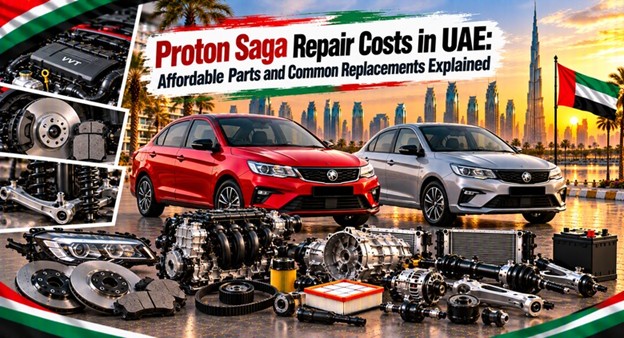
Proton Saga Repair Costs in UAE: Affordable Parts and Common Replacements Explained
October 13, 2026
The Proton Saga can be a remarkably inexpensive car to repair — right up until somebody orders the wrong part.
That sounds obvious, but it is where a surprising amount of repair money disappears. A brake pad is relatively straightforward. A bumper can usually be identified by shape, side and model year. Then you reach an automatic transmission, engine sensor, steering component or electronic module and suddenly the same-looking part may belong to another Saga generation, another engine, another transmission or another regional specification. The cheap component has become the expensive mistake.
And that matters in the UAE, where the Saga sits in an unusual position. It is not as heavily represented in the public parts market as Toyota, Nissan or Mitsubishi, yet specialist catalogues do list Saga applications across many production years, while general suppliers of Proton Saga spare parts in UAE carry the ordinary service categories — brakes, filters, electrical items, suspension and body components. The result is a market in which some repairs can be handled economically, while others demand considerably more checking before anyone reaches for a spanner.
The sensible question, then, is not simply “How much does a Proton Saga part cost in the UAE?”
It is: which Saga, which part, which condition, and what is the complete repair going to cost once the car is back on the road?
Why Saga repairs can still be relatively affordable
The Saga has never been built around exotic engineering. That helps.
Older Saga versions used relatively conventional four-cylinder petrol engines, front-wheel drive and uncomplicated transmission layouts. A published Saga specification for one established generation, for example, lists a 1.3-litre four-cylinder DOHC engine producing 95 PS and 120 Nm, with either a five-speed manual or four-speed automatic transmission.
That matters because straightforward mechanical architecture generally gives independent workshops more room to diagnose, repair and source components without turning every fault into a manufacturer-level parts exercise.
But don't confuse simple with interchangeable.
Saga production spans several generations, and current parts catalogues show applications stretching from older cars through 2026 model years. The badge on the boot therefore gets you only halfway there.
The rest is identification.
The first mistake: treating every Saga as the same car
A Saga from one generation can share very little beyond its name with another.
Engine capacity can change. Transmission type can change. Suspension components can change. Brake hardware can change. Electrical connectors can change. Even when two components perform the same job, their physical dimensions or mounting arrangement may differ.
That is why “Proton Saga spare parts” is a useful starting search but a poor final specification.
Give the supplier the model year, generation, engine, transmission and VIN wherever possible. If the old component has a part number, photograph that too.
It takes a few minutes.
A wrong suspension arm can take considerably longer to undo.
The Saga generation question changes the repair bill
The older 1.3-litre Saga specification is particularly useful as a warning because it shows how much the drivetrain can vary within the nameplate: five-speed manual and four-speed automatic versions existed alongside one another.
Then the newer Saga generation moved into different powertrain territory. The 2025/2026 Saga range introduced a 1.5-litre naturally aspirated engine, with the Standard and Executive using a four-speed automatic while the Premium uses a CVT.
So imagine somebody asks for “a Saga gearbox”.
Which one?
That single missing word — which — is where the repair estimate begins to split.
What counts as an affordable Saga repair in the UAE?
The cheapest repairs are usually the ones where the part is routine, the application is clear and fitting does not trigger a second repair.
Filters are a good example. Brake pads can be another. Some suspension bushes, batteries, belts or conventional service components can also remain relatively manageable, particularly where aftermarket equivalents exist and the application is properly confirmed.
The wider UAE market gives a useful sense of the scale, although these figures should not be presented as Proton Saga quotations. A current UAE parts guide places aftermarket brake-pad sets broadly around AED 150–400, shock absorbers around AED 180–500 each and batteries around AED 250–500, while another UAE market guide puts those categories into similarly broad bands.
Those are market benchmarks, not Saga-specific prices.
That distinction is worth keeping.
Brake pads are cheap until you compare what is actually in the box
Brake work is one of the easiest places to chase a low headline price.
A current UAE brake-cost observation published in September 2026 found advertised entry prices of roughly AED 150–250 for a pad replacement at two Dubai workshops, excluding VAT. Those were workshop-specific advertised figures, not a Saga-specific survey.
Another UAE brake guide records promotional offers below that level as well, while noting that the market varies substantially according to vehicle and component choice.
So if somebody offers to “do the brakes” for a suspiciously low amount, ask the dull questions.
Pads only?
One axle?
Discs included?
Brake cleaning?
Fitting?
VAT?
Which manufacturer?
The boring questions are usually the useful ones.
Brake discs need diagnosis, not automatic replacement
A Saga that shudders under braking does not automatically need new discs.
The workshop should establish whether the vibration is actually brake-related and then inspect disc condition, thickness, run-out, pad wear, caliper operation and wheel installation. A sticking caliper, uneven pad deposit or wheel-related problem can imitate a more expensive disc fault.
This is where repair cost becomes diagnostic cost.
Spending AED 100–250 on proper inspection before ordering parts can be considerably cheaper than buying discs, fitting them, discovering the vibration remains and then paying again.
Don't let the symptom choose the part.
Suspension repairs can stay sensible — if the noise is identified correctly
Knocking over uneven roads is a familiar complaint in older cars, but “suspension noise” describes a symptom, not a failed component.
The culprit could be a stabiliser link, bush, ball joint, control arm, shock absorber, top mount or even something loose around the underbody.
Current UAE general-market guidance places aftermarket shock absorbers broadly in the low hundreds of dirhams per unit, although the actual Saga component can differ substantially by generation and supplier.
A competent inspection should therefore identify where the movement is coming from before all four corners of the car become a parts-shopping exercise.
Shock absorbers: replace in pairs when the evidence supports it
A worn damper can affect ride control, braking behaviour and tyre contact, but that does not mean every shock absorber with a little age on it is immediately defective.
Look for leakage, poor damping, uneven tyre wear, abnormal bouncing and mechanical play, then compare left and right behaviour.
If one front damper has genuinely failed, replacing only one may leave the axle with noticeably different damping characteristics. The correct approach depends on the condition of the opposite unit, the vehicle's mileage and the manufacturer's/service recommendation.
Cheap parts are useful.
Cheap decisions are not.
Engine repairs start with a diagnosis, not an engine quotation
An engine that runs badly can frighten an owner into accepting a replacement-engine quote remarkably quickly.
Don't.
Poor starting, rough idle, loss of power, overheating, oil consumption or a check-engine light can originate from very different systems. A sensor, ignition fault, fuel-delivery problem, vacuum leak, cooling problem or compression issue can create symptoms that look far more serious than the underlying repair.
Before an engine is condemned, the workshop should establish what has actually failed.
Depending on the symptom, that may mean fault-code scanning, live-data analysis, compression testing, leak-down testing, oil-pressure measurement, cooling-system pressure testing, ignition inspection and fuel-system checks.
An engine replacement is a conclusion.
It should not be a guess.
The 1.3-litre Saga engine needs generation-specific parts
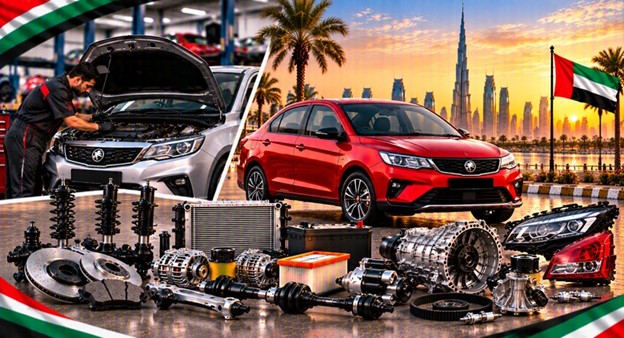
The established 1.3-litre Saga specification uses a 1,332 cc four-cylinder DOHC VVT engine with 95 PS and 120 Nm.
That gives a useful reminder when ordering components: an older 1.3-litre Saga is not automatically equivalent to every other 1.3-litre Proton.
Engine mounts, sensors, intake components, cooling parts, timing components and electrical items can vary according to generation and production specification.
The engine number and VIN are therefore more valuable than a vague description such as “Saga 1.3”.
If a supplier refuses to check them because “this one fits all Sagas”, pause.
The newer 1.5-litre Saga changes the equation again
The latest Saga generation moved to a 1.5-litre naturally aspirated petrol engine, producing around 118 hp and 150 Nm, with the transmission varying by trim.
That makes old and new parts catalogues especially dangerous to mix.
A 1.5-litre component appearing in a search result does not prove it belongs to the vehicle in your workshop bay. Nor does a photograph prove the connector, calibration or mounting arrangement is correct.
The newer powertrain may also be easier to source through current supply channels, but that is a market question rather than something a buyer should assume.
Check first.
Engine mounts are a small part with an annoying ability to waste money
An engine mount can produce vibration, clunking or excessive movement, yet the symptoms can overlap with drivetrain or suspension problems.
The part itself may be comparatively modest. Labour and misdiagnosis are where the bill starts creeping upwards.
A UAE listing previously observed for a Proton X70 engine mount, for example, showed AED 290, although it was out of stock when checked; it is not a Saga price, and it should not be repackaged as one. It is simply a useful illustration of why model-specific public pricing is often patchy.
For the Saga, insist on the correct mount reference and application.
Don't buy from the photograph.
Gearbox repairs deserve more suspicion than a gearbox replacement
A gearbox that slips, bangs, delays engagement or makes noise may have a mechanical fault. It may also have a fluid, linkage, sensor, hydraulic, electrical or adjustment problem.
Older Saga specifications include both manual and four-speed automatic transmissions, while newer models introduce different transmission arrangements, including CVT on the Premium version.
That is a substantial distinction.
Before a complete transmission is ordered, the workshop should identify the exact transmission, scan for relevant faults, inspect fluid condition where applicable, check for leaks, examine mounts and linkages, road-test the vehicle and establish whether the problem is mechanical or control-related.
A used gearbox can be a good purchase.
A used gearbox bought because “the old one feels bad” is a gamble.
UAE gearbox repair prices are broad — and Saga owners should use them carefully
One UAE workshop currently publishes a general gearbox-repair range from roughly AED 300 to AED 6,000, depending on vehicle and repair complexity. Another UAE service guide puts transmission repair considerably higher for major work and replacement.
Neither figure is a Proton Saga tariff.
That is precisely the point.
A price range copied from a general UAE repair website can provide context, but it cannot tell you what your Saga needs. A solenoid or linkage issue and a complete transmission overhaul are entirely different jobs.
Ask for the failed component and the proposed repair operation, not merely the phrase “gearbox problem”.
Air-conditioning work can look cheap until the compressor gets blamed
The UAE climate makes air-conditioning an everyday reliability issue, but hot weather itself is not a diagnosis.
Weak cooling can come from refrigerant loss, condenser airflow, pressure problems, electrical controls, sensors, compressor operation, expansion components or an evaporator issue.
A current UAE general parts guide places AC compressor prices broadly in the hundreds to low thousands depending on whether the unit is used, aftermarket or new OEM.
But don't order the compressor because the cabin is warm.
Check system pressures, compressor engagement/control, leaks, condenser condition, airflow and electrical operation first.
Otherwise the new compressor may arrive and the old fault will still be sitting there, quietly laughing.
Radiators and cooling components deserve the same discipline
A leaking radiator is one thing.
An overheating engine is another.
The two can overlap, but they are not interchangeable diagnoses.
A cooling system should be checked for leaks, pressure retention, coolant level and condition, fan operation, thermostat behaviour, hoses and signs of combustion gases where overheating has been severe.
A current UAE parts guide gives broad radiator ranges of roughly AED 350–800 for aftermarket units and AED 700–1,800 for new OEM parts across its general market sample.
Again, those are not Saga quotations.
Use them to understand market scale, then get a vehicle-specific price.
Batteries are one of the easiest Saga repairs to price — but specification still matters
Battery replacement is relatively simple compared with engine or transmission work, yet buyers still get caught by the cheapest number.
Capacity, physical dimensions, terminal layout and specification matter. So does the battery's manufacturing date and warranty.
A current UAE parts guide puts common 70–80 Ah batteries broadly around AED 250–500 aftermarket and AED 400–800 for new OEM-market examples, with considerable variation by brand and vehicle.
For a Saga, confirm the required specification rather than asking for “the cheapest battery”.
Five minutes of checking beats five months of starting trouble.
Filters and routine service parts are where genuine savings are easiest
This is where the Saga's relatively straightforward mechanical character can work in an owner's favour.
Oil filters, air filters, cabin filters, spark plugs and other routine service components are usually much easier to compare than a control module or transmission assembly. UAE parts catalogues currently show multiple Saga applications and a large aftermarket catalogue covering service, brake, filter, sensor and electrical categories.
That does not mean every aftermarket filter is equivalent.
Check specification, application and manufacturer quality. For engine oil, use the required viscosity and specification rather than simply choosing the cheapest bottle on the shelf.
Savings should come from informed substitution, not guesswork.
Body panels are often a better place to buy used
There is a useful dividing line in the used-parts market.
A used door shell, bonnet, wing or bumper can often be inspected physically. You can look at corrosion, previous repairs, mounting points, deformation and paint condition.
An electronic module is different.
A gearbox is different again.
A used body panel therefore carries a type of uncertainty that is much easier to see before purchase.
Current UAE general parts benchmarks place used front bumpers broadly around AED 200–700, although those figures cover multiple makes rather than the Saga specifically.
For a Saga accident repair, used bodywork can make financial sense — especially on an older car — provided the panel actually matches the generation and side.
Headlights are not always just plastic and glass
Older Saga lighting assemblies can be relatively straightforward compared with modern premium vehicles, but that does not justify buying the first matching-looking lamp.
Check mounting tabs, connector arrangement, bulb or LED configuration, left/right orientation and model year.
If the lamp contains integrated electronics, the question becomes broader still.
Was the component tested?
Does it include the required control hardware?
Does the vehicle require coding?
Has the connector been damaged in the accident?
The cheapest headlight is not necessarily the cheapest repair.
Electrical faults can turn a small part into a long diagnostic session
Intermittent electrical faults are where repair budgets go slightly feral.
A warning lamp may come from a sensor, wiring fault, connector, low battery voltage, communication problem or module fault. Replacing the sensor without testing the circuit can simply move the problem from one invoice to the next.
The workshop should scan the vehicle, identify relevant codes, check live data where appropriate and inspect power, ground and wiring before condemning an electronic component.
If the component is used, ask whether it has been tested and whether the supplier accepts a return if the module is incompatible.
Electronic parts need evidence.
Not optimism.
Used versus aftermarket versus genuine: the cheapness hierarchy is misleading
There are at least four different buying decisions hiding inside the phrase “replacement part”.
Genuine new gives you the strongest route to original specification, but usually at a higher purchase price.
Aftermarket new can be sensible when the manufacturer is reputable and the component is properly specified.
Used genuine can be excellent for some mechanical and body components, especially where a new part is disproportionately expensive.
Reconditioned depends almost entirely on what was actually rebuilt, which components were replaced, how it was tested and what warranty accompanies the work.
There is no universal winner.
A used bumper and a used engine should not be judged by the same logic.
The UAE price evidence is better for categories than for Saga-specific components
This is one of the awkward truths buyers need to hear.
Public UAE pricing for common car parts is available, but Proton Saga-specific retail pricing is much thinner. One UAE parts catalogue currently lists Saga applications from 1991 through 2026 and offers genuine and aftermarket categories, while individual displayed prices can vary by supplier and product.
That means a sensible article cannot honestly claim that “a Proton Saga alternator costs exactly AED X” unless a current, model-specific listing supports that number.
Instead, use three layers of evidence:
- a verified Saga part application;
- a current UAE quotation;
- the complete installed repair cost.
That produces a useful number.
A random internet price does not.
Labour can quietly overtake the part price
Consider a modest component costing AED 250.
If fitting takes little time and no calibration or supporting work is needed, the final bill may remain modest.
Now imagine a component costing AED 700 that requires extensive dismantling, diagnostic work, programming or additional parts. Suddenly the more expensive component may be the cheaper repair.
This is why part-price comparisons alone are a trap.
Ask for:
part + labour + diagnostics + consumables + programming/calibration + VAT + any required supporting parts.
Then compare.
The cost of getting the wrong Saga part
This is where the bargain turns sour.
You order a component because the photograph looks right. It arrives. The connector differs. The mounting hole is somewhere else. The supplier says it was ordered according to the information provided. The workshop has already dismantled the car.
Now you have a return, a delay, possibly a delivery charge and another labour operation.
The original “cheap part” has acquired administrative baggage.
Before buying, give the supplier the VIN, exact model year, engine, transmission, part number if available, and a photograph of the old component. For major assemblies, ask for the donor vehicle details and confirmation of compatibility in writing.
Do the paperwork before the car is on the ramp.
What a UAE workshop should check before expensive replacement
For a Saga with an expensive suspected failure, a useful diagnostic sequence might include:
- fault-code scan;
- visual and physical inspection;
- live-data checks where relevant;
- battery and charging-voltage assessment;
- fluid and leakage inspection;
- compression or leak-down testing for serious engine complaints;
- cooling-system pressure testing where overheating is involved;
- transmission road test and control-system diagnosis;
- suspension play and damper inspection;
- electrical power, ground and connector testing;
- post-repair road test.
Not every car needs every test.
That is the point.
A good diagnosis is selective. It follows the symptom instead of throwing every available test at the vehicle.
When repairing the original component makes more sense
Repair can beat replacement when the original assembly is fundamentally sound and the failed element is identifiable.
A starter motor, alternator, certain suspension components, air-conditioning systems and some transmission faults can fall into this territory, depending on the actual failure.
But “repairable” does not mean “repair it at any price”.
Compare the repair quotation with a tested used replacement and a new aftermarket or genuine alternative. Include warranty, downtime and the likelihood of doing the labour twice.
If a repaired component saves AED 400 but carries little warranty and another failure would require the same AED 700 labour operation, the apparent saving may be paper-thin.
When a new part is the more rational choice
New is particularly attractive where failure creates a safety issue, where reliability matters more than a small saving, or where a used component has an uncertain service history.
Braking hardware is the obvious example, although reputable aftermarket products can sometimes make more sense than expensive genuine parts.
Sensors and electronic modules require more nuance. A new aftermarket module is not automatically better if it is poorly matched to the vehicle.
The decision should follow the component's failure consequences.
Spend the money where failure hurts.
Save it where inspection gives you confidence.
A simple Saga repair-cost decision matrix
| Repair situation | Usually worth considering | What must be checked |
|---|---|---|
| Brake pads | New genuine or reputable aftermarket | Correct axle/application, pad specification |
| Brake discs | New or resurfacing where appropriate | Thickness, run-out, condition |
| Shock absorbers | New pair where required | Leakage, damping, opposite-side condition |
| Body panel | Used genuine or aftermarket | Generation, side, damage, mounting points |
| Headlight | New or tested used | Connector, mounting, specification |
| Battery | New | Capacity, dimensions, terminal layout, warranty |
| Alternator | Repair, tested used or new | Charging diagnosis, output, pulley/electrical condition |
| Starter | Repair or replacement | Current draw, engagement, electrical supply |
| Engine | Repair or tested replacement | Compression, leak-down, oil pressure, cooling |
| Gearbox | Diagnosis/repair or tested replacement | Exact transmission, symptoms, fluid, codes, road test |
| ECU/module | New, tested used or specialist repair | VIN compatibility, programming, immobiliser/coding |
The matrix is deliberately conservative.
A cheap part is only cheap if it solves the problem.
How to compare three Saga repair quotations properly
Don't collect three numbers and choose the middle one.
Collect three like-for-like scopes.
Ask each workshop to state the exact part, condition, manufacturer or source, labour, diagnostics, additional materials, warranty and VAT. If one quotation says “gearbox AED 2,500” and another says “transmission repair AED 4,000”, you are not comparing prices; you are comparing sentences.
Ask what has actually failed.
Ask what remains uncertain.
Ask what happens if the diagnosis changes after dismantling.
Those questions tend to expose the real cost surprisingly quickly.
Where PartFinder UAE fits into the buying decision
For owners comparing available Saga components, PartFinder UAE can be useful as part of the sourcing stage, particularly when the choice is between used and new replacement routes.
But sourcing should come after identification.
VIN first. Model and year next. Engine and transmission after that. Part reference where available. Then condition, price, warranty and return terms.
That sequence sounds painfully methodical.
It is also much cheaper than buying twice.
Is a Proton Saga still cheap to repair in the UAE?
For routine mechanical work, it can be.
The car's conventional engineering on many generations, relatively modest component sizes and availability of aftermarket categories can help keep ordinary maintenance under control. UAE parts catalogues currently show Saga applications across a very broad production range, including filters, brakes, sensors and electrical components.
But the economics become less comfortable when a vehicle-specific component is scarce, when a major assembly is involved, or when the wrong generation is ordered.
The Saga can be inexpensive to keep running.
It is not magically immune to bad parts sourcing.
The repair bill should be judged against the car, not just the component
Suppose an older Saga needs AED 1,500 of suspension work.
That might be sensible.
Suppose the same car needs a major engine repair, transmission work, air-conditioning overhaul and accident damage at the same time.
Now the calculation changes.
Repair economics are cumulative. The owner should consider current vehicle condition, mileage, body condition, tyres, cooling system, electrical health and expected future use. Spending AED 2,000 on a good car is very different from spending AED 2,000 on a car that already needs another AED 5,000 of deferred work.
The cheapest individual repair can therefore be the wrong financial decision.
The sensible UAE Saga buyer asks one more question
Before approving an expensive replacement, ask:
“What evidence proves this is the failed part?”
Not what symptom suggests it.
Not what another Saga supposedly needed.
Not what the supplier has sitting on the shelf.
What evidence?
That might be a failed electrical test, abnormal compression, confirmed leakage, excessive mechanical play, a verified fault code supported by live data, physical damage or a transmission diagnosis backed by road testing.
The answer should be specific.
If it isn't, keep asking.
A practical Proton Saga repair checklist
Before ordering any non-routine replacement, confirm:
- Exact Saga model year.
- Generation or chassis/application.
- Engine size and engine code where available.
- Transmission type.
- VIN.
- Original part number, if visible.
- Left/right or front/rear position.
- Genuine, aftermarket, used or reconditioned status.
- Supplier's testing procedure for used parts.
- Warranty period.
- Return conditions.
- Delivery time.
- Labour charge.
- Diagnostics included or separate.
- Programming/calibration requirements.
- VAT.
- Supporting parts, fluids or seals.
- Whether the workshop has confirmed the original component has actually failed.
That final question matters more than most buyers expect.
For UAE buyers comparing several routes, PartFinder UAE can be useful as part of that wider parts-search process, provided the final fitment is still confirmed against the vehicle rather than assumed from a generic model name.
The cheapest Saga repair is usually the one you don't have to repeat
There is nothing wrong with saving money on a Proton Saga.
In fact, that is part of the appeal.
Use a good aftermarket filter where it makes sense. Buy a properly identified used body panel. Consider a tested used mechanical assembly for an older car. Repair an original component where the economics and workmanship stack up. There are plenty of sensible ways to keep the bill down.
Just don't confuse low purchase price with low repair cost.
The part has to fit. The diagnosis has to hold up. The workshop has to install it properly. And the final number has to include the things that mysteriously appear after the first quotation — labour, fluids, diagnostics, VAT, programming, calibration and the inevitable little bits.
That's the real affordability test.
UAE Update Reference: October 2026
Current UAE parts-market and repair-price observations referenced in this article were checked in October 2026. Public Saga-specific component pricing remains less transparent than pricing for mainstream UAE-market Japanese and Korean models, so general UAE price ranges have been identified as market benchmarks rather than Proton Saga quotations. Current Saga specifications also span substantially different generations and transmission configurations, making VIN/application verification essential before using any advertised part price.
Frequently Asked Questions
Categories
- Audi
- BMW
- Car Accessories
- Car Tips
- Ford
- Land Rover
- Mazda
- Range Rover
- Top 10
- UAE Car Parts
- Used Car Parts
- Toyota
- Replacement Engines
- Nissan
- Hyundai
- Mitsubishi
- Volkswagen
- Honda
- Kia
- Chevrolet
- Dodge
- Jeep
- Subaru
- Renault
- Lexus
- Mercedes
- Suzuki
- Hummer
- Porsche
- Infiniti
- Peugeot
- GMC
- Mini
- Volvo
- Replacement Gearboxes
- MG
- Jaguar
- Skoda
- Cadillac
- Daihatsu
- Fiat
- German Car Parts
- Japanese Car Parts
- Aftermarket Car Parts
- Genuine Car Parts
- New Car Parts
- Reconditioned Car Parts
- European Car Parts
- American Car Parts
- Korean Car Parts
- British Car Parts
- Chinese Car Parts
- Sports/Exotic Car Parts
- Luxury Car Parts
- Performance Car Parts
- SUV/4x4 Spare Parts
- Truck Spare Parts
- EV Car Parts
- Hybrid Car Parts
- Auto Spare Parts in UAE
- Tesla
- Isuzu
- Ram
- Ferrari
- Bentley
- Lamborghini
- Genesis
- Maserati
- Lincoln
- Chrysler
- Opel
- Citroen
- SsangYong
- Seat
- McLaren
- Aston Martin
- Rolls Royce
- Maybach
- Alfa Romeo
- Bugatti
- Scion
- Abu Dhabi Car Parts
- Ajman Car Parts
- Al Khan Car Parts
- Al Sajaa Car Parts
- Deira Car Parts
- Dubai Car Parts
- Fujairah Car Parts
- Industrial Area 6 Car Parts
- Mussafah Car Parts
- Ras Al Khaimah Car Parts
- Sharjah Car Parts
- Umm Al Quwain Car Parts
- Acura
- BYD
- Chery
- Dacia
- DS
- Geely Emgrand
- EXEED
- GAC
- GAC Gonow
- Geely
- Gonow
- Great Wall
- Haima
- Haval
- Holden
- Iveco
- JAC
- Jaecoo
- Jetour
- Lotus
- Omoda
- Proton
- Renault Samsung
- Roewe