Range Rover Alternator Replacement in UAE: Prices, Charging Faults and Buying Options
September 23, 2026
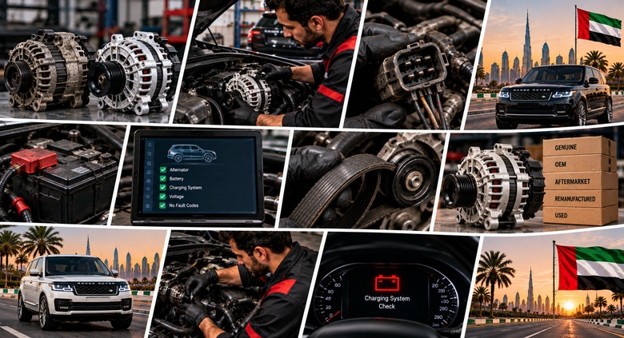
The Range Rover alternator replacement in UAE is rarely just a matter of removing a failed alternator and bolting in another one. On a Range Rover, the charging system works alongside the battery, belt drive, voltage regulation, wiring and vehicle energy-management systems, so a weak charging result can come from several places. In Dubai, Abu Dhabi or Sharjah, getting the diagnosis right before ordering the part matters just as much as choosing the correct alternator.
A Range Rover can have a perfectly healthy alternator and still throw a battery warning. That sounds backwards, but it happens more often than people expect. A weak battery, loose connection, slipping auxiliary belt, voltage-control problem, poor ground, excessive electrical load or a charging-system fault elsewhere can all muddy the picture.
So don't let a dashboard battery symbol push you straight towards buying an alternator.
Test the charging system first. Then buy the part.
That matters even more with Range Rover because the alternator is tied into a wider electrical ecosystem, and newer vehicles have increasingly sophisticated battery-management and vehicle-network systems. Land Rover's own current software documentation refers to battery management and vehicle communication systems, while its workshop procedures use approved diagnostic equipment after battery-related work.
What the Range Rover alternator actually does
The alternator converts mechanical energy from the running engine into electrical energy.
It supplies electrical power to the vehicle while the engine is operating and helps maintain the 12V battery's state of charge. Lights, infotainment, climate-control equipment, engine electronics, pumps, modules — all of it ultimately depends on a stable electrical supply.
The battery starts the story. The alternator keeps the story going.
Why a Range Rover charging fault is not automatically an alternator fault
This is where diagnosis gets interesting.
Imagine the battery warning appears, the headlights dim slightly and the car struggles to restart after being parked. You could replace the alternator and discover that the real culprit was a failing battery or a poor connection.
Or the alternator might genuinely be dying.
You need measurements before you know which one.
L322 alternator replacement
The L322's long production run means alternator specifications vary substantially with engine and model year.
A 3.0 diesel is not simply an older version of a 5.0 V8 for parts purposes. Output rating, pulley arrangement, mounting, electrical connection and part number can differ.
Give the supplier the VIN and engine details before ordering.
L405 alternator replacement
The L405 introduced a newer generation of electrical architecture and a broader range of engines.
Diesel, supercharged petrol and later Ingenium applications can use different alternator specifications.
That is why “Range Rover spare parts in UAE OR Range Rover L405 alternator” is still too broad for a safe parts order.
L460 charging system
The L460 is a very different proposition again.
Current Land Rover documentation emphasises VIN-based vehicle information because model-year selection can display derivatives and optional equipment that are not necessarily fitted to the particular vehicle.
For a modern Range Rover, VIN verification isn't paperwork for the sake of paperwork. It is the sensible starting point.
Range Rover Sport needs its own fitment check
A Range Rover Sport alternator should be matched to the Sport's generation and engine rather than assumed compatible with the full-size Range Rover.
Current UAE parts listings, for example, show a specific 12V 150A Range Rover Sport 2010 application, LR124471, listed at AED 2,094.
That's a useful illustration of why the engine and model year matter.
Evoque alternators vary too
The Evoque is smaller, but its alternator is not automatically a simpler purchase.
A current UAE listing for an AUTOSTAR 14V 180A LR067840 application covers L359/L538/L550 derivatives and is listed at approximately AED 763.76 including VAT in the current listing.
Another UAE listing for a HELLA 14V 180A L538 alternator shows approximately AED 2,393.46.
Same broad component. Very different price territory.
The first charging-fault clue: the battery warning
A battery-shaped warning lamp or charging-system message is the obvious clue.
But it tells you that the charging system has a problem; it does not necessarily identify which component has failed.
That's an important distinction.
Dim headlights
Headlights that become noticeably dim at idle or fluctuate with engine speed can point towards charging instability.
Yet poor battery condition, bad grounds and wiring resistance can produce similar behaviour.
Measure first.
The battery keeps going flat
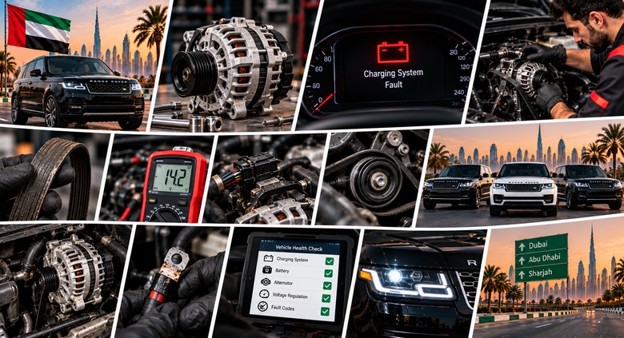
This is probably the symptom most owners notice.
The Range Rover starts normally one day, struggles the next, then needs a jump start. The obvious thought is “battery”.
But if a new battery repeatedly goes flat, stop buying batteries.
The charging system needs testing.
Slow electrical accessories
Windows, infotainment equipment, heated systems or other electrical functions behaving strangely can accompany low system voltage.
One odd window movement does not condemn the alternator, though.
Several unrelated electrical systems becoming unhappy at the same time is much more interesting.
Strange warning messages
Modern Range Rovers contain a large number of electronic control units.
When system voltage drops, several modules can complain at once. The resulting dashboard can look rather dramatic — multiple warnings, seemingly unrelated faults, maybe a message that disappears after restarting.
That does not mean all those systems have failed.
Low voltage can create a surprisingly noisy diagnostic picture.
A whining alternator
A worn alternator bearing can produce a whine that rises with engine speed.
The alternator pulley, belt, tensioner or another accessory can also make noises that seem to come from the same area.
Listen carefully before ordering anything.
Grinding or rough mechanical noise
A rough alternator bearing is more concerning than a faint electrical whine.
If the alternator is physically deteriorating, continued operation can eventually create belt-related problems as well.
A workshop should inspect the complete accessory drive rather than treating the alternator as an isolated component.
Burning smell near the belt drive
A hot rubber smell can indicate belt slip, friction or another accessory-drive problem.
It is not an alternator diagnosis.
But if the alternator pulley is binding, the belt may be working far harder than it should.
Don't keep driving around hoping the smell disappears.
Charging voltage: what should actually be tested?
A workshop should measure system voltage rather than simply saying “the battery looks weak”.
The useful test includes voltage with the engine off, voltage after starting, charging behaviour at idle and charging behaviour under electrical load.
Exact expected values depend on the vehicle's charging strategy, battery type and operating conditions, so a generic internet voltage number should not replace manufacturer-specific testing.
Test the battery separately
This is crucial.
A battery can be deeply discharged because of a failed alternator. It can also be internally defective and make a good alternator look suspicious.
Test the battery's state and condition independently.
Otherwise you are chasing your own tail.
Load-test the electrical system
Turn on appropriate electrical loads during diagnosis.
Headlights. Climate control. Heated equipment where applicable. Other significant consumers.
The technician wants to know whether the charging system remains stable when the vehicle actually has work to do.
Inspect the auxiliary belt
The alternator cannot do its job properly if the belt driving it is slipping.
Look for cracking, glazing, contamination, abnormal wear and incorrect tension.
On some Range Rover applications, belt and tensioner condition becomes part of the repair decision rather than an optional extra.
Check the tensioner and pulleys
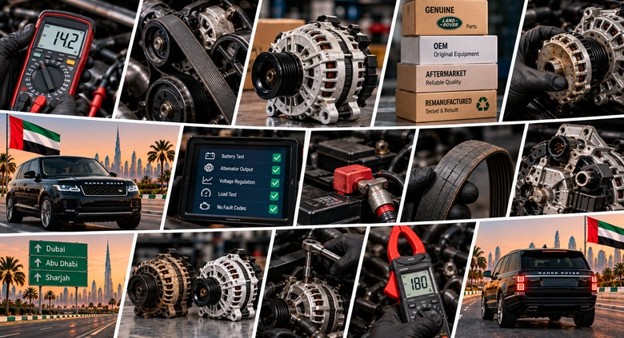
A worn tensioner can create belt movement and noise.
A damaged pulley can create vibration or belt tracking problems.
Replacing the alternator while leaving a failing tensioner in place is a classic “new part, same problem” scenario.
Check the alternator connector
Modern alternators can use control connections in addition to their primary power connection.
Inspect the plug, terminals, wiring and ground path.
A damaged connector can imitate an alternator failure, particularly if the fault is intermittent.
Check the main charging cable
The alternator may generate electricity perfectly well while a poor connection prevents that energy from reaching the battery and vehicle electrical system properly.
Inspect the positive charging cable and relevant connection points.
Corrosion, heat damage and loose terminals deserve attention.
Ground faults are easy to overlook
A poor engine-to-body or battery ground can cause strange charging behaviour.
It can also create misleading voltage readings depending on where the technician measures.
Good electrical diagnosis follows the circuit rather than guessing from the component name.
Alternator output rating matters
An alternator is not simply “12V”.
Current output matters.
The correct unit may be 150A, 180A, 200A or another rating depending on engine and vehicle specification.
For example, a current UAE listing identifies LR067840 as a 14V 180A alternator, while another Range Rover Sport listing identifies LR124471 as a 12V 150A unit.
That is why physical resemblance is not enough.
Pulley configuration matters too
Alternator fitment can involve pulley diameter, number of grooves and freewheel or overrunning pulley arrangements.
The current HELLA L538 listing, for instance, specifies a freewheel pulley with a 58 mm diameter and six grooves.
A supplier should therefore confirm the pulley specification rather than saying, “It fits Range Rover.”
Genuine Range Rover alternators
A genuine component is the factory-branded route.
For a newer or high-value Range Rover, some owners prefer that route because it keeps the replacement aligned with the original vehicle specification.
The drawback is obvious.
Price.
A genuine UAE listing for LR070718, identified for Range Rover Evoque applications and superseding to LR079255, is currently listed at AED 5,353.10.
That is a part-price reference, not a universal Evoque alternator price.
OE-supplier alternators
An OE-supplier component can sit between genuine and cheaper aftermarket options.
But don't rely on the phrase “OE quality” by itself.
Ask who made it, what its exact output rating is, what part numbers it replaces and what warranty comes with it.
The box matters less than what's inside it.
Aftermarket alternators
A reputable aftermarket alternator can cut the parts bill considerably.
Current UAE listings show a range of replacement options: one AUTOSTAR LR105985 application for Range Rover X760/X761/X540/L551/L560 is listed at about AED 1,043.68 including VAT, while another seller lists the same broad LR105985 application at AED 1,500.
That difference alone is a good reminder to compare specification, warranty and seller terms — not just the headline number.
Remanufactured alternators
A remanufactured alternator can be an economical middle ground.
But “remanufactured” needs unpacking.
Was the regulator replaced? Bearings? Slip rings? Rectifier? Pulley? Was the unit bench-tested under load?
If nobody can tell you what was actually done, you are buying a label.
Used genuine alternators
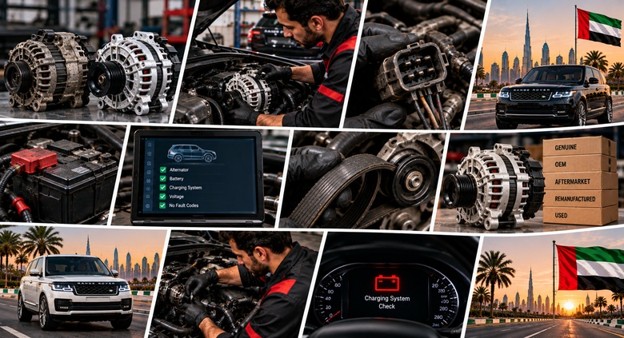
A used genuine alternator may make sense on an older L322, especially when the vehicle itself is no longer economically aligned with a high-priced new component.
One UAE listing, for example, shows a used 5.0 V8 Range Rover Sport alternator motor, part 8W83-10300-BA, at AED 600.
The catch? Used electrical parts need history.
Ask about donor mileage, donor vehicle, testing and return conditions.
Don't confuse an alternator with an alternator motor
Some used-parts listings describe the component as an “alternator motor”.
That wording can be misleading.
Find out whether you are receiving a complete alternator assembly or a component intended for rebuilding.
You don't want to discover after delivery that the regulator, pulley or other hardware is missing.
How much does Range Rover alternator replacement cost in Dubai?
As a September 2026 UAE market reference, one Dubai Range Rover specialist currently places complete alternator replacement at roughly AED 2,500–6,500, depending on model and specification. Its published breakdown puts basic older-model work around AED 2,500–3,500, standard Range Rover/Range Rover Sport work around AED 3,500–5,000, and higher-output applications around AED 5,000–6,500.
Another UAE specialist publishes a broader AED 1,600–4,000 replacement range, with genuine alternators around AED 1,800–3,500 and installation around AED 400–800.
These are published UAE market references, not fixed tariffs.
Why the quoted price can jump
The alternator itself may not be the expensive part of the job.
Access can add labour. A belt may need replacement. A tensioner may be worn. The battery may have been damaged by prolonged undercharging. Wiring might need repair.
A workshop quote of AED 4,000 and a parts listing of AED 1,500 are not necessarily contradictory.
They may simply cover different things.
A broader Dubai labour reference
A general Dubai alternator service provider currently advertises alternator replacement from AED 630, with actual pricing varying by vehicle and accessibility.
That is broad car-market context rather than a Range Rover-specific quote, so don't use it as a Range Rover budget by itself.
Separate the part price from the repair bill
This is the number buyers should actually write down.
Alternator price.
Diagnosis.
Labour.
Belt/tensioner if required.
Battery if damaged.
Electrical repairs.
VAT.
Once those are separated, the quote becomes much easier to judge.
Can a weak battery damage the new alternator?
A severely compromised battery can place unusual demands on the charging system.
More importantly, fitting a new alternator without identifying why the old charging system failed leaves the underlying problem unresolved.
Check the battery as part of the alternator diagnosis.
Can a bad alternator damage the battery?
Yes, prolonged undercharging can leave the battery deeply discharged and may shorten its useful life.
That is why a technician should test the battery after confirming an alternator fault rather than assuming the old battery is automatically reusable.
What about overcharging?
Overcharging is a different problem from simply not charging.
A voltage-control or regulator fault can produce excessive charging voltage, which can stress electrical components and the battery.
Again, measure it.
A battery warning does not tell you whether the system is undercharging, overcharging or intermittently losing the charging signal.
Intelligent charging changes the old-school test
Older vehicles can make alternator testing seem wonderfully simple: start engine, measure voltage, turn on headlights.
Modern Range Rovers are less obliging.
Charging strategy can involve electronic control and battery management, so the technician needs to interpret measured values in the context of the vehicle's operating state rather than applying one universal number.
Land Rover's current software documentation explicitly references battery-management functions and diagnostic improvements.
Battery registration and diagnostic procedures
Don't assume every Range Rover treats a battery replacement as a purely mechanical job.
Vehicle-specific procedures can involve diagnostic equipment and battery-management information.
Land Rover fitting documentation directs technicians to approved diagnostic equipment and references the vehicle's battery and charging-system procedures after battery-related work.
That doesn't mean every alternator replacement needs coding. It means the workshop should know the vehicle rather than guess.
UAE heat and alternator workload
Dubai traffic can be relentless.
Air conditioning runs hard, cooling fans cycle, electrical equipment stays busy and the vehicle can spend long periods idling or crawling through traffic. Heat also raises the temperature around the engine bay.
None of that proves an alternator has failed. It does, however, make proper charging-system inspection worthwhile on an ageing vehicle.
Stop-start traffic is particularly revealing
A Range Rover that behaves normally at motorway speed but starts showing low-voltage symptoms during prolonged urban driving deserves attention.
The charging system should be checked under realistic load and operating conditions.
Don't let a five-minute workshop idle test settle the matter if the original problem appears after forty minutes in traffic.
Don't ignore belt contamination
Oil contamination around the accessory belt can cause slip.
Coolant contamination can also affect belt behaviour.
If an alternator is replaced and the belt remains contaminated or damaged, the new component may not live a particularly happy life.
When alternator repair makes sense
Repair or rebuilding can be considered where the alternator housing and major mechanical components are sound and the fault is isolated to serviceable internals such as a regulator, bearings, rectifier or related components.
The economics depend on the exact alternator.
For an older Range Rover, rebuilding can sometimes be more attractive than buying a new genuine unit.
When complete replacement makes more sense
If the alternator has severe bearing damage, damaged windings, a badly worn slip-ring assembly or extensive internal failure, a complete replacement can be cleaner.
On a newer vehicle, the value of predictable fitment and warranty can outweigh the saving from an uncertain rebuild.
Before You Click Buy
Don't send a supplier only this message:
“Range Rover alternator price?”
Send the VIN, model year, exact variant, engine, existing alternator part number, output rating if visible, connector photograph and pulley details where available.
Then ask whether the quoted unit is genuine, OE-supplier, aftermarket, remanufactured or used.
That little bit of groundwork can save a remarkably irritating return-and-refund cycle.
Buying through a UAE parts marketplace
When using PartFinder UAE, the useful approach is to provide the VIN and existing alternator information first, then compare the available genuine, OE-supplier, aftermarket, remanufactured and used options against the vehicle's exact charging specification. The cheapest component is not automatically the cheapest repair once warranty, labour, compatibility and return risk are included.
A practical buyer decision matrix
| Situation | Option worth considering |
| Newer L460 with confirmed alternator failure | Exact VIN-matched genuine or reputable OE-supplier unit |
| Older L322 with a tight repair budget | Tested used, rebuilt or reputable aftermarket |
| L405 with high electrical load | Confirm exact output rating before choosing |
| Regulator fault only | Repair/rebuild may be worth investigating |
| Alternator mechanically damaged | Complete replacement usually makes more sense |
| Battery repeatedly goes flat | Test alternator and battery together |
| Belt/tensioner damaged | Repair accessory drive before judging new alternator |
| Imported Range Rover | VIN and original part number become especially important |
| Used alternator | Require donor information, testing and return terms |
| Two quotes differ sharply | Compare parts specification and labour line by line |
What should the workshop actually prove?
A proper charging diagnosis should establish whether the problem is coming from the alternator itself, the battery, belt drive, wiring, ground path, control circuit or another electrical-system component.
That means measurements.
Not “the battery light is on”.
Not “the alternator sounds old”.
And definitely not “we've seen this before”.
The useful repair is the one supported by the test result.
What should happen after the alternator is installed?
The charging system should be checked again after installation.
The belt should run correctly. Electrical connections should be secure. Charging behaviour should be verified under suitable loads. Diagnostic faults should be reviewed, and the battery should be reassessed if it has been subjected to prolonged undercharging.
If the original complaint happened during heavy traffic with the air conditioning running, reproduce those conditions where practical.
Otherwise, you have proved only that the car starts in a workshop.
FAQs
Categories
- Audi
- BMW
- Car Accessories
- Car Tips
- Ford
- Land Rover
- Mazda
- Range Rover
- Top 10
- UAE Car Parts
- Used Car Parts
- Toyota
- Replacement Engines
- Nissan
- Hyundai
- Mitsubishi
- Volkswagen
- Honda
- Kia
- Chevrolet
- Dodge
- Jeep
- Subaru
- Renault
- Lexus
- Mercedes
- Suzuki
- Hummer
- Porsche
- Infiniti
- Peugeot
- GMC
- Mini
- Volvo
- Replacement Gearboxes
- MG
- Jaguar
- Skoda
- Cadillac
- Daihatsu
- Fiat
- German Car Parts
- Japanese Car Parts
- Aftermarket Car Parts
- Genuine Car Parts
- New Car Parts
- Reconditioned Car Parts
- European Car Parts
- American Car Parts
- Korean Car Parts
- British Car Parts
- Chinese Car Parts
- Sports/Exotic Car Parts
- Luxury Car Parts
- Performance Car Parts
- SUV/4x4 Spare Parts
- Truck Spare Parts
- EV Car Parts
- Hybrid Car Parts
- Auto Spare Parts in UAE
- Tesla
- Isuzu
- Ram
- Ferrari
- Bentley
- Lamborghini
- Genesis
- Maserati
- Lincoln
- Chrysler
- Opel
- Citroen