Range Rover Evoque Replacement Engine in UAE: Complete Buyer's Guide to Costs, Engine Options, Installation and Long-Term Reliability
June 8, 2026
A replacement engine is rarely something owners plan for.
People budget for tyres. Brakes. Servicing. Perhaps even a suspension repair if the vehicle has covered serious mileage across Dubai, Abu Dhabi or Sharjah. An engine replacement, though, tends to arrive uninvited, usually after weeks or months of hoping that the warning signs might somehow disappear on their own.
They rarely do.
The interesting thing about a Range Rover Evoque engine failure is that it often catches owners at a strange point in the ownership journey. The vehicle may still look fantastic. The cabin still feels premium. The technology still works. From the outside, it remains a desirable luxury SUV.
Yet beneath the bonnet, the financial equation can suddenly change.
That is where many owners find themselves asking the wrong question.
They ask:
"How much does a replacement engine cost?"
A fair question.
But not the most important one.
The better question is this:
"Does replacing the engine make financial sense compared with every other option available to me?"
That single question can save thousands of dirhams.
Or cost them.
Because a replacement engine is not simply a mechanical repair. It is a long-term ownership decision. It affects reliability, resale value, future maintenance costs and, perhaps most importantly, whether the vehicle remains enjoyable to own over the next three, five or even seven years.
A poorly chosen engine can turn ownership into an endless cycle of workshop visits.
A properly chosen engine can make an Evoque feel years younger.
The difference matters.
Particularly in the UAE.
Why Range Rover Evoque Owners in the UAE End Up Needing an Engine Replacement
People often blame engine failures on mileage.
Mileage certainly plays a role.
Yet after speaking with workshop managers across Dubai, Abu Dhabi, Ajman and Ras Al Khaimah, a different pattern emerges. High mileage alone rarely kills an engine. Neglect does. Overheating does. Delayed maintenance does.
And the UAE has a remarkable ability to expose all three.
Think about a typical summer afternoon.
The temperature outside is approaching 45°C. Traffic is barely moving. The air-conditioning is working relentlessly. Heat is radiating from the road surface. Every major system inside the vehicle is working harder than it would in many other parts of the world.
That environment is unforgiving.
A healthy cooling system usually copes without complaint.
A compromised cooling system does not.
Small coolant leaks that might go unnoticed elsewhere can quickly become major problems in Gulf conditions. A failing water pump, damaged radiator, blocked coolant passage or faulty thermostat can trigger overheating events that place enormous stress on the engine.
Sometimes the damage is immediate.
Sometimes it develops slowly over months.
Owners may notice rising temperatures, coolant loss, rough running or warning lights. In other cases, there may be little warning before serious internal damage occurs.
Once overheating reaches a critical point, the consequences can be expensive.
Cylinder head damage.
Warped components.
Head gasket failure.
Scored cylinders.
Bearing damage.
In severe cases, complete engine seizure.
At that stage, repairing individual components may no longer be financially sensible.
Replacement becomes the more practical option.
Common Causes of Evoque Engine Failure
While every case is different, several issues appear repeatedly in workshop inspections across the UAE.
Cooling System Failures
Cooling-related problems remain one of the leading causes of major engine damage.
Leaks, failing pumps, cracked expansion tanks and neglected coolant maintenance can all contribute to overheating.
Many owners underestimate how quickly a minor cooling issue can escalate during UAE summers.
Oil Starvation
Modern Evoque engines rely heavily on proper lubrication.
Low oil levels, delayed oil changes or poor-quality lubricants can accelerate wear on critical internal components.
Turbocharged engines are particularly vulnerable because the turbocharger itself depends on a constant supply of clean oil.
When lubrication breaks down, expensive damage often follows.
Timing Chain Problems
Certain Evoque engine variants have experienced timing chain-related concerns over the years.
If ignored, timing chain wear can lead to poor engine performance, unusual noises and, in extreme situations, catastrophic internal damage.
Early diagnosis is essential.
Unfortunately, many owners continue driving after symptoms appear.
Turbocharger Failure
Turbochargers operate under intense heat and pressure.
When they fail, debris can sometimes enter the engine system, creating secondary damage that significantly increases repair costs.
A failed turbo alone may be repairable.
A failed turbo that damages the engine often changes the conversation entirely.
Lack of Preventive Maintenance
This remains the most avoidable cause of engine failure.
Skipping scheduled servicing may save money in the short term.
It rarely saves money in the long term.
Routine inspections often identify developing issues before they become major mechanical failures.
When maintenance is delayed repeatedly, small problems gain time to become expensive ones.
Signs Your Range Rover Evoque May Need an Engine Replacement
Not every engine problem requires a replacement.
In fact, many do not.
That is why proper diagnosis matters before making any major financial decision.
However, certain warning signs suggest that the engine may have suffered damage severe enough to justify replacement rather than repair.
Persistent Knocking or Internal Engine Noise
Engines naturally produce mechanical sounds.
Heavy knocking is different.
A deep metallic knocking noise often indicates internal wear involving bearings, connecting rods or crankshaft components.
These repairs can become extremely expensive because they require extensive engine disassembly.
In some situations, replacing the engine becomes more cost-effective than rebuilding it.
Excessive Exhaust Smoke
Different smoke colours often point to different problems.
Blue smoke may indicate oil burning.
White smoke can suggest coolant entering the combustion chamber.
Black smoke may indicate fuel system issues.
Occasional smoke is one thing.
Continuous smoke combined with poor performance is another.
When severe internal wear exists, replacement may become the most practical solution.
Significant Loss of Power
A noticeable reduction in acceleration, responsiveness or overall performance should never be ignored.
Power loss can result from numerous causes.
Some are relatively minor.
Others indicate serious internal engine damage.
Professional inspection is essential to determine the true cause.
Metal Particles in Engine Oil
Few findings concern technicians more than metal contamination in engine oil.
Metal fragments often indicate internal component wear.
Bearings, pistons, cylinder walls and crankshaft surfaces may all be affected.
Once widespread internal wear is confirmed, rebuilding costs can rise rapidly.
Repeated Overheating
One overheating incident may not destroy an engine.
Repeated overheating often does.
If an Evoque continues experiencing temperature-related issues despite repairs, technicians may discover deeper internal damage that cannot be economically repaired.
Engine Seizure
This represents one of the most serious outcomes.
A seized engine typically means internal components have locked due to overheating, lubrication failure or catastrophic mechanical damage.
At this stage, replacement is usually the most realistic path forward.
Repair, Rebuild or Replace: Understanding Your Options
One of the biggest mistakes owners make is assuming replacement is automatically the correct answer.
It is not.
The right decision depends on the extent of damage, vehicle condition, ownership goals and overall costs.
Before committing to a replacement engine, it is worth understanding all available options.
Option 1: Engine Repair
Repairs make sense when damage is isolated.
For example, replacing a water pump, repairing a cooling system leak or fixing a turbocharger issue may restore normal operation without major engine work.
This is typically the least expensive route when the underlying engine remains healthy.
The challenge is ensuring that hidden damage has not already occurred.
Option 2: Engine Rebuild
A rebuild involves dismantling the engine and replacing worn or damaged internal components.
This approach can work well when the engine block remains usable and damage is limited to specific areas.
However, rebuild costs can vary dramatically.
Labour requirements are substantial.
Parts availability may affect timelines.
And the final cost sometimes approaches the price of a replacement engine.
That is why detailed quotations are essential before proceeding.
Option 3: Engine Replacement
Replacement becomes attractive when damage is extensive or when rebuilding costs become difficult to justify.
Instead of repairing multiple internal components, the entire engine assembly is replaced with another unit.
For many UAE owners, this option offers a clearer path back to reliable motoring.
The key is selecting the correct replacement engine and ensuring professional installation.
That decision will ultimately influence reliability, performance and long-term ownership costs.
In the next section, we will examine the different types of Range Rover Evoque replacement engines available in the UAE, including used engines, reconditioned engines and remanufactured options, along with the advantages and disadvantages of each.
Understanding the Different Range Rover Evoque Replacement Engine Options Available in the UAE
The moment most owners hear the words "replacement engine", they immediately start searching for prices.
That is understandable.
Yet focusing on price before understanding the available engine options is a bit like buying a property after looking only at the monthly mortgage payment.
The number matters.
It just isn't the whole story.
The UAE market offers several different routes for Evoque owners. Some prioritise reliability. Some prioritise affordability. Some sit somewhere in the middle.
The challenge is knowing which option aligns with your ownership plans.
Because the best engine for someone planning to sell their vehicle within twelve months may be completely different from the best engine for someone intending to keep it for another five years.
That distinction matters more than many buyers realise.
Genuine Range Rover Evoque Replacement Engines
Let's start with the option most people instinctively trust.
A genuine engine.
In theory, this sounds like the simplest solution. Factory specifications. Original engineering standards. Strong compatibility confidence.
Few surprises.
The downside, of course, is cost.
Genuine engines are typically the most expensive route available. Availability can also become a factor depending on the specific Evoque model and engine variant.
That does not automatically make them poor value.
Quite the opposite.
For owners planning long-term ownership, particularly those who intend to keep the vehicle for several more years, the higher upfront investment may provide greater confidence and potentially stronger resale appeal later.
Peace of mind has a value of its own.
OEM Engines
The term OEM causes confusion because many buyers assume OEM and genuine mean exactly the same thing.
They don't.
OEM refers to Original Equipment Manufacturer.
In simple terms, these are engines or major parts produced by the same manufacturers responsible for supplying components used during vehicle production.
The branding may differ.
The engineering standards often do not.
For many UAE owners, OEM options occupy an attractive middle ground.
Quality remains high.
Compatibility is usually strong.
Costs are often lower than genuine alternatives.
That combination explains why OEM solutions continue attracting attention from experienced buyers.
Reconditioned Engines
Now things become more interesting.
And more complicated.
The phrase "reconditioned engine" can mean very different things depending on who is using it.
One workshop may perform a comprehensive rebuild involving extensive inspections, machining processes, replacement internal components and detailed testing procedures.
Another may use the same term rather generously.
This is where buyer diligence becomes essential.
A properly reconditioned engine can represent outstanding value.
A poorly reconditioned engine can become an expensive lesson.
The difference usually lies in documentation, workmanship standards and transparency.
Always ask questions.
Lots of them.
The answers often reveal more than the sales pitch.
Used Engines
Used engines remain popular throughout the UAE for one simple reason.
Cost.
They frequently offer the lowest entry point into an engine replacement project.
That does not make them automatically risky.
Nor does it make them automatically sensible.
Everything depends on the individual engine.
A low-mileage used engine with documented history may prove an excellent purchase.
A cheap engine with an uncertain background may create more problems than it solves.
The challenge is that buyers often focus on the purchase price while underestimating the financial consequences of installing the wrong engine.
Cheap mistakes have a habit of becoming expensive repairs.
Genuine vs OEM vs Reconditioned vs Used: Which Delivers the Best Value?
This is where conversations become interesting.
Because the best-value engine is not always the cheapest engine.
Nor is it always the most expensive.
Value exists somewhere between purchase price, reliability expectations, future ownership costs and risk.
That balance looks different for every owner.
Consider two Evoque drivers.
One plans to keep the vehicle for another six years.
The other intends to sell it next year.
Should they buy the same replacement engine?
Probably not.
Their objectives are different.
Their risk tolerance is different.
Their ownership horizon is different.
The sensible decision changes accordingly.
For Long-Term Owners
If your objective is stability, reliability and long-term confidence, genuine or high-quality OEM solutions generally deserve serious consideration.
The upfront cost may be higher.
Yet long-term ownership is often won through consistency rather than initial savings.
Repeated workshop visits quickly erase bargain purchases.
For Budget-Conscious Owners
A professionally reconditioned engine can offer an attractive compromise.
The key word there is professionally.
Documentation matters.
Testing matters.
Warranty support matters.
Without those elements, assessing value becomes significantly harder.
For Short-Term Ownership
Some owners simply need a practical solution that restores vehicle operation without maximising investment.
A carefully selected used engine may satisfy that objective.
The emphasis, however, remains on careful selection.
Blind optimism is not a sourcing strategy.
Range Rover Evoque Replacement Engine Cost in UAE: What Should Owners Expect to Pay?
This is usually the section readers jump to first.
Human nature.
Yet pricing discussions become far more useful once buyers understand the available engine options.
Because replacement-engine costs vary enormously.
There is no single UAE-wide price.
Anyone claiming otherwise is oversimplifying the situation.
Engine pricing depends on multiple variables.
Model year.
Engine variant.
Mileage.
Condition.
Availability.
Warranty coverage.
Country of origin.
Documentation.
Market conditions.
Even timing can influence pricing.
Certain engine variants become easier to source at particular periods. Others become unexpectedly scarce.
Supply affects everything.
The Mistake Many Buyers Make
A surprising number of owners compare engines using only one number.
Purchase price.
Nothing else.
That approach often produces misleading conclusions.
Imagine two replacement engines.
One costs significantly less.
The other costs more but includes stronger warranty coverage, lower mileage, better documentation and greater installation confidence.
Which one is actually cheaper?
The answer depends on what happens after installation.
That is the part many buyers overlook.
Looking Beyond the Engine Price
The engine itself is only one piece of the project.
A complete budget may also involve:
- Labour costs
- Diagnostic procedures
- ECU-related work
- Fluids and filters
- Cooling-system servicing
- Sensor replacement
- Engine mounts
- Turbocharger inspections
- Additional supporting parts
Suddenly the equation becomes more complex.
And more realistic.
Because owners do not buy engines.
They buy outcomes.
A replacement engine that performs reliably for years delivers a very different ownership experience from one that generates ongoing problems.
Engine Availability Across the UAE
Availability also influences costs.
Popular Evoque engine variants generally offer more sourcing opportunities across Dubai, Sharjah and Abu Dhabi.
Rarer variants may require broader sourcing efforts, including imported inventory.
Imported engines can sometimes provide excellent value.
They can also introduce additional considerations.
Shipping.
Inspection requirements.
Lead times.
Compatibility verification.
None of these are necessarily problems.
They simply need accounting for during the decision-making process.
The Better Question
Rather than asking:
"What is the cheapest replacement engine available?"
A smarter question might be:
"Which replacement engine is most likely to deliver the lowest ownership cost over the next five years?"
That is a very different conversation.
And usually a far more profitable one for the owner.
Labour Costs, Installation Charges and What a Range Rover Evoque Engine Replacement Really Costs in the UAE
This is usually the point where owners discover that the engine itself is only part of the bill.
A large part, certainly.
But only part.
Many people begin researching replacement engines expecting a single price. They want a number. Something simple. Something definitive.
Unfortunately, engine replacement projects rarely behave that way.
The final cost depends on dozens of variables.
Engine type.
Vehicle condition.
Labour requirements.
Supporting parts.
Electronic programming.
Cooling-system condition.
Even the workshop itself.
That is why two owners with seemingly identical Evoques can receive dramatically different quotations.
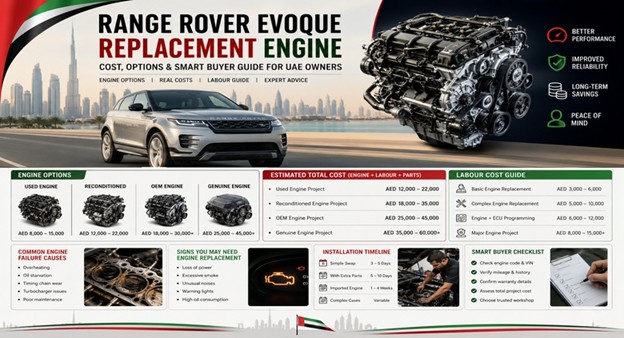
Typical Range Rover Evoque Engine Price Comparison in UAE
| Engine Type | Typical Engine Price (AED) | Ownership Profile |
| Used Engine | 8,000–15,000 | Budget-focused ownership |
| Reconditioned Engine | 12,000–22,000 | Balanced cost and reliability |
| OEM Engine | 18,000–30,000+ | Long-term ownership |
| Genuine Engine | 25,000–45,000+ | Maximum confidence and resale protection |
These figures are broad market estimates.
The exact price depends heavily on engine code, mileage, warranty coverage and availability.
A low-mileage imported engine will almost always command a premium over a high-mileage alternative.
And sometimes that premium is worth paying.
Typical Labour Cost Comparison
Many buyers underestimate labour because it is invisible.
You see the engine.
You do not see the dozens of hours required to remove the old unit, prepare the replacement, transfer necessary parts, perform testing and complete post-installation inspections.
Yet labour frequently becomes one of the largest parts of the project.
| Installation Type | Typical Labour Cost (AED) |
| Basic Engine Replacement | 3,000–6,000 |
| Engine Replacement with Additional Repairs | 5,000–9,000 |
| Engine Replacement with ECU Programming | 6,000–12,000 |
| Complex Engine Project | 8,000–15,000+ |
This explains why comparing engine prices alone can be misleading.
The cheapest engine does not always produce the cheapest project.
Far from it.
Realistic Total Project Cost Scenarios
This table provides a more useful perspective because it reflects the entire ownership decision rather than the engine alone.
| Project Type | Typical Total Cost (AED) |
| Used Engine Project | 12,000–22,000 |
| Reconditioned Engine Project | 18,000–35,000 |
| OEM Engine Project | 25,000–45,000 |
| Genuine Engine Project | 35,000–60,000+ |
Those figures often surprise owners.
Yet they also explain why careful planning matters so much.
An engine replacement is not a purchase.
It is a project.
And projects have a habit of revealing additional costs.
Engine Compatibility Checks: The Difference Between a Successful Installation and an Expensive Mistake
There is a peculiar assumption that catches many buyers.
If an engine came from a Range Rover Evoque, surely it should fit another Range Rover Evoque?
Not necessarily.
Modern vehicles are significantly more complex than that.
Two engines may appear almost identical.
Yet underneath those similarities can exist important differences involving electronics, sensors, turbochargers, emissions equipment and software requirements.
That is where trouble begins.
Essential Compatibility Checks
Before committing to any replacement engine, verify:
| Compatibility Item | Why It Matters |
| VIN Matching | Helps confirm correct specification |
| Engine Code | Prevents installation conflicts |
| Model Year | Production changes can affect compatibility |
| ECU Requirements | Ensures proper communication |
| Turbocharger Configuration | Performance and reliability impact |
| Transmission Compatibility | Critical for drivability |
Skipping these checks can create delays, additional expenses and unnecessary frustration.
The irony?
Most compatibility problems are entirely preventable.
Imported Engines and UAE Vehicles
Imported engines often provide excellent sourcing opportunities.
Particularly when local availability becomes limited.
Yet imported engines should never be purchased solely because they are available.
Specification matters.
Compatibility matters.
Documentation matters.
The cheapest imported engine can become the most expensive option if significant modifications become necessary afterwards.
ECU Programming and Electronic Considerations That Buyers Frequently Overlook
Engine replacements are no longer purely mechanical operations.
That era has largely disappeared.
Today's Evoque relies on sophisticated electronic communication between multiple systems.
The replacement engine is only one participant in that conversation.
Everything else must still understand what it is talking to.
Typical Electronic Procedures
Depending on the engine and vehicle combination, workshops may need to perform:
| Procedure | Purpose |
| ECU Adaptation | Optimises communication |
| Software Updates | Ensures compatibility |
| Module Synchronisation | Prevents system conflicts |
| Sensor Calibration | Maintains accurate readings |
| Fault-Code Management | Identifies hidden issues |
Most owners never see this work happening.
Yet it can significantly influence the quality of the finished project.
Why Specialist Workshops Often Cost More
A workshop equipped with advanced diagnostic tools may appear more expensive initially.
That additional cost often reflects capability.
Identifying electronic issues before they become ownership problems usually costs less than diagnosing them afterwards.
That distinction becomes clearer once warning lights start appearing.
Supporting Parts That Smart Buyers Replace While the Engine Is Already Out
Imagine paying for a complete engine replacement.
Then, three months later, paying additional labour because a relatively inexpensive supporting part failed.
It happens more often than many owners realise.
The reason is simple.
People focus on the engine.
The surrounding systems receive less attention.
That can be a mistake.
Common Supporting Parts Worth Evaluating
| Supporting Part | Typical Cost Range (AED) |
| Water Pump | 400–1,500 |
| Thermostat | 300–1,000 |
| Radiator | 800–3,000 |
| Coolant Hoses | 300–2,000 |
| Engine Mounts | 500–2,500 |
| Oil Cooler | 700–3,500 |
| Drive Belts | 200–1,000 |
| Fluids and Filters | 500–1,500 |
Individually, many of these items appear relatively inexpensive.
Collectively, they can significantly influence reliability.
Cooling-System Preparation Is Not Optional
This point deserves emphasis.
A replacement engine installed into a compromised cooling system remains vulnerable to exactly the same overheating risks that damaged the previous engine.
Many experienced UAE workshops therefore recommend inspecting the entire cooling system before installation is completed.
Given local climate conditions, that approach makes sense.
Warranty Coverage: What Buyers Should Demand Before Spending Thousands of Dirhams
Most owners ask whether a replacement engine includes a warranty.
A better question is what that warranty actually means.
Because not all warranties are created equally.
Warranty Comparison Framework
| Warranty Feature | Why It Matters |
| Internal Engine Coverage | Core protection |
| Labour Coverage | Potentially substantial savings |
| Documentation Requirements | Determines claim validity |
| Coverage Duration | Long-term confidence |
| Transferability | Potential resale benefit |
A warranty that appears generous on paper may contain significant exclusions.
Always read the details.
Every detail.
Common Warranty Red Flags
Be cautious when:
- Coverage terms remain vague
- Written documentation is unavailable
- Labour is excluded entirely
- Excessive conditions apply
- Mileage limits are unusually restrictive
Good warranties create confidence.
Bad warranties create future arguments.
Engine Mileage Evaluation: Looking Beyond the Odometer
Mileage remains important.
Yet mileage alone rarely tells the whole story.
A 90,000-kilometre engine with poor maintenance history may present greater risk than a 150,000-kilometre engine supported by comprehensive service records.
That reality surprises many buyers.
What Should Be Evaluated Alongside Mileage?
| Evaluation Area | Importance |
| Service History | Extremely High |
| Compression Results | Extremely High |
| Maintenance Records | High |
| Source Vehicle Details | High |
| Internal Inspection Results | High |
| Mileage Verification | High |
The strongest buying decisions usually combine multiple forms of evidence.
Not just a single number.
Five-Year Ownership Cost Perspective
This is where the conversation becomes interesting.
Many buyers focus intensely on saving money today.
Reasonable enough.
Yet what if spending slightly more now reduces ownership costs over the next five years?
| Engine Type | Initial Cost | Risk Level | Five-Year Ownership Outlook |
| Used | Low | Higher | Potentially highest long-term cost |
| Reconditioned | Moderate | Moderate | Balanced value |
| OEM | High | Low | Strong ownership economics |
| Genuine | Highest | Lowest | Often strongest long-term value |
That table does not mean genuine engines are always the correct choice.
It simply highlights a reality many owners eventually discover.
The cheapest engine and the cheapest ownership experience are rarely the same thing.
The next phase of the decision involves installation timelines, vehicle downtime, first 1,000 km ownership guidance, resale implications, cost-of-delay analysis and ultimately deciding whether replacing the engine is smarter than replacing the entire vehicle.
Installation Timelines and Vehicle Downtime: What Should Owners Expect?
One of the first questions business owners ask is surprisingly simple.
"How long will my vehicle be off the road?"
A fair question.
Because downtime has a cost.
Sometimes a very real cost.
For a family, downtime means inconvenience.
For a sales representative travelling across Dubai and Abu Dhabi, downtime can mean lost productivity.
For a business operating multiple vehicles, downtime can directly affect revenue.
Typical Engine Replacement Timelines
| Project Type | Estimated Timeline |
| Straightforward Engine Swap | 3–5 Days |
| Engine Replacement with Additional Parts | 5–10 Days |
| Imported Engine Project | 1–4 Weeks |
| Complex Diagnostic Cases | Variable |
Many delays are not caused by installation itself.
They are caused by waiting for parts.
Or waiting for additional inspections.
Or discovering unexpected issues once the old engine has been removed.
This is why realistic planning matters.
Optimistic timelines are pleasant.
Realistic timelines are useful.
First 1,000 Kilometres After Installation: The Period That Many Owners Get Wrong
A replacement engine does not instantly become a fully settled powertrain the moment installation finishes.
The first 1,000 kilometres matter.
Quite a lot.
This period allows systems to stabilise, fluids to circulate fully and technicians to identify any developing concerns.
Recommended First 1,000 km Practices
| Recommendation | Reason |
| Avoid Aggressive Acceleration | Reduces unnecessary stress |
| Monitor Fluid Levels | Identifies leaks early |
| Watch Temperature Behaviour | Detects cooling issues |
| Listen for New Noises | Early warning of problems |
| Attend Follow-Up Inspection | Confirms installation quality |
Many long-term reliability issues reveal themselves during this period.
Not because the engine is faulty.
Because installation projects occasionally expose hidden weaknesses elsewhere in the vehicle.
That distinction matters.
The Mistake Some Owners Make
A new engine often makes the vehicle feel significantly better.
More responsive.
More refined.
More powerful.
The temptation is obvious.
Drive it hard.
Immediately.
That approach rarely rewards patience.
Long-Term Reliability Expectations After an Engine Replacement
A common concern among buyers is whether a replacement engine will ever be as reliable as the original.
The honest answer?
It depends.
Not on luck.
On decisions.
The quality of the engine.
The quality of the installation.
The quality of future maintenance.
Those three factors largely determine the outcome.
Reliability Comparison
| Engine Type | Reliability Potential |
| Used Engine | Variable |
| Reconditioned Engine | Good to Very Good |
| OEM Engine | Very Good |
| Genuine Engine | Excellent |
Many replacement engines deliver years of dependable service.
Some exceed expectations.
Others disappoint.
The difference often originates long before installation begins.
It starts with sourcing.
Resale Value: How an Engine Replacement Affects Future Vehicle Value
Owners frequently worry that a replacement engine will destroy resale value.
The reality is more nuanced.
A poorly documented engine replacement may create concerns.
A properly documented replacement can actually reassure future buyers.
Particularly when the alternative is an ageing engine with an uncertain future.
Factors That Influence Resale Value
| Factor | Impact |
| Installation Documentation | High |
| Warranty Records | High |
| Engine Mileage Documentation | High |
| Workshop Reputation | Moderate to High |
| Service History | Very High |
Buyers generally dislike uncertainty.
Documentation reduces uncertainty.
Therefore documentation protects value.
Simple.
The Cost of Delaying the Decision
This section deserves attention because many owners spend months delaying difficult decisions.
Understandably.
Engine replacements are expensive.
Nobody rushes towards them.
Yet delay also has a cost.
Potential Consequences of Waiting
- Further internal damage
- Additional labour costs
- Turbocharger damage
- Cooling-system complications
- Reduced resale value
- Increased downtime
In some situations, a repairable engine gradually becomes a replacement-engine candidate because the underlying problem remained unresolved for too long.
The financial difference can be substantial.
Delay Cost Comparison
| Situation | Potential Financial Impact |
| Early Diagnosis | Lower overall repair costs |
| Delayed Action | Increased repair complexity |
| Continued Driving with Major Fault | Highest financial risk |
Not every warning light demands immediate panic.
Some do demand prompt investigation.
Knowing the difference can save thousands.
Should You Replace the Engine or Replace the Vehicle?
Eventually, many owners arrive here.
The biggest decision of all.
Should the engine be replaced?
Or should the vehicle be replaced?
The answer depends on numbers rather than emotion.
At least ideally.
Situations Where Engine Replacement Often Makes Sense
- Vehicle condition remains good
- Maintenance history is strong
- Interior and exterior condition remain excellent
- Ownership plans are long term
- Replacement costs remain significantly below vehicle replacement costs
Situations Where Replacing the Vehicle May Be Worth Considering
- Multiple major systems require repair
- Vehicle value is extremely low
- Repeated reliability issues exist
- Future maintenance costs appear excessive
Quick Decision Matrix
| Scenario | Likely Better Choice |
| Well-Maintained Vehicle + Engine Failure | Engine Replacement |
| Multiple Major Mechanical Problems | Vehicle Replacement |
| Long-Term Ownership Plans | Engine Replacement |
| Poor Overall Vehicle Condition | Vehicle Replacement |
The objective is not spending the least money today.
The objective is spending money wisely.
There is a difference.
Smart Buyer's Checklist for Choosing the Right Range Rover Evoque Replacement Engine in the UAE
Before committing to any purchase, work through this checklist.
Engine Checklist
✓ Confirm engine code compatibility
✓ Verify VIN compatibility
✓ Review service history
✓ Request mileage documentation
✓ Confirm warranty details
✓ Verify installation capability
✓ Assess cooling-system condition
✓ Inspect turbocharger status
✓ Review total project cost
✓ Evaluate long-term ownership plans
✓ Consider future resale value
✓ Obtain written quotations
The strongest buying decisions are rarely rushed.
They are informed.
Final Thoughts: Making the Right Range Rover Evoque Engine Replacement Decision
Most owners begin researching replacement engines expecting to find a price.
What they really need is a framework for making a decision.
Because engine replacement is not merely a technical process.
It is an ownership strategy.
The cheapest engine may not be the cheapest ownership experience.
The most expensive engine may not be the smartest investment.
And the correct decision for one owner may be entirely wrong for another.
A family in Sharjah planning to keep their Evoque for another five years will evaluate risk differently from a fleet manager in Dubai. An owner preparing to sell the vehicle next year will prioritise different factors from someone intending to drive it across the UAE for the foreseeable future.
That is why the best replacement-engine decision starts with understanding your goals.
Then your budget.
Then your risk tolerance.
Only then should you start comparing engines.
Because when the sourcing is right, the installation is right and the planning is right, a Range Rover Evoque replacement engine can transform what initially feels like a major setback into several more years of dependable ownership.
That is ultimately what most owners are buying.
Not an engine.
A future.
If you are currently comparing replacement-engine options, verifying compatibility, sourcing a used, reconditioned, OEM or genuine Range Rover Evoque engine, or simply trying to understand what your next step should be, exploring the available inventory through The Part Finder can help simplify the process.
The platform allows UAE vehicle owners to compare available engine options, review suitable replacements and make more informed purchasing decisions before committing to a major investment.
Ultimately, the right engine is not necessarily the cheapest one. It is the one that delivers the best balance of reliability, compatibility, warranty protection and long-term ownership value.
A replacement engine is an investment in the future of the vehicle.
Make sure it is an informed one.
Explore available Range Rover Evoque replacement engine options at PartFinder UAE.
Categories
- Audi
- BMW
- Car Accessories
- Car Tips
- Ford
- Land Rover
- Mazda
- Range Rover
- Top 10
- UAE Car Parts
- Used Car Parts
- Toyota
- Replacement Engines
- Nissan
- Hyundai
- Mitsubishi
- Volkswagen
- Honda
- Kia
- Chevrolet
- Dodge
- Jeep
- Subaru
- Renault
- Lexus
- Mercedes
- Suzuki
- Hummer
- Porsche
- Infiniti
- Peugeot
- GMC
- Mini
- Volvo
- Replacement Gearboxes
- MG
- Jaguar
- Skoda
- Cadillac
- Daihatsu
- Fiat
- German Car Parts
- Japanese Car Parts
- Aftermarket Car Parts
- Genuine Car Parts
- New Car Parts
- Reconditioned Car Parts
- European Car Parts
- American Car Parts
- Korean Car Parts
- British Car Parts
- Chinese Car Parts
- Sports/Exotic Car Parts
- Luxury Car Parts
- Performance Car Parts
- SUV/4x4 Spare Parts
- Truck Spare Parts
- EV Car Parts
- Hybrid Car Parts
- Auto Spare Parts in UAE
- Tesla
- Isuzu
- Ram
- Ferrari
- Bentley
- Lamborghini
- Genesis
- Maserati
- Lincoln
- Chrysler
- Opel
- Citroen
- SsangYong
- Seat
- McLaren
- Aston Martin
- Rolls Royce
- Maybach
- Alfa Romeo
- Bugatti
- Scion
- Abu Dhabi Car Parts
- Ajman Car Parts
- Al Khan Car Parts
- Al Sajaa Car Parts
- Deira Car Parts
- Dubai Car Parts
- Fujairah Car Parts
- Industrial Area 6 Car Parts
- Mussafah Car Parts
- Ras Al Khaimah Car Parts
- Sharjah Car Parts
- Umm Al Quwain Car Parts
- Acura
- BYD
- Chery
- Dacia
- DS
- Geely Emgrand
- EXEED
- GAC
- GAC Gonow
- Geely
- Gonow
- Great Wall
- Haima
- Haval
- Holden
- Iveco
- JAC
- Jaecoo
- Jetour
- Lotus
- Omoda
- Proton
- Renault Samsung
- Roewe
- Lucid
- Replacement Headlight