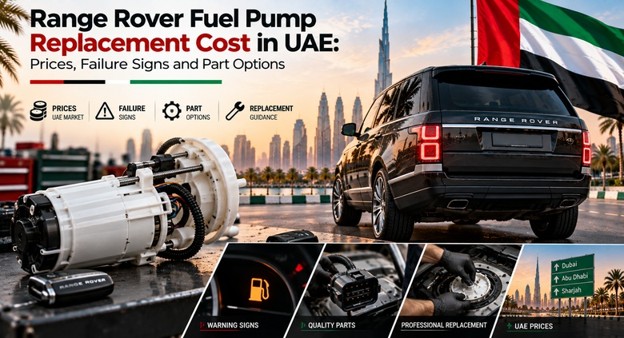
Range Rover Fuel Pump Replacement Cost in UAE: Prices, Failure Signs and Part Options
September 23, 2026
A Range Rover that cranks for several seconds before starting, loses power under load, stalls when hot or suddenly refuses to start does not automatically need a fuel pump. That distinction matters because the fuel system on a Range Rover can involve an in-tank low-pressure pump, a high-pressure pump, filter/strainer components, wiring, relays, fuel-pressure control and, on some engines, injectors that can create symptoms remarkably similar to pump failure.
And in the UAE, where a fuel-system repair can involve anything from a relatively modest pump replacement to a considerably more expensive high-pressure system repair, buying the part first and diagnosing afterwards is the wrong order.
What a Range Rover fuel pump actually does
The fuel pump's basic job is straightforward: move fuel from the tank towards the engine at the pressure and flow rate required by that particular fuel system.
The engineering is not always straightforward.
Modern petrol and diesel Range Rovers can use different stages of fuel delivery, so “fuel pump” is not necessarily a single component. A UAE Range Rover specialist, for example, separates in-tank pumps from high-pressure pumps and treats injector testing, fuel rails and low-pressure systems as different diagnostic layers.
The first question: which Range Rover?
Before discussing Range Rover fuel pump replacement cost in UAE, establish the vehicle.
The L322, L405 and L460 generations use different fuel-system architectures, while Range Rover Sport, Velar and Evoque applications introduce another layer of variation.
The engine matters just as much as the body.
A 3.0 diesel, 4.4 diesel, 5.0 supercharged petrol, Ingenium petrol/diesel or PHEV should not be treated as one generic fuel-pump application.
L322 fuel pump considerations
The L322 covers a long production period and a wide mixture of engines and fuel systems.
That means a 2005 L322 and a later L322 cannot safely be grouped together for parts ordering.
A used pump may be attractive financially on an older vehicle, but the exact engine, tank configuration, connector and part number still need to match.
L405 fuel pump considerations
The aluminium-bodied L405 introduced newer powertrains and increasingly sophisticated fuel management.
Diesel versions can involve a low-pressure fuel supply system feeding a high-pressure pump, while petrol engines have their own fuel-delivery requirements.
So if the engine is losing pressure, the technician needs to establish where that pressure is disappearing rather than simply declaring the in-tank pump defective.
L460 fuel pump considerations
The current-generation L460 brings newer electronic engine management and powertrain configurations.
The safest parts route is VIN-based identification because Land Rover's current iGuide specifically uses the VIN to align information with the vehicle's exact market and specification.
That same principle is useful when sourcing a fuel-system component.
Range Rover Sport is not the same application
Range Rover Sport fuel pumps should be matched to the Sport's exact generation, engine and build specification.
A supplier may list a pump as suitable for “Range Rover” while the actual part is intended for a particular Sport, Vogue or engine application.
The name on the boot is not sufficient fitment information.
Velar and Evoque need separate verification
The same warning applies to Velar and Evoque.
A fuel-pump assembly that physically resembles another Land Rover unit may still have a different sender arrangement, connector, pressure specification or tank fitment.
Use the VIN and original part number wherever possible.
In-tank fuel pump versus high-pressure pump
This is the distinction that can save you a lot of money.
An in-tank or low-pressure pump moves fuel from the tank towards the engine.
A high-pressure pump raises fuel pressure to the level required by the engine's injection system.
On diesel Range Rovers, confusing the two can send the diagnosis in completely the wrong direction. UAE specialist guidance explicitly separates in-tank pump work from high-pressure pump and injector work.
The classic hard-start symptom
Extended cranking is one of the symptoms that can point towards inadequate fuel delivery.
But it is not proof of pump failure.
A weak battery, low rail pressure, injector leakage, fuel-pressure regulation problem, filter restriction or another engine-management fault can produce similar behaviour.
Diagnosis first.
Starting and then immediately stalling
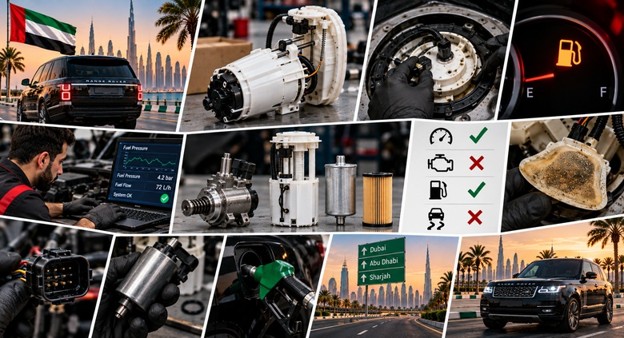
A Range Rover that starts and then dies can have a fuel-delivery problem, particularly if pressure drops as the system comes under demand.
But the workshop should still check fuel pressure and electrical supply rather than relying on the symptom alone.
A pump that runs is not necessarily a pump that produces sufficient flow.
Loss of power under acceleration
This is one of the more useful clues.
A vehicle may idle normally because fuel demand is relatively low, then lose power when accelerating because the fuel system cannot maintain the required delivery.
That is why a pressure test under appropriate operating conditions can tell you considerably more than simply listening for the pump.
A whining pump
A loud or newly noticeable whine from the fuel tank can be a warning sign.
It can indicate pump wear, restricted fuel supply or another condition causing the pump to work abnormally.
Still, noise alone should not trigger an expensive replacement.
Intermittent stalling when hot
A vehicle that works normally when cold but stalls after becoming hot deserves careful attention.
Electrical components can behave differently with temperature, and an ageing pump or connection may become unreliable after prolonged operation.
Record when the fault occurs: cold start, hot restart, heavy acceleration, low fuel level or traffic.
That information is diagnostically useful.
The low-fuel clue
If a Range Rover behaves worse when the tank is nearly empty, tell the workshop.
An ageing in-tank pump can be more vulnerable under certain low-fuel operating conditions, while contamination or pickup restrictions can also affect delivery.
Do not treat this observation as proof, though. It is a clue.
Engine warning light and fuel-system faults
A check-engine light can accompany a fuel-delivery problem.
But the stored diagnostic code should be interpreted alongside actual fuel-pressure data, electrical checks and the vehicle's symptoms.
A code is evidence, not a parts-ordering instruction.
Don't replace the pump because of one fault code
This is where many unnecessary repairs begin.
A pressure-related code can result from a weak pump, restricted filter, wiring issue, pressure sensor, regulator or high-pressure component.
The correct question is:
What test confirms that the pump itself cannot meet specification?
Fuel-pressure testing matters
A proper diagnosis should establish whether the low-pressure side is producing the expected pressure and flow.
Where the system permits it, the technician should compare measured values against the manufacturer's specified operating range.
A pump that produces pressure at idle but collapses under demand may require a different diagnosis from a pump that produces no pressure at all.
Flow matters as well as pressure
Pressure gets most of the attention, but flow matters too.
A restricted filter or failing pump can sometimes produce an apparently acceptable static pressure while failing to supply sufficient volume when the engine demands more fuel.
This is why a proper fuel-system test should not stop at “pressure looks okay”.
Check electrical supply to the pump
Before replacing an electrical pump, verify that it is receiving the correct electrical supply.
The technician should inspect:
- power supply
- ground
- connector condition
- wiring continuity
- relay/control operation where applicable
If the pump has no proper electrical feed, installing another pump may simply produce the same fault.
Inspect the connector
Fuel-pump connectors can suffer from heat, corrosion, poor contact and previous repair work.
A connector that looks acceptable from outside can still have a damaged terminal.
This is a small inspection with potentially large financial consequences.
Fuel filter problems can mimic pump failure
A restricted filter can starve the pump or restrict the fuel reaching the engine.
That is particularly relevant to diesel vehicles, where fuel cleanliness and filtration are critical.
A UAE fuel-system specialist specifically lists fuel-filter and water-separator service alongside low-pressure and high-pressure fuel-system repairs.
Diesel Range Rover: don't confuse pump stages
Diesel owners need to be particularly careful.
The low-pressure lift pump in the tank and the high-pressure pump on the engine perform different jobs.
Replacing the in-tank pump when the high-pressure system is actually at fault wastes money; replacing a high-pressure pump when the low-pressure supply is collapsing wastes considerably more.
Petrol Range Rover: direct injection changes the picture
Some petrol Range Rover engines use direct injection and a high-pressure fuel system.
That means an in-tank pump can be operating while the engine still suffers from inadequate injection pressure.
A proper diagnosis should identify which side of the fuel system is actually failing.
Injector problems can look like pump problems
A faulty injector can cause hard starting, rough running, poor performance or abnormal fuel pressure.
UAE specialist guidance includes injector leak-back, balance and spray-related testing as part of fuel-system diagnosis rather than treating every fuel-pressure symptom as a pump failure.
This is exactly why replacing the pump without testing the rest of the system is risky.
Fuel contamination deserves attention
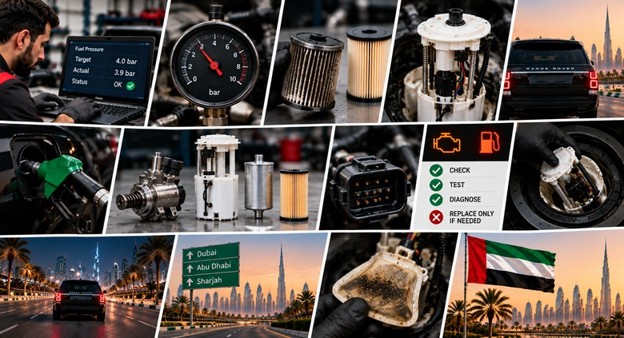
If contaminated fuel has entered the system, replacing only the pump may not solve the problem.
The filter, tank, lines, injectors and other components may need inspection depending on the severity and type of contamination.
Ask what caused the original failure before installing an expensive replacement.
UAE fuel-pump price reference: September 2026
Current UAE parts listings show how widely prices can vary.
One UAE Range Rover/Jaguar parts supplier currently lists aftermarket/SJM fuel-pump applications from approximately AED 290 to AED 1,050, including examples such as LR014997 at AED 290, LR015177 at AED 470, LR065230 at AED 470 and an L322 LR015178 application at AED 1,050.
These are part-price observations from September 2026, not universal Range Rover replacement prices.
High-pressure pump price is different
The same UAE market listing includes a high-pressure fuel pump application for Range Rover L319/L405/L494/L462 3.0T/5.0T at AED 570 for that particular aftermarket/SJM listing.
That should not be interpreted as the price of every high-pressure pump.
Genuine, OE-supplier, aftermarket, engine-specific and complete-module pricing can differ considerably.
General UAE replacement-cost context
A current UAE automotive service guide places fuel-pump replacement broadly at around AED 650–3,500 and above, depending on vehicle and repair requirements. It also notes that replacement time commonly falls around four to six hours, although access varies by vehicle.
For a Range Rover, treat that only as broad budgeting context.
A VIN-specific quotation is more useful.
Part price versus total repair cost
Do not compare a AED 500 pump with a AED 1,500 workshop quotation and assume the workshop is charging AED 1,000 labour.
The workshop price may include diagnosis, access, seals, installation, priming, testing, VAT and related components.
A parts-only online price is not the same thing as a completed repair.
What labour can add
Fuel-pump labour depends heavily on access.
Some in-tank assemblies can be accessed through service openings, while other jobs require considerably more disassembly.
A UAE workshop planning guide gives general diagnostic pricing of around AED 250–700 for Range Rover work, depending on test depth and fault complexity.
Ask for diagnosis and installation to be shown separately on the quotation.
Genuine Range Rover fuel pump
The Genuine component or Range Rover spare parts in UAE give you the strongest route when exact factory specification and parts provenance are priorities.
That can matter particularly on newer, higher-value vehicles where an incorrect pressure specification or poor-quality electrical component creates another diagnostic problem.
The trade-off is price.
OEM or OE-supplier option
“OE” and “OEM” are terms worth checking rather than simply accepting.
Ask who manufactured the component, what the exact part number is and whether it is supplied as the pump motor, sender assembly or complete module.
A cheaper component can be perfectly appropriate, but only when its specification is actually known.
Aftermarket fuel pumps
Aftermarket pumps can reduce the parts bill substantially.
The important question is not simply whether the pump fits physically.
Check pressure specification, flow capacity, electrical connector, sender arrangement, seals and warranty.
A fuel pump is one component where specification matters more than a photograph.
Used genuine fuel pumps
A used genuine pump can make financial sense on an older L322 or L405.
But the donor vehicle matters.
Ask for donor model, engine, year, mileage if available, accident history, storage conditions and any testing carried out before removal.
A used pump with unknown history is not equivalent to a tested used pump with a return policy.
Reconditioned fuel pumps
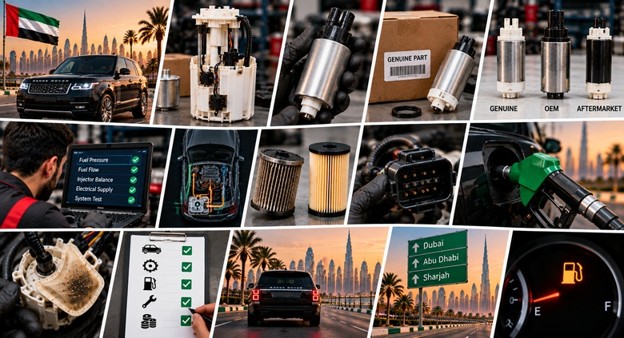
Reconditioned components require more questions.
Was the pump motor replaced?
Was the sender retained?
Was the pressure output tested?
Were seals renewed?
What warranty is provided?
Without answers, “reconditioned” can mean almost anything.
Complete module or pump motor only?
This is a surprisingly important buying decision.
A complete module may include the pump, sender, strainer and associated housing components.
A pump motor alone can be cheaper, but installation may require transferring components from the old assembly.
The correct choice depends on what actually failed and the condition of the existing module.
Fuel-level sender problems
If the Range Rover's fuel gauge is behaving strangely at the same time as the pump problem, tell the workshop.
The pump assembly and sender can be packaged together on some applications.
Replacing only the motor may leave a separate sender fault untouched.
Why VIN verification matters
Land Rover's own iGuide asks owners to enter the VIN to display information aligned to the vehicle's market and specification, noting that manual model-year selection can include derivatives and optional equipment that are not fitted to the particular car.
That is an excellent reason to use VIN-based parts verification for fuel-system components.
Part number beats model-name searching
“Range Rover 3.0 fuel pump” is a useful starting search.
It is not sufficient for ordering.
The correct part number should be checked against the vehicle's VIN, engine and existing component wherever possible.
This becomes particularly important with older vehicles that have received engine replacements or imported-market components.
What should a UAE workshop test before replacement?
At minimum, the diagnosis should be directed towards:
- fault-code scan
- battery and electrical supply
- pump power and ground
- fuel pressure
- fuel flow where appropriate
- filter condition
- pressure behaviour during starting
- pressure behaviour under load where applicable
- high-pressure system data on applicable engines
- injector condition where symptoms point that way
- contamination
- connector and wiring condition
That is a much stronger diagnostic process than “the pump sounds noisy, so replace it”.
UAE heat: useful context, not a diagnosis
The UAE climate is demanding, but heat should not become a catch-all explanation.
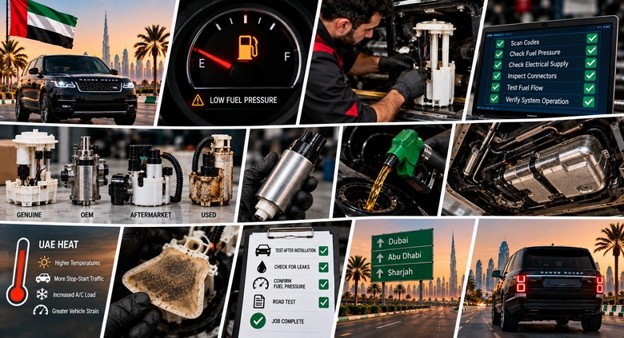
High ambient temperatures, long traffic periods and frequent air-conditioning use can increase the operating burden on a vehicle, but a fuel pump still needs to be tested before it is condemned.
A Dubai repair guide similarly notes that local heat and stop-start use influence vehicle operating conditions, although individual faults still require diagnosis.
Driving with a failing fuel pump
It is risky to keep driving a vehicle that is intermittently losing fuel pressure.
A pump can deteriorate from an intermittent fault into a no-start or sudden-stalling condition.
If the vehicle is already cutting out in traffic or losing power unexpectedly, arrange diagnosis rather than waiting for complete failure.
Before You Click Buy
Have these details ready:
VIN.
Model year.
Generation.
Engine.
Petrol, diesel or PHEV.
Existing fuel-pump part number.
Low-pressure or high-pressure pump.
Complete module or pump motor.
Left/right tank arrangement where applicable.
Whether the sender is included.
Warranty and return terms.
That list is far more valuable than simply asking for the cheapest Range Rover fuel pump.
Buying through a UAE parts marketplace
When sourcing a replacement through PartFinder UAE, give the supplier the VIN, exact engine and existing part number wherever possible, then ask whether the quoted item is a complete module, pump-only assembly or high-pressure pump. The useful comparison is not simply price; it is correct fitment + component specification + condition + warranty + total installed cost.
Fuel-pump replacement decision matrix
| Your situation | Option worth investigating |
| Confirmed failed in-tank pump on older L322 | Tested used, aftermarket or genuine |
| Newer L405 with confirmed pump failure | Genuine/OE or reputable aftermarket |
| Current L460 | VIN-matched exact-specification component |
| High-pressure fault confirmed | Correct high-pressure pump, not in-tank pump |
| Fuel sender also faulty | Complete module may make more sense |
| Damaged connector | Repair electrical fault before buying pump |
| Contaminated fuel | Inspect wider fuel system before replacement |
| Unknown used pump history | Ask for testing and return terms |
| Pump works but pressure is low | Diagnose filter, wiring, regulator and pressure system |
| Engine still has fuel-pressure fault after pump replacement | Re-test the entire system |
How to compare three quotes properly
Suppose one workshop quotes AED 700, another AED 1,100 and another AED 1,800.
The cheapest is not automatically the cheapest repair.
Ask each workshop:
- Which pump?
- Which part number?
- Genuine, OE, aftermarket or used?
- Complete module or pump motor?
- Is diagnosis included?
- Are seals included?
- Is VAT included?
- Is installation included?
- Is fuel-system testing included afterwards?
- What warranty applies?
Only then are the three quotes genuinely comparable.
When repair is better than replacement
If the actual problem is a wiring fault, connector, relay, fuse, filter or control issue, repairing that component is obviously preferable to replacing a perfectly functional pump.
The same applies when testing proves that fuel pressure is being lost elsewhere.
Diagnosis can therefore save the price of an unnecessary pump.
When replacement is the sensible route
Replacement becomes more compelling when testing confirms inadequate pump pressure or flow, the motor is mechanically worn, the pump intermittently stops, or the module has sustained internal damage.
On an older vehicle, the economics may favour a tested used or quality aftermarket unit.
On a newer vehicle, the consequences of an incorrect component make exact specification more important.
After installation: don't skip verification
Once the pump is fitted, the job is not finished.
The system should be primed correctly, checked for leaks and tested for pressure and normal engine operation.
The vehicle should then be checked under the conditions that originally produced the fault.
If it previously stalled when hot, a five-minute cold-start test proves very little.
The fuel system should be treated as one system
This is the point that gets lost in cheap-parts discussions.
The pump, filter, wiring, pressure regulation, injectors and engine-management system work together.
If one component fails, another can sometimes produce similar symptoms.
A Range Rover fuel-pump replacement should therefore be the result of a diagnosis, not the diagnosis itself.
FAQs
Categories
- Audi
- BMW
- Car Accessories
- Car Tips
- Ford
- Land Rover
- Mazda
- Range Rover
- Top 10
- UAE Car Parts
- Used Car Parts
- Toyota
- Replacement Engines
- Nissan
- Hyundai
- Mitsubishi
- Volkswagen
- Honda
- Kia
- Chevrolet
- Dodge
- Jeep
- Subaru
- Renault
- Lexus
- Mercedes
- Suzuki
- Hummer
- Porsche
- Infiniti
- Peugeot
- GMC
- Mini
- Volvo
- Replacement Gearboxes
- MG
- Jaguar
- Skoda
- Cadillac
- Daihatsu
- Fiat
- German Car Parts
- Japanese Car Parts
- Aftermarket Car Parts
- Genuine Car Parts
- New Car Parts
- Reconditioned Car Parts
- European Car Parts
- American Car Parts
- Korean Car Parts
- British Car Parts
- Chinese Car Parts
- Sports/Exotic Car Parts
- Luxury Car Parts
- Performance Car Parts
- SUV/4x4 Spare Parts
- Truck Spare Parts
- EV Car Parts
- Hybrid Car Parts
- Auto Spare Parts in UAE
- Tesla
- Isuzu
- Ram
- Ferrari
- Bentley
- Lamborghini
- Genesis
- Maserati
- Lincoln
- Chrysler
- Opel
- Citroen