Range Rover Gearbox Replacement in UAE: Prices, Used vs Reconditioned Options and What to Check
September 23, 2026
A Range Rover gearbox replacement in UAE is not the part to buy from a photograph and a model name. That sounds obvious until you see how easily a transmission can look “right” on the outside while carrying the wrong transmission code, ratio, torque-converter specification, software configuration or four-wheel-drive arrangement.
That is where a supposedly cheap gearbox becomes an expensive mistake.
Modern Range Rover models use sophisticated automatic transmissions, with current Range Rover and Range Rover Sport specifications including 8-speed automatic transmissions and AWD systems; the exact transmission configuration still depends on model, engine, market and build specification.
For UAE buyers, the real decision is rarely simply new gearbox versus used gearbox. It is usually repair the existing transmission, buy a tested used unit, choose a properly reconditioned/remanufactured unit, or replace the whole assembly when the original is economically beyond repair.
And those choices can be thousands of dirhams apart.
Why Range Rover gearbox replacement becomes expensive in the UAE
The gearbox itself is only one line on the final invoice.
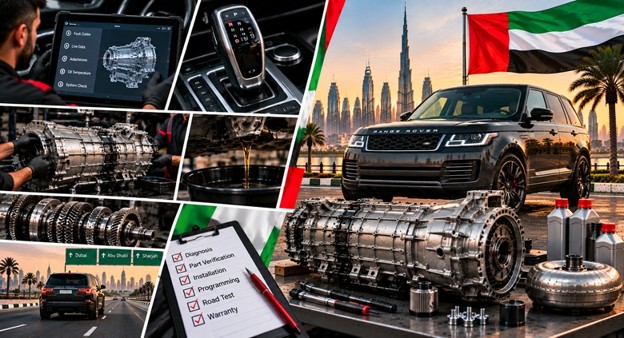
A replacement can involve transmission fluid, filter, seals, torque converter, mounts, cooler-line inspection, diagnostics, programming or adaptation procedures, removal and installation, and post-repair testing.
Published UAE specialist pricing in 2026 places complete Range Rover replacement work considerably above generic gearbox-market figures, with some published estimates putting used replacement transmissions around AED 6,000–15,000 before or alongside installation and remanufactured units around AED 12,000–25,000. These are market quotations from individual UAE businesses, not an official Range Rover price list or a national survey.
The first question should not be “How much is a gearbox?”
Ask:
What exactly has failed?
A harsh 2–3 shift does not automatically mean the complete transmission is finished. Delayed engagement may involve hydraulic pressure, solenoids, valve-body problems or fluid condition. A shudder under light throttle can involve the torque converter.
Replacing an entire gearbox before separating those possibilities is how repair bills get inflated.
Current Range Rover transmissions are not interchangeable by appearance
A transmission that physically resembles yours is not automatically compatible.
Current Range Rover specifications show 8-speed automatic transmission configurations, while Range Rover Sport and Velar also use 8-speed automatic systems in the documented specifications. But that does not mean one gearbox can simply be transferred between every model or engine.
Range Rover gearbox replacement price in UAE
For a useful starting point, published UAE market figures in 2026 include:
| Replacement route | Published UAE reference | What it means |
| Used Range Rover transmission | AED 6,000–15,000 | Unit price range published by a UAE specialist |
| Used replacement including installation | AED 9,000–18,000 | Published total estimate |
| Remanufactured transmission | AED 12,000–25,000 | Unit price range |
| Remanufactured replacement including installation | AED 15,000–30,000 | Published total estimate |
| Large/newer Range Rover remanufactured replacement | AED 25,000–40,000 | Higher-end published complete-package range |
These are 2026 published UAE reference ranges, not guaranteed quotes for a particular Range Rover. The actual number depends heavily on generation, transmission code, engine, drivetrain, condition and what the workshop includes.
Why generic gearbox prices can be misleading
A UAE gearbox guide may quote European automatic transmissions at roughly AED 4,000–12,000 or more, with fitting commonly adding AED 700–2,000.
That is useful market context, but a Range Rover should not be budgeted from a generic European-car average. Its transmission specification, electronics, AWD integration and installation requirements can push the real cost much higher.
The gearbox code matters more than the badge
When ordering a replacement, provide:
- VIN/chassis number
- registration details where appropriate
- model and model year
- engine
- drivetrain
- transmission code
- photograph of the transmission identification label
- part number if available
The model name alone is not enough.
Range Rover Vogue is not one gearbox specification
“Range Rover Vogue gearbox or Range Rover spare parts UAE” is a useful search phrase. It is a poor ordering description.
A Vogue can represent different generations, engines and transmission configurations. An L322 is not an L405, and an L405 is not an L460.
The generation has to be established before anyone talks seriously about fitment.
Range Rover Sport needs the same discipline
Range Rover Sport transmissions also vary by generation and powertrain.
Current Range Rover Sport specifications document an 8-speed automatic transmission, AWD and Terrain Response systems, while older vehicles may have completely different transmission arrangements.
Range Rover Velar should not be treated as a Vogue substitute
Velar also uses 8-speed automatic transmission configurations in documented model specifications, but its transmission is not automatically interchangeable with a Range Rover simply because both carry the same marque.
Evoque is another separate fitment exercise
The compact Range Rover Evoque has its own engine, drivetrain and transmission combinations.
A supplier saying “Range Rover gearbox available” tells you almost nothing until the exact vehicle is identified.
A gearbox can be mechanically compatible but electronically wrong
Modern transmissions communicate with the vehicle's control systems.
The transmission control module, calibration, sensors, solenoids and software configuration can all matter.
So “it bolts in” is not a sufficient compatibility test.
What does a used Range Rover gearbox actually mean?
Usually, it means the transmission has been removed from another vehicle.
That vehicle is the donor.
The gearbox may have been functional when removed, but that does not tell you everything about internal clutch wear, valve-body condition or fluid history.
That uncertainty is precisely why donor history and warranty matter.
A good donor story is valuable
Ask why the donor vehicle was dismantled.
An accident-damaged vehicle with a healthy drivetrain can be a reasonable source.
A vehicle dismantled because of transmission failure is a very different proposition.
Ask for donor mileage
Mileage does not prove gearbox condition.
But a documented donor mileage is still useful evidence.
A supplier who can identify the donor vehicle, mileage and removal circumstances gives you more information than someone offering an anonymous gearbox sitting on a pallet.
Ask whether the torque converter is included
This is one of those small questions that can suddenly become a large invoice.
A replacement gearbox may be supplied without the torque converter.
If yours is damaged or contaminated, the final repair cost changes.
Check the transmission casing carefully
Before purchase, inspect:
- casing damage
- mounting points
- electrical connectors
- fluid leaks
- identification plate
- output area
- cooler connections
- transfer-case interface where applicable
A clean exterior does not prove internal health, but obvious damage is an immediate warning.
Used gearbox warranty matters more than a small price saving
Published UAE guidance commonly places written warranties for used gearboxes around one to three months, with longer periods sometimes offered on rebuilt or reconditioned units. Terms vary substantially between suppliers.
Get the warranty in writing.
Not verbally.
What can invalidate a gearbox warranty?
Typical conditions can include:
- incorrect fluid
- incorrect fluid level
- poor installation
- failure to replace required seals
- failure to flush contaminated cooling circuits
- continued driving after a warning
- unauthorised modification
The exact conditions depend on the supplier.
Keep every fluid receipt
This sounds boring.
It is also practical.
If a warranty requires proof that the specified transmission fluid was used, the invoice becomes evidence.
Used versus reconditioned gearbox
Here is the basic distinction:
Used: removed from another vehicle.
Reconditioned/rebuilt: opened and repaired, with some worn or failed components replaced.
Remanufactured: generally rebuilt to a defined specification with systematic replacement and testing of components.
Those terms are sometimes used loosely in the UAE market, so ask what the supplier actually means.
“Reconditioned” does not have one universal specification
One rebuilder may replace clutch packs, seals, bearings, filter and other wear components.
Another may replace only the failed component.
Never assume the word “reconditioned” automatically means every internal wear component is new.
Ask what was replaced
A serious question for the rebuilder is:
Which parts are replaced as standard during your rebuild?
The answer should be specific.
If the response is simply “whatever is damaged”, you are buying a repair rather than necessarily buying a fully reconditioned transmission.
Ask whether the valve body was tested
The valve body controls hydraulic flow and gear application.
Wear, contamination or solenoid problems can produce symptoms that feel like a major mechanical gearbox failure.
A valve-body diagnosis can therefore change the repair decision.
The torque converter deserves separate attention
Torque-converter problems can produce:
- shudder
- vibration
- delayed engagement
- lock-up problems
- abnormal transmission behaviour under light throttle
Replacing a complete gearbox without considering the converter can leave the underlying issue unresolved.
Transmission fluid tells a story
Fluid inspection should consider:
- colour
- smell
- contamination
- metallic debris
- friction material
- coolant contamination
- correct fluid specification
Fluid alone cannot diagnose every internal fault, but ignoring it throws away useful evidence.
Metal debris changes the conversation
Fine material may occur through normal wear.
Large metallic particles, excessive clutch debris or obvious contamination are much more concerning.
The workshop should document what it actually finds rather than simply saying “gearbox is bad”.
Burnt fluid is not a complete diagnosis
Dark or burnt-smelling fluid indicates a problem worth investigating.
It does not, by itself, identify which component has failed.
Check transmission oil pressure where applicable
Pressure testing can help separate hydraulic problems from other faults.
The exact test procedure and expected pressure values depend on the transmission.
The important point is simple: use the transmission's proper diagnostic procedure rather than guessing from symptoms.
Scan the transmission control system
A diagnostic scan should look for relevant transmission faults and live data where supported.
Do not treat one generic fault code as proof that the complete gearbox needs replacement.
Fault codes need interpretation
A code can identify a circuit, sensor, pressure condition or communication issue.
It does not necessarily identify the component that must be replaced.
That distinction matters enormously on electronically controlled automatic transmissions.
Check battery and voltage before condemning electronics
Low system voltage can create apparently unrelated electronic faults.
If a Range Rover has multiple warnings at once, battery condition and charging voltage should form part of the initial diagnostic process rather than being ignored.
Look at adaptation values where supported
Modern automatic transmissions may adapt clutch application and shift behaviour.
A specialist can use available adaptation information alongside fault codes, fluid condition, pressure readings and road-test behaviour.
Road testing matters
A gearbox should be evaluated under controlled conditions where safe.
Useful observations include:
- cold engagement
- warm engagement
- Drive selection delay
- Reverse selection
- upshifts
- downshifts
- lock-up behaviour
- kick-down
- acceleration under load
- deceleration
- abnormal noise
A short parking-lot drive is not necessarily enough.
Cold versus hot behaviour can reveal different faults
Some transmission problems become obvious only after the fluid reaches operating temperature.
Others are most noticeable during cold engagement.
That is why “it drove fine for five minutes” is not a meaningful clean bill of health.
Delayed Drive engagement
If selecting Drive produces a noticeable pause before movement, possible causes can include fluid pressure problems, valve-body issues, clutch wear or other transmission faults.
Do not order a gearbox solely from this symptom.
Harsh gear changes
A hard shift can come from mechanical wear, hydraulic control, solenoid behaviour, software/adaptation issues or other drivetrain conditions.
Diagnosis comes before replacement.
Gear slipping
If engine speed rises without the expected increase in vehicle speed, clutch slip becomes a concern.
Repeated slipping generates heat and friction material.
At that stage, delaying diagnosis can make the repair more expensive.
Shudder at steady speed
A shudder during light throttle can sometimes be associated with torque-converter lock-up behaviour.
It can also be confused with engine or drivetrain issues.
The diagnostic process needs to separate those possibilities.
Whining does not automatically mean gearbox replacement
Whine can originate from bearings, pumps, differential components, transfer-case components or other drivetrain parts.
The source needs to be located before a gearbox is condemned.
Reverse gear problems deserve attention
If Reverse engages slowly, slips or refuses to engage, the workshop should determine whether the fault is hydraulic, electronic or internal.
A complete replacement may be unnecessary in some cases.
When repair can make sense
Repair may be worth considering when:
- the casing is sound
- the core transmission is identifiable
- the failure is localised
- replacement parts are available
- the rebuilder provides a defined scope
- the total repair cost is materially below replacement
- warranty terms are acceptable
When replacement starts making more sense
A replacement becomes more attractive when the original unit has extensive internal damage, damaged casing, multiple failed assemblies, severe contamination or a rebuild cost approaching a reliable replacement.
The arithmetic matters.
Repair versus used gearbox
| Situation | Possible route |
| Localised valve-body fault | Repair |
| Solenoid-related fault | Repair |
| Torque converter issue | Repair/replace converter |
| Major internal clutch damage | Rebuild or replacement |
| Damaged casing | Replacement often considered |
| Good low-mileage donor available | Used unit |
| Long-term ownership | Reconditioned/remanufactured may be considered |
| Unclear diagnosis | Diagnose first |
This is a decision framework, not a guarantee that one route will suit every vehicle.
Repair versus reconditioned
A properly documented reconditioning process can make sense when the vehicle is worth keeping and the replacement unit has uncertain history.
The crucial word is documented.
Reconditioned versus used
A used gearbox offers the advantage of lower initial cost and potentially quick availability.
A reconditioned unit offers the possibility of replacing known wear components and receiving a more substantial warranty.
Neither is automatically the right answer.
What does a proper reconditioning process look like?
Ask whether the unit was:
- disassembled
- cleaned
- inspected
- measured
- rebuilt using defined components
- fitted with new seals
- fitted with replacement wear components
- tested
- pressure-tested where appropriate
- calibrated or configured where required
The exact process varies by transmission.
Do not confuse a cleaned gearbox with a rebuilt gearbox
A gearbox can look immaculate externally after cleaning.
That does not mean its internal wear components have been replaced.
Appearance is not reconditioning.
Transmission mounts should be inspected
A replacement gearbox can be mechanically sound while worn mounts create vibration or movement.
Ask whether the mounts were inspected and whether replacement is included in the quote.
Cooler lines deserve attention
If the failed gearbox generated significant debris, contamination can remain in the cooling circuit.
Installing another transmission without dealing with contamination can create an avoidable risk.
The exact flushing procedure should follow the transmission manufacturer's requirements.
The transfer case is not the gearbox
This distinction matters particularly on four-wheel-drive Range Rovers.
A transfer case distributes drive between axles; the transmission changes gear and manages engine-to-drivetrain torque transfer.
They are related but different components.
A transfer-case fault can feel like a gearbox fault
Whining, binding, vibration or drivetrain judder can sometimes be blamed on the transmission when the actual source lies elsewhere.
The complete drivetrain should therefore be considered during diagnosis.
Differential problems can also confuse diagnosis
A Range Rover's drivetrain contains multiple components that can produce noises or vibration.
Replacing a gearbox without locating the actual source is an expensive experiment.
UAE heat matters, but do not use it as a diagnosis
High ambient temperatures and heavy traffic increase thermal demands on vehicles.
That makes transmission cooling and correct fluid specification important considerations.
It does not, however, mean every UAE gearbox failure is caused by heat.
The actual evidence still matters.
Dubai stop-start traffic changes the operating environment
Frequent low-speed acceleration, repeated manoeuvring and long periods of traffic place a different demand on an automatic transmission than steady motorway driving.
That is useful context when assessing a used donor gearbox.
Abu Dhabi and Dubai vehicles can have very different histories
A low-mileage vehicle is not automatically a low-wear vehicle.
A Range Rover that spent years in heavy urban traffic can experience different transmission operating conditions from one used mostly for longer-distance motorway travel.
Ask about GCC specification
A UAE vehicle and an imported Range Rover can have different specification histories.
VIN verification should establish the exact vehicle rather than relying on assumptions based on registration year.
Imported Range Rovers need extra fitment care
If the vehicle was imported from another market, verify the transmission against the VIN and physical identification before buying.
Do not assume that an apparently identical year has identical drivetrain hardware.
“Same engine” does not necessarily mean “same gearbox”
Transmission configuration can depend on drivetrain, model, market and specification.
This is one reason why engine-based searches alone are not enough.
Photograph the transmission label before ordering
Send the supplier:
- transmission identification label
- VIN/chassis information
- vehicle registration/model details
- photograph of the existing transmission where useful
That gives the seller something concrete to match.
Ask for the replacement unit's identification before payment
Do not wait until installation day.
Request photographs of the actual gearbox, its identification markings and any relevant part or transmission code.
Check whether the quoted price includes installation
A gearbox advertised at AED 8,000 may not mean an AED 8,000 repair.
Ask whether the quote includes:
- removal
- installation
- fluid
- filter
- seals
- programming
- adaptation
- diagnostics
- road testing
- warranty
Separate part price from repair price
This is essential when comparing UAE quotes.
Part price ≠ installed replacement cost.
A cheaper gearbox can become the more expensive option once labour, fluids, programming and warranty differences are added.
Published UAE repair figures vary widely
One 2026 UAE specialist guide places ZF gearbox rebuild work for BMW/Range Rover applications around AED 4,000–10,000 and full luxury-SUV gearbox replacement around AED 8,000–25,000, while another Range Rover-specific published guide places complete remanufactured replacements considerably higher. The difference reflects vehicle, transmission, scope and supplier assumptions rather than one universal UAE price.
A realistic gearbox budget needs a contingency
If the initial quote covers only the transmission itself, leave room for:
- seals
- fluid
- filter
- mounts
- cooler service
- labour
- diagnostics
- programming
- unexpected installation issues
Otherwise, the “cheap” gearbox may not remain cheap.
Warranty wording should be read before installation
Check:
- warranty duration
- mileage limit
- labour coverage
- parts covered
- exclusions
- fluid requirements
- installation requirements
- claim procedure
- return conditions
A warranty printed on an invoice is much more useful than a verbal promise.
Ask whether the warranty covers labour
This is frequently overlooked.
If the replacement gearbox fails and the supplier covers only the transmission, removing and reinstalling another unit can become your expense.
Ask about the return policy
Some parts may be non-returnable once installed.
That makes pre-purchase identification even more important.
Do not buy from a photograph alone
A photograph can confirm that a gearbox exists.
It cannot confirm internal clutch condition.
Ask for identification, donor information, mileage, warranty and testing details.
Beware of an unusually cheap Range Rover gearbox
A very low price may reflect:
- unknown mileage
- missing torque converter
- incomplete assembly
- no warranty
- incorrect specification
- damaged casing
- old stock
- transmission requiring rebuild
Cheap is not a technical description.
What should the workshop test before recommending replacement?
A serious diagnostic process should consider:
- fault codes
- live transmission data where available
- fluid condition
- leaks
- electrical supply
- selector operation
- engagement delay
- shift quality
- torque-converter behaviour
- pressure where applicable
- transmission identification
- drivetrain noises
- transfer-case condition
- differential condition
The exact tests vary by gearbox.
What should the supplier provide?
Before buying a used or reconditioned unit, ask for:
Transmission code + donor mileage + condition + included components + warranty + return terms + compatibility confirmation.
If several of those are missing, the price comparison is incomplete.
Where UAE buyers should be particularly careful
Sharjah Industrial Area, Dubai and Abu Dhabi all have extensive automotive parts and repair activity, but the existence of a large parts market does not make every transmission identical.
A documented supplier, clear identification and written warranty are more useful than simply buying from the nearest warehouse.
Finding the exact gearbox matters more than finding the cheapest gearbox
The UAE market contains used and new Range Rover transmission-related listings, including automatic gearbox categories and transfer-case parts, but availability changes and fitment must still be confirmed against the vehicle.
This is where PartFinder UAE can be useful as a sourcing route: the important part is not simply finding a gearbox listing, but sending the correct vehicle and transmission information so available units can be compared on fitment, condition and price.
Before You Click Buy:
Stop for five minutes.
Check the VIN.
Check the transmission code.
Ask whether the torque converter is included.
Ask the donor mileage.
Ask why the donor vehicle was dismantled.
Ask what was tested.
Ask what the warranty covers.
Ask whether fitting and programming are included.
Then compare the total installed cost, not the gearbox headline price.
A simple buyer decision matrix
| Your situation | What to investigate first |
| Older Range Rover, lower market value | Used unit versus targeted repair |
| Newer Range Rover | Warranty-backed replacement or manufacturer-supported route |
| Long-term ownership | Reconditioned/remanufactured option |
| Unknown gearbox failure | Full diagnosis before purchasing anything |
| Good low-mileage donor | Used gearbox with written warranty |
| Major internal damage | Rebuild versus replacement |
| Damaged casing | Replacement |
| Suspected valve-body fault | Specialist diagnosis before full gearbox replacement |
| Shudder under lock-up | Torque-converter diagnosis |
| Multiple drivetrain warnings | Full drivetrain/electronic diagnosis |
What a good replacement quote should look like
A useful written quote should identify the vehicle and specify:
Transmission: exact unit/code
Condition: used/reconditioned/remanufactured/new
Donor: mileage/history where used
Torque converter: included/not included
Fluid: specification and quantity
Filter/seals: included/not included
Labour: removal and installation
Programming: included/not included
Warranty: duration and conditions
Final price: including VAT where applicable
That is a much more useful document than “Range Rover gearbox — AED 12,000”.
What not to do after gearbox replacement
Do not immediately treat the car as finished simply because it moves.
The workshop should verify:
- correct fluid level
- leak-free connections
- gear selection
- shift behaviour
- reverse operation
- fault-code status
- adaptation/calibration where required
- road-test behaviour
Keep the old gearbox if there is a core-return arrangement
If the supplier operates an exchange system, your old gearbox may be treated as a core.
Ask about the core-return conditions before the old unit disappears.
Keep the paperwork
Save:
- original diagnostic report
- gearbox invoice
- transmission identification
- donor information
- fluid invoice
- labour invoice
- warranty
- programming/calibration record
- post-repair diagnostic report
This becomes particularly valuable when selling the vehicle later.
The cheapest gearbox is rarely the cheapest gearbox
The arithmetic is simple.
A used unit at AED 7,000 with no meaningful warranty may become expensive if it fails after installation.
A more expensive unit with documented mileage, correct specification, testing and written warranty may produce a higher initial bill but a different risk profile.
Neither should be judged from price alone.
Range Rover gearbox replacement: the practical UAE answer
For an older Range Rover with a sound body and drivetrain, a properly identified used gearbox can be a sensible route when the donor history and warranty are credible.
For a vehicle being kept long term, a properly documented reconditioned or remanufactured transmission may justify its higher purchase price.
For a transmission showing a potentially localised fault, repair should be investigated before anyone condemns the complete assembly.
And for newer vehicles, the exact manufacturer-supported repair and warranty position should be checked before fitting an unrelated replacement.
Frequently Asked Questions
Categories
- Audi
- BMW
- Car Accessories
- Car Tips
- Ford
- Land Rover
- Mazda
- Range Rover
- Top 10
- UAE Car Parts
- Used Car Parts
- Toyota
- Replacement Engines
- Nissan
- Hyundai
- Mitsubishi
- Volkswagen
- Honda
- Kia
- Chevrolet
- Dodge
- Jeep
- Subaru
- Renault
- Lexus
- Mercedes
- Suzuki
- Hummer
- Porsche
- Infiniti
- Peugeot
- GMC
- Mini
- Volvo
- Replacement Gearboxes
- MG
- Jaguar
- Skoda
- Cadillac
- Daihatsu
- Fiat
- German Car Parts
- Japanese Car Parts
- Aftermarket Car Parts
- Genuine Car Parts
- New Car Parts
- Reconditioned Car Parts
- European Car Parts
- American Car Parts
- Korean Car Parts
- British Car Parts
- Chinese Car Parts
- Sports/Exotic Car Parts
- Luxury Car Parts
- Performance Car Parts
- SUV/4x4 Spare Parts
- Truck Spare Parts
- EV Car Parts
- Hybrid Car Parts
- Auto Spare Parts in UAE
- Tesla
- Isuzu
- Ram
- Ferrari
- Bentley
- Lamborghini
- Genesis
- Maserati
- Lincoln
- Chrysler
- Opel
- Citroen