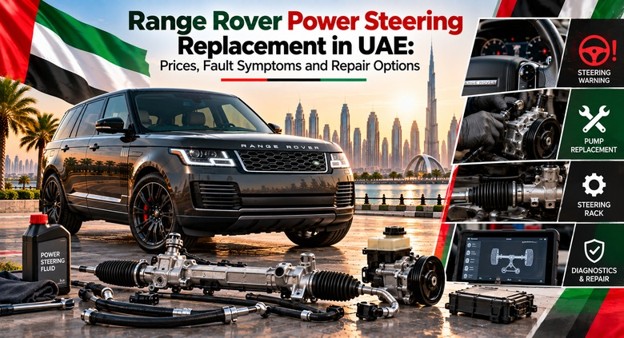
Range Rover Power Steering Replacement in UAE: Prices, Fault Symptoms and Repair Options
September 23, 2026
Power steering failure on a Range Rover is one of those repairs where buying the first part that matches the symptom can become an expensive mistake.
A heavy steering wheel does not automatically mean the rack has failed. A power-steering warning does not automatically mean the pump is dead. A whining noise can come from a hydraulic system, while a newer Range Rover may have an electronically controlled steering system where the diagnostic path is completely different.
That distinction matters in the UAE because Range Rover ownership spans several generations — from older L322 and L405 vehicles with very different steering hardware to newer L460 models with electronically managed steering systems. Land Rover's own current software documentation refers to the Power Steering Control Module (PSCM) and improvements to Electric Power Assisted Steering on newer vehicles, while its iGuide specifically lists a Power Steering Fault warning for current Range Rover models.
And then there is the bill.
A steering rack, pump, motor, module or hose can each produce a very different repair cost. Add diagnosis, fluid, labour, four-wheel alignment, steering-angle calibration or software work and the original parts quotation may tell only half the story.
Range Rover power steering replacement is not one repair
The phrase “Range Rover power steering replacement in UAE” is too broad to be useful on its own.
Depending on the Range Rover generation, the repair could involve:
- power steering pump
- electric steering motor
- steering rack
- steering control module
- torque sensor
- hydraulic hose
- fluid reservoir
- seals
- tie rods
- steering column components
- wiring and connectors
- software or calibration
Land Rover UAE's extended-warranty documentation specifically identifies the electric steering motor, electric steering pump and high-pressure pipes/hoses within its listed steering-system coverage.
So before anyone gives you a serious replacement quotation, the first question should be:
Which component has actually failed?
The first thing to identify is your Range Rover generation
This is especially important with steering parts.
A full-size Range Rover can mean:
- L322
- L405
- L460
And Range Rover Sport, Evoque and Velar have their own steering-system variations.
The same symptom can therefore point towards completely different hardware.
For example, an older hydraulic steering system may require pump-pressure testing and fluid inspection, while a newer electronically assisted system may need module diagnostics, motor data and software investigation.
Land Rover's own iGuide recommends using the vehicle VIN because manually selecting a model and year can expose information for derivatives and optional equipment that may not actually be fitted to the individual vehicle.
Your VIN matters before you order a steering part
A steering rack is not generic Range Rover spare parts UAE.
Neither is a pump.
Neither is an electric steering motor.
The VIN helps establish:
- exact model
- production specification
- market
- model year
- derivative
- fitted equipment
- steering-system configuration
Give the VIN to the parts seller before accepting a fitment confirmation.
If the seller only asks for “Range Rover 2015” and immediately offers a rack, slow down.
How much does Range Rover power steering replacement cost in the UAE?
There isn't one dependable figure.
Current UAE market references show just how widely the numbers can move.
One Dubai steering specialist currently advertises Range Rover steering-rack replacement from AED 2,000 including alignment, while another UAE specialist publishes a Range Rover Vogue rack replacement estimate of AED 3,500–5,500. These are workshop-specific published estimates rather than fixed UAE prices for every Range Rover generation.
A genuine Land Rover power-steering pump listing currently shows AED 2,714.45 plus VAT, or AED 2,850.17 including VAT, for part number QVB500390. The listing identifies it as a genuine Land Rover component and advises VIN fitment checking.
Another genuine pump listing for an older 2010–2012 Range Rover shows AED 3,777.02, demonstrating why even pump pricing cannot be treated as one universal number.
Those are dated September 2026 market observations, not guaranteed quotations.
Part price and total repair cost are two different numbers
Suppose a steering pump is listed at AED 2,850.
That does not necessarily mean the repair costs AED 2,850.
The final invoice could include:
- diagnostic scan
- pump removal
- replacement pump
- fluid
- hose inspection
- bleeding
- labour
- steering-system reset
- alignment
- road test
A rack quotation can be even more complicated.
Always ask for:
part price + labour + additional materials + calibration/alignment + VAT = total repair cost.
Heavy steering is the symptom — not the diagnosis
This is where owners can save money.
If the steering suddenly becomes heavy, possible causes include:
- loss of hydraulic assistance
- weak pump
- low fluid
- fluid leak
- restricted hose
- electrical steering fault
- steering motor fault
- control-module problem
- battery/voltage issue
- mechanical binding
- worn steering components
The symptom tells you something is wrong.
It doesn't tell you which part to buy.
A Range Rover that suddenly becomes very heavy needs immediate attention
Steering assistance is not an area for “I'll see how it goes for another week”.
If assistance disappears, the vehicle can become significantly harder to steer, particularly at low speeds and during parking.
The sensible response is to reduce driving until the cause is established and have the vehicle inspected.
If steering becomes erratic, locks, binds severely or behaves unpredictably, don't treat it as a normal workshop-drive situation.
Arrange appropriate recovery.
The power-steering warning deserves a proper scan
Land Rover's current Range Rover iGuide explicitly lists POWER STEERING FAULT among the warning indicators.
That warning is useful.
But it doesn't mean:
“Replace steering rack.”
A diagnostic scan should establish which module generated the fault and what supporting information is stored.
On electronically assisted systems, this distinction becomes even more important.
Newer Range Rovers use software as part of the steering system
Modern Range Rover steering is not simply mechanical hardware with assistance bolted on.
Land Rover's current software-update information refers to improvements involving the Power Steering Control Module (PSCM) on newer Range Rover and Range Rover Sport vehicles, as well as Electric Power Assisted Steering improvements.
That means software should be part of the diagnostic conversation when an electronic steering fault appears.
Before buying a costly module or rack, ask:
“Has the vehicle been checked for applicable software updates?”
Battery voltage can complicate electronic steering diagnosis
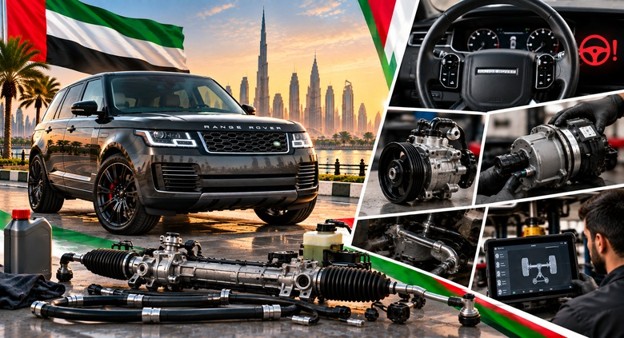
A modern Range Rover depends on a large number of electronic control systems.
If battery condition or system voltage is poor, multiple electronic faults can appear together.
That does not mean a weak battery is automatically responsible for every steering warning.
It means voltage should be checked rather than ignored.
A sensible diagnostic sequence can include:
- battery condition
- charging voltage
- relevant fuses
- grounds
- power supply
- steering-module communication
- stored fault codes
Older hydraulic Range Rovers require a different approach
On older vehicles with hydraulic assistance, start with the physical system.
Inspect:
- fluid level
- fluid condition
- pump noise
- hoses
- reservoir
- leaks
- steering rack
- belt drive where applicable
- hydraulic pressure
If the pump is being condemned, pressure testing is much more useful than simply listening to it.
A pump that whines isn't necessarily a pump that has completely failed.
Power-steering fluid loss is a major clue
If an older hydraulic Range Rover is losing fluid, don't just top it up.
Find the leak.
Possible areas include:
- steering rack seals
- high-pressure hose
- return hose
- pump
- reservoir connections
- unions
A new pump fitted to a system that is still leaking can become an expensive repeat repair.
Fluid level and fluid condition both matter
A low reservoir can explain reduced steering assistance.
But why is it low?
That is the more important question.
Fluid doesn't simply disappear because a Range Rover has reached a certain mileage.
If the level is repeatedly dropping, investigate the system for leakage.
Also use the fluid specification appropriate to the vehicle. Don't substitute a random hydraulic fluid because the colour looks similar.
Whining from the steering system can have several causes
A hydraulic pump may whine because:
- fluid is low
- air has entered the system
- fluid is contaminated
- the pump is worn
- the pump is cavitating
- the system has a restriction
The noise should be assessed alongside steering feel and fluid condition.
On an electric system, a completely different diagnostic route may be required.
A groan during parking does not automatically mean the pump is dead
Parking places the steering system under significant load.
If the vehicle produces noise only during low-speed steering, inspect the complete system.
Check:
- fluid
- pump
- rack
- suspension joints
- tyres
- steering geometry
- assistance level
- hydraulic pressure where applicable
Mechanical resistance elsewhere can increase steering effort without proving that the pump itself has failed.
Notchy steering is a different clue from simply heavy steering
If the steering feels smooth in one part of its travel and then catches or feels notchy around another position, don't immediately order a pump.
Possible areas for investigation include:
- steering rack
- torque-sensing components
- steering column
- joints
- suspension
- electric steering motor
- software/calibration
The exact diagnostic route depends heavily on generation.
Steering that pulls to one side may not be a power-steering fault
A Range Rover pulling left or right can be caused by:
- wheel alignment
- tyre pressure
- tyre condition
- suspension wear
- steering geometry
- braking imbalance
- damaged components
Replacing the steering rack because the vehicle pulls is poor diagnosis.
Check the basics first.
Steering-wheel play needs a mechanical inspection
Excessive play can involve:
- steering rack
- inner tie rods
- outer tie rods
- ball joints
- steering column joints
- mounting points
- suspension components
The steering wheel itself isn't necessarily the source.
A workshop should inspect the system while the vehicle is safely lifted and the steering is loaded appropriately.
A knocking noise doesn't automatically mean rack replacement
Knocking over speed bumps or rough roads can come from several front-end components.
A proper inspection should consider:
- rack mounts
- tie rods
- ball joints
- control arms
- bushes
- steering column joints
- suspension components
One UAE Range Rover steering specialist describes checking ball joints and tie rods alongside rack and steering data before recommending replacement. That approach reflects the basic principle that a steering symptom should be traced to the failed component rather than used as an excuse to replace the most expensive assembly.
The rack can be mechanically healthy while the assistance system is faulty
This distinction is particularly important on electronically assisted vehicles.
The steering rack provides the mechanical connection.
The assistance system helps the driver turn it.
A fault in the assistance electronics doesn't necessarily mean the rack's mechanical components are worn.
That is why a diagnostic scan and physical inspection need to work together.
What exactly is a steering rack?
The rack-and-pinion assembly converts steering input into movement at the front wheels.
It can contain or work alongside:
- steering gear
- inner tie rods
- seals
- bearings
- steering motor
- torque sensing
- electronic control components
The architecture differs between generations.
This is another reason a used rack should be matched by VIN and part number rather than appearance.
What exactly is a power-steering pump?
On a hydraulic system, the pump generates hydraulic pressure used to assist steering.
If it fails, steering can become very heavy.
But pump replacement should follow evidence such as:
- pressure testing
- noise assessment
- fluid inspection
- leakage inspection
- belt/pulley condition
- hose restriction checks
Don't replace the pump merely because the steering is heavy.
What is an electric power-steering system?
An electric power-assisted system uses electrical power and control electronics rather than relying on a conventional hydraulic-pressure circuit in the same way.
Components can include:
- steering motor
- control module
- torque sensor
- position sensing
- wiring
- communication network
Land Rover's software documentation specifically refers to the Power Steering Control Module and Electric Power Assisted Steering on newer vehicles.
So the diagnostic method needs to match the technology.
Why the steering rack is often blamed too quickly
The rack is expensive.
It is also visually associated with steering.
That makes it an easy target when the driver reports:
“The steering feels wrong.”
But several other components can create similar symptoms.
A proper diagnosis should establish:
mechanical failure or assistance failure?
Then:
which component?
Only then:
which replacement part?
Diagnostic scanning should come before expensive parts
For electronically assisted Range Rover steering, a workshop should ideally read the relevant steering-module data using equipment capable of accessing the vehicle's system.
One Dubai steering specialist states that its Range Rover EPS diagnosis uses brand-specific diagnostic software because generic tools may not access the relevant EPS modules.
The important principle is not the brand of scanner.
It is access to the correct module data.
A generic OBD scan isn't the whole diagnosis
A generic scan tool can be useful.
It is not necessarily enough.
A specialist diagnostic process may need access to:
- PSCM
- ABS/DSC
- body modules
- steering-angle information
- vehicle-network communication
- live steering data
If the workshop says, “There are no engine codes, so the steering is fine,” that's not a sufficient steering diagnosis.
What should a workshop check on an electric steering system?
A sensible inspection can include:
Fault codes: Which module reports the fault?
Live data: What are the torque and steering-position readings?
Power supply: Is the steering system receiving the required voltage?
Communication: Is the steering module communicating correctly?
Mechanical movement: Is the rack physically binding?
Motor operation: Is assistance being commanded and delivered?
Software: Is an applicable update available?
Calibration: Does the system require a steering-angle or related calibration?
The exact procedure depends on model and system.
What should a workshop check on a hydraulic system?
For an older hydraulic Range Rover:
- fluid level
- fluid specification
- leaks
- pump condition
- hydraulic pressure
- hoses
- reservoir/filter where applicable
- rack condition
- belt drive
- steering linkage
- alignment
A pressure test is particularly useful when the pump is suspected.
A steering rack leak doesn't always mean the entire rack is beyond repair
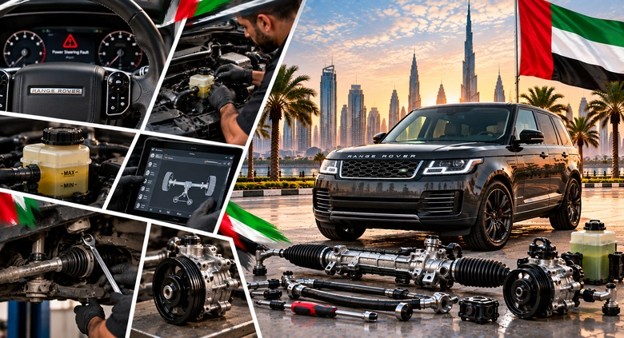
This is where repair versus replacement becomes relevant.
Depending on the rack design and condition, a specialist may be able to:
- replace seals
- rebuild the rack
- replace worn internal components
- recondition the assembly
But electronic racks are more complicated because the mechanical and electronic components may need to be evaluated together.
A “reconditioned rack” is therefore not automatically equivalent to a rebuilt hydraulic rack from an older vehicle.
When does steering-rack replacement make more sense?
Replacement becomes more defensible when there is:
- severe internal wear
- damaged rack teeth
- excessive internal play
- structural damage
- irreparable leakage
- damaged electronic steering components
- failed motor or sensor assembly where replacement is not economically viable
- unsuccessful or unsupported refurbishment
The diagnosis should explain why the original rack cannot be economically repaired.
When can a steering rack be reconditioned?
Potentially when:
- the casing is sound
- internal components are serviceable
- replacement seals/components are available
- the rebuilder has the correct specification
- electronic components can be tested
- the rebuilt rack comes with a meaningful warranty
Ask what “reconditioned” actually means.
Some sellers use it to describe a properly rebuilt assembly.
Others may simply mean cleaned, inspected and resold.
Those aren't equivalent.
Used genuine steering racks need more scrutiny than body parts
A used bumper is one thing.
A used steering rack is safety-critical.
Before buying one, ask for:
- exact part number
- donor VIN if available
- donor model/year
- mileage if known
- accident history
- leakage inspection
- physical condition
- electronic condition
- warranty
- return policy
If the donor vehicle suffered front-end impact, be especially cautious.
Don't buy a used rack simply because the part number looks close
A steering rack can vary with:
- generation
- wheelbase
- engine
- steering specification
- left/right-hand-drive configuration
- software
- equipment level
- market
- production revision
Use the VIN.
Then confirm the part number.
Genuine versus OEM versus aftermarket steering components
The terminology matters.
Genuine: supplied as a Land Rover genuine component.
OEM: usually refers to original-equipment manufacturing, but seller usage can vary.
Aftermarket: independent replacement component.
Used genuine: original component removed from another vehicle.
Reconditioned: previously used component rebuilt or repaired to a stated standard.
For steering, the manufacturer, rebuilder, warranty and exact specification are more important than the marketing label alone.
A cheap aftermarket rack isn't necessarily cheap after installation
Imagine an aftermarket rack costs AED 1,500.
Then it requires:
- additional parts
- unexpected bracket changes
- software adaptation
- repeated alignment
- return shipment because of incorrect fitment
The saving can disappear.
A higher-priced correctly specified rack may produce a lower total repair cost.
Steering pumps have the same problem
A pump advertised at AED 700 may look attractive beside a genuine pump costing several thousand dirhams.
But compare:
- manufacturer
- pressure specification
- part number
- vehicle compatibility
- warranty
- condition
- whether the pulley/reservoir is included
- whether installation is included
Don't compare a bare aftermarket pump against a complete genuine assembly and call the difference “dealer markup”.
Current UAE pump pricing shows why specification matters
A UAE parts listing currently shows genuine Land Rover pump QVB500390 at AED 2,714.45 before VAT and AED 2,850.17 including VAT, with three units listed in stock when the page was crawled. It also states that fitment should be checked against the VIN and that the item is non-returnable.
That last detail is important.
A non-returnable steering component should never be ordered on a guess.
Another older pump listing demonstrates the generation problem
A separate UAE listing for a genuine Land Rover power-steering pump identifies LR011844 as fitting Range Rover models from 2010–2012 and lists the part at AED 3,777.02.
That is a completely different part number and vehicle application.
So:
“Range Rover power steering pump price”
without a year and VIN is not a sufficiently precise buying query.
UAE labour is only one part of the steering bill
A rack replacement can involve several hours of work.
One current Dubai specialist states approximately 4–6 hours for Range Rover steering-rack replacement including alignment and calibration.
Another UAE cost guide places European/American steering-rack replacement labour broadly in the AED 400–700 range, although this is a general vehicle-category estimate rather than a Range Rover-specific quotation.
Treat these as reference points.
Actual labour depends on generation, access, workshop and the work required.
Alignment should be included after rack replacement
This isn't decorative workshop paperwork.
Removing and installing a steering rack can alter steering geometry.
After replacement, the vehicle should be checked and aligned appropriately.
One current Range Rover steering service listing explicitly includes four-wheel alignment and steering-angle recalibration as part of its steering repair process.
Ask whether alignment is included before accepting a rack quotation.
Steering-angle calibration may also matter
Modern vehicles use steering-angle information for systems such as stability control and driver assistance.
If steering components are replaced or steering geometry changes, the relevant calibration procedure may need to be performed.
Don't assume the alignment machine automatically completes every electronic calibration.
Ask separately.
A steering rack can be mechanically correct but electronically incompatible
This is a modern Range Rover problem worth taking seriously.
A rack may physically bolt into place while its electronics, software or vehicle configuration do not match.
The car might then display warnings or fail to provide correct assistance.
This is another reason a VIN and exact part number should come before purchase.
Software updates can sometimes be part of the repair decision
Land Rover's current software documentation includes power-steering-related improvements for several newer models. It specifically lists PSCM improvements for certain Range Rover and Range Rover Sport model years and steering-assistance improvements on other Range Rover-family vehicles.
That doesn't mean a software update will cure every steering fault.
It means the workshop should check whether software is relevant before condemning expensive hardware.
A warning that appears after battery replacement deserves investigation
If a steering warning appears immediately after battery work, don't automatically order a rack.
Check:
- battery voltage
- battery registration where applicable
- charging system
- stored faults
- module communication
- steering-angle data
- software status
The timing of the warning is useful diagnostic evidence.
UAE heat can influence steering components — but don't use it as the diagnosis
The UAE environment brings:
- high ambient temperatures
- intense solar exposure
- heavy air-conditioning loads
- dust
- stop-start urban traffic
- long highway journeys
These conditions form part of the vehicle's operating environment.
But “UAE heat damaged the rack” is not a diagnosis.
A leaking hose needs evidence.
A failed motor needs evidence.
A faulty module needs evidence.
Dubai traffic puts repeated low-speed steering loads on the system
Frequent parking manoeuvres and tight urban traffic mean steering assistance is repeatedly working at low vehicle speeds.
That makes symptoms such as:
- heavy parking steering
- whining during manoeuvres
- intermittent assistance
- notchy steering
particularly noticeable.
But again, symptom frequency is not proof of component failure.
Tyres can make steering feel heavier than expected
Don't overlook the tyres.
Check:
- tyre pressure
- tyre size
- tyre condition
- front-axle wear
- alignment
- uneven tyre wear
Incorrect pressure can noticeably change steering effort.
A workshop should eliminate simple causes before replacing expensive steering hardware.
Suspension faults can imitate steering problems
Worn front-end components can create:
- wandering
- pulling
- knocks
- steering vibration
- uneven steering return
Check the suspension and steering linkage together.
A steering rack should not be replaced simply because the customer says:
“The front end feels loose.”
Find the loose component.
Steering return-to-centre matters
After a turn, the steering should normally return towards centre in a predictable way.
If it doesn't, investigate:
- alignment
- tyre condition
- suspension geometry
- rack condition
- steering assistance
- steering-column components
A poor return-to-centre characteristic deserves diagnosis rather than a parts guess.
What a proper Range Rover steering inspection should include
For an older hydraulic vehicle:
Fluid → leaks → pressure → pump → rack → linkage → alignment.
For a newer electric system:
Battery/voltage → diagnostic scan → PSCM → live data → motor/torque sensing → wiring → mechanical rack → software → calibration.
The exact sequence can change with the model.
The principle doesn't:
diagnose first, replace second.
Before You Click Buy:
Use this checklist before ordering any steering component.
| Question | What to confirm |
| Exact model | Range Rover / Sport / Evoque / Velar |
| Generation | L322 / L405 / L460 or exact derivative |
| Model year | Confirmed |
| VIN | 17-character VIN |
| Steering type | Hydraulic or electric |
| Part | Pump/rack/motor/module/hose |
| Part number | Exact match |
| Condition | New/used/reconditioned |
| Manufacturer | Identified |
| Warranty | Written |
| Return policy | Written |
| Software | Check required? |
| Calibration | Required? |
| Alignment | Included? |
| Labour | Separate or included? |
| Fluid | Included where applicable? |
| Total repair | Final installed figure |
If the supplier cannot answer several of these, don't order yet.
A sensible UAE power-steering cost framework
| Repair route | Current UAE reference | Qualification |
| Steering-rack replacement | From AED 2,000 | Published Dubai specialist starting figure including alignment |
| Range Rover Vogue rack | AED 3,500–5,500 | Published specialist estimate |
| Genuine pump QVB500390 | AED 2,850.17 incl. VAT | Specific current listing |
| Older genuine pump LR011844 | AED 3,777.02 | Specific 2010–2012 listing |
| General European/American rack replacement | AED 1,600–3,200 | Broad 2026 UAE market estimate, not Range Rover-specific |
| Rack seal repair | AED 330–600 | Broad UAE market estimate, not necessarily Range Rover |
These figures are reference observations available in September 2026, not fixed prices. Vehicle generation, part specification, condition, workshop and additional calibration can materially change the final amount.
Why a rack quotation can jump from AED 2,000 to AED 5,000
The difference may come from:
- genuine versus aftermarket
- new versus reconditioned
- complete versus bare assembly
- steering motor included
- module included
- tie rods included
- alignment included
- calibration included
- warranty
- labour
- VAT
Always compare like with like.
A reconditioned rack can be worth investigating on an older Range Rover
For an older L322 or L405, a properly rebuilt rack can sometimes make financial sense.
But ask:
Who rebuilt it?
What was replaced?
Was the electronic component tested?
What warranty is provided?
Is the exact part number confirmed?
“Reconditioned” without a specification is not enough.
When a genuine new rack is easier to justify
A new genuine unit becomes more attractive when:
- the vehicle is newer
- the steering system is electronically integrated
- the vehicle is under warranty
- exact electronic compatibility is critical
- the existing rack is severely damaged
- a trustworthy reconditioned unit isn't available
Land Rover UAE states that new MENA-market vehicles currently receive manufacturer warranty coverage of five years or 150,000 km, whichever occurs first, subject to the warranty terms. Proven manufacturing defects are handled through authorised repairers.
If the vehicle is still covered, investigate warranty support before buying a rack privately.
Don't confuse warranty with accident damage
A steering rack damaged by an accident isn't the same as a rack that failed because of a manufacturing defect.
Land Rover UAE's warranty information specifically excludes damage resulting from misuse, neglect, accident or improper maintenance.
So establish the cause of failure before assuming warranty coverage.
What if the steering rack is leaking but the vehicle still drives normally?
Don't treat that as permission to postpone the repair indefinitely.
A small leak can become a large leak.
On hydraulic systems, loss of fluid can affect steering assistance and potentially damage other components if the system operates without sufficient fluid.
Inspect the leak source and determine whether repair or rack replacement is appropriate.
What if the steering is only heavy when parking?
That symptom is worth investigating carefully.
Possible areas include:
- hydraulic pressure
- pump condition
- electric assistance
- battery/voltage
- steering rack
- tyres
- alignment
- suspension
Low-speed steering is where assistance problems often become most obvious.
But it still doesn't identify the failed part by itself.
What if the power-steering warning disappears after restarting?
Don't ignore it.
Intermittent faults can be particularly valuable diagnostic clues.
Record:
- when it happens
- outside temperature
- whether the engine is hot/cold
- steering angle
- speed
- whether other warnings appear
- whether restarting clears it
Then have the vehicle scanned for stored faults.
The fact that a warning disappeared doesn't prove that the underlying fault disappeared.
The exact fault symptoms should be written down
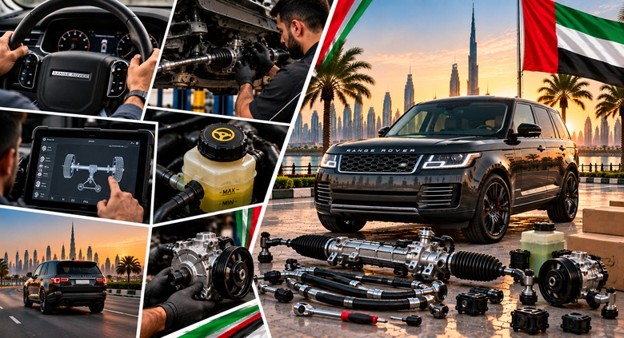
Instead of telling the workshop:
“Power steering problem.”
Give them something more useful:
“Steering becomes heavy at low speed after the vehicle has been driven for 20 minutes; no visible fluid leak; warning appears intermittently; restart temporarily restores assistance.”
That is diagnostic information.
The workshop can then reproduce the symptom instead of starting from a blank page.
A good steering quotation should identify the failed component
A professional estimate should ideally say something like:
Fault: steering assistance unavailable
Diagnosis: PSCM fault with confirmed motor/communication issue
Part: exact rack/motor/module part number
Condition: new/reconditioned/used
Labour: X
Calibration: included/not included
Alignment: included/not included
Warranty: X months
Total: AED X including VAT
That is considerably more useful than:
“Range Rover steering repair — AED 4,000.”
Don't approve additional parts without asking why
A steering repair can reveal worn tie rods, ball joints or suspension components.
Some additional work may genuinely be necessary.
Ask:
What failed?
Can you show me?
Is it safety-critical?
Does it affect the steering repair?
What is the additional cost?
This keeps the repair evidence-based.
Tie rods deserve particular attention during rack replacement
The tie rods connect the rack to the steering knuckles.
If they have excessive play, replacing the rack alone won't restore the front end completely.
Inspect:
- inner tie rods
- outer tie-rod ends
- boots
- play
- corrosion
- alignment
If worn parts are reused, the post-repair alignment may not remain correct.
Steering boots can reveal what is happening inside
Inspect the rack boots for:
- splits
- grease
- hydraulic fluid
- contamination
- damaged clamps
A damaged boot doesn't automatically mean the rack is finished.
But fluid inside a rack boot can be a useful clue that an internal seal is leaking.
The steering column shouldn't be ignored
If the steering feels notchy, stiff or produces unusual noises, the rack isn't the only possible source.
The workshop should consider:
- intermediate shaft
- universal joints
- column bearings
- steering lock
- column module
Again, follow the symptom.
Don't start with the most expensive component.
Steering-wheel vibration is not automatically a steering-rack fault
At motorway speed, vibration may be related to:
- wheel balance
- tyre condition
- wheel damage
- alignment
- suspension
- brake components
A steering rack problem can exist, but vibration alone doesn't prove it.
Start with the rotating components.
Road-test conditions matter
A steering diagnosis should not be based only on a workshop bay.
Depending on the symptom, the vehicle may need evaluation for:
- low-speed steering
- steering return
- straight-line stability
- braking stability
- steering noise
- assistance consistency
The road test should be carried out safely and only after the vehicle is considered roadworthy.
What if a used rack has no warranty?
For a steering component, that substantially changes the risk.
If the rack fails shortly after installation, you may have to pay again for:
- removal
- replacement
- alignment
- calibration
- diagnostic work
A slightly more expensive unit with a meaningful warranty can reduce that risk.
The donor vehicle matters
For a used Range Rover rack, ask:
- What model was it removed from?
- What year?
- What mileage?
- Was the vehicle running?
- Was the steering system tested?
- Was the donor involved in a front-end collision?
- Is the electronic module included?
- Is the rack leaking?
- Is the part number confirmed?
A dismantler who can answer these questions gives you much more useful information than a seller who simply says “good condition”.
A steering part stored badly can become a problem before installation
Used and reconditioned steering components should be stored appropriately.
Look for:
- exposed connectors
- damaged boots
- corrosion
- impact marks
- contamination
- fluid leakage
- bent mounting points
The fact that a part has never been installed on your vehicle doesn't mean it is automatically healthy.
UAE sourcing can make delivery part of the repair decision
Some steering components are available locally.
Others may need to be sourced from outside the UAE.
Ask:
Is it physically in UAE stock?
What is the expected delivery date?
Is the quoted price based on current stock?
What happens if the part is delayed?
For a vehicle that is already off the road, delivery time has a real cost.
Non-returnable steering parts deserve extra caution
The current UAE listing for the genuine QVB500390 pump states that the item is not returnable and recommends checking fitment against the VIN.
That is exactly why fitment should be confirmed before payment.
A non-returnable expensive steering component should never be purchased from a photograph alone.
PartFinder UAE can help when the job is to compare available Range Rover steering-part options in the UAE, particularly where the buyer wants to compare new, used or other supplier options before committing to a repair.
The important step is still the same: provide the exact vehicle information, confirm the part number and ask suppliers from PartFinder UAE whether the quoted component is complete, tested and covered by a warranty.
A cheaper quote is useful only when it is for the correct part.
The buyer decision matrix
| Situation | First diagnostic priority | Potential repair route |
| Older hydraulic Range Rover, low fluid | Find leak | Hose/seal/rack/pump repair |
| Hydraulic pump whining | Pressure + fluid test | Pump or system repair |
| Steering suddenly heavy | Assistance system check | Depends on diagnosis |
| Newer Range Rover warning | Diagnostic scan | PSCM/motor/software investigation |
| Rack leaking internally | Rack inspection | Rebuild or replacement |
| Excessive rack play | Mechanical inspection | Rack replacement/reconditioning |
| Steering pulls | Alignment/tyres/suspension | Correct underlying issue |
| Intermittent warning | Stored codes + live data | Electrical/software/component repair |
| Used rack available | VIN + part-number check | Only if condition/warranty acceptable |
| Vehicle under warranty | Manufacturer diagnosis | Warranty route if eligible |
Before approving a Range Rover steering repair
Ask the workshop these ten questions:
- What exact component has failed?
- What diagnostic code was recorded?
- Is the fault mechanical, hydraulic or electronic?
- Was the battery/charging system checked?
- Was the rack inspected physically?
- Was hydraulic pressure tested where applicable?
- Is software relevant?
- Is the replacement new, used or reconditioned?
- Is alignment included?
- Is calibration included?
If the workshop cannot explain the failure but wants to sell a complete rack, get another diagnostic opinion.
What should the final invoice contain?
Ideally:
Vehicle: exact Range Rover
VIN: confirmed
Fault: documented
Part: exact number
Condition: new/used/reconditioned
Manufacturer: identified
Labour: listed
Fluid: listed where applicable
Alignment: listed
Calibration: listed
Warranty: listed
VAT: listed
Total: final amount
That is the sort of quotation you can actually compare.
Don't compare a pump price with a rack price
This sounds ridiculously obvious.
Yet search results often place them beside one another under “power steering”.
A pump and a rack are completely different components.
The failure symptoms can overlap.
The repair cost can overlap.
The parts are not interchangeable.
Identify the failed component first.
Don't compare a bare rack with a complete rack
Ask whether the quotation includes:
- rack
- steering motor
- control module
- inner tie rods
- boots
- brackets
- programming
- calibration
The word “complete” should be backed by a parts list.
A new pump doesn't fix a mechanical rack problem
If the rack is internally damaged, installing a new pump may restore hydraulic pressure without solving the actual steering fault.
Likewise, replacing the rack won't fix a damaged high-pressure hose.
The system needs to be considered as a whole.
The same principle applies to electric steering
Replacing an electric rack without checking:
- power supply
- module communication
- software
- motor
- torque sensor
- wiring
can result in an expensive part swap without solving the underlying problem.
Range Rover steering repair in Dubai, Abu Dhabi and Sharjah
The technical requirements don't change because the workshop is in a different UAE emirate.
But sourcing and labour can vary.
Whether the vehicle is in Dubai, Abu Dhabi, Sharjah or elsewhere, ask for the same information:
exact diagnosis + exact part + exact condition + exact labour + exact calibration + exact warranty.
That makes quotations genuinely comparable.
A steering warning after front-end accident damage needs special attention
If the vehicle has recently suffered a collision, inspect more than the rack.
Look at:
- steering rack housing
- tie rods
- subframe
- suspension
- steering column
- wiring
- wheel alignment
- front-end geometry
A collision can create several related faults.
Replacing the rack without checking the surrounding structure can leave the original problem partly unresolved.
Flood or water exposure changes the buying equation
If a used steering component comes from a flood-damaged vehicle, be cautious.
Electronic steering components can be particularly vulnerable to:
- corrosion
- connector contamination
- internal moisture
- communication faults
Ask about donor history before purchasing.
Why “tested” isn't enough for a used rack
Ask:
What was tested?
Was it:
- physically inspected?
- pressure tested?
- electrically tested?
- installed on a running donor?
- scanned?
- checked for leakage?
- checked for play?
A useful test description is more valuable than the word “tested”.
Reconditioned steering parts need a written warranty
Ask for the warranty in writing.
Check whether it covers:
- the component
- electronic module
- internal leakage
- labour
- removal/refitting
- replacement if defective
A parts-only warranty may still leave you with a large labour bill if the component fails.
Alignment should be checked even when the steering fault seemed electronic
If the steering rack or steering linkage was physically removed, alignment should be verified.
An electronic fault can coexist with a mechanical alignment problem.
Don't assume one excludes the other.
What if the workshop says “the rack is fine”?
That can actually be good news.
If the rack is mechanically sound, the repair may involve:
- software
- steering module
- motor
- sensor
- wiring
- power supply
- calibration
The correct repair may therefore cost substantially less than a complete rack.
What if the workshop says “it's the module”?
Ask what proves it.
A module fault should be supported by diagnostic evidence.
Ask for:
- fault code
- communication status
- power/ground check
- relevant live data
- software status
Electronic parts are expensive enough without replacing them on suspicion.
What if the steering becomes heavy only after the vehicle warms up?
That is useful information.
Record when the symptom appears.
For hydraulic systems, temperature can affect fluid behaviour and a marginal pump or restriction may become more noticeable.
For electric systems, temperature-related electronic faults are also possible.
But the exact cause still needs testing.
What if steering is heavy only in one direction?
That is a particularly useful symptom.
It may suggest a mechanical or hydraulic issue that behaves differently through the steering range.
Don't simply replace the pump.
Describe exactly what happens to the workshop.
What if the steering wheel shakes while braking?
Start with the braking, wheels, tyres and suspension systems.
Don't automatically blame the power-steering system.
Steering vibration during braking has a different diagnostic starting point from a loss of steering assistance.
What if the steering wheel is off-centre after repair?
Have the alignment checked.
If the rack has been replaced, steering-centre calibration may also need attention depending on the model.
The vehicle should leave the workshop with correct straight-ahead geometry.
A proper post-repair test matters
After a steering repair, check:
- steering assistance
- warning messages
- steering-centre position
- steering return
- low-speed operation
- noise
- alignment
- steering-angle data where applicable
- fluid level on hydraulic systems
- leakage
- diagnostic codes
Then road-test the vehicle safely.
Don't ignore a new noise after steering repair
A new noise after a repair should be investigated.
It could be:
- loose mounting
- hose contact
- air in hydraulic system
- incorrect routing
- steering-column interference
- suspension component
- rack issue
“It's normal after replacement” should be supported by an explanation, not simply used to close the job.
The final repair decision should consider vehicle age
For a newer Range Rover, a genuine component with manufacturer support may make more sense.
For an older L322, a quality reconditioned rack or verified used genuine component may be worth considering if the economics are sensible.
For a high-mileage vehicle, compare the steering repair against the vehicle's overall condition.
But don't compromise on the steering system simply because the vehicle is old.
Steering is not the place for the cheapest possible part
Body trim can be approached differently.
Steering is a control system.
The component must be correctly specified, properly installed and properly tested.
Saving AED 500 on the wrong steering part isn't a saving.
It is another repair waiting to happen.
The most useful UAE steering quotation is an evidence-based one
The ideal quotation doesn't just say:
“Rack replacement — AED 4,500.”
It says:
Diagnosis: steering rack internal play confirmed
Part: exact VIN-matched rack
Condition: reconditioned
Labour: included
Alignment: included
Calibration: included
Warranty: 12 months
VAT: included
Total: AED X
Now you can make a meaningful comparison.
Final Range Rover power-steering buyer checklist
Before spending money, confirm:
- exact model
- generation
- year
- VIN
- hydraulic/electric system
- fault symptoms
- diagnostic codes
- battery/charging condition
- fluid condition if applicable
- leak location if applicable
- rack condition
- pump condition
- steering motor/module condition
- exact part number
- new/used/reconditioned status
- manufacturer
- warranty
- return policy
- software requirement
- calibration requirement
- alignment
- labour
- VAT
- final installed price
Miss one minor detail and you may be fine.
Miss the steering-system type or exact part number and the entire purchase can go wrong.
The real question isn't “How much is Range Rover power steering?”
It is:
“What failed, which part actually fixes it, and what will the complete repair cost after fitting and calibration?”
That is the question worth taking to a UAE workshop.
Because replacing a pump when the rack is failing is wasted money.
Replacing a rack when the fault is software is wasted money.
Buying a used electric rack without checking compatibility is risky.
And ordering a non-returnable pump without VIN confirmation is an entirely avoidable mistake.
FAQs
Categories
- Audi
- BMW
- Car Accessories
- Car Tips
- Ford
- Land Rover
- Mazda
- Range Rover
- Top 10
- UAE Car Parts
- Used Car Parts
- Toyota
- Replacement Engines
- Nissan
- Hyundai
- Mitsubishi
- Volkswagen
- Honda
- Kia
- Chevrolet
- Dodge
- Jeep
- Subaru
- Renault
- Lexus
- Mercedes
- Suzuki
- Hummer
- Porsche
- Infiniti
- Peugeot
- GMC
- Mini
- Volvo
- Replacement Gearboxes
- MG
- Jaguar
- Skoda
- Cadillac
- Daihatsu
- Fiat
- German Car Parts
- Japanese Car Parts
- Aftermarket Car Parts
- Genuine Car Parts
- New Car Parts
- Reconditioned Car Parts
- European Car Parts
- American Car Parts
- Korean Car Parts
- British Car Parts
- Chinese Car Parts
- Sports/Exotic Car Parts
- Luxury Car Parts
- Performance Car Parts
- SUV/4x4 Spare Parts
- Truck Spare Parts
- EV Car Parts
- Hybrid Car Parts
- Auto Spare Parts in UAE
- Tesla
- Isuzu
- Ram
- Ferrari
- Bentley
- Lamborghini
- Genesis
- Maserati
- Lincoln
- Chrysler
- Opel
- Citroen
- SsangYong
- Seat
- McLaren