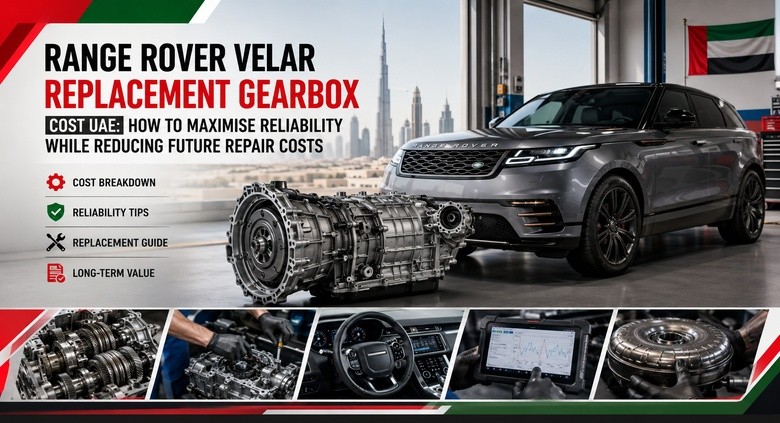
Range Rover Velar Replacement Gearbox Cost UAE: How to Maximise Reliability While Reducing Future Repair Costs
June 30, 2026
Understanding Gearbox Health Before Spending Money
Buying a replacement gearbox isn't simply about solving today's problem.
It's about protecting tomorrow's investment.
That distinction matters far more than many owners realise.
Across Dubai, Abu Dhabi, Sharjah and the rest of the UAE, experienced transmission specialists regularly meet Range Rover Velar owners who are frustrated by unexpected gearbox issues. Some have already received quotations for complete gearbox replacement. Others have spent money replacing individual components without fixing the original fault. A few have even been advised to sell the vehicle altogether.
Should you?
Perhaps.
Perhaps not.
The answer depends on one thing above everything else—accurate diagnosis.
Long-term value isn't created by purchasing the cheapest gearbox available. Nor does it automatically come from buying the most expensive option. It begins with understanding exactly what's wrong, identifying the most cost-effective solution and making a decision that continues paying dividends long after today's repair invoice has been forgotten.
That's precisely what this guide is designed to help you achieve.
Why Accurate Diagnosis Is the First Step Towards Long-Term Value
Imagine building a new house on unstable foundations.
No matter how expensive the materials are, problems will eventually appear.
Gearbox replacement works in much the same way.
Replacing the transmission before confirming the underlying fault can leave owners facing unnecessary costs, repeated workshop visits and avoidable frustration. A professional diagnosis, however, changes the entire picture. Instead of relying on assumptions, experienced technicians work through the evidence carefully until they identify the real cause.
Sometimes the gearbox genuinely needs replacing.
Sometimes it doesn't.
Across UAE transmission workshops, vehicles frequently arrive displaying symptoms that appear serious:
- Delayed gear engagement
- Harsh gear changes
- Transmission warning lights
- Hesitation during acceleration
- Reduced fuel efficiency
Yet after carrying out a complete inspection, technicians occasionally discover far less expensive causes.
Examples include:
- Worn transmission fluid
- Faulty speed sensors
- Solenoid problems
- Valve body issues
- ECU software calibration faults
Suddenly, the repair strategy changes.
So does the final invoice.
The smartest owners don't rush into replacement.
They slow down first.
Gather the facts.
Compare every option.
Then they move forward with confidence.
Ironically, that careful approach often saves both time and money.
How the Range Rover Velar Transmission System Works
Luxury performance comes at a price.
Not simply financially, but mechanically as well.
The Range Rover Velar combines refined road manners with off-road capability, smooth motorway cruising and impressive towing performance. Delivering all of that requires an exceptionally sophisticated transmission.
Its responsibilities extend well beyond changing gears.
The gearbox must:
- Transfer engine torque efficiently
- Optimise fuel economy
- Deliver smooth acceleration
- Respond instantly to changing road conditions
- Communicate continuously with multiple electronic control systems
- Maintain safe operating temperatures under demanding UAE conditions
Several complex components work together throughout every journey.
These include:
- Gear sets
- Torque converter
- Valve body
- Hydraulic circuits
- Oil pump
- Solenoids
- Clutch packs
- Bearings
- Transmission Control Module (TCM)
- Sensors
- Cooling system
Notice how interconnected everything is.
One component begins wearing out.
Another starts compensating.
Then another.
Before long, what appears to be a single fault may actually involve several systems working outside their normal operating limits.
That is exactly why professional diagnosis matters.
The Most Common Range Rover Velar Gearbox Problems Seen in UAE Workshops
Every vehicle develops characteristic weaknesses over time.
The Range Rover Velar is no exception.
Transmission specialists throughout the UAE regularly diagnose several recurring gearbox faults, particularly on vehicles exposed to heavy traffic, long-distance motorway driving and extreme summer temperatures.
Common issues include:
- Delayed engagement when selecting Drive or Reverse
- Harsh shifting between gears
- Gear slipping during acceleration
- Torque converter wear
- Valve body deterioration
- Solenoid failure
- Hydraulic pressure loss
- Transmission overheating
- Internal clutch wear
- Electronic communication faults
- Contaminated transmission fluid
Interestingly, several completely different faults produce remarkably similar symptoms.
That's where inexperienced diagnosis often goes wrong.
One workshop immediately recommends gearbox replacement.
Another investigates further and identifies a faulty solenoid costing only a fraction of the price.
Which option represents better long-term value?
The answer speaks for itself.
Early Warning Signs That Should Never Be Ignored
Gearboxes rarely fail without warning.
The signs are usually there.
The question is whether owners recognise them quickly enough.
Have you noticed any of these?
- Hesitation before moving away
- Slipping gears
- Rough or jerky gear changes
- Delayed acceleration
- Warning lights
- Whining noises
- Burning smell
- Fluid leaks
- Unexpected vibration
- Poor fuel economy
Ignore these symptoms and repair costs can escalate surprisingly quickly.
Investigate them early, however, and you may avoid replacing the gearbox altogether.
Small issues have an unfortunate habit of becoming expensive ones when left unchecked.
Act early.
Your future self—and your bank account—will almost certainly thank you.
How UAE Heat, Daily Traffic and Driving Conditions Affect Gearbox Life
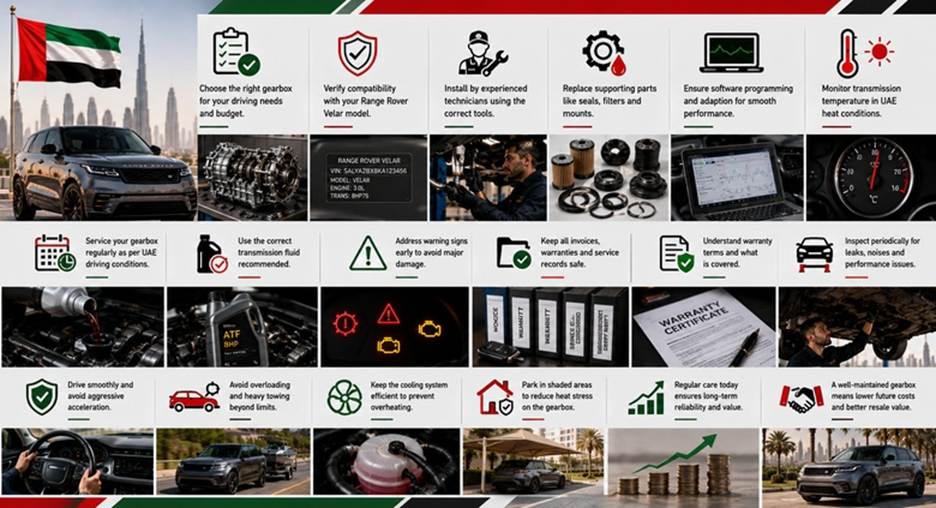
The UAE offers outstanding roads.
It also presents some of the toughest operating conditions for automatic transmissions anywhere in the world.
Summer temperatures frequently exceed 45°C.
Heavy traffic keeps transmission temperatures elevated for prolonged periods.
Luxury SUVs spend hours commuting through Dubai and Abu Dhabi before heading onto long motorway journeys or weekend desert excursions.
Every one of those conditions increases thermal stress.
Heat gradually breaks down transmission fluid.
Once that protective fluid begins losing its effectiveness, lubrication deteriorates, hydraulic pressure becomes less stable and internal wear accelerates.
Add towing, steep inclines or off-road driving into the equation and the workload increases again.
None of this happens overnight.
Wear builds gradually.
Owners rarely notice the process until symptoms finally appear.
Fortunately, routine servicing slows that progression considerably.
Preventive maintenance doesn't simply extend gearbox life.
It reduces long-term ownership costs.
That's exactly what long-term value looks like.
Mechanical, Hydraulic and Electronic Transmission Failures Explained
Not every gearbox problem belongs in the same category.
Professional workshops generally classify transmission faults into three main groups.
Mechanical failures
These involve physical wear inside the transmission.
Typical examples include:
- Worn bearings
- Damaged gears
- Clutch pack deterioration
- Torque converter failure
- Shaft wear
Mechanical failures usually develop gradually as mileage accumulates.
Hydraulic failures
Automatic transmissions rely on precisely controlled hydraulic pressure.
If pressure drops or fluid flow becomes restricted, gear changes quickly begin deteriorating.
Common hydraulic faults include:
- Contaminated transmission fluid
- Valve body wear
- Internal leakage
- Oil pump wear
- Blocked hydraulic passages
Many hydraulic issues respond well to early intervention.
Leave them too long, however, and mechanical damage often follows.
Electronic failures
Modern Range Rover Velar transmissions depend heavily upon electronic communication.
Even a relatively minor sensor fault can disrupt gear selection.
Electronic problems commonly involve:
- Faulty speed sensors
- Solenoid failures
- Wiring issues
- ECU communication faults
- Software calibration errors
Here's where diagnosis becomes particularly important.
A mechanical problem can feel almost identical to a hydraulic fault.
A hydraulic fault can mimic an electronic failure.
Without proper testing, replacing parts becomes guesswork rather than engineering.
Experienced specialists don't guess.
They investigate thoroughly, rule out unnecessary repairs and recommend solutions that deliver genuine long-term value.
Expected Range Rover Velar Gearbox Lifespan in UAE Conditions
One question appears in almost every gearbox consultation.
"How long should a Range Rover Velar gearbox actually last?"
The honest answer?
It depends.
A gearbox doesn't wear out according to a calendar. Nor does it suddenly fail because it reaches a specific mileage. Instead, its lifespan reflects years of driving habits, servicing standards and operating conditions.
Think about two Velars.
The first spends most of its life travelling between Dubai and Abu Dhabi on open motorways. It receives scheduled servicing, transmission fluid inspections and software updates on time. It rarely tows heavy loads, and it avoids prolonged overheating.
The second regularly sits in stop-start traffic, misses service intervals, tows heavy trailers during holidays and tackles demanding desert terrain throughout the year.
Both vehicles may share identical specifications.
Their transmissions certainly won't share the same lifespan.
Professional workshops generally evaluate gearbox longevity by considering:
- Maintenance history
- Transmission fluid condition
- Previous repairs
- Cooling system efficiency
- Driving style
- Towing frequency
- Off-road usage
- Operating temperatures
- Diagnostic history
When these factors are managed properly, many Range Rover Velar gearboxes continue operating reliably for well beyond 220,000 to 280,000 kilometres.
Ignore them and expensive repairs can arrive much sooner.
Mileage tells only part of the story.
Maintenance tells the rest.
Common Diagnostic Fault Codes and Their Real Meaning
Modern transmissions constantly monitor themselves.
Every journey generates thousands of electronic calculations, and whenever the system detects abnormal behaviour it records diagnostic trouble codes.
Useful?
Absolutely.
Definitive?
Not quite.
Fault codes provide clues rather than conclusions.
Among the codes transmission specialists frequently investigate are:
| Diagnostic Code | Typical Meaning |
| P0700 | General transmission control system fault |
| P0715 | Input speed sensor malfunction |
| P0720 | Output speed sensor problem |
| P0741 | Torque converter clutch performance issue |
| P0776 | Pressure control solenoid fault |
| P0841 | Transmission fluid pressure sensor concern |
Imagine receiving a temperature warning on your smartwatch.
It tells you something deserves attention.
It doesn't diagnose the illness.
Transmission fault codes work in exactly the same way.
Professional technicians don't simply replace the component named in a fault code. Instead, they combine electronic diagnostics with live data, hydraulic testing, visual inspection, fluid analysis and road testing before reaching a final decision.
That's engineering.
Not guesswork.
Why Early Repairs Usually Reduce Long-Term Ownership Costs
Let's consider two different owners.
The first notices a slight hesitation during gear changes. Instead of putting it off, they arrange a professional inspection. The workshop discovers contaminated transmission fluid together with an ageing solenoid. Both components are replaced promptly before internal wear develops.
The second owner notices identical symptoms.
They continue driving for another eight months.
Eventually the gearbox begins slipping, overheating and contaminating internal clutch packs. Hydraulic pressure falls, additional components wear out and what started as a relatively inexpensive repair develops into a complete gearbox replacement.
Which owner spends less?
The answer is obvious.
Early intervention protects:
- Internal clutch packs
- Bearings
- Valve body components
- Hydraulic circuits
- Torque converter
- Transmission cooling system
- Electronic control systems
Repairing a minor issue today often prevents a major financial commitment tomorrow.
That's one of the clearest examples of long-term value you'll find anywhere in vehicle ownership.
Professional Diagnostic Procedures Before Recommending Gearbox Replacement
Experienced transmission specialists don't replace gearboxes because symptoms "sound serious."
They investigate.
Every recommendation should be supported by evidence.
Professional diagnostic procedures usually include:
- Customer consultation
- Service history review
- Road testing under different conditions
- Visual inspection
- Diagnostic computer scan
- Live transmission data analysis
- Transmission fluid assessment
- Hydraulic pressure testing
- Cooling system inspection
- ECU communication checks
- Adaptation value analysis
- Final engineering evaluation
Each stage either confirms or rules out potential causes.
Sometimes the investigation confirms complete gearbox failure.
Sometimes it uncovers a relatively straightforward repair.
Either outcome is valuable because the owner can make an informed financial decision instead of relying on assumptions.
Good diagnosis doesn't simply identify faults.
It prevents unnecessary spending.
UAE Workshop Case Study: How Proper Diagnosis Prevented an Unnecessary Gearbox Replacement
A Range Rover Velar owner from Sharjah recently experienced increasingly harsh gear changes during the daily commute. Occasionally, the transmission hesitated before selecting Drive, while a warning light appeared briefly before disappearing again.
Concerned about escalating repair costs, the owner visited a workshop.
The initial recommendation?
Replace the gearbox immediately.
Fortunately, they decided to seek another opinion.
The second workshop approached the vehicle differently. Rather than jumping straight to replacement, technicians carried out a complete diagnostic programme. They examined live transmission data, inspected the fluid, measured hydraulic pressure, analysed ECU adaptation values, checked the cooling system and reviewed the vehicle's maintenance history.
The results completely changed the repair strategy.
The gearbox itself remained mechanically healthy.
Instead, the investigation identified:
- Degraded transmission fluid
- A sticking pressure-control solenoid
- Outdated transmission adaptation values
The workshop replaced the affected components, carried out a complete transmission service, updated the software, reset adaptation values and completed an extended road test.
The transmission returned to smooth operation.
The owner avoided spending many thousands of dirhams on an unnecessary gearbox replacement.
That's the difference accurate diagnosis makes.
Not only did it reduce immediate repair costs, but it also preserved the long-term value of the vehicle while extending the service life of the original transmission.
And that's the central theme of this guide.
Long-term value rarely comes from making the fastest decision.
It comes from making the most informed one.
Choosing the Right Gearbox for Maximum Long-Term Value
Buying a replacement gearbox is easy.
Buying the right replacement gearbox is considerably harder.
Many owners begin by comparing quotations. That's understandable because a Range Rover Velar gearbox replacement represents a significant financial commitment. Yet experienced transmission specialists across Dubai, Abu Dhabi, Sharjah and the other Emirates consistently point out the same mistake.
Too many buyers focus on today's invoice.
Too few think about the next five years.
Long-term value isn't measured by purchase price alone. It depends on reliability, compatibility, installation quality, warranty protection, future servicing costs and how confidently the transmission performs after thousands of kilometres of UAE driving.
That's where smarter buying decisions begin to separate themselves.
Used, Reconditioned, OEM and Genuine Range Rover Velar Gearboxes Compared
Four options generally dominate the UAE replacement gearbox market.
Each serves a different type of owner.
Understanding the strengths and compromises of every option helps prevent costly mistakes later.
Used Gearboxes
Used gearboxes usually attract buyers looking to reduce their initial expenditure.
Many are removed from accident-damaged vehicles with serviceable transmissions, while others originate from imported donor vehicles. If supplied by a reputable specialist, a carefully tested used gearbox can provide dependable service, particularly when the vehicle itself has already accumulated high mileage.
However, long-term value depends heavily on proper evaluation.
Before committing, always ask for:
- Verified mileage
- VIN details from the donor vehicle
- Service records
- Oil condition
- Diagnostic inspection results
- Warranty information
- Compatibility confirmation
Without that information, you're relying more on optimism than engineering.
Reconditioned Gearboxes
Professionally reconditioned gearboxes often represent the strongest balance between cost and reliability.
Unlike ordinary used transmissions, these units are completely dismantled and inspected. Worn components are replaced, internal clearances are measured, seals and bearings are renewed, clutch packs are rebuilt where necessary and the gearbox undergoes comprehensive testing before installation.
The result?
A transmission capable of delivering excellent reliability without reaching the price level of a brand-new genuine unit.
That explains why many independent transmission specialists recommend reconditioned gearboxes for owners planning to keep their Velar for several more years.
OEM Gearboxes
OEM gearboxes are manufactured to original engineering specifications by approved component manufacturers.
They generally provide:
- Excellent manufacturing quality
- High compatibility
- Consistent performance
- Long service life
- Strong reliability
For owners seeking dependable long-term ownership without necessarily purchasing genuine dealership components, OEM gearboxes remain an attractive option.
Genuine Range Rover Gearboxes
If maximum confidence is your priority, genuine transmissions naturally deserve consideration.
Advantages include:
- Original factory specifications
- Manufacturer-approved engineering
- Outstanding compatibility
- Strong resale confidence
- Excellent long-term durability
Yes, the purchase price is higher.
Yet many owners recover much of that additional investment through improved reliability, reduced repair frequency and stronger resale value.
Sometimes spending more today genuinely costs less tomorrow.
Which Gearbox Delivers the Best Long-Term Return on Investment?
There isn't a universal answer.
Instead, there is a best answer for your circumstances.
Ask yourself several important questions.
How long do you intend to keep the vehicle?
How many kilometres do you drive every year?
Do you tow regularly?
Do you commute daily between emirates?
How important is warranty protection?
The answers influence every buying decision.
For example:
- Owners planning another eight to ten years of ownership may benefit from OEM or genuine gearboxes.
- Those intending to sell within a shorter period often find professionally reconditioned units provide exceptional value.
- Higher-mileage vehicles approaching the latter stages of ownership may justify a thoroughly inspected used gearbox from a trusted supplier.
The key point remains the same.
Choose according to ownership strategy.
Not emotion.
Advantages and Risks of Buying a Used Gearbox
Used gearboxes continue attracting strong demand throughout the UAE.
And rightly so.
When properly sourced, they can reduce replacement costs significantly.
Potential advantages include:
- Lower purchase price
- Faster availability
- Reduced overall project cost
- Practical solution for older vehicles
However, every benefit comes with responsibility.
Potential risks include:
- Unknown service history
- Previous overheating
- Hidden internal wear
- Limited documentation
- Shorter warranty periods
- Variable remaining lifespan
That's precisely why supplier reputation matters so much.
Buying purely on price often proves expensive later.
Buying from a respected transmission specialist dramatically reduces those risks.
Why Professionally Reconditioned Gearboxes Offer Excellent Value
If long-term value forms the centre of your decision-making process, professionally reconditioned gearboxes deserve serious consideration.
Why?
Because uncertainty is removed wherever possible.
Typical rebuilding procedures include:
- Complete dismantling
- Ultrasonic cleaning
- Internal inspection
- Bearing replacement
- Seal replacement
- Clutch pack renewal
- Valve body servicing
- Solenoid testing
- Hydraulic pressure verification
- Computerised bench testing
Rather than wondering how the gearbox performed in its previous vehicle, owners receive a transmission restored to demanding engineering standards.
That additional confidence frequently outweighs the moderate increase in purchase price.
OEM vs Genuine Range Rover Gearboxes
This comparison generates countless discussions.
Both options deliver exceptional quality.
Both support long-term reliability.
Yet subtle differences remain.
OEM gearboxes often provide excellent engineering quality while reducing overall replacement costs slightly.
Genuine gearboxes offer factory-backed specifications together with maximum compatibility and stronger resale confidence.
Which should you choose?
If preserving the vehicle for many years remains your objective, genuine components may justify the additional investment.
If balancing quality with overall project costs feels more appropriate, OEM transmissions continue representing outstanding value.
Either approach supports responsible long-term ownership.
Why Mileage, Service History and Previous Repairs Matter
Two gearboxes may appear identical.
They rarely are.
Imagine comparing two advertisements.
One gearbox has completed 95,000 kilometres, accompanied by comprehensive servicing records, documented fluid changes and diagnostic reports.
The second shows 70,000 kilometres but lacks any maintenance history.
Which offers better value?
Most experienced buyers choose the first.
Service history reveals far more than mileage alone.
Always evaluate:
- Previous maintenance
- Transmission fluid replacement intervals
- Towing history
- Off-road usage
- Previous repairs
- Storage conditions
- Diagnostic reports
- Donor vehicle condition
Paperwork often tells a more accurate story than appearances.
Essential Compatibility Checks Before Buying a Range Rover Velar gearbox for sale
One incorrect gearbox can transform a straightforward installation into an expensive engineering exercise.
Professional workshops therefore verify compatibility before ordering any transmission.
Essential checks include for Range Rover Velar gearbox for sale:
- VIN verification
- Gearbox code
- Engine specification
- Model year
- Transmission variant
- Gear ratios
- ECU compatibility
- Wiring configuration
- Transfer case compatibility
Skipping these checks may create:
- Installation delays
- Additional labour costs
- Software programming issues
- Poor transmission performance
Ten minutes of verification today can prevent weeks of frustration later.
VIN Matching, Gearbox Codes and ECU Compatibility Explained
Modern luxury vehicles depend heavily upon electronic integration.
The gearbox doesn't operate independently.
Instead, it communicates continuously with multiple control modules.
Professional technicians therefore confirm:
- VIN information
- Gearbox serial numbers
- ECU software versions
- Transmission calibration
- Sensor compatibility
- Wiring integrity
Everything must work together.
Even an excellent gearbox can perform poorly if electronic communication isn't configured correctly.
Successful installations rely upon precision.
Not assumptions.
Why Torque Converter Inspection Is Essential During Replacement
Replacing the gearbox while overlooking the torque converter often proves to be a false economy.
Think about it.
The transmission has already been removed.
Labour access is available.
If the torque converter already shows signs of wear, postponing replacement simply creates another major labour bill later.
Professional workshops inspect:
- Lock-up clutch condition
- Internal bearings
- Heat damage
- Fluid contamination
- Balance
- Internal wear
Where necessary, replacing the torque converter during the same project frequently reduces long-term ownership costs.
It's another example of making one well-planned investment rather than paying twice.
Supporting Parts Worth Replacing During Installation
Gearbox replacement presents an ideal opportunity to inspect nearby components.
Experienced workshops commonly recommend evaluating:
- Transmission mounts
- Oil seals
- Driveshaft seals
- Transmission filter
- Cooling hoses
- Wiring connectors
- Flexible couplings
- Mounting bolts
- Transmission fluid
- Cooling system where required
Replacing worn supporting components during installation usually costs considerably less than dismantling the transmission again later.
Forward planning always pays dividends.
Comparison Table: Which Gearbox Offers the Best Long-Term Value?
| Gearbox Type | Initial Cost | Reliability | Warranty | Long-Term Value |
| Used | Lowest | Moderate | Limited | Good |
| Reconditioned | Medium | High | Strong | Excellent |
| OEM | High | Very High | Very Good | Outstanding |
| Genuine | Highest | Maximum | Excellent | Premium |
Notice something interesting?
The cheapest gearbox rarely delivers the lowest lifetime ownership cost.
A Range Rover Velar owner from Abu Dhabi recently compared three replacement quotations. One workshop proposed a low-cost used gearbox with minimal documentation. Another recommended an OEM transmission. The third suggested a professionally reconditioned gearbox supported by compatibility verification, comprehensive testing and warranty protection.
Rather than concentrating solely on the purchase price, the owner compared expected lifespan, future servicing costs, warranty cover, installation quality and long-term reliability.
The professionally reconditioned gearbox ultimately offered the strongest overall value.
That decision didn't simply reduce future repair risks.
It protected the vehicle's long-term ownership value.
And that's exactly what this article is about.
Making informed decisions today that continue saving money for years to come.
Range Rover Velar Replacement Gearbox Cost UAE: Complete Cost Analysis
By now, one thing should be clear.
Replacing a gearbox isn't simply about finding the lowest quotation.
It's about understanding the total financial picture.
Many owners begin by asking, "How much does a replacement gearbox cost?" It's an important question, but it isn't the only one worth asking.
What will the complete project cost?
How much will labour add?
Should supporting components be replaced at the same time?
Will software programming be required?
What happens if hidden faults appear after the gearbox has been removed?
These questions often make a much bigger difference to your final invoice than the gearbox itself.
Let's break everything down.
Range Rover Velar Replacement Gearbox Cost UAE: Complete Price Breakdown
Replacement costs vary according to gearbox type, vehicle specification, supplier quality and workshop expertise.
As a general guide across the UAE market, owners can expect:
| Gearbox Type | Typical UAE Price (AED) |
| Used Gearbox | 8,500–14,500 |
| Reconditioned Gearbox | 13,500–21,500 |
| OEM Gearbox | 20,000–30,000 |
| Genuine Range Rover Gearbox | 27,000–38,000+ |
These figures normally represent gearbox supply only.
Installation, programming and supporting components are usually calculated separately.
Consequently, comparing quotations without understanding what each includes can be misleading.
Always ask for a fully itemised estimate.
Used vs Reconditioned vs OEM vs Genuine Gearbox Cost Comparison
Initial purchase price tells only part of the story.
Let's compare long-term ownership value instead.
| Gearbox Type | Initial Cost | Expected Reliability | Future Repair Risk | Long-Term Value |
| Used | Lowest | Moderate | Higher | Good |
| Reconditioned | Medium | High | Low | Excellent |
| OEM | High | Very High | Very Low | Outstanding |
| Genuine | Highest | Maximum | Lowest | Premium |
Notice something?
The cheapest option doesn't automatically become the least expensive over five or ten years.
Replacing one low-cost gearbox twice generally costs more than installing one high-quality gearbox correctly the first time.
That's exactly why long-term value should guide every purchasing decision.
Labour Cost Comparison Across Dubai, Abu Dhabi, Sharjah and Other Emirates
Labour charges vary between workshops depending upon equipment, technician experience and project complexity.
Typical gearbox replacement labour costs include:
| Emirate | Typical Labour Cost (AED) |
| Dubai | 3,500–6,500 |
| Abu Dhabi | 3,500–6,200 |
| Sharjah | 3,000–5,800 |
| Ajman | 2,800–5,500 |
| Ras Al Khaimah | 2,800–5,400 |
| Fujairah | 2,800–5,400 |
| Umm Al Quwain | 2,700–5,300 |
Why the variation?
Several factors influence labour pricing:
- Vehicle specification
- Gearbox complexity
- Software programming
- Supporting-part replacement
- Workshop facilities
- Technician expertise
A cheaper labour quotation may not represent better value if installation quality suffers.
Poor workmanship often creates far greater costs later.
Dealer vs Independent Workshop Cost Comparison
Owners frequently ask whether dealerships justify their higher prices.
The answer depends upon priorities.
Dealership Advantages
- Manufacturer procedures
- Genuine components
- Factory software access
- Comprehensive documentation
Independent Specialist Advantages
- Lower labour costs
- Greater flexibility
- Wide gearbox sourcing options
- Extensive transmission-specific experience
- Faster turnaround times
For many owners, experienced independent transmission specialists provide an excellent balance between quality and affordability.
The key is choosing reputation over convenience.
Hidden Costs That Many Buyers Forget to Include
Here's where budgets often begin to drift.
A quotation that appears competitive initially may exclude several essential items.
Common hidden costs include:
- Transmission fluid
- Filters
- Oil seals
- Mounts
- Cooling hoses
- ECU programming
- Adaptation resets
- Diagnostic testing
- Recovery charges
- Additional labour
- VAT where applicable
Before approving any work, ask one simple question.
"Is this the complete project cost?"
That question alone can prevent unexpected surprises.
Supporting Parts Cost Breakdown
Experienced workshops rarely install a replacement gearbox in complete isolation.
Instead, they inspect surrounding components that may already show signs of wear.
Typical supporting-part costs include:
| Component | Typical UAE Cost (AED) |
| Torque Converter | 2,500–6,500 |
| Transmission Mounts | 500–1,500 |
| Oil Seals | 300–900 |
| Transmission Filter | 350–900 |
| Transmission Fluid | 900–2,000 |
| Cooling Hoses | 400–1,200 |
Replacing these items during gearbox installation often reduces future labour costs dramatically.
Removing the gearbox twice rarely makes financial sense.
ECU Programming, Software Updates and Transmission Calibration Costs
Modern Range Rover Velar transmissions rely heavily on software.
Even a perfectly installed gearbox may require:
- ECU programming
- Transmission calibration
- Adaptation reset
- Software updates
- Road-test verification
Typical UAE costs range between:
AED 700–2,500
Some owners question whether programming is necessary.
Absolutely.
Without proper calibration, the transmission may shift poorly despite being mechanically perfect.
Skipping programming can undermine the entire installation.
Installation Timeline, Vehicle Downtime and Project Planning
How long will the vehicle remain off the road?
Simple projects generally require:
2–4 working days
More complex installations involving additional repairs or imported parts may require:
5–8 working days
Occasionally, specialist components increase waiting times further.
Owners should therefore discuss:
- Parts availability
- Workshop scheduling
- Programming requirements
- Road testing
- Warranty documentation
Good planning reduces disruption.
Poor planning increases both stress and costs.
Total Gearbox Replacement Project Cost Examples
Let's put everything together.
Budget-Conscious Project
- Used gearbox: AED 10,000
- Labour: AED 3,500
- Supporting parts: AED 2,000
- Programming: AED 900
Estimated Total: AED 16,400
Long-Term Value Project
- Reconditioned gearbox: AED 17,500
- Labour: AED 4,500
- Supporting parts: AED 3,000
- Programming: AED 1,200
Estimated Total: AED 26,200
Premium Ownership Project
- Genuine gearbox: AED 32,000
- Labour: AED 6,000
- Supporting parts: AED 5,000
- Programming: AED 2,000
Estimated Total: AED 45,000
These examples illustrate an important principle.
The cheapest project isn't always the least expensive over the vehicle's remaining lifespan.
Comparing Multiple UAE Suppliers Efficiently Through PartFinder UAE
Choosing the first quotation you receive rarely produces the best outcome.
Instead, compare:
- Gearbox condition
- Warranty length
- Mileage
- Supplier reputation
- Compatibility verification
- Included labour
- Programming services
- Supporting components
- Delivery times
Using PartFinder UAE allows owners to compare multiple suppliers more efficiently, making it easier to identify options that balance quality, price and long-term reliability.
More comparisons usually lead to better decisions.
Long-Term Cost Comparison Between Cheap and Premium Replacement Options
Let's imagine two identical Range Rover Velars.
Owner A purchases the lowest-priced gearbox available.
Owner B spends slightly more on a professionally reconditioned transmission supported by comprehensive testing and warranty.
Five years later?
Owner A has paid for additional repairs, repeated diagnostics and further workshop visits.
Owner B has largely limited expenditure to routine servicing.
Which investment proved cheaper?
Clearly, the second.
This illustrates one of the most important ownership principles.
Purchase price and ownership cost are not the same thing.
One lasts for a day.
The other lasts for years.
Long-term value comes from reducing future repairs rather than simply reducing today's invoice.
Protecting Your Investment for Years to Come
Replacing the gearbox solves today's problem.
Protecting it determines tomorrow's ownership costs.
That's an important difference.
Many Range Rover Velar owners understandably relax once the replacement has been completed. The transmission feels smooth again. Gear changes become almost effortless. The warning lights disappear, and confidence returns every time the vehicle pulls away from a junction.
Excellent.
Now comes the part that many owners underestimate.
Long-term value isn't created inside the workshop alone.
It's created through the decisions you make afterwards.
Regular maintenance, sensible driving habits, timely inspections and proper documentation all work together to protect the investment you've already made.
Miss those opportunities and repair costs can gradually creep back in.
Stay ahead of them, however, and your replacement gearbox can continue delivering reliable performance for many years.
That's exactly what long-term value looks like.
The First 1,000 Kilometres After Gearbox Replacement
The first few weeks matter more than many people realise.
Although modern replacement gearboxes are thoroughly tested before installation, internal components still need time to settle under real-world driving conditions. Fresh transmission fluid circulates through every hydraulic passage, electronic control systems continue adapting to your driving style and new seals gradually bed themselves into normal operation.
Don't rush the process.
Instead, give the transmission every opportunity to perform at its best.
For approximately the first 1,000 kilometres, experienced transmission specialists usually recommend:
- Smooth acceleration
- Gentle gear engagement
- Avoiding hard launches
- Limiting heavy towing
- Delaying demanding off-road driving
- Monitoring transmission temperatures
- Checking regularly for fluid leaks
- Paying attention to warning lights
- Reporting unusual noises immediately
Simple precautions.
Long-lasting benefits.
Preventive Maintenance That Extends Gearbox Life
Preventive maintenance isn't an additional expense.
It's one of the best financial investments you can make.
Owners who keep on top of servicing frequently avoid the major repair bills that catch less attentive drivers by surprise.
Routine gearbox maintenance typically includes:
- Transmission fluid inspections
- Diagnostic scanning
- Hydraulic pressure checks
- Cooling system inspections
- ECU software updates
- Road testing
- Mount inspections
- Leak detection
- Wiring inspections
None of these services costs anything close to replacing another transmission.
That alone should make preventive maintenance an easy decision.
Recommended Transmission Fluid Service Intervals for UAE Conditions
Transmission fluid performs several vital jobs.
It lubricates.
It cools.
It transfers hydraulic pressure.
It protects internal components from premature wear.
However, the UAE climate places extraordinary demands on that fluid.
High ambient temperatures, heavy traffic, long motorway journeys and occasional off-road driving all accelerate fluid degradation.
Rather than relying exclusively on standard international service schedules, many UAE transmission specialists recommend more frequent inspections.
Typical recommendations include:
- Fluid condition assessment every 20,000–30,000 km
- Fluid replacement approximately every 50,000–70,000 km, depending on driving conditions
- Additional inspections after extensive towing or severe off-road use
Replacing transmission fluid at the correct time may cost between AED 900 and AED 2,000.
Replacing an entire gearbox could cost more than AED 30,000.
The comparison speaks for itself.
Common Owner Mistakes That Lead to Premature Gearbox Failure
Most transmission failures don't begin with catastrophic mechanical damage.
They begin with overlooked maintenance.
Small decisions gradually add up.
Common mistakes include:
- Ignoring warning lights
- Delaying transmission servicing
- Continuing to drive with slipping gears
- Using incorrect transmission fluid
- Overloading the vehicle
- Neglecting cooling system maintenance
- Ignoring fluid leaks
- Skipping diagnostic inspections
- Towing beyond recommended limits
Each mistake may seem relatively minor.
Together, they dramatically increase long-term repair costs.
Good ownership habits, on the other hand, quietly protect the transmission year after year.
How the UAE Climate Continues to Influence Long-Term Transmission Reliability
Replacing the gearbox doesn't change the environment in which it operates.
Summer temperatures still exceed 45°C.
Traffic congestion still increases operating temperatures.
Weekend desert trips still place additional stress on the drivetrain.
Heavy towing still generates significant internal heat.
Consequently, transmission care remains particularly important across Dubai, Abu Dhabi, Sharjah, Ajman, Ras Al Khaimah, Fujairah and Umm Al Quwain.
Fortunately, proactive servicing helps offset many of these environmental challenges.
Heat cannot be eliminated.
Its effects can certainly be managed.
Warranty, Insurance and Documentation Every Owner Should Keep
A professionally installed gearbox deserves professional documentation.
Keep every record.
Future buyers appreciate it.
Insurance providers appreciate it.
Warranty providers certainly appreciate it.
Important documents include:
- Itemised invoices
- Warranty certificates
- Diagnostic reports
- Programming records
- Gearbox serial numbers
- Parts invoices
- Service history updates
- Labour documentation
Organised paperwork strengthens resale confidence and makes future warranty claims considerably easier.
Good documentation protects your investment almost as effectively as good maintenance.
Professional Inspection Checklist Before Buying a Used Range Rover Velar
Suppose you're buying a pre-owned Range Rover Velar fitted with a replacement gearbox.
Should that concern you?
Not necessarily.
Instead, investigate carefully.
Begin by requesting:
- Service history
- Replacement gearbox invoice
- Warranty documentation
- Diagnostic reports
- Installation records
Next, inspect the vehicle itself.
Pay close attention to:
- Gear engagement
- Transmission fluid condition
- Cold-start performance
- Reverse selection
- Oil leaks
- Mount condition
- Cooling system
- Warning lights
- Road-test behaviour
A professionally installed gearbox supported by comprehensive documentation often represents a positive selling point rather than a disadvantage.
Replace the Gearbox or Replace the Vehicle?
This remains one of the most important financial decisions owners face.
Sometimes replacing the gearbox represents outstanding value.
Sometimes replacing the vehicle makes better financial sense.
How should you decide?
Evaluate the entire vehicle rather than focusing exclusively on the transmission.
Consider:
- Engine condition
- Compression results
- Suspension wear
- Cooling system
- Electrical reliability
- Previous accident history
- Body condition
- Chassis integrity
- Future ownership plans
- Expected annual mileage
Imagine spending AED 26,000 on a gearbox while anticipating another AED 25,000 in engine repairs during the following year.
Would that represent good value?
Probably not.
Conversely, investing AED 22,000–35,000 in a professionally installed gearbox for an otherwise well-maintained Range Rover Velar could easily extend ownership by many enjoyable years.
Context matters.
Every decision deserves careful analysis.
First-Year Ownership Costs, Fuel Economy and Resale Value
Many owners assume gearbox replacement marks the end of their financial commitment.
In reality, sensible budgeting should continue throughout the first year.
Typical ownership costs may include:
| Ownership Item | Typical UAE Cost (AED) |
| Follow-up inspection | 300–700 |
| Diagnostic scan | 250–600 |
| Routine servicing | 1,200–3,000 |
| Minor adjustments if required | 400–1,500 |
Fortunately, these relatively modest costs often deliver significant benefits.
Owners frequently notice:
- Smoother acceleration
- Better fuel efficiency
- Improved refinement
- Reduced drivetrain vibration
- More consistent gear changes
- Greater towing confidence
- Improved resale appeal
Vehicles supported by complete service records and professionally documented gearbox replacement often inspire greater confidence among prospective buyers.
That confidence frequently translates into stronger resale values.
Final Long-Term Ownership Strategy: Maximising Reliability While Reducing Future Repair Costs
Long-term value isn't created through luck.
It's built through informed decisions.
Start with accurate diagnosis.
Choose the gearbox that suits your ownership goals rather than your emotions.
Verify compatibility before purchasing.
Invest in skilled installation.
Replace supporting components when appropriate.
Keep detailed documentation.
Service the transmission regularly.
Address small problems before they become expensive ones.
Simple advice?
Perhaps.
Effective advice?
Absolutely.
Across Dubai, Abu Dhabi, Sharjah, Ajman, Ras Al Khaimah, Fujairah and Umm Al Quwain, the Range Rover Velar continues to offer luxury, performance and refinement that few SUVs can match. Give its transmission the same level of attention, and it will often reward you with dependable performance, lower lifetime ownership costs and stronger resale value.
After all, reducing future repair costs isn't about spending less today.
It's about making smarter decisions that continue paying off for years to come.
Frequently Asked Questions
Categories
- Audi
- BMW
- Car Accessories
- Car Tips
- Ford
- Land Rover
- Mazda
- Range Rover
- Top 10
- UAE Car Parts
- Used Car Parts
- Toyota
- Replacement Engines
- Nissan
- Hyundai
- Mitsubishi
- Volkswagen
- Honda
- Kia
- Chevrolet
- Dodge
- Jeep
- Subaru
- Renault
- Lexus
- Mercedes
- Suzuki
- Hummer
- Porsche
- Infiniti
- Peugeot
- GMC
- Mini
- Volvo
- Replacement Gearboxes
- MG
- Jaguar
- Skoda
- Cadillac
- Daihatsu
- Fiat
- German Car Parts
- Japanese Car Parts
- Aftermarket Car Parts
- Genuine Car Parts
- New Car Parts
- Reconditioned Car Parts
- European Car Parts
- American Car Parts
- Korean Car Parts
- British Car Parts
- Chinese Car Parts
- Sports/Exotic Car Parts
- Luxury Car Parts
- Performance Car Parts
- SUV/4x4 Spare Parts
- Truck Spare Parts
- EV Car Parts
- Hybrid Car Parts
- Auto Spare Parts in UAE
- Tesla
- Isuzu
- Ram
- Ferrari
- Bentley
- Lamborghini
- Genesis
- Maserati
- Lincoln
- Chrysler
- Opel
- Citroen
- SsangYong
- Seat
- McLaren
- Aston Martin
- Rolls Royce
- Maybach
- Alfa Romeo
- Bugatti
- Scion
- Abu Dhabi Car Parts
- Ajman Car Parts
- Al Khan Car Parts
- Al Sajaa Car Parts
- Deira Car Parts
- Dubai Car Parts
- Fujairah Car Parts
- Industrial Area 6 Car Parts
- Mussafah Car Parts
- Ras Al Khaimah Car Parts
- Sharjah Car Parts
- Umm Al Quwain Car Parts
- Acura
- BYD
- Chery
- Dacia
- DS
- Geely Emgrand
- EXEED
- GAC
- GAC Gonow
- Geely
- Gonow
- Great Wall
- Haima
- Haval
- Holden
- Iveco
- JAC
- Jaecoo
- Jetour
- Lotus
- Omoda
- Proton
- Renault Samsung
- Roewe
- Lucid
- Replacement Headlight
- Replacement Bumper