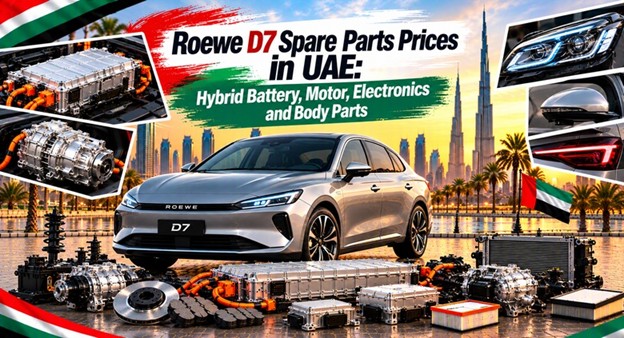
Roewe D7 Spare Parts Prices in UAE: Hybrid Battery, Motor, Electronics and Body Parts
October 13, 2026
The expensive part of owning a Roewe D7 in the UAE may not be the part itself. It may be the uncertainty around which part has actually failed.
That sounds like a technicality until a hybrid warning appears and somebody starts talking about a traction battery, electric motor or power-control assembly. The D7 is a relatively new car in the UAE market, and while its vehicle price is publicly visible, there is nothing like a dependable public UAE price list covering every high-voltage component, electronic module, lamp, bumper and body assembly. The official UAE specification identifies a 21 kWh lithium-iron-phosphate battery, a 201 hp electric motor and 315 Nm of motor torque, while the current UAE vehicle page lists the D7 at AED 100,000; another current UAE market reference places the 2026 D7 at AED 95,000 before VAT, registration and insurance.
So the useful question is not simply, “How much is a Roewe D7 battery?”
It is: what exactly has failed, which version of the part belongs on this car, and what will the complete repair cost once diagnosis, fitting, programming and calibration are counted?
That is where the money is won or lost.
Why Roewe D7 parts prices are unusually difficult to compare
There are two very different markets operating at once.
On one side, you have ordinary replacement items — brake components, suspension parts, filters, 12V batteries, body panels, mirrors, lamps and trim. These can often be compared through several UAE suppliers.
On the other, there are the D7's hybrid and electronic assemblies, where the publicly advertised UAE price may simply not exist.
That distinction matters because an apparently precise online price can be less useful than an honest statement that a component requires a VIN-specific quotation.
The D7 is still new enough that public UAE pricing is much clearer for the car than for its most expensive individual assemblies. That is not a reason to invent an average battery price. It is a reason to investigate the repair before buying the part.
What kind of D7 are we actually pricing?
The UAE-specification D7 is a front-wheel-drive plug-in hybrid sedan with a 1.5-litre petrol engine, 21 kWh LFP battery and 201 hp electric motor producing 315 Nm. Its published dimensions are 4,890 mm long, 1,890 mm wide and 1,510 mm high, with a 2,810 mm wheelbase.
The current UAE material also shows Standard and Comfort equipment levels, with differences in cabin equipment and instrumentation, although the fundamental hybrid specification shown on the technical page remains broadly consistent.
Why does this matter to a parts buyer?
Because “Roewe D7” is not enough information for an expensive electronic component. The vehicle's VIN, production year, market specification, trim and existing component reference should be used to establish the actual application.
The AED 95,000–100,000 car changes how you judge a major repair
Current UAE references put the D7 around AED 95,000 before VAT, registration and insurance in one 2026 market listing, while the UAE distributor's own vehicle page displays AED 100,000.
That creates an important economic reference point.
A replacement traction battery, electric-drive assembly or electronic control system cannot be judged in isolation. If a quotation starts approaching a meaningful proportion of the vehicle's current market value, the owner needs to consider alternatives — repair where technically appropriate, a tested used assembly, refurbishment by a competent specialist, or a new replacement with proper warranty.
This is where a cheap part can become expensive, too. A low-priced used component that fails after installation can consume the saving through labour and repeat diagnosis.
“Hybrid battery” is far too broad a description
When somebody says the D7 needs a hybrid battery, ask them to be more specific.
Are they referring to the complete high-voltage battery assembly?
A battery-management problem?
A cell or module issue?
A temperature-sensing fault?
A high-voltage connection?
An insulation-related problem?
A cooling problem?
Or has the workshop simply interpreted a stored fault code as proof that the whole battery has failed?
Those are different repairs.
The D7's published 21 kWh LFP battery is a sophisticated assembly rather than a single interchangeable commodity, so a complete replacement should be the end of a diagnostic process, not the beginning of one.
There is no defensible universal UAE price for a complete D7 battery
This is the point at which many parts articles become unreliable.
A neat number looks useful. It isn't useful if there is no solid UAE retail evidence behind it.
Current public UAE information does not establish a dependable universal retail price for a complete Roewe D7 traction battery. A genuine quotation can depend on the vehicle VIN, battery version, availability, whether the assembly is new or used, fitting requirements, warranty and any related diagnostic or programming work.
General UAE hybrid specialists do advertise lower-cost services such as battery health checks, cell-level work and refurbishment, but those advertised figures apply to hybrid systems generally and should not be presented as Roewe D7 battery prices.
The distinction is essential.
A battery-health check may be more valuable than a battery quotation
Suppose the D7 still drives but has begun displaying a hybrid warning.
The sensible first expenditure may be diagnosis.
A proper inspection should establish the stored and active diagnostic trouble codes, battery-related live data, relevant voltage and temperature information, communication status and the manufacturer's applicable diagnostic procedure. The technician should also examine the low-voltage system and relevant wiring before condemning a major high-voltage assembly.
A battery warning is evidence of a problem.
It is not, by itself, evidence of a dead battery.
That difference could be thousands of dirhams.
The 12V battery still matters in a plug-in hybrid
The D7's main traction battery gets most of the attention because it sounds expensive. The ordinary low-voltage battery can nevertheless affect how the car's electronic systems behave.
A weak 12V supply can produce communication problems, warning messages and unusual electronic behaviour.
That does not mean every D7 hybrid fault is secretly a 12V battery fault. It means the low-voltage system should not be skipped during diagnosis simply because the car has a large lithium battery underneath it.
Check the basics before replacing the exotic stuff.
Buying a used D7 battery is a provenance problem
A used battery is only as attractive as the information attached to it.
Ask where it came from.
What was the donor vehicle?
What was its mileage?
Why was it dismantled?
Was the donor involved in a collision?
Was there water or flood exposure?
Was the battery removed from a functioning vehicle?
Has its condition been tested?
What exactly is covered by the seller's warranty?
And, perhaps most awkwardly, what happens if it proves incompatible after installation?
A seller offering only a photograph and a price is giving you very little evidence.
A seller who can provide the donor details, component identification, condition information and return terms is offering something much more valuable.
LFP chemistry does not make two batteries interchangeable
The D7's published battery chemistry is lithium iron phosphate.
That is useful technical information, but it does not give a parts buyer permission to substitute any other LFP battery.
Battery chemistry is only one part of compatibility.
Physical dimensions, electrical characteristics, connectors, control electronics, software, cooling arrangements and vehicle integration all matter. The correct component therefore needs to be identified by application and part reference, not by the phrase “21 kWh LFP”.
A specification sheet describes the car.
A parts reference identifies the component.
The electric motor is a separate financial question
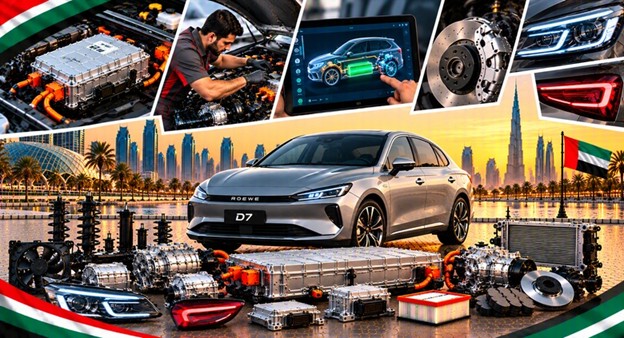
The D7's published electric motor produces 201 hp and 315 Nm.
If motor-related faults appear, the temptation is obvious: replace the motor.
But a motor-related warning can sit inside a wider electrical or control problem. Depending on the fault, diagnosis may need to consider motor position information, temperature sensing, wiring, power electronics, communication and related control systems.
A complete motor replacement should therefore come with a diagnostic explanation.
If the quotation says simply “motor fault — replace motor”, ask for the supporting evidence.
Don't price the inverter as if it were just another electrical module
Power electronics are where the economics become uncomfortable.
An inverter or related control assembly can be substantially more expensive than an ordinary sensor, but a warning involving the electric-drive system does not automatically identify the inverter as the failed component.
Before buying a used or new assembly, the workshop should establish the relevant diagnostic codes and electrical conditions, inspect connectors and wiring, and determine whether the fault follows the component or originates elsewhere.
This is also where a VIN becomes especially important.
The wrong electronic component can fit beautifully and still refuse to work properly.
Electronic modules are a different kind of spare part
The D7 has a 12.3-inch touchscreen, digital instrument display and surround-view camera equipment, alongside its hybrid control architecture.
That creates several layers of electronics: cameras, displays, control modules, sensors, communication networks and vehicle-specific software.
A used module may therefore require configuration, coding or other post-installation procedures, depending on the component.
Before accepting a bargain electronic part, ask whether the quoted price includes only the hardware or the complete process needed to make the vehicle recognise and operate it.
Hardware is sometimes the cheapest part of an electronic repair.
The 360-degree camera makes body repairs more complicated than they look
The D7's UAE specification includes a 60-degree HD surround-view camera system on the detailed specification page, while the current model material also promotes a 360-degree camera.
That means a front or rear collision can involve more than bumper plastic.
A damaged camera, bracket, wiring connection or mounting point may affect the system. If a camera is removed or replaced, the workshop needs to establish whether calibration or configuration is required for the particular repair.
The buyer should therefore ask whether a body-parts quotation includes the electronic work that follows the physical repair.
Headlight prices can swing dramatically depending on what is included
A headlamp is another classic trap.
One quotation may be for the complete lamp assembly. Another may be for the housing. Another may exclude control electronics, brackets or wiring.
So if one D7 headlamp appears dramatically cheaper than another, don't celebrate yet.
Ask:
Is it complete?
Does it include the control unit?
Is it new, used or repaired?
Does it match the exact vehicle specification?
Is programming or aiming required?
A lamp is not necessarily just a lamp anymore.
Body panels are easier to compare — until the repair starts
Bumpers, wings, doors, bonnet panels and mirrors generally have a much simpler supply chain than high-voltage assemblies.
UAE parts marketplaces currently offer sourcing routes for body panels, lighting and mechanical components, with some suppliers specifically asking for VIN details and photographs before confirming a match.
That is useful.
Yet the advertised panel price still does not represent the finished repair.
Paint, clips, brackets, sensors, trim, labour and delivery can all sit outside the component price.
A bumper that costs less but arrives incomplete can lose its advantage surprisingly quickly.
The front bumper may hide a much larger bill
After an accident, the bumper itself is often the least interesting part of the inspection.
Behind it could be damaged mounting points, wiring, cooling components, camera hardware or other systems.
The D7's hybrid architecture makes a proper post-impact inspection particularly important because a visible cosmetic repair does not establish the condition of the vehicle's electrical and mechanical systems.
Don't approve the bumper quote before the car has been inspected properly.
The bill should follow the damage assessment, not replace it.
Rear-end damage has its own complications
A rear bumper can look straightforward until the workshop removes it.
Parking sensors, camera equipment, wiring, brackets, boot trim and structural mounting points can turn a simple body repair into a mixed mechanical-electronic job.
The D7's published equipment includes surround-view technology, so the condition and operation of relevant cameras should be checked after collision repairs.
This is another reason to compare repair completion costs, rather than comparing bumper prices on their own.
Suspension parts are easier to source, but diagnosis still comes first
The D7 uses MacPherson independent front suspension and a multi-link independent rear arrangement.
That gives buyers a more conventional parts market: control arms, bushes, links, dampers, bearings and associated components can be assessed in the normal way.
But don't turn a noise into a parts order.
A knocking sound may come from a link, bush, mount or another component. A vibration can involve wheels, tyres, bearings or suspension geometry. Uneven tyre wear can have several causes.
The workshop should identify the failed component rather than replacing an entire corner because it is easier to quote.
Brake parts belong in the sensible-price category
Regenerative braking means the D7 does not use its friction brakes in exactly the same way as a conventional petrol sedan, but brake pads, discs, callipers and related hardware remain conventional service concerns.
These are usually poor candidates for speculative used-part buying.
For wear components, the condition of the component matters more than the excitement of finding a discount. New, correctly specified parts often make more economic sense once fitting and expected service life are considered.
Save the used-parts strategy for components where the economics genuinely favour it.
The engine is still a 1.5-litre petrol engine
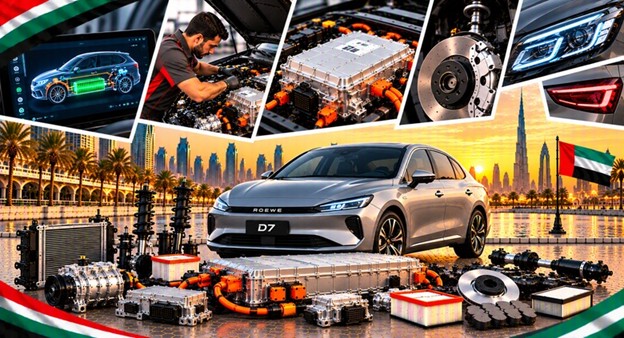
The D7's hybrid system does not remove the conventional engine from the maintenance equation.
The UAE specification identifies a 1.5-litre petrol engine, alongside the electric motor and 21 kWh LFP battery.
That means engine-related replacement costs can involve familiar territory: cooling components, ignition parts, sensors, mounts, pumps, belts and other mechanical or electrical components.
The correct approach remains the same — identify the failure first, then source the component.
The hybrid badge should make diagnosis more careful, not less.
Cooling-system faults need proper investigation in the UAE
The UAE climate makes thermal management relevant to every electrified vehicle.
It does not, however, prove that a cooling component has failed.
If the D7 reports a temperature-related warning, a competent inspection should consider the relevant coolant circuit, pumps, fans, sensors, heat exchangers and electrical controls as applicable to the actual fault.
That is particularly important because several systems in a hybrid vehicle can have thermal-management requirements.
Don't use “Dubai heat” as a diagnosis.
Use measurements.
Electronics can be cheap to buy and expensive to install
A sensor might be inexpensive compared with a traction battery.
Then comes the awkward part.
If the wrong sensor is supplied, the workshop has to remove it, diagnose the incompatibility and install another one. If calibration is required, the vehicle may need additional work before it can be returned to the road.
So when comparing D7 electronic parts, ask for the complete installed cost.
The cheapest listing is not necessarily the cheapest repair.
What a UAE supplier should ask you before quoting
For an expensive D7 component, a serious parts request should include:
- VIN or chassis number
- model year
- D7 variant
- UAE/GCC or other market specification
- engine/hybrid configuration
- existing part number
- clear photographs where useful
- side/location for body and lighting parts
- whether the part is new, used or refurbished
- donor information for used components
- warranty
- return conditions
- delivery time
- VAT treatment
- fitting requirements
- programming or calibration requirements
If nobody asks for any of this and the component is a major electronic or hybrid assembly, slow down.
New versus used: where the calculation changes
A used D7 bumper can make excellent financial sense.
A used electronic module may also make sense if its provenance and compatibility are clear.
A used traction battery is a much bigger gamble.
A used brake pad is simply a bad proposition.
That sounds obvious, but parts buyers sometimes treat every component as though the same price-versus-quality formula applies.
It doesn't.
The useful question is how much failure risk you are accepting for the saving.
Refurbished is not a magic middle ground
“Refurbished” can mean a properly tested, professionally rebuilt component.
It can also mean very little.
For a high-value D7 electronic or hybrid assembly, ask what was actually done. Which components were replaced? What tests were performed? Was the unit load-tested? Is the warranty written down? Is the repairer willing to accept a return if the component fails or proves incompatible?
A refurbished part with strong documentation can be more attractive than an anonymous used part.
An anonymous refurbished part is still anonymous.
A useful D7 parts-price framework for UAE buyers
Because public D7-specific UAE pricing is incomplete, the most defensible approach is to separate the market into categories.
| D7 part or repair | UAE pricing position | What should determine the final quote |
|---|---|---|
| 12V battery | Generally easier to source and compare | Battery specification, brand, installation |
| Brake pads/discs | Conventional replacement market | Exact specification, axle, brand, labour |
| Suspension components | More conventional parts market | VIN, suspension version, component condition |
| Bumper/body panel | Used/new sourcing possible | Completeness, paint, brackets, sensors, delivery |
| Headlamp | Potentially expensive electronic body component | Complete assembly, modules, specification, fitting |
| Camera/sensor | VIN-specific | Part number, software/configuration, calibration |
| Engine component | Conventional but application-specific | Engine specification, exact fault, OE reference |
| Electric motor | No dependable universal public UAE D7 price | Diagnosis, VIN, part reference, new/used condition |
| Inverter/power electronics | No dependable universal public UAE D7 price | Diagnosis, exact assembly, programming |
| Hybrid transmission component | Quote should be fault-specific | Exact failed assembly and installation |
| Complete traction battery | No reliable universal public UAE retail price | VIN, battery assembly, condition, warranty, labour |
| Refurbished hybrid assembly | Specialist quotation required | Testing, refurbishment scope and warranty |
The absence of a published number is itself useful information. It tells the buyer when Roewe D7 spare parts prices in UAE comparison needs to become technical due diligence.
Warranty should be checked before buying a major part
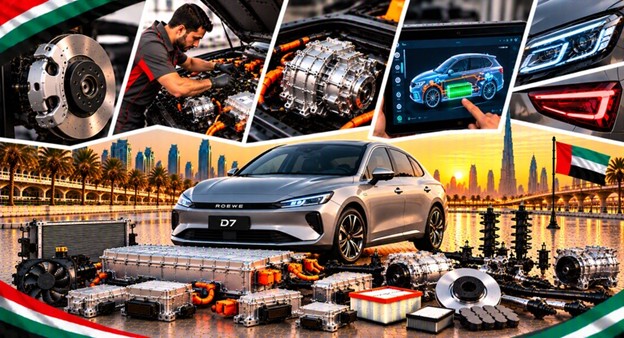
The D7 is sold through a UAE distributor with dedicated showrooms and after-sales contact points in Abu Dhabi and Dubai.
That matters particularly for a relatively new vehicle.
If a major hybrid component appears to have failed, check the vehicle's warranty documentation and eligibility before paying privately for a battery, motor, inverter or control module.
Don't assume a private replacement is the only route.
And don't assume that every component has identical warranty treatment. The actual vehicle documentation controls.
Grey imports complicate the parts conversation
A D7 sourced outside the UAE market may have a different specification, software configuration or equipment combination.
That does not automatically make it a bad purchase.
It does make the VIN more important.
Tell the supplier where the vehicle originated. If the seller says, “All D7 parts are the same,” ask for the exact application confirmation instead.
The five minutes spent establishing the vehicle identity can save a very awkward return later.
The cost of getting the D7 part wrong
Here is where the apparently cheap option starts to look less attractive.
Wrong battery.
Return freight.
Workshop labour.
Second diagnosis.
Possible programming.
Vehicle downtime.
A second installation.
Potential storage charges.
And, if the original fault was misdiagnosed, the first expensive component may never have been necessary.
The price of a part is therefore only one line in the repair equation.
The cost of being wrong belongs in the calculation too.
The D7 buyer's rule is simple, even when the technology isn't
For ordinary service parts, compare prices aggressively.
For body panels, compare completeness, paint and fitting rather than the panel alone.
For electronics, establish the exact part number and ask about programming or calibration.
For a motor, inverter or hybrid transmission component, insist on diagnostic evidence before accepting a replacement quotation.
For the traction battery, take an even slower breath.
The D7 currently has a visible UAE vehicle price — around AED 95,000 before VAT in one September 2026 market reference and AED 100,000 on the distributor's current vehicle page — but there is no equally reliable public UAE price for every major hybrid assembly.
That gap should make buyers more careful, not more willing to guess.
When comparing Roewe D7 replacement options through PartFinder UAE, the useful comparison is the verified part, its condition, compatibility, delivery, fitting, programming or calibration, warranty and return terms taken together — not merely the lowest number beside the component.
The right part at the right price is a saving.
The wrong part at a bargain price is just another repair bill.
UAE Update Reference: October 2026.
FAQ
Categories
- Audi
- BMW
- Car Accessories
- Car Tips
- Ford
- Land Rover
- Mazda
- Range Rover
- Top 10
- UAE Car Parts
- Used Car Parts
- Toyota
- Replacement Engines
- Nissan
- Hyundai
- Mitsubishi
- Volkswagen
- Honda
- Kia
- Chevrolet
- Dodge
- Jeep
- Subaru
- Renault
- Lexus
- Mercedes
- Suzuki
- Hummer
- Porsche
- Infiniti
- Peugeot
- GMC
- Mini
- Volvo
- Replacement Gearboxes
- MG
- Jaguar
- Skoda
- Cadillac
- Daihatsu
- Fiat
- German Car Parts
- Japanese Car Parts
- Aftermarket Car Parts
- Genuine Car Parts
- New Car Parts
- Reconditioned Car Parts
- European Car Parts
- American Car Parts
- Korean Car Parts
- British Car Parts
- Chinese Car Parts
- Sports/Exotic Car Parts
- Luxury Car Parts
- Performance Car Parts
- SUV/4x4 Spare Parts
- Truck Spare Parts
- EV Car Parts
- Hybrid Car Parts
- Auto Spare Parts in UAE
- Tesla
- Isuzu
- Ram
- Ferrari
- Bentley
- Lamborghini
- Genesis
- Maserati
- Lincoln
- Chrysler
- Opel
- Citroen
- SsangYong
- Seat
- McLaren
- Aston Martin
- Rolls Royce
- Maybach
- Alfa Romeo
- Bugatti
- Scion
- Abu Dhabi Car Parts
- Ajman Car Parts
- Al Khan Car Parts
- Al Sajaa Car Parts
- Deira Car Parts
- Dubai Car Parts
- Fujairah Car Parts
- Industrial Area 6 Car Parts
- Mussafah Car Parts
- Ras Al Khaimah Car Parts
- Sharjah Car Parts
- Umm Al Quwain Car Parts
- Acura
- BYD
- Chery
- Dacia
- DS
- Geely Emgrand
- EXEED
- GAC
- GAC Gonow
- Geely
- Gonow
- Great Wall
- Haima
- Haval
- Holden
- Iveco
- JAC
- Jaecoo
- Jetour
- Lotus
- Omoda
- Proton
- Renault Samsung
- Roewe