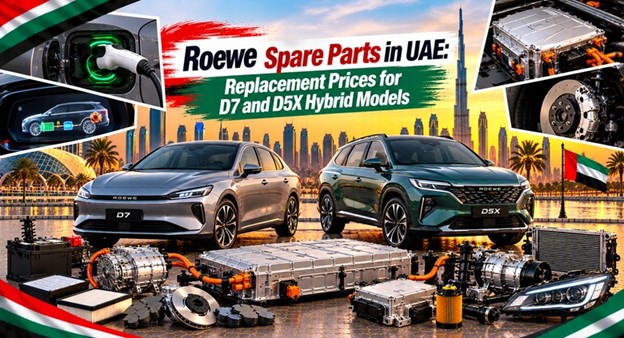
Roewe Spare Parts in UAE: Replacement Prices for D7 and D5X Hybrid Models
October 13, 2026
A hybrid warning light can produce a surprisingly large number before anyone has actually proved that the expensive component has failed.
That is the awkward bit with relatively new plug-in hybrids such as the Roewe D7 and D5X. The cars are sophisticated, the high-voltage systems are expensive, and the UAE market does not yet offer a neat public price list for every traction battery, inverter, electric motor, hybrid transmission component and control module. So an owner can be handed a quote for “battery replacement” when the real fault might sit somewhere else in the system entirely.
And once a large component has been ordered, the mistake becomes expensive.
The D7 currently sold in the UAE uses a 1.5-litre petrol engine with a 21 kWh lithium-iron-phosphate battery and a 201 hp electric motor producing 315 Nm. The D5X uses a 1.5-litre turbo petrol engine, a 21.4 kWh LFP battery and a 181 hp electric motor producing 340 Nm. Both are front-drive hybrids, but their mechanical packaging and hybrid-system details are not interchangeable simply because the battery capacities look similar.
That distinction sits underneath almost every sensible Roewe spare parts in UAE decision.
The frightening quote is often only the beginning
Imagine the situation. The car drives normally enough, then a warning appears. Perhaps EV operation becomes restricted. Perhaps charging behaviour changes. Perhaps the petrol engine starts more frequently than expected.
A workshop connects diagnostic equipment, sees hybrid-related faults and says the battery needs replacing.
Before agreeing to a five-figure repair, stop.
Ask what actually failed.
A battery fault code can point towards a problem in battery management, temperature monitoring, cell voltage balance, insulation, wiring, cooling or communication. It does not automatically establish that the entire battery pack has reached the end of its useful life.
That distinction is worth real money.
What you are actually buying when you buy a D7 or D5X
The D7 is a large plug-in hybrid saloon, 4,890 mm long with a 2,810 mm wheelbase. UAE specifications show a 21 kWh LFP battery, 201 hp electric motor and 125 km claimed pure-electric range.
The D5X is a 4,700 mm SUV with a 2,765 mm wheelbase. Its UAE specification lists a 1.5T engine, 21.4 kWh LFP battery, 181 hp motor and 120 km pure-electric range.
Those figures tell you something useful about replacement parts: neither vehicle should be treated as a generic “Roewe hybrid”.
A D7 battery assembly, D5X battery assembly, motor, cooling component, control module or transmission component needs application-specific verification.
The badge is the starting point. The VIN is where the argument gets serious.
Why UAE Roewe parts prices are still difficult to pin down
There is a peculiar gap between vehicle pricing and component pricing.
The cars have clear UAE pricing. The D5X is currently advertised at AED 100,000, while a September 2026 UAE market listing puts the D7 at AED 95,000 before VAT, registration and insurance. Those figures are useful for understanding the value of the vehicle, but they do not tell you what an individual battery module, inverter or hybrid control component should cost.
For major hybrid assemblies, publicly visible UAE retail pricing remains limited.
That means a sensible article about “Roewe spare parts prices” cannot honestly manufacture a tidy battery price range simply to make the page look complete. Some prices can be observed. Others need a VIN, a diagnosis and a quotation.
There is no shame in saying that. It is better information.
The phrase “battery replacement” needs unpacking
A traction-battery repair can mean several very different jobs.
A workshop might identify a defective module or cell group. Another fault may involve the battery management system, temperature sensors, cooling circuit, contactors, high-voltage connections or insulation monitoring.
Then there is the much larger proposition: replacing the complete battery assembly.
Those jobs live in completely different economic territories.
A UAE hybrid specialist currently advertises generic battery health checks from about AED 300, cell replacement from AED 800, full refurbishment from AED 2,000 and new replacement batteries from AED 4,000. These are general hybrid-market benchmarks, not Roewe D7 or D5X prices, and the final cost depends on the vehicle and battery system being inspected.
That is precisely why you should resist taking a generic “hybrid battery from AED X” figure and treating it as a Roewe quotation.
The 12-volt battery can muddy the diagnosis
Hybrid cars still have conventional low-voltage electrical systems.
If the 12V battery is weak, modules may communicate badly, electronic systems can behave strangely and fault codes can appear which send an inexperienced diagnosis in the wrong direction.
That does not mean a weak 12V battery explains every hybrid warning. It means the low-voltage system belongs near the beginning of the diagnostic process rather than being forgotten because the vehicle has a large traction battery.
Check the 12V battery condition, charging behaviour, relevant power supplies and stored faults before someone starts discussing major hybrid components.
Cheap checks first.
Expensive conclusions later.
What should happen before a D7 or D5X battery is replaced?
The workshop should establish a chain of evidence.
That normally means a proper scan, identification of active and historical diagnostic trouble codes, inspection of live battery data, checking relevant temperatures and voltage information, examining wiring and connectors, and determining whether the fault returns after the appropriate diagnostic procedure.
The precise tests depend on the fault.
There is no useful universal “battery test” that can replace diagnosis of the vehicle's complete hybrid system.
If the workshop cannot explain what failed, why the evidence points there and what was ruled out, the quotation is premature.
Battery capacity is not the same thing as battery health
The D7's published battery capacity is 21 kWh; the D5X's is 21.4 kWh. Both use LFP chemistry.
But capacity figures printed in a specification sheet tell you very little about the condition of a particular used battery.
A replacement battery needs to be assessed in context: state of health, relevant voltage behaviour, temperature performance, balancing behaviour, fault history, physical condition and compatibility with the vehicle's control system.
A used battery with the right-looking casing can still be the wrong purchase.
And a battery that appears physically identical may belong to another revision or software configuration.
Used D7 and D5X batteries are therefore a different proposition
A used hybrid battery should come with a history, not merely a price.
Ask where it came from. What vehicle did it leave? What was the donor's mileage? Why was the donor dismantled? Was it involved in a collision? Was there flood exposure? Was the battery removed after a hybrid-system fault? Has its condition been tested?
Then ask what happens if the battery fails after installation.
A vague answer about “tested before removal” is weak evidence. You want something more useful: identification, test information where available, condition, warranty and a clear return arrangement.
Otherwise you are buying uncertainty twice — once with the component and again with the labour required to fit it.
The D5X's battery should not simply be priced like the D7's
The capacities are close, but that does not make the assemblies interchangeable.
The D5X uses a 21.4 kWh LFP battery and a 181 hp electric motor, while the D7 uses a 21 kWh battery and a 201 hp motor. Their body dimensions, powertrain packaging and published specifications differ.
This is exactly the sort of situation where a parts seller should ask for the VIN rather than saying, “Yes, it is the same 21 kWh battery.”
Similarity is useful for research.
It is not proof of compatibility.
Electric motors: expensive, but don't condemn one from a dashboard warning
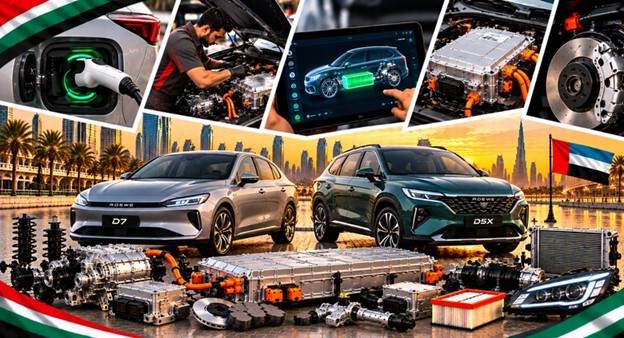
An electric-drive fault can originate in the motor itself, its position or temperature sensing, the inverter/power electronics, wiring, control software or another part of the hybrid system.
A warning displayed on the instrument panel tells the driver something is wrong. It does not necessarily tell the parts department which assembly to order.
The D7's published electric motor output is 201 hp and 315 Nm; the D5X's is 181 hp and 340 Nm.
That difference alone should discourage the lazy assumption that a motor from one model can simply be substituted for another because both are branded Roewe.
Inverter and power electronics deserve their own diagnosis
The inverter sits in the part of the system where electrical energy and motor operation meet, so a fault there can become expensive very quickly.
Yet the same warning can coexist with problems elsewhere.
A proper investigation should establish diagnostic codes, electrical conditions, communication integrity, cooling performance and the manufacturer's specified test sequence before a complete power-electronics assembly is condemned.
For the buyer of a used unit, part identification matters just as much as physical condition.
Ask for the complete reference, donor vehicle information and confirmation of compatibility.
Hybrid transmission costs can be misleading
The D5X uses a two-speed DHT arrangement in its published UAE specification context, while the D7's published UAE specification describes its hybrid system separately.
This matters when somebody quotes for a “hybrid gearbox”.
That phrase can cover a surprisingly broad range of things: complete transmission assembly, actuator, electronic control component, mechanical component or a related electric-drive part.
Before comparing prices, make the workshop state exactly which assembly has been diagnosed as faulty.
Otherwise you are comparing two different repairs while pretending they are the same job.
Don't forget the petrol engine hiding behind the hybrid label
The D7 uses a 1.5-litre petrol engine, while the D5X uses a 1.5T engine producing 141 hp and 230 Nm in UAE specifications.
So conventional engine parts remain part of the ownership equation.
Cooling components, ignition components, sensors, turbo-related components on the D5X, engine mounts, belts, pumps and other hardware still have to be diagnosed and sourced according to the exact application.
A hybrid badge does not make ordinary mechanical diagnosis disappear.
It adds another layer.
D5X turbo parts need particularly careful identification
The D5X's UAE specification identifies a 1.5T engine with 141 hp and 230 Nm.
If a turbocharger fault is suspected, the workshop should establish whether the problem is actually the turbocharger.
Boost-control issues, intake leaks, sensor faults, lubrication problems, actuator faults and other engine-management issues can produce similar symptoms.
A replacement turbo fitted to a vehicle with another underlying fault is a very expensive way of discovering that the first diagnosis was wrong.
Cooling parts matter more on a hybrid than the parts bill initially suggests
There are several reasons to take cooling-system diagnosis seriously.
The petrol engine has its own thermal requirements. The high-voltage battery and power electronics also operate within controlled temperature ranges. The precise architecture should be confirmed for the individual vehicle rather than assumed from a generic hybrid diagram.
In the UAE, ambient heat makes thermal management an especially relevant ownership consideration, but heat alone does not prove that a component has failed.
If the vehicle is overheating or a hybrid system reports a temperature-related fault, inspect the actual cooling circuit, sensors, coolant condition, pumps, fans and relevant heat exchangers.
Don't diagnose by climate.
Suspension parts are a much simpler financial problem — usually
The D7 and D5X both use MacPherson independent front suspension and multi-link independent rear suspension in the UAE specifications.
That makes components such as control arms, bushes, dampers, links and wheel bearings easier to understand than high-voltage electronics.
Yet the same buyer mistakes still appear.
A knock does not automatically mean a complete suspension assembly. A vibration does not automatically mean a wheel bearing. Uneven tyre wear does not automatically mean a worn arm.
Get the vehicle inspected on a lift, reproduce the symptom where possible and identify the failed component before ordering parts.
Brakes deserve a different approach from hybrid battery components
Regenerative braking changes how a plug-in hybrid uses its friction brakes, but the conventional braking system remains essential.
Pads, discs, callipers, sensors and associated hardware should be checked according to actual wear and fault condition.
This is an area where buying an expensive used component can make little sense. Wear-related components generally need condition-based replacement, and the economics of used versus new should be considered very differently from the economics of a scarce electronic module or complete hybrid assembly.
Cheap does not automatically mean economical.
Accident damage can turn a small parts order into a large hybrid repair
A damaged D7 or D5X deserves more than a body-panel inspection.
Look behind the visible damage.
Front-end impacts can involve cooling components, wiring, sensor brackets, cameras, radar equipment where fitted, structural mounting points and other systems that may not look damaged from outside.
The D5X offers advanced driver-assistance equipment including automatic emergency braking and lane-related systems, while higher equipment levels include a 360-degree camera.
After collision repair, the question becomes not merely “Does the bumper fit?”
It becomes: does everything behind it still operate and, where required, has it been correctly calibrated?
ADAS parts can be physically right and electronically wrong
A camera module can look identical to another camera.
That proves very little.
Modern assistance systems can depend on vehicle configuration, software, calibration data, mounting position and communication with other control modules. A replacement camera, sensor or related electronic component may therefore require more than mechanical installation.
If a seller offers a used sensor without asking for the VIN, part reference or original application, be cautious.
A component's casing is not its identity.
Body parts are easier to source, but colour and trim still complicate the bill
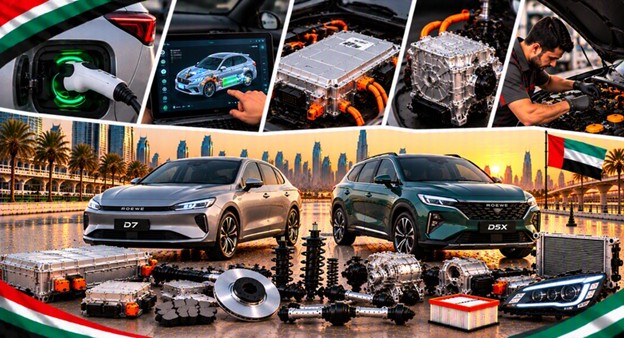
Bumpers, wings, doors, mirrors, grilles and trim can often be sourced through conventional new, used or aftermarket routes.
The apparent simplicity is deceptive.
A used bumper may come with or without brackets, sensors, grilles, trim, wiring or camera hardware. A door may be sold bare or complete. A headlamp may be supplied without control electronics.
Then there is paint.
The cheapest bumper in the UAE is rarely the cheapest completed repair if it arrives incomplete, requires additional brackets and needs painting before fitting.
Compare the finished job, not the plastic shell.
Why used Roewe parts can make financial sense
A used part becomes attractive when the replacement is expensive, scarce or discontinued and the used component has credible provenance.
For a body panel, lamp, interior trim, suspension component or certain electronic module, the saving can be meaningful.
For a safety-critical, wear-heavy or unknown-condition component, the calculation changes.
The question should always be: what failure risk am I accepting in exchange for the saving?
That is the more useful question than simply asking how many dirhams cheaper the used part is.
New, used and refurbished parts are three different bets
A new genuine component normally gives the strongest route where availability, warranty and budget justify it.
A used genuine part may be the sensible answer for an expensive body or electronic component, provided its history and compatibility are established.
A refurbished component sits somewhere else entirely. Its quality depends on what was replaced, how it was tested, which original components remain and what warranty accompanies the work.
Don't put all three into one “OEM versus aftermarket” bucket.
They carry different risks.
What should a UAE buyer ask for before paying?
For a major Roewe component, request:
- VIN/application confirmation
- exact model year
- D7 or D5X identification
- trim where relevant
- engine and hybrid configuration
- complete part number or reference
- donor vehicle details for used parts
- mileage where known
- condition or test information
- warranty period
- return conditions
- stock status
- delivery time
- VAT treatment
- fitting cost
- programming or calibration requirements
If the seller cannot establish compatibility, the buyer should not be expected to do it by looking at photographs.
The real UAE price is the installed price
Suppose a used electronic component looks attractively cheap.
Then add delivery.
VAT.
Diagnostics.
Labour.
Programming.
Calibration.
Perhaps a second visit if the first component does not communicate correctly.
That £50-looking bargain can become a completely different proposition in the workshop.
The same applies to a battery. A quoted component price is not the same as a complete installed repair, and a complete repair quotation should explain what is included.
This is where comparing Roewe replacement options through PartFinder UAE should focus on the whole repair equation rather than the largest-looking number on a listing.
A sensible price framework for D7 and D5X parts
The evidence currently supports a hierarchy rather than a fake universal price list.
| Component / repair area | What can reasonably be said about UAE pricing |
|---|---|
| 12V battery | Usually straightforward to price locally; exact specification still matters |
| Brake and suspension parts | More conventional aftermarket/new/used comparison is possible |
| Body panels and trim | Used-market pricing can be attractive, but completeness and paint change the final bill |
| Headlamps and electronic lighting | Price varies substantially with whether modules/electronics are included |
| ADAS camera/sensor | VIN, part reference and calibration requirements should be established |
| Electric motor | No defensible universal D7/D5X public UAE retail price; quote should be application-specific |
| Inverter/power electronics | VIN/diagnostic/part-number specific |
| Hybrid transmission | Exact failed assembly must be established before comparing quotations |
| Complete traction battery | No reliable universal public UAE Roewe price; diagnosis and VIN-specific quotation required |
| Hybrid battery testing/refurbishment | General UAE hybrid benchmarks start around AED 300 for health checks and AED 2,000 for some refurbishment services, but these are not Roewe-specific prices |
That final distinction is crucial.
A market benchmark is evidence of what a service provider advertises. It is not evidence that a D7 battery costs that amount.
Warranty changes the calculation completely
The D5X has been promoted in the UAE with an eight-year/150,000 km warranty offer, while the exact coverage applicable to an individual vehicle should be checked against its purchase documentation and warranty terms.
That matters enormously when a major hybrid component is suspected.
Before buying a used battery, inverter, motor or control module independently, establish whether the vehicle is still covered and whether the suspected failure falls within the applicable warranty.
Otherwise an owner can pay for a component privately that might have been investigated or covered through the authorised route.
The first replacement decision should sometimes be: don't replace anything yet. Check the warranty.
Grey-import and specification differences can quietly ruin a parts order
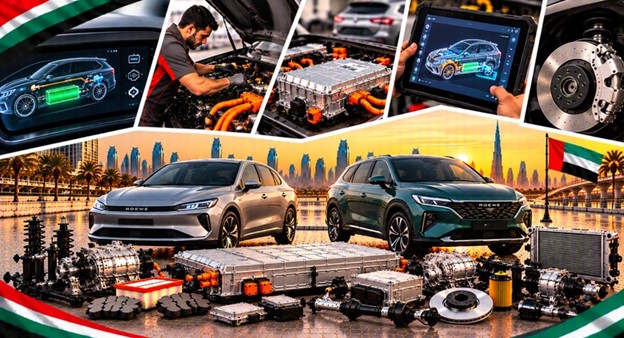
Roewe's current UAE operation provides dedicated ownership, service and spare-parts support, with listed locations including Abu Dhabi and Dubai.
That gives UAE-market cars a useful reference point.
A parallel-import or differently specified vehicle can complicate things, however. Software configuration, equipment level, wiring, sensors, calibration requirements and part revisions can vary by market.
If the vehicle did not originate through the UAE channel, tell the parts seller.
Hiding that detail in the hope of getting a cheaper answer is exactly the sort of shortcut that produces a wrong component.
The D7 and D5X should be judged by different repair economics
The D7's attraction is partly its large sedan footprint, 21 kWh LFP battery and strong electric motor; the D5X combines a 1.5T petrol engine with a 21.4 kWh battery, 181 hp motor and SUV packaging.
For the D7, a major body, electronic or hybrid component should be assessed against the value of the car and the cost of a complete repair.
For the D5X, the same principle applies, but SUV-specific bodywork, ADAS equipment and the turbocharged petrol system create their own replacement decisions.
So, there should not be one universal “Roewe repair budget”.
There are a D7 equation and a D5X equation.
What a good diagnostic report should actually tell you
A useful report should leave the owner able to answer five questions.
What failed?
What evidence proves it?
What other likely causes were checked?
What exact part is being proposed?
What will the complete repair cost once fitting and any programming or calibration are included?
If those questions cannot be answered, the problem is not yet ready for a parts order.
This sounds painfully obvious. It is also where a great deal of unnecessary spending begins.
The safest buying rule for expensive Roewe parts
For ordinary service items, price comparison can be relatively simple.
For a traction battery, motor, inverter, hybrid transmission assembly, ADAS module or expensive electronic component, slow the transaction down.
Give the seller the VIN. Get the exact part reference. Confirm the application. Ask about donor history if it is used. Find out whether programming or calibration is required. Get the warranty and return terms in writing. Then compare the installed repair cost, not the component price alone.
The D7 and D5X are still young enough in the UAE market that public pricing for their most expensive hybrid assemblies remains patchy. The current UAE vehicle prices are much easier to observe than the retail cost of a complete traction battery or inverter, and that gap is precisely why invented “average prices” are worse than no price at all.
For an owner, the useful discipline is simple: diagnose the system, identify the exact assembly, then buy the part.
Not the other way round.
UAE Update Reference: October 2026.
FAQ
Categories
- Audi
- BMW
- Car Accessories
- Car Tips
- Ford
- Land Rover
- Mazda
- Range Rover
- Top 10
- UAE Car Parts
- Used Car Parts
- Toyota
- Replacement Engines
- Nissan
- Hyundai
- Mitsubishi
- Volkswagen
- Honda
- Kia
- Chevrolet
- Dodge
- Jeep
- Subaru
- Renault
- Lexus
- Mercedes
- Suzuki
- Hummer
- Porsche
- Infiniti
- Peugeot
- GMC
- Mini
- Volvo
- Replacement Gearboxes
- MG
- Jaguar
- Skoda
- Cadillac
- Daihatsu
- Fiat
- German Car Parts
- Japanese Car Parts
- Aftermarket Car Parts
- Genuine Car Parts
- New Car Parts
- Reconditioned Car Parts
- European Car Parts
- American Car Parts
- Korean Car Parts
- British Car Parts
- Chinese Car Parts
- Sports/Exotic Car Parts
- Luxury Car Parts
- Performance Car Parts
- SUV/4x4 Spare Parts
- Truck Spare Parts
- EV Car Parts
- Hybrid Car Parts
- Auto Spare Parts in UAE
- Tesla
- Isuzu
- Ram
- Ferrari
- Bentley
- Lamborghini
- Genesis
- Maserati
- Lincoln
- Chrysler
- Opel
- Citroen
- SsangYong
- Seat
- McLaren
- Aston Martin
- Rolls Royce
- Maybach
- Alfa Romeo
- Bugatti
- Scion
- Abu Dhabi Car Parts
- Ajman Car Parts
- Al Khan Car Parts
- Al Sajaa Car Parts
- Deira Car Parts
- Dubai Car Parts
- Fujairah Car Parts
- Industrial Area 6 Car Parts
- Mussafah Car Parts
- Ras Al Khaimah Car Parts
- Sharjah Car Parts
- Umm Al Quwain Car Parts
- Acura
- BYD
- Chery
- Dacia
- DS
- Geely Emgrand
- EXEED
- GAC
- GAC Gonow
- Geely
- Gonow
- Great Wall
- Haima
- Haval
- Holden
- Iveco
- JAC
- Jaecoo
- Jetour
- Lotus
- Omoda
- Proton
- Renault Samsung
- Roewe