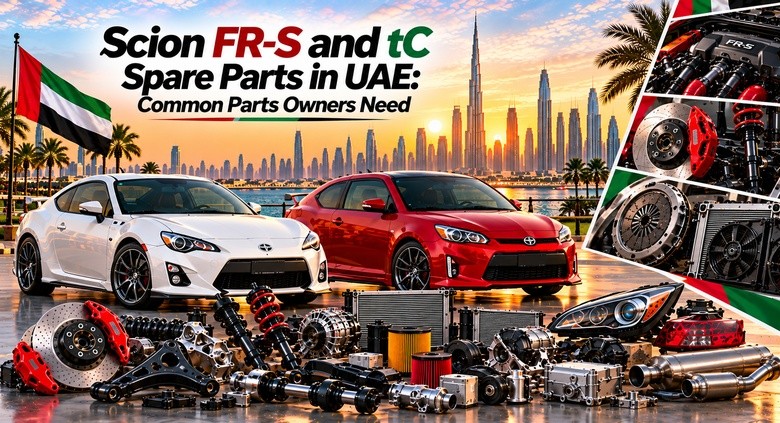
Scion FR-S and tC Spare Parts in UAE: Common Parts Owners Need
September 28, 2026
The FR-S and tC may share a Scion badge, but treating them as broadly interchangeable when buying parts is asking for trouble. They are fundamentally different cars: the FR-S is a front-engine, rear-wheel-drive sports coupe with a 2.0-litre boxer engine, while the tC is a front-wheel-drive coupe built around a 2.5-litre four-cylinder and a different suspension and drivetrain layout. Toyota’s own specifications make that distinction very clear.
That difference matters in the UAE because the parts that wear first are not necessarily the parts that attract the most attention online. An FR-S owner may be dealing with brakes, suspension, wheel bearings, clutch or drivetrain components; a tC owner may be looking at cooling parts, suspension, brakes, A/C components, engine ancillaries or electrical items.
And then there is the awkward little fact that Scion disappeared as a marque. Toyota announced that from August 2016, model-year 2017 vehicles would carry Toyota badges, while the tC ended production in August 2016.
So the sensible UAE parts strategy is not “find a Scion shop”.
It is identify the exact car, identify the exact component, then choose the appropriate genuine, aftermarket or used route.
FR-S and tC Are Not the Same Parts Platform
Start here because it prevents a remarkable amount of wasted money.
The FR-S uses a 2.0-litre horizontally opposed four-cylinder engine, rear-wheel drive, six-speed manual or six-speed automatic transmission and a standard Torsen limited-slip differential. Its suspension uses MacPherson struts at the front and a double-wishbone arrangement at the rear.
The second-generation tC, introduced for 2011, uses a 2.5-litre inline-four with front-wheel drive and six-speed manual or automatic transmission. It also uses MacPherson struts at the front and double wishbones at the rear, but that similarity does not make the two cars interchangeable.
Same badge.
Very different parts catalogue.
Which Scion FR-S Are We Talking About?
Toyota's Scion history records the FR-S entering the range in 2013, while the final Scion-era model was the 2016 FR-S before the transition to Toyota-badged vehicles.
That gives UAE owners a relatively narrow production window, but it does not eliminate fitment questions.
When ordering, establish:
- model year
- VIN
- transmission
- original specification
- standard or modified suspension
- standard or modified brakes
- original or aftermarket wheels
- any engine or exhaust modifications
The last three are particularly relevant to enthusiast-owned FR-S cars.
The tC Has Two Generations — and That Changes the Search
The first-generation tC launched in 2004. The second-generation car arrived for 2011 with a new 2.5-litre engine, six-speed transmissions and a revised chassis.
That means “Scion spare parts UAE” is not a sufficiently precise purchasing description.
For older tC components, give the supplier:
year + generation + engine + transmission + VIN
A photograph of the old component can help, but it should support the identification rather than replace it.
FR-S Brake Parts
The FR-S came with ventilated disc brakes at all four corners, and Toyota's original specification lists 17×7-inch alloy wheels.
For a UAE FR-S, brake-related sourcing can include:
- front brake pads
- rear brake pads
- front discs
- rear discs
- calipers
- caliper hardware
- brake hoses
- wheel-speed/ABS sensors
- wear-related mounting hardware
But don't order pads from a photograph alone.
Check the year, specification and existing brake setup first, particularly on cars that have been modified.
tC Brake Parts
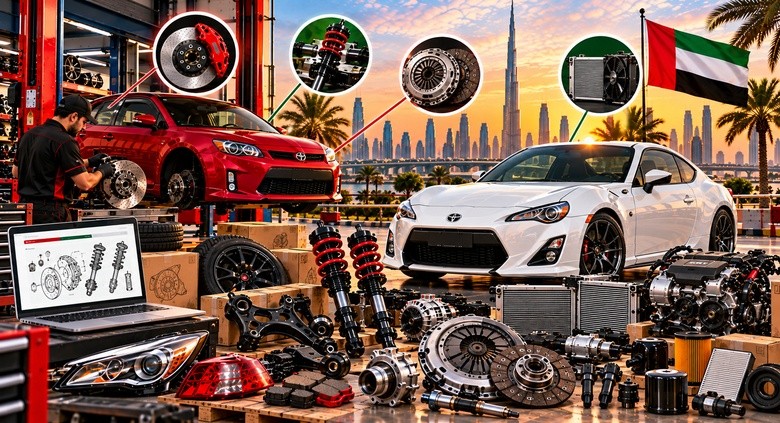
The second-generation tC arrived with larger disc brakes than its predecessor, with discs at all four corners; Toyota later specified 16-inch discs and 18-inch alloy wheels for the second-generation platform.
So the tC's brake shopping list can include:
- front pads
- rear pads
- front discs
- rear discs
- calipers
- slider hardware
- brake hoses
- ABS-related components
The important distinction is generation.
A first-generation tC brake component should not be ordered simply because a listing says “fits Scion tC”.
FR-S Suspension Parts Are More Than Shock Absorbers
The FR-S was engineered around low centre of gravity and balanced handling, with MacPherson struts at the front and double wishbones at the rear.
Common replacement categories can include:
- dampers
- springs
- top mounts
- bushes
- control arms
- ball joints
- stabiliser links
- stabiliser bushes
- wheel bearings
- steering components
This is also one area where an online listing can become misleading quickly.
A lowered FR-S, track-oriented car or vehicle fitted with aftermarket arms may no longer have the same parts configuration as a standard car.
tC Suspension Parts Have Their Own Wear Pattern
The second-generation tC also uses MacPherson front suspension and double wishbones at the rear, but its components are specific to the tC platform. Toyota also revised shock absorbers and chassis tuning for later model years.
When replacing suspension parts, check the complete assembly rather than assuming one noisy component is the entire problem.
A competent inspection should consider:
damper condition → bushes → ball joints → links → wheel bearing → alignment
Replacing one component while ignoring the worn part next to it can leave the original complaint only partly solved.
FR-S Wheel Bearings and Hubs
The FR-S sends power through the rear axle, so wheel-end components deserve proper inspection rather than guesswork.
Possible replacement items include:
- front wheel bearings/hubs
- rear wheel bearings/hubs
- wheel studs
- hub-related hardware
- ABS/wheel-speed sensors
A humming noise is not automatically a wheel bearing.
Tyre noise, uneven wear and drivetrain-related noise can produce similar complaints. Diagnosis should come before the online order.
tC Wheel Bearings
The tC's front-wheel-drive layout changes the surrounding mechanical context.
A wheel-bearing complaint should be checked alongside:
- hub condition
- CV axle condition
- tyre wear
- brake condition
- suspension play
- ABS sensor operation
That distinction is useful when comparing repair quotations because the bearing price is not the same thing as the installed repair cost.
FR-S Clutch Components
For a manual FR-S, clutch-related parts can become a substantial repair rather quickly.
Potential components include:
- clutch disc
- pressure plate
- release bearing
- flywheel
- clutch hydraulics
- master cylinder
- slave cylinder
The FR-S was offered with a six-speed manual from its introduction.
If the gearbox is already being removed, the workshop should assess the surrounding components before the replacement parts are ordered.
A cheap clutch kit is not necessarily cheap once labour is added twice.
tC Manual Clutch Parts
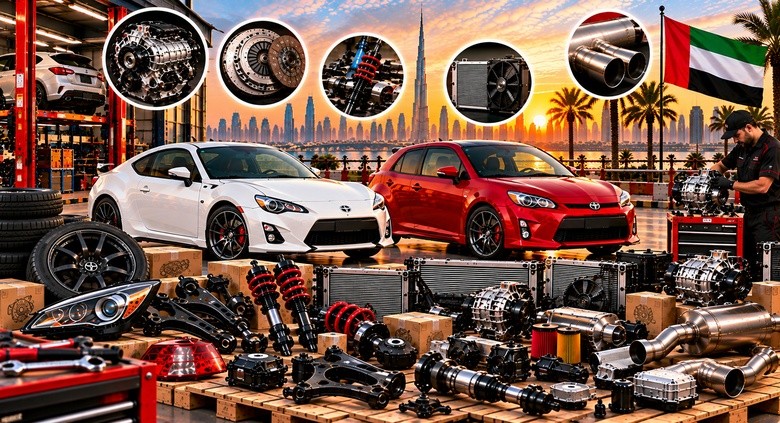
The second-generation tC also used a six-speed manual, alongside a six-speed automatic.
For a manual car, investigate the clutch system as an assembly rather than automatically blaming the clutch disc.
A slipping clutch, difficult engagement and hydraulic pedal problem can have very different causes.
The correct replacement therefore depends on the diagnosis.
FR-S Engine Parts
The FR-S uses a 2.0-litre boxer engine with Toyota's D-4S direct-and-port injection system. Toyota's original specification lists 200 horsepower and 151 lb-ft of torque.
That makes engine-part identification particularly important.
Depending on the fault, owners may need:
- filters
- belts
- spark plugs
- ignition components
- sensors
- gaskets
- cooling components
- oil-system components
- intake components
- exhaust components
The correct part depends on the exact engine application and the failure being diagnosed.
tC Engine Parts
The second-generation tC uses a 2.5-litre four-cylinder with Dual VVT-i. The 2011 version produced 180 horsepower, while the 2016 model was rated at 179 horsepower and 172 lb-ft of torque.
That small specification change across model years is precisely why model-year identification matters.
For routine maintenance, online sourcing can be relatively straightforward.
For engine internals, sensors and electronically controlled components, it becomes much more important to verify the application.
Cooling-System Parts Matter in UAE Conditions
The UAE puts a heavy workload on cooling and A/C systems simply because ambient temperatures can be severe and vehicles spend plenty of time in traffic.
Possible replacement parts include:
- radiator
- radiator fan
- fan motor
- thermostat
- water pump
- coolant hoses
- expansion/reservoir components
- temperature sensors
- radiator cap where applicable
But overheating is a symptom, not a parts order.
Before replacing a radiator or water pump, the workshop should establish coolant circulation, pressure behaviour, fan operation and the actual source of the problem.
FR-S Air-Conditioning Components
For an FR-S used through Dubai summer traffic, A/C performance is not a cosmetic issue.
Potential components include:
- compressor
- condenser
- evaporator
- expansion valve
- blower motor
- cabin filter
- pressure-related sensors
- A/C electrical components
If the compressor is suspected, check the complete system first.
Contamination or an underlying electrical problem can turn a single-component replacement into a second repair.
tC Air-Conditioning Parts
The tC has its own A/C components and electrical configuration, so don't use an FR-S listing simply because the component appears visually similar.
For an A/C complaint, a workshop should establish whether the problem is:
refrigerant-related, compressor-related, airflow-related, electrical or control-related.
That diagnosis should determine the part.
Not the dashboard symptom.
FR-S Drivetrain Parts Are Particularly Specification-Sensitive
This is where the FR-S deserves more caution than a generic Scion parts guide would suggest.
The car uses rear-wheel drive and a standard Torsen limited-slip differential.
Possible drivetrain-related replacement areas include:
- clutch
- driveshaft
- differential components
- CV axles
- wheel hubs
- differential seals
- mounts
- transmission-related components
For differential or transmission work, verify the exact assembly before buying.
A component that physically resembles the original can still have the wrong specification.
tC Driveshaft and CV Components
The tC's front-wheel-drive layout means CV axles, inner and outer joints, boots and related hardware become more relevant to the repair conversation.
If there is clicking during turns, vibration under acceleration or visible grease around a torn boot, the workshop should inspect the complete axle and surrounding components.
Sometimes the sensible repair is a boot.
Sometimes the joint has already suffered damage.
Sometimes replacing the complete axle makes more sense.
The diagnosis decides which one.
FR-S Exhaust Parts
The FR-S's naturally aspirated boxer engine and performance-oriented layout make exhaust modifications common enough that buyers should establish what is actually fitted to the car before ordering. Toyota described the standard FR-S with a specific factory exhaust arrangement and 2.0-litre engine.
Potential replacement areas include:
- exhaust manifold components
- catalytic-converter assemblies
- centre sections
- silencers
- gaskets
- oxygen sensors
- mounting hardware
An imported or modified FR-S may not retain the original exhaust.
Check underneath the car first.
tC Exhaust Components
The tC also received a sport-tuned exhaust system from its second-generation launch.
Common replacement categories can include:
- front exhaust components
- catalytic-converter assemblies
- centre pipes
- rear silencers
- gaskets
- oxygen sensors
- exhaust hangers
Again, distinguish the standard system from aftermarket modifications.
FR-S Electrical and Sensor Parts
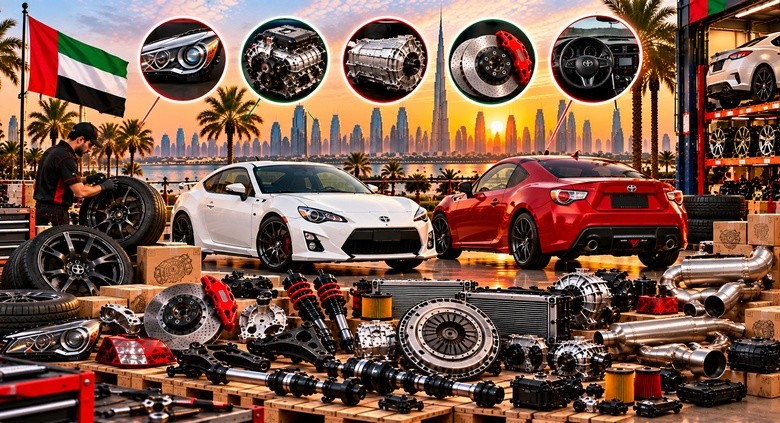
The FR-S contains a mixture of engine-management, ABS, stability-control and body electronics.
Possible replacement categories include:
- oxygen sensors
- crankshaft/camshaft sensors
- ABS sensors
- ignition components
- battery
- alternator
- starter
- switches
- control modules
- lighting components
A diagnostic code should not automatically become a parts order.
Check power, ground, wiring and live data where appropriate.
tC Electrical Parts
The tC also has plenty of electronics that can produce misleading symptoms:
- ABS sensors
- engine sensors
- alternator
- starter
- battery
- switches
- lighting
- window components
- audio/head-unit components
- control modules
Toyota's 2016 tC specification included Smart Key, updated audio technology and standard safety systems including ABS, EBD, Brake Assist, traction control and vehicle stability control.
That is why an electrical part should be matched by application and tested where possible.
FR-S Body and Lighting Parts
Body parts are often where discontinued-car sourcing becomes interesting.
FR-S owners may need:
- headlights
- tail lamps
- bumpers
- grilles
- bonnet components
- wings
- mirrors
- undertrays
- brackets
- trim
For these parts, used genuine components can sometimes make practical sense, particularly when colour-matched or discontinued items are involved.
But inspect mounting points and previous accident damage.
A cheap body panel with bent mounting tabs is not a bargain.
tC Body and Trim Parts
The tC's panoramic moonroof and coupe body introduce their own trim and sealing components, while later cars also received LED-related exterior details and revised front/rear styling.
Online searches should therefore include:
- model year
- body location
- left/right side
- front/rear
- colour where relevant
- original part number where available
“Scion tC headlight” is too broad if the seller has several generations or assemblies.
FR-S Tyres and Wheels
The original FR-S specification included 17×7-inch alloy wheels, but many surviving cars have been modified.
Before ordering wheels or tyres, check:
- wheel diameter
- width
- offset
- bolt pattern
- tyre size
- load rating
- clearance
- suspension modifications
Do not assume the current wheel is the factory specification.
It may be the very reason you are looking for replacement parts.
tC Wheels and Tyres
The second-generation tC was specified with 18-inch alloy wheels and wider tyres, while Toyota's original 2011 documentation distinguishes this generation from the earlier car.
That makes wheel-and-tyre sourcing another area where model year matters.
If the car has aftermarket wheels, record the actual dimensions rather than searching by badge alone.
Genuine, Aftermarket or Used?
There is no universal winner.
For a routine filter or service component, a reputable aftermarket product may be perfectly reasonable.
For an electronic module, unusual trim item or generation-sensitive component, genuine or verified used can reduce fitment uncertainty.
For discontinued bodywork, a used genuine component may be the most practical route.
For a heavily modified FR-S, an established specialist aftermarket component may be more appropriate than a standard replacement.
The sensible choice depends on the component, not the label.
What a UAE Workshop Should Check Before You Buy
For a significant repair, ask the workshop for the diagnosis in plain language.
A useful inspection might involve:
visual inspection → scan/DTC check → physical testing → electrical checks where relevant → road test → confirmation of failed component
For engine problems, additional testing may include compression, leak-down, oil-pressure or cooling-system checks where appropriate.
For suspension and drivetrain problems, look for physical play, leaks, bearing noise, vibration and mounting condition.
The point is simple: buy the part after establishing the failure, not before.
Part Price Is Not Repair Cost
Suppose an online listing shows a component for AED X.
That tells you almost nothing about the final repair bill.
The installed cost may include:
part + VAT + delivery + diagnostic time + labour + seals/gaskets + fluids + programming/calibration + alignment + post-repair testing
This distinction is especially important with FR-S drivetrain and suspension work, and with tC electrical, cooling and A/C repairs.
A component that is AED 300 cheaper can still produce the more expensive repair if it needs additional labour or turns out to be incorrect.
The Cost of Getting the Wrong Part
The obvious cost is the part itself.
The less obvious costs are:
- delivery
- return shipping
- workshop storage
- wasted diagnostic time
- removal and refitting
- vehicle downtime
- another replacement order
- possible damage from an incorrect component
This is why VIN confirmation becomes more valuable as the component becomes more expensive.
A five-minute fitment check can be worth considerably more than a small discount.
Buying Used FR-S Parts in the UAE
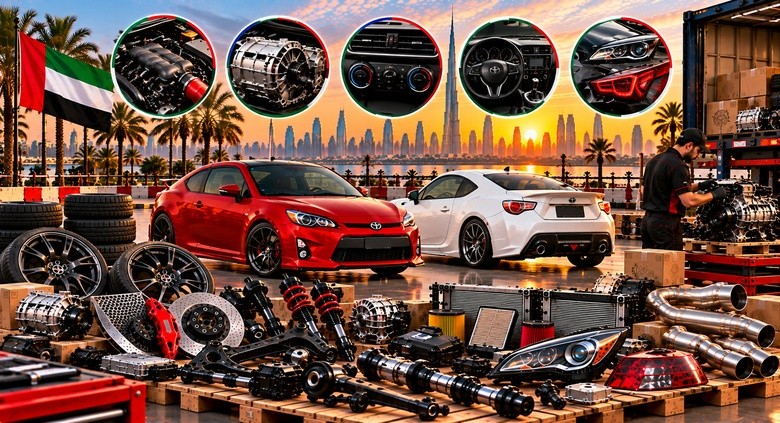
Used genuine FR-S parts can be useful for:
- body panels
- lights
- wheels
- trim
- drivetrain components
- selected suspension assemblies
- interior parts
Ask for donor information where available.
For mechanical assemblies, ask about mileage, testing and warranty.
For electronics, establish the exact part number and whether programming or pairing may be required.
For bodywork, inspect mounting points and repair history.
“Used” describes the part's history.
It does not describe its quality.
Buying Used tC Parts
The tC's age makes used parts increasingly relevant, particularly for discontinued body and interior components.
Good candidates can include:
- mirrors
- lamps
- bumpers
- trim
- interior pieces
- wheels
- selected mechanical assemblies
The same rule applies: inspect condition and verify application before comparing price.
A rare part is not automatically a good part.
UAE Heat Changes the Parts Conversation
The same vehicle can experience very different duty depending on how it is used.
A Dubai FR-S sitting in traffic with the A/C running through summer has a different thermal workload from an occasionally driven weekend car.
The same applies to the tC.
When diagnosing cooling, A/C, battery, charging or rubber-component problems, tell the workshop how the vehicle is actually used.
That context can change what they inspect first.
Where to Source These Parts in the UAE
The Toyota UAE network currently lists locations offering parts and service across Dubai, Abu Dhabi, Sharjah, Fujairah, Ras Al Khaimah and other emirates.
For a Scion owner, that gives you a manufacturer-linked route worth checking, particularly for identification-sensitive components.
For older or discontinued parts, however, the practical search may also extend to specialist suppliers, independent parts businesses and verified used-parts sources.
The sourcing route should follow the component.
A Simple Buyer Decision Matrix
| Part situation | Route to investigate | What to verify |
|---|---|---|
| Routine service item | Genuine or reputable aftermarket | Exact application |
| FR-S brake component | Genuine/aftermarket | Model year and existing setup |
| FR-S drivetrain component | Genuine/specialist/verified used | VIN, transmission/differential specification |
| tC suspension | Genuine/aftermarket | Generation and model year |
| ECU/module | Genuine or tested used | Part number, VIN and programming |
| Discontinued body panel | Used genuine | Condition, mounting points and colour |
| A/C component | Genuine/quality aftermarket | Diagnosis and system compatibility |
| Engine assembly | New/rebuilt/verified used | Test evidence and warranty |
Before You Click Buy
For either an FR-S or tC, have these details ready:
VIN
model year
exact model
engine
transmission
drivetrain
left/right or front/rear position
original part number
photograph of the existing component
standard or modified vehicle
new, aftermarket, used or rebuilt preference
If the supplier cannot identify the part from that information, the listing probably is not specific enough for an expensive purchase.
One Important Point About the FR-S Toyota Connection
The FR-S does not exist in isolation.
Toyota's documentation describes it as a Scion model, but the car's broader 86 engineering relationship means owners may encounter Toyota 86-related parts information during research. Toyota itself described the FR-S as drawing on Toyota's sports-car heritage and using a jointly developed boxer-engine architecture with D-4S injection.
That wider information can help with research.
It should not be treated as automatic proof that every Toyota 86 component fits every Scion FR-S.
Verify the individual application.
The tC's Toyota Connection Is Equally Useful — but Still Requires Fitment
The tC was Scion's top-selling model, with 418,235 units recorded in Toyota's Scion sales history through 2015.
That relatively large production run can help parts availability compared with genuinely obscure Scion models.
But age, generation and regional specification still matter.
A large original production number does not make every remaining component interchangeable.
For owners comparing genuine, aftermarket and used options, PartFinder UAE can be included in the sourcing process when checking available parts and comparing the right component for the vehicle.
The Parts Owners Are Most Likely to Need
For quick reference, the common categories worth investigating are:
FR-S: brakes, suspension, wheel bearings, clutch components, cooling parts, A/C components, sensors, electrical parts, exhaust components, CV/drivetrain parts, wheels and body/lighting items.
tC: brakes, suspension, wheel bearings, clutch components on manual cars, cooling parts, A/C components, engine ancillaries, sensors, electrical parts, exhaust components, CV axles, wheels and body/trim.
The lists overlap.
The actual parts do not necessarily do so.
The Practical Rule for FR-S and tC Owners
Don't begin with “What Scion part do I need?”
Begin with:
“What exactly has failed on my FR-S or tC, and what identifies the replacement?”
That means diagnosis first, then VIN/application, then part number, then supplier.
For an FR-S, pay particular attention to drivetrain, suspension and modification-related fitment. For a tC, pay particular attention to generation, model year and the distinction between first- and second-generation components.
And for both cars, don't let a low online price make the decision for you. The useful number is the correct part's total installed cost, including the price of discovering that the wrong component was ordered.
UAE Update Reference: September 2026. Scion model history and technical specifications in this article are based on Toyota's published material. UAE parts availability, supplier stock, delivery times and individual prices can change and should be confirmed against the vehicle VIN and current supplier information before purchase.
FAQs
Categories
- Audi
- BMW
- Car Accessories
- Car Tips
- Ford
- Land Rover
- Mazda
- Range Rover
- Top 10
- UAE Car Parts
- Used Car Parts
- Toyota
- Replacement Engines
- Nissan
- Hyundai
- Mitsubishi
- Volkswagen
- Honda
- Kia
- Chevrolet
- Dodge
- Jeep
- Subaru
- Renault
- Lexus
- Mercedes
- Suzuki
- Hummer
- Porsche
- Infiniti
- Peugeot
- GMC
- Mini
- Volvo
- Replacement Gearboxes
- MG
- Jaguar
- Skoda
- Cadillac
- Daihatsu
- Fiat
- German Car Parts
- Japanese Car Parts
- Aftermarket Car Parts
- Genuine Car Parts
- New Car Parts
- Reconditioned Car Parts
- European Car Parts
- American Car Parts
- Korean Car Parts
- British Car Parts
- Chinese Car Parts
- Sports/Exotic Car Parts
- Luxury Car Parts
- Performance Car Parts
- SUV/4x4 Spare Parts
- Truck Spare Parts
- EV Car Parts
- Hybrid Car Parts
- Auto Spare Parts in UAE
- Tesla
- Isuzu
- Ram
- Ferrari
- Bentley
- Lamborghini
- Genesis
- Maserati
- Lincoln
- Chrysler
- Opel
- Citroen
- SsangYong
- Seat
- McLaren
- Aston Martin
- Rolls Royce
- Maybach
- Alfa Romeo
- Bugatti
- Scion
- Abu Dhabi Car Parts
- Ajman Car Parts
- Al Khan Car Parts
- Al Sajaa Car Parts
- Deira Car Parts
- Dubai Car Parts