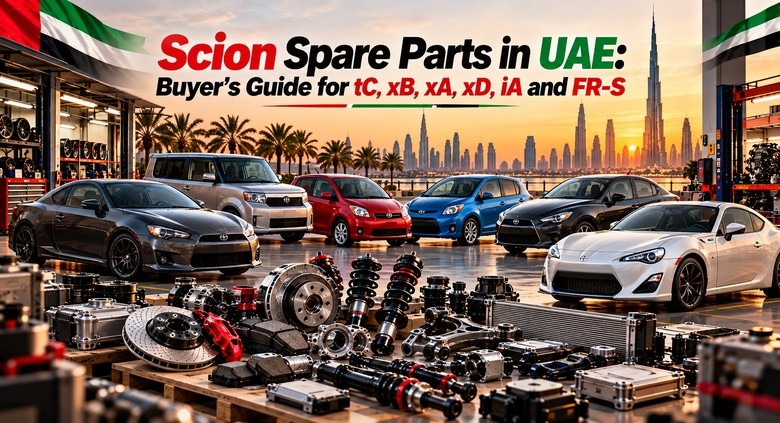
Scion Spare Parts in UAE: Buyer’s Guide for tC, xB, xA, xD, iA and FR-S
September 28, 2026
Scion is no longer a standalone new-car brand, but that does not mean its cars suddenly stopped needing parts. Quite the opposite. In the UAE, Scion ownership has become a sourcing exercise: identify the exact car, understand its Toyota relationship, confirm the specification, then find the component that actually belongs on that vehicle.
That last part matters more than it sounds.
A Scion tC, xB, xA, xD, iA and FR-S may all carry the same badge family, yet their engines, transmissions, suspension layouts, body hardware and electronic systems are not interchangeable simply because they come from the same brand. Toyota’s own historical records show how quickly the range changed: the xA ran from 2003–2008, the xD replaced it in 2008 and ended in 2014, the second-generation xB arrived in 2008 and ended in 2015, while the tC ended production in August 2016. From August 2016, model-year 2017 vehicles were badged as Toyotas rather than Scions.
For a UAE buyer, that history changes the way parts should be purchased.
Scion Spare Parts in UAE Are Really a Fitment Problem
The first mistake is searching only by “Scion spare parts”.
That is a brand-level description, not a fitment specification.
A supplier needs to know the model, model year, engine, transmission, body configuration and, for sensitive components, VIN or the original part number. This becomes particularly important with imported vehicles because a UAE workshop may encounter a US-market Scion alongside Toyota-badged equivalents or components supplied through different regional channels.
For expensive electronic, drivetrain, braking or body components, a photograph and VIN can be considerably more useful than a vague model description.
Why Scion Parts Can Still Be Sourced
Scion's disappearance from the showroom does not automatically make every component obsolete.
Toyota's historical Scion records show more than one million Scion vehicles sold in the United States from 2003–2015, with the tC and xB accounting for substantial volumes. The FR-S, xD, xA and iA were produced in smaller numbers, but they are not obscure one-off vehicles.
That gives UAE owners several possible sourcing routes: Toyota-linked parts where applicable, specialist suppliers, aftermarket manufacturers, used genuine components and dismantler stock.
The trick is identifying which route makes sense for the particular part.
The Scion-to-Toyota Connection Matters
This is one of the most useful pieces of information for a Scion owner.
Scion was a Toyota brand in North America, and Toyota later absorbed the models into its own range. Toyota's own announcement stated that beginning in August 2016, model-year 2017 vehicles would be badged as Toyotas.
That does not mean you can order every Toyota component for a Scion and assume it will fit.
It does mean a Scion spare parts in UAE search should not stop at the Scion badge. A competent supplier can investigate the Toyota equivalent, platform relationship or applicable part reference where one exists.
Scion tC Parts: The Coupe Needs Its Own Approach
The tC is probably the easiest Scion model to underestimate.
The final 2016 tC used a 2.5-litre four-cylinder producing 179 hp and 172 lb-ft, with six-speed manual or automatic transmission options. Its suspension used MacPherson struts at the front and a double-wishbone arrangement at the rear.
That immediately separates it from the smaller Scion hatchbacks.
For UAE sourcing, pay particular attention to suspension components, wheel bearings, brakes, engine accessories, cooling-system parts, A/C components and transmission-related items. On older examples, rubber components and electrical accessories deserve equal attention because age can become a bigger variable than mileage.
tC Engine and Transmission Fitment
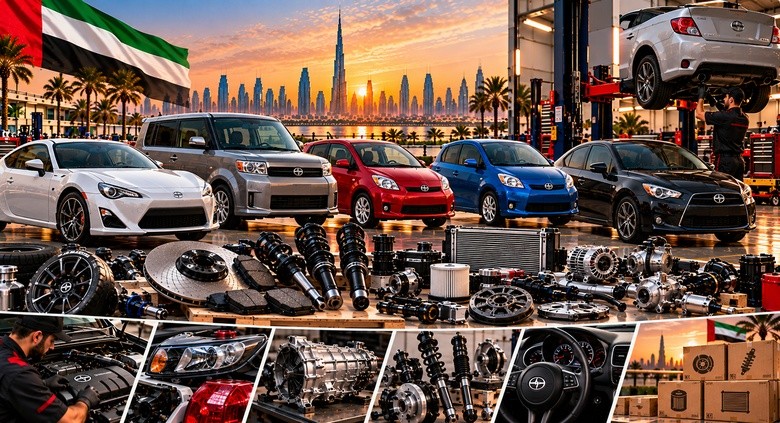
Do not order a tC engine-related component solely because the listing says “2.5L Scion”.
Check the model year and application.
The 2014 tC also received drivetrain and chassis changes, including an updated automatic transmission, modified stabiliser-bar hardware, revised shock absorbers and retuned electronic power steering.
For engine sensors, transmission components, steering electronics and suspension parts, those distinctions can matter.
A VIN or exact original part reference is the safer route when the component is expensive.
Scion xB Parts: The Box Is Mechanically More Serious Than It Looks
The xB's boxy body makes it instantly recognisable, but its mechanical specification is quite different from the smaller xA and xD.
The second-generation xB used a 2.4-litre four-cylinder producing 158 hp and 162 lb-ft. Toyota specified a five-speed manual or four-speed automatic, with MacPherson strut front suspension and torsion-beam rear suspension.
That matters when comparing listings.
An xB suspension component should not be assumed to fit an xD simply because both are five-door Scions. The same goes for engine mounts, transmission components, cooling parts and brake assemblies.
xB Body and Interior Parts Are a Different Sourcing Game
Mechanical components can sometimes be easier to cross-reference than body and trim pieces.
For an xB, buyers may be searching for bumpers, lamps, mirrors, tailgates, interior plastics, door hardware, switches or dashboard components. Here, colour, facelift, trim and exact body configuration can matter just as much as mechanical fitment.
Used genuine body parts can therefore make sense, particularly when a new original component is difficult to source.
But inspect mounting tabs, previous repairs, paint quality and damage around fixing points before buying.
Scion xA Parts: Older Does Not Mean Interchangeable
The xA was Scion's early subcompact, sold from 2003 to 2008. Toyota's historical Scion record confirms that production period.
That makes the xA a very different proposition in the UAE.
Age-related wear is now part of the sourcing equation. Suspension bushes, engine mounts, cooling-system components, seals, alternator/starter assemblies, A/C components and interior plastics can all become relevant simply because these vehicles are old.
For an xA, verify the component against the vehicle rather than assuming a newer Scion part is an upgrade or substitute.
Why xA Parts Need More VIN Discipline
A 2000s vehicle may have passed through several owners, countries and repair shops before reaching the UAE.
That creates a surprisingly common problem: the car may no longer contain every component originally fitted to it.
An engine swap, transmission replacement, aftermarket suspension kit or previous accident repair can alter what is physically installed.
If a replacement part looks “almost right”, stop there. Almost right is not a fitment standard.
Scion xD Parts: Small Car, Specific Components
The xD replaced the xA in 2008 and was discontinued in 2014. Toyota describes the 2014 xD with a 1.8-litre four-cylinder producing 128 hp and 125 lb-ft, paired with either a five-speed manual or four-speed automatic.
The front suspension uses MacPherson struts and the rear a torsion beam.
For everyday UAE ownership, common searches are likely to centre around brake components, suspension, wheel bearings, cooling, A/C, electrical parts and routine engine service components.
Again, the important word is application.
xD Transmission Choice Can Change the Part
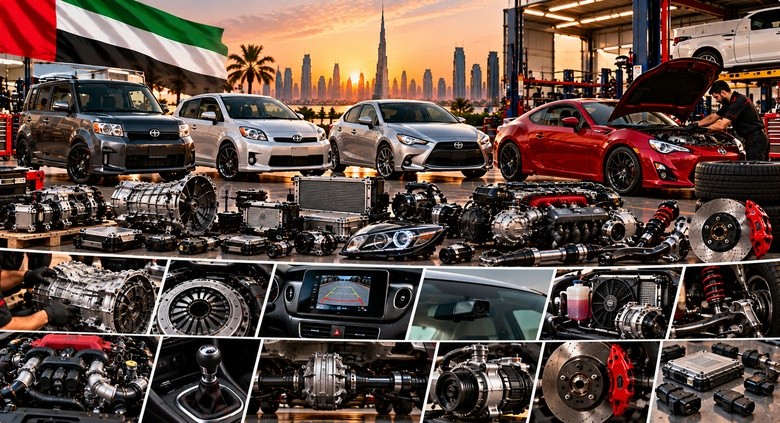
The xD was offered with both manual and automatic transmissions.
That distinction becomes critical when ordering transmission mounts, clutch-related components, driveshaft-related parts, sensors and transmission-specific hardware.
A supplier who asks whether your car is manual or automatic is not making the process difficult. They are reducing the chance of an expensive mistake.
Scion iA Parts: The Shortest Production History Needs Care
The 2016 iA arrived very late in the Scion story.
Toyota described it as Scion's first sedan, using a high-compression 1.5-litre engine producing 106 hp with either a six-speed manual or six-speed automatic transmission. It also used MacPherson struts at the front and a torsion-beam rear suspension.
That makes the iA interesting from a parts perspective because its Toyota connections can be particularly useful when researching replacement components.
But do not confuse “related” with “identical”.
Verify the exact application before ordering.
iA Electrical and Safety Parts Deserve Extra Attention
The iA was equipped with technology that older Scion models did not necessarily have, including a low-speed pre-collision safety system, rear-view camera and seven-inch multimedia system.
That means electronic parts should be treated differently from a simple suspension bush.
For sensors, camera components, control modules, wiring and safety-related electronics, confirm the exact vehicle specification and whether programming or calibration is required after installation.
Scion FR-S Parts Are a Completely Different Proposition
The FR-S is the odd one out.
It is a rear-wheel-drive sports car with a 2.0-litre horizontally opposed four-cylinder engine, D-4S injection, six-speed manual or six-speed automatic transmission and a Torsen limited-slip differential. Toyota's published specifications give the original production car 200 hp and 151 lb-ft.
That mechanical layout changes the parts conversation immediately.
The FR-S shares its broader engineering story with the Toyota 86/Subaru BRZ family, but a buyer should still confirm the exact application rather than treating every “86/BRZ/FR-S” listing as automatically correct.
FR-S Suspension and Differential Parts Need Particular Care
The FR-S uses MacPherson struts at the front and double wishbones at the rear, with ventilated discs at both ends.
It also uses a Torsen limited-slip differential.
That means suspension geometry, differential components, driveshafts, wheel hubs and braking parts deserve proper identification before purchase.
An enthusiast car is also more likely to have been modified, which introduces another variable: aftermarket springs, coilovers, brakes, wheels, differentials and engine components may already be fitted.
Never Assume an FR-S Has Its Original Specification
This is where a used FR-S can catch buyers out.
The car may look standard while carrying a modified exhaust, intake, suspension, clutch, differential or ECU calibration.
If you are replacing a component, inspect what is actually fitted to the car.
The original factory specification is useful, but the vehicle sitting in the workshop is the final reference point.
The Same Scion Name Does Not Mean the Same Parts
A simple comparison makes the point:
| Model | Factory configuration worth checking | Main fitment concern |
| tC | 2.5L, FWD, manual/automatic | Engine, transmission and chassis-year differences |
| xB | 2.4L, manual/automatic | Generation and body/trim differences |
| xA | Older subcompact | Age, exact application and previous repairs |
| xD | 1.8L, manual/automatic | Transmission and model-year fitment |
| iA | 1.5L, manual/automatic | Electronics and Toyota-related application |
| FR-S | 2.0L boxer, RWD | Performance drivetrain, suspension and modifications |
The table is a starting point, not a substitute for VIN verification.
Genuine, OEM, Aftermarket or Used?
There is no universal winner.
A genuine original component may be appropriate when fitment, electronics or safety are critical. A reputable aftermarket component can make sense for routine wear items where specification and quality are properly documented. A used genuine component can be useful when new supply is expensive or discontinued.
Reconditioned parts occupy another category altogether.
The question is not “Which label is best?”
It is: what does this particular part do, how failure-sensitive is it, and what evidence exists about the component being offered?
Used Scion Parts Need a Donor-Vehicle Check
A used part should come with a history whenever possible.
Ask:
- What vehicle did it come from?
- What model year was the donor?
- What engine and transmission did it have?
- Was the donor accident-damaged?
- Was it flooded?
- What mileage was recorded?
- Has the component been tested?
- Is the original part number visible?
- Is there a return period?
- Does the seller offer any functional warranty?
“Used” describes history. It does not describe quality.
UAE Heat Changes the Conversation
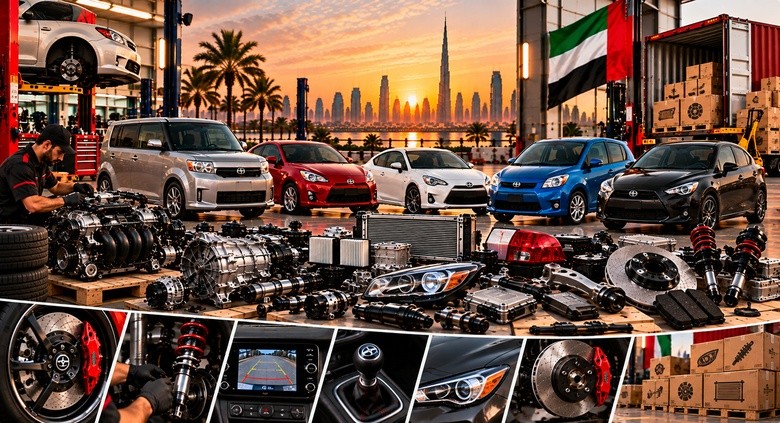
The UAE environment is hard on vehicles.
High ambient temperatures, heavy A/C use, dust, stop-start traffic and long periods of heat soak can expose weaknesses in cooling, electrical and rubber components.
That does not mean every Scion needs special parts simply because it lives in Dubai or Abu Dhabi.
It means cooling-system condition, battery/charging performance, A/C operation, hoses, belts, seals and electrical connectors deserve proper attention when an older imported car is being assessed.
A/C Parts Are Not the Same as Cooling-System Parts
This distinction is often blurred in parts searches.
The radiator, water pump, thermostat and coolant hoses belong to the engine cooling system.
The compressor, condenser, evaporator, expansion device, refrigerant circuit and associated controls belong to the A/C system.
Both can struggle in extreme heat, but they require different diagnosis.
Replacing an A/C compressor because the cabin is warm without checking refrigerant pressure, electrical command, condenser airflow and compressor operation is not a diagnosis. It is a guess.
Cooling-System Parts Should Be Diagnosed Before Buying
If a Scion is overheating, do not start with “I need a radiator”.
A competent workshop should establish whether the issue involves coolant loss, thermostat operation, water-pump circulation, radiator efficiency, fan operation, trapped air, pressure loss, head-gasket problems or another fault.
For an older vehicle, a cooling-system pressure test can be useful. Scan data may also matter on electronically controlled systems.
The correct replacement part follows the diagnosis.
Not the other way around.
Suspension Noise Does Not Automatically Mean Shocks
A UAE Scion travelling over speed humps and rough urban surfaces can develop multiple suspension noises.
A clunk could involve a stabiliser link, bush, ball joint, control-arm component, top mount or another connection.
Shock absorbers should be assessed on their own condition.
Before buying a complete suspension “kit”, identify the failed component and inspect the surrounding hardware. Otherwise a cheap-looking package can become an unnecessary repair bill.
Brakes Need Specification, Not Just Diameter
Brake components can vary by model and application.
Check the exact vehicle before buying discs, pads, callipers, backing hardware or sensors.
On an FR-S, this becomes particularly important if the vehicle has been modified for track or performance use. On an xA or xD, the priority may instead be restoring an older car to correct road-going specification.
Brake fitment is one area where “it looks the same” is a poor purchasing method.
Electronics Can Turn a Cheap Part Into an Expensive Repair
Sensors and modules often look small on a quotation.
Their consequences are not.
A faulty sensor may cause poor running, warning lights, fuel-mixture issues or drivability problems. A control module may require configuration or programming. A camera or safety sensor may require calibration.
Before buying, establish whether the component is plug-and-play or whether post-installation procedures are required.
Check the Part Number When the Part Is Expensive
For an inexpensive filter, model and engine information may be enough.
For a control module, transmission component, steering component, body control unit, airbag-related part or other expensive item, the original part number becomes much more valuable.
Photograph the old component label before removing it if possible.
Record connector configuration and physical differences.
Then compare the proposed replacement against that evidence.
Imported Scions Can Carry the Wrong Assumption
A UAE owner may have bought a US-spec vehicle, an imported example from another market, or a car that has already changed hands locally.
That history matters.
Two vehicles with the same badge and year can occasionally require different investigation because of equipment, trim or previous modifications.
VIN-based confirmation is particularly useful when ordering high-value or safety-sensitive components.
Part Price Is Not the Same as Repair Cost
A supplier may quote AED X for a component.
That is not necessarily the amount the owner will spend.
The real calculation can include:
Part + delivery + VAT where applicable + diagnosis + labour + fluids/seals/hardware + programming or calibration + alignment or post-installation testing.
A used component that costs less can therefore become more expensive if installation fails or the part is returned after several hours of labour.
Repair, Used or New?
For a Scion owner, the sensible choice depends heavily on the component.
A worn suspension bush may justify replacement rather than replacing an entire assembly.
A failed electronic module may make a tested used unit attractive, but only if compatibility and programming are understood.
A damaged safety-critical component may warrant a different sourcing standard.
The cheapest component is not automatically the cheapest repair.
The Cost of the Wrong Scion Part
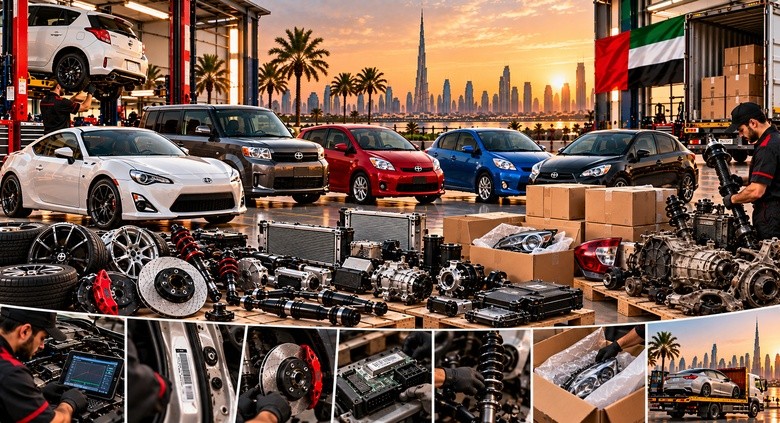
This is the part of the buying process people tend to skip.
If the wrong brake part arrives, you may lose labour time and vehicle availability.
If the wrong electronic module arrives, diagnosis can become even more confusing.
If the wrong engine or transmission component is installed, the consequences can be considerably more serious.
For older imported cars, return policy is therefore not a minor detail. It is part of the purchase.
What a UAE Workshop Should Check Before Ordering
For a recurring fault, the workshop should establish the failure rather than simply identify a suspicious component.
Depending on the problem, that can include:
- diagnostic scan and DTC interpretation
- live-data review
- visual inspection
- voltage and charging checks
- current-draw testing
- coolant-pressure testing
- cooling-fan operation
- fluid condition
- suspension play
- wheel-bearing noise/play
- brake measurements
- road testing
- compression or leak-down testing for relevant engine faults
The exact test depends on the symptom.
A long test list is not automatically better; the right test is the one that separates likely causes.
Before You Click Buy
For any significant Scion part, confirm these details first:
Vehicle: model, year and VIN
Engine: displacement and application
Transmission: manual or automatic
Part: exact description and original number where available
Condition: new, used, aftermarket or reconditioned
Donor: model year, mileage and history for used parts
Electronics: programming or calibration requirements
Installation: labour, fluids, seals and additional hardware
Warranty: duration and functional coverage
Returns: conditions, restocking charges and compatibility exclusions
Delivery: UAE location, lead time and special-order status
Ten minutes spent checking these points can save considerably more than ten minutes' worth of workshop labour.
A Practical Buying Matrix
| Option | Best suited to | Main advantage | Main risk | Verify |
| New genuine | Critical or exact-fit components | Factory application | Cost or availability | VIN/part number |
| Quality aftermarket | Routine wear items | Wider availability | Quality variation | Manufacturer/application |
| Used genuine | Older or discontinued parts | Original component | Unknown history | Donor and testing |
| Reconditioned | Repairable assemblies | Potential cost saving | Rebuild quality | What was actually replaced |
| Specialist import | Rare components | Access to wider stock | Lead time/returns | Exact specification |
There is no reason to use one sourcing method for every part on the car.
Where Scion Owners in Dubai and Abu Dhabi Can Lose Time
The issue is rarely the physical distance between the buyer and supplier.
It is usually identification.
A part may be available somewhere in the UAE, yet the supplier may still need confirmation of the exact application before releasing it.
For older Scions, it is sensible to send the VIN, photographs of the existing component, part-number images and vehicle details at the beginning of the enquiry rather than after several rounds of questions.
That makes the sourcing process much cleaner.
Sharjah and Other UAE Sourcing Routes
Used and dismantled components can be particularly relevant for older Scion models because the brand has been out of production for years.
But a dismantler's price alone tells you very little.
Ask about donor history, testing, storage, damage, mileage where known, warranty and return conditions.
A low-cost used component that cannot be returned is a different proposition from a slightly more expensive tested part with a functional warranty.
Finding the Right Supplier Is Part of the Repair
For Scion owners, sourcing is not merely a shopping task.
The supplier should be able to understand the difference between an xB and xD, between an FR-S and a front-wheel-drive Scion, between manual and automatic applications, and between a mechanical part and an electronically controlled component.
That is why a platform such as PartFinder UAE can be useful when the buyer approaches the search with complete vehicle information rather than simply typing a model name.
Evidence Matters More Than a Confident Listing
A convincing parts listing can still be wrong.
The strongest evidence normally comes from a combination of:
VIN/application confirmation → original part number → physical comparison → manufacturer specification → supplier confirmation → warranty/returns.
A photograph helps.
A part number helps more.
A verified application backed by the vehicle identification is stronger still.
The Simple UAE Rule for Scion Parts
Do not buy the part that merely says Scion.
Buy the part that can be traced to your Scion's exact application.
That distinction becomes increasingly important as these vehicles age and their original parts become less routinely stocked. Toyota's own historical records confirm that the Scion range ended at different times depending on the model, while the FR-S name itself transitioned into the Toyota 86 family after Scion's closure.
For UAE owners, that makes accurate identification the foundation of sensible sourcing.
UAE Update Reference: September 2026. Scion is a discontinued brand, and parts availability can change by model, component and supplier. Model specifications and historical production information above are based primarily on Toyota's published Scion records; current UAE stock, pricing, warranty and lead times should be verified at the point of purchase.
FAQs
Categories
- Audi
- BMW
- Car Accessories
- Car Tips
- Ford
- Land Rover
- Mazda
- Range Rover
- Top 10
- UAE Car Parts
- Used Car Parts
- Toyota
- Replacement Engines
- Nissan
- Hyundai
- Mitsubishi
- Volkswagen
- Honda
- Kia
- Chevrolet
- Dodge
- Jeep
- Subaru
- Renault
- Lexus
- Mercedes
- Suzuki
- Hummer
- Porsche
- Infiniti
- Peugeot
- GMC
- Mini
- Volvo
- Replacement Gearboxes
- MG
- Jaguar
- Skoda
- Cadillac
- Daihatsu
- Fiat
- German Car Parts
- Japanese Car Parts
- Aftermarket Car Parts
- Genuine Car Parts
- New Car Parts
- Reconditioned Car Parts
- European Car Parts
- American Car Parts
- Korean Car Parts
- British Car Parts
- Chinese Car Parts
- Sports/Exotic Car Parts
- Luxury Car Parts
- Performance Car Parts
- SUV/4x4 Spare Parts
- Truck Spare Parts
- EV Car Parts
- Hybrid Car Parts
- Auto Spare Parts in UAE
- Tesla
- Isuzu
- Ram
- Ferrari
- Bentley
- Lamborghini
- Genesis
- Maserati
- Lincoln
- Chrysler
- Opel
- Citroen
- SsangYong
- Seat
- McLaren
- Aston Martin
- Rolls Royce
- Maybach
- Alfa Romeo
- Bugatti
- Scion
- Abu Dhabi Car Parts
- Ajman Car Parts
- Al Khan Car Parts
- Al Sajaa Car Parts
- Deira Car Parts
- Dubai Car Parts