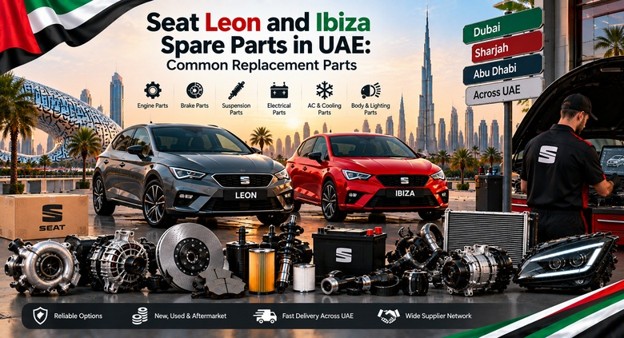
SEAT Leon and Ibiza Spare Parts in UAE: Common Replacement Parts
September 24, 2026
The part you need for a SEAT Leon or Ibiza is rarely identified properly by the badge alone. That is the first thing worth getting right, because these two cars span several generations, engines, transmissions and equipment levels, and the UAE market adds another variable: imported cars do not necessarily share one specification.
A Leon 1.9 TDI from the mid-2000s, a later 1.4 TSI DSG and a newer 1.5 TSI are three very different parts-buying exercises. The same is true of the Ibiza. SEAT's own technical documents show how widely the mechanical specification can change across production periods; one Leon generation, for example, was offered with 1.4 TSI engines and both manual and DSG transmissions, while later Leon versions added 1.0, 1.5, 2.0 TDI and electrified powertrains.
So the useful question in Dubai, Sharjah or Abu Dhabi is not simply “Where can I find the SEAT spare parts in UAE?”
It is “Which exact part belongs on this exact Leon or Ibiza, and is replacement actually the right repair?”
Leon and Ibiza are not interchangeable parts catalogues
They share engineering relationships across the wider SEAT/VAG family, but that does not make their components automatically interchangeable.
Some engine codes appear across several models, while body panels, lights, suspension geometry, electronics and interior components can be completely model-specific. A supplier may legitimately tell you that a particular engine is used in both Ibiza and another model, but that says nothing about whether a headlamp, bumper reinforcement or ECU from one car will work on another.
That distinction becomes especially important with used parts.
Start with the generation, not the model name
“SEAT Leon spare parts” is an incomplete search.
You need the generation or production period as well. The same model badge can cover very different electrical architecture, engines, braking systems and transmissions.
SEAT's own documentation still provides technical information for previous Leon and Ibiza generations, while its current owner resources separate current and previous models.
For an older UAE car, keep the registration details and VIN beside you before requesting a quotation.
The VIN should be part of the conversation
For a simple cabin filter, the VIN may not be necessary.
For an engine, gearbox, ECU, ABS module, headlamp assembly or complicated cooling component, it can be extremely useful.
Give the supplier the VIN and ask them to confirm the proposed part against the vehicle rather than asking whether the part merely “fits Leon”.
That one change in wording prevents a surprising number of expensive mistakes.
Engine code matters even more for replacement engines
A 1.0, 1.4, 1.5 or 1.8 engine description is still too broad.
Engine codes narrow the search considerably. A UAE listing for the SEAT Leon, for example, identifies the BAM engine as a 1.8-litre, 225 PS turbocharged application for 2003–2006 Leon models. Another documented listing identifies the BFQ as a 1.6-litre, 102 PS engine used in 2005–2006 Leon applications.
Those are not interchangeable simply because both say “Leon”.
Older Leon engines can be surprisingly different
Older Leon owners often have a wider replacement-parts problem than owners of newer cars.
The 1.9 TDI BXE is a good example. A UAE parts listing identifies it as a 1.9-litre, 105 PS turbo-diesel engine and lists SEAT Leon applications from 2005–2010.
That sort of information is useful when hunting for an engine, turbocharger, injectors or related components. It also shows why year, fuel type and engine code should be supplied together.
Newer Leon engines need generation-level checking
Later Leon models moved into smaller turbocharged engines and electrified variants.
SEAT's technical material for the fourth-generation Leon includes 1.0-litre petrol engines, 1.5 TSI units, 2.0 TDI applications and the 1.4 e-HYBRID.
That changes the spare-parts conversation considerably. A hybrid-specific component, DSG-related part or electronically controlled cooling component cannot be ordered by saying “Leon 2021” and hoping the seller guesses correctly.
Ibiza has just as much variation
The Ibiza looks like the simpler car. Its parts catalogue is anything but simple.
SEAT's technical data for the 2022 model year, for example, lists a 1.0 MPI with 80 PS and 1.0 TSI versions producing 95 PS and 110 PS, with manual and DSG transmission combinations depending on specification.
Earlier Ibiza documentation includes other engine families, including 1.4, 1.5 and 1.6 applications.
So “Ibiza 1.0” still leaves important questions unanswered.
Some Ibiza engine codes cross model boundaries
A UAE listing for the DKJA engine identifies a 999 cc, 115 PS three-cylinder turbocharged petrol engine and lists both SEAT Ibiza and Arona applications from 2017 onwards.
That is useful evidence of cross-model engine application, but it should not be misread as permission to cross-fit every associated component.
The engine may be shared. The ancillaries, ECU calibration, mounting hardware and surrounding installation can still differ.
Older Ibiza engines need the same caution
The BBY engine is another useful example. A UAE listing identifies it as a 1.4-litre, 75 PS naturally aspirated petrol engine and lists Ibiza applications from 2002–2007.
If you are looking for one of these older engines today, donor history and actual condition become much more important than a glossy photograph.
Air filters and oil filters are easy parts — until they aren't
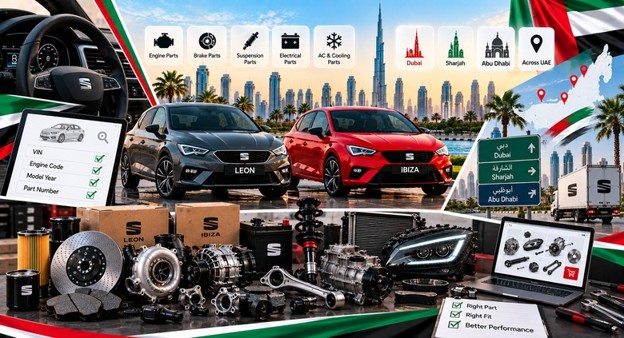
Routine filters are among the least complicated SEAT parts to source, but the correct filter still depends on engine and production specification.
For an oil filter, match the engine application and part number.
For an air filter, compare dimensions and the catalogue application.
For a cabin filter, check whether the car uses the relevant standard or activated-carbon configuration.
Cheap is fine here. Wrong is not.
Spark plugs should follow the engine specification
A spark plug is not simply a spark plug.
Heat range, electrode configuration, thread dimensions and manufacturer specification matter. Turbocharged petrol engines can be particularly unforgiving of casual substitutions.
Give the supplier the engine code rather than ordering from “SEAT Leon petrol” alone.
Ignition coils are common replacement items
A failing coil can produce rough running, hesitation, misfire codes and an illuminated engine warning lamp.
But replacing all coils because one cylinder is misfiring is not automatically justified.
The workshop should establish whether the fault follows the coil when positions are swapped, whether the spark plug is contributing and whether wiring or injector operation has been checked.
That is a small diagnostic distinction with a real effect on the bill.
Batteries need specification checking
Battery replacement becomes more complicated on cars with greater electrical loads, start-stop systems or battery-management functions.
Check physical dimensions, terminal arrangement, capacity and technology before ordering.
If the vehicle requires battery adaptation or registration after installation, factor that into the repair rather than treating the battery as the entire job.
Alternators are not always identical
A visually similar alternator can have different output, pulley configuration, regulator arrangement or electrical connections.
For an older Leon or Ibiza, ask for the alternator number from the existing unit.
For a used alternator, inspect the pulley, connector and casing carefully and ask whether it has been tested.
Starters should be diagnosed before replacement
A starter that clicks does not automatically mean the starter motor has failed.
Low battery voltage, poor earth connections, damaged wiring or a starter solenoid fault can produce similar symptoms.
If the starter is genuinely faulty, match the replacement against the engine and existing unit rather than buying the first “Leon starter” listing.
Brake pads are specification-sensitive
Brake pads need to match the correct axle, disc arrangement and brake package.
SEAT describes its Genuine brake components as being engineered around the vehicle's requirements, including weight and performance characteristics.
That principle remains relevant if you choose aftermarket parts.
Ask for the exact application and, where useful, the dimensions or existing part number.
Brake discs need more than diameter
Diameter alone is not enough.
Disc thickness, venting, hub arrangement and axle position can differ between variants.
A workshop should compare the old disc against the proposed replacement and confirm the specification before fitting.
ABS sensors should not be replaced blindly
An ABS warning does not prove that the wheel-speed sensor itself has failed.
A damaged reluctor ring, wiring fault, connector problem or bearing-related issue can create similar symptoms.
Scan the system, identify the affected wheel and inspect the sensor circuit before ordering the component.
Wheel bearings can imitate other faults
A humming or droning noise that increases with road speed may point towards a wheel bearing, but tyre wear can sound remarkably similar.
The workshop should identify whether the noise changes under load and inspect the bearing for play or roughness.
For a used hub assembly, condition matters more than simply knowing that it came from another Leon or Ibiza.
Suspension bushes often age before the major component does
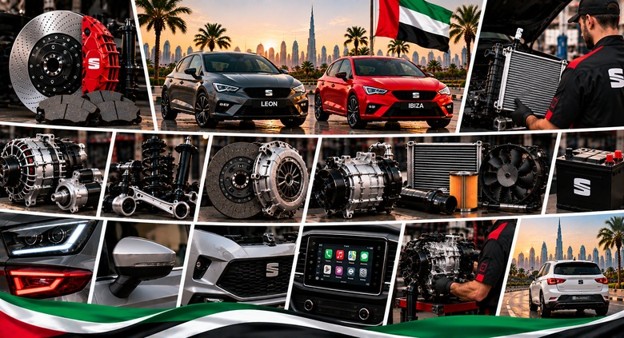
Control arms, bushes, ball joints, drop links and top mounts all have different failure modes.
Replacing the complete arm when only a replaceable bush has failed may not always be the best economic choice. Conversely, fitting one cheap bush to a heavily worn assembly may simply postpone the next repair.
The diagnosis should determine the part.
Shock absorbers should be assessed as a system
A leaking damper is an obvious replacement candidate.
A weak damper without visible leakage needs proper assessment rather than a guess based on mileage alone.
If one front damper has failed badly, the workshop should also consider the condition of its axle-mate, spring and top mount before ordering only one component.
Engine mounts deserve attention on older Leon models
A worn mount can create vibration, clunks or excessive drivetrain movement.
That does not necessarily mean the engine or gearbox itself is damaged.
Mounts should be inspected for collapsed rubber, cracking, leakage where hydraulic mounts are used and abnormal movement under load.
This is a classic example of why diagnosis should come before the expensive part.
Clutch kits are more than a clutch plate
For a manual Leon or Ibiza, a clutch repair may involve the friction disc, pressure plate, release mechanism and potentially the dual-mass flywheel depending on the vehicle.
If the flywheel is badly worn and only the clutch is replaced, labour may have to be repeated later.
Ask the workshop what was actually found before agreeing to the parts list.
DSG-related parts require proper diagnosis
A transmission fault does not automatically mean the complete DSG gearbox needs replacement.
Possible causes can include clutch wear, mechatronic faults, sensors, adaptation problems, fluid issues or internal mechanical damage, depending on the transmission.
A used gearbox can be a sensible solution in some cases. It can also be a very expensive mistake if the original fault was elsewhere.
Manual gearbox replacement needs code matching
Two manual transmissions can look almost identical and still have different ratios, mounting arrangements or applications.
Get the gearbox code.
Get the donor details if buying used.
Then confirm compatibility before removing the original transmission.
Radiators work hard in UAE conditions
High ambient temperatures and heavy traffic place considerable demand on cooling systems.
That does not mean a SEAT radiator automatically needs replacing because the car has overheated. First establish whether the radiator, thermostat, coolant pump, fan, condenser airflow, coolant level or another component caused the temperature problem.
A replacement radiator is only useful if the radiator was actually the failed component.
Thermostats can create misleading cooling symptoms
A thermostat stuck open can produce slow warm-up.
A thermostat that fails closed can contribute to overheating.
Electronic cooling systems can complicate diagnosis further.
For an online purchase, give the engine code and ask the supplier to confirm the exact thermostat specification.
Water pumps deserve proper investigation
A coolant leak, temperature rise or unusual noise may lead to a water-pump diagnosis, but several cooling-system faults can look similar.
On engines where the pump is integrated into a larger assembly or driven through a particular arrangement, the exact replacement part matters.
Do not order simply from a photograph.
Air-conditioning compressors are a different category
A weak air-conditioning system in a UAE summer is not something most owners want to postpone.
But compressor replacement should follow diagnosis.
Check refrigerant pressure, compressor operation, clutch or control behaviour where applicable, condenser condition and contamination before fitting a replacement compressor.
If the original compressor failed internally, the system may require more than a compressor swap.
Condensers and cooling components can be confused
The air-conditioning condenser and engine radiator perform different jobs even though they sit close together.
When ordering either, provide the exact model and engine specification and, where possible, the old part number.
This is particularly important when several equipment levels share the same body shell.
Headlamps can hide expensive electronics
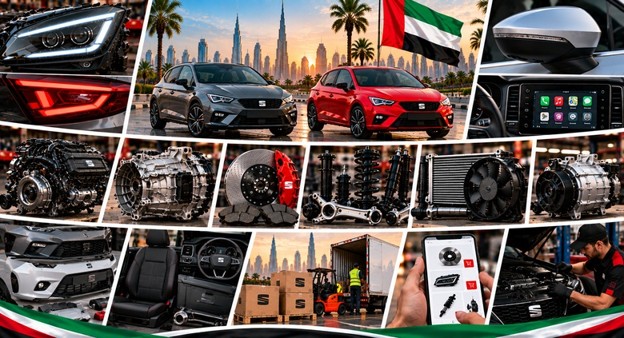
A headlamp assembly may include LED modules, control electronics, adjustment systems or other equipment depending on specification.
Two lamps can have the same shape and completely different electrical arrangements.
For a used headlamp, request photographs of the label, connectors, mounting tabs and actual lens condition.
Tail lamps also vary by generation
LED signatures, wiring connectors, mounting points and body style can differ between Leon generations.
For the Ibiza, three-door, five-door and other body configurations across different generations further complicate casual matching.
The vehicle's production period should be supplied with the request.
Mirrors are more complicated than they look
A replacement door mirror may contain heating, electric adjustment, folding motors, indicators, cameras or blind-spot-related equipment depending on specification.
If the mirror is being bought used, ask exactly what functions are included.
A bare mirror shell is not equivalent to a complete powered assembly.
Bumpers should be checked against equipment
Parking sensors, cameras, headlamp washers and trim packages can alter bumper configuration.
A used bumper can therefore be physically correct but electronically or cosmetically incomplete.
Ask whether brackets, grilles, sensor holders and other attached pieces are included.
Radiator fans and HVAC fans need electrical matching
Fan assemblies differ in motor specification, connector arrangement and control method.
A fan that physically fits may still be electrically wrong.
If the original unit has a visible label, photograph it before requesting prices.
ECUs and control modules need coding consideration
An ECU is not simply a replacement computer.
Part number, software version, immobiliser relationship, engine configuration and vehicle coding can all matter.
SEAT's own workshop information highlights specialist electronic diagnosis as part of its service process.
That is why a used module should be purchased with programming requirements understood beforehand.
Infotainment units can be vehicle-specific
A replacement screen or head unit may look identical while having different software, connectors, navigation capability or vehicle integration.
For later Leon and Ibiza models, connected services and infotainment availability can also vary according to production period and equipment. SEAT explicitly warns that connected-service availability depends on model, infotainment, production period and vehicle equipment.
That makes VIN and part-number checking particularly useful.
Sensors should be replaced only after diagnosis
Temperature, pressure, oxygen, boost and other sensors can produce overlapping symptoms.
Before buying one, identify the diagnostic code, inspect wiring and connectors and establish whether the measured value is actually implausible.
Otherwise the owner can end up replacing a perfectly good sensor while the underlying wiring or mechanical problem remains.
Genuine, aftermarket and used parts each have a place
There is no universal rule that every SEAT part should be genuine.
For a complicated electronic module or specification-sensitive component, genuine may offer useful certainty.
For routine service parts, a reputable aftermarket component can be perfectly reasonable when the specification is correct.
For an older Leon body panel or discontinued mechanical assembly, a good used genuine component can make more economic sense.
The important word is good.
Used engines need evidence, not optimism
A used engine should come with as much traceable information as possible: engine code, donor vehicle, mileage where available, photographs, known condition, test information and warranty.
A compression test can provide useful evidence on a used combustion engine, but it is only one part of the assessment. Oil contamination, coolant contamination, leak-down behaviour, turbo condition, crankcase pressure and external leaks can all matter.
A number printed on a seller's message is not an engine inspection.
Used gearboxes should be treated separately
Ask for the gearbox code and donor information.
For automatic or DSG units, ask whether the transmission has been tested and whether adaptation, coding or other post-installation procedures will be required.
For a manual gearbox, inspect casing damage, shafts, mounting points and evidence of oil leakage.
Do not assume that “tested” means the same thing from every supplier. Ask what was actually tested.
PartFinder UAE can help with supplier comparison
When you already know the required component, using PartFinder UAE to request and compare supplier quotations can make the sourcing stage more practical. Its UAE platform includes new, used, genuine and aftermarket options and lists coverage across locations including Dubai, Sharjah and Abu Dhabi.
The useful comparison is not simply AED 500 versus AED 700.
It is:
same part number + same condition + same specification + same warranty + same delivery terms.
Only then is the price comparison meaningful.
Dubai, Sharjah and Abu Dhabi are one sourcing market
For a buyer, the correct component does not become incorrect because it sits in another emirate.
A Dubai owner can reasonably source a part from Sharjah. An Abu Dhabi owner may find the right used gearbox elsewhere in the UAE.
What matters is whether the seller can provide the right component, whether delivery is practical and whether the warranty or return arrangement is clear.
UAE heat matters most when evaluating condition
Heat and heavy air-conditioning use can be relevant when assessing batteries, cooling components, electrical equipment, rubber parts and HVAC components.
But avoid the lazy assumption that every failed SEAT part is a “UAE heat problem”.
The workshop still needs to establish the actual failure.
That distinction keeps the repair evidence-based rather than turning climate into an explanation for everything.
Before You Click Buy
Have the VIN ready.
Have the engine code if you're buying an engine or engine-related component.
Have the gearbox code if you're buying a transmission.
Photograph the old part number.
Confirm the production year and generation.
Ask whether the quoted item is new, genuine, aftermarket, used or reconditioned.
If used, ask about donor mileage and testing.
For electronics, ask whether coding or programming is required.
For bodywork, check paint code, trim and mounting points.
For major mechanical parts, confirm exactly what the price includes.
And get the warranty and return terms before payment.
That sounds like a lot of checking.
It is.
But it is still less work than installing the wrong gearbox.
The cheapest replacement part is not necessarily the cheapest repair
Suppose a used alternator is AED 400 and a new alternative is AED 700.
The used unit may be the sensible choice if it has been tested, carries a useful warranty and matches the original part number.
But if it fails shortly after installation and the workshop has to remove and refit another unit, the original AED 300 saving becomes much less impressive.
For major components, compare total repair cost, not just the part price.
A practical Leon and Ibiza buying matrix
| Replacement part | What to verify first | Used-part caution |
| Engine | Engine code, VIN, generation, fuel type | Donor history, compression/testing, inclusions |
| Gearbox | Transmission code, engine pairing, drivetrain | Donor mileage, testing, adaptation |
| ECU | Part number, software, VIN compatibility | Coding/immobiliser requirements |
| Headlamp | Generation, lighting type, part number | Lens, mounts, modules, connectors |
| Brake discs | Axle, diameter, thickness, brake package | Avoid unknown-wear used components |
| Brake pads | Axle and brake system | Generally better sourced new |
| Suspension arm | Axle, dimensions, bush/ball-joint configuration | Inspect bends and bush condition |
| Alternator | Output, pulley, connector, part number | Test charging/regulator |
| AC compressor | Compressor number, engine, system condition | Check contamination and compressor condition |
| Bumper | Generation, body style, sensors/camera | Check tabs, brackets and attached trim |
| Mirror | Functions and connector | Verify folding, heating, indicator/camera equipment |
| Cooling fan | Motor and connector specification | Test motor and controller |
What a good workshop should test before ordering
A competent diagnosis should leave you with more than a part name.
For a misfire, you want evidence about ignition, fuelling, compression and wiring.
For an overheating complaint, you want cooling-system evidence.
For a gearbox fault, you want diagnostic codes, fluid condition, adaptation behaviour and mechanical assessment where appropriate.
For an electrical module, you want communication and fault-code information.
That makes the online parts search far more precise.
Leon and Ibiza owners should keep their old part until fitment is confirmed
This sounds mundane, but it is useful.
Keep the old sensor, module, lamp, alternator or other component until the replacement has been checked.
The label can contain information that was missing from the original online request. The connector can reveal a variation. Mounting points can expose a mismatch before installation.
Once the old component has been thrown away, that evidence is gone.
Common replacement parts worth keeping on your search list
For the SEAT Leon, common searches can include:
- brake pads and discs
- wheel bearings
- control arms and bushes
- shock absorbers
- engine mounts
- ignition coils and spark plugs
- filters
- alternators and starters
- cooling components
- AC compressors
- headlights and tail lamps
- ECUs and sensors
- clutch assemblies
- manual and DSG-related components
- used engines and gearboxes
For the SEAT Ibiza, the same broad categories appear, but the actual component depends heavily on generation and engine. That is why an Ibiza 1.4 from the early 2000s and a 1.0 TSI from a later generation should never be treated as one generic parts application. SEAT's own technical documentation demonstrates the breadth of engine and transmission variation.
The useful distinction: replacement part or replacement assembly?
Sometimes only one component has failed.
Sometimes the assembly is worn enough that replacing the complete unit is more sensible.
A worn clutch plate does not automatically mean a complete gearbox.
A failed thermostat does not automatically mean a complete cooling system.
A damaged ECU does not automatically mean replacing every related sensor.
But an engine with serious internal damage may make a tested replacement assembly economically sensible.
The diagnosis should decide the scale of the purchase.
FAQs
Categories
- Audi
- BMW
- Car Accessories
- Car Tips
- Ford
- Land Rover
- Mazda
- Range Rover
- Top 10
- UAE Car Parts
- Used Car Parts
- Toyota
- Replacement Engines
- Nissan
- Hyundai
- Mitsubishi
- Volkswagen
- Honda
- Kia
- Chevrolet
- Dodge
- Jeep
- Subaru
- Renault
- Lexus
- Mercedes
- Suzuki
- Hummer
- Porsche
- Infiniti
- Peugeot
- GMC
- Mini
- Volvo
- Replacement Gearboxes
- MG
- Jaguar
- Skoda
- Cadillac
- Daihatsu
- Fiat
- German Car Parts
- Japanese Car Parts
- Aftermarket Car Parts
- Genuine Car Parts
- New Car Parts
- Reconditioned Car Parts
- European Car Parts
- American Car Parts
- Korean Car Parts
- British Car Parts
- Chinese Car Parts
- Sports/Exotic Car Parts
- Luxury Car Parts
- Performance Car Parts
- SUV/4x4 Spare Parts
- Truck Spare Parts
- EV Car Parts
- Hybrid Car Parts
- Auto Spare Parts in UAE
- Tesla
- Isuzu
- Ram
- Ferrari
- Bentley
- Lamborghini
- Genesis
- Maserati
- Lincoln
- Chrysler
- Opel
- Citroen
- SsangYong
- Seat
- McLaren