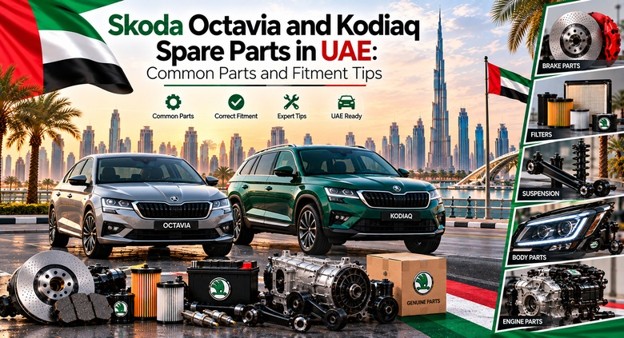
Skoda Octavia and Kodiaq Spare Parts in UAE: Common Parts and Fitment Tips
September 22, 2026
A Skoda Octavia and a Skoda Kodiaq can look like relatively straightforward cars to buy parts for. They are not. The badge tells you the family; it does not tell you the exact brake setup, transmission, drivetrain, sensor arrangement, suspension specification, engine code or even which revision of a particular part your car needs.
That distinction matters in the UAE because the current Octavia and Kodiaq sold locally sit alongside older imported, GCC-spec and used examples. The current UAE Octavia uses a 1.4 TSI producing 150 hp and 250 Nm with an 8-speed automatic and front-wheel drive, while the current Kodiaq is offered with 1.4 TSI and 2.0 TSI versions, both using 7-speed DSG transmissions; the 1.4 is front-wheel drive and the 2.0 is four-wheel drive.
So when someone says, “I need Octavia brake pads”, the sensible response is not immediately “which brand?” It is: which Octavia, which year, which engine, which brakes, which VIN?
Start With the Exact Car
Why the model name is not enough
Octavia is a model family, not a single mechanical specification. The same is true of Kodiaq.
A 2025 UAE-market Octavia can have a different transmission and electronic equipment from an older Octavia brought into Dubai as a used import. Kodiaq is even more obvious: the current UAE model has both 1.4 TSI and 2.0 TSI engines, with different drivetrain arrangements.
That means a parts listing saying simply “Skoda Octavia 2019–2025” deserves another question before you click Buy.
Current UAE Octavia fitment
The current UAE Octavia is listed with a 1.4 TSI petrol engine producing 150 hp and 250 Nm, an 8-speed automatic transmission and front-wheel drive. Škoda's UAE launch information also identifies Essence, Selection, Sportline and RS trims for the regional model range.
The RS is a different proposition. The UAE launch information identifies the RS with a 2.0 TSI producing 265 hp, so its braking, suspension and engine-related parts should never be assumed to match the standard 1.4 TSI simply because both cars carry the Octavia name.
Current UAE Kodiaq fitment
The current UAE Kodiaq is a seven-seat SUV and is offered with a 1.4 TSI making 150 hp and 250 Nm or a 2.0 TSI making 190 hp and 320 Nm. Both use a 7-speed DSG, but the 1.4 is front-wheel drive while the 2.0 uses four-wheel drive.
That drivetrain difference becomes particularly important when buying suspension, driveshaft, transfer-system, rear differential or AWD-related parts.
Model year matters more than people expect
A parts seller may group several model years into one search result because many parts overlap. That does not mean everything fits.
Facelift changes, revised electronic modules, brake options, trim equipment and engine/transmission revisions can quietly alter fitment. For a simple oil filter this may not cause trouble; for a headlamp, control module or transmission part, it can become an expensive mistake.
GCC-spec versus imported Octavia and Kodiaq
A UAE-registered car is not automatically a UAE-spec car.
Dubai and Sharjah have plenty of imported vehicles, including cars originally built for European, American or other markets. Cooling systems, lighting, emissions equipment, software configuration and equipment levels can vary.
Before buying major Skoda spare parts in UAE, check the VIN and the vehicle's original specification rather than relying only on its current registration location.
The fitment information worth sending
For most parts, give the seller as much of this information as possible:
| Information | Why it matters |
| VIN/chassis number | Identifies the exact vehicle |
| Model year | Separates revisions and generations |
| Engine size/code | Prevents engine-specific mismatch |
| Transmission type | Important for gearbox, clutch and drivetrain parts |
| FWD/4x4 | Critical for Kodiaq drivetrain parts |
| Trim/RS/Sportline | Can affect brakes, suspension and electronics |
| Existing part number | Helps confirm the physical part |
| Photograph | Useful as a secondary visual check |
A good listing should become more specific as the part becomes more expensive or electronically complicated.
The Parts Owners Replace Most Often
Brake pads and discs
Brake parts are among the most common Octavia and Kodiaq replacements, but they are also among the easiest to order incorrectly.
Disc diameter, thickness, caliper arrangement and pad shape can differ by engine, trim and axle. The Octavia RS is the obvious example: its performance-oriented specification means its braking hardware should be treated separately from the ordinary Octavia range.
Do not order pads from a photograph alone.
Filters
Oil, air, cabin/pollen and fuel filters are comparatively simple purchases, but they still need proper fitment.
The UAE climate makes filtration particularly important. Fine dust, construction activity and heavy traffic can put more pressure on air filtration than a casual owner might realise. Škoda itself lists filters among its Genuine Parts categories and explains that filter design is intended to control debris entering the engine.
Spark plugs
Spark plugs are small enough to look harmless. They are not something to guess at.
Engine generation, heat range, electrode design and specification matter. A plug that physically screws into the cylinder head is not necessarily the correct plug for the engine.
For a current 1.4 TSI, use the VIN and engine specification rather than assuming every 1.4 TSI across the wider Škoda/VW family uses an identical plug.
Suspension parts
Kodiaq suspension parts can become more complicated because of its size, seven-seat configuration and available chassis equipment. The UAE range also includes higher trims with equipment such as adaptive chassis control.
Octavia suspension is similarly sensitive to trim and chassis specification, particularly where Sportline or RS equipment is involved.
When buying dampers, springs or related hardware, confirm whether the car has standard or electronically controlled suspension.
Engine cooling parts
Radiators, thermostats, coolant pumps, hoses, expansion tanks and cooling fans all deserve exact fitment checks.
A UAE summer exposes cooling faults quickly. An engine that behaves perfectly during a mild morning drive can reveal a marginal cooling problem after sitting in Dubai traffic with the air conditioning working hard.
That does not mean every overheating complaint needs a new radiator. It means the diagnostic process needs to establish what actually failed.
Batteries
Modern Škoda vehicles can have more electrical demand than an older family car, particularly with extensive driver-assistance, infotainment and convenience systems.
Battery replacement should therefore consider battery technology, capacity and vehicle configuration rather than simply matching physical dimensions.
If the car has battery-management requirements, the workshop should also verify whether registration or adaptation is required after installation.
Octavia-Specific Buying Decisions
Octavia 1.4 TSI engine parts
The current UAE Octavia's 1.4 TSI is listed at 150 hp and 250 Nm, with an 8-speed automatic and front-wheel drive.
For engine-related purchases, confirm the exact engine identification first. Oil filters, spark plugs, ignition coils, sensors, belts, cooling parts and engine mounts can all depend on the precise engine version.
This is where a generic “1.4 TSI” search becomes too broad.
Octavia RS parts
The RS deserves its own parts trail.
The current regional RS uses a 2.0 TSI producing 265 hp. Its performance specification means brake discs, pads, suspension parts, wheels and certain engine-related items should not be casually mixed with the standard Octavia.
If a listing says “fits all Octavia”, ask the seller to confirm the RS specifically.
Octavia headlights
Headlights can become expensive because modern lighting assemblies are not merely pieces of plastic with bulbs inside.
Depending on specification, they may contain control electronics, LED modules and systems that interact with the vehicle's wider electronics. Škoda notes that authorised service centres can handle precision alignment of adaptive headlights and radar systems.
For an expensive headlamp, matching the physical shape is nowhere near enough.
Octavia infotainment parts
Infotainment screens, display units, head units, control modules and connectivity hardware should be bought only after confirming exact part-number compatibility.
A used screen that looks identical may have different software, connector configuration or vehicle coding requirements.
Ask for the part number printed on the original unit and, where possible, the donor vehicle's VIN.
Octavia sensors and cameras
Parking sensors are relatively manageable. Cameras and driver-assistance sensors are another story.
A replacement camera may need calibration or coding after installation. Škoda specifically states that radar and sensor calibration can be among the more complex operations for which authorised service facilities are equipped.
The cheapest physical part is not always the cheapest completed repair.
Octavia body parts
Bonnet, wing, door, mirror, grille and bumper purchases should be checked against generation and facelift status.
For a bumper, also check whether the vehicle has parking sensors, radar openings, headlamp washers or other equipment.
A painted bumper that fits physically but lacks the correct sensor openings is not a successful purchase.
Kodiaq-Specific Buying Decisions
Kodiaq 1.4 TSI parts
The current UAE Kodiaq 1.4 TSI produces 150 hp and 250 Nm and uses a 7-speed DSG with front-wheel drive.
This is important because a Kodiaq 1.4 is not simply a smaller-engine version of the 2.0. The drivetrain configuration changes the parts catalogue you need to work from.
Kodiaq 2.0 TSI parts
The UAE Kodiaq 2.0 TSI produces 190 hp and 320 Nm, with a 7-speed DSG and 4x4 drivetrain.
That means parts around the rear drivetrain and all-wheel-drive system need particular care. A front-wheel-drive part listing should not be treated as interchangeable simply because the engine displacement appears similar.
Kodiaq suspension and chassis equipment
The current UAE Kodiaq range includes versions with adaptive chassis control, and the higher specification can also include larger wheels and additional equipment.
For suspension purchases, give the seller the full vehicle specification.
A Kodiaq fitted with electronically controlled dampers is not a sensible candidate for a blind purchase based on model name and year alone.
Kodiaq seven-seat body parts
The Kodiaq's seven-seat layout makes it particularly useful for family ownership, but it also means buyers should be precise when ordering interior and trim parts.
Third-row seat components, interior panels, cargo-area trim and seat mechanisms can vary by equipment level.
If buying used interior parts, ask for photographs from several angles rather than relying on one catalogue image.
Kodiaq tailgate parts
Power-operated tailgates contain motors, latches, switches and electronic controls.
If the tailgate stops working, replacing the entire mechanism without diagnosis can be wasteful.
For a used replacement, confirm whether the donor vehicle had the same powered-tailgate configuration and whether the replacement includes the required motor, latch or control unit.
Kodiaq cameras and driver assistance
The UAE Kodiaq specification includes systems such as 360-degree camera functionality, lane-keeping assistance and rear traffic-related systems on relevant trims.
This makes accident-repair sourcing more complicated than buying a conventional bumper.
If a front-end repair affects cameras, radar or sensor mounts, the workshop needs to verify alignment and calibration after installation rather than simply clearing the dashboard warning.
Genuine, OEM, Aftermarket and Used
Genuine parts
Škoda describes Genuine Parts as parts developed and tested for its vehicles, and its official service information identifies compatibility and testing as key reasons for using them.
For safety-critical, electronically complex or difficult-to-source parts, buyers may reasonably place more importance on traceability and exact fitment.
OEM is not automatically the same as Genuine
“OEM” is often used loosely in the spare-parts trade.
A seller calling something OEM does not, by itself, prove that the part is identical to the factory-supplied item or appropriate for your exact vehicle.
Ask what the seller means by OEM and request the actual manufacturer or part number where relevant.
Aftermarket parts
Aftermarket can mean many different things.
There are established manufacturers producing replacement parts to recognised specifications, and there are also very cheap products where documentation is thin.
For filters, suspension consumables and other routine items, an established aftermarket alternative may be entirely practical. For sensors, electronics or safety-related parts, the consequences of poor fitment can be much greater.
Used genuine parts
Used parts can make financial sense when the original part is expensive and the donor vehicle is properly documented.
Headlights, body panels, wheels, interior trim, mirrors and certain mechanical parts can all be candidates.
The important distinction is between used and unknown. A used part with a known donor vehicle, visible part number and clear photographs is a different proposition from a part sitting anonymously on a shelf.
Reconditioned and exchange parts
Škoda's own parts programme includes factory-reconditioned Exchange Parts, alongside Genuine Parts and Economy Parts.
That is useful context because “reconditioned” should not automatically be interpreted as poor quality.
The critical questions are who rebuilt the part, what was replaced, what was tested and what warranty is provided.
The practical buying matrix
| Part | New Genuine | Quality aftermarket | Used genuine | Reconditioned |
| Brake pads | Strong option | Often practical | Usually not preferred | Not normally relevant |
| Headlamp | Strong option | Depends heavily on quality | Can make sense | Sometimes |
| Body panel | Useful | Often practical | Often economical | Rare |
| ECU/module | Preferred where possible | Requires caution | Possible with coding checks | Specialist route |
| Gearbox | Expensive | Limited choice | Possible with history | Can be worthwhile |
| Suspension | Strong option | Often practical | Condition-dependent | Depends on part |
| Interior trim | Expensive | Limited | Often sensible | Rare |
| Radiator | Strong option | Established aftermarket can work | Condition-dependent | Rare |
The right choice changes with the part. There is no universal “genuine is always better” purchasing formula, nor is cheap aftermarket automatically good value.
The VIN and Part Number Problem
VIN should be your starting point
If the part is expensive, complicated or safety-related, provide the VIN before payment.
This is particularly important for Octavia and Kodiaq because the same model family can contain different engines, transmissions, trims and electronic systems.
A VIN match is stronger evidence than a generic marketplace compatibility badge.
Read the existing part number
If the old part is accessible, photograph its label.
Part numbers can contain the information needed to identify a particular revision, and Škoda itself notes that genuine packaging should carry a part number.
Do not remove a part number from the buying decision simply because a seller says the new part “looks the same”.
Superseded part numbers
Manufacturers sometimes replace an old part number with a newer revision.
That does not automatically mean the newer number is wrong. It can mean the original part has been superseded.
Ask the seller to confirm that the newer number is the official replacement for your original number and, ideally, that the VIN catalogue supports it.
Photograph matching has limits
A photograph is useful for spotting obvious differences: connector positions, mounting holes, physical shape and sensor openings.
It is not proof of compatibility.
Two electronic modules can look virtually identical and still require different coding or software.
Connector checks
For sensors, lights, modules, pumps and electronic assemblies, compare connector type and pin arrangement.
But even that is only one layer of verification.
A matching plug does not necessarily mean identical calibration, communication protocol or software configuration.
Keep the old part until fitment is confirmed
This is simple and surprisingly useful.
Do not throw away the old part immediately after delivery. Keep it available until the replacement has been physically inspected and the workshop confirms that the new part matches.
It gives you something tangible to compare against if a dispute arises.
Buying Online in the UAE
Where to find the part
For routine parts, online marketplaces and established UAE parts channels can broaden availability beyond a single physical shop.
For unusual Octavia or Kodiaq parts, online searching can also make it easier to compare new, used and aftermarket availability.
PartFinder UAE can be useful as part of that search process, particularly when the buyer already knows the required model and fitment information.
Which option should you buy?
Do not begin with price.
Begin with the role of the part.
A cabin filter and an engine control module do not deserve the same buying strategy. Neither does a bumper and a brake caliper.
The more expensive the installation and the greater the consequence of failure, the more valuable proper traceability becomes.
Ask for a complete quotation
“Part price” is not the same as “repair price”.
A UAE workshop quotation can involve the part, delivery, labour, diagnostic time, programming, calibration, fluids, seals, clips and supporting parts.
For an electronic part, coding may matter. For a cooling repair, coolant and additional seals may matter. For bodywork, paint and fitting can exceed the price of the bare panel.
Delivery time matters
A cheap part that takes several weeks to arrive may not be economical if the car is needed daily.
Ask whether the part is physically in UAE stock or being imported.
For Dubai-based buyers, a part available locally can produce a very different repair timeline from one requiring international shipping.
Dubai, Abu Dhabi and Sharjah buyers
Dubai usually offers broad access to parts, workshops and logistics, while Abu Dhabi has its own established service network and Sharjah has a large automotive aftermarket ecosystem.
But geography should not override fitment.
A perfect part in Sharjah is better than the wrong part delivered to your door in Dubai within two hours.
Smaller-emirate sourcing
Owners in Ajman, Ras Al Khaimah, Fujairah or Umm Al Quwain may rely more heavily on delivery when a specialist part is required.
That makes the initial VIN and part-number verification even more valuable because returning an incorrectly supplied electronic module or large body part can be inconvenient and expensive.
What the Workshop Should Actually Check
Do not diagnose from the failed part alone
A failed part is sometimes a symptom, not the original cause.
If an alternator has failed, for example, the workshop should consider the charging system rather than simply fitting another alternator.
If a coolant pump has failed, check the surrounding cooling system.
If a suspension arm is worn, inspect alignment and adjacent bushes.
Scan electronic faults before ordering modules
A diagnostic scan should precede many expensive electronic purchases.
Fault codes can narrow the investigation, although a stored code does not automatically prove that the associated part has failed.
Live data, wiring checks, power supply and physical inspection may still be required.
Check wiring and connectors
UAE heat, age, previous accident repairs and engine-bay work can all expose wiring and connectors to stress.
Before replacing a sensor, inspect the connector and harness.
It is frustratingly easy to spend hundreds of dirhams on a sensor when the real issue is a damaged wire.
Check brakes as an axle system
When replacing brake discs or pads, inspect the complete axle.
Check disc condition, pad wear, caliper movement, sliders, hoses and tyre condition.
If one side is behaving differently, simply replacing both pads without finding the reason can leave the underlying problem untouched.
Check suspension geometry
If the Octavia pulls to one side or the Kodiaq develops uneven tyre wear, do not assume a new suspension part will automatically solve it.
Inspect bushes, arms, ball joints, dampers and wheel alignment.
A new part installed onto a vehicle with poor geometry can become another expensive half-solution.
Calibrate after relevant repairs
Modern driver-assistance systems make post-repair calibration increasingly important.
Škoda specifically notes that radar and sensor calibration can require specialist equipment and expertise.
After front-end, windscreen, suspension or sensor-related work, ask the workshop whether calibration is required for the specific repair.
UAE Ownership Reality
Heat changes the maintenance conversation
The UAE climate is hard on batteries, cooling systems, air-conditioning hardware, rubber components and some electronic equipment.
That does not mean a particular part will fail merely because the car is in Dubai. It means environmental conditions should be considered alongside mileage and age.
A low-mileage car that spent years parked outdoors is not necessarily mechanically “young”.
Traffic matters too
An Octavia used for long motorway journeys has a different operating pattern from one spending hours crawling through Dubai traffic.
Kodiaq owners carrying seven people, luggage and using the vehicle heavily in urban traffic may place different demands on brakes, tyres, cooling and suspension.
Mileage alone cannot tell the whole story.
The UAE air-conditioning burden
Air conditioning is not optional here.
Compressor, condenser, blower, cabin-filter and cooling-system condition therefore deserve more attention than they might in a mild climate.
If the air conditioning is weak, do not immediately buy a compressor. Check refrigerant condition, pressures, condenser airflow, electrical control and temperature performance first.
Dust and filtration
A dirty air filter is not just a cosmetic maintenance issue.
Restricted airflow can affect engine breathing, while an overloaded cabin filter can reduce ventilation performance.
For UAE vehicles frequently driven around construction zones or dusty roads, filter inspection should be part of sensible routine maintenance.
Used-import inspection
For an imported Octavia or Kodiaq, ask for evidence of its original market, service history and previous repairs.
Check whether the engine, transmission, cooling system and electronics correspond with the specification being advertised.
If the seller cannot explain why the vehicle has an unusual part configuration, stop before ordering expensive replacements.
Keep a parts record
A simple digital folder containing invoices, part numbers, workshop reports and photographs can become surprisingly valuable.
When the car needs another repair two years later, the previous part number may immediately answer a question that would otherwise require another inspection.
It also gives the next workshop useful history.
Before You Click Buy
The five-minute fitment check
Before paying for an Octavia or Kodiaq part, verify:
| Check | Confirm |
| Vehicle | Exact model and generation |
| Year | Production/model year |
| Engine | Exact engine specification |
| Transmission | Automatic/DSG and relevant type |
| Drivetrain | FWD or 4x4 |
| Part number | Existing and replacement numbers |
| VIN | Seller has checked it where necessary |
| Condition | New, used, reconditioned or aftermarket |
| Warranty | Written terms |
| Return policy | Especially for electrical parts |
| Installation | Labour, coding or calibration |
| Delivery | UAE stock or imported |
It takes longer than clicking “Buy now”. It can also save considerably more than it costs.
Questions to ask a used-parts seller
For a used Octavia or Kodiaq part, ask for the donor model, donor year, mileage if known, VIN or at least vehicle identification, exact part number, photographs of labels and confirmation that the part was tested.
For an engine or gearbox, request considerably more information: compression or diagnostic evidence where appropriate, oil condition, operating history, mileage documentation, warranty conditions and what exactly is included in the sale.
Questions to ask an aftermarket seller
Ask who manufactured the part, what specification it follows, whether it is a direct replacement and what warranty applies.
“German quality” or “European standard” is not enough evidence by itself.
You want a manufacturer, catalogue reference and fitment basis.
Warranty red flags
Be cautious when a seller says:
- no returns under any circumstances
- electrical parts cannot be checked
- exact part number is unnecessary
- VIN verification is impossible
- warranty applies only before installation
- used parts are sold without condition information
- the seller cannot identify the donor vehicle
Some restrictions may be commercially legitimate, but they should be clearly explained before payment.
The repair-cost decision
Before choosing a part, calculate the complete repair, not just the advertised item.
| Cost item | Example question |
| Part | What is the actual purchase price? |
| Delivery | Is UAE delivery included? |
| Labour | How many workshop hours? |
| Diagnostics | Is testing charged separately? |
| Coding | Required for this part? |
| Calibration | Required after installation? |
| Fluids | Any coolant, oil or brake fluid needed? |
| Supporting parts | Seals, clips, bolts, filters? |
| Return risk | What happens if fitment is wrong? |
This is where a supposedly cheap part can become expensive.
The safest fitment habit
For an Octavia or Kodiaq, the most useful habit is also the least glamorous: verify first, buy second.
Use the VIN when the part is complicated, compare the old part number where possible, confirm the engine and transmission, distinguish FWD from 4x4 on Kodiaq, separate standard Octavia from RS specification, and make the workshop confirm whether coding or calibration is required.
Škoda's own service guidance reinforces the importance of trained technicians, specialist diagnostic equipment and correctly specified Genuine Parts, while its UAE service programme currently covers scheduled servicing for up to five years or 75,000 km, subject to its stated terms.
That matters because the right spare part is not simply the one that fits the hole. It is the one that matches the car, the specification, the job and the repair process.
FAQs
Categories
- Audi
- BMW
- Car Accessories
- Car Tips
- Ford
- Land Rover
- Mazda
- Range Rover
- Top 10
- UAE Car Parts
- Used Car Parts
- Toyota
- Replacement Engines
- Nissan
- Hyundai
- Mitsubishi
- Volkswagen
- Honda
- Kia
- Chevrolet
- Dodge
- Jeep
- Subaru
- Renault
- Lexus
- Mercedes
- Suzuki
- Hummer
- Porsche
- Infiniti
- Peugeot
- GMC
- Mini
- Volvo
- Replacement Gearboxes
- MG
- Jaguar
- Skoda
- Cadillac
- Daihatsu
- Fiat
- German Car Parts
- Japanese Car Parts
- Aftermarket Car Parts
- Genuine Car Parts
- New Car Parts
- Reconditioned Car Parts
- European Car Parts
- American Car Parts
- Korean Car Parts
- British Car Parts
- Chinese Car Parts
- Sports/Exotic Car Parts
- Luxury Car Parts
- Performance Car Parts
- SUV/4x4 Spare Parts
- Truck Spare Parts
- EV Car Parts
- Hybrid Car Parts
- Auto Spare Parts in UAE
- Tesla
- Isuzu
- Ram
- Ferrari
- Bentley
- Lamborghini
- Genesis
- Maserati
- Lincoln
- Chrysler
- Opel