Subaru Spare Parts in UAE: Buyer’s Guide for Forester, Outback, Impreza, Legacy, WRX and BRZ

September 10, 2026
Subaru Spare Parts in UAE
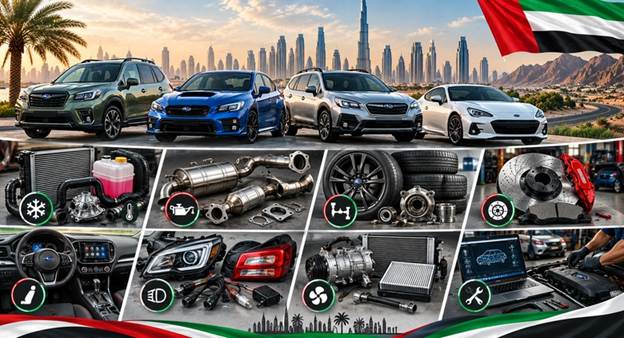
Subaru Spare Parts in UAE: What Owners Commonly Need
Subaru ownership in the UAE has one slightly awkward truth: the badge does not tell you enough about the part you need.
A Forester, Outback, Impreza, Legacy, WRX and BRZ may share engineering ideas, but that does not make their spare parts interchangeable. Engine code, model generation, transmission, drivetrain, production year and even equipment level can change the answer. A part that looks almost identical can still have a different connector, mounting point, ratio or specification.
And UAE driving adds its own punishment.
Heat. Dust. Long motorway runs. Stop-start traffic around Dubai and Sharjah. Air-conditioning running hard for much of the year. Speed humps, rougher road transitions and plenty of short urban trips. A Subaru used for daily commuting will not necessarily wear its parts in the same way as a BRZ used mainly at weekends.
The parts most commonly brought into UAE workshops tend to fall into familiar groups:
- Brake pads and discs
- Suspension bushes and control arms
- Shock absorbers
- Wheel bearings
- Batteries and charging-system parts
- Filters and spark plugs
- Belts and tensioners
- Cooling-system parts
- Sensors and ignition coils
- CV joints, driveshafts and axle parts
- Clutch and gearbox parts
- Engine seals and gaskets
- Headlights, mirrors and body panels
- Electrical modules and switches
But don't order from that list.
Use it to understand what may wear, not to decide what your car needs.
A Forester showing a coolant warning needs a cooling-system diagnosis. An Impreza with a misfire needs proper ignition, fuel and compression checks. A WRX with drivetrain vibration needs more than a quick glance underneath. And when a BRZ starts making a suspension noise, replacing the first bush someone points at can become an expensive guessing game.
For Subaru parts in the UAE, the practical starting point is simple: VIN, engine identification, transmission and original part number.
That combination removes a lot of uncertainty before the parts counter gets involved.
Subaru Forester Spare Parts: Common Replacement Needs
The Forester is probably the easiest Subaru to underestimate.
It looks like a practical family vehicle, and it is, but its combination of boxer engines, all-wheel drive, relatively tall suspension and regular family use means several different systems can accumulate wear at the same time.
Suspension is a common area to inspect. Control-arm bushes, ball joints, drop links, shock absorbers, wheel bearings and related hardware can gradually develop play or noise, particularly on vehicles that spend their lives crossing speed humps and uneven road transitions.
Then there is the cooling system.
In UAE conditions, don't ignore a small coolant leak simply because the temperature gauge has not moved yet. Radiators, hoses, thermostatic parts, water pumps and expansion-system parts should be checked properly when coolant loss appears.
Forester owners also commonly need:
- Brake pads and discs
- Air and cabin filters
- Spark plugs
- Ignition coils
- Batteries
- Belts and tensioners
- Wheel bearings
- CV joints and axle parts
- Sensors
- Suspension bushes
- Engine mounts
- Cooling-system parts
- AC-related parts
Older Foresters require another level of caution because age can matter as much as mileage. Rubber parts harden. Wiring repairs accumulate. Previous owners may have fitted non-standard parts. And an imported Forester can have a specification that differs from the version a workshop is accustomed to seeing.
For used parts, donor history matters too. A clean accident-damaged donor is one thing; a flood-exposed vehicle is a very different proposition, particularly for electrical parts.
Subaru Outback Spare Parts: Common Replacement Needs
The Outback tends to accumulate kilometres.
Family trips. Motorway commuting. Airport runs. Long journeys between emirates. Then somebody uses it for exactly what an Outback invites you to do—take the rougher route home.
That mileage eventually shows up in suspension, brakes, wheel bearings and drivetrain-related parts.
The Outback's larger body and equipment level also mean that some repairs can involve more than one supporting part. A worn suspension arm, for example, may come with tired bushes or associated hardware, while a drivetrain repair can expose worn seals, CV joints or mounts once everything is removed.
Common replacement areas include:
- Control arms and suspension bushes
- Shock absorbers and mounting parts
- Wheel bearings
- Brake pads and discs
- CV shafts and joints
- Engine mounts
- Cooling-system parts
- Batteries and alternators
- Filters and spark plugs
- Sensors
- AC parts
- Body and lighting parts
The important thing with an Outback is not to assume that “Subaru AWD” is enough information.
It isn't.
Transmission type, engine, generation and drivetrain specification should be confirmed before ordering drivetrain or transmission parts. Even apparently straightforward items can differ.
For UAE family owners, there is also a useful distinction between wear and neglect. A car with 180,000 km that has had suspension, cooling and transmission maintenance at sensible intervals may be a better parts-buying proposition than a 110,000 km example that has spent years being driven hard with little preventive maintenance.
Mileage tells you something.
Service history tells you much more.
Subaru Impreza Spare Parts: What Owners Replace Most
The Impreza covers a broad range of cars, so this is where parts shopping can go wrong quickly.
An ordinary naturally aspirated Impreza and a performance-oriented turbocharged variant should not be treated as the same mechanical package merely because the badge says Impreza.
The engine comes first.
Then the transmission. Then drivetrain specification. Then the production period.
Routine service parts are among the most common requirements on standard Impreza models: filters, spark plugs, belts, brake parts, batteries and ignition-related parts. Suspension wear also becomes increasingly noticeable as mileage rises, particularly through control-arm bushes, drop links, wheel bearings and shock absorbers.
Electrical diagnosis deserves patience. A warning light does not automatically mean the associated sensor has failed. Wiring, connectors, voltage supply and another upstream fault can produce the same symptom.
For UAE owners, a sensible Impreza parts check should therefore include:
- Engine code
- Transmission type
- VIN
- Original part number
- Existing part photographs
- Previous modifications
- Service history
That last point matters more with performance-oriented cars. An Impreza that has been modified may no longer have an entirely standard configuration, and ordering an original replacement without checking what has actually been fitted can create a rather awkward workshop discovery.
Nobody enjoys that moment.
Subaru Legacy Spare Parts: Common UAE Replacement Parts
The Legacy is another Subaru where age has become an important buying factor, particularly in the used UAE market.
Some owners focus heavily on mileage. I would look just as closely at rubber, seals, cooling parts, electrical connections and previous repair quality.
Older Legacy models can require suspension bushes, ball joints, wheel bearings, engine mounts, cooling-system parts, belts and tensioners as they accumulate years and kilometres. Brake parts and routine service items are more predictable, while electrical and body-related parts can become harder to source for particular generations.
Common Legacy parts include:
- Brake pads and discs
- Suspension bushes and arms
- Shock absorbers
- Wheel bearings
- Engine mounts
- Cooling hoses and radiator parts
- Thermostatic and water-pump-related parts
- Belts and tensioners
- Filters and spark plugs
- Sensors
- Alternators and starter motors
- AC parts
- Headlights and mirrors
- Interior switches and trim
The condition of an older used part matters enormously. A ten-year-old suspension part is not automatically a good purchase simply because it came from a genuine Subaru.
Rubber ages while sitting on a shelf too.
For Legacy body and interior parts, however, a clean used original can often be perfectly sensible when the alternative is an expensive new replacement, provided mounting points, colour, trim specification and condition are checked first.
Subaru WRX Spare Parts: Performance-Focused Replacement Needs
WRX parts need a different mindset.
Performance changes the consequences of a poor-quality part, and modifications make the compatibility question even messier. A WRX with an aftermarket intake, exhaust, intercooler, suspension setup or engine calibration may not respond well to the assumption that every replacement should simply return to factory specification.
Start with what is actually on the car.
Turbo-related parts deserve particular attention. Intake leaks, boost-control issues, cooling problems and sensor faults can overlap in their symptoms, so replacing a turbocharger because the car is losing power is not a diagnosis. It is an expensive guess.
The same applies to drivetrain complaints.
Clutch wear, flywheel condition, gearbox issues, differential behaviour, CV joints and driveshafts can produce symptoms that feel surprisingly similar from the driver's seat.
Common WRX replacement areas include:
- Turbo and intake-related parts
- Intercooler and charge-air parts
- Cooling-system parts
- Oil seals and gaskets
- Ignition coils and spark plugs
- Clutch kits
- Flywheels
- Gearbox-related parts
- Driveshafts and CV joints
- Brakes
- Shock absorbers
- Control arms and bushes
- Wheel bearings
- Sensors
UAE heat makes cooling even more important on a tuned WRX. More power means more heat to manage, and a car that survives a short spirited drive can still show a cooling weakness during prolonged summer use.
Before buying a major WRX part, establish whether the vehicle is factory standard, mildly modified or heavily modified.
That one question can save a very expensive mistake.
Subaru BRZ Spare Parts: Sports-Car Wear Areas
The BRZ is a different animal again.
It is lighter, lower and designed around handling, so suspension, tyres, brakes and clutch-related wear deserve more attention than they would on a typical family Subaru. A BRZ used for weekend driving may have relatively low mileage but still show accelerated wear if it has spent that mileage being driven aggressively.
Brake condition should be judged by actual wear and usage, not just the odometer.
Suspension needs the same treatment. Check bushes, ball joints, dampers, mounts and wheel bearings, while also looking at uneven tyre wear and alignment. A tyre wearing heavily on one edge may tell you something about the suspension or alignment that a quick visual inspection misses.
Common BRZ parts include:
- Brake pads and discs
- Calipers and braking hardware
- Shock absorbers
- Suspension bushes
- Control arms
- Wheel bearings
- Clutch kits
- Flywheels
- Gearbox-related parts
- Cooling parts
- Oil seals and gaskets
- Spark plugs and ignition parts
- Sensors
- Headlights and exterior body parts
There is another trap with BRZs: track use and modifications.
A car can look immaculate outside while carrying considerably more mechanical wear than its mileage suggests. Performance tyres, upgraded brakes, lowered suspension or engine modifications can also change which replacement parts are appropriate.
So when buying a used BRZ part, ask where it came from and what car it came off.
And when repairing your own BRZ, tell the workshop what has been modified. Don't make them discover it halfway through the job.
That conversation is much cheaper beforehand.
Mechanical Subaru Parts
Subaru Engine Parts: Boxer Engine Replacement Guide
Subaru's boxer engine layout gives these cars their character, but it also means you should be a little more careful when ordering engine parts. “It’s a Forester” is nowhere near enough information.
The engine code matters.
So does the generation, production period, turbocharged or naturally aspirated setup, and whether the car has been modified. A WRX engine cannot simply be treated like a Forester engine because both carry Subaru badges. Even within one model range, revisions can change sensors, seals, intake arrangements, cooling parts and other engine hardware.
Common Subaru engine-related replacement needs include:
- Engine mounts
- Head and valve-cover gaskets
- Oil seals
- Spark plugs
- Ignition coils
- Injectors
- Sensors
- Thermostatic parts
- Water pumps
- Radiators and cooling hoses
- Belts and tensioners
- Intake and charge-air parts
- Turbo-related parts
- PCV and crankcase ventilation parts
Oil leaks deserve proper diagnosis. A boxer engine showing oil around the lower engine area does not automatically mean the most expensive gasket has failed. Oil can travel, collect elsewhere and make the original leak difficult to identify.
The same caution applies to overheating. Check coolant level, pressure, hoses, radiator condition, thermostat operation, water-pump performance, fans and possible combustion-gas issues before ordering major parts.
For a used Subaru engine, ask for more than mileage. Confirm the engine code, donor vehicle, compression where appropriate, leak condition, oil and coolant condition, included ancillaries and warranty terms. A “complete engine” can mean very different things from one supplier to another.
Is the turbo included? Injectors? Alternator? Starter? Sensors? Wiring? Intake hardware?
Get that written down.
In the UAE, this matters because the labour bill can become substantial once an engine is removed. Saving money on the engine itself is not much of a victory if the workshop has to strip the replacement again to transfer missing parts.
Subaru Gearbox, Clutch and Transmission Parts
Transmission problems are notorious for producing expensive assumptions.
A strange noise does not automatically mean the gearbox is finished. A clutch that slips does not necessarily mean the entire transmission needs replacing. A warning message on a CVT-equipped Subaru should be diagnosed rather than treated as an automatic instruction to buy another gearbox.
Start with the transmission type.
Then identify the exact unit.
Manual Subaru models may require clutch kits, pressure plates, release bearings, flywheels, hydraulic parts, seals and related hardware. Automatic and CVT-equipped models bring different requirements, including transmission-specific service parts and electronic control considerations.
Common replacement areas include:
- Clutch kits
- Flywheels
- Release bearings
- Clutch hydraulic parts
- Gearbox mounts
- Driveshaft-related parts
- Transmission seals
- CVT service parts
- Transmission control-related parts
- Used or reconditioned gearboxes
- Differential-related parts
A worn clutch is relatively straightforward compared with a failed transmission, but there is still a trap: replacing the clutch while ignoring a damaged or heavily worn flywheel can leave the owner facing another removal job later.
Nobody wants to pay gearbox-removal labour twice.
Used gearboxes require even more checking. Confirm the transmission identification, donor model, donor mileage, drivetrain configuration and whether the unit has been tested. Ask what is included and whether fluid, seals or mounting hardware are supplied.
For UAE workshops, add downtime to the equation. A transmission that costs less but sits in transit for several days can become more expensive when the car is needed for work, family transport or daily commuting.
The cheapest gearbox is not necessarily the cheapest repair.
Subaru AWD and Drivetrain Parts: Differentials, CV Shafts and Axles
This is where Subaru ownership gets particularly interesting.
The all-wheel-drive system means drivetrain parts need to work together properly. A CV shaft, differential, driveshaft or axle is not just a generic metal tube that happens to bolt onto the car. Specification matters.
When sourcing these parts in the UAE, PartFinder UAE can be useful as part of the search process, but the exact vehicle specification still needs to be confirmed before ordering. VIN, model generation, engine, transmission and drivetrain details should all be checked, particularly for used drivetrain parts.
Common drivetrain replacement parts include:
- CV shafts
- CV joints
- Driveshafts
- Axles
- Differential parts
- Wheel hubs
- Wheel bearings
- Driveshaft centre-support parts where applicable
- Differential seals
- Mounts and associated hardware
A clicking noise during tight turns can point towards a CV-joint issue, while vibration under acceleration may involve a different part of the drivetrain altogether. Wheel-bearing noise can also be mistaken for tyre noise or general road noise, particularly at motorway speeds.
Diagnosis matters.
There is another issue worth taking seriously: tyre and drivetrain compatibility. Subaru owners should avoid casually mixing tyres with substantially different dimensions, wear levels or rolling characteristics, particularly on AWD vehicles. If the car has four mismatched tyres, the drivetrain deserves attention rather than simply fitting one replacement tyre and forgetting about it.
Modified WRX and BRZ-related setups need another check because suspension height, wheel fitment and aftermarket drivetrain work can alter how the car behaves.
When buying a used differential or driveshaft, verify the exact specification and donor vehicle. For a major drivetrain repair, the workshop should also inspect seals, mounts, CV boots and adjacent parts while access is available.
Replacing one failed part and ignoring the worn part beside it is false economy.
Subaru Suspension and Steering Parts in the UAE
Suspension wear usually announces itself quietly.
A knock over a speed hump. A steering wheel that no longer feels quite as settled. Uneven tyre wear. A car that wanders slightly on a straight road. Nothing dramatic at first, which is precisely why owners sometimes leave it too long.
Then the tyre wears badly.
Or another suspension part takes extra load.
Common Subaru suspension and steering parts include:
- Control arms
- Bushes
- Ball joints
- Drop links
- Shock absorbers
- Struts
- Top mounts
- Springs
- Tie rods
- Steering links
- Wheel bearings
- Hub assemblies
UAE roads create a fairly specific mixture of wear: frequent speed humps, kerb contact, hard road transitions and high temperatures that gradually age rubber bushes and other materials. A Forester or Outback doing thousands of kilometres of urban driving can therefore develop suspension wear quite differently from a low-mileage weekend BRZ.
Don't diagnose suspension from sound alone.
Put the car on a lift. Check for play. Inspect the bushes. Look at tyre wear. Check the dampers for leakage. Then check alignment if the symptoms point that way.
Used suspension parts can be tempting because they are often inexpensive, but rubber bushes and dampers have their own age-related deterioration. A used control arm may be perfectly usable; a tired old damper from an unknown donor is another story.
For WRX and BRZ owners, handling changes deserve particular attention. Aftermarket springs, coilovers, wheels and bushes can change the geometry and may require a different approach to replacement parts and alignment.
And after suspension work?
Get the alignment checked.
Skipping that small final step can eat a new set of tyres surprisingly quickly.
Subaru Brake Parts: Pads, Discs, Calipers and Sensors
Brakes are not the place for vague descriptions.
“Subaru brake pads” is not a sufficient order.
Front and rear systems can differ, while WRX and BRZ versions may have substantially different braking hardware from standard Forester, Outback, Impreza or Legacy applications. Disc diameter, caliper design, pad shape and wear-sensor arrangements all need confirmation.
Common brake parts include:
- Brake pads
- Brake discs
- Calipers
- Caliper repair parts
- Brake hoses
- Wear sensors where fitted
- Brake hardware
- Master-cylinder-related parts
- Parking-brake parts
The UAE climate adds heat to the equation. Heavy traffic, repeated braking and high ambient temperatures can create demanding operating conditions, particularly when a vehicle is driven aggressively or carries heavy loads.
Brake vibration should also be investigated rather than automatically blamed on “warped discs”. Disc condition, pad deposits, caliper operation, hub condition, wheel installation and other factors can contribute to steering-wheel or pedal vibration.
For a WRX, performance use changes the conversation again. Track or spirited driving can consume pads and discs much faster than ordinary commuting, and a higher-performance brake setup may require matching supporting hardware.
For a normal Forester or Outback, meanwhile, the sensible answer may simply be a quality brake pad and disc combination that suits the vehicle's specification and daily use.
The part price is only one line on the invoice.
Add fitting, cleaning, hardware, wear sensors where required and any necessary inspection or follow-up work before deciding which option is genuinely cheaper.
Subaru Cooling and Air-Conditioning Parts
In the UAE, cooling is not a background system.
It is working.
And during summer, it is working hard.
A Subaru's cooling system has to remove engine heat while the air-conditioning system is being used heavily, often during slow traffic when natural airflow through the radiator is limited. That makes cooling-system condition particularly important on Forester, Outback, Legacy and performance-oriented WRX models.
Common cooling parts include:
- Radiators
- Thermostats
- Water pumps
- Cooling hoses
- Expansion tanks
- Radiator caps
- Cooling fans
- Fan-control parts
- Temperature sensors
- Related seals and clamps
Air-conditioning parts commonly include:
- AC compressors
- Condensers
- Evaporator-related parts
- AC fans
- Pressure sensors
- Hoses and pipes
- Seals
- Control parts
The big mistake is replacing the obvious part without finding out why the system failed.
A coolant leak could come from a hose, radiator, thermostat housing, water pump or connection. A weak AC system could be caused by refrigerant loss, condenser damage, a pressure issue, airflow restriction, electrical control or compressor failure.
So if a compressor is noisy, don't immediately order a compressor.
Check the system.
If a radiator is leaking, inspect the hoses and surrounding fittings while the system is open.
And if a cooling fan isn't operating, establish whether the fan motor itself is faulty or whether the electrical control feeding it has failed.
That diagnostic discipline becomes especially valuable on a WRX, where additional heat from turbocharged performance driving leaves less room for a neglected cooling problem.
For UAE owners, preventive inspection is cheap compared with an overheating engine or an AC failure in August traffic. The warning signs may start small: coolant smell, falling coolant level, temperature fluctuation, weak airflow or an AC system that gradually stops performing as it used to.
Catch it early.
The workshop bill is usually much friendlier that way.
Electrical, Service and Body Parts
Subaru Electrical Parts: Batteries, Alternators, Sensors and Modules
Subaru electrical faults can be wonderfully misleading.
One warning light becomes three. The starter turns slowly. The dashboard suddenly looks busy. Then someone says, “Probably the sensor.”
Maybe.
Or maybe the battery is weak.
This is especially relevant in the UAE, where high temperatures can shorten battery life while heavy air-conditioning use, traffic and repeated short journeys put additional demand on the electrical and charging system. A battery that seems fine during one workshop test can still become unreliable under real starting conditions.
Common Subaru electrical parts include:
- Batteries
- Alternators
- Starter motors
- Ignition coils
- Sensors
- Control modules
- Relays
- Switches
- Wiring and connectors
- Lighting modules
- Window and door electrical parts
A proper diagnosis should establish whether the problem is actually the part named by the fault code. A sensor code, for example, can sometimes be linked to wiring damage, poor electrical supply, connector corrosion or another underlying issue.
That matters even more with older Forester, Outback, Impreza and Legacy models, where previous repairs may have left behind repaired wiring, non-standard connectors or aftermarket electrical equipment.
WRX owners should be particularly careful if the car has been modified. Additional electronics, lighting, audio equipment or engine-management changes can complicate fault diagnosis.
Used electrical parts can be good value, but ask where the part came from and whether it has been tested. For control modules, physical fitment is only the beginning; the correct specification, communication compatibility and possible coding or programming requirements should be confirmed before purchase.
And don't forget the alternator.
A new battery cannot fix a charging system that isn't charging properly. It will only postpone the same problem.
Subaru Service Parts: Filters, Spark Plugs, Belts and Fluids
Service parts are easy to overlook because they are ordinary.
That's exactly why owners sometimes buy them too casually.
Oil filters, air filters, cabin filters, spark plugs, belts, tensioners and other maintenance items are repeatedly replaced throughout a Subaru's life, but the correct specification still matters. The fact that a filter physically fits into the housing does not prove that it is the right filter for that engine.
Engine code and production period should be checked before ordering.
Common service parts include:
- Oil filters
- Air filters
- Cabin filters
- Spark plugs
- Ignition coils
- Drive belts
- Belt tensioners
- Oil and coolant service parts
- Wiper blades
- Brake-wear items
- Gaskets and drain-plug parts
Spark plugs deserve particular attention on turbocharged Subaru engines. Heat range, electrode design and specification matter, particularly when an engine has been modified or tuned.
Belts deserve the same broader inspection. If a belt is cracked, noisy or worn, check the tensioner, pulleys and related drive parts instead of simply fitting another belt and calling the job finished.
The UAE environment makes regular inspection worthwhile. Dust can increase the burden on filtration systems, while heat places additional stress on rubber and other service-related parts. Cars doing constant Dubai–Abu Dhabi motorway kilometres may also rack up mileage much faster than an owner realises.
For daily-driven Foresters and Outbacks, cabin filters are another small item worth keeping an eye on because the air-conditioning system is used so heavily.
And here is the bit that gets missed: service history is part of the spare-parts decision.
If you know when the plugs, belts, filters and cooling parts were last replaced, you can plan. If nobody knows, the workshop may have to inspect everything from scratch—and that uncertainty can turn a routine service into a much longer job.
Subaru Body Parts, Headlights, Mirrors and Exterior Trim
Body parts do not care how many kilometres are on the odometer.
A 70,000-kilometre Subaru can have badly faded exterior trim and damaged headlights, while a 180,000-kilometre car may still have perfectly usable original panels. For bodywork, condition, age, accident history and exposure usually tell you more than mileage.
The UAE sun is not gentle on exterior materials. Headlamp lenses, rubber seals, plastic trim, mirror housings and weather strips can deteriorate after years of heat and direct sunlight, while dust and road debris add their own collection of scratches and small damage.
Common Subaru exterior parts include:
- Front and rear bumpers
- Bonnet panels
- Wings
- Doors
- Grilles
- Headlights
- Rear lamps
- Door mirrors
- Mirror covers
- Wheel-arch liners
- Undertrays
- Exterior trim
- Door handles
- Weather seals
Used body parts can make excellent financial sense on an older Subaru, especially when a new genuine panel would require a substantial outlay.
But there is a catch.
A used panel is not necessarily ready to bolt on and drive away. It may need paintwork, dent repair, clips, brackets or alignment. Colour matching can also become an issue, particularly on older cars where the original paint has faded.
Headlights need more than a visual comparison. Different versions can have different mounting arrangements, connectors and electrical functions. A lamp that looks right in a photograph may not communicate correctly with the car.
For WRX and BRZ owners, body modifications add another complication. Bumpers, spoilers, lighting and trim may have been changed from factory specification, so the original VIN alone may not tell the whole story.
Take photographs.
Check the part number.
Compare mounting points.
And if it is a used body part, ask for clear pictures of the actual item—not a generic photograph of something similar.
That small distinction saves a lot of nonsense.
Subaru Interior Parts: Seats, Switches, Panels and Controls
Interior wear tells a story.
Sometimes quite an honest one.
A Subaru with a heavily worn driver's seat, shiny steering wheel, loose switches and damaged door trim may have spent years doing short urban trips with constant entry and exit, while another car with considerably more kilometres can have a remarkably clean interior because it was mainly used for long motorway journeys.
Common Subaru interior parts include:
- Seats
- Seat covers and trim
- Door panels
- Dashboard trim
- Centre-console parts
- Window switches
- Door handles
- Steering-wheel controls
- Gear-selector trim
- Instrument-cluster parts
- AC controls
- Interior lights
- Boot and luggage-area trim
- Floor and side panels
For Forester and Outback owners, family use can create its own wear pattern. Rear-seat plastics, door trims, boot liners and seat upholstery can take more punishment than the driver's area, particularly when the vehicle is regularly used for children, luggage or outdoor equipment.
Used interior parts are often a sensible solution because the original Subaru trim can match the car much better than a generic replacement.
Still, inspect the small details.
Broken mounting tabs. Cracked plastic. Torn upholstery. Faded surfaces. Missing clips. Damaged switches.
Heat is relevant here too. Interior plastics exposed to high temperatures for years can become brittle, and a trim panel that looks perfect while sitting on a shelf may crack during installation because its old clips have lost their flexibility.
Safety-related parts require more care. Seats, seat belts and airbag-related parts should be matched to the correct vehicle specification and checked for damage or previous deployment rather than selected solely because they physically fit.
For electronic interior parts, check connectors and compatibility before purchase.
A good used original part can be the sweet spot.
Not always. But often.
And if the part is difficult to replace, spend a little more time verifying it before the technician starts pulling the old one apart. The cheapest interior part is no longer cheap if it arrives wrong and leaves the car half-disassembled.
Buying the Right Subaru Parts in UAE
Genuine, OEM, Used or Aftermarket Subaru Parts: Which Is Best?
There is no magic winner.
For some Subaru parts, genuine is the easy choice. For others, a good OEM or reputable aftermarket part can make more financial sense. And for certain older Forester, Outback, Legacy or Impreza models, a clean used original part may be the option I would actually choose.
It depends on the part.
A brake pad, engine sensor, suspension arm, headlight and interior trim piece do not carry the same buying risk, so treating them all with one rule is rather pointless.
| Part choice | Best suited to | Main advantage | Main concern |
| Genuine | Safety-critical or specification-sensitive parts | Factory specification | Higher purchase price |
| OEM | Mechanical and service parts | Good balance of quality and cost | Manufacturer must be verified |
| Used original | Older or discontinued parts | Lower cost, original fitment | Unknown remaining life |
| Reconditioned | Selected engines, gearboxes and major assemblies | Can reduce replacement cost | Quality varies by rebuild |
| Aftermarket | Routine and mechanical applications | Wide choice and pricing | Quality differs significantly |
For a Forester used every day in Dubai, I would be more conservative with cooling, braking and electronic parts than I would be with a simple interior trim panel.
For a WRX, the calculation changes again. Performance driving and modifications can make poor-quality parts much more expensive when something goes wrong.
Then there is the used-parts question.
A used original Subaru headlight with clean mounting points may be perfectly sensible. A used sensor of unknown history? Less appealing. A used gearbox with documented donor mileage and testing? Worth considering. One with no history and a vague “working condition” description? I'd walk away.
Look beyond the sticker price.
Part price. Delivery. Labour. Supporting parts. Fluids. Coding, if required. Return risk.
That is the number that matters.
How to Check Subaru Spare-Part Compatibility Using VIN
VIN verification should happen before the order is placed.
Not when the mechanic has already removed the old part.
Subaru has produced multiple generations and specifications of the Forester, Outback, Impreza, Legacy, WRX and BRZ, and the same model name can cover very different engines, transmissions and equipment. Imported vehicles can add another layer of uncertainty.
A proper compatibility check should include:
- Full VIN
- Exact model
- Generation
- Production period
- Engine code
- Transmission type
- Drivetrain specification
- Original part number
- Existing part photograph
- Any aftermarket modifications
The original part number is especially useful. If the old part is still fitted, photograph its label before removing it. If it has already been removed, keep it rather than throwing it away until the replacement has been confirmed.
For engines and gearboxes, identification should go further. Confirm the exact unit rather than relying on a description such as “Forester gearbox” or “WRX engine”.
Electrical parts need even more caution.
A control module can physically plug into a car and still be unsuitable because of specification, communication or programming requirements. The same applies to certain lighting and electronic control parts.
Imported Subarus deserve particular attention because the car may have been brought into the UAE from a different market with different equipment or specifications.
The simple hierarchy is:
VIN → generation → engine/transmission → production period → part number → equipment.
Use all of them when the part is expensive or difficult to replace.
Subaru Spare Parts Buying Checklist for UAE Owners
Before paying for Subaru spare parts in UAE, stop for two minutes.
Seriously.
That tiny pause can prevent the most irritating kind of workshop problem: the part arrives, the car is already on the lift, and then someone discovers that the connector, mounting point or specification is different.
Keep this checklist handy:
- Confirm the full VIN.
- Identify the exact Subaru model and generation.
- Confirm engine code.
- Confirm transmission type.
- Check drivetrain specification.
- Match the original part number where available.
- Compare photographs and mounting points.
- Tell the supplier about modifications.
- For used parts, ask for donor vehicle and mileage.
- Ask whether the part has been tested.
- Confirm exactly what comes with an engine or gearbox.
- Check whether seals, brackets, wiring or sensors are included.
- Ask about warranty and returns before installation.
- Check whether coding or programming is required.
- Calculate delivery and workshop downtime.
- Add labour, fluids and supporting parts to the budget.
For UAE owners, downtime deserves more attention than it usually gets.
A Forester used for school runs and commuting cannot sit at a workshop for four days because the cheapest gearbox option is still somewhere in transit. An Outback used for long-distance work has the same problem. And with a WRX or BRZ, sourcing a specialised part can take longer still if the car has been modified.
There is also a useful rule for older Subarus:
Don't automatically replace everything with new.
A good used original body panel, mirror, interior switch or certain mechanical part can sometimes be the smarter purchase, while safety-critical, heavily worn or electronically sensitive parts may justify spending more.
And when comparing repair versus replacement, ask what happens after the part is fitted.
Will the workshop need alignment? New fluids? Seals? Coding? Additional hardware? Another inspection?
Those costs have a habit of appearing at the end.
A proper Subaru parts purchase should therefore finish with documentation: keep the invoice, part number, donor information, warranty details and installation record. It makes the next repair easier, protects you if a warranty issue appears and gives the next technician something useful to work with.
The goal isn't to buy the cheapest Subaru part.
It is to buy the right part once.
FAQs About Subaru Spare Parts in UAE
Categories
- Audi
- BMW
- Car Accessories
- Car Tips
- Ford
- Land Rover
- Mazda
- Range Rover
- Top 10
- UAE Car Parts
- Used Car Parts
- Toyota
- Replacement Engines
- Nissan
- Hyundai
- Mitsubishi
- Volkswagen
- Honda
- Kia
- Chevrolet
- Dodge
- Jeep
- Subaru
- Renault
- Lexus
- Mercedes
- Suzuki
- Hummer
- Porsche
- Infiniti
- Peugeot
- GMC
- Mini
- Volvo
- Replacement Gearboxes
- MG
- Jaguar
- Skoda
- Cadillac
- Daihatsu
- Fiat
- German Car Parts
- Japanese Car Parts
- Aftermarket Car Parts
- Genuine Car Parts
- New Car Parts
- Reconditioned Car Parts
- European Car Parts
- American Car Parts
- Korean Car Parts
- British Car Parts
- Chinese Car Parts
- Sports/Exotic Car Parts
- Luxury Car Parts
- Performance Car Parts
- SUV/4x4 Spare Parts
- Truck Spare Parts
- EV Car Parts
- Hybrid Car Parts
- Auto Spare Parts in UAE
- Tesla
- Isuzu
- Ram
- Ferrari
- Bentley
- Lamborghini
- Genesis
- Maserati
- Lincoln
- Chrysler
- Opel
- Citroen
- SsangYong
- Seat
- McLaren
- Aston Martin
- Rolls Royce
- Maybach
- Alfa Romeo
- Bugatti
- Scion
- Abu Dhabi Car Parts
- Ajman Car Parts
- Al Khan Car Parts
- Al Sajaa Car Parts
- Deira Car Parts
- Dubai Car Parts
- Fujairah Car Parts
- Industrial Area 6 Car Parts
- Mussafah Car Parts
- Ras Al Khaimah Car Parts
- Sharjah Car Parts
- Umm Al Quwain Car Parts
- Acura
- BYD
- Chery
- Dacia
- DS
- Geely Emgrand
- EXEED
- GAC
- GAC Gonow
- Geely
- Gonow
- Great Wall
- Haima
- Haval
- Holden
- Iveco
- JAC
- Jaecoo
- Jetour
- Lotus
- Omoda
- Proton
- Renault Samsung
- Roewe
- Lucid
- Replacement Headlight
- Replacement Bumper