Suzuki Jimny and Swift Spare Parts in UAE: Common Replacement Parts
August 31, 2026
Common Suzuki Jimny and Swift Replacement Parts
Common Suzuki Jimny Spare Parts Owners Replace in UAE
The Jimny has a funny way of exposing weak parts.
Drive one gently around town and it can feel almost indestructible. Take the same little 4x4 onto sand, rough tracks or badly broken roads, however, and the suspension, steering and drivetrain suddenly have much more work to do. That's where replacement-part searches usually begin.
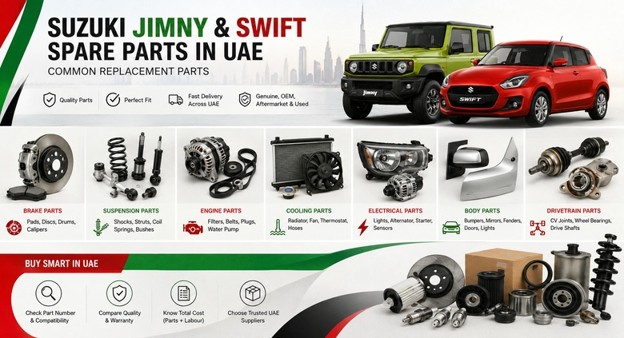
For UAE Jimny owners, common replacement needs can include brake parts, suspension bushes, shock absorbers, steering parts, wheel bearings, cooling-system parts, belts, hoses, lights, mirrors and body panels. Drivetrain parts deserve more scrutiny when the vehicle has regularly been used off-road.
A workshop may tell you that a particular part is worn.
Fair enough.
But before ordering it online, ask what actually failed.
A worn bush doesn't necessarily mean the entire suspension assembly needs replacing. A noisy bearing doesn't mean every nearby drivetrain part is finished. And a steering complaint can sometimes come from more than one worn area.
That's why diagnosis comes first.
Then the part search becomes much less messy.
For used Jimny parts, donor history is especially useful. A vehicle that spent most of its life commuting through Dubai traffic is not the same proposition as one that has been repeatedly driven through sand, mud or rough terrain.
Look for actual photographs, part numbers, donor information, mileage where relevant and a clear warranty.
Cheap is nice.
Known condition is better.
Common Suzuki Swift Spare Parts Owners Replace in UAE
The Swift lives a rather different life.
It is commonly used as an everyday runabout, commuter and city car, so its replacement-part story tends to revolve around ordinary wear, minor damage and the accumulated punishment of stop-start driving rather than the sort of off-road stress associated with a Jimny.
Common searches include brake pads, discs, suspension parts, filters, belts, lights, mirrors, bumpers, AC parts, cooling-system parts and electrical items.
And then there are the irritating little jobs.
A broken mirror housing. A damaged bumper clip. A cloudy lamp. A suspension noise that only appears over one particular road.
These don't necessarily call for expensive genuine-new replacements.
A clean used genuine part can sometimes be the sensible answer, particularly for bodywork and interior trim. On the other hand, buying a heavily worn used suspension or electrical part simply because it is cheaper can backfire.
Think about the part's job.
A bumper doesn't have a mileage in the same sense as a shock absorber.
An ECU doesn't become “good” merely because its casing looks clean.
A brake part should not be selected as though it were a decorative trim piece.
That distinction sounds obvious. Online listings have a habit of making it disappear.
Suzuki Jimny Suspension Parts: Common Failures and Replacement Signs
Listen to a Jimny over a rough road.
Not the engine. The suspension.
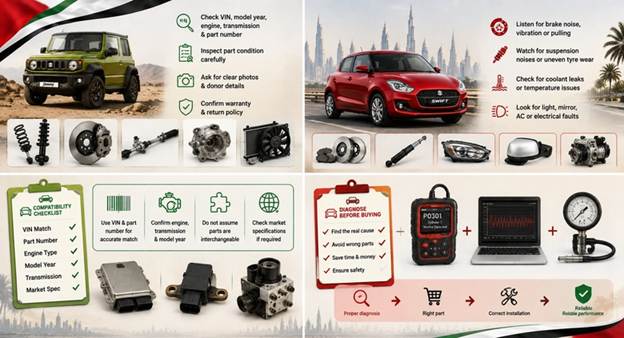
A knock, clunk, excessive bouncing, uneven tyre wear or unusual steering behaviour can point towards worn suspension-related parts, although the symptom alone doesn't identify the failed part.
Bushes can deteriorate.
Shock absorbers can lose effectiveness.
Springs can weaken or become damaged.
Steering and suspension joints can develop play.
And on a Jimny that has spent considerable time off-road, impacts and repeated articulation can accelerate wear.
The UAE makes this more interesting because the same vehicle might spend Monday to Friday crossing city roads and the weekend crawling over sand. Those are very different loads.
Before buying a replacement, get the vehicle inspected with the wheels and suspension loaded appropriately, and ask the technician to identify the actual source of the movement or noise.
If you're buying a used suspension part, inspect for bends, cracks, corrosion, damaged mounting points and excessive wear.
Don't buy an entire suspension assembly because one bush is tired unless there is a technical reason for doing so.
And if the vehicle has modified suspension, oversized tyres or other off-road changes, tell the supplier.
That information can change what parts are suitable.
Suzuki Swift Suspension and Brake Parts: What Usually Wears Out?
Swift suspension problems can start quietly.
A faint knock over speed bumps.
A steering wheel that no longer feels quite as settled.
Tyres wearing unevenly.
Then one day the noise becomes impossible to ignore.
Suspension bushes, shock absorbers, links and other wear-related parts can deteriorate with mileage, while UAE road conditions, kerbs and repeated stop-start driving add their own share of punishment.
Brakes are even less forgiving.
Squealing, grinding, vibration under braking, pulling to one side or a noticeably soft pedal deserves proper inspection rather than an online parts order based on symptoms alone.
Why?
Because several faults can produce similar sensations.
A vibration might involve the braking system, wheel condition, suspension or tyre.
So diagnose first.
Then match the replacement.
For brake parts in particular, prioritise correct specification, quality and condition over finding the absolute lowest price. A small saving is not especially impressive if the part has to be removed and replaced again.
For suspension, compare new and used options based on mileage and condition. If a used part has already done a substantial amount of work, the discount needs to be meaningful enough to justify that remaining uncertainty.
And after suspension work, remember alignment.
The parts may be correct.
The car can still drive badly if the geometry is wrong.
Symptoms, Compatibility and Diagnosis
Suzuki Jimny Warning Signs That a Spare Part Needs Replacing
A Jimny rarely sends a perfectly worded warning saying, “this particular part has failed.”
It gives you a noise.
A vibration.
A steering wheel that suddenly feels different.
Or, sometimes, nothing obvious until the workshop gets underneath it.
Knocking over rough roads can point towards worn suspension or steering parts, while vibration may involve wheels, tyres, suspension or drivetrain components. A humming or rumbling sound that changes with road speed can warrant inspection of bearings or related rotating parts. Overheating, meanwhile, shifts attention towards the cooling system rather than the suspension or brakes.
And then there is the Jimny's off-road history.
If the vehicle has been through sand regularly, inspect drivetrain and suspension parts more carefully. Repeated impacts, heavy articulation and modifications can change wear patterns, so a generic “Jimny problem” diagnosis isn't particularly useful.
Before ordering a replacement online, identify the fault.
Ask the workshop to show you the worn or damaged part where practical.
That little bit of evidence is valuable.
It stops the parts search from becoming a guessing exercise.
Suzuki Swift Warning Signs: When Should You Replace a Part?
The Swift tends to reveal problems through smaller annoyances.
A brake squeal.
A clunk over a speed bump.
A headlamp that stops working.
An AC system that isn't cooling as it used to.
A dashboard warning that wasn't there yesterday.
Don't immediately translate the symptom into a shopping list.
A noisy brake can have several causes. A vibration can come from tyres, wheels, suspension or braking components. An electrical warning may involve wiring, a sensor or a control module rather than the most expensive part mentioned in an online search.
This is particularly important when buying electronic parts.
A sensor may look like the correct one.
The connector may even look identical.
That still doesn't prove compatibility.
For Swift owners in Dubai, Sharjah or Abu Dhabi, a proper diagnosis before ordering can save both delivery time and workshop labour. The vehicle may already be dismantled when you start looking for the replacement, and that is exactly when mistakes become expensive.
Diagnose first.
Order second.
It sounds painfully obvious, yet plenty of parts buying happens the other way around.
Suzuki Jimny and Swift Part Number and VIN Compatibility Guide
The VIN is your strongest starting point when an online Suzuki parts search becomes uncertain.
A model name alone is too broad.
“Swift 2018” is better.
“Swift + VIN + engine + transmission + original part number” is much better.
The same principle applies to the Jimny.
Use the VIN, model year, engine specification, transmission type and original part number when asking for a replacement. For major mechanical parts, also confirm the engine or transmission identification where relevant.
Why so much information?
Because model generations overlap, specifications change and part numbers can be revised.
A seller might tell you that two parts are interchangeable.
Ask them to confirm it against your VIN.
If the original part number has been superseded, ask for the replacement number and an explanation of the supersession. Don't assume that a number which looks almost identical is automatically compatible.
For used parts, ask for a clear photograph of the identification label.
For electrical modules, this is especially important.
For engines and gearboxes, identification should be treated as non-negotiable.
Suzuki Jimny vs Swift Spare Parts: Which Parts Are Interchangeable?
This is one of those searches where the answer is often less exciting than people hope.
Some Suzuki spare parts in UAE may share manufacturing relationships or similar designs, but similar-looking does not mean interchangeable.
The Jimny and Swift have very different vehicle layouts and operating purposes. A suspension part, drivetrain part, engine-related item or electronic module should not be transferred simply because the dimensions appear close.
Even within one model, compatibility can change with:
Generation + model year + engine + transmission + trim + market specification.
There can also be differences between parts intended for different markets.
So if someone tells you, “It is Suzuki, it will fit,” ask for the part number.
If someone says, “The connector is the same,” ask for VIN confirmation.
If someone says, “I've fitted these before,” ask which model year and specification.
A proper compatibility check may take a few minutes.
Replacing an incorrect part after installation can take considerably longer.
Suzuki Jimny Parts Compatibility: What Should Be Checked Before Ordering?
Jimny owners should be particularly careful with parts connected to the drivetrain, suspension and steering, especially when buying used.
Start with the VIN and part number.
Then consider how the vehicle has been used.
A standard road-going Jimny and a modified example with suspension changes, different wheels or off-road equipment may require a different approach to certain replacement parts.
For used parts, ask whether the donor vehicle had similar modifications.
Inspect mounting points and physical condition.
If the part is from the drivetrain, ask about testing.
If it is a suspension item, ask about mileage and wear.
If it is an electrical unit, verify the number and programming requirements.
And don't rely on a photograph taken from ten metres away.
Get close-up images of the label, connector, mounting points and important surfaces.
Those details often tell you more than the main product photograph.
Suzuki Swift Parts Compatibility: Model Year Still Matters
Swift owners sometimes assume that a part listed under the same model name will fit every example.
That assumption can get expensive.
Confirm the generation, year, engine, transmission and VIN before ordering, especially for electronic, mechanical and body-related parts.
For a used bumper or mirror, visual comparison is useful.
For a sensor, module or transmission part, visual comparison isn't enough.
Electrical connectors, software requirements and part-number revisions can make two apparently similar items behave very differently.
Ask the supplier to verify the application.
If the seller says the part replaces an older number, ask for that information in writing.
If a used item comes from another vehicle, ask about the donor.
And if the workshop has already diagnosed a specific fault, pass that diagnostic information to the supplier rather than simply sending the model name.
Good parts sourcing is a conversation between diagnosis and identification.
The internet is merely where the conversation happens.
Suzuki Jimny and Swift Electrical Parts: Why Exact Matching Matters
Electrical parts are particularly unforgiving.
A headlamp may be straightforward.
An ECU, control module, sensor or other electronic unit can be another story entirely.
Two units can have almost identical housings while carrying different identification numbers, software configurations or vehicle applications.
Before ordering an electrical part, confirm:
Original part number + replacement number + connector configuration + vehicle specification + programming requirements.
Ask whether the part has been tested.
If it's used, ask whether it was removed from a running vehicle where appropriate.
If programming is required, establish who will perform it and whether that cost is included.
For a UAE vehicle, also inspect connectors for corrosion or heat-related deterioration, particularly on older cars.
Replacing a module without checking the wiring around it can be a costly exercise in replacing the wrong thing.
Suzuki Jimny and Swift Spare Parts: Diagnosis Before Replacement
There is a simple reason this deserves its own section.
Modern vehicles have overlapping symptoms.
A vibration can be tyres.
Or wheels.
Or suspension.
Or brakes.
Or drivetrain.
A warning light can be a sensor.
Or wiring.
Or a control module.
A cooling problem can involve a thermostat, radiator, hose, fan or another part of the system.
So don't let an online catalogue become your diagnostic tool.
Use the workshop for diagnosis.
Use the parts supplier for identification, availability, condition and pricing.
That's a much healthier division of labour.
For major repairs, ask the workshop to document the fault and, where possible, show you the failed part. For engines, compression testing can add useful evidence. For gearboxes, testing and transmission identification matter. For suspension, physical inspection is more valuable than guessing from a noise.
The replacement should solve the diagnosed problem.
Not merely resemble the part you saw in a photograph.
Prices, Quality and UAE Buying Options
Suzuki Jimny Spare Parts Prices in UAE: What Affects the Cost?
The price of a Jimny spare part can move around quite a bit.
And usually, there is a reason.
A genuine new part, a used genuine part, an aftermarket replacement and a reconditioned assembly aren't four versions of the same purchase. They carry different levels of previous use, manufacturer assurance, testing and warranty, so comparing them purely by AED value can produce a rather silly conclusion.
For UAE buyers, the final price can also depend on local availability, delivery, model year, part number, supplier location and workshop labour.
A used Jimny differential, for example, should not be compared with an untested unit simply because both are advertised as “used”. Ask about the donor vehicle and whether the assembly was tested.
The same applies to suspension.
A low-priced used shock absorber may have plenty of kilometres behind it. A new aftermarket unit may cost more but start with zero previous wear.
Then there are the hidden additions.
Delivery. Fluids. Seals. Fittings. Alignment. Diagnostic work.
For major repairs, calculate the installed cost rather than stopping at the online listing.
That's the number that matters when the Suzuki is finally back on the road.
Suzuki Swift Spare Parts Prices in UAE: New vs Used Options
Swift parts are available across a wide range of price points, but the sensible choice depends heavily on what has failed.
For a bumper, mirror, door, lamp housing or interior trim, a good used genuine part can sometimes be an excellent bargain. The condition is visible, the part can often be compared directly with the original and the saving can be meaningful.
Mechanical and safety-related parts require more caution.
A used suspension part may already have substantial wear. A questionable brake part is simply not worth buying because it is AED 50 cheaper. An electrical module can look pristine and still fail once connected to the car.
So compare:
| Option | Main advantage | Main concern |
|---|---|---|
| Genuine new | Strong fitment confidence | Higher purchase price |
| OEM | Potentially strong quality | Manufacturer must be verified |
| Aftermarket | Often competitive pricing | Quality varies |
| Used genuine | Lower cost | Previous use and condition |
| Reconditioned | Can balance cost and condition | Quality of rebuilding work |
For a daily Swift used around Dubai or Sharjah, don't overlook installation cost.
A cheap part that requires another removal and refitting later isn't cheap anymore.
Genuine vs OEM vs Aftermarket Suzuki Jimny and Swift Parts
The labels get thrown around rather casually online.
Genuine usually refers to the vehicle manufacturer's identified replacement part.
OEM refers to original-equipment manufacturing, but the term should not be accepted blindly. Ask who made the part and whether its specification and application can be verified.
Aftermarket simply means the part is produced outside the vehicle manufacturer's own branded parts channel. That does not automatically make it poor quality.
Some aftermarket manufacturers make very good parts.
Others don't.
For Jimny and Swift owners, the sensible approach is to judge the part according to its job.
A cosmetic trim piece gives you more room to experiment.
A suspension, brake or steering part deserves a much higher standard.
An electronic module needs exact identification.
A gearbox or engine needs evidence of testing and condition.
The right question isn't:
“Which category is always best?”
There isn't one.
Ask instead:
“Which option gives this particular repair the right balance of fitment, quality, risk, warranty and total cost?”
That's a far more useful comparison.
Used Suzuki Jimny and Swift Spare Parts: What Should Buyers Check?
Used parts can save serious money in the UAE.
But only when you know what you're buying.
Start with the actual photograph.
Not a generic catalogue picture.
Look for cracks, broken mounting points, corrosion, impact marks, repairs, heat damage and missing fittings. For mechanical parts, ask about donor mileage and previous use. For Jimny parts, ask whether the donor vehicle was heavily used off-road.
Then check the identification.
For UAE owners comparing genuine, OEM, aftermarket and used Suzuki parts, PartFinder UAE can make the search easier by keeping attention on fitment, condition, price and warranty rather than simply choosing the cheapest listing.
Part number. Engine code. Transmission identification. Connector. VIN compatibility.
For an engine, ask whether compression testing was carried out.
For a gearbox, ask how it was tested.
For an electrical module, ask whether it was tested and whether programming is required.
For bodywork, inspect the actual finish and mounting points.
And ask about the warranty before paying.
“Used, good condition” is not a technical report.
It's a starting point for more questions.
Suzuki Jimny Spare Parts: Sand and Off-Road Use Can Change Wear
A Jimny that spends its weekends in the desert deserves a different inspection from one that stays on city roads.
Sand gets into places you would rather it didn't.
Repeated articulation works suspension parts harder. Impacts can affect steering and drivetrain components. Modified wheels and tyres can alter loads. None of this means an off-road Jimny is unreliable—it simply means its parts may have lived a tougher life.
When buying used Jimny parts, ask about the donor's usage.
For differentials, driveshaft-related parts, steering components, hubs and suspension, inspect more carefully for impact damage, leaks, play and unusual wear.
A used part from a gently driven donor may be more attractive than a cheaper item from a heavily modified off-road vehicle.
That's why donor history matters.
Not as a nice extra.
As part of the buying decision.
Suzuki Swift Spare Parts: Dubai Driving and Everyday Wear
The Swift may not spend weekends climbing dunes, but city driving has its own punishment.
Constant braking.
Traffic queues.
Kerbs.
Speed bumps.
Short trips followed by long periods of AC use.
Then the occasional road surface that seems to have been designed specifically to test suspension components.
Over time, this can show up through worn bushes, brake wear, suspension noise, cooling-system problems or AC-related faults.
When buying used parts, consider what you're replacing.
A used mirror is one thing.
A used shock absorber is another.
A used electrical module needs its own compatibility checks.
A new quality replacement can sometimes be the more economical choice when the difference in price is small but the used part carries substantial previous mileage.
Suzuki Spare Parts Online in UAE: How to Compare the Real Price
Never compare two listings until you've stripped away the differences.
Check the same part number first.
Then the same condition.
Then the same completeness.
Then warranty.
Then delivery.
Only after that should you compare price.
A used gearbox at AED 2,000 with no documented testing is not necessarily cheaper than a tested replacement at AED 2,400 with a warranty.
Likewise, a used bumper at AED 400 isn't automatically a bargain if it needs painting, missing brackets have to be sourced and delivery costs another AED 100.
The useful calculation is:
Part + delivery + supporting parts + labour + additional work = real repair cost.
For UAE owners, this becomes especially important when a vehicle is already sitting at a workshop.
Every extra day can create transport costs and inconvenience.
Suzuki Jimny and Swift Spare Parts: Supporting Parts You Shouldn't Ignore
A replacement part rarely exists in complete isolation.
If a suspension assembly is being replaced, inspect associated bushes, mounts and alignment.
If an engine is being installed, check relevant seals, filters, fluids, hoses, belts and mounts according to the vehicle and repair.
If a gearbox is replaced, inspect related mounts, seals and fluid requirements.
If a cooling-system part has failed, investigate why it failed rather than simply installing another part and hoping for the best.
This doesn't mean accepting every additional item a workshop suggests.
Ask why it needs replacement.
Is it worn?
Is it damaged?
Is access difficult once the main repair is complete?
Does leaving it in place create a realistic risk of another breakdown?
That conversation separates sensible preventative work from unnecessary parts swapping.
Suzuki Spare Parts Labour Cost in UAE: What Should Be Included?
The online price tells only half the story.
A Suzuki part can cost AED 300 and still produce a much larger final invoice if installation is difficult.
For straightforward bodywork, labour may be relatively contained.
For an engine or gearbox, the workshop may need to handle removal, installation, fluids, testing, diagnostics and related adjustments.
Some jobs may also require programming or wheel alignment.
Ask the workshop for a clear labour quotation before ordering the part.
| Work area | Possible additional cost |
|---|---|
| Body part replacement | Fitting and paint |
| Suspension work | Labour and alignment |
| Brake work | Labour and related inspection |
| Engine replacement | Removal, installation, fluids and testing |
| Gearbox replacement | Removal, installation, fluid and testing |
| Electrical module | Diagnostics and programming |
| AC-related repair | Recovery, installation and testing |
Prices can differ between Dubai, Sharjah, Abu Dhabi and other emirates, so compare like-for-like quotations rather than comparing a part-only price with a complete workshop package.
Suzuki Spare Parts: When a Cheap Used Part Becomes Expensive
Here's the trap.
The used part costs AED 500 less.
You buy it.
The workshop installs it.
It doesn't work.
Now you pay for removal.
Then another replacement.
Then another round of testing.
Your AED 500 saving has disappeared, and then some.
This is why warranty becomes more important as installation complexity rises.
A used interior trim piece can be relatively low-risk.
A used gearbox is not.
A used engine is not.
A control module may require programming before you even discover that the unit is unsuitable.
For expensive or labour-intensive repairs, ask whether the supplier's warranty covers the part only or also the labour associated with a failure.
Don't assume.
Ask.
Suzuki Spare Parts UAE: Repair vs Replace the Whole Vehicle
A major Jimny or Swift repair can make an owner rethink the entire car.
Fair enough.
But don't make that decision from one invoice.
Look at the vehicle's broader condition.
If the car has a sound body, good AC, healthy transmission, decent suspension and a reliable maintenance history, a major repair may still be sensible.
If the vehicle needs an engine, suspension, AC work and several electrical repairs within the same period, the calculation changes.
Consider:
Current repair cost + likely maintenance over the next 12 months + downtime + alternative transport.
Then compare that with the actual cost of replacing the vehicle, including registration, insurance, financing where applicable and depreciation.
Sometimes repairing the old Suzuki is the boring but financially sensible choice.
Sometimes it really is time to move on.
The numbers should decide.
Suzuki Spare Parts Online: Buyer Decision Matrix
| Situation | Option worth investigating |
|---|---|
| Damaged Swift bumper | Used genuine or quality aftermarket |
| Jimny body trim | Used genuine |
| Worn Swift suspension | New quality replacement |
| Jimny off-road suspension damage | New or carefully tested used |
| Electrical module | Exact-number replacement |
| Engine failure | Used vs reconditioned vs rebuild |
| Gearbox failure | Repair vs tested used vs reconditioned |
| High-mileage vehicle with several faults | Repair vs replacement calculation |
There is no universal answer.
The vehicle's age, mileage, maintenance history and intended use all matter.
So does your tolerance for risk.
A low-cost part with a short warranty may be perfectly acceptable for a minor cosmetic repair. The same attitude becomes rather reckless when the part sits inside the drivetrain.
Suzuki Spare Parts Online: Check the First 1,000 km After Major Work
The repair isn't finished when the workshop hands over the keys.
The first 1,000 km are useful for catching problems early.
After an engine replacement, keep an eye on oil, coolant, temperature, warning lights, leaks and unusual vibration.
After gearbox work, pay attention to shifting behaviour, fluid leaks, noise and warning messages.
After suspension work, notice whether the vehicle pulls to one side, knocks over bumps or develops unusual tyre wear.
After brake work, monitor pedal feel, vibration, pulling and noise.
Don't ignore a small change because the workshop has already signed off the job.
Go back.
Ask.
Get it checked while the repair is still fresh and the cause is easier to trace.
Suzuki Spare Parts Documentation: Keep the Repair History
Keep the invoice.
Keep the part number.
Keep the warranty.
Keep the donor information where applicable.
For a used engine, retain the available mileage and compression-test information. For a gearbox, keep its identification and testing details. For electronic parts, keep programming or diagnostic records.
It might feel like paperwork for paperwork's sake.
Later, it becomes useful.
Another workshop can see what has already been replaced. A warranty claim has supporting evidence. And when you sell the Suzuki, a documented major repair is easier for the next buyer to understand than a vague explanation that “the gearbox was changed somewhere”.
Good records don't make a used part new.
They do make its history clearer.
Suzuki Spare Parts Online: The Final Cost Is More Important Than the Sticker Price
A Suzuki part listed for AED 700 can become an AED 1,100 repair.
Or AED 1,500.
Or more.
That doesn't necessarily mean the supplier overcharged you.
The part may need delivery, labour, fluids, seals, programming, alignment or additional supporting work.
That's why serious buyers should calculate the complete installed cost before choosing between genuine, OEM, aftermarket, used or reconditioned options.
The cheapest part is attractive.
The cheapest complete repair is what you actually want.
And for Jimny and Swift owners across the UAE, that distinction matters because workshop downtime, delivery between emirates and climate-related wear can all influence the final result.
Don't chase the first low number.
Work out the whole number.
Repair Decisions, Installation and Long-Term Ownership
Suzuki Jimny and Swift Spare Parts Warranty: What Should Buyers Check?
A warranty can make a used or reconditioned part considerably easier to consider, but only if you know what the warranty actually says.
“Warranty included” is not the finish line.
It's the beginning of the questions.
For a used Jimny engine or gearbox, ask how long the coverage lasts, what failure is covered, whether installation has to follow specific conditions and whether labour is included if the part has to come out again. For a Swift electrical module, ask whether programming or diagnostic work is covered—or whether the warranty applies only to the physical unit.
For body parts, check whether painting or modification affects returns.
And ask for the terms in writing.
A warranty that sounds generous over the phone can turn out to exclude the very failure you're worried about.
Suzuki Jimny and Swift Spare Parts Return Policy: Check Before Installation
Online buying removes one useful advantage of a physical shop.
You can't always inspect the part yourself before paying.
So establish the return conditions beforehand.
Ask whether the supplier accepts returns when:
The part is incorrect + the part arrives damaged + the part fails testing + the part does not match the agreed specification.
Then ask what happens after installation.
Electrical parts can have special conditions because installation or programming may affect returns. Major assemblies such as engines and gearboxes may have separate warranty and installation requirements.
For bodywork, don't rush into painting a replacement panel before checking fitment.
For a module, don't assume that because the connector plugs in, the return policy is irrelevant.
Once the part has been modified, fitted or programmed, your options may change.
Know that before the workshop touches it.
Suzuki Jimny and Swift Spare Parts Installation: What Should the Workshop Check?
The replacement itself is only one part of the job.
During installation, the workshop should check the surrounding area for related faults rather than simply pulling out the old part and dropping in the new one.
For suspension work, inspect mounts, bushes, joints and alignment.
For an engine replacement, check relevant seals, hoses, belts, fluids and mounts according to the actual vehicle and repair.
For gearbox work, inspect mounts, seals, fluid requirements and related drivetrain parts.
For electrical parts, check wiring and connectors before blaming the replacement module.
This doesn't mean approving every additional item the workshop recommends.
Ask why.
If a mechanic says a mount is worn, ask to see it. If a hose is brittle, inspect it. If a seal is leaking, find out where.
A sensible supporting repair can prevent another workshop visit.
An unnecessary one simply makes the invoice fatter.
Suzuki Jimny and Swift Spare Parts: UAE Climate and Heat-Related Wear
The UAE's heat changes the way some parts age.
Not dramatically overnight.
Gradually.
Rubber hardens. Plastic becomes brittle. Seals lose flexibility. Electrical connectors can deteriorate. Interior plastics can become fragile after years of high temperatures.
That matters when buying used Suzuki parts.
A used body panel may be perfectly fine.
A used plastic cooling-system fitting deserves a closer look.
A used electrical module should have its connectors inspected carefully.
A used AC-related part deserves attention because the vehicle may have spent years operating its air-conditioning system heavily.
The Jimny adds another factor—off-road use.
The Swift adds another—daily urban mileage.
So when evaluating used parts, ask not just how old the part is, but what sort of life it has already had.
Suzuki Jimny Spare Parts: Off-Road History Should Influence the Buying Decision
Two used Jimny parts can carry completely different histories.
One came from a vehicle used mainly for commuting.
The other came from a modified 4x4 that spent weekends in the desert.
Same model.
Not necessarily the same condition.
For used suspension, steering, drivetrain and wheel-related parts, ask about the donor vehicle's use. Look for impact marks, bends, leaks, damaged mounts and excessive play.
If the donor had oversized tyres or significant suspension modifications, mention that to the supplier or technician.
This doesn't mean every off-road Jimny is mechanically tired.
Some are maintained obsessively.
That's precisely why the history matters.
A well-maintained, properly tested used part can be a better purchase than an unknown low-mileage unit with no meaningful information behind it.
Suzuki Swift Spare Parts: City Use Can Still Produce Heavy Wear
The Swift is small.
The workload isn't always.
Daily Dubai traffic can mean constant braking, repeated acceleration, long AC operation and countless speed bumps. Add rough road surfaces, kerb strikes and high annual mileage, and ordinary wear starts to accumulate.
So when buying used Swift parts, consider what type of part you're actually purchasing.
A used mirror?
Usually easy to inspect.
A used bumper?
Mostly a condition and fitment question.
A used shock absorber?
Previous mileage suddenly matters.
A used electrical module?
Identification and testing become more important.
This is why there isn't one universal answer to “used or new?”
The correct choice changes with the part.
Suzuki Jimny and Swift Spare Parts: Repair or Replace the Vehicle?
Eventually, the repair bill can become large enough to trigger the uncomfortable question:
“Should I just replace the car?”
Sometimes yes.
Sometimes absolutely not.
A Jimny with one major mechanical failure but a healthy chassis, good interior, sound cooling system and strong maintenance history may still be worth repairing.
A Swift needing one suspension repair is hardly a reason to abandon it.
But if the vehicle has several major faults arriving together, the calculation changes.
Look at the next 12 months, not just today's workshop invoice.
Consider expected maintenance, tyres, AC, brakes, suspension, electrical repairs and possible downtime. Then compare that with the cost of acquiring another vehicle, including insurance, registration, financing and depreciation where applicable.
Don't compare a AED 8,000 repair with a AED 40,000 replacement vehicle and declare the repair expensive.
Compare the actual ownership costs.
That's where the answer usually becomes clearer.
Suzuki Jimny and Swift Spare Parts: First 1,000 km After Installation
A major repair needs a short settling-in period.
The first 1,000 km are worth watching.
After an engine replacement, check oil level, coolant level, temperature, warning lights, unusual vibration and visible leaks.
After gearbox work, pay attention to shifting behaviour, abnormal noises, fluid leaks and warning messages.
After suspension work, watch for knocking, steering pull, vibration and uneven tyre wear.
After brake work, notice any pulling, vibration, unusual noise or changes in pedal feel.
Don't ignore something because the vehicle technically runs.
If a new noise appears, tell the workshop.
If a fluid level drops unexpectedly, have it checked.
If a warning light returns, diagnose it.
Early inspection is far less painful than discovering a problem after thousands of kilometres.
Suzuki Spare Parts Documentation: Keep Every Important Record
Keep the paperwork.
Seriously.
A replacement part without documentation becomes a vague memory surprisingly quickly.
Save the invoice, part number, donor details, mileage, testing records, warranty and installation invoice.
For a used engine, keep compression-test results if available.
For a gearbox, keep its identification and testing information.
For an electronic part, retain programming or diagnostic records.
This helps with future servicing, warranty claims and troubleshooting.
It can also help when selling the vehicle.
A buyer may be perfectly comfortable with a Jimny that has received a documented replacement gearbox. What makes them nervous is a gearbox replacement nobody can explain.
The repair history doesn't need to be beautiful.
It needs to exist.
Suzuki Jimny and Swift Spare Parts: Resale Value After Major Repairs
A replacement part doesn't automatically damage resale value.
Poorly documented repairs can.
There's a difference.
Suppose a Swift has had its gearbox replaced. One owner can show the invoice, part identification, workshop record and warranty.
Another owner says:
“Yeah, the gearbox was changed somewhere.”
Both cars may have similar mechanical condition.
The buyer's confidence won't be the same.
The same applies to a Jimny with major drivetrain or suspension work.
Keep evidence.
Keep dates.
Keep mileage.
Keep invoices.
If a part was used, document that honestly.
If it was reconditioned, retain whatever information describes the work.
A clear history won't turn an old vehicle into a new one, but it can make the vehicle much easier to evaluate.
Suzuki Jimny and Swift Spare Parts: When Is Reconditioned Better Than Used?
Reconditioned and used are not interchangeable terms.
A used assembly generally means the part has been removed from another vehicle and is being sold according to its existing condition.
A reconditioned unit has undergone some form of inspection, repair or rebuilding.
What was actually done?
That's the important question.
For an engine or gearbox, ask whether internal parts were inspected, which parts were replaced and what testing was performed afterwards.
A reconditioned unit with clear documentation and warranty may justify a higher price than an untested used assembly.
But “reconditioned” should not be accepted as a magic word either.
Ask for evidence.
What was repaired? What was replaced? What was tested? What warranty applies?
The answers matter more than the label.
Suzuki Jimny and Swift Spare Parts: Supporting Parts and Hidden Costs
The part itself may be only the beginning.
A replacement engine can require fluids, filters, seals or other supporting items.
A gearbox job may involve fluid, seals or mounts.
Suspension work may require alignment.
An electronic module may require programming.
A body part may require painting or additional fittings.
None of these automatically means the supplier or workshop is overcharging.
They are simply costs that should be known before you approve the repair.
Ask for a complete estimate.
Part + delivery + supporting parts + labour + diagnostics + programming/alignment where required.
That gives you a number you can actually work with.
A cheap part with expensive installation can be worse value than a slightly dearer part that fits properly and reduces additional work.
Suzuki Jimny and Swift Spare Parts: Cost of Delay in the UAE
There is another number people often forget.
Zero.
As in, zero income or zero convenience while the vehicle sits waiting for a part.
For a privately owned Swift, that might mean taxis or alternative transport.
For a family Ertiga or another daily-use Suzuki, it can disrupt several routines.
For a Jimny used for work or regular travel, downtime can be inconvenient in a different way.
So if two suitable parts cost AED 500 and AED 650, but one is available immediately and the other requires several days of sourcing, compare the complete situation.
Maybe the AED 150 saving is worth waiting.
Maybe it isn't.
At least make the decision with the downtime visible.
Suzuki Jimny and Swift Spare Parts Buying Checklist: What to Check Before Ordering
Before payment, run through the basics.
VIN confirmed?
Correct model year?
Engine and transmission confirmed?
Exact part number checked?
Condition clearly described?
Actual photographs available?
Used donor information available where relevant?
UAE stock confirmed?
Delivery date clear?
Warranty written down?
Return conditions understood?
Installation cost known?
Supporting parts identified?
Programming or alignment required?
If the answer to several of these is “we'll see later”, don't rush the order.
Online purchasing is at its best when uncertainty is removed before money changes hands.
Suzuki Jimny and Swift Spare Parts: The Final Buying Decision
There is no universally perfect Suzuki spare part.
There is only the part that makes sense for that vehicle, that repair and that budget.
A used genuine mirror may be an excellent purchase.
A new aftermarket suspension part may be the smarter move.
A tested reconditioned gearbox may make more sense than an unknown used unit.
A genuine electronic module may be worth paying extra for because compatibility matters more than a small saving.
And sometimes the right decision isn't another part at all. If a high-mileage Suzuki has accumulated several expensive faults, step back and compare the cost of keeping it with the cost of replacing it.
That's the useful end point.
Not “buy genuine”.
Not “always buy used”.
Not “cheapest wins.”
Check the vehicle.
Check the failure.
Check the part.
Check the numbers.
Then buy the option that still looks sensible after delivery, installation, warranty and the next year of ownership have been dragged into the calculation.
FAQs — Suzuki Jimny and Swift Spare Parts in UAE
Categories
- Audi
- BMW
- Car Accessories
- Car Tips
- Ford
- Land Rover
- Mazda
- Range Rover
- Top 10
- UAE Car Parts
- Used Car Parts
- Toyota
- Replacement Engines
- Nissan
- Hyundai
- Mitsubishi
- Volkswagen
- Honda
- Kia
- Chevrolet
- Dodge
- Jeep
- Subaru
- Renault
- Lexus
- Mercedes
- Suzuki
- Hummer
- Porsche
- Infiniti
- Peugeot
- GMC
- Mini
- Volvo
- Replacement Gearboxes
- MG
- Jaguar
- Skoda
- Cadillac
- Daihatsu
- Fiat
- German Car Parts
- Japanese Car Parts
- Aftermarket Car Parts
- Genuine Car Parts
- New Car Parts
- Reconditioned Car Parts
- European Car Parts
- American Car Parts
- Korean Car Parts
- British Car Parts
- Chinese Car Parts
- Sports/Exotic Car Parts
- Luxury Car Parts
- Performance Car Parts
- SUV/4x4 Spare Parts
- Truck Spare Parts
- EV Car Parts
- Hybrid Car Parts
- Auto Spare Parts in UAE
- Tesla
- Isuzu
- Ram
- Ferrari
- Bentley
- Lamborghini
- Genesis
- Maserati
- Lincoln
- Chrysler
- Opel
- Citroen
- SsangYong
- Seat
- McLaren
- Aston Martin
- Rolls Royce
- Maybach
- Alfa Romeo
- Bugatti
- Scion
- Abu Dhabi Car Parts
- Ajman Car Parts
- Al Khan Car Parts
- Al Sajaa Car Parts
- Deira Car Parts
- Dubai Car Parts
- Fujairah Car Parts
- Industrial Area 6 Car Parts
- Mussafah Car Parts
- Ras Al Khaimah Car Parts
- Sharjah Car Parts
- Umm Al Quwain Car Parts
- Acura
- BYD
- Chery
- Dacia
- DS
- Geely Emgrand
- EXEED
- GAC
- GAC Gonow
- Geely
- Gonow
- Great Wall
- Haima
- Haval
- Holden
- Iveco
- JAC
- Jaecoo
- Jetour
- Lotus
- Omoda
- Proton
- Renault Samsung
- Roewe
- Lucid
- Replacement Headlight