Suzuki Spare Parts Prices in UAE: New, Used, Genuine and Aftermarket Options
August 31, 2026
Suzuki Spare Parts Prices and What Changes the Bill
Suzuki Spare Parts Prices in UAE: What Do Owners Actually Pay?
There isn't one Suzuki spare-parts price in the UAE. Not even close.
A Swift front bumper, a Jimny differential, a Ciaz AC compressor and an Ertiga engine live in completely different price brackets, and even two supposedly identical parts can come back with different quotations because one is genuine, another aftermarket, one is sitting in UAE stock and another has to be sourced, while a used part may carry a completely different history.
So, when a workshop says, “The Suzuki part will cost AED 600,” don't stop there.
Ask what you're actually getting.
Is it new, used, genuine, OEM or aftermarket? Is the quoted amount for the complete assembly? Does it include brackets, sensors, seals or other fittings? Is VAT included? What about delivery and installation?
This matters particularly with older Suzuki vehicles. A low-priced used part can look brilliant on paper, but if it needs additional hardware, paint, programming or another workshop visit, the saving starts to melt away.
The useful figure is the complete installed cost.
Not the number printed beside the part in an online listing.
Suzuki Spare Parts Price List in UAE: How Prices Differ by Part Type
Some Suzuki parts are relatively straightforward purchases.
Others can swallow a repair budget surprisingly quickly.
For everyday models such as the Swift, Jimny, Vitara, Baleno, Ciaz and Ertiga, common replacement categories include brakes, suspension, AC parts, cooling parts, lights, mirrors, body panels, electrical parts and engine-service items. Major assemblies such as engines, automatic gearboxes and differentials sit in another category altogether because the purchase price is only one part of the equation.
A body panel may need painting.
A suspension repair may need wheel alignment.
An electronic module may need programming.
An engine replacement can bring fluids, filters, seals and supporting parts into the bill.
And then there is labour.
That's why a useful UAE Suzuki spare-parts price comparison should never put AED 300 for a used part beside AED 500 for a new part and declare the first one cheaper. The second might include stronger warranty protection, while the first could need delivery and extra installation work.
Same repair.
Very different final bill.
What Affects Suzuki Spare Parts Prices in Dubai, Abu Dhabi and Sharjah?
Location can nudge the price, but availability often matters more than the emirate written on the workshop sign.
A Suzuki owner in Dubai may find a required part already sitting with a local supplier. Someone in Abu Dhabi might have the same item sourced from another emirate. A customer in Sharjah could find a cheaper used genuine part nearby, while a rare Jimny drivetrain item may need additional sourcing regardless of where the workshop is located.
Then the clock starts ticking.
If the Suzuki is already dismantled, waiting several days for a cheaper part isn't necessarily a saving. For a daily-use Swift or Ertiga, that delay can mean taxis, alternative transport or missed work. For a business or fleet vehicle, the cost of downtime can become even more obvious.
UAE climate and usage also influence what is worth buying. A vehicle that spends long summer hours in Dubai traffic with the AC running constantly has a different maintenance story from a lightly used car kept mostly in a garage.
When comparing prices across Dubai, Abu Dhabi, Sharjah, Ajman or another emirate, check the full offer: part, availability, delivery, VAT, labour and warranty.
Then compare.
Suzuki Spare Parts Cost: Why the Cheapest Part Is Not Always the Cheapest Repair
This is where many parts searches go slightly sideways.
The owner finds a part for AED 250.
The workshop quotes AED 450.
Someone else finds a “better deal” for AED 180.
Great?
Maybe.
Now add delivery. VAT. Installation. A seal. A litre or two of fluid. Alignment. Programming. Perhaps a damaged mounting bracket that wasn't visible in the original photograph.
That AED 180 can suddenly look rather ordinary.
For a simple interior trim piece, these extras may barely matter. For an engine, gearbox, AC assembly or suspension job, they can change the economics completely.
A useful way to judge a Suzuki spare part is to ask four blunt questions:
What am I buying?
Will it definitely fit?
What else must be done to install it?
What happens if it fails?
If those answers are clear, the price becomes meaningful.
If they're vague, the price is just a number.
And numbers without context are how perfectly avoidable repair bills start.
Genuine, OEM, Aftermarket and New Suzuki Parts
Genuine Suzuki Spare Parts in UAE: Are They Worth the Price?
Genuine Suzuki parts usually attract the strongest confidence because they are supplied for the manufacturer's vehicle application.
But here's the awkward bit.
The highest-priced option isn't automatically the smartest option.
For a critical engine part, transmission part, sensor or electrical item, the confidence of getting the correct specification can justify spending more. On an older Swift, Baleno or Ciaz, however, paying a large premium for a minor trim piece may not make much financial sense when a good-quality alternative does the same job.
Think about the part's job.
A brake-related item deserves a different buying standard from a dashboard clip. An engine sensor deserves more scrutiny than a cosmetic exterior trim. A Jimny drivetrain part used for serious off-road driving needs more attention than an interior panel.
Genuine is a useful category.
It isn't a shortcut around checking the part number, vehicle specification, warranty and total cost.
OEM vs Genuine Suzuki Spare Parts: What Is the Difference?
This is where parts shopping gets muddy.
People often use OEM and genuine as though they mean exactly the same thing. They don't necessarily describe the same purchasing route.
A genuine part is generally sold under the vehicle manufacturer's parts identity. An OEM part refers to a part made by an original-equipment manufacturer, although the exact meaning of “OEM” can become rather loose in online listings.
So don't buy based on the label alone.
Ask:
Who made it?
What is the exact part number?
Is it new?
Does the specification match the vehicle?
What warranty comes with it?
That approach is much harder for vague marketing language to derail.
For a Suzuki Swift brake part, a Ciaz sensor or an Ertiga suspension item, manufacturer identity and exact application matter considerably more than somebody typing “OEM quality” into a product description.
Aftermarket Suzuki Spare Parts in UAE: Are They Good Quality?
Aftermarket doesn't mean rubbish.
It also doesn't mean excellent.
There is a wide spread between reputable manufacturers and anonymous low-cost parts, which is why the word aftermarket on its own tells you surprisingly little.
A good aftermarket replacement can make sense for an older Suzuki where the owner wants to control repair costs without dropping to the cheapest available option. Suspension, filters, selected brake parts, belts and other service-related items can be compared this way, provided the specification and manufacturer are clear.
But don't use the same standard for everything.
A cosmetic trim piece can tolerate more uncertainty than an engine-internal part.
A used mirror isn't the same buying decision as an aftermarket steering or braking part.
And if a part has an important electronic function, confirm connector design and vehicle compatibility before ordering.
The sensible question isn't:
“Is aftermarket good?”
It is:
“Is this particular aftermarket part good enough for this particular job?”
Much better question.
New Suzuki Spare Parts in UAE: When Paying More Makes Sense
New parts remove one major unknown: previous usage.
That's valuable.
You don't have to wonder whether a shock absorber spent years on rough roads, whether an electronic module came from a water-damaged donor or whether a gearbox has already suffered hidden wear.
For certain repairs, that peace of mind is worth paying for.
New parts are particularly attractive where the used saving is small, the part is safety-critical, or installation is expensive enough that doing the job twice would hurt.
Imagine saving AED 150 on a used part, only for it to fail and require another workshop visit.
The saving has disappeared.
Maybe more than disappeared.
But don't turn this into a “new is always better” argument either. For an older Suzuki needing a cosmetic body panel, a clean genuine used panel can be perfectly sensible, especially if it already matches the vehicle's specification and requires little additional work.
The right choice depends on risk, price and the cost of failure.
New vs Genuine vs OEM vs Aftermarket Suzuki Parts
| Option | Main advantage | Main concern | Often useful for |
| Genuine new | Strong specification confidence | Higher price | Critical or exact-fit parts |
| OEM new | Potential quality/value balance | Manufacturer needs verification | Mechanical and service parts |
| Aftermarket new | Wider price range | Quality varies | Routine replacement parts |
| Used genuine | Lower purchase price | Previous wear | Body, trim and selected assemblies |
| Reconditioned | Can reduce major repair cost | Rebuild quality varies | Engines and gearboxes |
There isn't a trophy waiting for the person who buys the most expensive part.
The objective is the right part at the right risk level.
That sounds obvious.
It is, until you're standing beside a Suzuki with the workshop waiting for an answer and three quotations open on your phone.
Suzuki Spare Parts Quality: How to Judge an Aftermarket Manufacturer
Don't judge a part solely by its packaging.
Check the manufacturer.
Then check whether the manufacturer has a clear application for your particular Suzuki.
Look at part-number references, specifications, warranty terms and available technical information. If the seller cannot tell you who actually manufactured the part, that's already useful information in itself.
For Swift, Baleno, Ciaz and Ertiga owners, a reputable aftermarket part can sometimes offer a sensible middle ground between expensive genuine parts and questionable low-cost alternatives.
For a Jimny, usage should influence the choice.
If the vehicle spends weekends in sand and rough terrain, don't choose a suspension or drivetrain part solely because it happens to be the cheapest one that fits.
“Fits” is the starting point.
It isn't the finish line.
Suzuki Spare Parts: Does More Expensive Mean Better?
Not necessarily.
A higher price might reflect genuine branding.
It might reflect better materials.
It might include a stronger warranty.
It might simply reflect supply and availability.
You need to know which.
If two parts have the same application and one carries a much higher price, ask what you're gaining for the difference.
Longer warranty? Better manufacturer? Better specification? More complete assembly? Faster local availability?
If nobody can explain the difference, don't assume the expensive one is superior.
On the other hand, if the cheaper part has no identifiable manufacturer, no warranty and unclear fitment, then the price gap suddenly looks rather reasonable.
Cheap becomes expensive when uncertainty gets added to it.
Suzuki Spare Parts Warranty: Compare Protection, Not Just Price
Warranty can completely change the buying decision.
A new aftermarket part with a useful warranty may be more attractive than a slightly cheaper used part with no return protection.
For major assemblies, the difference becomes much larger.
Ask:
How long is the warranty?
What exactly is covered?
Is installation required at a specific workshop?
Does labour count?
What happens if the replacement fails?
Are fluids or supporting parts excluded?
Don't accept “warranty available” as a complete answer.
That's a headline.
You need the small print.
Genuine Suzuki Parts for Older Cars: Is the Premium Still Worth It?
This is where the vehicle's age changes the calculation.
Suppose you're maintaining an older Swift that has already accumulated considerable mileage. Paying a large premium for every single replacement part may make little sense if the car is otherwise being kept on a sensible budget.
For a minor trim piece, used genuine may be perfectly adequate.
For a major engine sensor, the calculation changes.
For a safety-critical brake part, it changes again.
For a high-mileage Jimny used off-road, drivetrain reliability may deserve a higher budget.
The part doesn't exist in isolation.
It sits inside a vehicle with a particular age, mileage, condition and purpose.
That's the context you should price.
Suzuki Aftermarket Parts in Dubai: Why Local Availability Matters
A part can be cheaper on paper and still be the worse purchase.
Imagine an aftermarket suspension part that costs less but needs several days to arrive. The Suzuki is already in a Dubai workshop, partly dismantled, and the owner needs it back for work.
A locally available alternative costs somewhat more.
Which one is cheaper?
That's not as obvious as the online prices suggest.
For owners in Dubai, Abu Dhabi and Sharjah, check actual UAE stock, delivery time, warranty and installation schedule alongside the purchase price.
The same logic applies to Ajman, Ras Al Khaimah, Fujairah and Umm Al Quwain, particularly when uncommon Suzuki parts need to be sourced from another emirate.
Sometimes availability wins.
Suzuki Spare Parts and UAE Climate: Does Heat Affect the Choice?
The UAE climate isn't kind to ageing vehicles.
Long periods of heat can be hard on rubber seals, plastic fittings, hoses, interior trim, electrical connectors and cooling-system parts, while constant AC use adds another layer of workload.
This becomes particularly relevant when inspecting used parts.
A used plastic component with brittle clips isn't much of a bargain.
A used electrical module with corrosion around its connector deserves a hard pass.
For cooling and AC parts, inspect carefully and establish why the original part failed before installing another one.
Don't simply replace the symptom.
Find the cause.
Suzuki Spare Parts for Fleet and Family Vehicles: Reliability vs Price
An Ertiga used for family transport doesn't necessarily need the same parts strategy as one working hard in fleet service.
The fleet vehicle may accumulate mileage quickly.
The family vehicle may spend hours in traffic with passengers and constant AC use.
A Jimny used for recreation may experience severe off-road loads.
A Swift used for commuting may accumulate thousands of kilometres without dramatic abuse.
These details affect how aggressively you should chase the lowest price.
If a vehicle's downtime costs you money, a more reliable part with faster UAE availability can be worth the additional expense.
If the vehicle is a secondary car and the repair is cosmetic, the equation may point towards a used genuine part.
There's no universal “best”.
There is only best for this vehicle and this repair.
Suzuki Spare Parts: When Used Genuine Beats New Aftermarket
This is one of the more interesting comparisons.
Suppose a clean, undamaged genuine Suzuki body panel is available used, while the alternative is a new aftermarket panel that needs considerable adjustment and paint preparation.
The used genuine part may be the better purchase.
The same can apply to selected mirrors, lamps, interior trim and other parts where original fitment matters and previous wear is easy to inspect.
But this logic becomes weaker as hidden mechanical or electronic risk increases.
A used genuine body panel?
Potentially excellent.
A used electronic control module with unknown history?
Much more caution.
The word genuine doesn't remove used-part risk.
It simply tells you something about the part's original specification.
Suzuki Spare Parts: When New Aftermarket Beats Used Genuine
The opposite can happen too.
A used genuine brake component may have an unknown wear history.
A reputable new aftermarket replacement may come with a clear specification and warranty.
In that situation, the newer part can make more sense even though the original manufacturer label sounds more reassuring.
This is especially important for wear items.
Brake pads.
Certain belts.
Filters.
Some suspension and steering-related parts.
The decision should follow the part's function.
If it wears out through use, buying somebody else's worn version isn't necessarily clever.
Suzuki Spare Parts Buying Rule: Match Quality to the Job
Here's the rule worth keeping.
Cosmetic part? Focus heavily on condition and fit.
Routine service part? Prioritise manufacturer quality and specification.
Safety-critical part? Put reliability and correct specification ahead of a small saving.
Electrical module? Verify exact part number and testing.
Engine? Demand mechanical evidence.
Gearbox? Demand transmission identification, testing and warranty.
Jimny off-road part? Consider the vehicle's actual use, not just its road-going specification.
Once you start looking at parts this way, the genuine-versus-aftermarket argument becomes much less dramatic.
You're not choosing a label.
You're choosing an appropriate level of risk.
Suzuki Spare Parts Price Comparison: What Should Be Included?
When collecting quotations, ask each supplier for the same information.
| Cost item | Why it matters |
| Part price | Basic purchase cost |
| VAT | Changes final payable amount |
| Delivery | Especially between UAE emirates |
| Installation | Labour can be substantial |
| Supporting parts | Seals, clips, fluids, etc. |
| Programming | Relevant to some electronics |
| Alignment | Often relevant after suspension work |
| Warranty | Changes risk exposure |
| Return policy | Important if fitment fails |
A quotation that leaves half these items blank isn't necessarily wrong.
It is simply incomplete.
And incomplete quotations make bad comparisons.
Suzuki Spare Parts: How to Compare Three Quality Levels
Suppose you have:
Genuine new — AED 900
Quality aftermarket new — AED 600
Used genuine — AED 350
Don't immediately choose AED 350.
Ask what the used unit has been through.
Then ask who made the aftermarket part.
Then check the warranty on all three.
Finally, ask how expensive installation will be if the part fails.
If the used part has known donor history and strong condition, it may be the obvious choice.
If the aftermarket part comes from a reputable manufacturer with warranty, it may be the sweet spot.
If the job is difficult to repeat and reliability matters most, genuine new could still win.
That's a proper comparison.
Suzuki Spare Parts: Don't Confuse “Compatible” With “Identical”
A listing can say compatible.
That doesn't always mean identical.
A part may fit the mounting points but differ in connector design, material, dimensions or operating specification.
This matters with Suzuki's electrical, engine, transmission, suspension and braking parts.
Check the exact part number.
Then confirm the VIN.
Then ask whether additional programming or calibration is required.
If a seller refuses to verify the application, don't compensate for that uncertainty by simply paying more or less.
Find another part.
Suzuki Spare Parts: The Right Price Depends on the Risk
There are cheap parts.
There are expensive parts.
And then there are expensive mistakes.
For an older Suzuki in the UAE, the smartest purchase is usually the one that balances price, fitment, quality, condition, warranty and expected service life.
A used genuine part can be excellent.
A new aftermarket part can be excellent.
A genuine new part can be exactly what the repair needs.
A reconditioned assembly can rescue a vehicle from an otherwise painful repair bill.
But each option needs evidence.
Check what you're buying.
Check why you're buying it.
Check what happens if it fails.
Then—and only then—look at the price.
Used Suzuki Parts, Model-Specific Prices and Quality Checks
Used Suzuki Spare Parts Prices in UAE: How Much Can You Actually Save?
The gap between a new Suzuki part and a used one can look tempting.
Sometimes it is substantial.
But don't measure the saving from the listing price alone. Measure it from the finished repair.
A used Swift headlight might cost considerably less than a new assembly, yet the saving can shrink if the mounting tabs are damaged, the lens is cloudy or the unit needs additional electrical work. A used Ertiga suspension part may look inexpensive until the workshop adds labour and alignment. A used Ciaz gearbox may be dramatically cheaper than a new replacement, but only if the transmission is correctly identified, tested and covered by a useful warranty.
That's the real calculation.
Used part price + delivery + VAT + installation + supporting parts + possible diagnostic or programming costs.
Now compare that figure with the new option.
For body panels and interior pieces, the used route can be particularly attractive because condition is easier to inspect. For engines, gearboxes and electronic parts, the saving needs to be large enough to justify the additional uncertainty.
Cheap is useful.
Cheap and uncertain is something else.
Used Suzuki Spare Parts in Dubai: When Does Buying Second-Hand Make Sense?
A used part makes the most sense when three things line up:
The part is correctly identified + its condition can be established + the price difference is meaningful.
Take a Swift mirror.
If the used genuine unit is clean, the electric adjustment works, the connector is intact and it costs substantially less than a new assembly, why pay extra simply because the box is older?
Now change the example to a brake part with an unclear wear history.
Different story.
For Dubai owners, availability also matters. If a used genuine part is already in UAE stock and can reach the workshop quickly, it may beat a cheaper alternative that takes several days to source.
The same principle applies across Abu Dhabi and Sharjah.
The total repair cost and downtime matter more than the first price you see on a screen.
For UAE owners comparing genuine, OEM, aftermarket and used options, PartFinder UAE can help make the search more focused by keeping the comparison centred on the correct Suzuki part, fitment and overall repair cost.
Used Suzuki Swift Parts: Which Items Are Usually Easier to Buy Used?
The Swift has a broad second-hand parts market because many examples are on UAE roads, and some parts are relatively easy to inspect.
Bumpers, fenders, doors, mirrors, lamps and interior trim can be sensible used purchases when they are undamaged and correctly matched.
Bodywork deserves a close look around mounting points.
That's where advertisements tend to be less generous with photographs.
Check for cracks, repaired plastic, bent brackets, broken clips and previous paintwork.
For lights, look for moisture inside the housing and damaged connectors.
For mirrors, check the electrical functions rather than merely folding the mirror by hand.
And for mechanical parts, raise the standard.
A used Swift suspension part isn't just another used item. Its previous mileage and road conditions matter.
Used Suzuki Jimny Parts: Why the Donor Vehicle Matters
The Jimny can be a wonderful candidate for used parts.
It can also be one of the worst if you ignore how the donor vehicle was used.
A Jimny that spent most of its life on paved roads has a different history from one that has repeatedly been through dunes, rocky tracks and rough trails. The exterior might look almost identical. Underneath, things can be very different.
For used Jimny suspension, steering, drivetrain, differential and underbody parts, ask about the donor's usage.
Look for:
Impact marks + bent metal + leaking seals + damaged mounts + worn bushes + corrosion + signs of modification.
Was the donor lifted?
Was it used off-road?
Was it involved in a collision?
Those aren't nosy questions.
They're buying information.
Used Suzuki Vitara Parts: Check the Generation Before the Price
“Vitara spare part” is too broad.
Confirm the generation and specification before discussing price.
A used Vitara body part may appear almost identical to another version but use different mounting points. Electrical parts can be even less forgiving, with different connectors or specifications creating problems after installation.
Before ordering, provide the VIN, model year, engine, transmission and original part number where available.
For bodywork, include photographs.
For mechanical assemblies, ask for identification markings.
For electronic modules, photograph the connector.
The cheapest wrong part is still the wrong part.
Used Suzuki Baleno Parts: Don't Assume Every Cheap Listing Is a Bargain
Baleno owners can run into another problem: very cheap parts can encourage impulse buying.
The seller says it fits.
The photograph looks right.
The price is excellent.
Then the workshop opens the packaging and finds a different connector or damaged mounting point.
Before ordering a used Baleno part, ask for the actual unit's photographs rather than generic catalogue imagery.
For body panels, inspect the rear side.
For lights, inspect the housing and connectors.
For suspension, check rubber components and mounting hardware.
For electrical parts, confirm the exact number.
A few minutes of checking can save a second delivery and another workshop appointment.
Used Suzuki Ciaz Parts: Where Condition and Labour Intersect
Ciaz owners should pay particular attention to the relationship between part price and installation cost.
A used suspension part may be inexpensive, but the workshop still has to remove and fit it.
A used AC component may look cheap until refrigerant recovery, installation and testing are included.
A used gearbox may offer a huge purchase saving, but removal and installation are labour-intensive.
That's why the best quotation should separate:
Part + labour + fluids + alignment + diagnostics + additional parts.
If one seller gives you a bare Suzuki spare parts prices in UAE and another gives you a complete installed quotation, don't compare them directly.
They're different offers.
Used Suzuki Ertiga Parts: High Mileage Changes the Calculation
The Ertiga is often asked to work.
Family trips.
Daily commuting.
Long traffic queues.
Fleet use.
Lots of passengers.
Lots of AC.
So when considering a used Ertiga part, ask about the donor vehicle's mileage and operating history where it matters.
A used body panel doesn't care much about mileage.
A shock absorber certainly does.
An engine cares a lot.
A gearbox does too.
This is why donor mileage should be treated according to the part, rather than as a universal quality score.
Used Suzuki Engine vs New Engine: Which Makes Financial Sense?
For most Suzuki owners, a genuinely new engine can be prohibitively expensive or simply unnecessary.
That makes used and reconditioned engines worth comparing when the vehicle itself is still healthy.
A used engine can offer a lower initial cost and potentially faster installation if the correct unit is already available.
A reconditioned engine may cost more but can provide greater clarity about what has been renewed—provided the rebuilding work is properly documented.
Compare:
| Factor | Used engine | Reconditioned engine | New engine |
| Initial price | Lower | Medium | Highest |
| Previous use | Yes | Usually based on used core | No previous vehicle use |
| Internal work | Unknown unless tested | Should be documented | Factory/new specification |
| Testing | Essential | Essential | Usually stronger baseline |
| Warranty | Varies | Varies | Usually stronger |
| Best suited to | Cost-conscious major repairs | Longer-term repair strategy | Highest certainty |
The important word is tested.
Without evidence, the categories become much harder to compare.
Used Suzuki Engine Inspection: What Should the Workshop Check?
Before installation, inspect the engine as far as practical.
Look for:
Oil leaks + coolant residue + damaged mounts + cracked housings + corrosion + wiring damage + signs of overheating.
If compression testing is possible, obtain the actual readings.
Also check the engine identification.
Don't assume that a similar-looking engine belongs in the vehicle.
A Suzuki engine replacement can become very expensive if the wrong specification reaches the workshop after the original engine has already been removed.
And ask what is included.
A bare engine is not the same purchase as a complete assembly with selected accessories.
Used Suzuki Gearbox vs Reconditioned Gearbox: Which Should You Choose?
This is one of those decisions where the cheaper option can be attractive right up until installation.
A used gearbox may be ideal when it has known donor information, appropriate mileage, testing evidence and warranty.
A reconditioned gearbox can make sense when the internal work is documented and the supplier can explain what was replaced.
A rebuild of your original gearbox may be worth considering if the casing and major internal parts remain usable.
The correct route depends on the failure.
If nobody has properly diagnosed the original gearbox, stop before buying another one.
You don't want to install a replacement transmission only to discover that the original problem was electrical.
Used Suzuki Gearbox Testing: What Evidence Should You Demand?
Ask how the gearbox was tested.
Not just whether it was tested.
For a manual transmission, useful information can include gear engagement, abnormal noise, bearing condition and general operating behaviour.
For an automatic transmission, ask about shift operation, abnormal noise, fluid condition and any known warning symptoms.
If the supplier cannot provide detailed test information, don't necessarily reject the gearbox immediately—but understand that you are accepting greater uncertainty.
And price it accordingly.
A tested unit with a meaningful warranty should not be valued the same as an unidentified gearbox pulled from an unknown donor.
Used Suzuki Electrical Parts: Cheap Today, Diagnostic Bill Tomorrow
Electrical parts can be particularly deceptive because they often look perfect.
An ECU can look almost untouched.
A sensor can look brand new.
A control module can have no visible damage whatsoever.
None of that proves it works.
For used Suzuki electrical parts, verify:
Exact part number + connector + donor vehicle + testing + programming requirements.
Ask the workshop whether the replacement needs coding or configuration.
If it does, include that cost before comparing prices.
A module costing AED 250 may not remain a AED 250 solution if another AED 300 of diagnosis and programming is required.
Again, the complete repair matters.
Used Suzuki Body Parts: Genuine Used Can Beat Cheap New
This is one area where second-hand genuine parts can be surprisingly attractive.
Suppose a used genuine Ciaz door is straight, structurally sound and already close to the correct colour, while a new aftermarket panel requires extensive preparation and paintwork.
The used genuine door may be the better buy.
Check:
Mounting points + edges + hinges + trim holes + clips + previous repairs + paint condition.
If sensors, wiring or handles are included, confirm that too.
A photograph from the front isn't enough.
Ask for the inside.
Used Suzuki Spare Parts and UAE Heat: Inspect Plastics Carefully
The UAE's heat can make ageing plastic parts brittle.
Clips snap.
Connectors become fragile.
Rubber hardens.
Trim can deteriorate.
That matters when buying used parts from older donor vehicles.
A used bumper may look excellent until one of its mounting tabs breaks during installation.
A used electrical connector may have corrosion or brittle locking tabs.
A cooling-system fitting may look fine until it is disturbed.
For used plastic, rubber and electrical parts, inspect flexibility, cracks, discolouration, corrosion and connector condition.
Don't force a brittle part just to prove that it moves.
Used Suzuki Spare Parts: What Should the Donor Vehicle Tell You?
The donor vehicle is part of the story.
Ask:
Why was it dismantled?
Was it accident damaged?
Was it flood damaged?
Did it have an engine or gearbox fault?
How many kilometres had it travelled?
Was it modified?
The answers can change which parts you should consider.
A front bumper from a rear-end collision donor may be perfectly usable.
An ECU from a flood-damaged vehicle deserves much more suspicion.
An engine from a car that overheated repeatedly?
That needs evidence.
The donor isn't background trivia.
It's part of the condition report.
Used Suzuki Parts Warranty: What Is Actually Covered?
A warranty can make a used part considerably more attractive.
But only if you understand it.
Ask whether the warranty covers:
The part itself + internal failure + replacement + labour + return shipping.
Then check exclusions.
For engines and gearboxes, ask whether the supplier requires installation by a particular workshop or replacement of specified fluids and seals.
For electronic parts, check whether programming or coding problems are included.
Don't confuse a return period with a performance warranty.
They aren't necessarily the same thing.
Used Suzuki Spare Parts Return Policy: Ask Before Installation
Once a used part has been installed, returning it can become more complicated.
So ask beforehand.
What happens if:
The part doesn't match?
The connector is different?
The part arrives damaged?
The part fails during testing?
The workshop identifies another specification?
For engines and gearboxes, ask whether the supplier accepts returns after installation if the unit proves faulty.
For body parts, confirm whether paint or modification affects return eligibility.
The boring questions are usually the useful ones.
Used Suzuki Parts Price vs Warranty: Which Offer Is Better?
Imagine two offers.
Used genuine part — AED 400, no warranty.
Used genuine part — AED 500, 30-day warranty.
The second isn't automatically better.
But the AED 100 difference may be worthwhile if the part is difficult to install or expensive to diagnose.
Now imagine:
Used part — AED 400.
New quality aftermarket — AED 520 with a longer warranty.
That changes the calculation again.
Price should be judged alongside risk and replacement cost.
The cheapest part isn't necessarily the lowest-cost option.
Used Suzuki Spare Parts: When Should You Buy New Instead?
Go new when the used saving is too small to justify the uncertainty.
That's particularly relevant for wear items and safety-critical parts.
If a new quality brake part costs only slightly more than an unknown used one, buying used doesn't accomplish much.
Likewise, if a new sensor has a clear warranty while the used equivalent has no testing evidence, the extra cost may be sensible.
Used works best when the saving is meaningful and the condition is reasonably knowable.
If neither is true, why take the gamble?
Used Suzuki Spare Parts: First-Year Cost After a Major Repair
A major repair should trigger a wider inspection of the vehicle.
If an older Vitara needs a used engine, check the condition of the cooling system, AC, suspension, brakes, tyres and battery.
If an Ertiga needs a gearbox, look at its service history and upcoming maintenance.
If a Jimny needs drivetrain work, inspect the rest of the 4x4 system.
This isn't about finding more things to replace.
It's about avoiding the situation where a vehicle receives a major repair and then immediately develops another expensive fault.
Calculate the likely first-year ownership cost, not merely today's invoice.
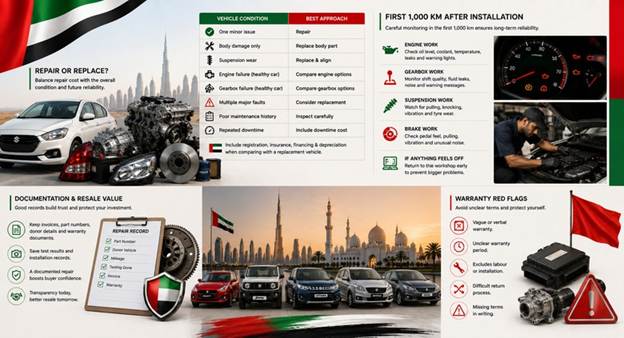
Used Suzuki Spare Parts: Repair or Replace the Vehicle?
A Suzuki with one expensive failure isn't necessarily a bad car.
A Suzuki with five expensive failures at once may be telling you something.
Use a simple comparison:
| Vehicle situation | Better starting point |
| One failed minor part | Repair |
| Body damage only | Used body part |
| Suspension wear | Repair with suitable replacement |
| Healthy car with engine failure | Compare used/reconditioned engine |
| Healthy car with gearbox failure | Compare repair and replacement units |
| Multiple major mechanical faults | Calculate replacement vehicle |
| Poor maintenance history | Inspect carefully before spending heavily |
| Repeated downtime | Include downtime in ownership cost |
Don't make the decision based on frustration.
The car has annoyed you.
Fair enough.
Now run the numbers anyway.
Used Suzuki Spare Parts: First 1,000 km After Installation
The repair isn't really finished when you collect the car.
Pay attention.
After suspension work, watch for knocking, steering pull, vibration and uneven tyre wear.
After brake work, watch for pulling, grinding, vibration or unusual pedal feel.
After an engine replacement, monitor coolant, oil, temperature, warning lights and leaks.
After gearbox work, watch for shift quality, fluid leaks, abnormal noise and warning messages.
If something feels wrong, don't wait for it to become spectacular.
Go back to the workshop.
Early inspection is cheaper than late diagnosis.
Used Suzuki Spare Parts Documentation: Keep the Repair Trail
Save the invoice.
Save the part number.
Save the donor information.
Save the warranty.
Save the test results.
For an engine, keep compression-test information where available.
For a gearbox, retain its identification and warranty paperwork.
For bodywork, photographs can also be useful.
This documentation helps if another workshop later needs to understand the vehicle's history, and it becomes particularly useful when you sell the Suzuki.
“Engine replaced” is a statement.
“Engine replaced at 126,000 km, donor information recorded, compression tested and supplied with warranty” is evidence.
Big difference.
Used Suzuki Spare Parts: The Final Price Is the One That Matters
Don't get trapped by the first number.
A used Suzuki part may be AED 300.
Fine.
Now add everything required to put the car back on the road.
Delivery. VAT. Labour. Fluids. Alignment. Programming. Supporting parts. Warranty risk.
That is the real price.
For a Swift, Jimny, Vitara, Baleno, Ciaz or Ertiga, used parts can be a very sensible way to control repair costs in the UAE—but only when the part is correctly identified, its condition is understood and the saving is large enough to justify the remaining risk.
Check the part.
Check the donor.
Check the number.
Check the warranty.
Then check the total.
That's where the sensible purchase usually reveals itself.
Buying Suzuki Spare Parts, Compatibility, Warranty and Final Cost
How to Compare Suzuki Spare Parts Prices Before Ordering
Three quotations can look almost identical until you read the small details.
One supplier quotes only the part. Another includes delivery. A third includes installation and a short warranty. Which one is cheaper?
You can't tell yet.
For a Suzuki Swift, Jimny, Vitara, Baleno, Ciaz or Ertiga, ask every supplier to quote against the same VIN, same part number and same specification. Then compare what is actually included.
| Check | Why it matters |
| Part price | Starting cost |
| Exact part number | Confirms application |
| Condition | New, used or reconditioned |
| Manufacturer | Genuine, OEM or aftermarket |
| Delivery | Affects final cost and downtime |
| Labour | Can be significant on major repairs |
| Supporting parts | Seals, fluids, clips and fittings |
| Programming | May apply to electronics |
| Warranty | Reduces replacement risk |
| Return terms | Protects against mismatch |
Don't compare a bare used gearbox with a fully tested replacement gearbox and call the first one cheaper.
That's not a fair comparison.
Suzuki Spare Parts Compatibility: Why VIN Verification Matters
The Suzuki badge is only the beginning.
The VIN gives the workshop or supplier a much stronger basis for identifying the correct part, particularly when several model years or specifications exist.
For an electrical module, the connector may look almost right but still be wrong.
For an engine, the mounting arrangement may be similar while the specification differs.
For a gearbox, the transmission code can matter enormously.
For bodywork, generation and trim can change fitment.
Give the supplier:
VIN + model year + engine + transmission + original part number.
If possible, send a photograph of the original part as well.
And if someone says, “Don't worry, all Swift parts are the same,” don't take that as confirmation.
Ask them to verify the actual application.
Suzuki Spare Parts Part Number Check: The Small Number That Can Prevent a Big Mistake
Part numbers aren't decoration.
They are useful identification tools.
Before ordering, photograph the number printed, stamped or moulded on the original Suzuki part. Compare it with the replacement being offered, while allowing for superseded numbers or manufacturer revisions that a knowledgeable supplier can explain.
This becomes especially important with:
ECUs + sensors + lights + gearboxes + engine assemblies + suspension parts.
A visual match is useful.
A matching identification number is much stronger.
And if the numbers don't match, don't assume that the part is wrong—or right.
Ask why.
There may be a legitimate supersession.
There may also be a completely different application.
Find out before paying.
Suzuki Spare Parts Warranty in UAE: What Should Buyers Ask?
“Warranty included” sounds reassuring.
It isn't enough.
Ask exactly what the warranty covers and when it begins.
For a used engine or gearbox, clarify whether the warranty covers internal mechanical failure, and whether labour is included if the assembly has to be removed again.
For electrical parts, ask whether the warranty covers the part itself or also problems discovered during programming or installation.
For body parts, check return conditions before painting or modifying the item.
A useful warranty discussion includes:
Warranty period + covered failure + exclusions + installation requirements + labour responsibility + return process.
Get it in writing.
A verbal promise can be difficult to prove once the workshop invoice arrives.
Suzuki Spare Parts Return Policy: What Happens If the Part Is Wrong?
Compatibility should be checked before ordering, but mistakes can still happen.
Maybe the connector differs.
Maybe the supplier sent the wrong part number.
Maybe the physical condition doesn't match what was agreed.
Find out the return process before installation.
Ask whether the part must remain uninstalled, whether original packaging is required and who pays return delivery. For engines and gearboxes, ask specifically whether a defective unit can be returned after installation and testing.
This matters because some suppliers distinguish between:
Incorrect part + defective part + changed mind.
Those situations may have completely different return conditions.
Suzuki Spare Parts Online UAE: How to Judge a Supplier Before Paying
Online shopping makes comparison easy.
It also makes vague descriptions easy.
Look for clear information about the actual part rather than a page filled with broad claims.
For a used Suzuki part, useful information includes:
Actual photographs + part number + condition + donor vehicle + mileage where relevant + testing + warranty + location.
If the seller refuses to provide basic identification, don't compensate by asking for a bigger discount.
Find another option.
For UAE buyers, also establish whether the part is physically available in Dubai, Abu Dhabi, Sharjah or another emirate, or whether it must be sourced from outside the country.
That affects both price and delivery.
Suzuki Spare Parts Delivery: Is Faster Always Better?
No.
But when the vehicle is already sitting in a workshop, faster can become valuable.
A family Ertiga waiting for an engine isn't merely an inconvenience.
A fleet vehicle waiting for a gearbox can affect operations.
A daily Swift sitting on a lift can disrupt commuting.
So include downtime in the calculation.
If one part costs AED 100 more but arrives tomorrow, while the cheaper option takes five days, the extra AED 100 may be perfectly reasonable.
Not always.
But worth calculating.
Suzuki Spare Parts Labour Cost in UAE: Ask What the Workshop Includes
Labour quotations can be misleading when the job description isn't clear.
Ask whether the quotation includes:
Removal + installation + diagnosis + testing + alignment + programming + fluids.
Not every repair needs all of these.
A mirror replacement won't normally be treated like an engine swap.
A suspension repair may need alignment.
An electronic module may need programming.
A gearbox replacement can involve fluid and related checks.
The important thing is consistency.
If two workshops quote different labour prices, make sure they are actually quoting the same work.
Suzuki Engine Replacement: Don't Ignore Supporting Parts
When a used or reconditioned engine is installed, the engine itself may not be the only thing worth inspecting.
Depending on the vehicle and repair, the workshop may recommend checking or replacing gaskets, seals, fluids, filters, belts, hoses, mounts, spark plugs and other supporting items.
That doesn't mean every surrounding part should automatically be replaced.
It means the workshop should inspect them while access is available.
This is particularly relevant to older Suzuki vehicles where age, heat and mileage may have affected rubber and plastic parts.
Replacing one worn seal while everything is accessible can be very different financially from discovering the same leak after the entire assembly has been installed.
Suzuki Gearbox Replacement: Check the Parts Around It
The same principle applies to gearbox work.
Depending on the transmission and vehicle, inspect the mounts, seals, fluid condition and related drivetrain parts during installation.
For manual vehicles, clutch condition deserves attention.
For automatic vehicles, use the correct fluid and follow the appropriate installation and testing procedure.
The goal isn't to turn one repair into five.
It is to avoid removing the same expensive assembly twice because a related problem was ignored.
Suzuki Spare Parts and UAE Climate: Factor Heat Into Used-Part Decisions
Heat matters.
Especially when buying used.
A used plastic fitting, hose, seal, connector or interior piece may already have spent years exposed to high temperatures. It may look acceptable until someone handles it during installation and discovers that it has become brittle.
For used parts, inspect:
Plastic brittleness + rubber condition + connector corrosion + heat discolouration + cracking.
This is particularly relevant to cooling and AC-related parts because UAE vehicles can spend long periods operating under heavy thermal and air-conditioning loads.
A part's age isn't everything.
Its previous environment matters too.
Suzuki Spare Parts for High-Mileage Cars: Should You Spend More?
High mileage doesn't automatically mean “replace the vehicle”.
It does mean you should widen the inspection.
Suppose a 180,000-km Ertiga needs a used gearbox.
Before approving the job, inspect the engine, cooling system, suspension, brakes, AC and electrical system.
If they're healthy, the gearbox repair may be entirely reasonable.
If several major systems are already approaching failure, the equation changes.
This is where first-year ownership cost becomes useful.
Don't ask only:
“How much is the gearbox?”
Ask:
“How much am I likely to spend keeping this car on the road over the next year?”
That's a much better question.
Suzuki Spare Parts Repair vs Replacement Vehicle: When Should You Reconsider?
A major repair isn't automatically a reason to sell.
Nor is a cheap repair automatically a reason to keep the car.
Look at the vehicle's overall condition.
| Situation | Sensible direction |
| One minor failed part | Repair |
| One body panel damaged | Used/new replacement |
| Healthy car with engine failure | Compare engine options |
| Healthy car with gearbox failure | Compare rebuild, used and reconditioned |
| Several major faults | Calculate first-year ownership cost |
| Poor maintenance history | Full inspection before major spending |
| Repeated workshop visits | Consider replacement economics |
| Strong history and good body/chassis | Repair may remain worthwhile |
Also consider the replacement vehicle itself.
Buying another car brings its own registration, insurance, maintenance, financing and depreciation.
The repair bill shouldn't be compared with the sticker price of another vehicle alone.
Suzuki Spare Parts First 1,000 km: What Should You Monitor?
Collecting the car isn't the final checkpoint.
After a major replacement, pay attention during the first 1,000 km.
After engine work, monitor:
Oil level + coolant level + temperature + warning lights + leaks + unusual vibration.
After gearbox work, watch:
Shift quality + fluid leaks + abnormal noise + warning messages.
After suspension work:
Steering pull + knocking + vibration + uneven tyre wear.
After brake work:
Pedal feel + pulling + vibration + unusual noise.
If something doesn't feel right, return to the workshop early.
Don't wait for a small noise to become a dramatic one.
Suzuki Spare Parts Documentation: Keep Everything
Keep the paperwork.
It sounds dull.
It becomes useful later.
Save the invoice, part number, donor information, mileage, test results, warranty and installation record.
For an engine, keep compression-test information where available.
For a gearbox, retain its identification and warranty documents.
For electronic parts, keep any programming or diagnostic records.
This helps the next workshop understand what has already been done, and it can strengthen your position when selling the vehicle.
A documented repair has a very different feel from:
“Yeah, we changed something there a while back.”
Suzuki Spare Parts and Resale Value: Does New or Used Matter More?
Buyers generally want confidence.
A documented used genuine part isn't automatically a resale problem. Poor workmanship and unexplained major repairs are usually more concerning.
Imagine two Suzuki Ciaz vehicles with replacement gearboxes.
One has:
Part number + donor information + installation invoice + warranty.
The other has nothing except the owner's verbal explanation.
Which one would you feel more comfortable buying?
Exactly.
Keep the evidence.
Suzuki Spare Parts Buyer Decision Matrix: Which Option Fits Your Situation?
| Repair situation | First option to investigate |
| Cosmetic body damage | Used genuine |
| Interior trim | Used genuine |
| Minor exterior trim | Used or aftermarket |
| Safety-critical brake repair | Quality new |
| Electrical module | Tested correct-spec replacement |
| Suspension repair | New vs verified used |
| Engine failure | Used vs reconditioned vs rebuild |
| Gearbox failure | Rebuild vs used vs reconditioned |
| Rare Jimny drivetrain part | Verified used may be valuable |
| Several major failures | Repair vs vehicle replacement |
The table isn't there to make the decision for you.
It is there to stop the conversation becoming “new or used?” before anyone has asked what actually failed.
Suzuki Spare Parts: The Best Option Depends on the Repair
A genuine new part may be the right answer.
A quality aftermarket part may be smarter.
A clean used genuine part can sometimes save a substantial amount.
A properly reconditioned engine or gearbox may keep an otherwise healthy Suzuki on the road for years.
There is no prize for choosing one category every time.
Choose according to risk, vehicle age, mileage, part function, condition, warranty and complete installed cost.
Then check the numbers again.
If the used part saves a meaningful amount and comes with convincing evidence, it can be a very good purchase.
If the saving is tiny but the risk is high, buy new.
And if the repair itself no longer makes financial sense, step back and calculate the cost of keeping the vehicle for another year.
That final pause can save more money than any discount.
FAQs About Suzuki Spare Parts Prices in UAE
Categories
- Audi
- BMW
- Car Accessories
- Car Tips
- Ford
- Land Rover
- Mazda
- Range Rover
- Top 10
- UAE Car Parts
- Used Car Parts
- Toyota
- Replacement Engines
- Nissan
- Hyundai
- Mitsubishi
- Volkswagen
- Honda
- Kia
- Chevrolet
- Dodge
- Jeep
- Subaru
- Renault
- Lexus
- Mercedes
- Suzuki
- Hummer
- Porsche
- Infiniti
- Peugeot
- GMC
- Mini
- Volvo
- Replacement Gearboxes
- MG
- Jaguar
- Skoda
- Cadillac
- Daihatsu
- Fiat
- German Car Parts
- Japanese Car Parts
- Aftermarket Car Parts
- Genuine Car Parts
- New Car Parts
- Reconditioned Car Parts
- European Car Parts
- American Car Parts
- Korean Car Parts
- British Car Parts
- Chinese Car Parts
- Sports/Exotic Car Parts
- Luxury Car Parts
- Performance Car Parts
- SUV/4x4 Spare Parts
- Truck Spare Parts
- EV Car Parts
- Hybrid Car Parts
- Auto Spare Parts in UAE
- Tesla
- Isuzu
- Ram
- Ferrari
- Bentley
- Lamborghini
- Genesis
- Maserati
- Lincoln
- Chrysler
- Opel
- Citroen
- SsangYong
- Seat
- McLaren
- Aston Martin
- Rolls Royce
- Maybach
- Alfa Romeo
- Bugatti
- Scion
- Abu Dhabi Car Parts
- Ajman Car Parts
- Al Khan Car Parts
- Al Sajaa Car Parts
- Deira Car Parts
- Dubai Car Parts
- Fujairah Car Parts
- Industrial Area 6 Car Parts
- Mussafah Car Parts
- Ras Al Khaimah Car Parts
- Sharjah Car Parts
- Umm Al Quwain Car Parts
- Acura
- BYD
- Chery
- Dacia
- DS
- Geely Emgrand
- EXEED
- GAC
- GAC Gonow
- Geely
- Gonow
- Great Wall
- Haima
- Haval
- Holden
- Iveco
- JAC
- Jaecoo
- Jetour
- Lotus
- Omoda
- Proton
- Renault Samsung
- Roewe
- Lucid
- Replacement Headlight